Call for Papers | Sixth Annual Feminist Art History Conference
Sixth Annual Feminist Art History Conference
American University in Washington, D.C., 6–8 November 2015
Proposals due by March 2015
This annual conference builds on the legacy of feminist art-historical scholarship and pedagogy initiated by Norma Broude and Mary D. Garrard at American University. To further the inclusive spirit of their groundbreaking anthologies, we invite papers on subjects spanning the chronological spectrum, from the ancient world through the present, to foster a broad dialogue on feminist art-historical practice. Papers may address such topics as: artists, movements, and works of art and architecture; cultural institutions and critical discourses; practices of collecting, patronage, and display; the gendering of objects, spaces, and media; the reception of images; and issues of power, agency, gender, and sexuality within visual cultures. Submissions on under-represented art-historical fields, geographic areas or national traditions, and issues of race and ethnicity are encouraged.
To be considered for participation, please provide a single document in Microsoft Word. It should consist of a one-page, single-spaced proposal of unpublished work, up to 500 words in length for a 20-minute presentation, followed by a curriculum vitae of no more than two pages. Please title the document “[last name]-proposal”. Submit materials with the subject line “[last name]-proposal” to: fahc6papers@gmail.com. Submission Deadline: May 15, 2015. Invitations to participate will be sent by July 1. Send general queries to: fahc2015queries@gmail.com.
Keynote speaker: Professor Amelia Jones, University of Southern California: “The Curating of Feminist Art (or is it the Feminist Curating of Art?)”
Sponsored by the Art History Program and the Department of Art, College of Arts and Sciences, American University. Organizing committee: Juliet Bellow, Norma Broude, Kim Butler Wingfield, Mary D. Garrard, Helen Langa, Andrea Pearson, and Ying-chen Peng
Call for Papers | Fancy‒Fantaisie‒Capriccio: Diversions and Distractions
From the Call for Papers:
Fancy‒Fantaisie‒Capriccio: Diversions and Distractions in the Eighteenth Century
Toulouse, 3–4 December 2015
Proposals due by 31 March 2015
Keynote speaker: Professor Martin Postle, Deputy Director of Studies, Paul Mellon Centre for British Art
In conjunction with the exhibition of paintings, Fantasy Figures, to be held at the Musée des Augustins, Toulouse, the Université de Toulouse Jean Jaurès and the University of Exeter are pleased to announce a call for papers for an interdisciplinary colloquium.
Associated with the imagination and not reason, fancy (fantaisie) in the eighteenth century was a sort of whimsical distraction from the everyday. For Voltaire it was ‘a singular desire, a passing whim’ (‘un désir singulier, un goût passager’), while for Samuel Johnson it was ‘something that pleases or entertains without real use or value’. Together with its near-synonym caprice (capriccio), fancy was part of a rich semantic network, connecting wit, pleasure, erotic desire, spontaneity, improvisation, surprise, deviation from norms, the trivial and inconsequential. Unpredictable and quirky, it offered many outlets for artistic creativity.
Papers are invited that investigate the expressive freedom of fancy (fantaisie, capriccio) in European culture during the eighteenth century—in figure and landscape painting, architecture and garden design, philosophy and fiction, theatre and music. Topics may include, but are not limited to the following:
• Tensions between fancy/capriccio and reason
• Fancy’s relationship to the imagination
• Fancy as a precursor of the Gothic and the fantastic
• The fancy picture or tête de fantaisie
• Capriccio in landscape, architectural painting, engraving
• Fancy in conjunction with a space, place or decorative schema
• Fantasia in musical composition or musical theatre
• Anecdote, imagination and desire in fiction
• The role of fancy in the discourse of love and seduction
• Creativity as a deviation from norms and rules
The colloquium will incorporate a guided visit of the fantasy figures exhibition with the curators. It is hoped that a volume of published essays will arise from the event. Participants should be prepared to meet their own travel and accommodation expenses. Refreshments will be provided on the day. Proposals (maximum 250 words in English or French) should be submitted to Professor Melissa Percival, University of Exeter, M.H.Percival@exeter.ac.uk by the 31 March 2015.
Call for Papers | Artistic Correspondences: Rome and Europe, 1700–1900
From H-ArtHist:
Artistic Correspondences: Rome and Europe in the 18th and 19th Centuries
Rome, 15–16 June 2015
Proposals due by 1 March 2015
Epistolary correspondence among artists is a privileged source to unravel the dynamics of intellectual exchange across regional and national boundaries, as it requires a research agenda necessarily focused on ‘mobility’, and a transnational approach and methodology avoiding the rhetorical pitfalls of past European historiography. By focusing on the cosmopolitan context of 18th- and 19th-century Rome as a paradigmatic field of enquiry, the research network Artistic Correspondences: Rome and Europe in the 18th and 19th Centuries aims to recast epistolary exchanges among artists as an inescapable source of information on the transnational circulation of a shared stock of artworks, people, books, models, technical and critical skills across Europe. The organizing research team would like to meet other academics and research groups working on the same topic in order to explore new opportunities of collaboration at a European level.
The workshop to be held in Rome, 15–16 June 2015, is intended to explore new forms of research collaboration and dissemination of sources (e.g. networks, databases, digital repositories, etc.). The ultimate goal of the workshop is to initiate a debate leading to the construction of a digital platform of artists’ correspondences in the modern era. The workshop endorses a synchronic and diachronic approach to the study of artistic correspondences that will enable the mapping of geographical trajectories and cultural exchanges. We particularly welcome proposals illustrating the role of artists’ letters as a tool to study the history and historiography of collections from a comparative and interdisciplinary perspective; as a source offering new clues on the education and professional training of artists and their self promotion (e.g., the links between artists and institutions, artists and patrons, artists and intellectuals, etc.); as a document to trace the circulation of ideas and practices, rather than for sketching individual biographies (with a focus, therefore, on itineraries, geographies, social exchange, etc.); as a material providing insight on technical and specific terminology (e.g. words of practice, description of works of art, etc.).
Abstracts (maximum 200 words) for 25-minute papers should be submitted to Serenella Rolfi (serenella.rolfi@uniroma3.it) before 1 March 2015. We intend to provide travel allowance and/or accommodation for speakers with accepted papers.
Conference Committee: Serenella Rolfi (Dipartimento di Studi Umanistici, Università di Roma TRE), Giovanna Capitelli (Dipartimento di Studi Umanistici, Università della Calabria), Susanne Adina Meyer (Dipartimento di Scienze della formazione, dei beni culturali e del turismo, Università di Macerata), Ilaria Miarelli Mariani (Dipartimento di Lettere, Arti e Scienze Sociali, Università di Chieti), Christoph Frank and Carla Mazzarelli (Istituto di Storia e Teoria dell’arte e dell’architettura, Università della Svizzera Italiana), Maria Pia Donato (CNRS Institut d’Histoire Moderne et Contemporaine). With the cooperation of KNIR, Koninklijk Nederlands Instituut Rome and of the Svenska Institutet i Rom.
Call for Papers | Irishness? Changing Perspectives on Irish Identity
From the conference website:
Irishness? Changing Perspectives on Irish Identity, 1700–1914
Department of History, Classics and Archaeology, University of Edinburgh, 14 May 2015
Proposals due by 28 February 2015
Papers are invited from postgraduates and early career researchers for a one-day workshop at the University of Edinburgh. The workshop will explore the changes that took place in Irish society and identity formation between 1700 and 1914. We hope to move away from the standard narrative of rebellion and famine which currently dominate conferences on Irish history and studies. While acknowledging the role played by politics and rebellion in the moulding of Irish society, this workshop will approach the changes in how Irish people saw themselves, and how they were seen by others, from angles that are often excluded from the mainstream academic narrative. We hope to attract papers from students of cultural, social and economic history, history of art, literature, and other fields to create a truly interdisciplinary discussion on the idea of what constitutes Irish identity.
In accordance with the non-traditional approach of this workshop, the format of the event will consist of morning and afternoon panels of papers from a variety of disciplines, followed by a late afternoon roundtable discussion, which although led by a senior academic, will encourage all attendees to engage on issues raised by the research earlier in the day, and on discussion of the future of the wider field of Irish Studies.
While this one-day workshop will be primarily concerned with Ireland and Irish society, we are keen to stress that Irish society was not purely influenced by the events within the national-boundaries of Ireland and the wider United Kingdom. To this end, this workshop will also incorporate notions of, and ideas about, ‘Irishness’ which involve those who self-identified, or were identified by others, as Irish, whatever their ancestry, religious inheritance, current location, or personal allegiances.
Abstracts of 200–300 words that relate to this theme are sought. Please send enquiries and abstracts to organisers Maeve O’Dwyer and Sophie Cooper (perspectivesonirishness@gmail.com) by 28 February 2015. The workshop will take place on 14 May 2015 at the University of Edinburgh.
Call for Articles | Court Etiquette
From the Call for Articles:
Court Etiquette: Normative Texts and Customs, 2014–16 Research Progamme
Bulletin du Centre de recherche du château de Versailles

Antoine Dieu, Marriage of Louis de France, Duke of Burgundy and Marie-Adélaïde de Savoie, 7 December 1697 (Château de Versailles)
For its three-year research programme (2014–16), the Centre de recherche du château de Versailles has launched a research axis on Court Etiquette: Normative Texts and Customs and wishes to publish articles related to this subject in the Bulletin du Centre de recherche du château de Versailles.
Although the word etiquette has today taken on an accepted meaning that might appear clear and well defined, it quickly becomes clear that this notion is far from self-evident. In addition to the fact that people often confuse ‘ceremonial’, ‘protocol’ and ‘etiquette’, the latter term was only used rarely at the time, and often with very different meanings. Whether in Richelet’s dictionary or Furetière’s, the lexicographers took it in what was essentially a legal sense. In fact, in France, the word related to elements of judicial procedure. However, the dictionary of the Académie Française (starting with its 1718 edition and in the last definition it gives of the word) recalls the familiar use of this word in Spain in the sense of “what must be done daily in the King’s Household, and in the principal ceremonies.” The absence of the current definition of the word etiquette in contemporary dictionaries in no way means that the word was not used in this sense in the language. We have evidence of this in a letter by Madame Palatine dated 3 February 1679 in which the Duchess of Orléans explained that she had never been able to get used to this “insipid etiquette.”
Bernard Hours in his study on the court of Louis XV describes the historical authenticity and origins of French etiquette (Louis XV et Sa Cour, Paris, PUF, coll. “Le Nœud Gordien”, 2002, p. 77–98). It goes back to the Burgundian court of Philippe le Bon in the 15th century when “it referred to a written formula setting out the timetable of the prince and his court” (ibid., p. 78). From then on, there was an effort to retain the customs in order to perpetuate them. As situations developed, so did etiquette and each new code was recorded to establish a precedent.
This line of research aims to formalise the unwritten customs of the French court. In fact, in contrast to the many systematic studies carried out particularly on the Hapsburg court in Madrid and those on the court in Vienna, French etiquette has always been universally viewed according to the customs and rituals of the court. The main objective here is to understand the evolution of etiquette as it developed, improved and declined.
Article proposals can deal with one or several of the following themes and lines of enquiry:
• The definition of etiquette
• The origins and emergence of etiquette
• The nature of etiquette in relation to court ritual
• The circumstances in which etiquette was applied (large household, ceremonial occasions, rituals) and etiquette according to topography, and vice versa
• Etiquette as a political tool, or a means to control or civilise
• Who determines or arbitrates on matters of etiquette?
• Are courtisans the protagonists, driving force or victims of etiquette?
• A Europe-wide expansion of etiquette
Authors can refer to a non-exhaustive bibliography on the subject (available as a PDF file).
Article proposals (abstracts of about 5,000 characters) should be addressed to Mathieu da Vinha (mathieu.da-vinha@chateauversailles.fr) in French or in English. These proposals will be reviewed by the scientific committee. If the proposals are accepted by the scientific committee, the full articles will be examined both by the latter and by two members of the Centre de recherche du château de Versailles’s peer review committee (or by external scholars appointed by the scientific or peer review committee if necessary). Articles must be submitted before 31 December 2015. Proposals can be submitted in French, English, German, Italian, or Spanish. The final articles will be 40,000 characters maximum (bibliography and footnotes included). Authors should comply with the editorial guidelines of the Bulletin du Centre de recherche du château de Versailles.
Scientific Committee of the Court Etiquette Research Programme
Mathieu da Vinha (Centre de recherche du château de Versailles), Raphaël Masson (château de Versailles), Alice Camus (Centre de recherche du château de Versailles), Delphine Carrangeot (université de Versailles Saint-Quentin-en-Yvelines, centre de recherche ESR-DYPAC), Nicole Lallement (Centre de recherche du château de Versailles), Bénédicte Lecarpentier-Bertrand (université Paris-Est Créteil Val-de-Marne), Pauline Lemaigre-Gaffier (université de Versailles Saint-Quentin-en-Yvelines, centre de recherche ESR-DYPAC), Benjamin Ringot (Centre de recherche du château de Versailles)
Peer Review Committee
Marc Bayard (Mobilier national), Monique Chatenet (université Paris-Sorbonne/École du Louvre), Anne Conchon (université Paris 1 Panthéon-Sorbonne), Claire Constans (conservateur général honoraire du patrimoine), Alexandre Gady (Centre André Chastel/université Paris-Sorbonne), Pauline Lemaigre-Gaffier (université de Versailles Saint-Quentin-en-Yvelines, centre de recherche ESR-DYPAC), Nicolas Le Roux (université Lumière – Lyon 2),Nicole Reinhardt (université de Durham, Grande-Bretagne), Thierry Sarmant (musée Carnavalet)
Call for Papers | Know Thyself: Early Modern Images
From H-ArtHist:
Know Thyself: A Conference on Early Modern Images
University College London, 2 May 2015
Proposals due by 2 February 2015
Nosce te ipsum/ know thyself
The tragedy of Narcissus was his failure to recognise the image he admired on the surface of the pool as his own. His fate might have improved, had he possessed the deeper self-knowledge implied by the Delphic maxim, “know thyself.” The question prompted by Narcissus, of how images pertain to self-knowledge, is especially relevant to the Early Modern period, during which the ancient aphorism nosce te ipsum was engaged provocatively in a range of visual material: it is quoted in illustrations of anatomy, natural history and cartography, and evoked in religious and secular works of art. This renewed cultural imperative to self-knowledge is bound up with the scientific and technological advancements of the period. It is epitomised by the technical refinement of the looking glass, which enabled a person to admire—or better, scrutinise—her own face with unprecedented clarity.
The premise of this conference is that consideration of the Delphic maxim can be productively channeled into interrogating the role of the image in relation to the self: How might images mobilise the philosophical challenge to “know thyself”? What are the mechanisms within images that invite participation in the practices of selfdiscovery and self-representation? The conference aims to explore the role of visuality in the early modern pursuit of self-knowledge in a broad sense. As such, it invites approaches to visual material by which the Delphic maxim is evoked knowingly, or otherwise. Focusing on images from the period c.1500–1800, proposals for papers may include, but are by no means limited to: mortality and bodily materiality, cultural identity and difference (race, religion, gender…), subjectivity and self-fashioning, and encounters with the new world and new technologies.
UCL Department of History of Art invites proposals for 20-minute presentations on the theme of ‘self-knowledge’ in early modern images. Please send abstracts of no more than 300 words to Sophie Morris
sophie.morris@ucl.ac.uk and Nathanael Price n.price.12@ucl.ac.uk by 2nd February 2015.
Call for Articles | Special Issue of Perspective on Textiles
From H-ArtHist:
Thematic Issue of Perspective: La Revue de l’INHA—Textiles
Submissions due by 31 March 2015
The forthcoming thematic issue of Perspective: La Revue de l’INHA (slated for publication in December 2016 and conceived jointly with the Mobilier national and the Manufactures nationales) will be devoted to textiles across different periods and different places of production and use. The double purpose of this issue is to bring together articles that represent the state of recent—or even ongoing (in the case of Switzerland, Germany and France)—research, while at the same time following single diachronic threads: from medieval embroidery to Louise Bourgeois’s arachnid works, from the ornamentation of the body in antiquity to the Silk Road… It will provide an occasion to examine the textile craft as portrayed by Diego Velázquez in Las Hilanderas (1657, Madrid, Museo Nacional del Prado); indeed, this seminal painting from the artist’s abundant oeuvre inspires precisely the sort of innovative study that considers the notion of textile as a metaphorical and intermedial space, whereby the canvas reveals itself as both surface and subject.
While textiles offer art history a plethora of objects and subjects, the field must also open itself to interdisciplinary dialogue involving labor history, gender studies, and museum studies, as well as material culture studies, postcolonial studies, economic history, and geopolitics, especially as it relates to the procurement of raw materials. Art history is similarly strengthened when it brings scientific and technical history to bear on the fabrication of hand-made or industrial artifacts. The history of artisans and other agents, from producers to consumers, also offers particularly rich areas of study, on topics ranging from the Cévennes weavers of yesteryear to today’s Bangladeshi textile workers to visitors at the Centre national du costume de scène (National Center for Stage Costumes) in Moulins. In the context of a denationalized history of art, it is possible to examine—to name just a few—the industry of Indian-inspired cotton fabrics in eighteenth-century Europe, the international distribution in the twentieth century of ready-made clothing manufactured in China, or the many avatars of African textiles that reappear, for example, in the contemporary art of Yinka Shonibare, but that can also be traced through the long history of Benin appliqué cloths or the appropriation of ancestral textile practices in contemporary art of the Maghreb.
The issue will delve into the worlds of cultivation (sowing and harvesting), manufacture (weaving, dyeing, tailoring), and local and international commerce, and, more generally, examine the manifold uses of textiles in all periods and in all the corners of the globe. Artists have constantly been reinventing their relationship to textility as both ideal and material, from Mesoamerican feather cloth to Jana Sterbak’s Flesh Dress, not to mention the well-established archetypal relationship with abstract painting. Finally, a diachronic exploration of the history of textile institutions is also encouraged, ranging from centuries-old traditional manufactures to franchised fashion institutes such as the Parsons The New School for Design, now established in New York, Paris, and Shanghai. Similarly, much can be gained from looking more closely at museums involved in the conservation, restoration, or exhibition of textiles, or even the re-creation of old textiles and the commissioning of contemporary creations (Aubusson, Beauvais, The Gobelins).
These numerous topics (textile archeology, printed embroidery materials, theories of the arabesque, sampling processes, etc.) and objects (wall hangings, rugs, lace, clothing, upholstery, stage props, sculpted draperies, and so on) represent a variety of leads that Perspective wishes to explore. The thematic issue on textiles will comprise articles representing multiple forms and contents. Proposals may fall into one of two categories: either a synthetic article highlighting a particular aspect of textiles (25,000 characters/4,000 words) or a historiographical study concentrating on a specific medium, territory of production, or historical period whose textile specificity (in terms of materials, style, etc.) remains to be defined (45,000 characters/7,000 words).
This call for papers does not aim to cover all of the projected subjects. All submissions are therefore welcome, although we wish to favor, as far as possible, a trans-chronological approach. Submissions will be examined by the editorial committee for the issue, which includes Marc Bayard, Marion Boudon-Machuel, Catherine Breniquet, Pascale Charron, Rossella Froissart, Charlotte Guichard, Rémi Labrusse, Anne Lafont, Johanne Lamoureux, Philippe Malgouyres, Sara Martinetti, Nicole Pellegrin, Zahia Rahmani, Katie Scott, Philippe Sénéchal, Philippe Thiébaud, Merel van Tilburg, and Tristan Weddigen.
Please send submissions (a 2000–3000 character/300–500 word abstract and a 2–3 line biography) to revue-perspective@inha.fr by March 31, 2015.
The British and Irish Studies Intelligencer
As a follow-up to yesterday’s posting of the call for papers for this year’s meeting in November of the North American Conference of British Studies, I would draw readers’ attention to The British and Irish Studies Intelligencer (BISI), a blog founded in the summer of 2014 under the auspices of the NACBS. While its reach extends well beyond the eighteenth century, for those of you working within the field of British Studies, there will be items of potential interest. A piece from last month, for instance, by Robin Eagles, “John Wilkes the Tourist: Travel in 18th-century England,” occasioned by the publication of Eagles’s edition of The Diaries of John Wilkes 1770–1797 (London Record Society, 2014), addresses not only Wilkes’s travels but underscores the usefulness of his diaries for eighteenth-century travel more generally thanks to the specificity of his notes.
As a member of BISI’s editorial board, I encourage you to have a look at the submissions page, and please feel free to contact me with questions or ideas for contributions. –CH
Editorial Board
Elaine Chalus, Bath Spa University
Craig Hanson, Calvin College
Jason M. Kelly, Indiana University-Purdue University Indianapolis
Isaac Land, Indiana State University
Bloggers
Caroline Boswell, University of Wisconsin, Green Bay
Stephen Jackson, University of Sioux Falls
Call for Papers | NACBS in Little Rock, 2015

Skyline of Little Rock, Arkansas, from the top of the River Market parking deck looking southwest, March 2005. Photo by Bruce Stracener, via Wikimedia Commons.
◊ ◊ ◊ ◊ ◊
From NACBS:
North American Conference of British Studies Annual Meeting
Little Rock, Arkansas, 13–15 November 2015
Proposals due by 3 March 2015
The NACBS (North American Conference on British Studies) and its Southern affiliate, the Southern Conference on British Studies, seek participation by scholars in all areas of British Studies for the 2015 meeting. We will meet in Little Rock, Arkansas, November 13–15, 2015 (in conjunction with the meeting of the Southern Historical Association). We solicit proposals for panels on Britain, the British Empire and the British world. Our interests range from the medieval to the modern. We welcome participation by scholars across the humanities and social sciences.
We invite panel proposals addressing selected themes, methodology, and pedagogy, as well as roundtable discussions of topical and thematic interest, including conversations among authors of recent books and reflections on landmark scholarship. We are particularly interested in submissions that have a broad chronological focus and/or interdisciplinary breadth. North American scholars, international scholars and Ph.D. students are all encouraged to submit proposals for consideration. Panels typically include three papers and a comment, and ideally a separate chair; roundtables customarily have four presentations, as well as a chair; proposals which only include papers will be less likely to succeed. We are not able to accommodate individual paper proposals; those with paper ideas may search for additional panelists on lists such as H-Albion or at venues such as the NACBS Facebook page. Applicants may also write to the Program Chair for suggestions (nacbsprogram@gmail.com).
In addition to the panels, this year we will be sponsoring a poster session. The posters will be exhibited throughout the conference, and there will be a scheduled time when presenters will be with their posters to allow for further discussion.
All scholars working in the field of British Studies are encouraged to apply for the 2015 conference. Panels that include both emerging and established scholars are encouraged; we welcome the participation of junior scholars and Ph.D. candidates beyond the qualifying stage. To foster intellectual interchange, we ask applicants to compose panels that feature participation from multiple institutions. No participant will be permitted to take part in more than one session.
More information is available here»
Call for Papers | Classical Influences on Georgian Stourhead
Thanks to Hélène Bremer for passing along this CFP:
Classical Influences on Georgian Stourhead
Stourhead, Wiltshire, 11–12 November 2015
Proposals due by 31 March 2015
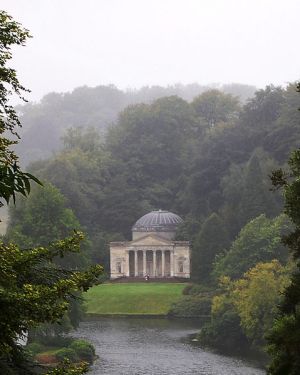
Pantheon at Stourhead, via Wikimedia Commons. Photo by Luke Gordon, 14 August 2007.
The gardens at Stourhead feature a number of elements influenced by the legacy of classical Rome. Henry Hoare, the owner of Stourhead from 1741 to 1783, travelled to Rome as part of his own Grand Tour and his chief architect, Henry Flitcroft, was part of Lord Burlington’s circle. On Day 1 of this event we will explore classical influences on the eighteenth-century English country garden. On Day 2 we will consider classical influences solely in the context of the garden and wider estate at Stourhead.
We invite papers on all aspects of classical influences on the eighteenth-century English garden and particularly the following topics:
• The influence of the Grand Tour on eighteenth-century English country gardens
• Visitor accounts of Stourhead and other eighteenth-century English country gardens
• Eighteenth-century English country garden designers
• The picturesque and the design and reception of the eighteenth-century English country garden
• Depiction of the eighteenth-century English country garden in the fine arts
• The country garden and publishing: newspapers, periodicals, guidebooks and journals
• Topographical poetry
• Theories of meaning in the eighteenth-century English country garden
• Relationships between houses, gardens and wider estates
• Lord Burlington and his circle
• The influence of classical Roman literature on the eighteenth-century English country garden
• Greek influences in eighteenth-century English country gardens
If you would like to present a paper, then please send a 300-word abstract to Dr. John Harrison at: jeh87@my.open.ac.uk by 31st March 2015.
Keynote Speakers
Roey Sweet, author of Cities and the Grand Tour: The British in Italy, 1690–1820 (University of Leicester); and Richard Wheeler, National Specialist in Garden History (National Trust)










leave a comment