Call for Essays | Art and Social Change, La Salle University Art Museum
Art and Social Change: The Collection of La Salle University Art Museum
Abstracts for an edited volume due by 30 June 2014; completed essays due by 30 January 2015
We are seeking scholarly essays (3,000–6,000 words) for an edited book on the subject of art and social change. The book will focus on Western art from the Renaissance to about 1950 (after which artists-activists and art for social change become important themes—and the focus of numerous other recent books). Scholarly essays should address some aspect of the subject and should ideally engage with one or more artworks in the collection of La Salle University Art Museum. (See the museum’s website for images of artworks on display; detailed lists of artworks in storage are also available on request.)
We welcome proposals from established scholars, recent Ph.D. recipients, upper level graduate students and museum professionals. The deadline for submission of abstracts (300–600 words) is June 30, 2014, with notification by August 30, 2014. The deadline for completed essays is January 30, 2015, with peer reviews taking place in early spring 2015. More information is available here.
Please direct proposals and inquiries to the editors:
Susan Dixon, Ph.D., Chair/Associate Professor Art History, La Salle University Deptartment of Fine Arts, dixons@lasalle.edu
Klare Scarborough, Ph.D., Director/Chief Curator, La Salle University Art Museum, scarborough@lasalle.edu
Call for Papers | The Monkey in the 17th and 18th Centuries
The call for papers includes a bibliography. From Le Blog de L’ApAhAu:
Le singe aux XVIIe et XVIIIe siècles: Figure de l’art, personnage littéraire & curiosité scientifique
CLARE Université Bordeaux Montaigne, 28–29 May 2015
Proposals due by 15 June 2014
 Colloque international, organisé par Florence BOULERIE, CEREC [Centre de Recherches sur l’Europe Classique (XVIIe et XVIIIe siècles)], EA 4593 CLARE, Université Bordeaux Montaigne, Bordeaux (France), et Katalin BARTHA-KOVÁCS, Université de Szeged (Hongrie)
Le singe figure dans les représentations littéraires et artistiques depuis l’Antiquité, en particulier autour du culte des singes dans l’Égypte ancienne ; on le rencontre fréquemment au Moyen âge, notamment dans la statuaire, illustrant la symbolique chrétienne de l’homme déchu, et il reste familier dans l’imaginaire burlesque de la Renaissance (voir à ce sujet la journée d’étude « Singes et singeries à la Renaissance », Chantilly, 15 mars 2014, organisée par l’Atelier XVIe siècle de l’université Paris-Sorbonne).
Au XVIIe siècle, l’intérêt pour cet animal connaît cependant un essor nouveau : les singes prolifèrent dans les fables et les représentations allégoriques, devenant figures du double trompeur et images satiriques de la vanité humaine. La mode des chinoiseries à la fin du XVIIesiècle vient renforcer la vogue des représentations picturales de singes, avant que le XVIIIe siècle ne s’enthousiasme pour les singeries… et les singes, animaux de compagnie fort prisés au milieu du siècle.
Allégorie de l’artiste (peintre, écrivain, acteur), le singe interroge aussi sur l’humain d’un point de vue religieux, moral et philosophique. Les naturalistes l’observent, le dessinent ; l’on découvre de nouvelles espèces au gré des explorations géographiques, de sorte que la limite entre l’homme et le singe est parfois bien près de chanceler.
Notre colloque entend éclairer les multiples aspects du singe dans la culture européenne des XVIIeet XVIIIe siècles : la mode picturale des « singeries », à son apogée vers 1740, doit être replacée dans un contexte artistique (l’héritage des peintres flamands), littéraire (la tradition de la fable concurrencée par les nouveaux visages du singe littéraire) et anthropologique (les interrogations sur l’homme et les espèces). (more…)
Call for Papers | Congress of German Art Historians: The Value of Art
From the Verband Deutscher Kunsthistoriker:
33rd Congress of German Art Historians | The Value of Art
Johannes Gutenberg University of Mainz, 24–28 March 2015
Proposals due by 14 May 2014
The social and political function of art is currently being interrogated, more intensively and thoroughly than we have seen in a long time. The explosive nature of the Cornelius Gurlitt case is thereby a daily topic of discussion, as are forgeries and the relevance of everything that, subsequent to the iconic turn, we might term the upward revaluation of the art work or of images per se. Not least in view of these many debates, the Verband Deutscher Kunsthistoriker e. V. (Association of German Art Historians) and the Institute of Art History at the Johannes Gutenberg University of Mainz, as joint organizers of the 2015 Congress of German Art Historians, have chosen “the value of art” as the central theme of its multi-day conference.
During the meeting, the spotlight will fall in particular on those research activities that reflect the current social and political status of the discipline of art history, and also that of its objects and institutions. The twelve sessions making up the programme each approach the conference’s theme from a different perspective and thereby clearly demonstrate how the enquiry into values and evaluations is reflected in a wealth of aspects and current academic discourses within art history’s various professional groups. The sessions that have been chosen correspondingly include those that take a completely fresh look at traditional art-historical forms and contexts, such as gold, the Church and court art. Other sessions go on to discuss the question of the value of art for our own present. In an epoch in which museums, and the role they play in cultural education and the preservation of the arts, no longer enjoy automatic social acceptance, the question of the value of art is being raised with increasingly urgency. The sessions will therefore ask, from the perspective of today, how the value of art, and more generally the medium of the image, restates itself in museums, churches and cultural landscapes, as well as in other disciplines such as the neurosciences.
Following the call for sessions in autumn 2013, interested colleagues are warmly invited to submit their proposals (1–2 pages) for individual papers to be delivered in the sessions outlined below. Each session can accommodate five 30-minute papers. The final selection will be made by the heads of each session and the members of the board at a joint meeting.
Please send your proposals to:
Verband Deutscher Kunsthistoriker e. V.
Haus der Kultur
Weberstraße 59a
53113 Bonn
◊ ◊ ◊ ◊ ◊
S E S S I O N S (more…)
Call for Papers | Port Cities in the Early Modern World, 1500–1800
Port Cities in the Early Modern World, 1500–1800
Philadelphia, 5–7 November 2015
Proposals due by 15 September 2014
Co-sponsored by the McNeil Center for Early American Studies, the Program in Early American Economy and Society, and Temple University.
In the early modern period, advances in maritime technology redrew the global map-not only through the ‘discovery’ of new worlds, but by reorienting patterns of commerce and migration to transform what had been peripheries into vital nodes of exchange, power, and culture. Port cities rose to occupy a critical space, mediating between their own hinterlands and an oceanic world of circulation and exchange. Highly local institutions and networks influenced and reacted to global networks and the movements of people, goods, fashions, ideas, and pathogens. This conference will explore comparisons and connections among ports in the age of sail. Through broadly comparative papers and revealing case studies this conference provides a forum to explore comparisons and contrasts, diversity and congruence, competition and emulation, among far-flung port cities on a global scale. Among the topics the organizers hope to explore are socio-political organization, economic and labor patterns, and cultural productions
We seek proposals from scholars at all stages of their careers. Committed participants include Christopher Hodson, Richard Kagan, Willem Klooster, Christian Koot, Kris Lane, Ty Reese, Philip Stern, and David Wheat.
Paper proposals should include an abstract of no more than 500 words and a one-page curriculum vita. Papers, which will be pre-circulated, should be approximately 7,500 words in length. Please e-mail paper proposals to mceas@ccat.sas.upenn.edu by September 15, 2014. All queries should be sent to the conference organizer, Jessica Choppin Roney (roney@ohio.edu). The program committee will reply by December, 2014.
Some support for participants’ travel and lodging expenses will be available for paper presenters.
Call for Papers | The Long Eighteenth Century (Down Under)
From the Sydney Intellectual History Network:
‘Ideas and Enlightenment’, The Long Eighteenth Century (Down Under)
David Nichol Smith Seminar in Eighteenth-Century Studies XV
The University of Sydney, 10–13 December 2014
Proposals due by 15 June 2014
The Sydney Intellectual History Network and ‘Putting Periodisation to Use’ Research Group at the University of Sydney invite you to the Fifteenth David Nichol Smith Seminar (DNS), with the theme ‘Ideas and Enlightenment’. Inaugurated and supported by the National Library of Australia, the DNS conference is the leading forum for eighteenth-century studies in Australasia. It brings together scholars from across the region and internationally who work on the long eighteenth century (1688–1815) in a range of disciplines, including history, literature, art and architectural history, philosophy, the history of science, musicology, anthropology, archaeology and studies of material culture. We welcome proposals for papers or panels on the following topics, as well as proposals for subjects that fall outside of these broad themes:
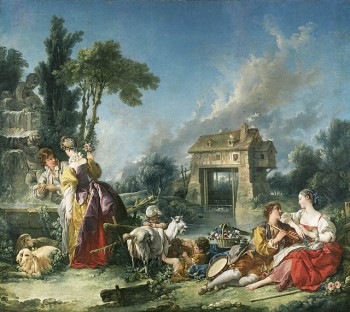
François Boucher, The Fountain of Love, 1748, 116 x 133 inches
(Los Angeles: Getty Museum, 71.PA.37)
• Making Ideas Visible
• Biography and the History of Individual Life
• Economic Ideas in Social and Political Contexts
• Global Sensibilities
• National Identity and Cosmopolitanism
• Antiquaries and Alternative Versions of the Classical Tradition
• Periodisation and the Question of Period Styles
• ‘Enlightenment’ and the Pacific
• Spectacle, Sociability and Pleasure
• Genres of Enlightenment
• Science, Technology and Medicine
• Borders and Empire
• Historiography of the Enlightenment
• Post-Enlightenment Trajectories in Literature and Art
We welcome proposals for 20-minute papers. Proposals consist of a 250-word abstract and 2-page cv, sent via email as a pdf attachment to sihn.dns@sydney.edu.au. Further details are available at the Sydney Intellectual History Network website, where accommodation and keynotes will be posted soon. If you have questions about the conference, please contact the organizing committee at sihn.dns@sydney.edu.au. Deadline for submissions: 15 June 2014.
DNS XV Organizing Committee: Dr Jennifer Ferng, Prof Mark Ledbury, Prof Jennifer Milam and Dr Nicola Parsons
◊ ◊ ◊ ◊ ◊
Added 4 April 2014:
Post Graduate Travel Grants
The 15th David Nichol Smith Seminar organizing committee is pleased to announce that they will be able to offer a limited number of travel grants to expand postgraduate participation in the 2014 ‘Ideas and Enlightenment’ conference. These are provided through generous funding contributions from the Faculty of Arts and Social Sciences, the Putting Periodisation to Use Group, and the Sydney Intellectual History Network at the University of Sydney. These scholarships are part of an extended postgraduate program at DNS XV, which will be supported by the newly formed DNS Graduate Caucus. We anticipate that the program will include paired mentoring between junior and senior colleagues at the conference and a professional development workshop. Those awarded scholarships travel grants would be expected to be actively involved in this program.
Conditions
Travel grants (up to a maximum amount of $2000) will be awarded as reimbursement of travel expenses. Funds may be used for transportation to and from the conference and accommodation only, not for meals). Partial grants may be offered. Recipients must attend the full conference and present a paper at the David Nichol Smith Seminar XV at the University of Sydney. Costs incurred, up to the amount granted, will be reimbursed upon presentation of receipts. In certain cases, fares or other expenses may be paid directly by the DNS XV organizing committee through the office of the Sydney Intellectual History Network. Applications from international and Australian postgraduate students are invited.
Eligibility
The recipient must be actively engaged in full- or part-time doctoral study in eighteenth-century studies, in any field, at a recognised university.
Applications should include
• A completed application form
• A copy of their DNS proposal for a 20 minute paper (250-word paper proposal and 2-page CV)
These materials must be sent as a single pdf document and attached to an email sent to the attention of the organising committee at: sihn.dns@sydney.edu.au. Inquiries about the scholarships should also be directed to members of the committee through this email. Application forms are available to download from the on the conference webpages. Closing date: 15 June 2014
◊ ◊ ◊ ◊ ◊
Please note the confirmation of these keynote speakers (added 16 May 2014). . .
Keynote Speakers
John Dixon Hunt (University of Pennsylvania)
Sophia Rosenfeld (University of Virginia)
Michael McKeon (Rutgers University)
Erika Naginski (Harvard University)
Call for Panel Proposals | 2016 Congress in the History of Art, Beijing
As posted at CAA News (14 March 2014), From the International Committee of the History of Art (Comité International de l’Histoire de l’Art, known as CIHA) and from the conveners of the Beijing Committee for the Congress: Professors LaoZhu, Fan Di’an, and Shao Dazhen.
Thirty-Fourth Congress in the History of Art
Beijing, September 2016
Session Proposals are due by 10 April 2014
The organizing committee for the thirty-fourth Congress in the History of Art, which will take place in Beijing, China, in September 2016, warmly invites expressions of interest from the international community of art historians. The concepts for the sessions are outlined below. We ask for expressions of interest from scholars who wish to develop these themes as session chairs.
Each session will have an international chair and a Chinese chair. A Chinese chair may be from Chinese mainland, Taiwan, or abroad. An early career researcher might serve as associate chair, if necessary. The two cochairs (and an early career researcher, if there is one) will act as a committee to define and refine the session’s concept for the preliminary congress in 2015, and to select presenters for the major congress in Beijing in 2016.
Applications for chairs may be made by academics or independent scholars. We want to remind applicants that no member of the CIHA board, and no one having been a chair in the Nuremberg Congress in 2012, can apply for serving as chair of a session at the Beijing Congress.
Applicants should:
1. Be thoroughly acquainted with the most recent developments in the field of art history relevant to the topic of their session
2. Be able to develop the chosen concept by organizing relevant symposia and workshops before 2016, to initiate dialogue and discussion, and to identify important issues for discussion at CIHA 2016 in Beijing
3. Be able to identify global experts in the appropriate fields and to collaborate with them
4. To be present at CIHA 2016 in Beijing
Applicants should send the following to the CIHA scientific secretary with copy to Chinese committee:
1. Number and title of the proposed session
2. 1–2 pages explaining the perspective they intend to give to the session and the main ideas they would like to be developed and discussed
3. A first draft of the call for papers to be developed with the Chinese chair if the session is selected
4. A short CV stressing the activities and publications related to the session
The deadline for applications is April 10, 2014. The list of the chairs will be established during the CIHA board meeting in Marseilles, France (June 25, 2014) and immediately announced on CIHA website and the Beijing Congress website.
Session Themes
The sessions as defined by the National Committee of the People’s Republic of China and the International Committee for the History of Art are as follows:
1. Words and Concepts【语词与概念】
2. The Rank of Art【标准与品评】
3. Imagination and Projection【想象与投射】
4. Appreciation and Utility【欣赏与实用】
5. Self-Awareness or Self-Affirmation【自觉与自律】
6. Politics of Identity: Tradition and Origin【传统与渊源】
7. Translation and Change【流传与嬗变】
8. Art and Taboo【禁忌与教化】
9. Autonomy and Elusion【独立与超脱】
10. Gendered Practices【性别与妇女】
11. Landscape and Spectacle【风景与奇观】
12. Garden and Courtyard【园林与庭院】
13. Transmission and Adoption【传播与接受】
14. Othering and Foreignness【他者与陌生】
15. Creative Misunderstanding【误解与曲用】
16. Commodity and Market【商品与市场】
17. Display and Observation【展示与观看】
18. Media and Visuality【媒体与视觉】
19. History of Beauty vs. History of Art【审美与艺术史】
20. Professional Education and Aesthetic Education【专业与美育】
21. Connecting Art Histories and World Art【多元与世界】
Full session theme descriptions are available at CAA News»
Call for Papers | Fraktur, 1683–1850
From the Facebook page of the McNeil Center for Early American Studies:
Fraktur and the Everyday Lives of Germans in Pennsylvania and the Atlantic World, 1683–1850
Philadelphia, 5–7 March 2015
Proposals due by 15 April 2014

Reward of Merit (Belohnung),watercolor on laid paper
10.6 cm x 9.4 cm, ca. 1790s (Free Library)
Paper and panel proposals are invited for a conference on Fraktur and the Everyday Lives of Germans in Pennsylvania and the Atlantic World, 1683–1850 to be jointly sponsored by the McNeil Center for Early American Studies, the Free Library of Philadelphia, and the Philadelphia Museum of Art and to be held in Philadelphia, Pennsylvania, 5–7 March 2015. The conference will coincide with major exhibitions at both the Museum and the Free Library. The Philadelphia Museum will be exhibiting fraktur from the collection of Joan and Victor Johnson, featuring many extraordinary manuscript and printed examples from southeastern Pennsylvania along with other objects, and will also be publishing a comprehensive scholarly catalogue of the Johnson collection [more information on the collection is available from a 2013 article at The Magazine Antiques]. The Free Library will feature historically significant, rare and unique examples of Fraktur, manuscripts, broadsides, and printed books from the Henry Stauffer Borneman Pennsylvania German Collection. Presently many of these items are available to scholars in an online database and are featured on the Free Library’s PA German Collection Blog.
These two exhibitions and their accompanying digital and printed components offer a tremendous opportunity for boundary-crossing discussion and analysis. While German-speaking people in Pennsylvania are often conceptualized as a distinctive and isolated group, the exhibitions and this conference encourages efforts to see them as a common subject of inquiry that provides a point of entry for a much broader understanding of the significance of art and culture and for how we understand human experience in the past and the present.
Among the potential themes that the conference hopes to explore are:
• the place of ethnicity within the Early American Republic
• Philadelphia’s historic and on-going relationship to its rural, small-town, and suburban hinterlands
• Pennsylvania Germans and acculturation
• varieties of German culture in European, Atlantic, and non-Pennsylvania contexts
• digital projects as a transformative force for studying art, material culture, history, genealogy, and our understanding of the past
• the relationship of libraries, museums, and university-based academic programs to the general public
• the strengths and weaknesses of art and material culture for understanding the past
• the role of the collector in preserving the past for the future
Proposals are welcome for papers of 25 to 30 pages in length, which will be pre-circulated to all conference participants. Suggestions for complete panels will also be considered, but the organizers reserve the right to accept, reject, or reassign individual papers. Please submit proposals of approximately 500 words, along with curriculum vitae, to mceas@ccat.sas.upenn.edu no later than 15 April 2014. Accepted panelists will be notified by late May 2014. Papers will be due for pre-circulation no later than 15 January 2015. Some support for participants’ travel and lodging will be available for paper presenters.
Call for Papers | Decline—Metamorphosis—Rebirth
From the conference website:
Decline—Metamorphosis—Rebirth: International Conference for PhD Students
Ljubljana, Slovenia, 18–19 September 2014
Proposals due by 12 May 2014
Throughout history mankind has witnessed rises and declines of civilisations, governments and regimes, ideologies and ideas, cultural movements and artistic creativity. The periods of crisis in social as well as artistic fields are generally periods of reflection and pursuit of new ways. However, crises often bring about voices that advocate a return to old values and beliefs. Various connotations may be implied by the word decline, which in turn leads to different understandings of the concept. That is why the term itself rarely refers to something terminal—revivals of ideas, past ages and artistic movements are a common historical occurrence. In connection to these revivals and bearing in mind Heraclitus’s utterance »Ever-newer waters flow on those who step into the same rivers.«, new questions emerge: what is the effect of a new historical context on old, revived ideas, and what is the dialectical relationship between their manifestations in different periods of time?
The international conference Decline—Metamorphosis—Rebirth is intended for PhD students and recent PhD graduates from different fields of humanities and social sciences, who are invited to participate. Proposed topics for interdisciplinary analyses are:
• understanding and interpretation of concepts of decline, transformation/metamorphosis and rebirth in different periods and in different fields of humanities and social sciences
• artistic creation and modes of living in periods of decline, transformation and rebirth (the effect of social changes on artistic creativity, artistic and/or creative reactions on social changes)
• ways of understanding and attitudes towards historical phenomena, periods, and cultural heritage in different periods of time
• decline, transformation and rebirth of social systems, political structures, ideologies
• artistic and social contexts and the role of historicisms, neo- and post- styles in art
• decline, transformation and rebirth as iconographical motifs
• metamorphosis of iconographical motifs, ways in which they are perceived in new contexts
• forgotten, rediscovered or »rehabilitated« artists
• crisis, transformation, and rebirth in an individual artist’s oeuvre
• revival (Nachleben) of concepts and content within art historical periods
Abstract in English of maximum 400 words should be send, with the title of the paper, name and contact information (address, phone number, e-mail) until 12th of May 2014 by e-mail to phdconference2014@gmail.com or by post to Department of Art History, Faculty of Arts, Aškerčeva 2, SI-1000 Ljubljana, Slovenia (with the note ‘Conference for PhD students’).
Call for Papers | Paragone Studies
Paragone Studies
Musée des Beaux-Arts du Québec, 18–20 September 2014
Proposals due by 1 April 2014
Papers are invited for The 3rd Annual International Conference in Paragone Studies, to be held at the Musée des beaux-arts du Québec, just outside of the old quarter of the City of Québec in Canada. The conference’s purpose is to support the scholarly investigation of the paragone, or rivalry in the arts, as it has been manifested in all media across history. The conference will also include a round-table session featuring artists who choose to discuss how competition in the arts, past or present, has impacted their work or their professional lives. To apply, please submit a 300-word abstract using the paper or round-table presenter appropriate form on the conference website and send to paragonestudies@gmail.com. Please include a c.v.
Call for Papers | Amateurs: Practices and Representations
From Le Blog de L’ApAhAu:
L’amateurisme dans l’Europe du XVIIIe siècle. Pratiques et représentations
Paris, Université Sorbonne Nouvelle, 3–4 October 2014
Proposals due by 30 April 2014
Le XVIIIe siècle a souvent été décrit comme l’âge d’or de l’amateur. De cette consécration, le signe le plus visible est la création en France du titre d’« amateur honoraire » à l’Académie royale de peinture et de sculpture, dont la personne du comte de Caylus fut l’un des plus brillants représentants. Dans son abstraction, le terme renvoie moins à une fonction déterminée qu’à un goût pour l’art, lequel recouvre concrètement une configuration d’aptitudes ou de rôles (du collectionneur, du mécène, de l’esthète, du savant, du praticien) : parce qu’il combine ces différents usages du goût, le modèle académique constitue un type idéal et accompli de l’amateur, au point qu’on a pu identifier le déclin de ce modèle à la disparition de cette figure au siècle suivant.
Dépassant ce cadre d’analyse centré sur les beaux-arts et le cas français, on se fondera ici sur une compréhension extensive du terme, qui s’étendra aux domaines artistiques autres que les arts plastiques (théâtre, architecture, musique, arts des jardins, etc.) voire au champ esthétique en général (incluant à ce titre le paysage) et l’on abordera cet objet d’étude dans une perspective comparatiste, ouverte sur les particularités lexicales et sémantiques qui caractérisent sa conceptualisation dans les différentes langues et cultures européennes.
On s’interrogera sur les antagonismes et les évolutions qui travaillent la définition de l’amateur, au sein d’un champ de forces où s’affrontent des intérêts divergents. Pour être d’institution récente, la figure de l’amateur académique n’en reste pas moins partiellement tributaire des structures et des valeurs propres à cette sociabilité aristocratique au sein de laquelle s’est constituée une tradition du loisir cultivé et qui définit, depuis le XVIIe siècle, le cadre de la pratique de l’amateur des belles-lettres. Or la campagne que les « gens de lettres », Diderot en tête, vont mener contre Caylus et ses confrères à partir du milieu du XVIIIe siècle, contribue à élargir l’horizon de communication dans lequel se déploie l’activité de l’amateur. Dénonçant la restriction du domaine de juridiction en matière esthétique aux relations entre particuliers à l’intérieur de cercles d’initiés, les critiques d’art revendiquent leur rôle « dans la formation d’un espace public et civique du goût » (Charlotte Guichard, Les amateurs d’art à Paris au XVIIIe siècle, 2008). Ils promeuvent une nouvelle vision de l’amateurisme sous l’espèce du critique d’art, qui prétend former le goût général en s’exprimant en tant que personne particulière, sans être un professionnel ni un praticien. (more…)










leave a comment