Exhibition: Baroque Ivory at the Court of Vienna
From the Liebieghaus Skulpturensammlung:
Ivory: Baroque Splendor at the Viennese Court / Elfenbein: Barocke Pracht am Wiener Hof
Liebieghaus Skulpturensammlung, Frankfurt am Main, 3 February — 26 June 2011
Curated by Maraike Bückling and Sabine Haag

Ignaz Bendl (1682–1730) "Medaillon commemorating the erection of the mercy columm," ca. 1692
Ivory has been one of the most popular materials since ancient times. Its origins in unknown faraway lands and its rarity account for its costliness. It was particularly the Baroque era that had an extraordinarily high demand for ivory. In the seventeenth century, ivory work reached its culmination in Vienna in the days of Prince Karl Eusebius of Liechtenstein and Emperor Leopold I. The shimmering appearance of the polished material served princely-imperial claims to prestige, as its possession testified to its owners’ power and wealth. The exhibition Ivory: Baroque Splendor at the Court of Vienna, presented in the Liebieghaus Skulpturensammlung from February 3 to June 26, 2011, will focus on this heyday of ivory art. It will feature thirty-six splendid, virtuoso carvings impressively documenting the artisans’ great skill, among them masterly executed statuettes, pitchers, goblets, tankards, and bowls of ivory, objects created for display in so-called cabinets of curiosities and not intended for any practical use. The show comprises works by the most famous ivory artists of the Baroque period, such as Adam Lenckhardt, Johann Caspar Schenck, and Matthias Steinl. It was prepared together with the Kunsthistorisches Museum in Vienna, whose world-renowned Cabinet of Wonders is closed for the time being because of comprehensive restoration measures. This presented the Liebieghaus with the unique opportunity to show a high-caliber selection of masterpieces from the Kunstkammer of the Kunsthistorisches Museum in Frankfurt before the items will be on display again on a permanent basis in Vienna after the Cabinet’s reopening in late 2012. Eight additional high-carat loans come from the Reiner Winkler Collection.

Matthias Steinl (1643/44–1727) "Allegory of the Elements of Water and Air," ca. 1688
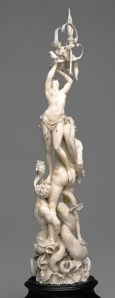
Matthias Steinl (1643/44–1727) "Allegory of the Elements of Water and Air," ca. 1688
In Ancient Greece, Phidias already created large statues of gods whose skin was executed in ivory, and the Bible describes Solomon’s throne as made up of ivory parts. It was above all in the Middle Ages and in the Baroque era that ivory was held in high esteem as a material. The great demand finally resulted in the emergence of new ports of entry in the seventeenth century; both the East India Company and the West India Company furthered the transport of African ivory in particular. The concentration on necessarily small-format ivory works fit in well with the fact that there were hardly any or no commissions at all conferred for large-size church or palace interiors during the Thirty Years’ War and the plague epidemics. Sculptors and their clients increasingly or entirely dedicated themselves to small mobile sculptures.
In the Renaissance and Mannerist periods, bronze was preferred for small sculptures. Yet, ivory outstripped the material in the course of the seventeenth century. People appreciated its combination of elasticity and hardness, as well as its gleaming transparency and delicate veining resembling the tone of flesh. The heyday of the production of ivory works in the seventeenth century was based on sixteenthcentury ivory turnery, on such early examples as those by the Master of the Furies. Besides the major bourgeois towns, the secular and ecclesiastical capitals became centers of ivory production from about 1650 on – a development that did not come to an end before the early eighteenth century. Ivory carvers were to be found mainly in Munich and Augsburg, but also in Schwäbisch Hall, Ulm, Mechlin, Amsterdam, Dresden, and Düsseldorf. (more…)
Furniture: ‘Inspired by Antiquity’ Highlights Thomas Hope
From a Carlton Hobbs press release:
Inspired by Antiquity: Classical Influences on 18th- and 19th-Century Furniture and Works of Art
Carlton Hobbs, New York, 20 January — 14 February 2011

One of a pair of wall lights in the form of a griffin, related to a design by Thomas Hope, bronze, ca. 1802
The opening night reception, on January 19th, benefited the Sir John Soane Museum Foundation. Tim Knox, the Soane Museum’s eminent director, lectured on the subject of the exhibition and elaborated on some of the highlights on view. “We are honored to have Sir John Soane’s Museum Foundation as the opening night beneficiary,” said Carlton Hobbs. “We are particularly enthusiastic to present forty magnificent pieces inspired by antiquity, including the important group of Thomas Hope pieces from the Philip Hewat-Jaboor collection of Regency furniture and works of art,” he said. “It is the single largest collection of Thomas Hope pieces to come onto the market since the Christie’s auction of the contents of Deepdene, Hope’s country estate, in 1917.” Thomas Hope, the fabulously successful banker, connoisseur collector and designer, revolutionized British taste of the late 18th, early 19th century with his radical, classically inspired design ideas and came to be one of the key figures shaping the Regency taste.
In the continuous effort to deepen our understanding of the decorative arts of the 18th and 19th centuries we wanted to further explore the visual and philosophical inspirations that gave rise to the multitude of fascinating designs, which are now broadly described as Neoclassical,” said Stefanie Rinza. “We are thrilled to collaborate with some of today’s leading academics in identifying the ancient design sources for our pieces and in interpreting the symbolism of the decorative devices used. We hope our clients, colleagues and friends will much enjoy the catalog accompanying the exhibition.
Carlton Hobbs is most grateful for the contributions and collaboration of some of today’s leading experts in the field of decorative arts and in the compilation of the catalog accompanying the exhibition, including Martin Levy, former chairman of the British Antiques Dealers Association, author and specialist in 19th-century furniture and works of art, Tim Knox, Director of the Sir John Soane Museum, Philip-Hewat Jaboor, the authority on Thomas Hope and independent art consultant to private and institutional collectors, and John Hardy, the long-time director of Osterley Park House Museum, who added his insights into the meaning of the symbolism of the classical design elements to every entry.
Exhibition: Paper Dresses of Isabelle de Borchgrave
From the Legion of Honor Museum:
Pulp Fashion: The Art of Isabelle de Borchgrave
Legion of Honor, Fine Arts Museums of San Francisco, 5 February — 5 June 2011
Curated by Jill D’Alessandro
 Belgian artist Isabelle de Borchgrave is a painter by training, but textile and costume are her muses. Working in collaboration with leading costume historians and young fashion designers, de Borchgrave crafts a world of splendor from the simplest rag paper. Painting and manipulating the paper, she forms trompe l’oeil masterpieces of elaborate dresses inspired by rich depictions in early European painting or by iconic costumes in museum collections around the world. The Legion of Honor is the first American museum to dedicate an entire exhibition to the work of Isabelle de Borchgrave, although her creations have been widely displayed in Europe.
Pulp Fashion draws on several themes and presents quintessential examples in the history of costume—from Renaissance finery of the Medici family and gowns worn by Elizabeth I and Marie-Antoinette to the creations of the grand couturiers Frederick Worth, Paul Poiret, Christian Dior, and Coco Chanel. Special attention is given to the creations and studio of Mariano Fortuny, the eccentric early-20th-century artist who is both a major source of inspiration to de Borchgrave and a kindred spirit.
Catalogue: Jill D’Alessandro, Pulp Fashion: The Art of Isabelle de Borchgrave (Prestel, 2011), 104 pages, ISBN: 9783791351056, $29.95.
◊ ◊ ◊ ◊ ◊
From the artist’s website (worth visiting for lots more amazing images). . .
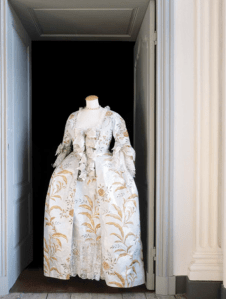
Isabelle de Borchgrave, "Madame de Pompadour paper dress," inspired by a 1755 painting by Maurice Quentin de la Tour, 85 cm x 65 cm x 165 cm, 2001 (Photo: René Stoeltie).
. . . . Following a visit to the Metropolitan Museum in New York in 1994, Isabelle dreamed up paper costumes. While keeping her brushes in hand and her paintings in mind, she worked on four big collections, all in paper and trompe l’œil, each of which set the scene for a very different world. “Papiers à la Mode” (Paper in Fashion), the first, takes a fresh look at 300 years of fashion history from Elizabeth I to Coco Chanel. “Mariano Fortuny” immerses us in the world of 19th century Venice. Plissés, veils and elegance are the watchwords of that history. “I Medici” leads us through the streets of Florence, were we come across famous figures in their ceremonial dress. Figures who made the Renaissance a luminous period. Gold-braiding, pearls, silk, velvet … here, trompe l’œil achieves a level of rediscovered sumptuousness. As for the “Ballets Russes”, they pay tribute to Serge de Diaghilev. Pablo Picasso, Léon Bakst, Henri Matisse, … all designed costumes for this ballet company, which set the world of the 20th century alight. These dancing paper and wire figures play a very colourful and contemporaneous kind of music for us.

Isabelle de Borchgrave, "Madame de Pompadour paper dress," detail
It’s true that, today, Isabelle de Borchgrave has become a name that is readily associated with fashion and paper. But her name is also closely linked to the world of design. By working together with Caspari, the potteries of Gien, Target, and Villeroy and Boch, Isabelle has turned her imagination into an art that’s accessible to anyone who wants to bring festivity into their home. Painted fabrics and paper, dinner services, curtains, sheets, decor with a personal touch for parties and weddings,… All this tells of the world in which she has always loved to move.
But in a 40-year career, she has never put to one side the thing that has always guided her in her life: painting. She still exhibits her paintings and her large folded paper works all over the world. With an imagination increasingly stimulated by her knowledge and interpretation of art, Isabelle, a follower of the Nabis movement, has a fresh perspective of a world that flies around her like a dream.
Exhibition: The Landscape of Tivoli in the Eighteenth Century
Tivoli: Variations sur un paysage au XVIIIe siècle
Cognacq-Jay Museum, Paris, 18 November 2010 — 20 February 2011

Joseph Vernet, "La cascade," ca. 1748 (Photo: Roger Viollet)
L’exposition Tivoli. Variations sur un paysage au XVIIIe siècle propose une réflexion originale sur l’évolution du paysage, de 1720 à 1830, autour d’un motif particulier : le site de Tivoli et son célèbre temple dit de la Sibylle.
Lieu de villégiature fameux depuis l’Antiquité, Tibur (le nom latin de Tivoli) fut mise à la mode par l’empereur Auguste et par Mécène, le fastueux ami des arts, et célébrée par les poètes Horace et Catulle (Ier s. av. J.-C.). La Sibylle Albunea y exerçait son art divinatoire. Le site est exceptionnel : bâtie sur les premiers contreforts des Apennins, à une trentaine de kilomètres à l’est de Rome, Tivoli se présente comme une ville à flanc de montagne, dominant la plaine qui s’étend de là jusqu’à la mer. Une rivière, l’Aniene, s’y précipite en multiples cascades. Une petite acropole s’élève au bord du gouffre : les ruines de deux temples sont encore conservées, l’un quadrangulaire, l’autre rond. Ce dernier surtout est devenu célèbre, sous le nom de temple de la Sibylle ou de Vesta.

ISBN : 9782759601462, 30€
Au XVIIIe siècle, Tivoli et son temple sont progressivement devenus l’un des motifs les plus représentés dans l’histoire de la peinture, singulièrement dans la peinture française. La perfection architecturale du monument, son emplacement au coeur d’un paysage sublime et terrifiant, la richesse incomparable de son histoire, de ses légendes, en ont fait un motif adulé par les peintres et leurs collectionneurs. C’est aussi l’époque où l’on décline le temple de Tivoli sous forme de fabriques édifiées dans les jardins.
En cinquante oeuvres, peintures, dessins et gravures, l’exposition propose de confronter le regard porté par les plus grands artistes de l’époque sur ce motif : une brève introduction présente l’origine de son succès, au début du XVIIe siècle, dans l’entourage de Paul Bril et de Gaspard Dughet. Pour le XVIIIe siècle, Vanvitelli, Boucher, Vernet, Hubert Robert, Piranèse… se succèdent autour du même motif. Puis Valenciennes, Simon Denis ou Granet qui furent en France les précurseurs du paysage moderne. Composées ou plus spontanées, caprices, variations poétiques, études faites en plein air, les oeuvres présentées posent de manière contradictoire la question du sujet dans la peinture de paysage. Le plus singulier est sans doute qu’un même motif ait intéressé tous les artistes sur une période aussi longue, des plus traditionnels aux plus modernes.
L’exposition sera accompagnée par un catalogue en couleurs. En plus de notices détaillées sur chaque oeuvre, des essais confiés à plusieurs auteurs traiteront notamment du site de Tivoli, de sa fortune dans l’histoire de l’art ou dans les récits de voyageurs, et de l’importance de certains artistes particulièrement associés à Tivoli (Joseph Vernet, Hubert Robert).
◊ ◊ ◊ ◊ ◊
Didier Rykner’s review of the exhibition (in French) for La Tribune de l’Art (30 November 2010) is available here»
Settecento Paintings in New York
The following press release comes from Sperone Westwater (as noted at Art Daily) . . .
Italian Paintings from the 17th and 18th Centuries
Sperone Westwater Gallery, New York, 7 January — 19 February 2011
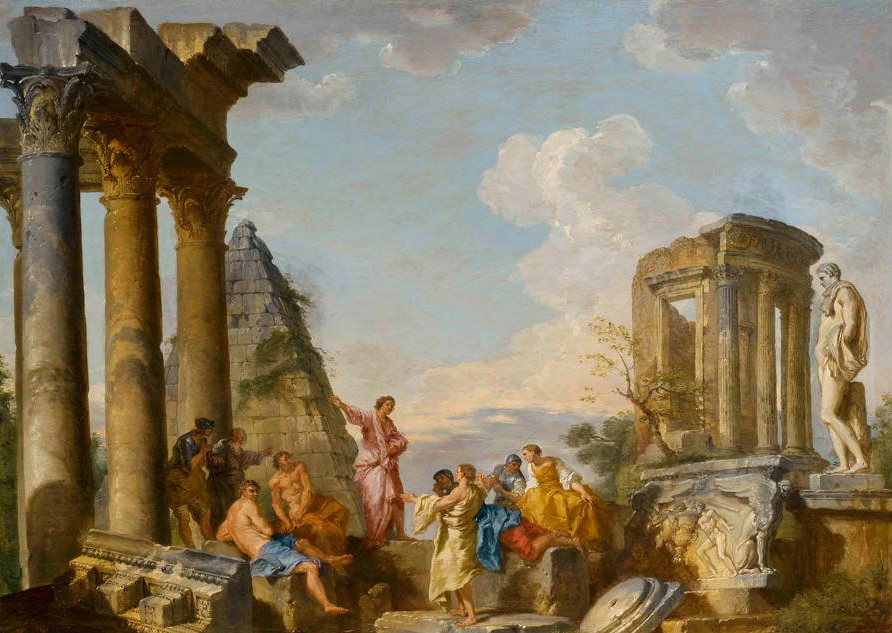
Giovanni Paolo Panini, "Architectural Capriccio with an Apostle Preaching," 1755-60, oil on canvas, 20 7/8 x 28 7/8 inches (52.9 x 73.5 cm). Courtesy Sperone Westwater, NY.
Sperone Westwater is pleased to announce an exhibition of Italian Paintings from the 17th and 18th Centuries in partnership with Robilant + Voena. This survey of Italian Old Master paintings, with notable masterpieces by painters such as Canaletto (1697-1768), Cavalier d’Arpino (1568-1640), Artemisia Gentileschi (1593-1653), and Michele Marieschi (1710-1743), intends to reassert the historical importance of Italian painting in the centuries following the Renaissance – a period which was to become an important foundation for modern art.
The exhibition unveils several new discoveries. One highlight is a very uncommon signed Portrait of an Unidentified Man (1630-1640) by Artemisia Gentileschi, among the most highly regarded female artists of the Baroque. It is exhibited alongside Tiberio Titi’s Portrait of Ferdinando Gonzaga, Duke of Mantua (ca. 1617) – also a new addition to his body of work. An early Francesco Guardi, Piazza San Marco, looking West, from the Campo di San Basso (1757-1758), a newly discovered work from the late 1750s, represents a period when he was still very much under Canaletto’s influence. When comparing this to Guardi’s later and previously unpublished painting, Venice. The Lagoon and the Fort of San Niccolo at Lido (1775-1785), it is possible to see how far the artist took his own individual interpretation of the Venetian veduta. Canaletto’s small and exquisite View of Dolo at the bank of the Brenta (1763) completes this set of important additions.
Other early masterworks will include two rare paintings by Cavalier d’Arpino, who first hosted Caravaggio in his studio after his arrival in Rome. The first, David with the Head of Goliath (1598) is a signed and dated work from the extensive Aldobrandini collection that was treasured by several papal Cardinals since its creation. It contrasts forcefully with d’Arpino’s Venus and Cupid (1602-1603), executed a few years later. Works by Battistello Caracciolo, Angelo Caroselli and Carlo Dolci further exemplify the prominence of religious narrative during the 17th century. Paintings by Marieschi, Panini and Joli also underline the 18th-century fascination with the veduta.
By jointly exhibiting Italian Baroque paintings and vedute from the 17th and 18th centuries in New York, Sperone Westwater and Robilant + Voena inaugurate a closer partnership between the two galleries. In 2011 both galleries will open a new shared space in London, 2nd Floor at 38 Dover Street, W1, with a joint show in 2011.
A fully illustrated, scholarly catalogue is being published on the occasion of the show. There will be an opening reception on 7 January from 6-8 pm. For more information, please visit www.speronewestwater.com or contact Maryse Brand at +1 (212) 999-7337 or maryse@speronewestwater.com.
Chardin Exhibition in Ferrara and Madrid
Roderick Conway Morris reviews the Chardin exhibition currently in Ferrara for The New York Times, 22 December 2010, “Chardin’s Enchanting and Ageless Moments” . . .
Chardin: The Painter of Silence
Ferrara, Palazzo dei Diamanti, Ferrara, 17 October 2010 — 30 January 2011
Museo Nacional del Prado, Madrid, 1 March — 29 May 2011
ISBN: 9788889793107, $90
“We stop in front of a Chardin as if by instinct,” wrote Diderot in his review of the Paris Salon of 1767, “like a traveler weary of the road choosing, almost without realizing, a place that offers a grassy seat, silence, water and cool shade.”
Jean-Siméon Chardin’s small still lifes and genre scenes have been working their magic ever since the 18th century. And trying to explain how Chardin created his enchanting effects has never ceased to exercise writers on art.
The Louvre has the world’s largest collection of Chardins, and Pierre Rosenberg, formerly the director of the museum, has made a lifelong study of the painter. He is now the curator of “Chardin: Painter of Silence,” the first exhibition devoted to the French artist ever to be staged either in Italy or Spain (the show will travel on to the Prado in February). The event brings together 52 pictures (with four additional works and a few substitutions in the Madrid version). . . .
The full article is available here. Didier Rykner reviewed the exhibition for The Art Tribune in October. The catalogue is available at artbooks.com.
Exhibition: Napoleon and Europe
From the Bundeskunsthalle’s website:
Napoleon and Europe: Dream and Trauma (Traum und Trauma)
Art and Exhibition Hall of the Federal Republic of Germany, Bonn, 17 December 2010 — 25 April 2011
Musée de l’Armée, Paris, March — June 2012
The source of all great mistakes and thence of all the great suffering of our time was that Napoleon was
perceived either as a demigod or as a monster or, more often than not, as both at the same time.
Friedrich von Gentz, 1814

Exhibition catalogue, 368 pp, ISBN 9783791350882
During the nearly sixteen years of his reign, Napoleon Bonaparte (1769–1821), more than any other historical figure, redrew the very foundations of European history. and wrought changes that can be felt to this day – both positively and negatively. The exhibition, which has been panned and organised by the Art and Exhibition Hall of the Federal Republic of Germany, draws on a selection of high-calibre loans from all over Europe to present a comprehensive picture of Napoleon and his time. Painting and sculpture reached new heights of excellence in the Napoleonic era – both in the propaganda paintings by David, Gérard and Ingres and in the work of those who opposed the French emperor, among them Goya and the German Romanticists. Staying clear of well-worn clichés that paint Napoleon as a warmonger or a larger than life political genius, the exhibition aims to draw a more differentiated picture of the Napoleonic era between war, politics, administration, art theft and
cultural prosperity.
The exhibition is held under the patronage of Federal Chancellor Angela Merkel and the President of the French Republic, Nicolas Sarkozy. The exhibition was planned by the Art and Exhibition Hall of the Federal Republic of Germany, Bonn, in cooperation with the Musée de l’Armée in Paris and will be shown in Paris from March to June 2012.
The exhibition is subdivided into the following thematic chapters, which are explained in a microsite NAPOLEON:
- Generation Bonaparte
- Fascination and Revulsion
- Physical and Symbolic Birth
- The Dream of a Great Empire
- Blood and Sex: Europe, a Family Business
- Space, Law, Religion: New Ways of Controlling Space and the Mind
- Objects of Desire: Napoleon and the Appropriation of European Art and Heritage
- The Empire of Symbols
- Duels
- Nations – Emotions
- Symbolic and Physical Death
- Projections: A ‘Divided’ Icon
Additional information about the exhibition is available at ArtDaily. An article from The Wall Street Journal (12 November 2010) by J. S. Marcus addresses the show within the larger context of Bonn’s emergence as “a cultural hub.”
Reviewed: ‘The Intimate Portrait’
Recently added to caa.reviews:
Stephen Lloyd and Kim Sloan, The Intimate Portrait: Drawings, Miniatures, and Pastels from Ramsay to Lawrence, exhibition catalogue (Edinburgh and London: National Galleries of Scotland and British Museum, 2009). 272 pages, ISBN: 9781844543984, £25.
Reviewed by Robin Nicholson, Virginia Museum of Fine Arts; posted 1 December 2010.
The 2008 exhibition that this catalogue accompanied was instigated by the British Museum’s acquisition of an important drawing by Sir Thomas Lawrence, “Mary Hamilton” (1789). Cover-girl of the catalogue and an astonishing tour-de-force by the gifted nineteen-year-old artist, this work reminded authors Stephen Lloyd and Kim Sloan of just how ubiquitous miniatures and portrait drawings were in the eighteenth and nineteenth centuries—particularly at the Royal Academy—and how central they were to the contemporary debates on the purpose and significance of portraiture. As Lloyd (of the Scottish National Portrait Gallery) and Sloan (of the British Museum) admit, this publication only begins to address some of the pressing issues of the genre. Their goal is “to open up the discourse . . . looking at them as physical objects as well as symbolic ones, asking how and why they were made, commissioned, whether for pleasure or as gifts, where they were kept or hung or worn—displayed, encased or bejeweled” (9). Although it can be deemed only a partial success, the catalogue is nonetheless a beautiful, erudite, and informative publication. . . .
For the full review, click here» (CAA membership required)
Exhibition: Furniture of John Shearer
From the DAR Museum:
‘A True North Britain’: The Furniture of John Shearer, 1790-1820
Daughters of the American Revolution Museum, Washington, D.C., 8 October 2010 — 26 February 2011
Curated by Elizabeth Davison
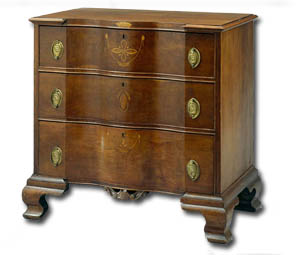 The exquisitely detailed furniture of craftsman John Shearer is showcased in the DAR Museum exhibition ‘A True North Britain’: The Furniture of John Shearer, 1790-1820, which runs from October 8, 2010, through February 26, 2011. Noted not only for its form but also for the politically charged symbols inlaid in many pieces, the furniture helps to explore early America’s cultural ties to Great Britain during the most contentious period in the two nations’ shared history.
John Shearer worked in northern Virginia and western Maryland in the late 18th and early 19th centuries. He left behind no paper trail, choosing instead to inscribe his biography and his politics directly on his furniture. While other early craftsmen were inlaying
their work with eagles to symbolize a new American government,
Shearer glorified Great Britain and its Royal Navy.
Shearer was from Edinburgh, Scotland. Like many from this region, he identified with the Kingdom of Great Britain, formed by the 1707 Treaty of Union which unified Scotland and England. Shearer touts his loyalty by signing two desks on view in this exhibition with the slogan, “A True North Britain.” On another desk, he cheers Napoleon’s downfall and Britain’s victory in the Peninsular War by depicting a crowned lion rampant (rearing on hind legs, paws raised) from the Scottish and English royal coats of arms along with the inscription “Victory Be Thine.”
Shearer documented the Royal Navy’s exploits almost like a political cartoonist. Although fine furniture was an unusual medium for these messages, 52 of his pieces survive, showing that his pro-British sentiments did not deter demand for the simple but unconventionally embellished furniture. As America formed a national identity, its cultural and political diversity included many who retained a strong sense of loyalty to Great Britain.
 Not all Shearer’s messages were meant to be seen, however. Shearer, following the age-old tradition of artist retaliating against problematic patron, hid a note inside one desk accusing his customer, a slave holder and trader, of being “the Greatest Scoundrel in Loudoun County.” This unique piece is among 20 on display in “A True North Britain.” Independent scholar Elizabeth Davison is the guest curator for this exhibition. Her book, a catalog raisonne of Shearer’s work, will be published this winter. Her expertise informs this exhibition, exploring the work of one eccentric artist to show how a diversity of cultures and loyalty was built into the foundations of our country.
◊ ◊ ◊ ◊ ◊
Elizabeth Davison, The Furniture of John Shearer, 1790-1820: A True North Britain in the Southern Backcountry (Altamira Press, 2011), 256 pages, ISBN: 978-0759119543, $90.
Exhibition to Recreate a Day in the Life of a Parisian Townhouse
Press release from the Getty:

Paris: Life & Luxury
J. Paul Getty Museum, Los Angeles, 26 April — 7 August 2011
Museum of Fine Arts, Houston, 18 September — 10 December 2011
Curated by Charissa Bremer-David with Peter Björn Kerber
The nation of France, and its capital city of Paris in particular, held a special status in European culture during the 18th century. The upper echelons of societies throughout Europe were predominantly Francophiles—imitating French fashions of dress and furniture in their daily lives. On view in the Exhibitions Pavilion at the J. Paul Getty Museum at the Getty Center, April 26 through August 7, 2011, Paris: Life & Luxury re-imagines, through art and material culture, the complex and nuanced lifestyle of elite 18th-century Parisians who made their city the fashionable and cultural epicenter of Europe.

ISBN: 978-1606060520, $45
Inspired by the Getty Museum’s extensive French decorative arts collection and the correspondingly strong holdings of French illustrated books in the Getty Research Institute, Paris: Life & Luxury will provide a rich cultural and historical experience that closely mirrors daily life in 18th-century France. Bringing together approximately 160 objects, roughly half of which will be on loan from twenty-six museums and private collections around the world, the exhibition will include a wide range of paintings, sculpture, applied arts, drawings, metalwork, furniture, architectural fittings, lighting and hearth fixtures, scientific and musical instruments, clocks and watches, textiles and dress, books, and maps.
David Bomford, acting director of the J. Paul Getty Museum said, “Paris: Life & Luxury will transport visitors back to Paris in the mid-1700s. More than celebrating the period or perpetuating the mythology of its charm and gallantry, this exhibition re-imagines the varied and complex range of values and practices of the city’s elite within a rich material context.”
Charissa Bremer-David, curator of sculpture and decorative arts at the J. Paul Getty Museum and the exhibition’s co-curator added, “The exhibition will be a rich and deep sensory experience, engaging the viewer’s initial attention with the compelling visual appeal of superlative and virtuoso works of art. From this breadth and diversity, visitors will learn generally about the contributions of the French, and in particular the Parisian, to the visual and performing arts, language, literature, history, science, and even culinary arts during this time period—in short, about their major contribution to the humanities at large.”
Following a structure based on the traditional visual allegories of the Four Times of Day, the objects in the exhibition are grouped according to their associations with common activities as pursued in the chronology of a single day, from morning to night. As such, objects of diverse mediums are juxtaposed, as they would have been within an 18th-century Parisian domestic setting, regardless of modern museological or academic categories. Through constellations of art and related artifacts, the exhibition follows the conventional activities in the cycle of a Parisian day, such as dressing, writing, collecting, eating, and evening entertainment—allowing visitors to envision the activities and accessories of quotidian life, in order to find resonances with their own daily lives. (more…)










 Enfilade
leave a comment