Exhibition | ‘Without Hands’: The Art of Sarah Biffin
Now on view at Philip Mould in London:
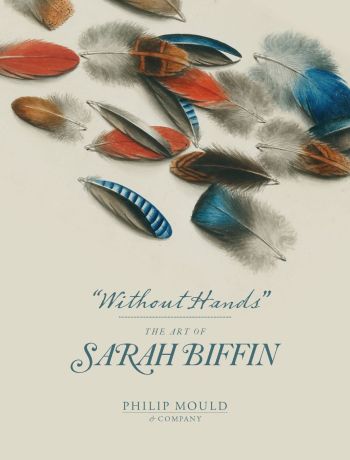
‘Without Hands’: The Art of Sarah Biffin
Philip Mould & Company, London, 1 November — 21 December 2022

Sarah Biffin, A miniature watercolour of subaltern or captain of a British ‘royal’ regiment of line infantry by, ca. 1815–20.
The remarkable story of Sarah Biffin (1784–1850), has been largely overlooked by historians. Those who have attempted to illustrate her life have often perpetuated misconceptions, and Biffin’s artistic reputation has suffered as a result. This exhibition, established upon ground-breaking primary research, is the first of its kind to present Biffin’s artistic achievements and represent her history.
Sarah Biffin (or Beffin) was born into a farming family in Somerset in 1784, where her baptism records state that she was “born without arms and legs.” Teaching herself to write and draw from a young age, Biffin rose to fame as an artist and established a professional career as a portrait painter. Throughout her long and successful career, she travelled extensively, took commissions from royalty, and recorded her own likeness through exquisitely detailed self-portraits. Her artworks—many proudly signed “Without Hands”—are a testament to her talent and accomplishment.
Around the age of twenty, Biffin left home. She contracted herself to a ‘Mr Dukes’ who toured the country with Biffin, visiting county fairs where she was described as the “Eighth Wonder.” Using her mouth and shoulder, Biffin would sew, write, and paint watercolours and portrait miniatures in front of crowds who turned up and left with a sample of her writing included in the cost of their ticket. One such spectator was the wealthy and well-connected Earl of Morton, who supported her in her quest to finesse her artistic skills. In her mid-twenties she began formal tuition with a miniature painter, William Marshall Craig. From 1816 she set herself up as an independent artist and later took commissions from nobility and royalty.
 Biffin travelled extensively, exhibiting her artwork and taking commissions all over the country and abroad. She took studios in cities including London, Brighton, Birmingham, Cheltenham, and Liverpool. In each of these cities, she taught the art of miniature painting and was a champion of women students in particular. Continuously recording her own image throughout her lifetime, Biffin’s self-portraits evidence the artistic aptitude, self-respect, and skill of this tenacious artist.
Following the story of her life, the exhibition includes original handbills and broadsides from Biffin’s time in travelling fairs, along with the samples of her writing included in the cost of the entry tickets. Visitors to the exhibition will also be able to see examples of the art from her professional career, including portraits, landscapes, and highly-skilled still lifes. More personal exhibits include private letters (including one to her mother) and almost every self-portrait she ever painted. With advisor, artist Alison Lapper MBE (born 180 years later with the same condition); consultant and contributor, Professor Essaka Joshua (specialist in Disability Studies at the University of Notre Dame, Indiana); and loans from national institutions, the exhibition will celebrate Biffin as a disabled artist who challenged attitudes to disability.
The catalogue is published by PHP and distributed by The University of Chicago Press:
Emma Rutherford and Ellie Smith, eds., with contributions by Essaka Joshua, Alison Lapper, and Elle Sushan, ‘Without Hands’: The Art of Sarah Biffin (London: Paul Holberton, 2022), 80 pages, ISBN: 978-1913645366, £18 / $25.
Emma Rutherford is a portrait miniatures consultant at Philip Mould & Company in London. Ellie Smith is a researcher at Philip Mould & Company. Professor Essaka Joshua is a specialist in disability studies at the University of Notre Dame, Indiana. Based in Brighton, Alison Lapper is an artist, television presenter, speaker, and Gig-Arts Charity patron. Elle Shushan is a specialist, author, lecturer, and museum consultant in Philadelphia.
Exhibition | Archive of the World: Spanish America, 1500–1800
The exhibition closes at LACMA this weekend, but the catalogue remains available, and a version of the show will open at Nashville’s Frist Art Museum this time next year and then in Saint Louis in 2024.
Archive of the World: Art and Imagination in Spanish America, 1500–1800
Los Angeles County Museum of Art, 12 June — 30 October 2022
Frist Art Museum, Nashville, 20 October 2023 — 28 January 2024
Saint Louis Art Museum, 22 June — 1 September 2024
Curated by Ilona Katzew
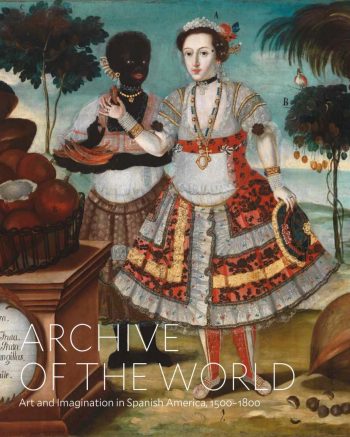 Archive of the World: Art and Imagination in Spanish America, 1500–1800 is the first exhibition of LACMA’s notable holdings of Spanish American art. Following the arrival of the Spaniards in the Americas in the 15th century, the region developed complex artistic traditions that drew on Indigenous, European, Asian, and African art. The Spanish conquest of the Philippines in 1565 inaugurated a commercial route that connected Asia, Europe, and the Americas. Private homes and civic and ecclesiastic institutions in Spanish America were filled with imported and locally made objects. Many local objects also traveled across the globe, attesting to their wide appeal. This confluence of riches signaled the status of the Americas as a major emporium—what one author described as “the archive of the world.” Featuring approximately 90 works, including several recent acquisitions, the exhibition emphasizes the creative power of Spanish America.
Following its presentation at LACMA, Archive of the World: Art and Imagination in Spanish America, 1500–1800 will be on view at the Frist Art Museum, Nashville, from 20 October 2023 through 28 January 2024.
The press release is available as a PDF file here»
Ilona Katzew, ed., Archive of the World: Art and Imagination in Spanish America, 1500–1800, Highlights from LACMA’s Collection (New York: DelMonico Books, 2022), 391 pages, ISBN: 978-1636810201, $85. With contributions by Ilona Katzew, Pablo F. Amador Marrero, Rafael Barrientos Martínez, Patricia Díaz Cayeros, Carlos F. Duarte, Clarissa M. Esguerra, Cristina Esteras Martín, Alejandra Mayela Flores Enríquez, Aaron M. Hyman, Rachel Kaplan, Paula Mues Orts, Jeanette Favrot Peterson, Elena Phipps, JoAnna M. Reyes, Maya Stanfield-Mazzi, Edward J. Sullivan, and Luis Eduardo Wuffarden. Designed by Lorraine Wild and Xiaoqing Wang, Green Dragon Office.
◊ ◊ ◊ ◊ ◊
Note (added 13 June 2024)— The posting was updated to include the Saint Louis Art Museum as a venue; there, the exhibition is entitled simply Art and Imagination in Spanish America, 1500–1800, Highlights from LACMA’s Collection.
The Burlington Magazine, September 2022
The eighteenth century in the September issue of The Burlington . . .
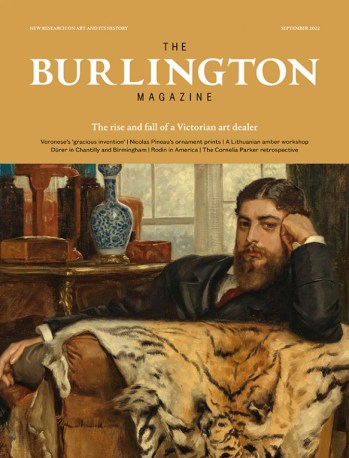
The Burlington Magazine 164 (September 2022)
 E D I T O R I A L
• “A Practical Guide to Restitution,” p. 835.
A R T I C L E S
• Rahul Kulka, “Counter-Reformation Ambers: Friedrich Schmidt’s Workshop in Kretinga, Lithuania,” pp. 839–53.
On the basis of a unique signed and dated domestic altarpiece it has been possible to attribute a significant body of work to the amber workshop of Friedrich Schmiddt, who worked in Kretinga in the seventeenth century. They include a reliquary of St Casimir given in 1678 with other works in amber to Grand Duke Cosimo III of Tuscany by the Bishop-Elect of Vilnius, Mikolajus Steponas Pacas.
• Aurora Laurenti, “Nicolas Pineau as a Designer of Ornament Prints,” pp. 864–73.
Although designs by the woodcarver Nicolas Pineau in publication by Jean Mariette and Jacques-François Blondel played a significant role in the creation and dissemination of the Rococo style in the first half of the eighteenth century, they have never been studied in detail and their sequence and chronology have remained uncertain.
R E V I E W S
• Alison Wright, Review of the exhibition Gold (British Library, 2022), pp. 910–12.
• Philippe Bordes, Review of the exhibition Le Voyage en Italie de Louis Gauffier (Montpellier, 2022) and the catalogue raisonné by Anna Ottani Cavina and Emilia Calbi, Louis Gauffier: Un pittore francese in Italia (Silvana Editoriale, 2022), pp. 915–18.
• Ariane Varela Braga, Review of Dario Gamboni, Jessica Richardson, and Gerhard Wolf, The Aesthetics of Marble: From Late Antiquity to the Present (Hirmer, 2021), p. 934.
• Celia Curnow, Review of J.V.G. Mallet and Elisa Sani, eds., Maiolica in Italy and Beyond: Papers of a Symposium held at Oxford in Celebration of Timothy Wilson’s Catalogue of Maiolica in the Ashmolean Museum (Ashmolean Museum, 2021), pp. 937–38.
• François Marandet, Review of Delphine Bastet, Les Mays de Notre-Dame de Paris, 1630–1707 (Arthena, 2021), pp. 938–40.
• John Bold, Review of Christina Strunck, Britain and the Continent 1660–1727: Political Crisis and Conflict Resolution in Mural Paintings at Windsor, Chelsea, Chatsworth, Hampton Court and Greenwich (De Gruyter, 2021), pp. 940–41.
• Mark Stocker, Review of Matthew Potter, Representing the Past in the Art of the Long Nineteenth Century: Historicism, Postmodernism, and Internationalism (Routledge, 2021), pp. 941–42.
• Yuriko Jackall, Review of Alan Hollinghurst and Xavier F. Salomon, Fragonard’s Progress of Love (Frick Collection, 2022), pp. 945–46.
O B I T U A R I E S
• Tim Knox, Obituary for John Harris (1931–2022), pp. 950–52.
Symposium | Early Modern Global Political Art
From the Krannert Art Museum:
Early Modern Global Political Art
In-person and online, Krannert Art Museum, University of Illinois, Urbana-Champaign, 20–21 October 2022
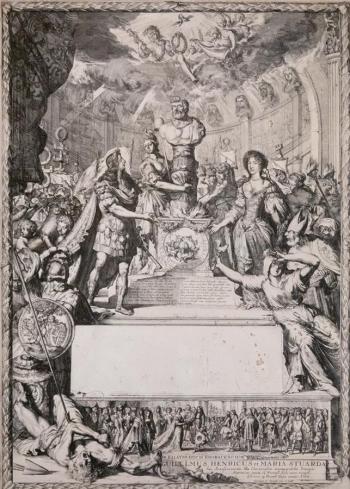
Romeyn de Hooghe, Marriage of William and Mary, 1677, etching (Krannert Art Museum, 2019.7.7).
Featuring emerging scholarship on the art of this period against the backdrop of the exhibition Fake News & Lying Pictures: Political Prints in the Dutch Republic, Krannert Art Museum hosts a symposium on Early Modern Global Political Art.
In the early modern period, nations, nobles, corporations, religious groups, and others found dynamic and innovative ways to use the visual arts for a wide range of political purposes. Nations dispatched elaborate diplomatic gifts to initiate and consolidate alliances. Aristocratic powers and individual collectors alike amassed collections to convey and enhance their political and economic power. Courts and cities produced ephemeral decorations to assert and display ideal political relations between nobility and their subjects, and between regional and outside authorities. Broadsheets addressing factional conflicts within and among institutions proliferated with the expansion of affordable print media. This symposium will investigate visual media that communicated political ideas, arguments, positions, and forms of resistance in the early modern period.
The event will be hybrid, blending in person presentations with online presentations via Zoom to facilitate greater accessibility and wider participation. All virtual components will be live captioned in English via Zoom. If you have a question or an accessibility request, please email us at kam-accessibility@illinois.edu. Registration is required for virtual and in-person components of the symposium.
Keynote Speakers
Dawn Odell (Lewis & Clark College) — Dr. Odell studies artistic exchange between China and northern Europe in the 17th and 18th centuries. She is currently writing a book on Andreas Everardus van Braam Houckgeest, an 18th-century Dutch Immigrant to the newly formed United States whose travelogues and Chinese porcelain collection were leveraged for social and political power.
Liza Oliver (Wellesley College) — Dr. Oliver’s research focuses on 18th- and 19th-century India, Europe, and the West Indies. Her current projects include the book Empire of Hunger: Representing Famine, Land, and Labor in Colonial India and work about British prints about abolition and the Haitian Revolution.
T H U R S D A Y , 2 0 O C T O B E R 2 0 2 2
9.00 Catholic Rulership around the World, Part One
• Moyun Zhou (PhD Candidate, University of Hong Kong), Can You Feel Me? The Global Space of St. Paul’s in Macao, 1592–1644
• Maria Vittoria Spissu (Senior Assistant Professor, University of Bologna and Marie Skłodowska-Curie Global Fellow), Bonds and Tenets in the Wider Iberian Catholic Universe: Fostering Political Unanimity by Means of Early Modern Altarpieces and Books
• Małgorzata Biłozór-Salwa (Curator of Old Master Drawings, University of Warsaw Library), Let’s Make A Crusade! Power of Images Under Louis XIII
10.20 Fashion, Part One
• Isabel Escalera (PhD Candidate, University of Valladolid), Jewelry as A Political Instrument: Renaissance Women and the Transmission of Their Power
• Diana Lucía Gómez-Chacón (Faculty, Complutense University of Madrid), Fashion as A Political Art: Gender, Monarchy, and Spectacle in Early Modern Castile
11.15 Negotiating Political Power in Republics
• Răzvan-Iulian Rusu (Graduate Student, Utrecht University), Global Gifts of Johan Maurits: Patronage, Image-Formation, Art & Material Culture
• Laura Blom (Postdoctoral Fellow, Dutch University Institute for Art History, Florence), Death as Dissent: The Macabre and the Medici in Renaissance Florence
5.30 Keynote Lecture
• Liza Oliver (Associate Professor of Art, Wellesley College), An Economy of Sentiment: The Shared Language of Abolitionists and the West India Interest in Late 18th-Century British Print Culture link»
This talk considers how spectatorial sympathy, a governing principle of 18th-century British art and literature, was deployed by opposing sides of the debate on Britain’s slave trade in the decades preceding its abolition. Considering broadsides, travel narratives, and caricatures, it argues for the ways in which sentiment became a common visual currency among both abolitionists and the pro-slavery lobby, with each side respectively seeking to sever or reaffirm the connection between morality on the one hand and self-interest and economic prosperity on the other.
F R I D A Y , 2 1 O C T O B E R 2 0 2 2
9.30 Coffee
10.00 Catholic Rulership around the World, Part Two
• Rachel Wise (2020 PhD in Art History, University of Pennsylvania), A Royal Devotion: Printed Habsburg Propaganda and the 80 Years’ War
• Angela Ho (Associate Professor, George Madison University), Risks and Payoffs: Ferdinand Verbiest’s World Map for Kangxi in Political Context
11.00 Fashion, Part Two
• Heather Hughes (Curator of Prints, Philadelphia Museum of Art), Recognizing the Enemy: The Spaniard in Dutch and Flemish Costume Prints
• Nancy Karrels (2022 PhD in Art History, University of Illinois Urbana-Champaign), Women for Bonaparte: Political Prints and Female Self-Fashioning in France’s Cultural Conquests
12.00 Lunch Break
1.30 Keynote
• Dawn Odell (Associate Professor of Art History, Lewis & Clark College), The Politics of Personhood in A.E. Van Braam Houckgeest’s China Memoir link»
Following his participation in the Dutch East India Company’s last embassy to the Chinese court (1794–95), A.E. van Braam Houckgeest moved to Philadelphia with an enormous personal collection of Chinese art. This talk explores van Braam’s self-fashioning through his collaboration with two unnamed Guangzhou artists and the French émigré printer and defender of race-based slavery, M.L.E. Moreau de Saint-Méry. The illustrated memoir these men produced places van Braam’s textual narrative within an expansive visual environment of Chinese landscape paintings and other works of Asian art, conjuring artistic presences as testaments to the author’s self-proclaimed virtue, prestige, and republican ideals.
3.00 Tour of Fake News and Lying Pictures: Political Prints in the Dutch Republic
◊ ◊ ◊ ◊ ◊
From the Krannert:
Fake News & Lying Pictures: Political Prints in the Dutch Republic
Krannert Art Museum, University of Illinois, Urbana-Champaign, 25 August — 17 December 2022
Curated by Maureen Warren
 Comedians, editorial cartoons, and memes harness the power of satire, parody, and hyperbole to provoke laughter, indignation—even action. These forms of expression are usually traced to eighteenth-century artists, such as William Hogarth, but they are grounded in the unprecedented freedom of artistic expression in the seventeenth-century Dutch Republic.
Maureen Warren, ed., with contributions by Wolfgang Cillessen, Meredith McNeill Hale, Daniel Horst, Maureen Warren, and Ilja Veldman, Paper Knives, Paper Crowns: Political Prints in the Dutch Republic (Champaign: Krannert Art Museum, 2022), 184 pages, ISBN: 978-1646570294, $40.
Exhibition | Painted Cloth: Fashion and Ritual in Colonial Latin America

From the press release for the exhibition:
Painted Cloth: Fashion and Ritual in Colonial Latin America
Blanton Museum of Art, The University of Texas at Austin, 14 August 2022 — 8 January 2023
The Blanton Museum of Art at The University of Texas at Austin is pleased to present Painted Cloth: Fashion and Ritual in Colonial Latin America, an ambitious and timely show that explores the production, meaning, and representation of fabric and garments as they were experienced in civil and religious settings across Latin America during the 1700s. Painted Cloth features over 70 objects produced in five countries from the Blanton’s growing collection of art of the Spanish Americas, alongside key loans from distinguished institutions and private collections around the world.

Our Lady of Bethlehem with a Donor, Cusco, 18th century, oil with gold leaf on canvas, 105 × 73 inches (Collection of Carl and Marilynn Thoma)
“With the opening of Painted Cloth, we’re thrilled to finally unveil the extraordinary exhibition made possible by our longstanding partnership with the Thoma Foundation, whose investment and belief in the Blanton over the years has strengthened our commitment to the study of art of the Spanish and Portuguese Americas,” said Blanton director Simone Wicha. “Thanks to their support, the work of Rosario I. Granados, the first Marilynn Thoma Associate Curator, Art of the Spanish Americas, has advanced significant scholarship in this still underrepresented era of art history. The elaborate fabrics, fashion, and other richly textured works in this show are not only a feast for the eyes, they also will give our audiences a good look into everyday life during an era of dynamic cultural exchange and show how clothing—then as now—is so intertwined with our identities. Equally beautiful as it is insightful, Painted Cloth is sure to inspire conversations about race and colonialism’s complex legacies and offer a greater understanding of this period in Latin America’s history.”
An unquestionable marker of identity, clothing distills complex relationships between race, gender, religion, and class. Painted Cloth reflects on the social roles of textiles and their visual representations, emphasizing how aesthetic traditions of Indigenous and European origin wove themselves into civil, religious, and artistic life at a time when the Spanish monarchy imposed their rule in the region.
As the title references, the exhibition foregrounds not only beautifully crafted garments and textiles, but also explores how the practice of depicting textiles in paintings, sculptures, prints, and furnishings created a visual artifice that captured their aesthetic, ritual, and commercial value. This interplay between objects and images courses through five visually striking sections: Cloth Making, Wearing Social Status, Dressing the Sacred, The Holiness of Cloth, and Ritual Garments.
“Collectively, these groupings address how cloth and their representation in other media articulated narratives of social privilege and survival of cultural traditions, while also highlighting the mixed identity of colonial Latin America,” said Granados. “Garments are a lens by which we can recognize the many inequalities and societal contradictions that characterized the social fabric of this contested era, which altered the lives of so many Indigenous communities, but also the beauty of the Spanish America’s artistic production and thereby the diverse cultures of its peoples.”

José Joaquin Magón, Two Casta Paintings, ca. 1770.
Cloth Making
Painted Cloth begins with the manufacture and artistry of textiles in the 1700s. Works in the first section on Cloth Making underscore how various kinds of European and Indigenous garments were manufactured, emphasizing the role persons of different social status played in the industry. Included are works from the only series of casta paintings (a Mexican artistic genre that documents mixed-race couples and their children according to a caste system defined by Spanish elites) to prominently showcase women as integral to the production of textile arts, from spinning and weaving wool to their work as seamstress and tailor’s aids. In one example of this series by Mexican painter José Joaquín Magón, a woman makes bobbin lace, a costly material that was commonly imported from Europe and adopted in local attire.
The interlacing of foreign materials and traditions with local practices is also present in a set of silk swatches from Mexico. Sent with official reports to the King of Spain, these rare fabric samples show the production of block-print patterns inspired by textiles from India that signal the presence of highly skilled silk weavers in the New Spanish (Mexican) capital. The Cuzqueña painting Virgen de los Sastres (Virgin of Tailors) gives evidence that tailors, many of whom were of mixed-race descent, produced liturgical vestments made from imported European silks and brocades—examples of which are seen in the last section of the exhibition.
Many of the works in this section also address how Indigenous and Christian notions of the sacred were combined. Christian missionaries in the Andes popularized iconography that linked spiritual devotion with the labor involved in manufacturing cloth, circulating paintings that depicted the Virgin Mary or Holy Family undertaking artistic or industrious activities. By depicting Mary embroidering and spinning, the two paintings La Casa de Nazareth (The House of Nazareth) and La Virgen niña hilando (The Child Mary Spinning) make a connection between Christianity and the Indigenous cultures’ regard for the sacred nature of textiles.
Wearing Social Status

Miguel Cabrera, Doña María de la Luz Padilla y Gómez de Cervantes, ca. 1760, oil on canvas, 43 × 33 inches (Brooklyn Museum).
The second and largest section of the exhibition, Wearing Social Status, explores how fashion codes determined social interactions and collective identities in terms of gender, race, and class. This is particularly visible in Mexican casta paintings and a unique series of Peruvian mestizaje paintings, on view in the U.S. for the first time, as well as in commissioned portraits—an increasingly popular genre in this period. Since few garments from the era have survived, such paintings, although ripe with artifices, serve as an invaluable source for the study of fashion and its social significance.
One of the most memorable features of this section is the pairing of painted garments in portraits with actual garments. Paintings of well-dressed Latin American sitters by Miguel Cabrera, one of the most celebrated and prolific artists of the period, demonstrate a desired social prestige, as evident in the great attention paid to the subject’s dress. These costly dresses and elegant three-piece suits are in dialogue with similar European costumes, illustrating the influence of global trade as well as French fashion.
Clothing is also relevant in the portraits Indigenous elite commissioned to assert noble ancestry. The figure in Inca Noblewoman, notably dressed in an intricate anuca, or women’s dress, resembles the first queen of the Inca dynasty, Mama Occllo. Such motifs and codes of dress establish the sitter’s connection to Inca royalty and, as the inscription makes clear, her status as the first Christian Inca woman. In conversation with this portrait is a late 17th-century camelid wool anacu embroidered with mermaids, Inca queens, and traditional Andean geometric patterns, accompanied by a silver fastening pin known as a ttipqui or tupo incised with the imperial double-headed eagle. These artifacts offer examples of fusing Incan and European motifs to negotiate identity in a colonial environment.
Dressing the Sacred
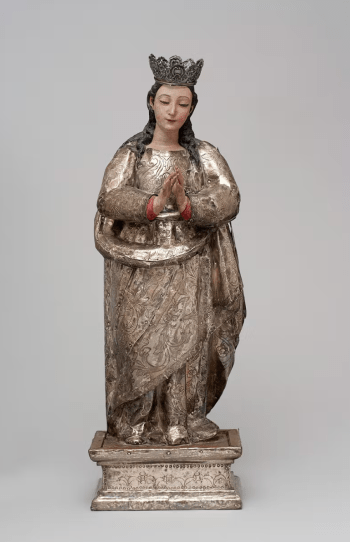
Inmaculada Concepción (Immaculate Conception), Guatemala, ca. 1740–80, silver and oil on wood, 34 inches high (Blanton Museum of Art, The University of Texas at Austin, 2019).
The exhibition’s third section exemplifies how religious material culture enhanced the experience of the holy for all social sectors. The use of fine materials in sacred objects amplified an object’s visual appearance, and with it, its sacred aura, thereby facilitating conversion and enhancing devotional practice. This is particularly true of the fabrics placed on imágenes de vestir, or ‘dress images’. These simple wooden structures were explicitly made to be clothed in rich fabrics, like the satin mantle on view, embroidered in gold and silver threads for a statue of the Virgin Mary.
In other instances, real fabrics were imitated by modeled silver, as in an example of a devotional sculpture from Guatemala, a practice that continues in the Central American country today. Fabrication of reality was likewise achieved by replicating golden embroideries and brocade fabrics using estofado, a technique that involves applying gold leaf to wooden surfaces. In two paintings from the so-called Cusco School, respectively depicting St. Lawrence and St. Jerome, gilded details emphasize the richness of saintly garments.
Brimming with golden brocades, the large painting Nuestra Señora de Belén con un donante (Our Lady of Bethlehem with a Donor) bookends this section. The work, a brilliant example of a verdadero retrato, or ‘true portrait’, depicts the 16th-century cult statue of Our Lady of Bethlehem of Cusco placed on a processional platform. Displayed in a dimly lit gallery that alludes to the painting’s original display, viewers can get a sense of the effect such objects were intended to evoke.

Presentation of the Virgin Mary at the Temple, Cusco, 18th century, oil and gold on canvas, 38 × 52 inches
(Collection of Carl and Marilynn Thoma)
Holiness of Cloth
The fourth section, Holiness of Cloth, illuminates how the actual depiction of fabric was central to images that were believed to be of miraculous nature. Cloth could provide material substance to help elucidate abstract notions of the divine, as in examples from the Cusco School of painting, which introduced Andean renditions of Catholic subjects.
The painting Virgen del Carmen salvando a las almas del Purgatorio (Virgin of Carmel Saving Souls in Purgatory) depicts the Virgin Mary with an open cloak—a familiar iconography across the Spanish Americas that symbolized protection. In a disparate work that renders the iconographic Presentation of the Virgin Mary at the Temple, tunics and mantles are gilded with brocateado, elaborate gold-brocade decoration, a technique characteristic of the Indigenous artistic production of Cusco.
In some cases, cloth becomes the divine itself, such as in Mexican painter José de Alzibar’s two works, united and on display together for the first time in history. The first, a representation of Our Lady of Guadalupe, the national patron of Mexico, depicts the cloak of an Indigenous man where the sacred image was thought to have been miraculously imprinted. The second, La Verónica, depicts the Veil of Veronica, one of the most recognizable images in which cloth is represented as a vehicle for the holy.
Ritual Garments
The final section focuses on the use of fabric in church interiors and ritual ceremonies as well as in the formation of clerical identities. Since much of the material used was extraordinarily delicate, prone to damage and decay, paintings of the era help reconstruct an understanding of the use of cloth.
The hierarchical position of Catholic clergy could be recognized by distinct, standardized liturgical clothing. A small glass painting from Bolivia details the repertoire of garments and accessories worn by priests, bishops, cardinals, and the pope, whereby the particular use of colors functioned as a key signifier of rank. In the case of the chasuble, the outermost vestment worn during the celebration of the Eucharist, four seasonal colors were used to represent the passage of time in the liturgical calendar. Although the chasuble was worn by the lowest rank of priest, the artifact on view from Mexico is crafted in fancy silks and embroidered with silken threads covered in silver and gold.
In the context of the Catholic church, the altar is an important ritual site; in the Spanish Americas it was lavishly decorated, as visual depictions like Misa frente al Cristo de los Temblores (Masses before Christ of the Earthquakes) convey. Like many works that depicted ideal Masses, this painting was created for a private home and painted from the view of a churchgoer to direct focus to the fine textiles and silverware covering the altar. On occasion, a less costly ‘painted cloth’ instead decorated the altar—exemplified by a canvas altar cloth with floral designs that mimic actual textiles. In contrast, a Guatemalan processional banner created entirely from silver emphasizes the use of even valuable materials to imitate cloth and create visual artifice.
 “Painted Cloth rejoices in the artifice of the visual arts to uncover the complexities of human nature,” concluded Granados. “Together, I hope these stunning artworks and artifacts encourage reflection on values of the past and shed new light on the factors that have shaped contemporary Latin American experience.”
The exhibition includes works from the Blanton’s collection, including from the recently acquired Huber Collection, and loans from: Benson Latin American Collection, The University of Texas at Austin; Brooklyn Museum of Art, New York; Carl & Marilynn Thoma Collection, Chicago and Santa Fe, NM; Colección Andrés Blaisten, Mexico City; Colección Barbosa Stern, Lima; Denver Art Museum; Hispanic Society of America, New York; Museo Franz Mayer, Mexico City; Museo de Arte de Lima; Museo Pedro de Osma, Lima; Museo de América, Madrid; Museo Nacional de Antropología, Madrid; Los Angeles County Museum of Art; San Antonio Museum of Art; Witte Museum, San Antonio.
Rosario Inés Granados, ed., Painted Cloth: Fashion and Ritual in Colonial Latin America (Austin: University of Texas Press, 2022), 248 pages, ISBN: 978-1477323977, $45. With contributions by Granados, Ana Paulina Gámez Martínez, Julia McHugh, Ricardo Kusunoki Rodríguez, Patricia Díaz Cayeros, and Maya Stanfield-Mazzi.
Exhibition | Canova: Sketching in Clay
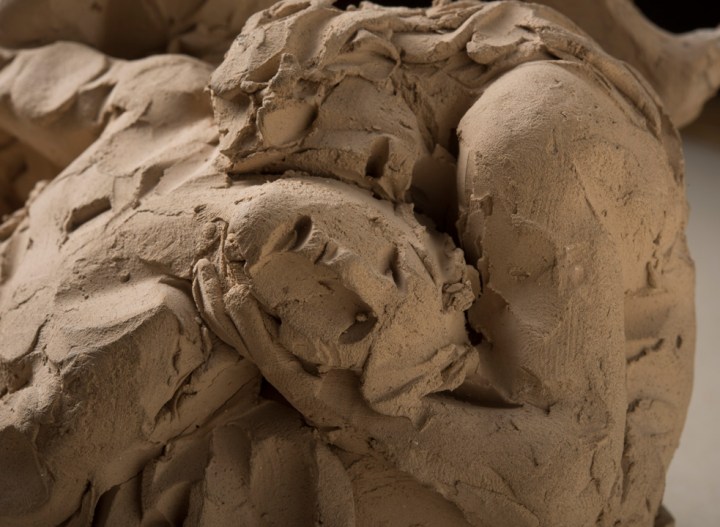
Antonio Canova, Adam and Eve Mourning the Dead Abel, detail of Eve and Abel, ca. 1818–22, terracotta
(Possagno: Museo Gypsotheca Antonio Canova; photograph by Tony Sigel)
◊ ◊ ◊ ◊ ◊
Antonio Canova, at age 64, died on this day (13 October) 200 years ago; his clay models are the subject of a major exhibition opening in June. From the NGA:
Canova: Sketching in Clay
National Gallery of Art, Washington, DC, 11 June — 9 October 2023
Art Institute of Chicago, 19 November 2023 — 18 March 2024
Curated by C. D. Dickerson and Emerson Bowyer
How does a sculptor turn an initial idea into a finished work of marble? For Antonio Canova (1757–1822), the most famous artist of Europe’s revolutionary period, the answer was with clay. Working with his hands and small tools, Canova produced dazzling sketch models in clay, which helped him plan his designs for his large statues in marble. Imprinted with the fire of his imagination, these sketches were boldly executed in mere minutes. Canova also made more finished models, sensuous in their details, that he showed to patrons or used as guides for carving. Approximately 40 of the some 60 of his surviving models reveal the artist’s extraordinary working process—a process that led to the creation of some of the most iconic works in the history of sculpture.
Canova: Sketching in Clay is organized by the National Gallery of Art, Washington and The Art Institute of Chicago. The exhibition is curated by C. D. Dickerson, curator and head of sculpture and decorative arts, National Gallery of Art, and Emerson Bowyer, Searle Curator, Painting and Sculpture of Europe, The Art Institute of Chicago.
C. D. Dickerson and Emerson Bowyer, with contributions by Anthony Sigel and Elyse Nelson, Canova: Sketching in Clay (New Haven: Yale University Press, 2023), 280 pages, ISBN: 978-0300269758, $65.
◊ ◊ ◊ ◊ ◊
Note (added 12 June 2023) — The original posting was updated to include information on the catalogue, which was published 6 June 2023.
Exhibition | Maria Hadfield Cosway
Now on view at the Fondazione Maria Cosway in Lodi, in the nineteenth-century rooms of the Collegio delle Grazie, the girls’ school that Cosway founded in 1812 (with additional information available here) . . .
Maria Hadfield Cosway
Fondazione Maria Cosway, Lodi, 23 September — 27 November 2022
Curated by Monja Faraoni and Laura Facchin with Massimiliano Ferrario and Maria Cristina Loi
 Oltre cinquanta opere tra dipinti, lettere, spartititi musicali e sculture che ripercorrono la vita di Maria Hadfield Cosway (1760–1838) sono esposti a Lodi nella mostra a lei dedicata visitabile fino al 27 novembre.
Il visitatore sarà accompagnato nel percorso da pannelli esplicativi e didascalie che mettono in luce le fasi essenziali della biografia dell’artista e filantropa, nonché i personaggi e gli eventi della “Grande Storia” che segnarono le diverse fasi della sua vita. L’artista e donna di cultura è molto nota sia a Londra che negli Stati Uniti d’America per la sua amicizia con Thomas Jefferson, terzo Presidente USA. Un periodo della sua vita lo trascorse anche a Lodi, dove morì nel 1838.
La sua profonda convinzione nell’importanza dell’educazione per i giovani portò Maria Cosway ad aprire proprio a Lodi, nella sede dell’ex convento dei padri Minimi, il collegio della Beata Vergine Maria delle Grazie, destinato alle bambine dai 6 ai 12 anni, che ospiterà anche Vittoria Manzoni.
La mostra è stata organizzata dalla Fondazione Maria Cosway e vede la collaborazione di diverse realtà locali tra cui due istituti lodigiani, il liceo artistico Callisto Piazza e la Fondazione Luigi Clerici. Studenti ed insegnanti sono stati coinvolti nella creazione del catalogo e dell’allestimento delle diverse tappe dell’esposizione, visitabile presso la sede della Fondazione di via Paolo Gorini 10.
Monja Faraoni, Laura Facchin, Massimiliano Ferrario, and Maria Cristina Loi, eds., Maria Hadfield Cosway (Lodi: Fondazione Maria Cosway, 2022), 444 pages, ISBN: 979-1280950208.
S O M M A R I O
Presentazioni istituizionali
Maria Cosway tra Firenze, Londra, Parigi e Lodi: Le Ragioni della Mostra
• L’educazione in età napoleonica — Mario Riberi
• Maria Cosway in London, 1780–1790 and 1794–1801 — Stephen Lloyd
• ‘I am susceptible and everything that surrounds me has great power to magnetise me’: Maria Cosway e l’ambiente romantico — Massimiliano Ferrario
• Maria Cosway et l’ambiente artistico-letterario femminile fra la fine dell’Antico Regime e la Restaurazione — Laura Facchin
• Maria Cosway, Leonardo e Giuseppe Bossi: fra teorie artistiche e appunti figurativi — Rosalba Antonelli
• La musica nella vita e nel progetto educativo di Maria Cosway — Patrizia Fiorio
• Una storia ancora da raccontare: la biblioteca della Fondazione Maria Cosway — Francesco Laghezza e Beatrice Porchera
• La moda nella Parigi et nella Milano di Maria Cosway — Silvia Mira
• La vita di Blevio — Laura Facchin e Massimiliano Ferrario
• Un titolo nobitare per Maria Cosway — Luca Marcarini
• Gaetano Manfredini: ‘volente scultore pei quale l’ingiusta sorte non ha benigni sorris!’ e l’eterno volto di Maria Cosway — Beatrice Bolandrini
Catalogolo delle opere
Maria Cosway et gli Stati Uniti, a cura di Maria Cristina Loi
• ‘But that immense sea, makes it a great distance’: note sui carteggio Maria Cosway–Thomas Jefferson — Maria Cristina Loi
• Thomas Jefferson and Maria Cosway in Paris: art and affection — Susan R. Stein
Catalogo delle opere
L’allestimento della mostra Maria Hadfield Cosway — Elena Amoriello, Luca Armigero, Annalisa Aversa, Maria Teresa Carossa, Chiara Lupi, Susanna Marinoni e Angela Mento
Bibliografia
Indice dei nomi
Credit fotografici
Exhibition | Vive le Pastel!
On view for a few more weeks at the Alte Pinakothek:
Vive le Pastel! Pastel Painting from Vivien to La Tour / Pastellmalerei von Vivien bis La Tour
Alte Pinakothek, Munich, 7 May — 23 October 2022
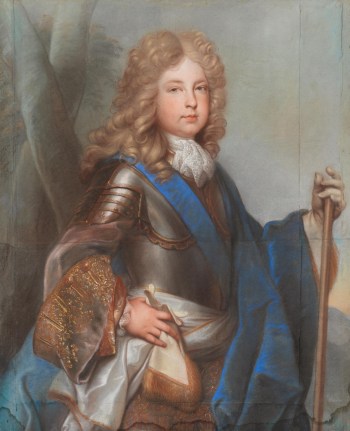
Joseph Vivien, Portrait of Charles, Duke of Berry (1686–1714), 1700, pastel on paper, 100 × 81 cm (Staatsgalerie im Neuen Schloss Schleißheim).
Often seen in art galleries or palaces, in magnificent ornamental frames and behind glass, their powdery surface making them seem as delicate as they are exquisite: pastels. They enjoyed considerable popularity in the 18th century when many works were created, especially in France. The colours are applied dry, using pastel sticks and covering the whole surface. The pastel painting technique was frequently used for lively, sensitively composed portraits in particular. But what are the reasons for the technique’s blossoming at the time? What advantages did pastels have over oil paintings? Who had their portraits painted in pastel? And how exactly were pastels created? These questions are explored in this special exhibition presented by the Bayerische Staatsgemäldesammlungen at the Alte Pinakothek.
The focus is on the two collections’ own holdings, in which such important names as Joseph Vivien, Maurice Quentin de La Tour, Rosalba Carriera, and Jean-Étienne Liotard are represented. For the first time pastel paintings from the Alte Pinakothek are shown together with those from the state gallery in Neues Schloss Schleißheim. In addition, some rarely displayed works from the depot by anonymous artists, as well as a few selected loans are also exhibited. This unique combination of works makes it possible to compare artists and their approaches and invites visitors to discover the variety of different effects realised in these works.
 There are two further reasons for this exhibition. Generous support provided by the Corona Fund of the Ernst von Siemens Kunststiftung has made it possible for urgently needed conservation and restoration work to be carried out on the Schleißheim pastels by a specialist. As a result, and due to examinations being carried out as part of a current research project on the French paintings, the works are temporarily in Munich. Before their return to the gallery in Schleißheim the opportunity is being taken to exhibit them in the Alte Pinakothek and, as such, within a larger context. At the same time, the presentation also celebrates a new acquisition—Portrait of Jean-Baptiste Philippe by Maurice Quentin de La Tour—donated by Mr Fritz Lehnhoff as a loan from the Museumsstiftung zur Förderung der Staatlichen Bayerischen Museen, that entered the collection in 2021.
A guide to the collection, covering the complete holdings of pastels from the late 17th and 18th centuries in the Bayerische Staatsgemäldesammlungen, accompanies the exhibition.
Elisabeth Hipp, ed., with an introduction by Bernhard Maaz and contributions by Bernd Ebert, Ulrike Fischer, Elisabeth Hipp, Xavier Salmon, and Herbert Rott, Pastellmalerei vor 1800 in den Bayerischen Staatsgemäldesammlungen (Berlin: Deutscher Kunstverlag, 2022), 136 pages, ISBN: 978-3422989009, 15€.
Exhibition | The Eveillard Gift
From The Frick:
The Eveillard Gift
The Frick Madison, New York, 13 October 2022 — 26 February 2023
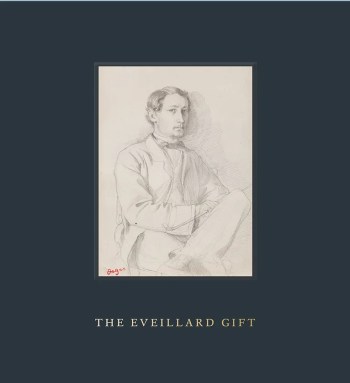 In the summer of 2021, The Frick Collection announced the largest and most significant acquisition of drawings and pastels in its history, the generous promised gift of Elizabeth ‘Betty’ and Jean-Marie Eveillard. This promised gift of twenty-six works (eighteen drawings, five pastels, two prints, and one oil sketch) has inspired the museum’s major fall 2022 exhibition, which will be accompanied by a lavishly illustrated catalogue and complementary public programs.
Over the past forty-five years, the Eveillards have assembled an outstanding collection of works on paper, ranging in date from the end of the fifteenth century to the twentieth century and representing artists working in France, Britain, Italy, Spain, the Netherlands, and the United States. The Eveillards’ landmark promised gift draws upon some of their finest European acquisitions. Along with preparatory figurative sketches, independent studies, and portraits are two vivid landscape scenes. Fittingly for the Frick, artists represented in the gift include François Boucher, Edgar Degas, Jean-Honoré Fragonard, Francisco de Goya y Lucientes, Thomas Lawrence, and Jean-François Millet. The group also introduces to the Frick’s holdings works by artists not previously represented in the museum’s permanent collection, including Gustave Caillebotte, Maurice Quentin de La Tour, Jan Lievens, John Singer Sargent, and Elisabeth Vigée Le Brun.
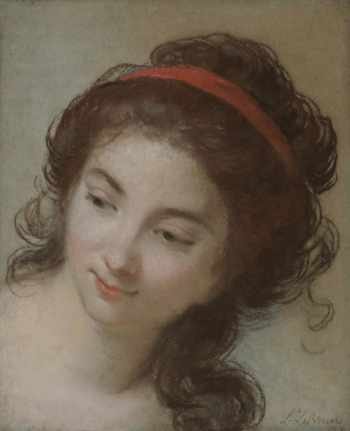
Elisabeth Vigée Le Brun, Head of a Woman, 1784, pastel on paper, 12 × 10 inches (New York: Frick Collection, promised gift from the Collection of Elizabeth and Jean-Marie Eveillard; photo by Joseph Coscia Jr.).
Each of the twenty-six works—selected for their beauty, quality, and condition—either appreciably deepens the Frick’s current holdings of familiar artists or brings to the institution a work by an artist who is not—but should be—represented within the museum’s core areas of European Old Master art. In adding five pastels and an oil sketch, the gift also strengthens the Frick’s holdings in these media. Betty and Jean-Marie Eveillard have been deeply involved with the Frick for many years, both having served as Trustees. Betty is currently the Board’s Chair.
Giulio Dalvit, Aimee Ng and Xavier F. Salomon, The Eveillard Gift (London: Paul Holberton Publishing, 2022), 168 pages, ISBN: 978-1913645281, £35 / $45.
Giulio Dalvit is the Frick’s Assistant Curator of Sculpture. He is a specialist of fifteenth-century Italian sculpture and painting, but his publications also span modern and contemporary art. Dalvit has held various lecture and research positions, most recently as an Associate Lecturer at the Courtauld Institute of Art, London.
Aimee Ng is a Curator at the Frick, where she is a specialist in Italian Renaissance art. She has held academic and curatorial and positions at Columbia University and the Morgan Library & Museum, where, before joining the Frick, she served as Post-Doctoral Fellow at the Morgan’s Drawing Institute.
Xavier F. Salomon is the Frick’s Deputy Director and Peter Jay Sharp Chief Curator. A noted scholar of Paolo Veronese, he has curated many exhibitions and written or contributed to countless publications. Previously, he was Curator in the Department of European Paintings at the Metropolitan Museum of Art and, before that, the Arturo and Holly Melosi Chief Curator at Dulwich Picture Gallery.
Exhibition | A Splendid Land: Paintings from Royal Udaipur

Sunrise in Udaipur, ca. 1722–23, detail (Udaipur: The City Palace Museum, The Maharana of Mewar Charitable Foundation, 2012.20.0015).
◊ ◊ ◊ ◊ ◊
From the press release (29 August) for the exhibition:
A Splendid Land: Paintings from Royal Udaipur
Sackler Gallery, National Museum of Asian Art, Washington DC, 19 November 2022 — 14 May 2023
Cleveland Museum of Art, 11 June — 10 September 2023
Curated by Debra Diamond and Dipti Khera
The National Museum of Asian Art, in collaboration with The City Palace Museum in Udaipur, presents A Splendid Land: Paintings from Royal Udaipur, an exhibition that brings together 63 works on paper, cotton, and scrolls from collections across the world to reveal how artists sought to convey the sensory and lived experience of the lake city of Udaipur in Rajasthan, India. Many of the paintings have never been publicly exhibited or published. Curated by Debra Diamond (Elizabeth Moynihan Curator for South Asian and Southeast Asian Art at the National Museum of Asian Art) and Dipti Khera (associate professor at New York University), A Splendid Land will be on view in the museum’s Arthur M. Sackler Gallery. It is the first in a series of exhibitions that celebrate the National Museum of Asian Art’s centennial in 2023.
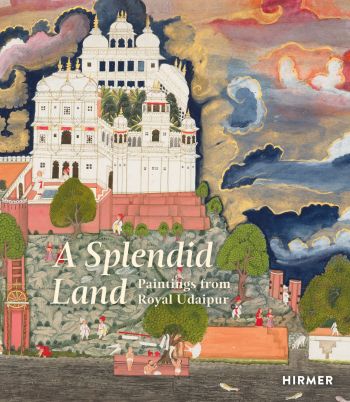 In the 18th century, the artists of Udaipur shifted their focus from small poetic manuscripts to large-scale paintings of the city’s palaces, lakes, mountains, and seasons. They sought to convey the bhava, the emotional tenor and sensorial experiences, that make places and times memorable. This was unlike anything else in Indian art. The paintings express themes of belonging and prosperous futures that are universal. A Splendid Land explores the environmental, political, and emotional contexts in which the new genre emerged. Udaipur’s economy depended on annual monsoons, extensive water harvesting, and securing the loyalty of nobles and allies. By celebrating regional abundance and courtly refinement, the paintings strengthened friendships in the changing political landscapes of early modern South Asia.
“The National Museum of Asian Art has a rich history of connecting visitors with South Asian arts and cultures,” said Chase Robinson, Dame Jillian Sackler Director of the Arthur M. Sackler Gallery and Freer Gallery of Art. “Built upon a long-standing collaboration with Indian colleagues, the exhibition will allow the museum to bring extraordinary but little-known pieces to a global audience, enriching its understanding of a fascinating moment in India’s past.”
The National Museum of Asian Art has more than 1,200 objects in its South Asian collections. Sculpture, paintings, and manuscripts illuminate the subcontinent’s many religious and courtly traditions; photography is at the center of the contemporary Indian holdings. A Splendid Land includes 13 paintings from the National Museum of Asian Art; paintings from Udaipur are a strength of the collection.
The artworks featured in the exhibition reveal how painters developed a new genre centered upon the lived experience of local landscapes, lake systems, and palaces. The atelier became an incubator; over some 200 years, artists found ever-new ways to evoke ambience, trigger memories, and create feelings of connection. This departure in subject matter differs from the body-focused visual traditions of Indian art over two millennia. A Splendid Land is the first exhibition to examine closely this shift and how it expands people’s understanding of emotions and sensorial experience, as well as climate and natural resource management, in early modern India.
A Splendid Land is organized as a journey that begins at Udaipur’s center and continues outward: first the lakes and lake palaces, then to the city, the countryside, and finally to the cosmos. An ambient soundscape by the renowned experimental filmmaker Amit Dutta (b. 1977, Jammu, India) underscores the sensorial elements in the paintings, inviting contemporary audiences to sense—and not just see—the moods of these extraordinary places and paintings. The installation will include 51 works on paper (roughly 3 feet by 4 feet), five monumental works on cotton (ranging in height from 5 feet to 10 feet), one scroll (9 feet in length) from the 17th through 19th centuries, and six photographs from the 19th and 20th centuries.
“The exhibition structure directly responds to the visuality of the paintings and the historical goals of the artists,” said Diamond, who is a specialist in Indian court painting. “Each gallery centers upon the emotions engendered by a particular place or season. The sequence of immersive moods will heighten the sensorial experience of place for museum visitors. I am grateful to the City Palace Museum for their partnership on this exciting project that allows our visitors to get a sense of Udaipur and its cultural heritage, and to co-curator Dipti Khera, whose groundbreaking work on historical emotions is central to the exhibition.”
Debra Diamond has curated numerous exhibitions with the National Museum of Asian Art, including Garden & Cosmos (2008–09), Yoga: The Art of Transformation (2013–14), and Body Image: Arts from the Indian Subcontinent, currently on view in the museum’s Freer Gallery of Art. Dipti Khera, associate professor in New York University’s Department of Art History and Institute of Fine Arts, has published extensively, foregrounding art that challenges colonial perspectives and global histories of the 18th and 19th centuries.
A Splendid Land will be accompanied by a robust program of public events, most notably a public symposium on the monsoon, past and present, and the ways that art reveals cultural attitudes towards natural resources and speaks to climate crises in South Asia that will bring perspectives of the past together with insights of the future. Additionally, the traditional Rajasthani music band Raitila Rajasthan will present Music of Splendid Land, featuring songs inspired from themes of Udaipur paintings showcased at the exhibition.
A Splendid Land: Paintings from Royal Udaipur is organized by the Smithsonian’s National Museum of Asian Art in collaboration with The City Palace Museum, Udaipur administered by The Maharana of Mewar Charitable Foundation.
Debra Diamond and Dipti Khera, eds., A Splendid Land: Paintings from Royal Udaipur (Munich: Hirmer Verlag, 2022), 400 pages, ISBN: 978-3777439440, $60.










 Enfilade
leave a comment