Exhibition | The Key to Life: 500 Years of Mechanical Amusement

From the press release (30 May 2022) from the Staatliche Kunstsammlungen Dresden:
The Key to Life: 500 Years of Mechanical Amusement
Kunsthalle im Lipsiusbau, Dresden, 3 June — 25 September 2022
Automatons, androids and robots—they now dominate our professional and private environments and are expressions of the human desire to create artificial life. The Mathematisch-Physikalischer Salon and the Museum für Sächsische Volkskunst and Puppentheatersammlung of Staatliche Kunstsammlungen Dresden (SKD) are presenting roughly 70 of these artefacts in the exhibition The Key to Life: 500 Years of Mechanical Amusement on view from 3 June to 25 September 2022 in the Kunsthalle im Lipsiusbau.
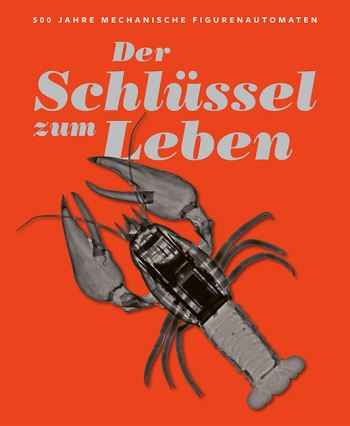 For the first time, the SKD is showing the full range of its unique collection of mechanical figurines and amusements in one exhibition, supplementing them with constructions of artificial life. Beside the unique wealth of mechanical objects spanning from the Renaissance to the present day from the inventory of the Mathematisch-Physikalischer Salons, the Grünes Gewölbe, and the Puppentheatersammlung, the exhibition also features selected loans from the Bayerisches Nationalmuseum, the Maximilianmuseum in Augsburg, and the Roentgen-Museum Neuwied, among others. Through several exhibition chapters on the mechanical figurines and tableaux from the period around 1600, 18th-century-androids and mechanical amusements in the 19th century, to the nickelodeons and slot machines of the early 20th century and contemporary moving art, the exhibition showcases how the mechanical has fascinated people for 500 years.
The items on display include complicated mechanical tableaux from the late 16th century that feature not only agile figurines and playing drummers, but also movements on the tableau itself. A fur-covered bear beats its drum every hour on the hour. The replica ‘iron hand’ of knight Götz von Berlichingen is an excellent example of early modern prosthetics. Contemporary research is also represented: the prototype ‘mika²’ from Dresden University of Technology’s historical acoustic and phonetic collection is a mechanical simulation of the main parts of the human vocal tract, which was developed at the Chair of Speech Technology and Cognitive Systems. The exhibition’s interactive design allows visitors to bring the amusements to life themselves and understand their movements. There will be a varied program of tours and workshops, including some during the school holidays and the Dresden Night of Museums.
Peter Plaßmeyer, Hagen Schönrich and Igor A. Jenzen, eds., Der Schlüssel zum Leben: 500 Jahre mechanische Figurenautomaten (Dresden: Sandstein Verlag, 2022), 224 pages, ISBN: 978-3954986828, €38.
The Burlington Magazine, May 2022
The eighteenth century in the May issue of The Burlington . . .
The Burlington Magazine 164 (May 2022)
 E D I T O R I A L
• “The Rustat Memorial,” p. 443.
When the statue of Edward Colston was defaced and thrown into Bristol harbour on 7th June 2020 the resulting publicity was so enormous that it seemed likely that a wholesale assault on memorials to men who took part in the slave trade or were racist would inevitably follow. In fact, remarkably little has happened. . . .
Little more has been done in the case of church monuments. . . . Only one such case is outstanding, an application by St Peter’s church, Dorchester, to move a late eighteenth-century wall memorial to the slave owner John Gordon from the church to Dorchester Museum. If such an application is contested the matter is referred to the judgment of a diocesan Chancellor in a Consistory Court. This was the result of the ecclesiastical case that has attracted most attention, the application by the Master and governing body of Jesus College, Cambridge, to remove the monument to Tobias Rustat (1608–94) from the college chapel, which was opposed by a group of former members of the college. The case was heard in February by David R. Hodge, Deputy Chancellor of the Diocese of Ely, who in March dismissed the application. Last month the college announced that it would not appeal against his decision. . .
A R T I C L E S
• Antoinette Friedenthal, “Prince Eugene of Savoy’s Rembrandt Drawings: A Newly Discovered Provenance,” pp. 450–61.
• Pascal-François Bertrand and Charissa Bremer David, “Paintings in Beauvais Tapestry, 1764–67,” pp. 462–72. In 1764, at a time when the Royal Tapestry Manufactory at Beauvais was short of work, its directors, Laurent and André Charlemagne Charron, initiated the weaving of small tapestry panels based on designs by François Boucher. Intended as inexpensive, independent works of art, they were in essence a short-lived marketing venture. Records of their weaving in the firm’s payment registers allow a number of surviving examples to be identified.
• Sofya Dmitrieva, “Carle Van Loo at the 1737 Salon,” pp. 473–77. Although not pendants in the traditional sense, since they were painted for different patrons, it is argued here that Carle Van Loo’s A Pasha Having His Mistress’s Portrait Painted and The Grand Turk Giving a Concert to His Mistress, shown at the Salon of 1737, were meant to be read as a pair|—as portraits of the artist and his wife and as allegories of Painting and Music. By linking the paintings, Van Loo, may have intended them to make a statement on the changing relations between art and patronage.
R E V I E W S
• Duncan Robinson, Review of Susan Sloman, Gainsborough in London (Modern Art Press, 2021), pp. 478–85.
• Satish Padiyar, Review of the exhibition Jacques-Louis David: Radical Draftsman (The Metropolitan Museum of Art, 2022), pp. 492–95.
• Kee Il Choi, Jr., Review of the exhibition Inspiring Walt Disney: The Animation of French Decorative Arts (The Metropolitan Museum of Art, The Wallace Collection, and The Huntington, 2022–23), pp. 504–07.
• Camilla Pietrabissa, Review of the re-installation of seventeenth- and eighteenth-century Venetian paintings at the Gallerie dell’Accademia in Venice (from August 2021), pp. 507–09.
• Stefania Girometti, Review of Joachim Jacoby, Städels Erbe: Meisterzeichnungen aus der Sammlung des Stifters (Sandstein Verlag, 2020), pp. 529–30. Comprehensive analysis of “the collection of drawings assembled by Johann Friedrich S (1728–1816), the founder of the art institute and museum in Frankfurt that bears his name.”
• Christoph Martin Vogtherr, Review of the exhibition catalogue Watteau at Work: La Surprise (Getty, 2021), pp. 530–31.
• Hugo Chapman, Review of Cristiana Romalli, Cento Disegni dalla Collezione della Fondazione Marco Brunelli (Ugo Bozzi, 2020), pp. 531–32.
Exhibition | Indian Textiles: 1,000 Years of Art and Design

Fragment of chintz, coastal southeast India, 1700–30, made for a Dutch market but found in Japan (Washington, DC: The George Washington University Museum and the Textile Museum, T-2864; Bruce M. White Photography).
◊ ◊ ◊ ◊ ◊
Closing this week at The Textile Museum at The George Washington University (with videos of past programming and the catalogue still available) . . .
Indian Textiles: 1,000 Years of Art and Design
The Textile Museum, The George Washington University, Washington DC, 22 January — 4 June 2022
Vibrant textiles have long been synonymous with Indian culture. Their distinctive abstract, floral, and figurative patterns have inspired countless variations. Featuring masterworks from The Textile Museum Collection and the private collection of Karun Thakar, this major exhibition and accompanying publication showcase court weavings, folk embroideries, and other fabrics from the eighth through the early 20th centuries.
 The Indian subcontinent is home to some of the world’s most ancient and illustrious textile traditions. Over the centuries, Indian textile artists have developed an enduring design vocabulary—from simply woven stripes to floral motifs to complex narrative scenes. Indian Textiles: 1,000 Years of Art and Design presents a stunning array of fabrics patterned with India’s most distinctive designs: abstract, floral, and figurative.
Some of the region’s oldest known textiles feature abstract patterns such as circles, stripes, and zigzags. Examples in the exhibition range from a fragment of a block-printed cloth traded to Egypt around the 15th century to intricately embroidered dresses made in present-day Pakistan’s Swat Valley in the 1800s and 1900s.
Floral patterns in Indian textiles became increasingly widespread in the 13th century, and artists excelled in adapting them for global markets. Embroidered caps from Bengal, for example, were fashionable ‘at home’ wear in 18th-century Europe; a man would often don one in the evening after removing his wig.
Figurative patterns provide a window into different religious beliefs across South Asia. A 15th-century narrative cloth from Gujarat depicts deities and other figures central to the Jain religion. A shrine cloth from Uttar Pradesh honors Sayyid Salar Mas’ud, a Muslim warrior-saint venerated by Muslims and Hindus alike.
The exhibition is accompanied by a gallery guide and a catalogue.
Karun Thakar, Rosemary Crill, Steven Cohen, Avalon Fotheringham, and Sylvia Houghteling, Indian Textiles: 1,000 Years of Art and Design (London: Hali Publications, 2021), 391 pages, ISBN: 978-1898113966, $80.

Installation view of Indian Textiles: 1,000 Years of Art and Design at the George Washington University Museum and the Textile Museum, featuring on the back wall (center, top) a ceremonial cloth crafted in India for Indonesian buyers; late 18th or 19th century, Karun Thakar Collection (Dave Scavone/The George Washington University Museum and the Textile Museum).
Exhibition | Luis Paret (1746–1799)

Luis Paret y Alcázar, The Shop of Geniani, 1772, oil on panel, 49 × 57 cm
(Madrid: Museo Lázaro Galdiano)
◊ ◊ ◊ ◊ ◊
Now on view at the Prado:
Paret
Museo Nacional del Prado, Madrid, 24 May — 21 August 2022
Curated by Gudrun Maurer
In the words of Javier Solana, President of the Royal Board of Trustees of the Museo Nacional del Prado: “Luis Paret is possibly the 18th-century Spanish artist who most deserved a major exhibition of the type now opening at the Museo del Prado.” With the invaluable collaboration of private and public lenders and the support of Fundación AXA, the Prado has thus reunited most of the artist’s known paintings. They include Masquerade, The Puerta del Sol, Paret’s Daughters, View of Bermeo, and The Annunciation to Zacharias, in addition to a remarkable group of drawings such as Hannibal at the Temple of Hercules in Cadiz and The Oath of Allegiance to don Fernando as Prince of Asturias, which together allow for an appreciation of the richness and variety of a painter alert to the changes of his day and one characterised by a remarkable originality and versatility.
In this first monographic exhibition on Paret organised by the Prado, Gudrun Maurer, the museum’s Curator of 18th-century Painting and Goya and the curator of the exhibition, has surveyed Paret’s professional career with the aim of singling out the excellent technical level and striking originality with which the artist depicted his chosen subjects while also presenting the new information on Paret’s working method obtained from the scientific analysis of his paintings undertaken by the Museum’s technical department.
The exhibition offers a complete survey of Paret’s career and is divided into nine sections. The first provides a unique opportunity to compare a key drawing from his early period with the first documented painting by his celebrated fellow-Spaniard Francisco de Goya, who, like Paret, was born in 1746. The two artists started their careers (Paret in fact five years before Goya) after being singled out in competitions organised by different Fine Arts Academies: Paret by the Academia de San Francisco in Madrid and Goya by the one in Parma, Italy. Those two works which brought the artists recognition—both, in fact on the subject of Hannibal—are now on display in the exhibition, one loaned from the Academia de San Fernando and the other in the Prado’s collection. In general, the two paintings reveal the importance of both academic competitions and the period of training in Italy for artists’ careers. The comparison with Goya also emphasises Paret’s notable technical and compositional skills at this early date while the marked artistic personalities of the two artists are evident in the different styles of their works.
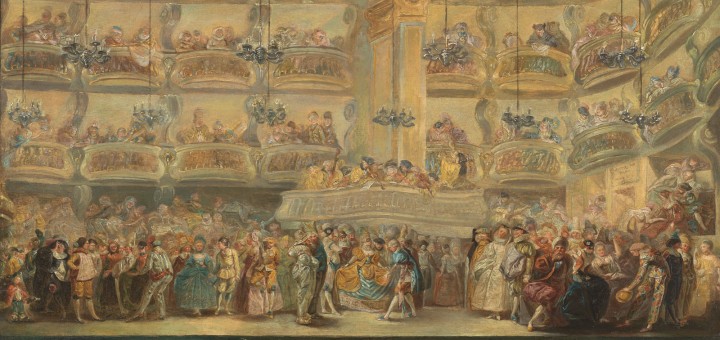
Luis Paret y Alcázar, Masquerade, detail, ca. 1767, oil on panel
(Madrid, Museo Nacional del Prado)
◊ ◊ ◊ ◊ ◊
The next section starts with a small group of early drawings by Paret from the collection of the Prado and the Biblioteca Nacional de España. They reveal the artist’s originality in his inventive and versatile approach to the subjects and the modernity of his choices. Subjects include The Necromancer, The Glory of Anacreon, and Roman Military Trophy. The principal work in this room is one of Paret’s earliest known paintings, Masquerade of 1767 from the Prado’s collection. It once again reveals Paret’s modernity in the context of his time, as an artist who from the outset was able to respond to the new demand for images of society in the public and private space and which reflected the varied fashions and customs of the different social classes. Displayed here are other small-format cabinet paintings on innovative subjects in the context of Spanish art of this period, such as Scene of a Boudoir (previously Play Rehearsal) from the Prado; The Letter from the Musée Goya in Castres; Geniani’s Shop from the Museo Lázaro Galdiano; and The Puerta del Sol from the Museo Nacional de Bellas Artes de Cuba. In addition, paintings on rarely depicted episodes from life at the Spanish court, such as The Royal Couples and Charles III dining before the Court (both in the Prado), offer a panoramic view of different facets of contemporary society and also demonstrate the success Paret enjoyed between 1766 and 1775, the year he was exiled.

Luis Paret y Alcázar, Zebra, 1774, Black pencil, gouache brush and opaque pigment gouache (Madrid: Museo Nacional del Prado).
The third section presents one of the artist’s exquisite coloured drawings of birds alongside Zebra from the Prado’s collection and a private collection respectively, works executed by Paret for the Natural History Cabinet of the Infante don Luis, Charles III’s brother, who appointed Paret his painter in 1774. They reveal the artist’s ability to combine an almost scientific depiction of his subjects with landscape settings of great subtlety and refined beauty.
The fourth section focuses on Paret’s few known portraits, which are notable for their exquisite technique and personal, intimate nature. They also mark the transition between the artist’s Madrid phase and his years in Bilbao. The four known Self-portraits of around 1770–75 to 1780 reflect the painter’s powerful, self-confident personality but also his different states of mind. This is evident during his exile in Puerto Rico when he portrayed himself not just as a jíbaro or local peasant in 1776 but also in the melancholy Self-portrait in the Studio of 1777 which Paret sent to a trusted individual in Madrid, as the inscription detected by the recent X-radiograph reveals. Shown alongside these works are other portraits such as those of the artist’s wife and their daughters, compositions enhanced by complex floral ornamentation; a portrait of a typical Enlightenment gentleman (on loan from the Real Academia de Bellas Artes de San Fernando); and that of Antonio Sancha from the Biblioteca Nacional de España. Finally, there are compositions on the theme of motherhood, such as the small painting of The Virgin and Child from the Abelló Collection, The Orange Seller from Patrimonio Nacional, and the two floral bouquets from the Prado. Flowers were an enormously important motif in Paret’s work and one that reveals the virtuosity characteristic of all the paintings in this section.
The fifth section opens with a painting of The Circumspection of Diogenes which Paret sent from Bilbao in 1780 to the Real Academia de Bellas Artes de San Fernando and which led to his nomination as an Academician of Merit. His subsequent enhanced reputation is evident in the large-format religious compositions that he executed in Bilbao, such as The Invention of the True Cross painted for the Gortázar family and their family chapel (private collection) and The Martyrdom of Saint Lucy for the parish church of Santa María in Larrabezúa (now in the Museo Diocesano de Arte Sacro in Bilbao). These exceptionally exquisite paintings of great technical and compositional delicacy demonstrate Paret’s importance in the context of 18th-century Spanish art. Their presence in the exhibition makes it possible to appreciate his mastery in devising subjects that were unusual in the context of the day and his ability to create scenes of a monumental nature with extremely dynamic figures. Furthermore, they reveal the artist’s extensive knowledge of classical sculpture and the work of the Old Masters such as Rubens, as well as his exceptional manner of combining grandiose, classical beauty with lighter Rococo resources such as a markedly pastel palette. The juxtaposition of these works with small-format paintings and drawings on religious subjects—including The Apparition of Saint Michael to Charles VIII of France and Saint Francis of Paula (private collection), a unique subject in Spanish art—and with a number of his designs for religious monuments in Bilbao further reveals Paret’s multifaceted nature in this pictorial genre.

Luis Paret y Alcázar, Self-portrait Attired in Blue, ca. 1780, oil on paper affixed to canvas (Colección Abelló).
The next section is devoted to paintings and drawings on bucolic subjects and classical, erotic ones produced for private clients. These reveal Paret’s enormously original powers of invention, including The Triumph of Love over War from the Museo de Bellas Artes de Bilbao and the drawings of The Eclogue from the Prado, which are shown together with paintings on similar subjects from real life, albeit with a certain critical element, such as Gallant Scene of High Society and Gallant Scene of Low Life (private collection), Saying the Rosary from Patrimonio Nacional and the drawing of The Procuress and the Lovers from the Prado. The small painting of Young Woman asleep in a Hammock from the Prado establishes a connection between the two worlds through references to classical sculpture and modern society, the latter including the exoticism of the Caribbean.
The seventh section features eight of the nine currently known views of the Basque Country painted by Paret, executed for the Prince of Asturias, for private clients and as commissions for Charles III. These are now divided between museums in Spain, France, and the UK. The group constitutes a striking survey of landscape and also of the variety of society of the day, its different working and leisure activities and the region’s ports and coastline. These notably complex paintings in both technical and compositional terms are among Paret’s most important creations from his time in Bilbao. Also on display are the two fine drawings of ports in the Basque country, loaned from private collections, which reveal the artist’s masterly ability in the use of different media, such as black chalk, pen, and brush, which he employed to capture the characteristics of these landscapes and the brilliant effects of light observed in nature.
The eighth section focuses on two oils on canvas executed by the artist for the chapel of San Juan del Ramo in the church of Santa María de la Asunción in Viana: The Annunciation to Zacharias and The Visitation of the Virgin to Saint Elizabeth. In these striking paintings, which are among the last produced by Paret during his Bilbao period, the remarkable quality and technical and compositional complexity achieved by the artist reaches its peak. Furthermore, they reveal the original way in which he made use of models to add liveliness and expressivity to his figures and scenes, as well as the excellent technique that he employed to describe all the details in his works with enormous naturalness and variety. Also evident is the way in which Paret applied a modern, art historian’s eye to make use of the Baroque and Neo-classical styles in order to emphasise the era of the scenes depicted. Finally, this section includes a group of excellent preparatory drawings for one of these paintings (private collection) and for the mural decoration of this chapel (Museo del Prado).

Luis Paret y Alcázar, The Oath of Allegiance to Ferdinand VII as Prince of Asturias, 1791, oil on canvas, 237 × 159 cm (Madrid: Museo Nacional del Prado).
Following his return to Madrid in 1789, in 1792 Paret was appointed Vice-secretary of the Academia de San Fernando and Secretary to its Architectural Committee, receiving few commissions for paintings but producing numerous drawings of beautiful scenes and figures for book illustrations and other projects. The paintings from the end of the artist’s career are displayed in this ninth section of the exhibition. They include three allegories of one of the provinces of Spain, works of enormous classical beauty which are the only ones now known from a series of ten paintings executed in 1789 for the headquarters of the Five Major Guilds in Madrid (private collection and Museo del Prado). The one in the Prado was only rediscovered five years ago and was acquired for the Museum. Finally, visitors will be able to appreciate an example of Paret’s creative process through the painting of The Oath of Allegiance to don Fernando as Prince of Asturias, its remarkable preparatory drawing in the Louvre, two preliminary drawings of details for that work (Biblioteca Nacional), and an infrared reflectograph that reveals an excellent underdrawing. Other equally important examples are shown in a video.
The exhibition closes with an unfinished painting of The Botanical Garden from the Paseo del Prado. It depicts the entrance to the garden, located close to the Museo del Prado.
This extremely comprehensive survey of Paret’s career furthers an analysis of his approach and techniques while promoting his recognition as the most important Spanish artist of the 18th century alongside Goya.
The exhibition is accompanied by a catalogue by the curator Gudrun Maruer with texts written by her, by other specialists, and by the technical staff of the Museo del Prado and the Museo de Bellas Artes de Bilbao.
Gudrun Maurer, ed., Paret (Madrid: Prado, 2022), 288 pages, €28.
Exhibition | Fashioning Masculinities: The Art of Menswear
Press release for the exhibition now on view at the V&A:
Fashioning Masculinities: The Art of Menswear
Victoria & Albert Museum, London, 19 March — 6 November 2022
Curated by Claire Wilcox and Rosalind McKever
Fashioning Masculinities: The Art of Menswear is the first major V&A exhibition to celebrate the power, artistry, and diversity of masculine attire and appearance. The show traces how menswear has been fashioned and refashioned over the centuries, and how designers, tailors, and artists—together with their clients and sitters—have constructed and performed masculinity, and unpicked it at the seams.
 Fashioning Masculinities will present around 100 looks and 100 artworks, displayed thematically across three galleries. Contemporary looks by legendary designers and rising stars will be displayed alongside historical treasures from the V&A’s collections and landmark loans: classical sculptures, Renaissance paintings, iconic photographs, and powerful film and performance. From looks by Harris Reed, Gucci, Grace Wales Bonner and Raf Simons, to paintings by Sofonisba Anguissola and Joshua Reynolds, contemporary artworks by Robert Longo and Omar Victor Diop, to an extract from an all-male dance performance by Matthew Bourne’s New Adventures, the exhibition will showcase the variety of possible masculinities across the centuries from the Renaissance to the global contemporary. Outfits worn by familiar faces will be interspersed throughout, from Harry Styles, Billy Porter and Sam Smith, to David Bowie and Marlene Dietrich. Innovative creations and diverse representations will highlight and celebrate the multiplicities of masculine sartorial self-expression, dressing beyond the binary.
Claire Wilcox and Rosalind McKever, co-curators of Fashioning Masculinities: The Art of Menswear, said: “Masculine fashion is enjoying a period of unprecedented creativity. It has long been a powerful mechanism for encouraging conformity or expressing individuality. Rather than a linear or definitive history, this is a journey across time and gender. The exhibition will bring together historical and contemporary looks with art that reveals how masculinity has been performed. This will be a celebration of the masculine wardrobe, and everyone is invited to join in.”
Fashioning Masculinities opens with a Craig Green SS2021 ensemble of a deconstructed suit, alluding to the construction and deconstruction of both the masculine body and conventions of masculinity, a central theme throughout the show. The three main galleries—’Undressed’, ‘Overdressed’, and ‘Redressed’—follow, with the exhibition design by JA Projects. ‘Undressed’ explores the male body and underwear in a utopian dreamscape, whilst ‘Overdressed’ takes visitors into the elite masculine wardrobe in a sumptuous, immersive space with courtly grandeur, featuring oversized silhouettes, abundant colour, and lavish materials. The third section, ‘Redressed’, explores the construction and dissolution of the suit, with the exhibition design conveying the idea of an urban reawakening.
‘Undressed’ explores the male body and underwear, looking at how classical European ideals of masculinity have been perpetuated and challenged over the centuries. Plaster casts of the Apollo Belvedere and the Farnese Hermes—which highlight a tradition of depicting idealised male bodies draped in textiles that reveal more than they conceal—are juxtaposed with modern and contemporary representations of the body, from prints and photography by David Hockney, Lionel Wendt, Zanele Muholi, and Isaac Julien, to a Calvin Klein advertisement.
Also on display is a film of Matthew Bourne’s Spitfire (1988) performed by New Adventures dancers, which takes place in the world of men’s underwear advertising and mail order catalogue photography, whilst contemporary ensembles highlight how designers are appropriating sheer fabrics to create ensembles, alluding to a new honesty about menswear. Fashion’s fascination with the body has seen it support changing masculine ideals from evoking classical drapery, to sculpting flesh—as seen in garments by Jean-Paul Gaultier and A- COLD-WALL*—to celebrating body diversity. This is exemplified in the exhibition by excerpts of Arrested Movement by Anthony Patrick Manieri, an inclusive portrait series and awareness initiative celebrating and promoting positive body image. ‘Undressed’ ends with Auguste Rodin’s Age of Bronze sculpture, and Tiresias, a performance by Cassils, in which the artist melts a neoclassical torso carved in ice with their body heat.

Installation view, V&A.
◊ ◊ ◊ ◊ ◊
The second gallery, ‘Overdressed’, explores the elite masculine wardrobe, epitomised by oversized silhouettes, lavish materials like silks and velvet in daring colours, and symbolic patterns to express status, wealth, and individuality. Drawing synergies across the centuries, the section will feature armoured breastplates to silky smoking suits, sweeping capes to ribbons and lace, including Grinling Gibbons’ wooden carving imitating a Venetian needlepoint lace cravat, displayed alongside real lace, and a Dolce & Gabbana cape juxtaposed with a Sofonisba Anguissola painting. The section also includes grooming, with makeup and shaving equipment.
Historically, menswear was full of pattern and colour, and a section on scarlet and pink highlights the return of this masculine colour to popularity. Aristocratic sitters in oil paintings by Joshua Reynolds and Jean-Baptiste Perronneau are displayed alongside pink ensembles by Harris Reed and Grace Wales Bonner among others. Nearby, a custom Randi Rahm ensemble—a suit and full-length embroidered cloak with a hot pink lining—worn by Billy Porter at the Golden Globes in 2019, complement the selection. Internationally traded textiles, imported silks, and floral patterns reflect their wearers relationship to the world. Through the lens of contemporary fashion, from Kim Jones for Fendi and Alessandro Michele for Gucci to Rahemur Rahman, Ahluwalia and Orange Culture, ‘Overdressed’ shows how historic ideas begin to shift, with a full rainbow of masculine outfits on display.
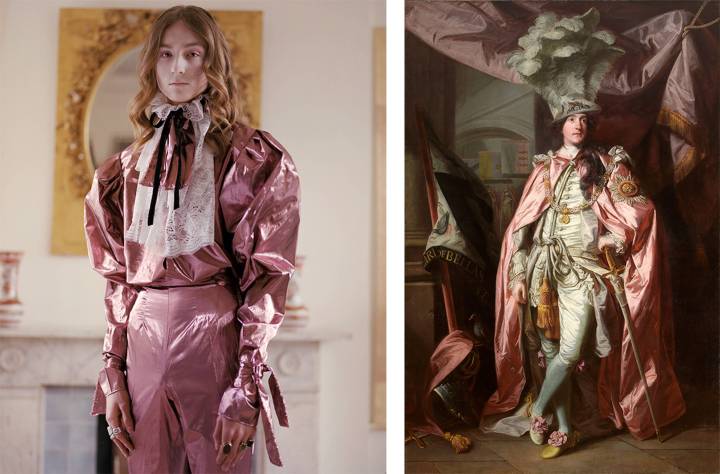
Left: Harris Reed Fluid Romanticism 001 (Courtesy Harris Reed; photo by Giovanni Corabi). Right: Joshua Reynolds, Portrait of Charles Coote, 1st Earl of Bellamont (1738–1800), in Robes of the Order of the Bath, 1773–74 (Dublin: National Gallery of Ireland).
◊ ◊ ◊ ◊ ◊
The third gallery, ‘Redressed’, pieces together the modern masculine uniform of the suit, from Beau Brummell to the contemporary runway. ‘Redressed’ opens with a reflection on English country tailoring and the origins of the suit—with historic garments from the V&A collection shown alongside contemporary reimaginings, including a kilt by Nicholas Daley—before exploring how military attire influenced civilian dress.
In the twentieth century an abundance of mass-produced suits bred creativity as Mods, Teddy Boys, and all manner of subcultures looked to define their styles through tailoring, explored in the exhibition through garments and photography. A section on leather shows how designers like Tom Ford for Gucci and Donatella Versace took their interest in leather to a new place, whilst a series of frock coats from the mid-nineteenth century to the present day include examples by Prada, Alexander McQueen, and Raf Simons. ‘Redressed’ also includes paintings as well as extensive photography showing changing styles and attitudes, from Oscar Wilde, Claude Cahun, and Cecil Beaton to The Beatles and Sam Smith.
Robert Longo’s 1981 drawing from the series Men in the Cities introduces the final part of the section about the dissolving of the suit. A new wave of fashion designers from Rick Owens to JW Anderson to Comme des Garçons to Lesiba Mabitsela are slashing away at conventions, both for menswear and masculinity.
Claire Wilcox and Rosalind McKever, eds., Fashioning Masculinities: The Art of Menswear (London: V&A Publishing, 2022), 272 pages, ISBN: 978-1838510114, $60.
Catalogue cover image: Jean-Baptiste Belley, by Omar Victor Diop, 2014, pigment inkjet print on Harman by Hahnemühle paper (Courtesy MAGNIN-A Gallery, Paris © Omar Victor Diop).
Exhibition | La Chine
Closing this weekend in Dresden at the Kupferstich-Kabinett:
La Chine: The 18th-Century China Collection in the Dresden Kupferstich-Kabinett
Residenzschloss, Staatliche Kunstsammlungen Dresden, 19 November 2021 — 8 May 2022
 In the early eighteenth century, when the legendary art collection of August the Strong (1670–1733), came into being, Asia was viewed with excited fascination in Europe.
In addition to today‘s world-famous porcelain wares, more than 1100 Chinese drawings and watercolour paintings on paper and silk, as well as woodcuts and coloured prints, were brought to Dresden. This important collection, along with 850 chinoiserie prints, is preserve in the Kupferstich-Kabinett of the Staatliche Kunstsammlungen Dresden. In the first inventory of the Kupferstich-Kabinett, drawn up in 1738, the objects were listed under the categories ‘La Chine’ and ‘La Chine européenne’.
An outstanding feature is the large collection of Chinese popular prints. In China itself, such New Year pictures, congratulatory leaflets, and theatre scenes were considered mere commodities, so that hardly any have been preserved. The prints were cheap to buy. With their wideranging symbolism, usually promising good fortune and prosperity, these sheets were hung up in homes for the New Year or passed on as a blessing, for example, and usually were not preserved. In Europe, Chinese folk art was seen as documenting the costumes and customs of distant lands. In the courtly sphere, the sheets were used as wall decorations, for example. They also served as models for chinoiserie prints. These provided motifs for decorations on buildings and furniture, as well as for porcelain painting.
Ines Beyer, Transformation
The first copperplate prints created in China were made by Matteo Ripa in collaboration with artists from the court painting workshops, on commission to the Kangxi Emperor, after woodcuts illustrating the Emperor’s own poems. The work by Ines Beyer entitled Transformation, based on the eighth view in the series, creates a link to the present day.
Cordula Bischoff and Petra Kuhlmann-Hodick, La Chine: Die China-Sammlung Des 18. Jahrhunderts Im Dresdner Kupferstich-Kabinett (Dresden: Sandstein Verlag, 2021), 256 pages, ISBN: 978-3954986286, €38.
Exhibition | Bestowing Beauty

Inkwell, Pakistan, Sindh, eighteenth century, steel, overlaid with gold (koftgari) (Houston: Hossein Afshar Collection at the MFAH). This inkwell is dedicated to Mir Fateh ‘Ali Sarkar-i Khan Talpur (r. 1783–1801/2), chief of the Talpurs, a tribe that conquered and ruled Sindh, in present-day Pakistan, from 1783 until 1843. The slit in the inkwell’s base, which makes it possible for a belt to pass through, suggests its portability and importance as part of courtly attire. The gold overlay, delicate decoration, and dedicatory inscription emphasize the power and prestige of the written word.
◊ ◊ ◊ ◊ ◊
From the Toledo Museum of Art’s press release for the exhibition:
Bestowing Beauty: Masterpieces from Persian Lands
The Museum of Fine Arts, Houston, 19 November 2017 — 11 February 2018
High Museum of Art, Atlanta, 12 December 2020 — 18 April 2021
Toledo Museum of Art, 23 April — 17 July 2022
Curated by Aimée Froom
This spring and summer the Toledo Museum of Art offers a spectacular exhibition of more than 100 objects drawn from one of the most significant private collections of Persian art. Bestowing Beauty: Masterpieces from Persian Lands showcases the artistic inventiveness of Persian culture across different media, featuring a broad array of textiles, ceramics, metalwork, lacquer, paintings, jewelry, and manuscripts from the Hossein Afshar Collection. Historically Persian lands—a wide swath of territory that at various times spanned from Cairo to Delhi, with its heart in what is now modern-day Iran—saw centuries of conquest and globalization. The art that resulted both reinforced Persian culture and assimilated these cross-cultural exchanges.
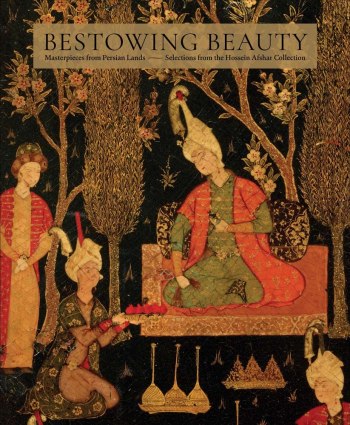 Woven throughout the stories of these extraordinary objects are experiences, ideas, and emotions shared by cultures across the globe. By evoking universal themes of love, loss, conflict, and spirituality the exhibition brings to life the rich heritage and enduring beauty of Persian art.
“Celebrating the cultural heritage of Iran at the Toledo Museum of Art with Bestowing Beauty represents a rare opportunity for our audiences to experience the grandeur and beauty of these objects in person,” said Diane Wright, the Museum’s senior curator of glass and contemporary craft. “An important area of trade and migration, Persian lands served as critical centers of artistic production and influence for centuries, which the exhibition brilliantly highlights through these extraordinary works of art.”
The visual and literary arts have held a privileged place in Iranian civilization for centuries. The Hossein Afshar Collection, which embraces a diverse range of treasures from the eve of Islam’s arrival in the seventh century to the end of the 19th century, was assembled to preserve and share Persian art and culture today and for future generations. The exceptional objects in Bestowing Beauty embody the history of trade and migration found in Persian art, as well as map the legacy of artistic and technological advancements across the region.
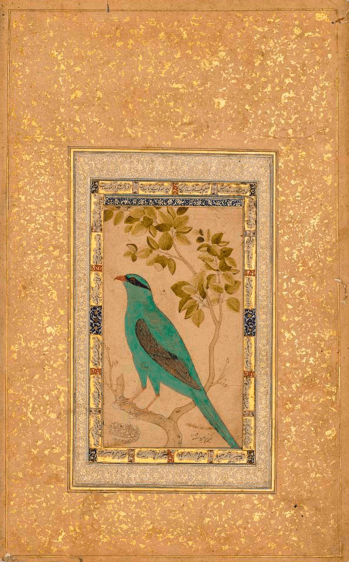
Signed ‘Ali-Quli’, Common Green Magpie, 1746–47, ink, opaque watercolor, and gold on paper (Hossein Afshar Collection at the MFAH).
The exhibition is divided into six sections:
Banquets and Battles features the exuberance of palace feasting and fighting, quintessential aspects of Persian kingship and perennially popular subjects in Persian art and literature. Feasts are portrayed across media, such as a 19th-century painting of a female juggler accompanied by a cat, and the exhibition also includes lavishly decorated serving vessels and utensils fashioned from metals and ceramic.
Faith and Piety explores how, after the advent of Islam, words from the Qur’an became paramount as a mode of expression. Exquisitely penned and sumptuously illuminated Qur’an manuscripts were produced across the Islamic world. Calligraphers also copied a variety of texts in addition to the Qur’an, such as sayings from the Hadith, Shi‘a invocations, literary manuscripts and poetry, all of which are included in the exhibition.
Art of the Word, the third section, delves into the different developments, styles and uses of calligraphy, enhancing the aesthetic form and rhythmic beauty of calligraphy. Words were woven into textiles, engraved onto metalwork, painted on ceramic objects and enamels, and carved into wood.
In Persian literature, love finds expression as a profound human connection and metaphor for a yearning for unity with the divine. Love and Longing traces how calligraphers and painters brought to life the rich corpus of Persian literature, from the exquisite miniature paintings from the Shahnama (Book of Kings), the Persian national epic, to couplets of lyric poetry and a pair of tightly embracing lovers on a slim lacquer pen case.
Kingship and Authority explores the kingly ideal, which figures prominently in Persian visual and literary culture. In addition to the Shahnama—the masterpiece that reflects the legends and virtues of Persian dynasties—court painters in the 19th century captured portraits of royalty and the ruling elite. This section also incorporates monumental silk carpets of the 16th and 17th centuries and an exquisite 19th-century pendant of gold, pearls, and gemstones.
The concluding section, Earth and Nature, examines the manifestations of flora and fauna that abound in the art of Iran. Its people were among the earliest civilizations to cultivate gardens. The garden’s symbolism—of paradise, of the promise of spring, of renewal—permeated Persian culture and can be seen in the exhibition through glorious depictions of lions, falcons, nightingales, roses, and fruit.
“The significance of Persian lands geographically, culturally and politically cannot be overstated,” said Sophie Ong, Hirsch curatorial fellow at the Toledo Museum of Art. “Bestowing Beauty draws attention to the splendor and complexity of Persian art, continuing TMA’s enrichment of the medieval world and beyond.”
Bestowing Beauty: Masterpieces from Persian Lands is organized by the Museum of Fine Arts, Houston.
Aimée Froom, ed., Bestowing Beauty: Masterpieces from Persian Lands—Selections from the Hossein Afshar Collection (New Haven: Yale University Press, with The Museum of Fine Arts, Houston, 2021), 304 pages, ISBN: 978-0300247022, $85. With contributions by Walter Denny, Melanie Gibson, David Roxburgh, Robert Hillenbrand, Mary McWilliams, Janet O’Brien, Marianna Shreve Simpson, Eleanor Sims, Margaret Squires, and Julie Timte.
Exhibition | Louis Chéron (1655–1725)
The exhibition closed last month, but the catalogue is still available:
Louis Chéron: L’ambition du dessin parfait
Musée des Beaux-Arts, Caen, 4 December 2021 — 6 March 2022
Curated by François Marandet
 Le musée des Beaux-Arts propose la première rétrospective consacrée à Louis Chéron, au travers d’une soixantaine d’œuvres issues de collections françaises et anglaises, couvrant une large période, de 1678 jusqu’aux années 1720.
Né à Paris en 1655, Louis Chéron quitte la France pour l’Angleterre en 1683. C’est à Londres qu’il vivra pendant trente ans, occupant là une place centrale au sein de la scène artistique. Les études académiques, les dessins d’invention, les projets d’illustration, les programmes pour de grands décors peints et les rares tableaux de chevalet conservés permettent de découvrir un artiste prolifique et précurseur. Contemporain de Louis Laguerre et de James Thornhill, à cheval sur deux siècles et deux nations, Cheron, souvent considéré comme un « suiveur de Charles Le Brun », reflète l’esprit classique français. Il annonce également, par ses dessins d’invention et sa peinture de chevalet proprement fantastiques, l’art de la génération suivante. En 1720, il crée sa propre école d’art à Londres, dont l’originalité est l’introduction de femmes nues comme modèles. Un peintre aussi célèbre que William Hogarth y suivra des cours.
The press packet is available as a PDF file here»
François Marandet, with prefaces by Emmanuelle Delapierre and Robin Simon, Louis Chéron (1655–1725): L’ambition du dessin parfait (Ballan-Miré: Illustria Librairie des Musées, 2022), 288 pages, ISBN: 978-2354040956, 30€.
The Burlington Magazine, April 2022
The eighteenth century in the April issue of The Burlington . . .
The Burlington Magazine 164 (April 2022)
 A R T I C L E S
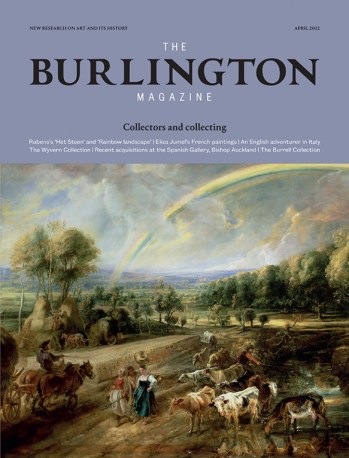
• Lucy Davis and Natalia Muñoz-Rojas, “The Provenance of Het Steen and The Rainbow Landscape by Rubens,” pp. 333–41. New documentary evidence elucidates the hitherto uncertain history of these two celebrated landscapes painted by Peter Paul Rubens ca. 1636. Having remained with this family after his death, they were purchased by the Marquess of Caracena, Governor of the Spanish Netherlands, and taken to Madrid. By 1706 they were in Genoa, in the collections of successively Bartolomeo Saluzzo (1652–1705) and Costantino Balbi (d. 1740). This article assimilates a number of archival discoveries that shed light not only on the provenance of these two paintings but also on two important Genoese collections.
• Lucia Bonazzi, “Richard Vickris Pryor in the Art Market of Napoleonic Europe,” pp. 342–49. The son of a Quaker family of brewers and wine merchants, Richard Vickris Pryor (1780–1807) spent his brief adult life in pursuit of paintings. A characteristic example of the sort of entrepreneur who sought to exploit the release of works of art onto the market in the wake of Napoleon’s campaigns, he scored his greatest success with the purchase of the Lechi collection in Brescia in 1802.
• Margaret Oppenheimer, “From Paris to New York: French Paintings from the Collection of Eliza Jumel,” pp. 350–61. Eliza Jumel (1775–1865), born in poverty, was one of New York’s richest women at her death in 1865. While in Paris in 1815–17 she formed the largest collection of European paintings yet assembled by an American, the largest part of them French. Sold in 1821, the collection has been all but forgotten, but it has proved possible to trace a number of the works she owned.
R E V I E W S
• Noémi Duperron, Review of the exhibition Le Théâtre de Troie: Antoine Coypel, d’Homère à Virgile (Musée des Beaux-Arts de Tours, 2022), pp. 394–96.
• Eric Zafran, Review of the exhibition Paintings on Stone: Science and the Sacred, 1530–1800 (Saint Louis Art Museum, 2022), pp. 396–99.
• Peter Y. K. Lam, Review of the exhibition catalogue Sarah Wong and Stacey Pierson, eds., Collectors, Curators, Connoisseurs: A Century of the Oriental Ceramic Society, 1921–2021 (Oriental Ceramic Society, 2021), pp. 402–03.
• Rowan Watson, Review of Richard Rouse and Mary Rouse, Renaissance Illuminators in Paris: Artists and Artisans, 1500–1715 (Harvey Miller, 2019), pp. 418–19.
• Richard Wrigley, Review of Iris Moon and Richard Taws, eds., Time, Media, and Visuality in Post-Revolutionary France (Bloomsbury, 2021), pp. 423–24.
• Philip Ward-Jackson Review of Bayerische Staatsgemäldesammlungen / Neue Pinakothek: Katalog der Skulpturen; Volume I: Die Sammlung Ludwigs I, Volume II: Adolf von Hildebrand (Deutscher Kunstverlag, 2021), pp. 424–25. “This is a vital link in the chain between Enlightenment celebrations of worthies and grand hommes and such later nineteenth-century sculptural pantheons as those on the Musée du Louvre, Paris, and the Albert Memorial, London . . .” (424).
O B I T U A R I E S
• Peter Cherry, Obituary for Jonathan Brown (1939–2022), pp. 427–28. As well as bringing many fresh insights to the study of the major Spanish artists from El Greco to Picasso, with a particular focus on Velázquez, Jonathan Brown made important contributions to the study of patronage and collecting and of the diffusion of the images and ideas in the wider Hispanic world. Much honoured in Spain as well as in his native America, he will also be remembered as a dedicated and assiduous teacher.
Exhibition | Boilly: Parisian Chronicles

Louis-Léopold Boilly, Trompe-l’oeil aux cartes et pieces de monnaie, detail, ca. 1808–15
(Lille: Palais des Beaux-Arts)
◊ ◊ ◊ ◊ ◊
From the Cognacq-Jay:
Boilly: Parisian Chronicles
Musée Cognacq-Jay, Paris, 16 February — 26 June 2022
Curated by Annick Lemoine and Sixtine de Saint-Léger
A virtuosic and prolific artist in a class of his own, Louis-Léopold Boilly (1761–1845) was the enthusiastic chronicler of Parisian life for sixty years, spanning a period from one revolution to the dawn of the next (1789 and 1848). In addition to being a portraitist for Parisians and a painter of city scenes, Boilly was also the inventor of stunning trompe-l’œil paintings and the author of witty caricatures. This monographic exhibition explores Boilly’s productive career through a selection of 130 works, giving us a glimpse into the artist’s uniqueness, brilliance, humour, and inventiveness. It presents several previously unseen masterpieces, some of which have never been shown in France.
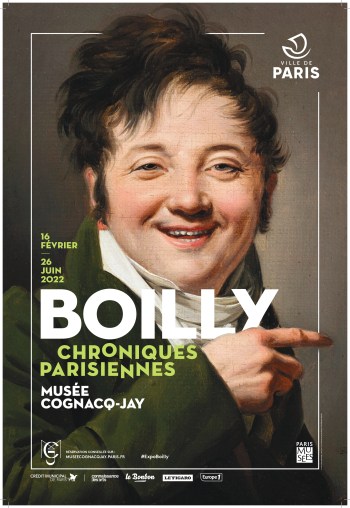 Born in the North of France, Boilly set out to win over the capital at the age of 24, in 1785. He would live there his whole life. Taking little interest in the grand history of Paris, he instead became fascinated by the city’s modernity, its hustle and bustle, and its many spectacles. As a true chronicler of everyday life, Boilly painted an intimate portrait of his generation. The artist developed a fondness for scrutinising the views and faces he came across in the city. He distinguished himself in the art of portraiture by capturing the faces of Parisians on the small formats that would become his trademark. The portraitist was also a keen caricaturist who looked at his fellow citizens with an amused, and perhaps even scathing, eye. His taste for provocation and technical proficiency can also be found in his stunningly illusionistic trompe-l’œil.
The exhibition also showcases the subtle tricks the artist employed to depict himself in his works. In addition to painting derisive self-portraits and using a variety of signatures, he also slid his likeness amongst the protagonists of his crowd scenes, just as Alfred Hitchcock did in his films. These stratagems establish a knowing relationship between the artist and viewer. Throughout the exhibition, visitors are taken along on a fun treasure hunt to find Boilly’s face or clues of his presence.
Organised as a follow-up to the publication of Étienne Bréton and Pascal Zuber’s catalogue raisonné of the artist’s work (Boilly: Le peintre de la société parisienne de Louis XVI à Louis-Philippe, Arthena, 2019), the exhibition is curated by Annick Lemoine and Sixtine de Saint-Lége. On display are several masterpieces never before shown in France on loan from prestigious private collections, including one of the largest, currently held by the Ramsbury Manor Foundation (United Kingdom).
Annick Lemoine, ed., with contributions by Etienne Bréton, Sixtine de Saint-Léger, Côme Fabre, Martial Guédron, Charlotte Guichard, Annick Lemoine, Susan L. Siegfried, Anne-Laure Sol, Francesca Whitlum-Cooper, and Pascal Zuber, Boilly: Chroniques Parisiennes (Paris: Musées, 2022), 160 pages, ISBN: 978-2759605187, €30.










 Enfilade
leave a comment