Print Quarterly, June 2018
The eighteenth century in the current issue of Print Quarterly:
Print Quarterly 35.2 (June 2018):

Juan Camarón, Robinson in his Llama Skin Habit and Parasol, 1788–89, brush and grey wash, 110 × 65 mm (London, British Library).
A R T I C L E S
• Benito Navarrete Prieto and Alejandro Martínez Pérez, “Drawings for the Spanish Robinson Crusoe by José Juan Camarón and Rafael Ximeno,” pp. 160–72.
The article addresses newly identified drawings by José Camarón and Rafael Ximeno for the seminal Spanish edition of Robinson Crusoe by Tomás de Iriarte, published in Madrid in 1789. The presence of the drawing for the map and the narrative illustrations among Iriarte’s papers underscore the poet’s close involvement with the book’s production and illustration.
• Kate Heard, “The Royal Collection of Satirical Prints in the Nineteenth and Twentieth Centuries,” pp. 173–82.
In describing the the history of the collection of satirical prints in Britain’s royal collection before their sale in 1921 to the Library of Congress, the article explains the origins of the collection under George III, its development most famously under George IV, its continued growth under Queen Victoria and Prince Albert—when Georgian works entered the collection that would not have been acquired earlier, including prints that were critical of the royal family—and finally the disfavor the collection solicited during the reign of George V from the royal librarian John Fortescue, who brokered the 1921 sale.
N O T E S A N D R E V I E W S
• Celina Fox, Review of Bernard Nurse, London: Prints and Drawings before 1800 (Bodleian Library, 2017), pp. 198–200.
• Susan Sloman, Review of Ann Gunn, The Prints of Paul Sandby (1731–1809): A Catalogue Raisonné (Brepols and Harvey Miller Publishers, 2016), pp. 200–03.
• Flavia Pesci, Review of the exhibition catalogue Nicholas Stanley Price, At the Foot of the Pyramid: 300 Years of the Cemetery for Foreigners in Rome (Casa di Goethe Museum, 2016), pp. 203–04.
• Mark McDonald, Review of the catalogue Peter Raissis, Prints and Drawings: Europe 1500–1900 from the Art Gallery of New South Wales (Art Gallery of New South Wales, 2014), pp. 204–06.
• Charles Newton, Review of Elisabeth Fraser, Mediterranean Encounters: Artists between Europe and the Ottoman Empire, 1774–1839 (Pennsylvania State University Press, 2017), pp. 206–09.
◊ ◊ ◊ ◊ ◊
Note (added 6 June 2018) — The original posting did not include descriptions for the two articles.
The Burlington Magazine, May 2018
The eighteenth century in The Burlington:
The Burlington Magazine 160 (May 2018)
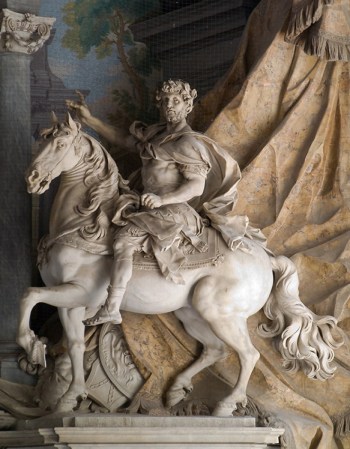
Agostino Cornacchini, Charlemagne, 1725, marble (St Peter’s Basilica).
A R T I C L E S
• Gloria Martínez Leiva, “Art as Diplomacy: John Closterman’s Portraits of Carlos II of Spain and His Wife Queen Maria Anna of Neuburg,” pp. 381–86.
• Teresa Leonor M. Vale, “Art and Festivities in Eighteenth-Century Rome: Letters from a Portuguese Priest, 1721–22,” pp. 387–93.
R E V I E W S
• Christopher Rowell, Review of the exhibition Thomas Chippendale: A Celebration of Craftsmanship and Design, 1718–2018 (Leeds City Museum, 2018), pp. 414–16.
• Charles Darwent, Review of the exhibition The Dutch in Paris, 1789–1914 (Paris: Petit Palais, 2018), pp. 420–21.
• Stéphane Loire, Review of Giancarlo Sestieri, Il capriccio architettonico in Italia nel XVII e XVIII secolo (Etgraphiae editoriale, 2015), p. 432.
• Andrew McClellan, Review of Geneviève Bresc-Bautier and Béatrice de Chancel-Bardelot, eds., Un musée révolutionaire: Le Musée des Monuments français d’Alexandre Lenoir (Musée du Louvre, 2016), pp. 432–33.
Exhibition | Canaletto, 1697–1768
Now on view at the Museo di Roma:
Canaletto, 1697–1768
Museo di Roma, Palazzo Braschi, Rome, 11 April — 19 August 2018
Curated by Bożena Anna Kowalczyk
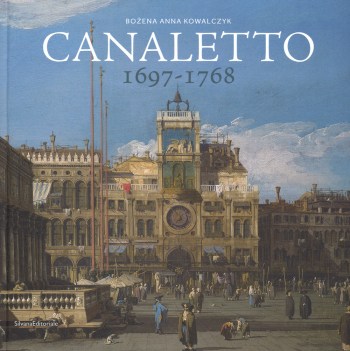 Italy’s capital celebrates Canaletto (1697–1768) by bringing together works from some of the most important museums and galleries in the world. On display, to celebrate the 250th anniversary of the artist’s death, is the largest collection of his works ever exhibited in Italy: 67 paintings, drawings, and documents. Outstanding among the masterpieces are two works from the Pinacoteca del Lingotto Giovanni e Marella Agnelli in Turin, The Grand Canal from the North, towards the Rialto Bridge and The Grand Canal with Santa Maria della Carità, on display for the first time together with the manuscript from the Biblioteca statale di Lucca. Also for the first time, the two parts of a single large canvas cut before 1802, depicting Chelsea from Battersea Reach, are brought together. The left part comes from the National Trust property Blickling Hall in the UK; the right part, from the Museo Nacional De Bellas Artes de la Hanana, has been loaned for the first time by the government of Cuba.
Bozena Anna Kowalczyk, Canaletto, 1697–1768 (Milan: Silvana, 2018), 256 pages, ISBN: 978-8836639328 (English edition), €34 / $55.
New Book | A Princely Pursuit
Part of a promised gift to the Fine Arts Museums of San Francisco, approximately 100 works from the Malcolm D. Gutter porcelain collection were exhibited at the Legion of Honor in 2015 and 2016. Published by Hirmer and distributed by The University of Chicago Press, the catalogue of the collection is now available.
Maria Santangelo, ed., A Princely Pursuit: The Malcolm D. Gutter Collection of Early Meissen Porcelain (Munich: Hirmer Publishers, 2018), 256 pages, ISBN: 978-3777429847, $65.
 Through tremendous grit and research, Malcolm D. Gutter has been forming a remarkable porcelain collection over several decades, primarily on a professor’s salary. A Princely Pursuit presents more than one hundred significant pieces from the collection, which focuses primarily on early Meissen, particularly the royal collection that Augustus II (1670–1733) commissioned for the Japanisches Palais, his pleasure palace in Dresden, and the porcelain works he had imported from China and Japan. In addition to reproducing many documented pieces from the royal collection, this volume includes numerous ‘collector’s stories’ which capture, in Gutter’s own voice, his determined and painstaking hunt for Meissen porcelain around the world, as well as the legendary figures he has met and worked with along the way. Pairing Meissen history with exemplary objects from the German manufactory, A Princely Pursuit makes an essential contribution to the field of decorative arts.
Maria Santangelo is curator of fine arts for Ann and Gordon Getty.
Exhibition | Canova’s George Washington
In February, we noted the exhibition (which opened at The Frick Collection yesterday), but the original posting did not include details for the catalogue, which is now available from Giles Ltd and Artbooks.com:
Xavier Salomon with Guido Beltramini and Mario Guderzo, Canova’s George Washington (London: Giles, 2018), 188 pages, ISBN: 9781911282174, $45.
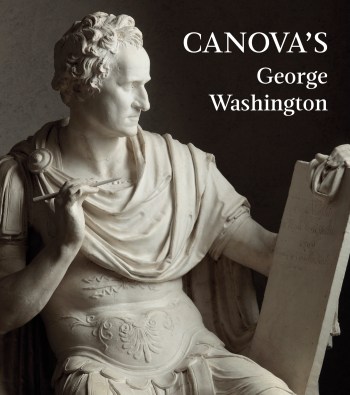 In 1816, the North Carolina State House in Raleigh commissioned a full-length statue of George Washington to stand in the hall of the State Senate. Thomas Jefferson, believing that no American sculptor was up to the task, recommended Antonio Canova (1757–1822), then one of Europe’s most celebrated artists. The first and only work Canova created for America, the statue depicted the nation’s first president in ancient Roman garb, per Jefferson’s urging, drafting his farewell address to the states. It was unveiled to great acclaim in 1821, and people traveled from far and wide to see it. Tragically, only a decade later, a fire swept through the State House, reducing the statue to just a few charred fragments.
Canova’s George Washington examines the history of the artist’s lost masterpiece, probably the least well known of his public monuments. It brings together for the first time Canova’s full-sized preparatory plaster model (which has never left Italy), four preparatory sketches for the sculpture, and related engravings and drawings. The exhibition also includes Thomas Lawrence’s 1816 oil portrait of Canova, which, like the model and several sketches, will be on loan from the Gypsotheca e Museo Antonio Canova in Possagno, Italy, the birthplace of the artist.
C O N T E N T S
Ian Wardropper, Director’s Foreword
Preface and Acknowledgments
Xavier F. Salomon, ‘The Boast and Pride of North America’: Antonio Canova’s George Washington
Mario Guderzo, The Classical Conception of Antonio Canova
Guido Beltramini, Jefferson, Italy, and Palladio
Appendix
Bibliography
Index
Photography Credits
Note (added 29 May 2018) — The original posting did not included the contents.
Exhibition | The Art of Iron

Florist’s Sign and Bracket, 18th century, France, wrought iron and rolled iron, cut, polychromed, and gilded; fastened with rivets and rings. Sign: 28 × 21 × 5 inches (71.5 × 52.6 × 12.5 cm), bracket: 33 × 52 × 2 inches (84 × 132.5 × 6 cm) (Rouen: Musée Le Secq des Tournelles, inv. LS 2011.0.199)
◊ ◊ ◊ ◊ ◊
Some of the objects included in the exhibition opening soon at The Clark were also included in the 2015 exhibition at The Barnes Foundation. From the press release (8 May 2018). . .
The Art of Iron: Objects from the Musée Le Secq des Tournelles, Rouen, Normandy
The Clark Art Institute, Williamstown, MA, 9 June — 16 September 2018
Curated by Kathleen Morris
The Clark Art Institute is the exclusive venue for the exhibition The Art of Iron: Objects from the Musée Le Secq des Tournelles, Rouen, Normandy. The exhibition presents thirty-six historic objects in an installation celebrating the craft and beauty of wrought iron. Salvaged by the founders of the Musée Le Secq during the second half of the nineteenth century, when wrought iron was being rapidly discarded and replaced with modern materials, these pieces tell stories of preindustrial times.
The Musée Le Secq des Tournelles’s celebrated collection originated with Jean-Louis-Henri Le Secq Destournelles (1818–1882), a painter who studied in Paris and Rome and became one of the first photographers in France. In the 1850s while photographically documenting various French monuments for a government project, he developed an appreciation for the ironwork adorning towns and ancient cathedrals. This inspired him to begin his own collection, much of which contained objects he salvaged as buildings were renovated or torn down. His son Henri (1854–1925, who changed the spelling of his last name to des Tournelles), continued to add to the collection, and in 1900 he loaned nearly a thousand objects to the Paris Universal Exhibition before donating the collection to the city of Rouen.
 “We are so pleased to bring this wonderful collection of decorative arts to the Clark,” said Olivier Meslay, the Felda and Dena Hardymon Director of the Clark. “While wrought iron has long been an intrinsic part of the architecture of most European capitals, the Musée Le Secq des Tournelles collection encourages us to consider this work for its beauty—and to appreciate the exceptional ingenuity of the blacksmiths and ironworkers who took a humble material and elevated it to an art form. The Musée Le Secq is a colleague museum in the French American Museum Exchange (FRAME), a consortium of thirty-one major museums in France and North America that promotes cultural exchange through museum collaborations, and we are eager to share this wonderful collection with our visitors.”
The Art of Iron features a myriad of signs, masterful locks and lockboxes, a variety of utilitarian household objects, and architectural grilles, gates, and balcony railings. The objects are at once strange and familiar, inviting the viewer to marvel at the creative inventiveness and technical skill of their makers as well as reflect on earlier ways of life.
The works included in the exhibition represent a variety of the methods used in creating objects from iron. Much of the work is the result of a blacksmith working at his forge to bend, twist, and hammer rods of wrought iron into shape. Sheets of rolled iron were cut to shape and could be decorated by embossing designs from the back and by chiseling on the surface. Small objects might have been hammered or cast in molds and then welded into place. Many objects incorporate all of these techniques.
“The first time I visited the Musée Le Secq, the collection and its display took my breath away,” said Kathleen Morris, the Sylvia and Leonard Marx Director of Exhibitions and Curator of Decorative Arts at the Clark. “The opportunity to work with this collection has been incredible, compelling me to look closely at the extraordinary craftsmanship and design of these handmade creations. The sophistication and skill on display in these objects is phenomenal—and our dynamic installation will both captivate and delight our visitors.”
Signs
Shop, inn, and tavern signs make up an important part of the collection of the Musée Le Secq des Tournelles. Prior to widespread literacy, in an era before buildings were given numbered addresses, businesses depended on pictorial signs for identification and advertising. The Art of Iron contains fifteen signs representing a variety of business from taverns and inns to drapers, florists, and fishmongers. In many cases these signs hung on equally elaborate and well-crafted wrought iron brackets, which are also included in the exhibition.
Henri Le Secq des Tournelles salvaged many such signs, but he was more concerned with preserving them than with documenting their original locations. However, the location of some shops, such as one advertising a draper, is known. A sign known as “The Dry Tree” once stood on the Parisian street that still carries the name of its shop, rue de l’Arbre-Sec (Street of the Dry Tree). Drapers, or cloth merchants, often used the tree as a symbol of their business, evoking legends from the ancient Near East, a source of luxury fabrics. “The Dry Tree” refers to a specific tree that stood alone in a vast desert and was said to grow on the exact spot where Alexander the Great and Darius fought a great battle in the fourth century BCE. Marco Polo reported having seen this legendary tree during his travels.
A lighted bat-shaped sign that once hung outside the entrance to a cabaret or tavern is a remarkable example of nineteenth-century French ironwork. The bat is a clever reference to the nocturnal nature of this business and suggests a dim and mildly dangerous atmosphere within. The light cavity was later fitted with a lightbulb and electrical wiring—probably in the early twentieth century.
Grilles, Gates, and Balconies
Ironsmiths did not necessarily design the objects they created. In particular, wrought-iron grilles, gates, and railings for buildings were often conceived by architects, and in many cases the smith was probably working from a pre-existing drawing. This in no way diminishes the technical and creative skill of ironsmiths, who often infused their works with individual flourishes. The contrast between the strength of the material and the airy, often delicate lines and scrolls that form the composition gives these objects a presence that hovers between the sculptural and the graphic.
The Art of Iron contains many examples of these architectural elements that served a multitude of practical purposes. Window and transom (over-door) grilles, as well as door and balcony railings, allow light and air circulation while offering security against intrusion or protection from falls. An eighteenth-century Italian grille is one of many objects in the exhibition that includes this elaborate scrollwork.
A magnificent eighteenth-century French round grille, finished on both sides, features the symmetrical monogram GBM surrounded by an elaborate array of scrolls and volutes. It was originally installed in a building on the rue des Vergeaux in Amiens, France, perhaps to echo the spectacular rose windows of a nearby cathedral.
Locks and Lockboxes
Before the advent of banks, personal wealth was largely represented by items such as jewels, property deeds, and objects made of silver or gold. Safekeeping these items with locks or lockboxes was essential to financial security. These utilitarian objects, as well as their keys, were often highly decorated.
An eighteenth-century German strongbox and key is a spectacular example of the locksmith’s skill. The keyhole on the front of this chest is a decoy. The real keyhole is on the top of the box, concealed under the body of the double-headed eagle. Pushing on the eagle’s right talon releases a hinge and reveals the keyhole. The locking mechanism is visible on the underside of the box’s lid. The lock’s functional parts, including eighteen sliding bolts, are embellished with decorative flowers, leaves, and scrolls.
A French safe door (1823), signed by a maker named Poifol, is fitted with a complicated mechanism made of wrought iron and brass, including a mounted English pistol by the manufacturer Wilson. Attempts to tamper with the lock caused the gun to discharge, acting as an alarm system.
Household Objects
The durability of wrought iron made it a common material for many household objects, from cooking and kitchen utensils to wares for the bedroom and garden.
Before the invention of modern stoves, food was prepared over open fires in large kitchen fireplaces using cooking pots and pothooks. The ratchets on the pothook could be adjusted to hold the pot nearer to or further from the flame. Cast-iron pots were essential items in any kitchen and were often given as wedding gifts.
In contrast to the unadorned cooking pot, coffee and spice mills were specialty items sometimes elaborately decorated. The Musée Le Secq des Tournelles has extensive holdings of early spice and coffee grinders, including an eighteenth-century mill crafted by Benoit Tivelier the Elder included in the exhibition. The mill was made in the city of Saint-Étienne, France, a center of production for grinders.
The Art of Iron is co-organized by the Clark Art Institute, Williamstown, Massachusetts, and the Réunion des Musées Métropolitains, Rouen, Normandy. Generous contributors to the exhibition include Sylvia and Leonard Marx and the Selz Foundation, with additional support from Richard and Carol Seltzer.
Kathleen Morris, with contributions by Alexandra Bosc and Anne-Charlotte Cathelineau, The Art of Iron: Objects from the Musée Le Secq des Tournelles, Rouen, Normandy (Williamstown: The Clark Art Institute, 2018), 112 pages, ISBN: 978-0300237047, $35.
Published by the Clark and distributed by Yale University Press, the catalogue for the exhibition combines stunning photography with fresh and engaging scholarship. An essay by Kathleen M. Morris offers a contemporary perspective on these extraordinary works of art, while current and former curators of the Musée Le Secq provide fascinating insights into the magnificent holdings of the museum’s renowned collection.
Exhibition | Dibujos de Luis Luis Paret (1746–1799)
Opening this week at the National Library of Spain:
Dibujos de Luis Paret (1746–1799)
Biblioteca Nacional de España, Madrid, 25 May — 16 September 2018
Curated by Alejandro Martínez Pérez

Luis Paret, Thalia, 1794, pencil, pen and ink, with white highlights and golden pigment (Madrid: BNE).
Luis Paret y Alcázar was one of the most important Spanish artists of the eighteenth century. This exhibition shows his numerous drawings, prints, and paintings. Known as the ‘Spanish Watteau’, Paret was isolated from the academic art theory after an unfortunate incident with the Prince don Luis. This event led him to exile, and many historians judge that this was the reason why he was distanced from the Spanish art of his time. His nonconformity with other artists of his time is most likely the result of his culture and great humanistic education. Paret has been recognized as the best representation of Spanish Rococo and the second most important Spanish painter of the eighteenth century, after Goya. The exhibition focuses on the multidisciplinary character of the artist including his drawings, paintings, prints, but also showing him as a great translator and calligrapher.
◊ ◊ ◊ ◊ ◊
Luis Paret y Alcázar es una de las figuras más interesantes del arte español del siglo XVIII. Artista erudito de azarosa biografía, ha sido aislado del discurso teórico del arte español de su tiempo debido a un eslogan —el «Watteau espagnol»— que se repite constantemente y le señala como el más genuino representante del rococó en España, y segundo pintor más importante del siglo XVIII… después de Goya, ¡claro está!
El episodio que le llevó al exilio, consecuencia directa de su relación con el infante don Luis, ha servido como causa en las consideraciones de muchos historiadores sobre la distancia de Paret con respecto al arte español de su tiempo. La expulsión de la patria, y el consiguiente distanciamiento de la corte, justificarían la pérdida de la oportunidad de hacer carrera al servicio del rey y de triunfar en la Academia de San Fernando, donde se había formado. Sin embargo, su heterodoxia respecto a otros artistas contemporáneos se debe a su formación y cultura.
La imagen, proyectada por Ceán Bermúdez, de un artista con una gran formación humanística ayudó a trazar ese halo de heterodoxia que le rodea. Por ello, para comprender mejor su singularidad, conocer sus modelos y desentrañar cómo se fraguó su personalidad artística, hemos querido adentrarnos en el corpus de dibujos de Luis Paret y analizar el contenido de su biblioteca, con el fin de averiguar el porqué de ese distanciamiento del arte académico.
Con este telón de fondo historiográfico planteamos la exposición, un repaso completo a su trayectoria a través de dibujos y estampas, pinturas y libros, prestando atención a las múltiples facetas de dibujante, pintor, grabador, traductor, calígrafo, etcétera, en las que se manifestó su creatividad e ingenio.
Alejandro Martínez Pérez se doctoró en Historia del Arte por la Universidad Autónoma de Madrid con una tesis dedicada a la cultura artística de Luis Paret y Alcázar. Recientemente ha publicado los libros Historia de las Artes entre los Antiguos de J. J. Winckelmann (2014), a partir del manuscrito de Diego Antonio Rejón de Silva de 1784, y Patrimonio en conflicto. Memoria del botín napoleónico recuperado (1815–1819) (con Esperanza Navarrete, 2015). Es autor además de diversos artículos en revistas especializadas y estudios sobre el arte y la historia cultural española de la segunda mitad del siglo XVIII.
An accompanying catalogue raisonné is published by CEEH:
Alejandro Martinez Perez, Dibujos de Luis Paret (1746–1799) (Madrid: Centro de Estudios Europa Hispánica, 2018), 352 pages, ISBN: 9788415245773, 38€ / $68.
Este catálogo razonado reúne un corpus de 165 dibujos ordenados cronológicamente que permiten conocer tanto los procesos creativos de Paret como los temas y motivaciones que le animaron a lo largo de su carrera. Se incluyen también como anexos la identificación del contenido de la biblioteca del artista, una relación de estampas autógrafas y otra de obras desaparecidas sólo conocidas a partir de grabados. Este volumen constituye además el catálogo de la exposición del mismo título celebrada en la Biblioteca Nacional de España.
Exhibition | Artists at Work

Carlo Labruzzi, The Colosseum seen from the Palatine Hill, Rome, graphite, pen and brown and grey ink, watercolour
◊ ◊ ◊ ◊ ◊
Now on view at The Courtauld:
Artists at Work
The Courtauld Gallery, London, 3 May — 15 July 2018
Curated by Deanna Petherbridge with Anita Viola Sganzerla
 With drawings ranging from Tiepolo and Ingres to Schiele and Lovis Corinth, this exhibition explores the rich subject of the artist at work, illustrating the variety of ways in which artists have represented themselves and others making art through a selection of drawings from the sixteenth to the twentieth centuries, drawn primarily from the Katrin Bellinger Collection. Whether in their studios or art academies, out and about sketching a landscape or recording their own likeness in a mirror, artists have long taken pleasure in representing themselves at work. When immersed in the act of drawing or painting, artists are often shown with their backs turned to the spectator. We, therefore, are invited to look over their shoulders and share in the moment of creation.
Depictions of the artist in the studio are expressions of creative concentration and introspection and, like self-portraits, offer a chance to reflect on artistic practice and identity. The care consistently taken in recording the studio apparatus of easels and palettes, or assistants grinding pigments, indicates their significance for practitioners. Yet, the studio, as well as being the everyday workshop of dirty brushes and sculptural debris, is also the realm of allegory and myth where artists create or dream.
Deanna Petherbridge and Anita Viola Sganzerla, edited by Ketty Gottardo and Rachel Sloan, Artists at Work (London: Paul Holberton, 2018), 64 pages, ISBN: 978-1911300441, £17.
Additional information is available from Anita Sganzerla’s blog posting for the Tavolozza Foundation.
Exhibition | Exhibiting Art In Georgian Ireland
From the press release for the exhibition:
Exhibiting Art In Georgian Ireland: The Society of Artists’ Exhibitions Recreated
City Assembly House, Dublin, 16 June — 29 July 2018
Curated by Ruth Kenny
 This summer the Irish Georgian Society will host a world-class exhibition of eighteenth-century Irish paintings to mark the restoration of the City Assembly House and to commemorate the Society of Artists in Ireland who erected the building over 250 years ago. Celebrating the building’s original incarnation as the first purpose-built public gallery in Britain and Ireland, the exhibition will re-assemble works by Society of Artists members such as Thomas Roberts, Jonathan Fisher, James Forrester, Robert Carver, Robert Healy, and Hugh Douglas Hamilton, including many pieces which were first displayed in the room in the series of exhibitions the Society held there between 1766 and 1780.
By honouring the pioneering spirit of these exhibitions, we aim to provide an insight into the fascinating range of artistic production taking place in eighteenth-century Ireland. As the original exhibition catalogues reveal, Georgian Dublin was a hive of creativity, with landscape artists working alongside portraitists, history painters, sculptors, printers, and draughtsmen in an astonishing range of media, including oil paint, pastel, marble, wood, glass, wax and hair. With loans secured from national institutions and private collectors, this exhibition will reunite over eighty works by exhibiting Society of Artists’ members. An accompanying catalogue will evaluate these stimulating years, assessing Ireland’s first introduction to exhibition culture and the significant contribution it made to an increasingly self-confident national school of Irish art.
Exhibiting Art In Georgian Ireland has been curated by Dr Ruth Kenny, formerly Assistant Curator of British Art, 1750–1830 at Tate Britain, who has identified over seventy works of art that will showcase the breadth of talent displayed by the Society of Artists’ initial series of exhibitions between 1765 and 1780. The public will have free access to the exhibition, with guided tours and exclusive events to mark the completion of the restoration of the City Assembly House.
David Fleming, Ruth Kenny, and William Laffan, eds., with contributions by Victoria Browne, Paul Caffrey, Donough Cahill, Logan Morse, and Brendan Rooney, Exhibiting Art In Georgian Ireland: The Society of Artists’ Exhibitions Recreated (Dublin: Irish Georgian Society, 2018), .
Exhibition | Andreas Gallasini (1681–1766)

Now on view in Fulda:
Andrea(s) Gallasini: Vom Stuckateur zum fürstlichen Baumeister in Fulda
Vonderau Museum, Fulda, 13 May — 19 August 2018
In der Reihe „Berühmte Architekten in Fulda” wird nach Johann Dientzenhofer und Sep Ruf am Internationalen Museumstag die große Sonderausstellung über den Barockbaumeister Andrea(s) Gallasini (1681–1766) eröffnet.
 Der in Lugano im Tessin geborene Andrea(s) Gallasini begann seine Laufbahn als Stuckateur, avancierte zunächst zum Bauinspektor in Waldeck–Pyrmont und war dann seit 1720 für rund 40 Jahre in den Diensten der Fuldaer Fürstäbte als Baumeister tätig. Unter seiner Regie entstanden rund 45 Bauten unterschiedlichster Bestimmung: vom Amtshaus über das Adelspalais bis zum repräsentativen Landsitz, von der Pfarrkirche bis zur anspruchsvollen Kloster- oder Propsteikirche. Zu seinen Hauptwerken gehören die fürstliche Sommerresidenz Schloss Fasanerie, das Heilig-Geist-Hospital und die „Alte Universität”.
Schwerpunkt der Ausstellung bilden zum einen Person und der bis jetzt noch weitgehend unbekannte Lebensweg des italienischen Stuckateurs und Hofbaumeisters Andrea(s) Gallasini sowie die zeitgenössischen politischen und organisatorischen Verhältnisse in Fulda. Ein zweiter Schwerpunkt der Schau nimmt das architektonische Werk Gallasinis in den Fokus, um den typischen „Gallasini – Stil” aufzuzeigen, der das Gesicht der Stadt Fulda bis heute prägt.
Zur Ausstellung erscheint ein Begleitband. Außerdem wird ein Begleitprogramm mit Führungen mit den Ausstellungsmachern, regelmäßigen Führungen am Sonntag, Architekturspaziergängen, Exkursionen, Workshops mit Stucktechniken sowie einem Konzert mit Musik aus der Feder der Komponisten des 18. Jahrhunderts angeboten.
Volker Rößner and Sabine Wagner with contributions by Thomas Heiler and Markus Miller, edited by Sabine Fechter, Andrea(s) Gallasini 1681–1766: Vom Stuckateur zum fürstlichen Baumeister in Fulda (Petersberg: Imhof Verlag, 2018), 320 pages, ISBN: 978-3731907176, 25€.










leave a comment