Conference | European Portrait Miniatures
From the conference flyer:
European Portrait Miniatures: Artists, Functions, and Collections
The Tansey Miniatures Foundation, Bomann-Museum, Celle, 11–13 November 2016
 The conference is being held on the occasion of the opening of the sixth exhibition of the Tansey Miniatures Foundation and the publication of the accompanying catalogue Miniatures from the Baroque Period in the Tansey Collection.
Both conference venues are within walking distance (20 minutes) from the railway station. Trains from Hannover take approximately 25 to 45 minutes (Deutsche Bahn, Metronom, and S-Bahn).
For registration, please contact Juliane Schmieglitz-Otten, Head of the Residence Museum at Celle Castle, juliane.schmieglitz-otten@tansey-miniatures.com. For more information, please contact Bernd Pappe, Art Historian and Restorer, bernd.pappe@tansey-miniatures.com. Conception IT Coordination by Birgitt Schmedding, Photo Designer, birgitt.schmedding@tansey-miniatures.com.
◊ ◊ ◊ ◊ ◊
F R I D A Y , 1 1 N O V E M B E R 2 0 1 6
15:00 Registration
16:30 Welcome and opening of the exhibition Miniatures from the Baroque Period in the Tansey Collection
S A T U R D A Y , 1 2 N O V E M B E R 2 0 1 6
9:00 Objects, Agencies, and Social Practices
• Ulrike Kern (Frankfurt), The Limner’s Language: Words and Concepts Related to Miniature Painting in England
• Miranda L. Elston (Chapel Hill, North Carolina), Hilliard’s Miniatures: Enacted Desire within the Elizabethan Court
• Eloise Owens (New York), The Hand behind the Likeness: Women’s Practice as Portrait Miniaturists in Eighteenth-Century England
• Christoph Großpietsch (Salzburg), Portrait Miniatures of Mozart: Problems of Authenticity
• Violaine Joëssel (Geneva), A Quest for Legitimacy: The Practice of Miniature Painting in Colonial America
• Dimitri Gorchko (Moscow), ‘… et que tout ait un nom nouveau’: Portrait Miniatures of Napoleon’s Marshals, Generals, and Colonels: Analysis and Identification
13:00 Lunch
14:15 Politics and Representation
• Delia Schffer (Kassel), Power through Relations: Duke Louis of Württemberg‘s Family Ties in a Series of Miniature Portraits
• Sarah Grandin (Paris), Density in the ‘Boîte à Portrait’ under Louis XIV
• Stefanie Linsboth (Vienna), From Large-Scale Paintings to Precious Miniatures: Maria Theresa’s Portrait Miniatures
• Karin Schrader (Bad Nauheim), ‘Taking the Veil’: Miniatures of Royal Widows from the Sixteenth to the Nineteenth Centuries
16:30 Coffee
17:00 Special Techniques and Materials
• Tatjana Wischniowski (Dresden), Oil-Based Paint under a Layer of Water: Arnaud Vincent de Montpetit’s ‘Eludoric Painting’, a Rare Miniature Painting Technique
• Emma Rutherford, Alan Derbyshire, and Victoria Button (London), The Drawings of John Smart (1742–1811): Function, Purpose, and Line
S U N D A Y , 1 3 N O V E M B E R 2 0 1 6
9:00 Miniature Collections
• Lucy Davis (London), Famous Women in the Miniatures at The Wallace Collection
• Catherine Hess (San Marino, California), Up Close and Personal: Portrait Miniatures at The Huntington Art Collections
• Isabel M. Rodríguez-Marco (Madrid), The Collection of Portrait Miniatures and Small Portraits in the Museo Nacional de Artes Decorativas, Madrid
• Paul Caffrey (Dublin), European Enamels from the National Gallery of Ireland Collection
• Wladyslaw Maximowicz (Bergamo), The Portrait Miniature in Russian Provincial Collections
• Reetta Kuojärvi-Närhi (Helsinki), Small Treasures in Finland: Paul Sinebrycho as a Miniature Collector
13:00 Lunch
14:15 Miniature Painters
• Halgard Kuhn (Hannover), Peter Boy (c. 1650–1727): Medallions and Miniatures by the Frankfurt Baroque Goldsmith and Enamel Painter as Integrating Parts in Golden Jewellery
• Karen Hearn (London), The ‘Small Oil Colour Pictures’ of Cornelius Johnson (1593–1661)
• Marco Pupillo (Rome), Francesco Antonio Teriggi, a Miniaturist in the Service of Joseph Bonaparte
• Roger and Carmela Arturi Phillips (Ringwood), The True and Flawed Genius of John Engleheart
• Stephen Lloyd (Liverpool), Copying Portraits in Miniature in Regency England: The Work of William Derby (1786–1847) for the 13th Earl of Derby at Knowsley Hall
◊ ◊ ◊ ◊ ◊
The exhibition catalogue is distributed in North America and Japan by The University of Chicago Press (with information on the other five volumes published thus far from The Tansey Foundation). . .
Bernd Pappe and Juliane Schmieglitz-Otten, eds., Miniatures from the Baroque Period in the Tansey Collection / Miniaturen des Barock aus der Sammlung Tansey (Munich: Hirmer Publishers, 2016), 400 pages, ISBN: 978-3777426389, $64.
The Tansey miniatures, now held by the Bomann Museum in Celle, represent one of the most significant collections of European miniature paintings. This volume is the sixth in a series exploring the collection in key periods. Each volume presents new photographic reproductions of the miniatures at actual size and with close-up photographs that show important details. This volume covers portrait miniatures created throughout the Baroque period of the seventeenth-century, with more than one hundred representative works. Essays by specialists in the field offer insights into the artworks, their patrons, and the period. The resulting book is as informative as it is beautiful, a stunning testament to a bygone age and a once-popular form.
Exhibition | Fragonard: Un Provençal aux Pays-Bas
Now on view at the Villa-Musée Fragonard:
Fragonard: Un Provençal aux Pays-Bas
Villa-Musée Jean-Honoré Fragonard, Grasse, 1 July — 30 September 2016
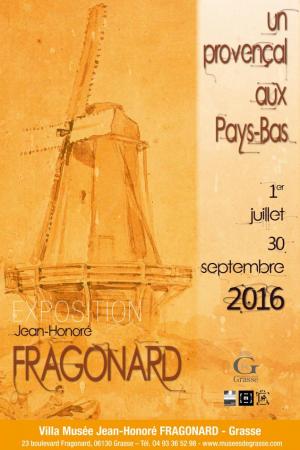 Grasse et Fragonard, l’association semble évidente et pourtant la réalité est plus complexe. Certes Jean-Honoré Fragonard naît à Grasse en 1732 dans une famille modeste d’ouvriers gantiers, cet artisanat grassois qui, depuis le XVIIe siècle, accompagne et est aussi pour partie à l’origine du développement de l’activité liée au parfum dans la ville. Mais dès ses six ans, en 1738, toute la famille quitte la ville pour s’installer à Paris. Par la suite nous n’avons ni témoignages ni documents écrits qui pourraient faire supposer un retour ou un séjour du peintre dans sa ville natale. Cela jusqu’en février 1790, où Alexandre Maubert, son cousin, consigne, avec précision dans son livre de compte, un loyer mensuel que Fragonard lui verse pour loger avec sa femme et sa belle-soeur, Marguerite Gérard, dans sa bastide à un jet de pierre de l’entrée de Grasse. L’année suivante les Fragonard retournent à Paris, leur présence est confirmée dans la capitale en août 1793 par un document bancaire. Rien n’établit ensuite que le peintre revienne à Grasse. Il meurt le 22 août 1806 après une promenade sur le Champs de Mars à Paris. Six ans puis une grosse année : certes deux périodes cruciales dans la vie du peintre, mais c’est au final assez peu.
Ajoutons à cela la théorie, paradoxalement uniquement défendue localement, avec aplomb, depuis les années 1980, que les travaux de décoration de la cage d’escalier de la Villa Maubert n’étaient pas de la main de Jean-Honoré mais de son fils, le musée Fragonard rebaptisé Musée d’Art et d’Histoire de Provence en 1977, de trop rares expositions consacrées au peintre, une en 1957, une autre en 2006, voilà que progressivement semble s’éloigner la présence du peintre à Grasse. Pourtant la Villa Maubert, transformée en Villa Musée Fragonard par la ville, conserve un trésor. En ses murs ce sont les derniers feux créateurs du peintre en cette fin du XVIIIe siècle que l’on peut encore admirer aujourd’hui. Ce patrimoine, dont l’histoire est complexe et mal documentée, est unique et original, il justifie pleinement de mettre en lumière Jean- Honoré Fragonard dans la capitale des parfums.
Avec cette première exposition d’été, Un Provencal aux Pays-Bas, c’est ce que les musées de Grasse veulent réaffirmer en s’efforçant d’initier un nouveau cycle de travaux et de recherches consacré à cet enfant du pays grassois.
◊ ◊ ◊ ◊ ◊
The catalogue is available from Artbooks.com:
Marie-Anne Dupuy-Vachey, Fragonard: Un Provençal aux Pays-Bas (Milan: Silvana, 2016), 32 pages, ISBN: 978-8836633388, $23.
 Né à Grasse en 1732, à quelques lieues de la frontière italienne, Fragonard ne pouvait qu’être séduit par les paysages méditerranéens comme ses deux séjours dans la péninsule en témoignent. Mais le peintre a aussi exploré des territoires plus septentrionaux. A l’instar des amateurs de son temps, Fragonard fut très attiré par la peinture flamande et hollandaise du XVIIème siècle. Tout au long de sa carrière il entretint un dialogue fructueux avec les maîtres du passé, étudiant et copiant les toiles de Rembrandt et de Rubens, les paysages de Ruysdael. Il en vint même à absorber leur style et leur technique au point de les pasticher tout en restant lui-même. Cette pratique fut stimulée par des voyages, dont un documenté en 1773, qui le mena de Paris à Amsterdam en passant par Bruxelles, Malines, Anvers et La Haye. Les collections de la ville de Grasse, complétées par des prêts de collections publiques et privées, offrent l’occasion de se pencher sur cet aspect moins connu de l’auteur du Verrou et des Hasards heureux de l’escarpolette.
Exhibition | Fragonard: Drawing Triumphant

Jean Honoré Fragonard, Rinaldo in the Enchanted Forest, ca. 1763; brown wash over very light black chalk underdrawing; 33.5 × 45.7 cm
(New York: The Metropolitan Museum of Art, 2009.236).
◊ ◊ ◊ ◊ ◊
Press release (2 August 2016) from The Met:
Fragonard: Drawing Triumphant—Works from New York Collections
The Metroplitan Museum of Art, New York, 6 October 2016 — 8 January 2017
Curated by Perrin Stein
Jean Honoré Fragonard (French, 1732–1806)—one of the most forward-looking and inventive artists of the 18th century—was equally skilled in painting, drawing, and etching. Yet, unlike many old masters for whom drawing was a preparatory tool, Fragonard explored the potential of chalk, ink, and wash to create sheets that were works of art in their own right. As displays of virtuosity and an imaginative spirit, his drawings were highly prized from his own day to the present, and New York has long been a center for collecting these works.
The exhibition Fragonard: Drawing Triumphant—Works from New York Collections, opening October 6 at The Metropolitan Museum of Art, will celebrate the artist’s achievements as a master draftsman. A similar brio and inventiveness mark the artist’s etchings, and examples of these will also be featured. Among the 100 works on paper on view, nearly half are from private collections, some of which will be shown publicly for the first time. The exhibition will thus provide a rare opportunity to see well-loved masterpieces alongside new discoveries and works that have long been out of the public eye.
Fragonard’s career took place in the later 18th century when the role of drawing was undergoing a critical transformation. No longer regarded solely as a step in the genesis of another work, drawings were appreciated by a growing audience as original works by the artist’s hand, precious manifestations of creative inspiration. As the century progressed, sheets by living artists appeared at public auctions with growing frequency, suggesting either that they were made for the market as independent works of art or that the value assigned to such works provided an incentive for artists to part with them.
The freedom and speed afforded by chalk or wash on paper were particularly suited to Fragonard’s improvisational talents and allowed his creative genius to shine. Among the subjects for which he is best known are joyful images of daily life, portraits, and landscapes, as well as episodes from the Bible and from diverse works of literature, ranging from the fantastic to the licentious. The frolicking children, young lovers, and sunlit gardens that sprang from his imagination are not weighed down by specificity or detail, but rather speak to the universality of such themes.
By uniting works in The Met collection with loans from other New York City museums and private collections, the exhibition will represent Fragonard’s entire range and achievement as a draftsman at the highest level. The selection will embrace the full spectrum of his career as well as all the genres in which he worked. In technique, they range from the most spontaneous sketches to highly worked studio pieces, intended to be framed and displayed.
The exhibition will follow the chronology of the artist’s life, from his early training in Paris in the studio of François Boucher, to his training at the French Academy in Rome, to his return to the French capital, and ultimately to his break with the official arts establishment. By spurning royal patronage in order to work for private clients, Fragonard gained the freedom to choose his own subjects and formats, thus contributing to our modern view of the artist as innovative and independent. Groupings within this chronological framework will illuminate Fragonard’s practice of revisiting themes and compositions he had already explored to create new works in a different medium or technique. Cross-fertilization and play between media were central to his working method.
A highlight will be the display of all five of the works on paper—three drawings, an etching, and a gouache—related to his famous composition The Little Park (Le petit parc). The constellation of works on this subject will be reunited for the first time since the artist’s lifetime, providing important insight into his working methods. Also on view will be many pairs of works whose compositions echo one another, experimental variations on themes, often in different media.

Jean Honoré Fragonard, A Gathering at Wood’s Edge, ca. 1770–73; red chalk, 37.5 × 49.2 cm
(New York: The Metropolitan Museum of Art, 1995.101).
◊ ◊ ◊ ◊ ◊
Four major sheets acquired by The Met in recent years will also be featured. A Gathering at Woods’ Edge depicts a lush scene of well-dressed visitors finding respite at the shady entrance of a sunlit grove of trees, rendered in a vibrant yet precise manner in red chalk, also called sanguine. Later and equally masterful are two large-scale studies of fishermen drawn at the edge of the sea in Naples, where Fragonard visited in 1774. Acquired in 2009, Rinaldo in the Enchanted Forest is fueled more by imagination than by observation, as Fragonard used layers of fluidly applied gold-brown wash to produce, seemingly effortlessly, the dramatic tenor of a brave warrior battling magical creatures.
The exhibition is organized by Perrin Stein, Curator in the Department of Drawings and Prints. Exhibition design is by Brian Oliver Butterfield, Senior Exhibition Designer; graphics are by Chelsea Amato, Graphic Designer; lighting is by Amy Nelson, Lighting Designer, all of the Museum’s Design Department.
Fragonard: Drawings Triumphant—Works from New York Collections is one of a series of exhibitions and programs organized to celebrate the centennial of the Department of Prints and Drawings at The Met, one of the most comprehensive and distinguished collections of works of art on paper in the world. The centennial began in January 2016.
◊ ◊ ◊ ◊ ◊
Distributed by Yale UP:
Perrin Stein, with contributions by Marie-Anne Dupuy-Vachey, Eunice Williams, and Kelsey Brosnan, Fragonard: Drawing Triumphant (New York: The Metropolitan Museum of Art, 2016), 320 pages, ISBN: 978-1588396013, $65.
One of the most forward-looking artists in 18th-century France, Jean-Honoré Fragonard (1732–1806) is considered the preeminent draftsman of his time. This fresh assessment of the artist focuses on the role of drawing in his creative process and showcases Fragonard’s mastery and experimentation with drawing in a range of media, from vivid red chalk to luminous brown wash, as well as etching, watercolor, and gouache. Unlike many old master painters, Fragonard explored the potential of drawings as works of art in their own right, ones that permitted him to work with great freedom and allowed his genius to shine. The drawings featured here come from public and private collections in New York, balancing a mix of well-loved masterpieces, new discoveries, and works that have long been out of the public eye.
Perrin Stein is a curator, Department of Drawings and Prints, The Metropolitan Museum of Art. Marie-Anne Dupuy-Vachey is an independent art historian based in Paris. Eunice Williams is an independent scholar. Kelsey Brosnan is research assistant, Department of Drawings and Prints, The Metropolitan Museum of Art.
Exhibition | Fiji: Art and Life in the Pacific

Double-hulled Fijian Canoe (drua), Suva Harbour, August 2015.
Photo: Steven Hooper.
◊ ◊ ◊ ◊ ◊
Press release for the exhibition:
Fiji: Art and Life in the Pacific
Sainsbury Centre, University of East Anglia, Norwich, 15 October 2016 – 12 February 2017
Curated by Steven Hooper with Katrina Igglesden and Karen Jacobs
Revealing stunning sculptures, textiles, ceramics, and ivory and shell regalia, Fiji: Art and Life in the Pacific opens in October 2016 at the Sainsbury Centre, Norwich. The largest and most comprehensive exhibition about Fiji ever assembled, it will take the visitor on a journey through the art and cultural history of Fiji since the late 18th century. A highlight of the exhibition will be a beautiful, newly commissioned, eight metre-long double-hulled sailing canoe that has been built in Fiji and shipped to Norwich for display. Made entirely of wood and coir cord, with no metal components, the canoe results from a project to encourage canoe-building skills and is a small version of the great 30-metre- long vessels of the 19th century, the biggest canoes ever built.
Over 270 works of art, including European paintings and historic photographs, are being loaned by exhibition partner the Museum of Archaeology & Anthropology at Cambridge, and by the Fiji Museum, the British Museum, the Pitt Rivers Museum (Oxford) and museums in Aberdeen, Birmingham, Exeter, London, Maidstone, as well as Dresden and Leipzig in Germany.
This exhibition results from a three-year Arts & Humanities Research Council-funded project which examined the extensive but little-known Fijian collections in the UK and overseas and uncovered some significant treasures. Research project leader and exhibition curator Professor Steven Hooper says, “An important aspect of this exhibition is that the many examples of exceptional Fijian creativity on display are not presented as ethnographic specimens or illustrations of Fijian culture, but as works of art in their own right, as worthy of attention as any art tradition in the world, including Modernism. Remarkable creative imagination is applied to the making of ancestral god images, ritual dishes and regalia, and to the decoration of enormous barkcloths.”
Paintings, drawings and photographs of the 19th and 20th century provide context for the artworks. These include exquisite watercolours by the intrepid Victorian travel writer and artist Constance Gordon Cumming and by naval artist James Glen Wilson, who was in Fiji in the 1850s.
Fiji has always been a dynamic place of cultural interactions and exchanges. Since 1000 BC voyaging canoes have transported people and objects around the region, including to Tonga, Samoa and other neighbouring Pacific islands. In the 19th century new voyagers arrived—Europeans—with their new technologies, metal, guns, and Christian religion. Sophisticated strategists, Fijian chiefs twice asked to join the British Empire, and a colonial government was established in 1874. Fiji became independent in 1970. Fiji managed the British colonial administration quite effectively, establishing a particularly close relationship with the British royal family, notably with Her Majesty the Queen.
Fiji has also succeeded in maintaining and adapting many of its proud cultural traditions, and today woodcarvers and textile artists continue to produce sailing canoes, kava bowls (for the preparation of the important ritual drink), and impressive decorated barkcloths—some over 60m long, for weddings and mortuary rituals. In the vibrant Pacific fashion scene designers are using barkcloth and other local materials to make gowns and wedding dresses, showing their creations in London and Los Angeles.
The Sainsbury Centre’s large 900m suite of galleries will be used to present Fiji’s rich cultural past and its important relationship with Britain. Despite a population below one million, Fiji is known globally as a major rugby nation (they are currently World Champions at Rugby 7s) and as an alluring destination for travellers, for whom Fijian hospitality is legendary. The Sainsbury Collection, housed at the Sainsbury Centre, Norwich is world renowned for its works of art from the Pacific, the Americas, Africa, and Asia, as well as for its antiquities and modern works by Picasso, Moore, Giacometti, and Bacon. A selection of contemporary Fijian works such as painted barkcloths and small wood carvings will be stocked for sale in the Museum shop during the exhibition. A fully illustrated book by Steven Hooper will serve as a catalogue of the exhibition and an art history of Fiji.
The exhibition is curated by Professor Steven Hooper, with Katrina Igglesden and Karen Jacobs, all at the Sainsbury Research Unit at the University of East Anglia. Steven Hooper became passionate about Pacific art when growing up in his grandfather’s private museum, the Totems Museum in Arundel, Sussex. It was full of objects brought back from the Pacific as a result of Britain’s naval, missionary, and colonial past. He initially spent over two years (1977–79) doing anthropological research on Kabara, a remote island in eastern Fiji, where canoes, bowls, and barkcloths were still made and which had retained a rich traditional culture. In August 2015 he was in Fiji sailing on, and filming, the canoe that has been specially made for the exhibition. Katrina Talei Igglesden is a PhD student studying Fijian barkcloth and design/fashion. Her mother is Fijian. Karen Jacobs is Lecturer in the Arts of the Pacific specialising in clothing, missionary collections, and the arts of the Kamoro region of West Papua. In 2014 Jacobs and Igglesden co-curated the exhibition Art and the Body at the Fiji Museum.
This exhibition is one of the main outcomes of a research project Fijian Art: political power, sacred value, social transformation and collecting since the 18th century, funded by the UK s Arts and (umanities Research Council A(RC from 2011 to 2014. It was a collaborative endeavour of the Sainsbury Research Unit (SRU) at the University of East Anglia, Norwich, and the Museum of Archaeology and Anthropology (MAA) at the University of Cambridge. Led by Professor Steven Hooper (SRU) and Dr Anita Herle (MAA), project members undertook extensive research on Fijian collections in the UK and overseas, with the aim of bringing these substantial but hitherto little-known collections into the academic and public domains. Artefacts, archives, and pictorial material, including photographs, are being brought together to allow fresh perspectives on the art and history of Fiji.
The islands now called Fiji were first settled about 1000 BC by voyagers from the west, probably from Vanuatu. During the subsequent 3000 years further migrations occurred and the population had expanded to over 120,000 by the late 18th century, when Fiji was briefly visited by Captain Cook and Captain Bligh. After the mutiny on the Bounty in 1789, Bligh was chased by Fijian canoes and was fortunate to escape. The 19th century saw the arrival of European traders, missionaries and planters, and after the first request in 1859 to join the British Empire was turned down, Fiji eventually became a British colony in 1874, with Sir Arthur Gordon as first Governor. He and others based at Government House, including Baron Anatole von Hügel and the redoubtable lady traveller Constance Gordon Cumming, were avid collectors and turned it into a kind of museum. Much of this material was eventually sent back to Britain, hence the substantial collections at Cambridge, the British Museum, and elsewhere. There is also a major high-quality collection in Fiji Museum in the capital, Suva. Although pre-Christian images, ritual objects, and weapons ceased to be made after conversion to Christianity and the cessation of warfare during the 19th century, other traditions, such as canoe building and barkcloth making, have continued as part of a rich traditional cultural life.
Exhibition | Revisiting Rome: Prints of the Eighteenth Century

Giuseppe Vasi, Prospetto dell’ Alma Città di Roma visto dal Monte Gianicolo, ca. 1765, etching
(Staatliche Kunstsammlungen Dresden)
◊ ◊ ◊ ◊ ◊
Upcoming exhibition from the Staatliche Kunstsammlungen Dresden:
Revisiting Rome: Prints of the Eighteenth Century
Begegnungen mit Rom: Druckgraphik des 18. Jahrhunderts
Dresden Royal Palace, 19 October 2016 — 15 January 2017
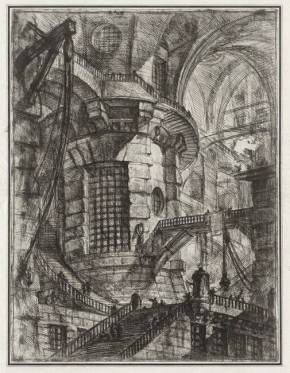
Giovanni Battista Piranesi, Carceri episode: The round tower, ca. 1749–50, etching.
In the eighteenth century Rome was a popular travel destination. Its remains of antiquity, the Renaissance, and Baroque monuments transformed the city into a laboratory of urban and aesthetic innovation. As a location with a rich publishing tradition, Rome also had the necessary infrastructure at its disposal to effectively spread the fame of local landmarks through printed images: illustrators, engravers, and etchers met here with publishers, printers, and distributors of different nationalities.
Thanks to the international circulation of the images, most visitors to Rome had already taken a visual journey through the city. Veduta, maps or panoramas, such as those from Giuseppe Vasi, provided the viewer with an overview of the monuments. Like today’s tourist guides they offered directions on how one might explore the city.
For artists, Rome was also an inexhaustible source of inspiration for architectural fantasies, which, alongside the realistic panoramas, enjoyed a growing popularity. With these inventions, Veneto-born architect Giovanni Battista Piranesi caused something of a stir. At the time, his masterly etchings were significant in establishing Rome alongside Venice as a center of Italian printmaking.

Pier Leone Ghezzi, Signor Domenico Annibali, che parla all’Eminentissimo di San Cesareo, ca. 1749
During his lifetime, almost the entire etched œuvre of the artist made its way to the Dresden Kupferstich-Kabinett. The purchase of Piranesi’s works is only one example of the extensive and selective acquisitions of Roman printmaking that were made at the time. Piranesi’s lifespan covers roughly the same time frame as the exhibited works, which concentrate on panoramas of the ancient and modern Rome as well as unreal spaces. To this day, most of these sheets are bound in so-called collector’s albums—large format volumes that were preferred in the eighteenth and nineteenth centuries for the storage and presentation of print collections.
Additionally, with caricatures by Pier Leone Ghezzi the exhibition offers insights into who populated the streets of the Eternal City in the eighteenth century. Numerous Ghezzi drawings were etched by order of the Saxon Royal Court. Today these sheets are presented as a particularly charming witness of the intensive relationship between Rome and Dresden at that time.
A catalog of the same name published by Sandstein-Verlag Dresden will accompany the exhibition.
Exhibition | Shakespeare in Soane’s Architectural Imagination
Press release for the exhibition on view now at Sir John Soane’s Museum:
‘The Cloud-Capped Towers’: Shakespeare in Soane’s Architectural Imagination
Sir John Soane’s Museum, London, 21 April – 8 October 2016
Curated by Alison Shell
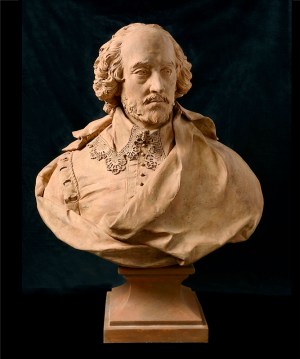
Louis-François Roubiliac, Bust of William Shakespeare (modern replica), 1742 (London: The Garrick Club).
A new exhibition coinciding with the 400th anniversary of the death of William Shakespeare will open at Sir John Soane’s Museum on 21st April. ‘The Cloud-Capped Towers’: Shakespeare in Soane’s Architectural Imagination focuses on Soane’s extensive Shakespeare collections, including his ownership of the first four Folios of Shakespeare’s collected works, the way Soane and his family participated in the eighteenth-century Shakespearean revival, and the influence of the Bard on Soane’s architecture. Guest-curated by Dr Alison Shell of UCL, the exhibition will largely consist of Soane’s own collection, supplemented by important loans from The Garrick Club. Whilst Soane’s fascination with Shakespeare is evident throughout his house-museum, this is the first time the elements have been drawn together to provide a cohesive study of the way Shakespeare influenced Soane. It is also a rare opportunity to see Shakespeare’s first our Folios displayed together in one exhibition.

Robert Adam, Adam’s interior of the Drury Lane Theatre from Works in Architecture of Robert and James Adam, 1779.
The first room of the exhibition introduces the 400th anniversary of Shakespeare’s death, setting it in the context of the 200th anniversary celebrations in 1816, and discusses the intersection between literature and architecture with a particular focus on David Garrick, the celebrated actor-manager of the Drury Lane Theatre who was so instrumental in the popularisation of Shakespeare in Georgian London.
The Garrick Club has loaned two paintings: David Garrick between the Muses of Tragedy and Comedy, after Sir Joshua Reynolds, and John Philip Kemble as Hamlet, from the studio of Sir Thomas Lawrence. These are instantly recognisable portraits of two of the greatest actors of the eighteenth century, famed for their interpretations of Shakespeare. The Adam brothers’ designs for Drury Lane Theatre will also be on display, as well as a rare coloured edition of The Works in Architecture of Robert and James Adam.
The second room in the gallery goes on to consider Shakespeare in Soane’s architectural imagination. In 1788–89 ‘The Shakespeare Gallery’, only the second purpose-built art gallery in England, was built in Pall Mall to designs by George Dance the Younger, Soane’s first architectural teacher and mentor. These in turn influenced Soane’s later designs for the Dulwich Picture Gallery—itself the first public art gallery in Britain.
The exhibition closes with a selection of Soane’s large-scale Royal Academy lecture drawings, allowing access to these appealing and striking images which can usually be viewed only by appointment.
◊ ◊ ◊ ◊ ◊
Catalogue available through Sir John Soane’s Museum:
Frances Sands, Alison Shell, Stephanie Coane, and Emmeline Leary, ‘The Cloud-Capped Towers’: Shakespeare in Soane’s Architectural Imagination (London: Sir John Soane’s Museum, 2016), 48 pages, ISBN: 978-0993204128, £10.
 This book of essays, ‘The cloud-capped towers:’ Shakespeare in Soane’s Architectural Imagination, is published to coincide with an exhibition with the same title to be shown at Sir John Soane’s Museum in 2016 as part of the nationwide commemoration of the 400th anniversary of the death of the great English playwright William Shakespeare.
Sir John Soane (1753–1837) was a highly literary architect, who appears to have valued Shakespeare for the architectural pictures he conjured up, and also as a moral teacher. He had a deep knowledge of Shakespeare’s work, quoting (and misquoting) it often, notably in his Royal Academy lectures. His fascination with Shakespeare is evident both in his library and in the Shakespearian references throughout his house-museum, the most obvious being the Shakespeare Recess, a shrine to the Bard on the staircase.
The four essays in this volume look at the influence of Shakespeare on Soane’s architecture, against the wider background of the eighteenth-century Shakespearean revival; at Soane as a ‘bardolator’ and bibliophile; and at contemporary performance and theatre-going, with a particular focus on the plays seen by Soane and his wife Eliza. The essays are illustrated by a number of illustrations in full colour, the majority drawn from Soane’s own collection.
Frances Sands is Curator of Drawings and Books at Sir John Soane’s Museum. Alison Shell is a professor in the Department of English, University College London. Emmeline Leary is an independent scholar. Stephanie Coane is Senior Librarian is Senior Librarian, College Library, Eton College and Honorary Librarian to Sir John Soane’s Museum.
Exhibition | Giambattista and Domenico Tiepolo: Master Drawings

Domenico Tiepolo, A Centaur Playing with Punchinellos, ca. 1770 (Bloominton Indiana: The Anthony Moravec Collection of Old Master Drawings, Eskenazi Museum of Art)
◊ ◊ ◊ ◊ ◊
From the Eskenazi Museum of Art at Indiana University:
Giambattista and Domenico Tiepolo: Master Drawings from the Anthony J. Moravec Collection
Eskenazi Museum of Art, Indiana University, Bloomington, 1 October 2016 — 5 February 2017
Crocker Art Museum, Sacramento, California, 29 October 2017 — 4 February 2018
Curated by Adeheld Gealt
This fall, the Eskenazi Museum of Art at Indiana University will showcase a series of Italian master drawings, in an exhibition that highlights a major gift of art in the museum’s 75-year history. Giambattista and Domenico Tiepolo: Master Drawings from the Anthony J. Moravec Collection will present a collection of works on paper by the Venetian masters Giambattista and Domenico Tiepolo—a father and son who are widely considered two of the most notable Italian draftsmen of their era—along with works by contemporaries Ubaldo Gandolfi and Giuseppe Bernardino Bison, as well as their predecessor Jacopo Palma il Giovane. Giambattista and Domenico Tiepolo marks the first time that the Eskenazi Museum has comprehensively exhibited the collection of Anthony J. Moravec, an Indiana philanthropist and civic leader who spent five years building the collection in concert with Dr. Adelheid Gealt, the museum’s director emeritus, before donating his holdings to the Eskenazi Museum in 2010.

Domenico Tiepolo, Jesus in the Garden of Gethsemane: The Second Prayer, ca. 1785, pen and brown ink wash over black chalk on paper (The Anthony Moravec Collection of Old Master Drawings, Eskenazi Museum of Art, 2010.118).
On view from October 1, 2016 through February 5, 2017, the exhibition and its accompanying catalogue will provide new scholarship and curatorial insight on Giambattista and Domenico Tiepolo, two of the most important artists in the Old Masters canon. The exhibition will center on a set of 12 New Testament drawings by Domenico Tiepolo, part of a now-scattered cycle of 320 drawings that is regarded as the most exhaustive and sustained visual exploration of the subject by any artist in history. Domenico’s large pen, brush, and ink drawings were dispersed after his death in 1804, and entered many public and private collections where they were prized as outstanding drawings. However, the actual series to which these individual drawings belonged was not known until two scholars— Adelheid Gealt and George Knox, professor emeritus of the University of British Columbia, Vancouver—spent 10 years piecing the series back together and publishing it as a newly discovered New Testament cycle in 2006. Following Moravec’s 2010 gift, which was the largest private collection of New Testament drawings to enter a public collection in recent history, the Eskenazi Museum has become the world’s third-largest repository of works from Tiepolo’s New Testament series, after the Museé du Louvre and the Morgan Library and Museum.
In addition to works from Domenico’s New Testament series, the Moravec collection also includes important works on paper by his father, Giambattista Tiepolo, who is widely regarded as one of the greatest draftsmen of the 18th century. Works by Ubaldo Gandolfi and Giuseppe Bernardino Bison round out the collection, along with a drawing by Jacopo Palma il Giovane—a previously unidentified study for his painting St. John the Baptist Preaching, which was acquired by the museum in 1964. In total, 24 works on paper will be displayed in Giambattista and Domenico Tiepolo, which will be a major highlight of the Eskenazi Museum’s 75th-anniversary season.
◊ ◊ ◊ ◊ ◊
The catalogue will be available in October from Indiana University Press:
Adeheld Gealt, with George Knox, Giambattista and Domenico Tiepolo (Bloomington: Indiana University Press, 2016), 136 pages, ISBN: 978-0253022905, $50.
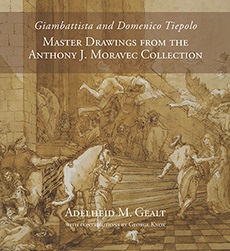 Giambattista and Domenico Tiepolo documents an important collection of master drawings donated by an individual to the Sidney and Lois Eskenazi Museum of Art at Indiana University, including five drawings by the celebrated Venetian genius Giambattista Tiepolo and sixteen drawings by his most famous son, Domenico Tiepolo. Twelve of the sixteen form part of Domenico’s most important drawing series—his exhaustive visual exploration of the New Testament. Also included are two drawings discovered after the 2006 publication of Domenico Tiepolo: A New Testament and seen here for the first time. Gealt and Knox are world-renowned experts on the Tiepolos and this book will serve as a useful reference to understanding their work as draftsmen. This beautiful illustrated volume will appeal to art lovers, biblical scholars, and those who value the unique work of the Tiepolos.
Adeheld M. Gealt is Director Emerita of the Eskenazi Museum of Art. Her research has concentrated on reconstructing the lost serial narratives of the Venetian draftsman Domenico Tiepolo (1727–1804). She is editor (with George Knox) of Domenico Tiepolo: Master Draftsman (1997) and Domenico Tiepolo: A New Testament (2006).
◊ ◊ ◊ ◊ ◊
C O N T E N T S
Foreword, David Brenneman
Preface and Acknowledgments
Structure of the Catalogue
An Interview with the Collector, Anthony J. Moravec and Adelheid M. Gealt
A Brief History of Venetian Drawing
Giambattista Tiepolo, a Brief Biography
Development as a Draftsman
Flight into Egypt
Holy Family
Caricatures
Domenico Tiepolo, a Brief Biography
St. Anthony of Padua
Satyrs and Centaurs
Punchinello
New Testament
Palma Giovane
Ubaldo Gandolfi
Giuseppe Bernardino Bison
Notes
Bibliography
Index
◊ ◊ ◊ ◊ ◊
Note (added 29 October 2017) — The posting was updated to include the Crocker Art Museum as a venue.
Exhibition | Highest Heaven: Spanish and Portuguese Colonial Art
Now on view at the San Antonio Museum of Art:
Highest Heaven: Spanish and Portuguese Colonial Art
of the Roberta and Richard Huber Collection
San Antonio Museum of Art, 11 June 2016 — 14 September 2016
Crocker Art Museum, Sacramento, 23 October 2016 — 22 January 2017
Worcester Art Museum, 12 March — 9 July 2017
Chrysler Museum of Art, Norfolk, Virginia, 2 March — 3 Jun 2018
Curated by William Keyse Rudolph and Marion J. Oettinger

Our Lady of Candlemas with Donors, Bolivian, Potosí, 1799, oil on canvas (Roberta and Richard Huber Collection; photograph by Graydon Wood, Philadelphia Museum of Art)
Highest Heaven explores the paintings, sculpture, furniture, ivories, and silverworks of the Altiplano, or high plains, of South America in the 18th century. Through the work of both well-regarded masters and lesser-known artists, Highest Heaven highlights the role of art in the establishment of new city centers in the Spanish Empire and the propagation of the Christian faith among indigenous peoples. Drawn exclusively from the distinguished collection of Roberta and Richard Huber, the exhibition highlights the distinct visual language created by the cultural and creative exchanges that occurred between Spain and Portugal and their South American colonies. The exhibition will remain on view through September 4, 2016, before traveling to the Crocker Art Museum in Sacramento, California in October, and to the Worcester Art Museum in Worcester, Massachusetts the following March.
The exhibition features more than 100 works, including religious paintings, carved and gilded wooden sculptures, intimate ivories, and silverwork, originally housed in ecclesiastical and private collections throughout the former colonial possessions of Spain and Portugal. The majority of these works were created for functional purposes, as articles of faith or symbols of civic order, and were displayed in a manner that enhanced religious understanding, brought social order, and spurred conversion among colonial populations. Highest Heaven examines these uses, focusing in particular on the translation of Christian imagery to the colonies and the ways in which these works and objects worked to establish an ordered society and were integrated into religious life. The exhibition includes approximately 20 recent acquisitions by the Hubers, many of which have never before been seen in a museum exhibition.
“A central component of our mission is to examine and communicate the historic and cultural contexts of artworks, along with the objects themselves. Highest Heaven is an exciting opportunity to not only investigate the aesthetic beauty of this art, but also the significant role that it played in the cultural, religious, and social lives of these peoples,” said Katherine Luber, The Kelso Director of San Antonio Museum of Art. “We are grateful to Roberta and Richard for their collecting vision and the chance to share this incredible collection with our audiences. San Antonio is a city rich in history and diversity, and we look forward to engaging our community with this work, which we think will have a particular meaning here.”

Pax Depicting the Ecce Homo, Peruvian, 18th century, silver (Roberta and Richard Huber Collection; photograph by Graydon Wood, Philadelphia Museum of Art)
The exhibition is co-curated by William Keyse Rudolph, Mellon Chief Curator and Marie and Hugh Halff Curator of American Art, and Marion J. Oettinger Jr, Curator of Latin American Art. Unlike many previous exhibitions of Colonial Art, which have arranged objects by media, Highest Heaven will be organized according to iconography. After an introductory section that explores a group of objects made for secular life, the exhibition considers the art works religiously, from the angels and archangels that foretold the coming of Jesus Christ, through imagery dealing with the life of Christ and spread of the gospel, to the importance of the Virgin Mary and the saints. Each section of the exhibition contains a mixture of works of art in all media, from paintings to sculpture to silverwork and ivories.
The Altiplano stretches from northern Argentina to the flatlands of Peru, and much of the exhibition focuses on works produced by workshops in the major cities of Cuzco and Lima in modern day Peru and Potosi in modern day Bolivia, where both European and native artists practiced. Paintings and sculpture served primarily to disseminate Christian images and faith to the New World, while works in ivory and silver underscored the wealth and prosperity of the growing Empire. Paintings also frequently depicted major colonial cities to both capture their urban fabric and educate those back home on the appearance and existence of the colonies.
With the extensive growth of trade across the Empire, works of art took on a range of styles that represented European traditions and local idioms. In some instances, European aesthetics and subjects were replicated directly. In others, European saints, idols, and figures took on the appearance of native populations, enhancing their relevance and influence. Yet, in other work, Christian symbols were incorporated into scenes of local rural and urban life. Together, these distinct yet interrelated approaches, created a new visual culture that represented the expansiveness of the Empire, and spoke to the integration of a diversity of peoples into a single faith.
“In contrast to other areas of Spanish colonial scholarship, such as New Spain (present-day Southwestern United States, Mexico, and Central America), much less is known about the artists, workshop practices, and even the names of South American artists,” said Luber. “Collectors are often the first to blaze the trail of discovery, and then the scholarship follows. A show like Highest Heaven opens up avenues of investigation. We are producing a catalogue that we hope will spur additional scholarship in the field. That’s part of what is so exciting about this exhibition.”
New York-based collectors Roberta and Richard Huber developed the collection of colonial South American art over the last 40 years. The Hubers continue to discover new artists and works, building on their holdings for personal enjoyment and public education and making their collection a living and evolving one. They first discovered the art and antiquities of the Spanish Empire when Richard Huber was relocated for work to Buenos Aires, Argentina in 1962. His and Roberta’s love for the period grew as they traveled and lived in other areas of South America. Today, they are committed to enhancing understanding of the diversity, depth, and intricacy of art produced by artists across the Altiplano during Spanish rule.
Erin Kathleen Murphy and William Keyse Rudolph with contributions by Thomas B. F. Cummins, Katherine Moore McAllen, and Katherine Crawford Luber, Highest Heaven: Spanish and Portuguese Colonial Art from the Roberta and Richard Huber Collection (San Antonio: San Antonio Museum of Art, 2016), 192 pages, ISBN: 978-1883502225, $40.
Exhibition | Gardens, Art, and Commerce in Chinese Woodblock Prints
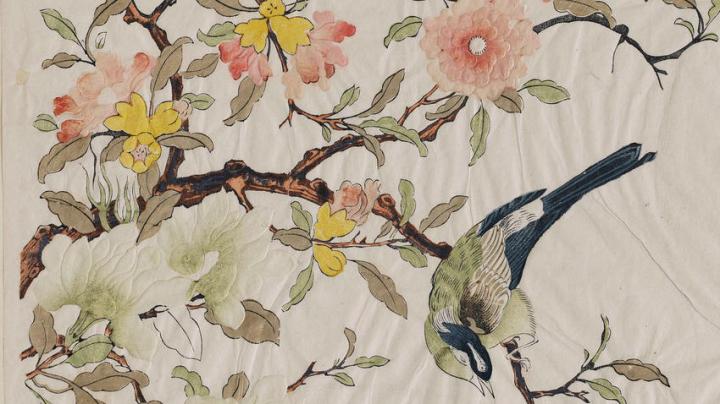
Ding Liangxian, Pomegranate and Magnolia with Bird, (detail), Qing Dynasty, 1700–50; woodblock print with embossing, ink, and colors on paper (multiblock technique with hand-coloring), 11 7/8 × 14 3/4 inches (Boston: Museum of Fine Arts)
◊ ◊ ◊ ◊ ◊
Press release (28 June 2016) from The Huntington:
Gardens, Art, and Commerce in Chinese Woodblock Prints
The Huntington, San Marino, CA, 17 September 2016 — 9 January 2017
Curated by June Li and Suzanne Wright
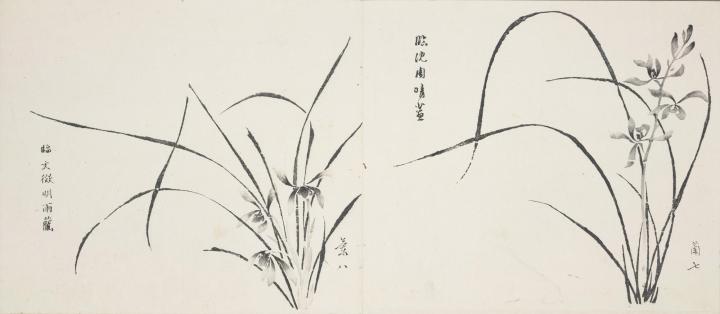
The Huntington Library, Art Collections, and Botanical Gardens will present a major international loan exhibition exploring the art, craft, and cultural significance of Chinese woodblock prints made during their golden age, with works made from the late 16th century through the 19th century. Gardens, Art, and Commerce in Chinese Woodblock Prints brings together 48 of the finest examples gathered from the National Library of China, Beijing; the Nanjing Library; the Shanghai Museum; and 14 institutional and private collections in the United States. The exhibition presents monumental visual accounts of sprawling, architecturally elaborate ‘scholar’s gardens’, alongside delicate prints with painterly textures and subtle colors depicting plants, birds, and other garden elements so finely wrought they might be mistaken for watercolors. A highlight of the exhibition is The Huntington’s rare edition of the Ten Bamboo Studio Manual of Calligraphy and Painting (ca. 1633–1703), acquired in 2014, and on public view for the first time in this exhibition.
Research informing the exhibition and an accompanying catalog reveals much about the history and significance of Chinese pictorial printing during the period, including its influence on better-known Japanese woodblock artists and collectors. Coveted for their artistic merit and technical virtuosity, Chinese illustrated books and pictorial works were collected by the literati and wealthy merchant classes in both China and Japan. The Ten Bamboo Studio Manual, for example, contains the inscriptions of five renowned Japanese artists, successive owners who treasured the artistically ambitious and visually creative volumes as an important resource.
Lotus Leaf, Lotus Root, and Two Jitou Capsules, with calligraphy by Sun Yuwang, Fruit 10, from Ten Bamboo Studio Manual of Calligraphy and Painting, compiled and edited by Hu Zhengyan; woodblock-printed book, ink and colors on paper, each page 9 7/8 × 11 1/4 inches (San Marino: Huntington Library, Art Collections and Botanical Gardens)
◊ ◊ ◊ ◊ ◊
The founding curator of The Huntington’s Chinese Garden, June Li, is co-curator of the exhibition and co-author of the catalog, along with Chinese woodblock print specialist Suzanne Wright, associate professor of art history at the University of Tennessee.
Gardens, Art, and Commerce in Chinese Woodblock Prints unites several interests at The Huntington. It is the home of one of the most extensive collections of early printed books in the nation, various collections of prints by European and American artists, and one of the largest Chinese scholar’s gardens outside of China.
“This exhibition is utterly evocative of The Huntington’s transdisciplinary nature,” said Laura Skandera Trombley, Huntington president. “Woodblock prints were formative communication and aesthetic tools that served a number of purposes over time, from disseminating Buddhist teachings to depicting ideals of beauty. This perfect fusion of art and language, an integration of emotion and intellectual pursuit, is evidenced in The Huntington’s art and library collections, and is embodied in our stunning Suzhou-style Chinese Garden. We are enormously grateful for June Li’s commitment and guiding vision for this extraordinary exhibition.”
During the late Ming (1368–1644) and early Qing (1644–1912) dynasties, an increase in wealth, stemming in part from the salt, rice, and silk industries, led to higher levels of literacy and education. Consumer demand for printed words and images increased as merchants and scholars looked for ways to display their taste in drama, poetry, literature, and art. For these elites, gardens were central to a cultured life, appearing frequently in woodblock prints as subject or setting. By the 1590s, several enterprising publishers were successfully meeting the strong demand for woodblock prints. They hired renowned designers, carvers, and printers to produce sophisticated and exquisite works, raising the standards of printmaking. During the last decades of the Ming dynasty, several centers of printing around the lower Yangzi River delta grew in reputation, ushering in a golden age of Chinese pictorial printing.
“In the realm of Chinese art, pictorial woodblock prints are not as familiar as paintings, calligraphy, or ceramics,” said Li. “The subject of woodblock prints usually brings to mind Buddhist icons, Daoist deities, or folk images, rather than refined and artistic works. But, over the past few years, scholars researching the historical and artistic aspects of these prints have re-introduced a trove of beautiful works that are highly accomplished.”
Building on this story, Gardens, Art, and Commerce in Chinese Woodblock Prints is organized into thematic sections with explanatory panels in both English and Chinese. In the first gallery visitors will find an impressive nine-and-an-half-foot long hand scroll that was commissioned by the Song emperor Taizong (r. 976–97). An unusual Buddhist work that depicts landscape rather than images of deities, it is the earliest and only religious work in the exhibition, showing the lofty achievements of woodblock printers by the 10th century, with enormous clarity of line and painstaking attention to the details of mountains, streams, trees, and tiny figures. The accomplishments of such early printing established the technical foundation from which later Ming and Qing artists grew. Illustrations of the Garden Scenery of the Hall of Encircling Jade, an extraordinary set of 45 prints produced around 1602 to 1605, will be displayed in facsimile (the only evidence that remains of the original). Taken as a whole, the prints illustrate the enormous garden estate of a successful merchant, scholar, and book publisher of the early 17th century. The detailed prints show what seems to be acres of a fashionable garden, with a large, elegant hall framing scholars seated in conversation; a courtyard where figures re-enact a famous poetry game around a table; an enclosure for carefully sculpted penjing (bonsai trees); and more than a hundred names inscribed on buildings, ponds, and rocks. The print has an elevated viewpoint and changing perspectives that allow glimpses into interior spaces, revealing a cultivated life of books and men in scholars’ robes deep in discussion.
The exhibition next focuses exclusively on prints about gardens, both historical and fictional. Historical gardens include famous sites recorded by emperors, such as Suzhou’s Lion Grove, a popular tourist destination to this day. Another imperial work, a scroll more than 25 feet long (six feet of which will be displayed), shows urban gardens and the bustle of daily life in 18th-century Beijing.
The effects of exchanges between European missionaries and the Chinese also are explored in the exhibition. One publisher incorporated biblical illustrations into his ink catalog, produced around 1616. The Qianlong emperor in 1783–86 commissioned a set of large copperplate engravings in a European style that showed details of the European pavilions in his private retreat.
Another section of the exhibition explores the styles of print artists from the late 16th through the 18th centuries in publishing centers such as Hangzhou, Huizhou, Wuxi, and Suzhou. On view are several examples by different publishers illustrating a single popular story, The Story of the Western Chamber, making clear their varying visual and artistic interpretations. In some cases, prints were made to resemble known paintings. Sometimes famous painters, such as Chen Hongshou (1598–1652), designed works expressly for printing. The exhibition includes a rare early edition of Chen’s version of The Story of the Western Chamber, as well as a set of cards he designed for a drinking game.
The exhibition also looks at accomplishments in multi-color and embossed printing, such as beautifully printed guides offering suggestions for cultivating taste. These manuals prescribed appropriate pastimes for a cultivated life, instructed on calligraphy, and advised on chess strategy and drinking games for men, and embroidery patterns for women. They also illustrated musical and dramatic works such as the popular Peony Pavilion. Many of these leisure activities took place in the garden, and prints showing scholar’s rocks, which had become precious items for the discerning collector, will be represented by finely printed editions of well-known works including a rare edition of The Stone Compendium of Plain Garden. Two examples of actual scholar’s rocks from The Huntington’s collection will be on view to complement the book.
Additionally, four iPads in the galleries will allow for a deeper investigation of Illustrations of the Garden Scenery of the Hall of Encircling Jade (a work showing the large garden estate of the successful merchant and publisher Wang Tingna) and allow visitors to see all the leaves of The Huntington’s Ten Bamboo Studio Manual of Calligraphy and Painting, a work that due to its delicate nature can only be viewed a few leaves at a time in the galleries.
Visitors of all ages can view Chinese woodblock printing techniques in a gallery featuring a replica of a printing table, along with carving tools, colored inks, paper, brushes, and burnishers. To better understand the multi-color printing process, a set of woodblocks and step-by-step prints replicating a page of the Ten Bamboo Studio Manual will be on view, a display commissioned from the Shanghai publisher Duo Yun Xuan especially for the exhibition.
T. June Li and Suzanne E. Wright, Gardens, Art, and Commerce in Chinese Woodblock Prints (San Marino: The Huntington Library, Art Collections, and Botanical Gardens, 2016), 176 pages, ISBN 978-0873282673, $50.
June Li details the origins and provenance of The Huntington’s Ten Bamboo Studio Manual of Calligraphy and Painting, a landmark of multi-block color printing, with particular emphasis on its appeal to 18th- and 19th-century Japanese collectors. Suzanne Wright traces the development of three distinct regional styles of woodblock-printed illustrations during the late Ming dynasty, with striking examples of each style drawn from the exhibition. The 176-page volume, published by The Huntington, features more than 150 illustrations, including full-color plates of each work in the exhibition.
◊ ◊ ◊ ◊ ◊
Exhibition Symposium | Word and Image: Chinese Woodblock Prints
The Huntington, San Marino, CA, 12 November 2016
The late Ming period witnessed an unprecedented production of woodblock images printed for many different purposes, including illustrations for drama and games, decorations for stationery paper or ink making, as well as pictorial works for the market. This symposium will explore the relationship and interaction between image and text in woodblock prints during the late Ming and early Qing periods. Register online here.
• Kai-Wing Chow (University of Illinois at Urbana-Champaign), “Nature, Print, and Art: Commerce and Garden Culture in Late Imperial China”
• He Yuming (University of California, Davis), “Illustrating Encyclopedic Knowledge in the Ming”
• Richard Strassberg (University of California, Los Angeles), “The Kangxi Emperor’s Thirty-Six Views: The Making of an Imperial Publication”
• Meng-ching Ma (National Tsing Hua University, Taiwan), “‘Poetic Pictures’ in Late-Ming Illustrated Dramatic Publications”
• Suzanne Wright (University of Tennessee, Knoxville), “The Swallow Messenger: Text and Image”
• Hu Jun (Northwestern University), “A Panoply of Metaphor: Painting and Intermediality in the Late Ming”
Exhibition | Rooms Hidden by the Water: Photographs from Venice

◊ ◊ ◊ ◊ ◊
From Kansallis Museo Finland:
Rooms Hidden by the Water: Photographs from Venice by Jaakko Heikkilä
National Museum of Finland, Helsinki, 29 April — 28 August 2016
The exhibition features approximately 50 photographs by Jaakko Heikkilä, taken between 2005 and 2015 in the palaces of Venetian nobility along with Venetian furniture from the late 1800s from the National Museum’s collections.
Jaakko Heikkilä (b. 1956) is an observer, renowned for photographing people and groups of people around the world. Heikkila photographs people in their own environment: at home, working, at museums, or as flickering shadows on walls. Heikkilä started photographing the Venetian nobility through a friend who opened the doors of the first palace for him. The photographs offer a unique opportunity to peek inside the palaces of the decreasing Venetian nobility and meet the residents and their life stories.
The Venetian nobility live a somewhat isolated life that is bound and protected by their history. The nobility consists of merchants from La Serenissima, the golden age of the Republic of Venice, which existed from the 500s to 1797. They represent Old Europe, the lost world, which is disappearing under the waves just like Venice is due to climate change.
Jaakko Heikkilä, Barone Alberto Franchetti, Alex Snellman, and Minerva Keltanen, Rooms Hidden by the Water: Photographs from Venice by Jaakko Heikkilä (Helsinki: Maahenki, 2016), 131 pages, ISBN: 978-9516162723, €43.










leave a comment