Exhibition | Unbounded: The Eighteenth Century Mirrored by the Present
Now on view in Sweden at the Gothenburg Museum of Art:
Unbounded: The Eighteenth Century Mirrored by the Present / Gränslöst: 1700-tal speglat i nuet
Göteborgs Konstmuseum, Gothenburg, 4 May — 13 November 2016
 The major exhibition of the spring is based on unexpected encounters. Here, art from the eighteenth century is shown alongside crafts, fashion, design, and popular culture, in order to let visual expressions from different periods of time clash against each other, creating friction and new perspectives. The exhibition highlights the boundless and boundary transcending, with a focus on conceptions of gender, man’s relation to nature and the West’s image of China. These themes all touch on areas where norms and values are in a process of renegotiation. The exhibition is a collaboration between the Gothenburg Museum of Art, the Röhsska Museum, and the University of Gothenburg.
Kristoffer Arvidsson, ed., Gränslöst. 1700-tal speglat i nuet / Unbounded: The Eighteenth Century Mirrored by the Present (Gothenburg: Göteborgs Konstmuseums Skriftserie, 2016), 376 pages, ISBN: 978-9187968969.
Exhibition | A Third Gender: Beautiful Youths in Japanese Prints
Press release (via Art Daily) for the exhibition now on view at ROM:
A Third Gender: Beautiful Youths in Japanese Prints
Royal Ontario Museum, Toronto, 7 May — 27 November 2016
Japan Society, New York, 10 March — 11 June 2017
Curated by Asato Ikeda

Suzuki Harunobu, Mitate-e of a Poem by Saigyō Hōshi. 1767/68 (Ontario: ROM, Sir Edmund Walker Collection 926.18.113)
The ground-breaking A Third Gender: Beautiful Youths in Japanese Prints opened at the Royal Ontario Museum on Saturday, May 7, 2016. Featuring stunning woodblock prints, samurai armor, a kimono, screen paintings, lacquerwork, and illustrated books, the exhibition explores issues of gender and tells a pivotal story of sexuality in Japan’s Edo period (1603–1868).
A Third Gender is the first North American display on wakashu. Four hundred years ago in Japan, a complex social structure existed in which gender involved more than a person’s biological sex. Age, position in the sexual hierarchy, and appearance were also considered. Fundamental to this structure were youths termed wakashu. Neither ‘adult man’ nor ‘woman’—each a separate gender—wakashu were objects of desire for both, playing distinct social and sexual roles. Constituting a third gender, they are visually represented in these Edo period woodblock prints.
The exhibition features approximately 60 woodblock prints (ukiyo-e), visually representing wakashu. Many never before displayed, they are from the ROM’s Japanese art collection—the largest in Canada. Produced since the 8th century in Japan, woodblock prints, created collaboratively by a designer, engraver, printer, and publisher, became popular in the 17th century. The exhibition’s prints were created in early 18th to mid-19th centuries by major ukiyo-e masters including Okumura Masanobu, Suzuki Harunobu, and Kitagawa Utamaro.
A Third Gender is curated by Dr. Asato Ikeda, Assistant Professor of Art History at Fordham University, New York and the ROM’s 2014–16 Bishop White Postdoctoral Fellow of Japanese Art and Culture. In Ikeda’s words, “A Third Gender invites ROM visitors to think differently about gender and sexuality and we anticipate the exhibition will be of interest to a diverse audience.”
◊ ◊ ◊ ◊ ◊
From Brill:
Joshua Mostow, Asato Ikeda, and Ryoko Matsuba, A Third Gender: Beautiful Youth in Japanese Edo-period Prints, 1600–1868 (Leiden: Hotei, 2016), 215 pages, ISBN 978-0888545145, $50.
 For the first time outside Japan, A Third Gender examines the fascination with wakashu in Edo-period culture and their visual representation in art, demonstrating how they destabilize the conventionally held model of gender binarism. The volume will reproduce, in color, over a hundred works, mostly woodblock prints and illustrated books from the eighteenth and nineteenth centuries produced by a number of designers ranging from such well-known artists as Okumura Masanobu, Suzuki Harunobu, Kitagawa Utamaro, and Utagawa Kunisada, to lesser known artists such as Shigemasa, Eishi, and Eiri. A Third Gender is based on the collection of the Royal Ontario Museum, which houses the largest collection of Japanese art in Canada, including more than 2500 woodblock prints.
Joshua S. Mostow is Professor of Asian Studies at the University of British Columbia, Vancouver. Asato Ikeda is Assistant Professor of Art History at Fordham University, New York and the ROM’s 2014–16 Bishop White Postdoctoral Fellow of Japanese Art and Culture.
◊ ◊ ◊ ◊ ◊
P R O G R A M S E R I E S
Elements of Sake
3 May 2016
Join Michael Tremblay for an introduction and guided tasting of sake, designed to demystify and engage. This special evening will explore the basics of sake, its production and history, and the culture that created it.
Japanese Visual Culture: Gender and Sexual Diversity
12 May 2016
Asato Ikeda, the curator of A Third Gender, will examine the role of male youths in Edo-period Japan and how this gender and sexuality system can be understood from a contemporary North American perspective.
It’s Complicated: Gender Ambiguity in Early-Mondern Japan
7 June 2016
Explore the roles of gender, sexuality, and erotic art in Japanese culture with internationally renowned scholar Joshua Mostow. Please note this lecture will contain explicit images and discussions of a sexual nature, and is not recommended for those under the age of 18.
Lost in Translation? Gender and Sexuality Across Time and Cultures
21 June 2016
How do we understand representations of sexuality, including same sex sexuality, across different historical and cultural moments without imposing contemporary norms? Join our panel as they explore concepts surrounding our exhibition A Third Gender.
The Art of Japan
16 October 2016
Experience the fundamentals of Japanese art in this in-depth workshop lead by ROM Educator George Hewson. This full day workshop includes a guided visit of the exhibition A Third Gender and lunch.
◊ ◊ ◊ ◊ ◊
Note (added 14 March 2017) — The original posting did not include the Japan Society as a venue.
Exhibition | William Hogarth: A Harlot’s Progress and Other Stories
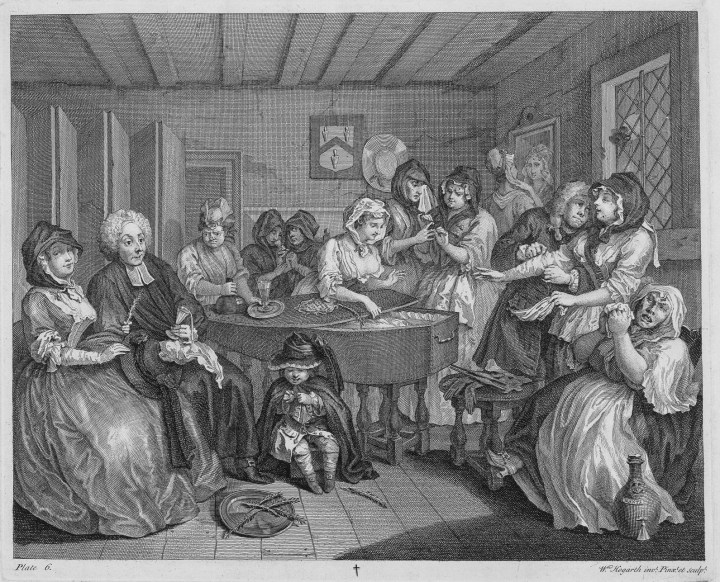
William Hogarth, A Harlot’s Progress, Plate 6, 1732, 364 × 440 mm
(Copenhagen: SMK – The National Gallery of Denmark)
◊ ◊ ◊ ◊ ◊
Press release (22 February 2016) from the National Gallery of Denmark:
William Hogarth: A Harlot’s Progress and Other Stories
William Hogarth: En skøges liv og andre historier
Statens Museum for Kunst, Copenhagen, 14 April — 7 August 2016
Curated by Vibeke Vibolt Knudsen
A young country girl arrives in London in search of work. Instead she ends up a prostitute, and her life spirals steadily downwards, bringing stints in prison and venereal disease. With the exhibition William Hogarth: A Harlot’s Progress and Other Stories, the SMK turns back time to visit eighteenth-century city life in London. The exhibition presents work by the British artist and satirist William Hogarth (1697–1764), who invented a new kind of narrative picture series that served up satirical and moral points with acerbic wit. His style of social critique was unique for the time, focusing on many highly topical subjects: Prostitution, poverty, violence, drunkenness, deceit, self-aggrandisement and desire.
 Three series hold a particularly prominent position in Hogarth’s oeuvre: A Harlot’s Progress (1732), A Rake’s Progress (1735), and Marriage à-la-mode (1745). Each series describes a main protagonist who strives to climb the rungs of the class ladder, but loses their way in debauchery, heading directly for self-destruction and death.
In his autobiographical notes Hogarth states that his pictures are scenes from a play and his subjects are actors strutting soundlessly on the stage. His stories became highly successful, attracting a large audience that included the lower echelons of society as well as the elite. Hogarth insisted that a picture must capture the viewer’s attention by entertaining and pleasing the eye, thereby allowing the serious aspects of its subject to gradually sink in as the narrative progresses towards its tragic climax.
Hogarth’s art is closely linked to London and city life. Around the year 1700 the city had swelled to a population of 600,000, making it the largest city in Europe. He made daily records of the chaotic urban crowds, of all the many and varied forms of life unfolding in the city’s streets and houses; he had a particularly keen eye for the contrasts between different social strata and how they met and clashed.
William Hogarth: A Harlot’s Progress and Other Stories is an exhibition of works from The Royal Collection of Graphic Arts, which is one of the oldest collections of prints and drawings in the world. Housing more than 240,000 works, the collection has roots that date back to the sixteenth century. In 1843 the collection was opened to the public, and in 1896 it was relocated to the new National Gallery of Denmark alongside The Royal Collection of Paintings and The Royal Cast Collection.
The catalogue is available from Arnold Busck:
Vibeke Vibolt Knudsen, William Hogarth: En skøges liv og andre historier (Odder: Narayana Press, 2016), 96 pages, ISBN 978-8792023971, 128KR.
Exhibition | Classical Splendor: Painted Furniture
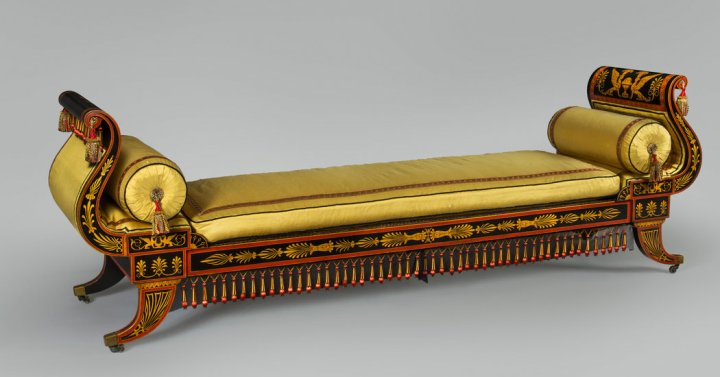
Sofa, designed by Benjamin Henry Latrobe, decorated by George Bridport
(Philadelphia Museum of Art, 1986-126-2a-c).
◊ ◊ ◊ ◊ ◊
Writing for The Magazine Antiques, Alexandra Kirtley previews the exhibition Classical Splendor: Painted Furniture for a Grand Philadelphia House, which opens this fall in Philadelphia.
Alexandra Alevizatos Kirtley, “Superfluity & Excess: Quaker Philadelphia Falls for Classical Splendor,” The Magazine Antiques (March/April 2016).
The fruits of extensive research on Benjamin Henry Latrobe’s 1808 house and furniture for William and Mary Waln begin with their impact on the aesthetic of the city itself.
 By the middle of the eighteenth century the “greene Country Towne” founded by William Penn in 1682 was bustling with commercial and social activity. Colonists from Europe and the British Isles who spoke a variety of languages and practiced a number of religions filled the city. Although the aura of the British and European Quakers who had followed Penn to Philadelphia was still palpable, ambitious merchants had begun to create New World versions of aristocratic styles and customs quite at odds with Quaker comportment . . .
Despite this atmosphere of admonishment against hierarchical social customs and “Superfluity & Excess in Buildings and Furniture,” many Philadelphia Quaker and non-Quaker artisans and their patrons did embrace the luxury of contemporary European and Asian styles. . . . The taste for aristocratic style persisted in the city’s public and private spheres even after the Revolution. . . .
By 1805 the city was no longer the nation’s capital, but it was about to witness the creation of its most innovative, resplendent, and potent interior—the work of a team of artisans commissioned by a Quaker merchant and his socially adept Episcopalian wife. British-born architect Benjamin Henry Latrobe—known as Henry—had arrived in the city in early spring 1798 and had already completed several commissions: the Bank of Pennsylvania in the plain Greek revival style; the domed Pump House for the Centre Square Water Works (completed in 1801, demolished in 1829);4 and a Gothic-style country house in Fairmount Park for the merchant William Cramond called Sedgeley (completed in 1802, demolished around 1857). Latrobe had also established himself in Philadelphia society by marrying Mary Elizabeth Hazlehurst (1771–1841), the daughter of Isaac and Johanna Purviance Hazlehurst—a prominent couple with family, commercial, and political ties in Philadelphia, Baltimore, and Salem, New Jersey.
Philadelphia merchant William Waln, the son of the Quaker preacher Nicholas Waln (1742–1813), had made a bold departure from his faith when he was married by Episcopal Bishop William White to Mary Wilcocks on March 14, 1805, at Christ Church, Philadelphia. But what the couple did next in commissioning Henry Latrobe to design and oversee the building of their magnificent house and its furnishings was even bolder: they unleashed Latrobe to design for them furniture that directly imitated ancient furniture, moving once and for all beyond the restrained bounds of mere references to classical art, and transforming Philadelphia’s—and indeed America’s—interpretation of classical art . . . .
The full article is available here»
◊ ◊ ◊ ◊ ◊
Press Release from the Philadelphia Museum of Art:
Classical Splendor: Painted Furniture for a Grand Philadelphia House
Philadelphia Museum of Art, 3 September 2016 — 1 January 2017
Curated by Alexandra Alevizatos Kirtley and Peggy Olley

Card Table, designed by Benjamin Henry Latrobe, decorated by George Bridport (Philadelphia Museum of Art, photograph by Gavin Ashworth)
This exhibition will showcase a set of furniture designed by architect Benjamin Henry Latrobe (1764–1820) and made in Philadelphia in 1808 for William and Mary Wilcocks Waln. The Museum’s ten surviving pieces of furniture from the Walns’ original set will be shown in a new light, reimagined after a comprehensive five-year curatorial study and conservation treatment.The exhibition will highlight the team of makers—the designer (Latrobe), the maker (John Aitken, d. 1839), the painter (George Bridport, 1783–1819), and the upholsterer (John Rea, 1774–1871)—and the fashion for classical art that the furniture ushered into American interiors. The Walns’ drawing rooms and their furniture provided a setting imitating the art and culture of ancient Greece. The exhibition will consider Latrobe’s groundbreaking ‘Klismos’ chair design, and reveal the London-trained Bridport as the visionary artist who translated Latrobe’s design for the walls into classical designs for the painted furniture and whose work is represented today only by the surviving Waln furniture. The Walns’ extraordinary house, which stood at the southeast corner of Seventh and Chestnut Streets in Philadelphia, was torn down in 1847. Through the use of large-scale computer renderings and various other interactive technologies, visitors will be able to explore the way the two drawing rooms were furnished how they interacted with the rest of the house and the gardens, which were also designed by Latrobe.
◊ ◊ ◊ ◊ ◊
From Yale UP:
Alexandra Alevizatos Kirtley and Peggy Olley, with an essay by Jeffrey Cohen, Classical Splendor: Painted Furniture for a Grand Philadelphia House (New Haven: Yale University Press, 2016), 160 pages, ISBN: 978-0300221718, $35.
 This handsome book explores in depth a group of stunning painted and gilded furniture designed by the architect Benjamin Henry Latrobe (1764–1820), best known for originating the plans for the United States Capitol. The furniture was made in Philadelphia for one of the city’s finest houses—the home of William and Mary Wilcocks Waln, which Latrobe also designed. Drawing on a multiyear conservation and research project, Classical Splendor reveals new insights into the patrons, makers, and history behind these extraordinary pieces. In addition to extensively documenting each item, the book attests to Latrobe’s significant contributions to American furniture design—his pieces for the Waln house introduced, and served as exemplars of, a classical style rooted in ancient Greek and Roman design.
Alexandra Alevizatos Kirtley is the Montgomery-Garvan Curator of American Decorative Arts and Peggy A. Olley is the associate conservator of furniture and woodwork, both at the Philadelphia Museum of Art. Jeffrey A. Cohen is senior lecturer and chair of the Growth and Structure of Cities Program at Bryn Mawr College.
Exhibition | Global by Design: Chinese Ceramics
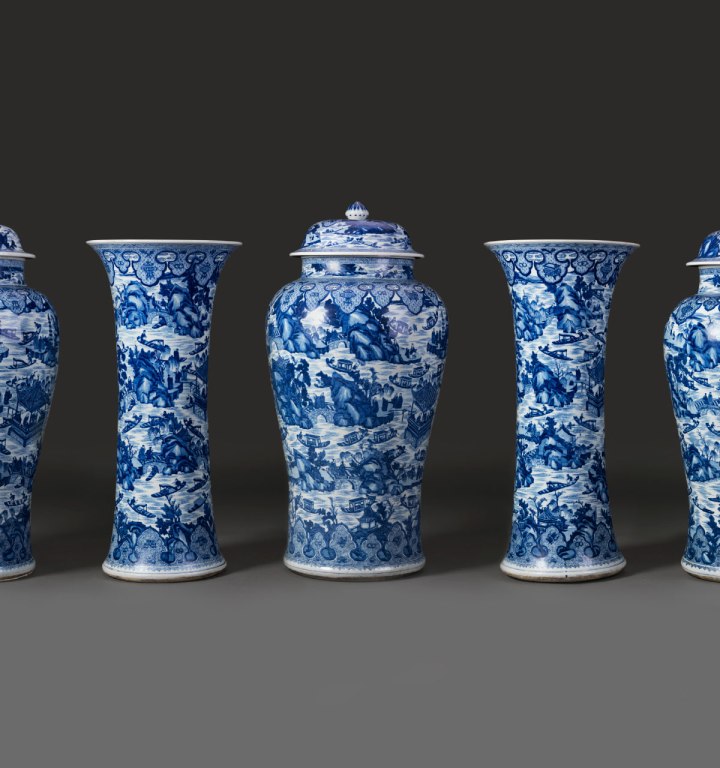
Garniture with Scenes of West Lake, ca. 1700. China, Qing dynasty (1644–1911). Porcelain painted with cobalt blue under a transparent glaze; Jars, H. 40 3/4 in., Vases, H. 35 5/8 in. (R. Albuquerque Collection)
◊ ◊ ◊ ◊ ◊
Press release (25 April 2016) for the exhibition now on view at The Met:
Global by Design: Chinese Ceramics from the R. Albuquerque Collection
The Metropolitan Museum of Art, New York, 25 April — 7 August 2016
Curated by Jeffrey Munger and Denise Patry Leidy
An international loan exhibition of 60 exquisite and unusual Chinese ceramics drawn from a Brazilian private collection—never before exhibited publicly—is now on view at The Metropolitan Museum of Art through August 7. Global by Design: Chinese Ceramics from the R. Albuquerque Collection focuses on the period—from the late 16th to the 18th century—when Chinese porcelain became a global luxury, transforming both the European ceramic industry and styles of dining and drinking.
The introduction of porcelain to Europe can be traced to the period between the late 15th and early 16th centuries known as the ‘Age of Exploration’. This period includes both the discovery by Vasco da Gama (1460–1524) in 1498 of a maritime route around the Cape of Good Hope in Africa to South and East Asia, and the slightly earlier travels of Christopher Columbus (1451–1506) that led to the discovery of the Americas. Supported by Portuguese and Spanish courts, both explorers were searching for a sea route that would provide quicker access to coveted Asian luxuries, including tea, spices, silk, and porcelain.
When the Portuguese first reached China in the 16th century, the extensive kiln complex at Jingdezhen in Jiangxi Province in the southeast dominated porcelain production. (China and, to a lesser extent, Korea were the only places in the world making porcelain at that time.) Portuguese rulers were the first Europeans to commission works from China, and these early-commissioned objects are among the rarest works on view in the exhibition. They include pieces with royal designs, such as a flattened bottle with a coat of arms, and Catholic imagery, such as a delicate bowl with the opening lines of the Hail Mary.
By this time, porcelain had long been treasured in inner-Asian trade, particularly with the Islamic world, and shapes and designs from the Middle East, which had been incorporated into the porcelain industry, were also transmitted to Europe. In the exhibition, a rare example of a kraak dish (ca. 1628–1642) depicting two Persian figures and made for either the Islamic world or Europe provides one example of these complicated interchanges. (The term kraak derives from the Portuguese word for ‘ship’ and is often used in Western sources to define Chinese porcelains made specifically for export in the late 16th and early 17th centuries.) In addition, an unusual bowl with pierced decoration and the Islamic profession of faith has European gilt mounts, indicating its fascinating journey from China to the Islamic world and, ultimately, Europe.
In the early 17th century, after the Dutch auctioned porcelain from two captured Portuguese ships and overtook the Portuguese and Spanish maritime routes, porcelain became widespread throughout northern Europe. By the late 17th and 18th centuries, with the ongoing exchange of shapes and designs, a global artistic language in porcelain making was fully developed. One of the most compelling examples in the exhibition is a monumental set of five vessels; produced for display in a European home, it depicts scenes from West Lake in southern China. In addition, tureens—including a delightful piece in the form of a crab with movable eyes, another in the shape of the historical Chinese Buddhist monk Budai, and a third, based on European silver, with lush patterns incorporating Western and Eastern imagery—exemplify the innovation and experimentation that characterized the Chinese porcelain industry in the 18th century.
The exhibition includes three generous gifts to the Museum from the R. Albuquerque Collection. The exhibition is organized by Jeffrey Munger, Curator, Department of European Sculpture and Decorative Arts, and Denise Patry Leidy, Brooke Russell Astor Curator of Chinese Art, Department of Asian Art. In conjunction with the exhibition, the Museum will offer education programs, including gallery talks and, on June 5, a Sunday at The Met program focusing on trade in Chinese ceramics and their continuous and complicated impact on global traditions.
◊ ◊ ◊ ◊ ◊
Published by Jorge Welsh, the catalogue is available from The Met:
Denise Patry Leidy with catalogue entries by Maria Antónia Pinto de Matos, Global by Design: Chinese Ceramics from the R. Albuquerque Collection (London: Jorge Welsh Research & Publishing, 2016), 240 pages, ISBN: 978-0993506802 (hardcover), £40 / ISBN: 978-0993506819 (softcover), £30 / $40.
 The companion catalogue to The Met exhibition, this beautifully illustrated volume explores the period from the late sixteenth to the eighteenth century when Chinese porcelain became a global luxury, and in doing so, transformed both the European ceramic industry and fashionable styles of dining and drinking. Featuring exquisite and unusual pieces from an important Brazilian private collection, it challenges the long-standing tradition of cataloguing Chinese ceramics as domestic or trade items.
In addition to exploring the trade in Chinese ceramics within Asia, this new book looks at the development of ceramic shapes and designs that reflect the long history of exchange between China and the Islamic world, as well as the period in the late sixteenth century when works reflecting both Chinese and Islamic decorative traditions were introduced and incorporated into Europe and the Americas.
Denise Patry Leidy is the Brooke Russel Astor Curator of Chinese Art at The Metropolitan Museum of Art. Maria Antónia Pinto de Matos is director of the Tile Museum in Lisbon.
Exhibition | Unfinished: Thoughts Left Visible

Benjamin West, American Commissioners of the Preliminary Peace Negotiations with Great Britain, begun in 1783, oil on canvas, 72.3 × 92.7 cm. (Winterthur 1957.856)
◊ ◊ ◊ ◊ ◊
With nearly 200 objects, The Met Breuer’s inaugural exhibition includes a handful of striking eighteenth-century paintings and prints. From the press release:
Unfinished: Thoughts Left Visible
The Met Breuer, New York, 18 March — 4 September 2016
Curated by Andrea Bayer, Kelly Baum, Nicholas Cullinan, and Sheena Wagstaff
Unfinished: Thoughts Left Visible examines a subject that is critical to artistic practice: the question of when a work of art is finished. Opening March 18, 2016, this landmark exhibition inaugurates The Met Breuer, ushering in a new phase for The Met’s expanded engagement with modern and contemporary art, presented in Marcel Breuer’s iconic building on Madison Avenue. With over 190 works dating from the Renaissance to the present—nearly forty percent of which are drawn from The Met’s collection, supplemented with major national and international loans—the exhibition demonstrates the type of groundbreaking show that can result when the Museum mines its vast collection and curatorial resources to present modern and contemporary art within a deep historical context.
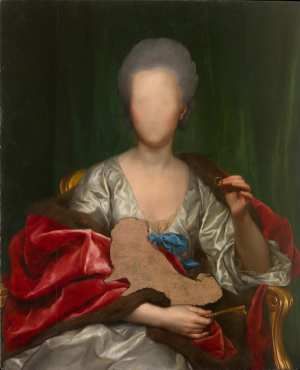
Anton Raphael Mengs, Portrait of Mariana de Silva y Sarmiento, duquesa de Huescar, 1775 (Mr. and Mrs. Otto Naumann, New York)
The exhibition examines the term ‘unfinished’ across the visual arts in the broadest possible way; it includes works left incomplete by their makers, a result that often provides insight into the artists’ creative process, as well as works that engage a non finito—intentionally unfinished—aesthetic that embraces the unresolved and open-ended. Featured artists who explored such an aesthetic include some of history’s greatest practitioners, among them Titian, Rembrandt, Turner, and Cézanne, as well as modern and contemporary artists, including Janine Antoni, Lygia Clark, Jackson Pollock, and Robert Rauschenberg, who have taken the unfinished in entirely new directions, alternately blurring the distinction between making and un-making, extending the boundaries of art into both space and time, and recruiting viewers to complete the objects they had begun.
The accompanying catalogue expands the subject to include the unfinished in literature and film as well as the role of the conservator in elucidating a deeper understanding of artistic thought on the subject of the unfinished.
“Unfinished is a cornerstone of The Met Breuer’s inaugural program and a great example of The Met’s approach to presenting the art of today,” said Thomas P. Campbell, Director and CEO of The Met. “Stretching across history and geography, the exhibition is the result of a cross-departmental collaboration, drawing on the expertise of The Met’s outstanding faculty of curators. We hope the exhibition inspires audiences to reconsider the artistic process as they connect to experiences shared by artists over centuries.”
Sheena Wagstaff, Leonard A. Lauder Chairman of Modern and Contemporary Art, added: “It is rare that an exhibition covering such a broad time span can trace a theme as intimate and essential to the creative process. This sweep of art history throws into sharp focus the ongoing concern of artists about the ‘finishedness’ of their work—which, in the 20th century, they co-opt as a radical tool that changes our understanding of Modernism.”
Using works of art as well as the words of artists and critics as a guide, Unfinished: Thoughts Left Visible strives to answer four questions: When is a work of art finished? To what extent does an artist have latitude in making this decision? During which periods in the history of art since the Renaissance have artists experimented most boldly with the idea of the unfinished or non finito? What impact has this long trajectory had on modern and contemporary art?
The exhibition features works that fall into two categories. The first includes works of art that are literally unfinished—those whose completion was interrupted, usually because of an accident, such as the artist’s death. In some instances, notably Jan van Eyck’s Saint Barbara (1437), there is still debate about whether the artist meant the work to be a finished drawing, which would have been considered unusual at the time, or if it was meant to be a preparation for a painting. Because such works often leave visible the underlying skeleton and many changes normally effaced in the act of completion, they are prized for providing access to the artist’s thoughts, as well as to his or her working process.
The second category includes works that appear unfinished—open-ended, unresolved, imperfect—at the volition of the artist, such as Janine Antoni’s Lick and Lather (1993–1994). Antoni used a mold to create a series of self-portrait busts, half from chocolate and half from soap, fragile materials that tend to age quickly. After finishing the busts, she set to work unfinishing them, licking those in chocolate and bathing with those in soap, stopping once she had arrived at her distinctive physiognomy. The unfinishedness of objects in this second category has been debated and appreciated at definite times, in definite places. Unlike the historical art presented in the exhibition, which includes a significant number of truly unfinished objects, art from the mid-to-late 20th and 21st centuries is represented almost entirely through the lens of non finito.
The exhibition is organized chronologically, spanning the third and fourth floors of The Met Breuer. The works are subdivided thematically, with each group representing a specific case-study in unfinishedness—corresponding to specific times (such as the Renaissance, Baroque, and Modern periods), media (prints and sculpture), artists (including Turner, Cézanne, and Picasso), and genres (most importantly portraiture).
A new, light-based installation by Tatsuo Miyajima, created especially for Unfinished, will be on view in the Tony and Amie James Gallery in the lobby of The Met Breuer (late April through mid-October).
Unfinished: Thoughts Left Visible is curated by Andrea Bayer, Jayne Wrightsman Curator in the Department of European Paintings; Kelly Baum, Curator of Postwar and Contemporary Art in the Department of Modern and Contemporary Art, both at The Metropolitan Museum of Art; and Nicholas Cullinan, former curator in The Met’s Department of Modern and Contemporary Art and current Director of the National Portrait Gallery in London, all working under the direction of Sheena Wagstaff, Leonard A. Lauder Chairman of Modern and Contemporary Art at The Metropolitan Museum of Art. Many curators, conservators, fellows, and research assistants at The Met contributed to this exhibition and its accompanying catalogue, including experts from the Museum’s departments of American Paintings and Sculpture, Drawings and Prints, European Paintings, European Sculpture and Decorative Arts, Paintings Conservation, and Modern and Contemporary Art.
A series of experimental films made by many of the 20th and 21st century’s most innovative filmmakers are being shown in conjunction with the exhibition. Organized by Thomas Beard, founder and director of Light Industry, a venue for film and electronic art in Brooklyn, these screenings, which take place on The Met Breuer’s second floor, address the unfinished in cinematic terms. Details on screening times will be available at a later date.
In collaboration with The Met, The Orchestra Now (TŌN) will present The Unfinished, a performance at Carnegie Hall of two unfinished works: Schoenberg’s Chamber Symphony No. 2 and Mozart’s Great Mass in C minor. The concert will include a panel discussion with the Museum’s Sheena Wagstaff and Andrea Bayer; TŌN’s music director Leon Botstein; Columbia University’s Elaine Sisman, Anne Parsons Bender Professor of Music; and others. Friday, May 13, 2016, 7:30–9:45 pm; tickets start at $25.
Related programs include a Sunday at The Met on May 8 that considers the idea of the unfinished in relation to works across times and cultures and a lecture series on June 20 presenting new scholarship on the subject.
Kelly Baum, Andrea Bayer, and Sheena Wagstaff, Unfinished: Thoughts Left Visible (New York: The Metropolitan Museum of Art, 2016), 336 pages, ISBN: 978-1588395863, $65.
The exhibition is accompanied by a 336-page fully illustrated catalogue that constitutes the most exploratory, yet also comprehensive, introduction to date of the long history of the unfinished in the visual arts, film, and literature. The book is divided into two main sections that roughly correspond to the periods 1435–1900 and 1900–2015. It contains essays by 13 curators, scholars, and a conservator on a range of artists and subjects related to the theme of the unfinished. The catalogue also features interviews with five contemporary artists—Vija Celmins, Marlene Dumas, Brice Marden, Luc Tuymans, and Rebecca Warren—whose work is represented in the exhibition; and a section of brief catalogue entries on each of the objects featured in the exhibition that explores the significance of the work, with an emphasis on its place in the broader narrative and, frequently, an account of its reception. The catalogue is published by The Met and distributed by Yale University Press. The catalogue is made possible by the Samuel I. Newhouse Foundation, Inc. and the Roswell L. Gilpatric Publications Fund.
Exhibition | Netherlandish Drawings, 15th to 18th Centuries

Now on view at the GNM in Nuremberg:
Netherlandish Drawings: Newly Discovered Works from the Germanisches Nationalmuseum
Niederländische Zeichnungen: Neu entdeckte Werke aus dem Germanischen Nationalmuseum
Germanisches Nationalmuseum, Nuremberg, 18 February — 22 May 2016
Since the Renaissance, drawing has been particularly valued—not just because of its relevance to the creative process in all the arts, but also as an insight into an artist’s inspiration. In his Schilder-Boeck (Book of Painters) of 1604, the Dutch biographer Carel van Mander also describes it admiringly as the “father of painting.”
The prominent role of graphic art is also reflected in the GNM’s holdings of Netherlandish drawings of the 15th to 18th century, which are now being shown for the first time in a special exhibition. Featuring around 90 selected works, the exhibition traces an arc from pieces from the workshop of Jan van Eyck through to the decorative designs of Jacob de Wit. The diversity of techniques and themes so typical of the Flemish and Dutch masters is revealed in depictions of landscapes, figure studies, genre scenes, allegories or religious subjects. The exhibition also looks at the various functions of draughtsmanship: from the first sketched idea through to independent works produced for the art market.
The GNM’s Department of Prints and Drawings includes around 150 drawings by Netherlandish artists from the 15th to the 18th century. The geographical term ‘Netherlandish’ refers to both the northern provinces of Holland and the Flemish areas in present-day Belgium. With a few exceptions, these drawings, from the hand of both prominent and not so prominent masters, have remained unpublished and therefore unknown to art historical research.
The museum’s founder, Freiherr Hans von und zu Aufseß, owned Netherlandish drawings, e.g. a sheet signed and dated by Bartholomeus Spranger. However, most of the holdings were acquired through individual purchases between 1866 and 1939. The Netherlandish collection also grew in 1940 and 1982 as a result of bequests from two private collectors.
In addition to a couple of early works, the holdings contain many 17th-century drawings from the Dutch Golden Age. The pictorial genres include landscapes, figures, genre scenes, allegories and religious and mythological subjects. A few 18th-century technical drawings of Netherlandic origin from the ‘Historical Sheets’ are worthy of note as items specific to the collection. The functional relationships between the drawings are diverse, and not always obvious—studies, sketched ideas, drafts for specific paintings, printed graphics etc. can be found alongside independent works produced for the art market.
The goal is to created a printed catalogue describing and depicting the Department of Prints and Drawings’ Netherlandish drawings in accordance with scientific standards and thus open them up for further research. This work is focusing on collecting and evaluating the technical findings, stylistic peculiarities and possible functions of the drawings, particularly in view of the discussion about issues of dating and attribution. The results of the research project are presented in this special exhibition, from February 18 to May 22, 2016.
◊ ◊ ◊ ◊ ◊
Claudia Valter, with contributions by Frank Matthias Kammel and Thomas Ketelsen, Die Niederländischen Zeichnungen 1400–1800 im Germanischen Nationalmuseum (Nuremberg, 2016), 280 pages, ISBN: 978-3936688979, 60€.
 Die Graphische Sammlung des Germanischen Nationalmuseums bewahrt rund 130 niederländische Zeichnungen des 15. bis einschließlich 18. Jahrhunderts, die durch Ankäufe, Schenkungen und Vermächtnisse in den Jahren 1858 bis 1982 erworben wurden. Hierzu zählen Werke von Jan Breughel d.J., Philips Koninck oder Bartholomeus Spranger, aber auch Arbeiten von weniger bekannten und anonymen Meistern. In dem vorliegenden Bestandskatalog sind die niederländischen Zeichnungen nun erstmals in ihrer Gesamtheit wissenschaftlich bearbeitet, mit Provenienzangaben sowie den technischen und bibliographischen Daten dokumentiert und farbig abgebildet. Den Katalog ergänzen Textbeiträge zur Sammlungsgeschichte niederländischer Kunst am Germanischen Nationalmuseum sowie zu den Funktionen niederländischer Zeichnungen.
Exhibition | Freemasonry
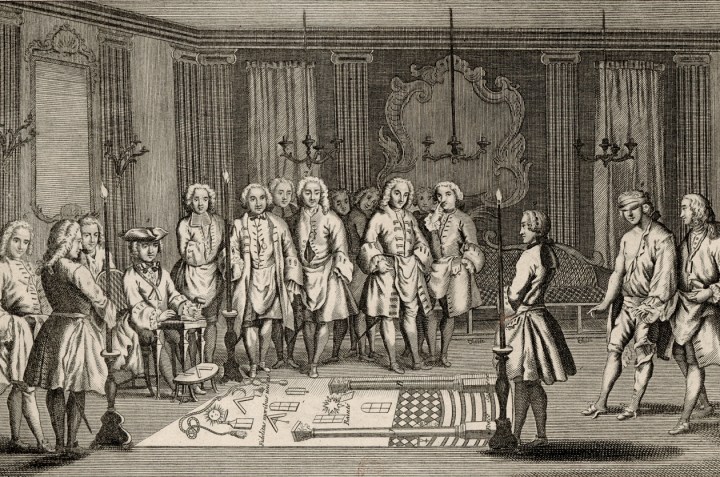
Assemblée de Francs-Maçons pour la réception des Maîtres, 1745
◊ ◊ ◊ ◊ ◊
Now on view at the BnF:
Freemasonry
Bibliothèque Nationale de France, Paris, 12 April — 24 July 2016
Curated by Pierre Mollier, Sylvie Bourel, and Laurent Portes
The Bibliothèque nationale de France, which houses one of the most important Masonic collections in the world, organizes a major exhibition dedicated to French freemasonry, in partnership with the Musée de la franc-maçonnerie. Over 450 pieces are presented, some of them for the first time ever. Some of these pieces belong either to the library’s collections or to major French obediences. Others were exceptionally lent by foreign owners. The exhibition focuses on the following issues: the origins of freemasonry, how it was founded in France, its symbols and rituals, its involvement in the political, religious, artistic and philosophical fields, the variety of associated legends… Its aim is to present freemasonry as an accessible issue.
The exhibition website is available here»
◊ ◊ ◊ ◊ ◊
Pierre Mollier, Sylvie Bourel, et Laurent Portes, La franc-maçonnerie (Paris: Bibliothèque Nationale de France, 2016), 344 pages, ISBN: 978-2717726992, 45€.
 À partir du XVIIIe siècle, la franc-maçonnerie s’implante aussi profondément que durablement dans la société française. Si, de nos jours, celle-ci fait régulièrement la une des journaux, elle n’en demeure pas moins mal connue—quand elle ne nourrit pas encore d’obscurs soupçons de trafic d’influence, de complot ou d’occultisme. Publié à l’occasion de l’exposition d’une envergure sans précédent que la Bibliothèque nationale de France consacre à la franc‑maçonnerie, cet ouvrage est appelé à devenir l’une des références incontournables du domaine. Réunissant les contributions des plus grands spécialistes, il répond à la légitime curiosité dont la maçonnerie fait l’objet.
Des origines légendaires à la franc-maçonnerie moderne, dite spéculative, il retrace l’histoire de la franc-maçonnerie en faisant la part du fantasme et de la réalité. Il présente le corpus symbolique et les rites maçonniques associés à la notion, ici centrale, d’initiation. Excluant tout esprit polémique, il répertorie les réalisations politiques et sociétales de l’histoire moderne qui puisent leurs sources dans l’engagement philanthropique des maçons : les lois sur la liberté de la presse, la liberté d’association, la laïcité, l’école gratuite et obligatoire ou encore les premières bases de la protection sociale. Il relève également les inspirations maçonniques variées qui, depuis trois siècles, irriguent les arts et les lettres, de La Flûte enchantée de Mozart à Léon Tolstoï ou Rudyard Kipling, en passant, aujourd’hui, par la bande dessinée ou le roman policier. Riche par la diversité des thèmes abordés, cet ouvrage l’est enfin par son iconographie. La Bibliothèque nationale de France abrite l’un des plus importants dépôts de documents maçonniques au monde : manuscrits, estampes, livres rares y sont à la fois nombreux et d’une qualité remarquable. Ces collections exceptionnelles méritaient d’être connues et admirées au-delà du monde des chercheurs et des spécialistes ; reproduites ici, parfois pour la toute première fois, elles contribueront désormais, de manière aussi spectaculaire que documentée, à la meilleure compréhension d’une société dont les adeptes eux-mêmes reconnaissent la complexité.
Cet ouvrage est publié à l’occasion de l’exposition «La franc-maçonnerie», organisée par la Bibliothèque nationale de France et présentée sur le site François-Mitterrand, du 12 avril au 24 juillet 2016.
Exhibition | Three Centuries of American Prints
From the press release (3 February 2016) for the exhibition:
Three Centuries of American Prints from the National Gallery of Art
National Gallery of Art, Washington, D.C., 3 April 3 — 24 July 2016
National Gallery, Prague, 4 October 2016 — 5 January 2017
Antiguo Colegio de San Ildefonso, Mexico City, 7 February — 30 April 2017
Curated by Amy Johnston and Judith Brodie

John Simon after John Verelst, Sa Ga Yeath Qua Pieth Tow, King of the Maquas, after 1710 (Washington, D.C.: National Gallery of Art, Paul Mellon Fund)
A new international traveling exhibition will explore major events and movements in American art through some 150 outstanding prints from the Colonial era to the present. Three Centuries of American Prints from the National Gallery of Art is the first major museum survey of American prints in more than 30 years. Timed to coincide with the National Gallery of Art’s 75th anniversary, the exhibition is drawn from the Gallery’s renowned holdings of works on paper, and features more than 100 artists such as Paul Revere, James McNeill Whistler, Mary Cassatt, Winslow Homer, George Bellows, John Marin, Jackson Pollock, Louise Nevelson, Romare Bearden, Andy Warhol, Robert Rauschenberg, Chuck Close, Jenny Holzer, and Kara Walker.
Organized chronologically and thematically through nine galleries, Three Centuries of American Prints reveals the breadth and excellence of the Gallery’s collection while showcasing some of the standouts: exquisite, rare impressions of James McNeill Whistler’s Nocturne (1879/1880), captivating prints by Mary Cassatt, a singularly stunning impression of John Marin’s Woolworth Building, No. 1 (1913), and Robert Rauschenberg’s pioneering Booster (1967).
The exhibition is bracketed by John Simon’s Four Indian Kings (1710)—stately portraits of four Native American leaders who traveled to London to meet Queen Anne—and Kara Walker’s no world (2010), which recalls the disastrous impact of European settlement in the New World. Both prints address the subject of transnational contact, a theme that runs through the history of American art.

Paul Revere, The Boston Massacre, 1770, hand-colored engraving (Washington, D.C.: National Gallery of Art, Rosenwald Collection)
Three Centuries of American Prints features works intended to provoke action, such as Paul Revere’s call for moral outrage in The Bloody Massacre (1770) and Jenny Holzer’s appeal to “Raise Boys and Girls the Same Way” in her Truisms (1977). Others lean more strongly toward visual concerns, such as Stuart Davis’s striking black-and-white lithograph, Barber Shop Chord (1931), and Richard Diebenkorn’s resplendent Green (1986). This duality between prints designed to exhort or teach and ones more weighted to artistic matters is an undercurrent of both the exhibition and the history of American prints.
Since its opening in 1941, the National Gallery of Art has assiduously collected American prints with the help of many generous donors. The Gallery’s American print collection has grown from nearly 1,900 prints in 1950 to some 22,500 prints in 2015. The collection was transformed in recent years by the acquisition of the Reba and Dave Williams Collection, the personal print archive of Jasper Johns, and some 2,300 American prints from the Corcoran Gallery of Art, along with a gift and pledge of 18th- and early 19th-century prints from Harry W. Havemeyer.
“In the past few decades the American collections at the National Gallery of Art have grown vastly in quality and scale. From 2000 until today—thanks to generous donors and acquisitions from the Corcoran Gallery of Art—the collection of American prints has almost doubled and now numbers some 22,500 works,” said Earl A. Powell III, Director, National Gallery of Art. “We are tremendously grateful to hundreds of donors, foremost among them Lessing J. Rosenwald and Reba and Dave Williams, as well as grateful to Altria Group, the Terra Foundation for American Art, and The Exhibition Circle of the National Gallery of Art for their vital support.”
The exhibition is made possible by Altria Group in celebration of the 75th Anniversary of the National Gallery of Art. This is the twelfth exhibition sponsorship by Altria Group at the Gallery. “For more than 50 years, Altria and its companies have supported visual and performing arts. Our partnership with the National Gallery of Art to share Three Centuries of American Prints is an important way that we’re bringing world-class cultural experiences to our communities,” said Bruce Gates, Senior Vice President of External Affairs for Altria Client Services. The international tour of the exhibition is sponsored by the Terra Foundation for American Art. Additional support is provided by The Exhibition Circle of the National Gallery of Art.
The curators of the exhibition are Amy Johnston, assistant curator of prints and drawings, and Judith Brodie, curator and head of the department of modern prints and drawings, both at the National Gallery of Art. The exhibition catalog is conceived and edited by Judith Brodie, with coauthors Amy Johnston and Michael J. Lewis, the Faison-Pierson-Stoddard Professor of Art History at Williams College. The Terra Foundation for American Art provided additional funding for the exhibition catalog.
Judith Brodie, Amy Johnston, and Michael J. Lewis, Three Centuries of American Prints (New York: Thames & Hudson, 2016), 306 pages, ISBN: 978-0500239520, $60.
Exhibition | Maria Merian’s Butterflies
From the Royal Collection Trust:
Maria Merian’s Butterflies
The Queen’s Gallery, Buckingham Palace, London, 15 April — 9 October 2016
The Queen’s Gallery, Palace of Holyroodhouse, Edinburgh, 17 March — 23 July 2017
Curated by Kate Heard
I had the plates engraved by the most renowned masters, and used the best paper in order to please both the connoisseurs of art and the amateur naturalists interested in insects and plants.
—Maria Sibylla Merian
 In 1699, the German artist and entomologist Maria Sibylla Merian set sail for Suriname, in South America. There she would spend two years studying the animals and plants which she encountered, aiming to explore the life-cycle of insects (then only partially understood). Those studies led to the publication of the Metamorphosis Insectorum Surinamensium (the Metamorphosis of the Insects of Suriname), a luxury volume which brought the wonders of Suriname to Europe.
Maria Merian’s Butterflies tells Merian’s story through her works in the Royal Collection, acquired by George III. Many are luxury versions of the plates of the Metamorphosis, partially printed and partially hand painted onto vellum by the artist herself. Over three hundred years after they were made, these meticulous, brilliant works celebrate a woman whose art and whose story are enduringly popular.
Maria Merian’s Butterflies is shown at The Queen’s Gallery, Buckingham Palace with Scottish Artists 1750–1900: From Caledonia to the Continent.
The catalogue is available in the U.S. and Canada from The University of Chicago Press:
Kate Heard, Maria Merian’s Butterflies (London: Royal Collection Trust, 2016), 192 pages, ISBN: 978-1909741317, £15.
Maria Sibylla Merian (1647–1717) trained as an artist under her stepfather in Nuremberg. Fascinated by butterflies and moths from an early age, she studied the insect life cycle through the animals she found in local fields and gardens, recording her discoveries in meticulous watercolors and prints. After she moved to Amsterdam in 1691, Merian became interested in the wildlife of Suriname, which she encountered in the collectors’ cabinets and botanical gardens in the city. Merian’s fascination with Suriname led her to undertake a trip to the country, then a Dutch colony, to study insects in their natural habitat. Between 1699 and 1701, she worked in Suriname, making expeditions around the country to collect specimens, rearing butterflies and moths and recording their eating habits and metamorphoses.
Merian’s work in Suriname was published on her return to Amsterdam as the Metamorphosis Insectorum Surinamensium, or The Metamorphosis of the Insects of Suriname. This groundbreaking book presented the insects that Merian had studied, with each insect life cycle shown on the correct host plant—an approach which has seen her described as ‘the first ecologist’. Merian’s illustrations are scientifically rigorous, but they are also beautiful, reflecting her training as an artist in the still-life tradition. Her approach to scientific illustration would be adopted by many of the natural historians who followed her.
Maria Merian’s Butterflies tells Merian’s story through her works in the Royal Collection. The core of these is a set of plates from the Metamorphosis, partially printed and partially drawn on vellum, which were acquired by George III as part of his extensive scientific library. Over three hundred years after they were made, these meticulous, brilliant works celebrate a woman whose art and whose story are enduringly popular.
Kate Heard is Senior Curator of Prints and Drawings, Royal Collection Trust. Her previous publications include High Spirits: The Comic Art of Thomas Rowlandson (2013) and she is Deputy Editor of the Journal of the History of Collections.










leave a comment