Exhibition | Georgia’s Girlhood Embroidery
Press release (21 September 2015) from the Georgia Museum of Art:
Georgia’s Girlhood Embroidery: ‘Crowned with Glory and Immortality’
Georgia Museum of Art, University of Georgia, Athens, 31 October 2015 — 28 February 2016
Curated by Kathleen Staples and Dale Couch

Frances Roe (Savannah, Georgia), Sampler, ca. 1815 (Georgia Museum of Art, University of Georgia)
The Georgia Museum of Art at the University of Georgia will present the exhibition Georgia’s Girlhood Embroidery: ‘Crowned with Glory and Immortality’ October 31, 2015, through February 28, 2016. Organized by curators Kathleen Staples, independent scholar, and Dale Couch, curator of decorative arts at the museum, it focuses on ornamental needlework created in Georgia and is the first comprehensive exhibition of Georgia samplers.
Girls between the ages of 8 and 12 created embroidered samplers during the 18th and 19th centuries in Georgia as an exercise to gain skills in sewing, needlework and embroidery. Wealthier girls were expected to possess such skills as part of their participation in polite society. Girls from humbler backgrounds and free African Americans could use their skills to find paid employment. The samplers include rows of alphabets, quotations in prose and verse, images of architecture and embellished floral borders. Written documents from the period show that needlework took part in many different settings: public and private, elective and required, urban and rural.
Couch said, “The Henry D. Green Center for the Study of the Decorative Arts, at the Georgia Museum of Art, is keen to examine and present the art of all groups of people who were present in Georgia’s history. My predecessor Ashley Callahan and I searched for embroidery examples that represented the work of Georgia’s women for more than a decade. With the help of textile specialist Kathy Staples, we have been able to decipher the needlework done by elite women in early Georgia. These women were literate and educated, which provided them with the means of creating such ornamental needlework. In spite of the elite nature of embroidery, Staples has touched on many important tangents of Georgia experience, including African American sewing and girlhood education.”
The exhibition includes about two dozen samplers created in Georgia or by Georgians between the mid-18th century and about 1860, on loan from public and private collections, including those of the Museum of Early Southern Decorative Arts (MESDA), the Midway Museum, the Charleston Museum, the Telfair Museums, St. Vincent’s Academy (Savannah, Georgia) and the President James K. Polk Home and Museum. It will be accompanied by a fully illustrated catalogue published by the museum and for sale through the Museum Shop.
One example, worked by Martha ‘Patsey’ Bonner McKenzie (1775–1851), was used as evidence by its maker to claim a Revolutionary War widow’s pension. Another, by Eliza S. Blunt, consisted of architectural embroideries, which were very uncommon in Georgia at the time. Blunt’s needlework probably shows the Eatonton Academy, built ca. 1807.
Associated museum events include a public tour at 2 p.m. on November 11; a Family Day focusing on embroidered holiday ornaments at 10 a.m. on December 5; and the eighth biennial Henry D. Green Symposium of the Decorative Arts, organized by the museum and held at the UGA Hotel and Conference Center February 2–4, 2016. The museum will also host and co-organize this year’s MESDA Textile Seminar, Interwoven Georgia: Three Centuries of Textile Traditions, to be held January 14–16, 2016.
The exhibition is sponsored by the National Endowment for the Arts, the W. Newton Morris Charitable Foundation and the Friends of the Georgia Museum of Art.
Exhibition | Ceci n’est pas un portrait: Figures de fantaisie
Opening next month at the Musée des Augustins in Toulouse:
Ceci n’est pas un portrait: Figures de fantaisie de Murillo, Fragonard, Tiepolo…
Musée des Augustins, Toulouse, 21 November 2015 — 28 February 2016
Curated by Melissa Percival and Axel Hémery
Le Musée des Augustins, musée des beaux arts de Toulouse présentera, à partir du 21 novembre 2015, une exposition totalement inédite sur les figures de fantaisie en Europe du XVIe au XVIIIe siècle. Encore peu étudiées comme un sujet à part entière dans l’histoire de l’art, les figures de fantaisie regroupent des peintures illustrant la fascination qu’ont pu exercer la figure et le corps humains sur l’art européen pendant plus de deux siècles.

Jean-Honoré Fragonard, Cavalier assis près d’une fontaine, ca. 1769 (Barcelone, MNAC, Museu Nacional d’Art de Catalunya de Bellas Artes)
Centrées sur les émotions et les passions humaines, elles offrent au regard une intimité au plus près du sujet et abordent des thèmes universels, toujours étonnement modernes, comme l’apparence des sentiments, l’ambivalence des êtres humains ou la question du genre. Loin de l’art du portrait contraint par la commande ou la mode, cette exposition est un véritable éloge à la liberté, à l’invention et à la virtuosité en peinture.
Quatre-vingt tableaux provenant de musées français et européens seront réunis au musée des Augustins pour évoquer cet art intemporel en marge des traditionnelles classifications et mouvements de l’histoire de l’art. Les plus grands comme les plus attachants des peintres y seront représentés comme Annibal Carrache, Van Dyck, Jordaens, Hals, Murillo, Fragonard, Greuze, Tiepolo, mais aussi Dosso Dossi, Sweerts, Schalcken, Giordano, Piazzetta, Grimou, Ceruti, Morland… Cette sélection d’œuvres exceptionnelles sera présentée sous un angle inhabituel mélangeant provenances, époques et écoles pour se concentrer sur des sections dynamiques.
Les thèmes développés par le parcours de l’exposition seront les suivants : Jeux de regards ; Musiciens ; Vies intérieures ; Dormeurs ; Rires et sarcasmes ; Le laboratoire du visage ; L’atelier du costume. Tous ces sujets permettront de mettre en valeur l’originalité profonde de cette peinture et la cohérence de ces œuvres à travers le temps et l’espace.
Commissariat de l’exposition
Melissa Percival : professeur d’histoire de l’art et de français à l’université d’Exeter, auteur de Fragonard and the Fantasy Figure (auteur pour le catalogue qui accompagnera cette exposition de l’essai principal et des notices sur le XVIIIème siècle)
Axel Hémery, Co-commissaire : Directeur du musée des Augustins de Toulouse, conservateur en chef du patrimoine spécialiste de peinture du XVIIème siècle (auteur pour le catalogue d’un avant-propos et des notices XVIème et XVIIème).
Pour plus d’information, téléchargez le communiqué de presse.
◊ ◊ ◊ ◊ ◊
The catalogue is published by Somogy:
Melissa Percival and Axel Hémery, ed., Figures de fantaisie du XVIe au XVIIIe siècle (Paris, Somogy éditions d’Art, 2015), 288 pages, ISBN: 978-2757209981, 35€.
 Figures de fantaisie du XVIe au XVIIIe siècle explore les recherches et inventions des artistes européens autour de la figure humaine, sur presque trois siècles. Le rapprochement d’œuvres jusque-là rattachées aux catégories usuelles de l’histoire de l’art (peinture d’histoire, portrait, scène de genre, etc.) éclaire de façon saisissante la récurrence de certains types de figures, dans différents pays et à différentes périodes de l’histoire : ici, les mendiants italiens se comparent aux vagabonds d’Espagne, les courtisanes de la Renaissance rencontrent les bergères du Nord du XVIIe siècle, les tronies nordiques renvoient aux figures caravagesques, les têtes d’expression de Tiepolo, aux figures de fantaisie de Fragonard, et Greuze répond aux fancy pictures anglaises. Il s’en dégage un ensemble d’une cohérence inattendue, véritable éloge de la liberté et de la virtuosité en peinture.
S O M M A I R E
Avant-propos
• Les figures de fantaisie. Un phénomène européen / Melissa Percival
• Sensualité des figures à mi-corps et théâtralité de la peinture / Bronwen Wilson
• Pathos et mystère : la figure de fantaisie endormie / Petra ten-Doesschate Chu
• La tête de vieillard dans l’art européen : sacrée et profane / Martin Postle
• Les fenêtres du possible : la figure de fantaisie et l’esprit d’entreprise au début du XVIIIe siècle / John Chu
Œuvres exposées
Jeux de regards, cat. 1–15
Musiciens, cat. 16–22
Vies intérieures, cat. 23–34
Dormeurs, cat. 35–41
Rires et sarcasmes, cat. 42–55
Le laboratoire du visage, cat. 56–69
L’atelier du costume, cat. 70–83
Annexes
Index des artistes exposés
Bibliographie
Exhibition | Watteau’s Soldiers: Scenes of Military Life
Press release (23 October 2015) from The Frick:
Watteau’s Soldiers: Scenes of Military Life in Eighteenth-Century France
The Frick Collection, New York, 12 July — 2 October 2016
Curated by Aaron Wile
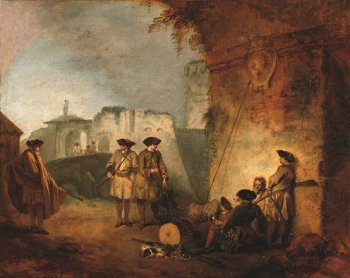
Jean-Antoine Watteau, The Portal of Valenciennes (La Porte de Valenciennes), ca. 1711−12, oil on canvas, 12 3/4 x 16 inches (New York: The Frick Collection; photo by Michael Bodycomb)
It would be difficult to think of an artist further removed from the muck and misery of the battlefield than Jean-Antoine Watteau (1684–1721), who is known as a painter of amorous aristocrats and melancholy actors, a dreamer of exquisite parklands and impossibly refined fêtes. And yet, early in his career, Watteau painted a number of scenes of military life, remarkable for their deeply felt humanity and intimacy. These pictures were produced during one of the darkest chapters of France’s history, the War of the Spanish Succession (1701–14). But the martial glory on which most military painters of the time trained their gaze—the fearsome arms, snarling horses, and splendid uniforms of generals glittering amid the smoke of cannon fire—held no interest for Watteau, who focused instead on the most prosaic aspects of war: the marches, halts, encampments, and bivouacs that defined the larger part of military life. Inspired by seventeenth-century Dutch and Flemish genre scenes, the resulting works show the quiet moments between the fighting, when soldiers could rest and daydream, smoke pipes and play cards.
Watteau produced about a dozen of these military scenes, but only seven survive. Though known primarily only to specialists, they were once counted among the artist’s most admired works and owned by such prominent figures as Catherine the Great and the Prince of Conti. Presented exclusively at The Frick Collection in the summer of 2016, Watteau’s Soldiers is the first exhibition devoted solely to these captivating pictures, introducing the artist’s engagement with military life to a larger audience while offering a fresh perspective on the subject. Among the paintings, drawings, and prints are four of the seven known paintings—with the Frick’s own Portal of Valenciennes as the centerpiece—as well as the recently rediscovered Supply Train, which has never before been exhibited publicly in a museum. Also featured are about twelve studies of soldiers in red chalk, many directly related to the paintings on view.
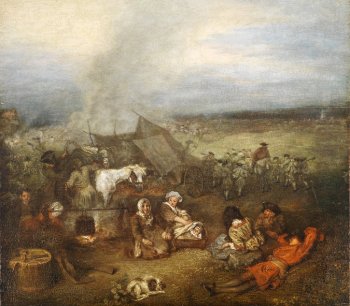
Jean-Antoine Watteau, The Supply Train (Escorte d’équipages), ca. 1715, oil on panel, 11 1/8 x 12 3/8 inches (Private collection)
The works on display offer a rare opportunity to study the drawings and paintings together and probe Watteau’s complex and remarkable working methods. Unlike most of his contemporaries, Watteau did not proceed methodically from compositional sketches, studies, and full-scale models to the final painting. Instead, his process followed the whims of his imagination and the demands of the moment. He began by drawing soldiers from life, without a predetermined end in mind. These drawings provided him with a stock of figures, often used multiple times, that he would arrange in an almost spontaneous fashion on the canvas. As a result, figures previously isolated in his sketchbook were brought together and juxtaposed in new social relationships on the canvas, producing the ambiguous, dreamlike effects that make his paintings so intriguing.
The exhibition is rounded out by a selection of works by Watteau’s predecessors and followers: the Frick’s Calvary Camp by Philips Wouwerman, a typical example of the seventeenth-century Dutch paintings after which Watteau modeled his own; a study of a soldier by Watteau’s follower Jean-Baptiste Pater, from the Fondation Custodia, Paris; and a painting of a military camp by his other great follower, Nicolas Lancret, from a private collection. These works shed light on the ways in which Watteau transformed the painting of military life in Europe, demonstrating his pivotal influence on the genre.
Aaron Wile, Watteau’s Soldiers: Scenes of Military Life in Eighteenth-Century France (London: D. Giles, 2016), 112 pages, ISBN: 978-1907804793, £25 / $40.
Published by The Frick Collection in association with D Giles, Ltd., London, the book accompanying the exhibition is the first illustrated catalogue of all Watteau’s works related to military subjects.
Additional works included in the exhibition are illustrated here»
Exhibition | Wicked Wit: Darly’s Comic Prints
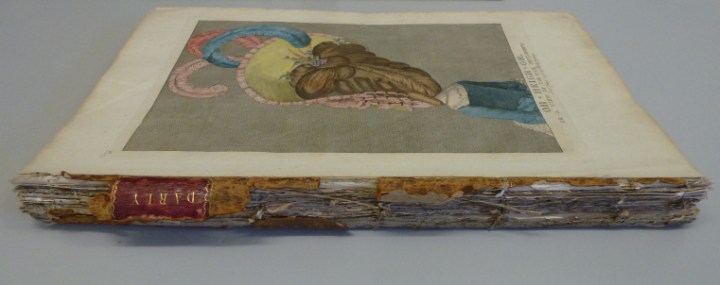
Album of Darly prints in the Chester Beatty Collection (Wep 0494), with its much deteriorated eighteenth-century binding, as photographed in the Library’s conservation studio in 2015. More information is available at the Chester Beatty Conservation Blog.
◊ ◊ ◊ ◊ ◊
Now on view at the Chester Beatty Library:
Wicked Wit: Darly’s Comic Prints
Chester Beatty Library, Dublin Castle, Dublin, 11 September 2015 — 14 February 2016
Curated by Jill Unkel
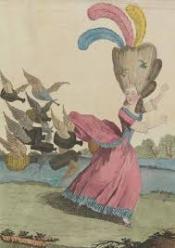 Drawing on the Library’s own collections, this exhibition features over 100 hand-coloured, eighteenth-century etchings by the husband and wife team, Mary and Matthew Darly. From the time of their marriage, they worked in tandem designing, engraving and publishing prints using the signature, MD or MDarly.
This printer-publisher team produced well over 500 comic images of Caricatures, Macaronies, and Characters from no. 39 Strand (London) between 1770 and 1780. At the height of their fame, carriages lined the streets so their occupants could titter at the images on display in Darly’s Comic Exhibitions, held every spring from 1773 to 1778. By the end of the decade, they had become so popular that their publications were available throughout Great Britain and Ireland, Europe and even America. The name Darly became synonymous with the humorous images they produced.
◊ ◊ ◊ ◊ ◊
The catalogue is available for purchase through the Beatty Library’s shop:
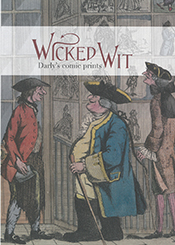 Jill Unkel, Wicked Wit: Darly’s Comic Prints (Dublin: Chester Beatty Library, 2015), 80 pages, ISBN: 978-0957399822, 20€.
This fully illustrated catalogue is divided into a number of themes and opens with a general introduction to Mary and Matthew Darly. It then examines more specifically their comic prints, publications, and exhibitions. This is followed by a more detailed exploration of the various subjects presented in their comic images: stereotyped characters (and their relation to theatre), caricatures of notable contemporaries, satires of the dress of young macaroni (akin to a dandy or fop) men and their feathered-feminine counterparts, and finally the impolitical satires related to the war with the American Colonies.
Exhibition | Dutch Dining: Four Centuries of Table Settings
Thanks to Hélène Bremer for noting this exhibition (along with installation by Bouke de Vries). . .
Nederland Dineert: Vier Eeuwen Tafelcultuur
Dutch Dining: Four Centuries of Table Settings
Gemeentemuseum, The Hague, 28 February 2016
Fine dining is a form of sensory seduction. It operates not only via the taste buds, but also via the visual appeal of the food and table setting. Beautiful porcelain and silverware, glittering crystal, fine damask and extravagant sugarwork table ornaments all have a part to play. This exhibition at the Gemeentemuseum Den Haag uses a spectacular display of complete table settings, complemented by drawings, paintings and liveries, to bring the history of formal dining among the Netherlands’ wealthy elite, ruling class and royal house to vivid life. The perfect place to find inspiration for that very special Christmas dinner table!
 Dutch Dining paints a fascinating picture of the way people in the top echelons of Dutch society were once accustomed to dine together. At tables laden with exquisite culinary delights and surrounded by an army of liveried footmen. The show is both a feast for the eye and a unique insight into the past. All of the objects in the reconstructed table settings are completely authentic—from the tableware to the ornaments, and even the furniture. The table linen comes from the very linen cupboard in which it has lain ever since the 18th century.
No table setting would be complete without meticulously folded napkins. The European fashion for the decorative use of table linen dates back to the Renaissance. In our own day, Catalan artist Joan Sallas is reviving this ‘forgotten art’ with his astonishingly skilful birds, fish and rabbits. The exhibition will feature ten such virtuoso constructions, all specially folded for the occasion.
An exclusive peek inside the royal porcelain and silverware cabinet will transport visitors right to the heart of the Noordeinde Palace. Stars of the show are two complete table services—a silver one of modern design and its more traditional porcelain counterpart—on loan from the collection of the Dutch Royal House. Both services were presented to Queen Wilhelmina and Prince Hendrik on the occasion of their marriage in 1901 and the exhibition discloses which of the two found most favour with the royal couple.
The design of the exhibition is by Maarten Spruyt and Tsur Reshef. The lavishly illustrated Dutch-language catalogue, Nederland dineert. Vier eeuwen tafelcultuur, offers the first ever reliable survey of four centuries of Dutch table settings and contains historical essays. For the museum’s youngest visitors there is also a children’s picture book and a related exhibition in the children’s gallery. The Gemeentemuseum Den Haag and the Netherlands Nutrition Centre (Voedingscentrum) are joining forces to organize a range of activities during the Dutch Dining exhibition.
The exhibition includes items generously loaned by the Rijksmuseum, Amsterdam Museum, Museum Van Loon, Kastelen Middachten, Amerongen, Twickel and de Haar, Fundatie van Renswoude Utrecht, Koninklijke Verzamelingen Den Haag, RCE/Jachthuis St. Hubertus, Huis der Provincie Arnhem and private collections.
Nederland Dineert: Vier Eeuwen Tafelcultuur (Zwolle: Waanders, 2015), 320 pages, ISBN: 978-9462620575, €34.50.
Koken en eten hoort als vanzelfsprekend bij het leven. Veel esthetiek komt hier in eerste instantie niet bij kijken. Maar zodra gezamenlijk wordt gegeten, wordt eten een sociale bezigheid, een middel tot communicatie, tot representatie, tot onderscheid. Voor dit boek is een keur aan specialisten op zoek gegaan naar de specifieke eetcultuur van Nederland. Aan de hand van een tiental authentieke ensembles van eetvertrekken van verschillende landgoederen en paleizen met daarbij bewaard gebleven voorwerpen, wordt het dineren in de afgelopen vier eeuwen geïllustreerd. Laat u betoveren door de verhalen rond de maaltijd en de uitstraling van volledig opgetuigde tafels, gedekt met tafellinnen, porselein en zilver, decoraties van suikerwerk en bloemen, van de bijbehorende meubels en het dienstpersoneel in livrei.
Exhibition | Following Hercules: The Story of Classical Art
◊ ◊ ◊ ◊ ◊
Press release (11 September 2015) from The Fitzwilliam:
Following Hercules: The Story of Classical Art
The Fitzwilliam Museum, Cambridge, 25 September — 6 December 2015
Curated by Caroline Vout
A colossal polystyrene statue of Hercules by contemporary artist Matt Darbyshire will be the star exhibit in a new exhibition at the Fitzwilliam Museum exploring the story of classical art. How did artefacts made in the Mediterranean millennia ago come to define western art? To show us how Greece and Rome’s gods and heroes came to inhabit post-antique painting and sculpture, the Fitzwilliam Museum has called upon one of them to act as a guide: Hercules.

Hercules and the Erymanthian Boar, ca. 1790, Wedgwood, Etruria, Staffordshire, Jasperware plaque, h. 212 mm (Cambridge: Fitzwilliam Museum)
Hercules is one of the best-loved ancient heroes. Known in antiquity for completing twelve tasks or ‘labours’ that confirmed his status as a god, Hercules is today tasked with one more—to tell the story of classical art. Hercules is brought to life by each of the forty objects on display (from exquisite gems and coins, Renaissance drawings and bronzes, to eighteenth-century paintings, and Matthew Darbyshire’s giant polystyrene statue…). Their interaction also reveals how classical art was born, and gives classical art on-going relevance.
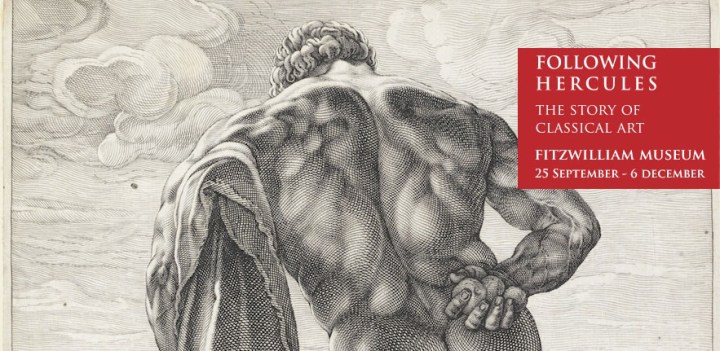
The exhibition takes its lead from its star exhibit, a colossal sculpture by Cambridge-born artist Matthew Darbyshire. Darbyshire’s intervention is a version of the Farnese Hercules, a marble statue unearthed in Rome in 1546, but is made from sheets of polystyrene—classical art for a consumerist age. Up close, its cut, crisp polystyrene layers make it appear pixelated, but step back, and the statue comes into focus, shining like marble. Back in 1850, two years after the Founder’s Building opened to the public, the Fitzwilliam Museum exhibited another Farnese Hercules, a plaster version, now in Cambridge’s Museum of Classical Archaeology. Before being given to the Fitzwilliam, it stood in a private house in Battersea, where it moved London’s artists to tears. The Fitzwilliam Museum’s own collection is well equipped with prototypes and later versions of the Farnese Hercules: from a bronze statuette of the first century BCE, through Hendrick Goltzius’s sixteenth-century engraving of the Farnese statue’s rear view, Wedgwood’s white on blue cameo plaque, and William Blake’s illustration of the statue for Abraham Rees’s The Cyclopædia, or, Universal Dictionary of Arts, Sciences, and Literature. The Museum’s collection also provides competing images of Hercules—images of Hercules young, drunk, or dressed as a woman, in bronze, wood and painted porcelain. These give context to Darbyshire’s sculpture, underlining that classicism and modernism are not opposites. In the fast moving, digital age in which we live, we perhaps need tradition more than ever.
The exhibition is curated by Dr Caroline Vout, Reader in Classics in the University of Cambridge and Fellow of Christ’s College, and is part of her British-Academy funded research project entitled Classical Art: A Life History.
Caroline Vout, Following Hercules: The Story of Classical Art (Cambridge: The Fitzwilliam Museum, 2015), 48 pages, ISBN: 978-1910731024, £5.
◊ ◊ ◊ ◊ ◊
Note (added 2 December 2018) — The posting was updated to include information about the catalogue.
Exhibition | Titian to Canaletto: Drawing in Venice
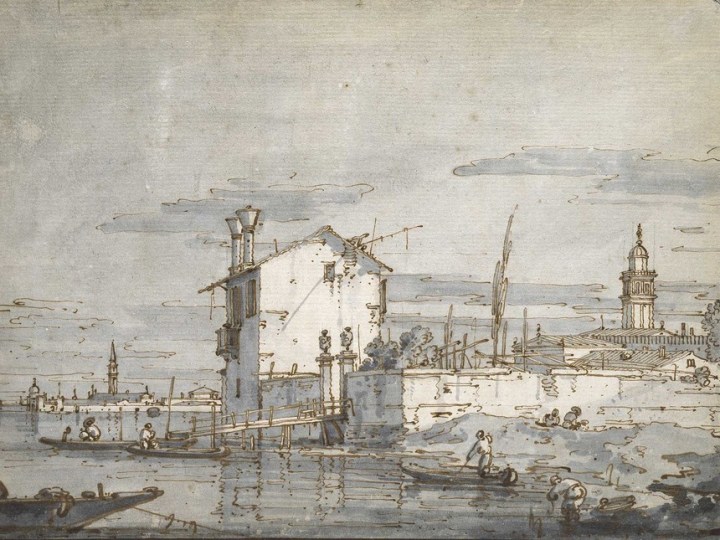
Giovanni Antonio Canal, known as Canaletto (1697‒1768), An Island in the Lagoon, pen, brown ink with grey wash over ruled pencil lines on blue paper, 20 x 27.9 cm (Ashmolean Museum, University of Oxford).
◊ ◊ ◊ ◊ ◊
Press release (28 August 2015) for the exhibition opening this week at the Ashmolean:
Titian to Canaletto: Drawing in Venice
Ashmolean Museum of Art and Archaeology, Oxford, 15 October 2015 — 10 January 2016
Curated by Catherine Whistler
Featuring a hundred drawings from the Uffizi, the Ashmolean, and Christ Church, Oxford, Titian to Canaletto is a groundbreaking exhibition based on new research. Venetian art has long been associated with brilliant colours and free brushwork, but drawing has been written out of its history. This exhibition highlights the significance of drawing as a concept and as a practice in the artistic life of Venice. It reveals the variety of purposes and techniques in drawing from Bellini, Titian and Tintoretto to Tiepolo and Canaletto. In a parallel exhibition, Jenny Saville Drawing, one of the UK’s most celebrated contemporary artists, Jenny Saville, has produced new work on paper and canvas in response to the Venetian Old Masters.
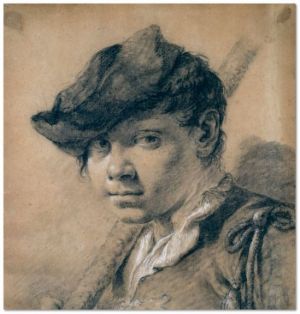
Giovanni Battista Piazzetta (1682‒1754), Head of a Youth, black and white chalks on brownish paper, 31.5 x 29.9 cm (Ashmolean Museum, University of Oxford)
Putting the words ‘drawing’ and ‘Venice’ together seems paradoxical. Writing on Venetian art has located creativity and artistic ambition in painting above all, emphasizing the materiality and sensuous effects achieved by Venetian artists. The intellectual and reflective qualities encapsulated in drawing are seen as irrelevant in the artistic world of Venice. The idea that Venetian artists did not use or value drawing was articulated in Florence, in Giorgio Vasari’s Lives of the Artists of 1568. Vasari’s influential statements were repeated and elaborated by later writers, so that in 1770s London, Joshua Reynolds confidently asserted that artists in Venice did not care about drawing with all of its virtues of discrimination and judgement, and that they went straight to working with brushes on canvas. This potent literary tradition had a major impact on the survival of drawings.
Titian to Canaletto presents new research which traces continuities in Venetian drawing over three centuries, from around 1500 to the foundation of the first academy of art in Venice in 1750. The exhibition emphasizes the role of drawing from sculpture and from life in the education and identities of Venetian artists, and it reveals tensions between theory and practice in the activities of artists and of collectors. Venetian artists used drawing for innovating and experimenting, or as a tool for research and observation; a variety of drawings were made and admired as works of art in their own right. The exhibition poses questions about the survival and value of drawings: does the fact that we have so few by Titian mean that he did not draw? Why were many Venetian drawings thought unworthy of collecting?
Ironically, while the story that Venetian artists did not respect drawing was first told in Florence, one of the world’s great collections of Venetian drawings is held at the Uffizi where many drawings were acquired in the mid-seventeenth century for Leopoldo de’Medici. Not only are there masterpieces by Carpaccio, Bassano, Titian and Tintoretto, and high-quality works by lesser-known seventeenth- century artists, there are also drawings that reveal early attitudes to collecting and connoisseurship. The Uffizi will also lend drawings by Tiepolo that have never been shown before, to be grouped with the Ashmolean’s own superb collection. Pioneering collectors in England owned Venetian drawings, and loans of important works by Veronese and Tintoretto will come from the intact early eighteenth-century collection at Christ Church, Oxford, together with the extraordinary Portrait of a man, by Giovanni Bellini.
Dr Catherine Whistler, Keeper of the Department of Western Art, Ashmolean Museum, and curator of the exhibition, says: “The beauty and visual impact of these drawings speak eloquently of the importance of drawing in Venice. We hope this exhibition will challenge traditional views of Venetian art and provoke new thinking on some of the greatest names in Italian art from the Renaissance to the eighteenth century.”
Dr Alexander Sturgis, Director of the Ashmolean, says: “The Ashmolean is bringing to a close its year of drawings exhibitions with this landmark show. Titian to Canaletto includes some of the Ashmolean’s greatest treasures, brought together with examples from two of the world’s finest collections of Old Master drawings—that of the Uffizi and the Christ Church Picture Gallery. Many of the works in the exhibition have not been displayed in public since the 1950s. The captivating beauty of these drawings is evident in the response they have elicited from one of this country’s most distinguished contemporary artists, Jenny Saville, who has produced a new body of work inspired by pieces in the exhibition and her enduring love of Venetian art.”
In Jenny Saville Drawing, Jenny Saville will present a body of drawings, including several new and unseen works in a dedicated exhibition space that accompanies Titian to Canaletto: Drawing in Venice. The rich material and gestural qualities of Venetian drawings have been an inspiration for the thoughtful yet visceral works on paper and canvas that will be on view. For Jenny Saville, the blurred or grainy charcoal marks and the agile, robust pen lines of Venetian artists such as Titian or Palma Giovane become catalysts for exploring the nature and power of drawing, in new, highly charged works of art.
◊ ◊ ◊ ◊ ◊
The catalogue is distributed by ACC:
Catherine Whistler, ed., Drawing in Venice: Titian to Canaletto (Oxford: Ashmolean Museum/ Woodstocker Books, 2015), 256 pages, ISBN: 978-1854442994, $45.
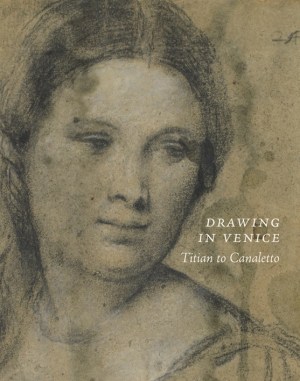 Featuring over a hundred drawings from the outstanding collections of graphic art at the Uffizi, Florence, and the Ashmolean, and Christ Church, Oxford, Drawing in Venice is based on ground-breaking new research and accompanies an Ashmolean-Uffizi collaborative exhibition (2015–16) which traces continuities in Venetian drawing over three centuries, from around 1500 down to the foundation of the first academy of art in Venice in 1750.
Venetian art has long been associated with brilliant colours and free brushwork, but drawing has been written out of its history. This book highlights the significance of drawing as a concept and as a practice in the artistic life of Venice. It reveals the variety of aims, purposes, and techniques in drawing through the works of the Venetian Renaissance masters Giovanni Bellini, Titian, and Tintoretto to those of the great eighteenth-century artists, Giovanni Battista Tiepolo and Canaletto.
Dr Catherine Whistler is Keeper of the Western Art Department at the Ashmolean Museum, University of Oxford. Her previous publications include Michelangelo and Raphael Drawings (1990); Drawings by the Carracci from British Collections (joint author, 1996); Opulence and Devotion: Brazilian Baroque Art (2001); and Graceful and True: Drawings in Florence c.1600 (joint author, 2003).
C O N T E N T S
Essays
1 Catherine Whistler, Drawing in Venice from Titian to Canaletto: Practice and Perception
2 Giorgio Marini, Disegni a stampa: Drawing Practice and Printmaking in Venice from the Sixteenth to the Eighteenth Centuries
3 Marzia Faietti, Giorgio Vasari’s ‘Life of Titian’: Critical Misinterpretations and Preconceptions Concerning Venetian Drawing
4 Jacqueline Thalmann, General John Guise and His Collection of Venetian Drawings
Catalogue Entries
Glossary of Materials and Techniques of Drawing
Artists’ Biographies
Bibliography
Exhibition | The Edible Monument: The Art of Food for Festivals

Marcantonio Chiarini and Giacomo-Maria Giovannini, Disegni del convito fatto dall’illustrissimo signor senatore Francesco Ratta all’illustrissimo publico, eccelsi signori anziani and altra nobilità: terminando il svo confalonierato li 28. febraro 1693 (The Getty Museum). More information is available here.
◊ ◊ ◊ ◊ ◊
The Edible Monument revisits the exhibition mounted at the Getty in 2000, with the publication this fall of an accompanying catalogue.
The Edible Monument: The Art of Food for Festivals
The Getty Research Institute, Los Angeles, 13 October 2015 — 23 March 2016
Detroit Institute of Arts, 16 December 2016 — 16 April 2017
Curated by Marica Reed
Elaborate artworks made of food were created for royal court and civic celebrations in early modern Europe. Like today’s Rose Bowl Parade on New Year’s Day or Mardi Gras just before Lent, festivals were times for exuberant parties. Public celebrations and street parades featured large-scale edible monuments made of breads, cheeses, and meats. At court festivals, banquet settings and dessert buffets displayed magnificent table monuments with heraldic and emblematic themes made of sugar, flowers, and fruit. This exhibition, drawn from the Getty Research Institute’s Festival Collection, features rare books and prints, including early cookbooks and serving manuals that illustrate the methods and materials for making edible monuments.
Edited by Marcia Reed with contributions by Charissa Bremer-David, Joseph Imorde, Marcia Reed, and Anne Willan, The Edible Monument: The Art of Food for Festivals (Los Angeles: Getty Publications, 2015), 192 pages, ISBN 978-1-60606-454-2, $35.
 The Edible Monument considers the elaborate architecture, sculpture, and floats made of food that were designed for court and civic celebrations in early modern Europe. These include popular festivals such as Carnival and the Italian Cuccagna. Like illuminations and fireworks, ephemeral artworks made of food were not well documented and were challenging to describe because they were perishable and thus quickly consumed or destroyed. In times before photography and cookbooks, there were neither literary models nor a repertoire of conventional images for how food and its preparation should be explained or depicted. Although made for consumption, food could also be a work of art, both as a special attraction and as an expression of power. Formal occasions and spontaneous celebrations drew communities together, while special foods and seasonal menus revived ancient legends, evoking memories and recalling shared histories, values, and tastes. Drawing on books, prints, and scrolls that document festival arts, elaborate banquets, and street feasts, the essays in this volume examine the mythic themes and personas employed to honor and celebrate rulers; the methods, materials, and wares used to prepare, depict, and serve food; and how foods such as sugar were transformed to express political goals or accomplishments.
Marcia Reed is chief curator at the Getty Research Institute. She is coeditor of China on Paper (Getty Publications, 2007).
◊ ◊ ◊ ◊ ◊
C O N T E N T S
Acknowledgments
1 Marcia Reed—Food, Memory, and Taste
2 Marica Reed—Court and Civic Festivals
3 Marcia Reed—Feasting in the Streets: Carnivals and the Cuccagna
4 Joseph Imorde—Edible Prestige
5 Charissa Bremer-David—Of Cauliflower and Crayfish: Serving Vessels to Awaken the Palate
6 Anne Willan—Behind the Scenes
Contributors
Illustration Credits
Index
◊ ◊ ◊ ◊ ◊
Note (added 2 November 2016) — The DIA venue was not included in the original posting.
Exhibition | The Fabric of India
I noted this exhibition last fall, but it’s worth following up now that the show is on view at the V&A (3 October 2015 — 10 January 2016). The press release is available as a PDF file here, with information on the catalogue included below. –CH
◊ ◊ ◊ ◊ ◊
From the V&A shop:
Rosemary Crill, The Fabric of India (London: V&A Publishing, 2015), 240 pages, ISBN: 978-1851778539, £30 / $60.
 This is the first truly comprehensive book on Indian textiles, featuring stunning examples from all over the country. Lavishly illustrated, it begins with an in-depth exploration of the different materials, techniques, and dyeing processes used in the creation of these sumptuous fabrics before exploring the central importance of cloth to Indian life and culture from ancient times to the present day. Special features focus on objects of historical importance, including a Kashmir map shawl, Tipu Sultan’s tent, and a remarkable 18th-century temple hanging from South India.
While many are familiar with Mughal velvets, western-market chintzes, or rural embroideries, for example, this book will surprise, inspire, delight, and inform with an extraordinary range of material, much of it new. Along with presenting great historical masterpieces, the importance and variety of the basic fibers—silk, cotton, wool—from which Indian textiles are traditionally made is emphasized, and the remarkable techniques of weaving, printing, dyeing, and embroidery that have made them prized across the world are illustrated in specially taken photographs.
Exhibition | Woven Gold: Tapestries of Louis XIV
Press release (30 April 2015) from The Getty:
Woven Gold: Tapestries of Louis XIV
The Getty Center, Los Angeles, 15 December 2015 — 1 May 2016
Curated by Charissa Bremer-David
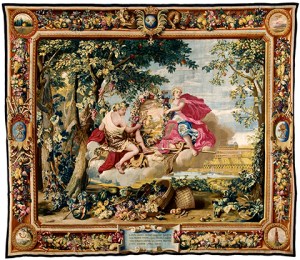
Autumn, after 1664, tapestry, wool, silk and gilt-metal wrapped thread, Gobelins Manufactory, cartoon attributed to Beaudrin Yvart (French, 1611–1690), after Charles Le Brun (French, 1619–1690), The Mobilier National, France. Photo by Lawrence Perquis.
It was during the reign of the Sun King, Louis XIV (r. 1643– 1715), that the art of tapestry weaving in France blossomed. Three hundred years after his death, the Getty Museum will showcase 15 monumental tapestries—from the French royal collection during the reign of Louis XIV. Woven Gold: Tapestries of Louis XIV will be the first major museum exhibition of tapestries in the Western United States in four decades.
During Louis XIV’s time, colorful and glittering tapestries, handwoven after designs by the most renowned artists, were the ultimate expression of status, power, taste, and wealth. The exhibition will feature 15 larger-than-life tapestries ranging in date from about 1540 to 1715 and created in weaving workshops across northern Europe. In an exclusive loan from the French nation, most of the tapestries are from the collection of the Mobilier National, which preserves the former royal collection. Eleven have never before been exhibited in the Unites States. The Getty Museum is supporting the conservation of two of the tapestries.
At the Getty, preparatory drawings, related prints and a life-sized cartoon (oil) will accompany the immense hangings. The tapestries in the exhibition are after works of art by Raphael (Raffaello Sanzio, Italian, 1483–1520), Peter Paul Rubens (Flemish, 1577–1640), Charles Le Brun (French, 1619–1690), and others. They come from the most notable workshops in Europe, including the Gobelins, which rose to preeminence under Louis XIV’s patronage. Several of the best-preserved and most famous examples of Gobelins weaving will be on view in the exhibition.
Woven Gold: Tapestries of Louis XIV is curated by Charissa Bremer-David, curator of sculpture and decorative arts at the Getty, and was organized by the J. Paul Getty Museum in association with the Mobilier National et les Manufactures Nationales des Gobelins, de Beauvais et de la Savonnerie.
◊ ◊ ◊ ◊ ◊
Charissa Bremer-David, with essays by Pascal-François Bertrand, Arnauld Brejon de Lavergnée, and Jean Vittet, Woven Gold: Tapestries of Louis XIV (Los Angeles: Getty Publications, 2015), 168 pages, ISBN: 978-1606064610, $50.
 Meticulously woven by hand with wool, silk, and gilt-metal thread, the tapestry collection of the Sun King, Louis XIV of France, represents the highest achievements of the art form. Intended to enhance the king’s reputation by visualizing his manifest glory and to promote the kingdom’s nascent mercantile economy, the royal collection of tapestries included antique and contemporary sets that followed the designs of the greatest artists of the Renaissance and Baroque periods, including Raphael, Giulio Romano, Rubens, Vouet, and Le Brun. Ranging in date from about 1540 to 1715 and coming from weaving workshops across northern Europe, these remarkable works portray scenes from the bible, history, and mythology. As treasured textiles, the works were traditionally displayed in the royal palaces when the court was in residence and in public on special occasions and feast days. They are still little known, even in France, as they are mostly reserved for the decoration of elite state residences and ministerial offices. This catalogue accompanies an exhibition of fourteen marvelous examples of the former royal collection that will be displayed exclusively at the J. Paul Getty Museum at the Getty Center from December 15, 2015, to May 1, 2016. Lavishly illustrated, the volume presents for the first time in English the latest scholarship of the foremost authorities working in the field.
Charissa Bremer-David is curator in the Department of Sculpture and Decorative Arts at the J. Paul Getty Museum. She is author of French Tapestries and Textiles in the J. Paul Getty Museum (Getty Publications, 1997) and has published extensively on French tapestries.
◊ ◊ ◊ ◊ ◊
Also on view at the Getty
As 2015 is the tercentenary of the death of Louis XIV, several exhibitions at the Getty Center will explore the Sun King’s tremendous influence on Western Art and his distinctive role as collector, heir, and patron of the art of tapestry and other arts.
• A Kingdom of Images: French Prints in the Age of Louis XIV, 1660–1715
16 June to 6 September 2015
• Louis XIV at the Getty
9 June 2015 to 31 July 2016
• Louis Style: French Frames, 1610–1792
15 September 2015 – 3 January 2016










leave a comment