Exhibition | The Fabric of India
I noted this exhibition last fall, but it’s worth following up now that the show is on view at the V&A (3 October 2015 — 10 January 2016). The press release is available as a PDF file here, with information on the catalogue included below. –CH
◊ ◊ ◊ ◊ ◊
From the V&A shop:
Rosemary Crill, The Fabric of India (London: V&A Publishing, 2015), 240 pages, ISBN: 978-1851778539, £30 / $60.
 This is the first truly comprehensive book on Indian textiles, featuring stunning examples from all over the country. Lavishly illustrated, it begins with an in-depth exploration of the different materials, techniques, and dyeing processes used in the creation of these sumptuous fabrics before exploring the central importance of cloth to Indian life and culture from ancient times to the present day. Special features focus on objects of historical importance, including a Kashmir map shawl, Tipu Sultan’s tent, and a remarkable 18th-century temple hanging from South India.
While many are familiar with Mughal velvets, western-market chintzes, or rural embroideries, for example, this book will surprise, inspire, delight, and inform with an extraordinary range of material, much of it new. Along with presenting great historical masterpieces, the importance and variety of the basic fibers—silk, cotton, wool—from which Indian textiles are traditionally made is emphasized, and the remarkable techniques of weaving, printing, dyeing, and embroidery that have made them prized across the world are illustrated in specially taken photographs.
Exhibition | Woven Gold: Tapestries of Louis XIV
Press release (30 April 2015) from The Getty:
Woven Gold: Tapestries of Louis XIV
The Getty Center, Los Angeles, 15 December 2015 — 1 May 2016
Curated by Charissa Bremer-David
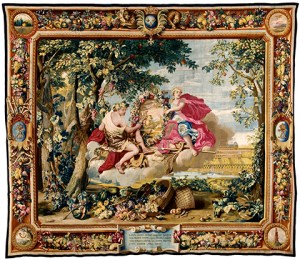
Autumn, after 1664, tapestry, wool, silk and gilt-metal wrapped thread, Gobelins Manufactory, cartoon attributed to Beaudrin Yvart (French, 1611–1690), after Charles Le Brun (French, 1619–1690), The Mobilier National, France. Photo by Lawrence Perquis.
It was during the reign of the Sun King, Louis XIV (r. 1643– 1715), that the art of tapestry weaving in France blossomed. Three hundred years after his death, the Getty Museum will showcase 15 monumental tapestries—from the French royal collection during the reign of Louis XIV. Woven Gold: Tapestries of Louis XIV will be the first major museum exhibition of tapestries in the Western United States in four decades.
During Louis XIV’s time, colorful and glittering tapestries, handwoven after designs by the most renowned artists, were the ultimate expression of status, power, taste, and wealth. The exhibition will feature 15 larger-than-life tapestries ranging in date from about 1540 to 1715 and created in weaving workshops across northern Europe. In an exclusive loan from the French nation, most of the tapestries are from the collection of the Mobilier National, which preserves the former royal collection. Eleven have never before been exhibited in the Unites States. The Getty Museum is supporting the conservation of two of the tapestries.
At the Getty, preparatory drawings, related prints and a life-sized cartoon (oil) will accompany the immense hangings. The tapestries in the exhibition are after works of art by Raphael (Raffaello Sanzio, Italian, 1483–1520), Peter Paul Rubens (Flemish, 1577–1640), Charles Le Brun (French, 1619–1690), and others. They come from the most notable workshops in Europe, including the Gobelins, which rose to preeminence under Louis XIV’s patronage. Several of the best-preserved and most famous examples of Gobelins weaving will be on view in the exhibition.
Woven Gold: Tapestries of Louis XIV is curated by Charissa Bremer-David, curator of sculpture and decorative arts at the Getty, and was organized by the J. Paul Getty Museum in association with the Mobilier National et les Manufactures Nationales des Gobelins, de Beauvais et de la Savonnerie.
◊ ◊ ◊ ◊ ◊
Charissa Bremer-David, with essays by Pascal-François Bertrand, Arnauld Brejon de Lavergnée, and Jean Vittet, Woven Gold: Tapestries of Louis XIV (Los Angeles: Getty Publications, 2015), 168 pages, ISBN: 978-1606064610, $50.
 Meticulously woven by hand with wool, silk, and gilt-metal thread, the tapestry collection of the Sun King, Louis XIV of France, represents the highest achievements of the art form. Intended to enhance the king’s reputation by visualizing his manifest glory and to promote the kingdom’s nascent mercantile economy, the royal collection of tapestries included antique and contemporary sets that followed the designs of the greatest artists of the Renaissance and Baroque periods, including Raphael, Giulio Romano, Rubens, Vouet, and Le Brun. Ranging in date from about 1540 to 1715 and coming from weaving workshops across northern Europe, these remarkable works portray scenes from the bible, history, and mythology. As treasured textiles, the works were traditionally displayed in the royal palaces when the court was in residence and in public on special occasions and feast days. They are still little known, even in France, as they are mostly reserved for the decoration of elite state residences and ministerial offices. This catalogue accompanies an exhibition of fourteen marvelous examples of the former royal collection that will be displayed exclusively at the J. Paul Getty Museum at the Getty Center from December 15, 2015, to May 1, 2016. Lavishly illustrated, the volume presents for the first time in English the latest scholarship of the foremost authorities working in the field.
Charissa Bremer-David is curator in the Department of Sculpture and Decorative Arts at the J. Paul Getty Museum. She is author of French Tapestries and Textiles in the J. Paul Getty Museum (Getty Publications, 1997) and has published extensively on French tapestries.
◊ ◊ ◊ ◊ ◊
Also on view at the Getty
As 2015 is the tercentenary of the death of Louis XIV, several exhibitions at the Getty Center will explore the Sun King’s tremendous influence on Western Art and his distinctive role as collector, heir, and patron of the art of tapestry and other arts.
• A Kingdom of Images: French Prints in the Age of Louis XIV, 1660–1715
16 June to 6 September 2015
• Louis XIV at the Getty
9 June 2015 to 31 July 2016
• Louis Style: French Frames, 1610–1792
15 September 2015 – 3 January 2016
Exhibition | The Italian Travels of Louis-François Cassas
Opening in November at the Musée des Beaux-Arts:
Voyages en Italie de Louis-François Cassas (1756–1827)
Musée des Beaux-Arts, Tours, 21 November 2015 — 22 February 2016
 Louis-François Cassas compte parmi les grands artistes voyageurs du XVIIIe siècle. L’exposition dévoile ici les dessins de l’artiste réalisés lors de son Grand Tour en Italie. Cette manifestation s’inscrit dans le thème transversal et séduisant du voyage et de l’Italie dans toute sa diversité archéologique, urbaine, insulaire… à la fin du Siècle des Lumières. La découverte récente de nombreux dessins inédits en Angleterre est venue confirmer l’opportunité de cette exposition : cinquante dessins prêtés par le National Trust et provenant de la collection du marquis de Bristol à Ickworth (Suffolk) seront montrés pour la première fois en France.
L’exposition s’articulera autour des deux grands voyages en Italie de L.-F. Cassas et de ses différents mécènes tous grands amateurs et collectionneurs, à l’origine de l’évolution de la carrière de l’artiste. Parmi les 116 œuvres exposées figurent des prêts de musées français et étrangers prestigieux : Paris : Bibliothèque Mazarine, Bibliothèque Nationale, Ecole Nationale Supérieure des Beaux-Arts, Fondation Custodia / New-York : Metropolitan Museum of Art / Londres : Victoria and Albert Museum, The National Trust : Ickworth (Suffolk), The Bristol Collection / Cologne : Wallraf-Richartz Museum / Vienne : Albertina Museum, et de collections privées.
Le premier voyage en Italie, 1778–83
Le Grand Tour pour le plaisir de dessiner
Grâce au mécénat du duc de Chabot, Cassas découvre l’Italie et peut obtenir une chambre d’externe à l’Académie de France à Rome. Seront évoquées les grandes étapes de cette pérégrination : Lyon, Genève, les Alpes, Bologne, Parme, Rome, Naples, Paestum… Invité à Venise au printemps 1782, puis à Trieste par le Baron Pittoni, Cassas travaille alors pour l’Empereur Joseph II jusqu’aux frontières de l’Empire ottoman. À l’automne 1782, Cassas part en Sicile travailler pour l’abbé de Saint-Non. Ses vues de Messine, de Catane, du Val di Noto… seront particulièrement remarquées.
Le second voyage en Italie, 1787–92
Les années romaines d’un artiste indépendant
Le nouveau mécène de Cassas, le comte de Choiseul- Gouffier (1752–1817), ambassadeur de France à Constantinople, permit à l’artiste de découvrir les provinces de l’Empire ottoman de 1784 à 1786. Désormais c’est dans son atelier à Rome, Piazza di Spagna, que Cassas accroche ses aquarelles de Palmyre, du Caire, de la Corne d’Or, de Chypre… qui suscitent l’admiration, notamment celle de Goethe, et des amateurs qui font le Grand Tour. Trois maquettes de monuments romains, provenant de la collection de Cassas, restaurées pour l’exposition : le Temple de la Fortune Virile, le Temple de Tivoli et l’Arc de Constantin, seront exceptionnellement présentées.
The catalogue will be available from Artbooks.com:
Sophie Join-Lambert, Louis-François Cassas (1756–1827): Ses Voyages en Italie et Ses Mécènes (Milan: Silvana Editoriale, 2015), 280 pages, ISBN: 978-8836631636, $65.
Exhibition | Aristocratic Life in the Eighteenth Century
From the Musée National de la Renaissance:
Être et paraître, la vie aristocratique au XVIIIe siècle:
Trésors cachés du Musée national de la Renaissance
Château de La Roche Guyon, 11 April — 29 November 2015
Curated by Muriel Barbier
 Sortis exceptionnellement des réserves du musée national de la Renaissance, des objets d’art du XVIIIe siècle retracent en dix tableaux les thèmes majeurs de la vie aristocratique à l’époque des Lumières. Au travers de quatre-vingt-cinq oeuvres, le quotidien de l’aristocratie du XVIIIe siècle revit dans les grands salons du château de La Roche Guyon ornés de leurs lambris d’époque et dépourvus de mobilier.
Une journée ordinaire dans une demeure seigneuriale au siècle des Lumières. L’exposition, articulée en dix vitrines, suit le déroulement d’une journée de la haute société des Lumières, en abordant les thèmes suivants : toilette et soins, parure et élégance, arts de la table, lecture et écriture, jeux et divertissements, priser et fumer, ouvrages de dames, prières et dévotions, armes d’apparât et chasse. Cette présentation, entend faire comprendre la fonction de ces objets, la préciosité de leur décor et leur utilisation. Elle propose une autre approche des arts décoratifs non fondée sur l’évolution des stymes et des techniques mais sur l’histoire des civilisations et des moeurs.
Muriel Barbier, Être et paraître: La vie aristocratique au XVIIIe siècle (Artlys, 2015), 142 pages, ISBN: 978-2854956108, 18€.
Bénédicte Bonnet Saint-Georges reviewed the exhibition for La Tribune de l’Art (21 August 2015).
Exhibition | De Versailles à La Motte Tilly: L’abbé Terray
Press release for the exhibition now on view at the Château de La Motte Tilly:
De Versailles à La Motte Tilly: L’abbé Terray, Ministre de Louis XV
Château de La Motte Tilly, 29 May — 20 September 2015
Curated by Gwenola Firmin and Vincent Bastien
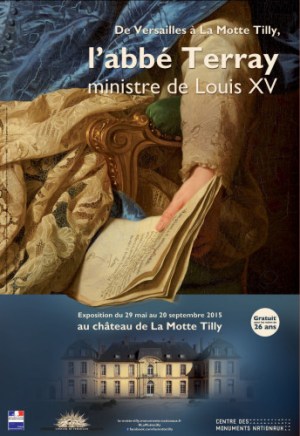 Après Sacres Royaux, de Louis XIII à Charles X au palais du Tau à Reims et Le salon de George Sand à Nohant, en 2014, la troisième exposition du partenariat entre le Centre des monuments nationaux et le château de Versailles se tiendra au château de La Motte Tilly (Aube) du 29 mai au 20 septembre 2015. Cette nouvelle exposition conjointe est consacrée à l’abbé Joseph Marie Terray (1715–1778), ministre des finances de Louis XV, à l’occasion du tricentenaire de sa naissance.
L’abbé Terray et La Motte Tilly
Joseph Marie Terray bénéficie, à ses début, de l’héritage financier de son oncle, premier médecin de la princesse Palatine, belle-sœur de Louis XIV. Nommé abbé de Notre-Dame de Molesme, au diocèse de Langres, en octobre 1764, il devient, le 23 décembre 1769, contrôleur général des Finances de Louis XV. Après le renvoi du duc de Choiseul en 1770, il est l’un des hommes forts du ministère dit du Triumvirat. Incarnation de l’ascension sociale du XVIIIe siècle, talentueux réformateur, grand homme de l’histoire économique et politique du règne de Louis XV, l’abbé Terray, malgré l’appui constant de Madame de Pompadour puis de Madame Du Barry, est très impopulaire. Il mène en effet une politique financière, certes efficace et progressiste, mais aussi brutale et autoritaire. Le ministre occupe finalement la prestigieuse charge de directeur des Bâtiments du Roi en août 1773. Mais, un an plus tard, il démissionne avec l’avènement de Louis XVI et se retire à La Motte Tilly, tout en rêvant secrètement d’être rappelé au gouvernement.
Son domaine de La Motte Tilly, parfait exemple de l’architecture du XVIIIe siècle, est sa résidence de 1748 à son décès en 1778. La demeure et son parc, comprenant aujourd’hui près de 1080 hectares, témoignent d’un certain art de vivre au Siècle des Lumières. L’actuel château, élevé à partir de 1755, est l’œuvre de l’architecte parisien François-Nicolas Lancret (1717–1789), le neveu du célèbre peintre de scènes galantes, Nicolas Lancret. L’implication de l’abbé Terray dans les différents chantiers de sa demeure de plaisance s’amplifie à mesure que sa carrière politique prend de l’importance.
L’exposition
Présentée dans les anciens appartements du ministre, l’exposition De Versailles à La Motte Tilly. L’abbé Terray, ministre de Louis XV retrace l’ascension et la vie du maître des lieux, personnage historique parmi les plus influents de la fin du règne de Louis XV mais aussi parmi les plus controversés du XVIIIe siècle. Réunis pour la première fois, des documents d’archives, des objets d’art précieux, des dessins et des tableaux contribuent également à mettre en lumière le domaine de La Motte Tilly, chef-d’œuvre architectural trop longtemps ignoré. L’exposition est enfin l’occasion unique de présenter un somptueux portrait conservé dans les collections versaillaises : l’effigie officielle du ministre tout puissant peinte par Alexandre Roslin à la demande de Terray en 1773. Ce dernier y est figuré au sommet de sa gloire.
L’exposition est rendue possible grâce au prêt d’œuvres des collections du musée national de Versailles et de Trianon, ainsi qu’aux concours généreux du musée du Louvre, de l’abbaye de Chaalis, de la Bibliothèque nationale de France, de la Bibliothèque municipale de Versailles, des Archives nationales, des Archives départementales de l’Aube et de plusieurs collections particulières.
Ce parcours historique est conçu par Gwenola Firmin, conservateur, en charge des peintures du XVIIIe siècle au château de Versailles, assistée de Vincent Bastien, docteur en Histoire de l’art, chargé de mission.
Le partenariat entre le CMN et le château de Versailles
Le partenariat établie en 2013 entre le CMN et le château de Versailles instaure un dialogue entre des collections trop souvent méconnues et des hauts lieux du patrimoine national. Des expositions temporaires conjointes permettent aux deux institutions d’unir leurs ressources afin de donner au plus grand nombre la possibilité de découvrir ou de redécouvrir quelques pages de l’Histoire de France. En 2014, les expositions Sacres royaux, de Louis XIII à Charles X au palais du Tau à Reims et Le salon de George Sand au domaine de Nohant ont attiré au total près de 76 000 visiteurs.
Gwenola Firmin and Vincent Bastien, De Versailles à la Motte Tilly: L’abbé Terray, Ministre de Louis XV (éditions du Patrimoine / Centre des Monuments Nationaux, 2015), 48 pages, ISBN: 978-2757704714, 12€.
The full dossier de presse is available as a PDF file here»
Galleries Reopen at the Bayerisches Nationalmuseum

◊ ◊ ◊ ◊ ◊
From the Bavarian National Museum:
Barock und Rokoko
Bayerisches Nationalmuseum, Munich, open from 9 July 2015
Seit dem 9. Juli 2015 ist der zum Englischen Garten gelegene Westflügel des Bayerischen Nationalmuseums nach mehrjähriger Sanierung wieder für den Besucher zugänglich. Auf rund 1500 m² werden mehr als 600 einzigartige kunst- und kulturhistorische Glanzstücke des 17. und 18. Jahrhunderts in neuem Licht präsentiert. Skulpturen, Möbel, Gemälde, Uhren, Porzellan, Goldschmiedewerke, Prunkwaffen und Tapisserien künden von Vorlieben, Alltag und Entwicklungen jener Epoche.
 Im Hauptgeschoss des Museums wird damit der kunst- und kulturhistorische Rundgang fortgesetzt, der sich in erster Linie an bayerischen Kurfürsten Maximilian I., Ferdinand Maria, Max Emanuel und Karl Albrecht und ihren Kunstvorlieben orientiert. Erstmals präsentiert sind große Teile der Kunstsammlung des Kurfürsten Johann Wilhelm von der Pfalz, dessen Kunstschätze aus Düsseldorf und Mannheim um 1800 nach München kamen. Bei den nun neu ausgestellten Werken handelt es sich um einen Großteil der Objekte, die das Haus Wittelsbach dem Museum kurz nach dessen Gründung 1855 übergeben hat.
Ein eigener Saal widmet sich Facetten des barocken Gartens und dem von der Natur inspirierten Kunsthandwerk. Ein weiterer Raum, das sogenannte Landshuter Zimmer aus dem Stadtpalais der Freiherren von Stromer in Landshut, veranschaulicht die Wohnwelt des Adels im 18. Jahrhundert. Einen weiteren Schwerpunkt der Sammlung bilden schließlich die Skulpturen des Barock und Rokoko, allen voran die Werke von Johann Baptist Straub und Ignaz Günther.
In der Vermittlung beschreitet das Museum neue Wege. Medienstationen mit Touchscreens ermöglichen den Besuchern spannende Blicke hinter verschlossene Schranktüren oder auf tickende Uhrwerke.
Additional images are available here»

◊ ◊ ◊ ◊ ◊
The catalogue, published by Sieveking Verlag, is available from Artbooks.com:
Renate Eikelmannn, Barock und Rokoko: Meisterwerke des 17. und 18. Jahrhunderts (München: Sieveking Verlag, 2015), 248 pages, ISBN: 978-3944874364, 25€ / $45.
The collections of Baroque and Rococo art at the Bayerisches Nationalmuseum are among the most important in Europe. Many of the works created by the international artists and craftsmen represented at the museum are outstanding achievements. Sculptures, furniture, paintings, clocks, porcelain objects, goldsmith work, sumptuously decorated weapons, and tapestries bear witness to the tastes and trends of the era. The succession of rulers who had a profound impact on Bavaria between the Thirty Years’ War and the French Revolution provides the chronological focus for this catalogue of selected works: Bavarian electors Maximilian I, Ferdinand Maria, Max Emanuel, and Karl Albrecht, as well as Elector Palatine Johann Wilhelm, whose art collection arrived in Munich by way of family succession. The publication also includes a look at the domestic environments of the nobility and the eighteenth-century passion for gardens. Baroque and Rococo sculptures constitute a cornerstone of the museum’s collections, especially works by Munich sculptors Johann Baptist Straub and Ignaz Günther. Their masterpieces, produced for churches and monasteries as well as for aristocratic patrons, are now considered quintessential examples of southern German Rococo.
Exhibition | Canaletto’s Vedute Prints

Canaletto (Giovanni Antonio Canal), La Libreria. V. (The Library,
Venice), ca. 1740–44. Etching on laid paper (Hood Museum of Art,
Dartmouth College: Gift of Jean Weil in memory of Adolph Weil Jr.,
Class of 1935, PR.997.5.37)
◊ ◊ ◊ ◊ ◊
Press release (13 July 2015) for the exhibition now on view at the Hood Museum of Art:
Canaletto’s Vedute Prints
Montgomery Museum of Fine Arts, Montgomery, Alabama, 10 January — 8 March 2015
Hood Museum of Art, Dartmouth College, Hanover, New Hampshire, 1 August — 6 December 2015
Beginning August 1, 2015, the Hood Museum of Art, Dartmouth College, will present an exhibition of thirty etchings from the museum’s collection that represent a nearly complete set of Venice-inspired prints by Giovanni Antonio Canal (1697–1768). Known as Canaletto, the artist is famous for his luminous, sweeping views of the Grand Canal and Piazza San Marco. The Vedute, a series of prints he made in the early 1740s, reveal another, often more modest, side of Venice. These scenes are intimate in scale and depict an extraordinary variety of subject matter, encompassing both real and imaginary views, from urban portraits to bucolic landscapes. This exhibition presents the full range of Canaletto’s Vedute project while celebrating the legacy of Adolph J. ‘Bucks’ Weil, Dartmouth Class of 1935, an astute and generous collector who assembled this remarkable suite of etchings and over his lifetime amassed one of the most impressive collections of Old Master prints in the country.
Mr. Weil’s many extraordinary gifts to the Hood include exceptional prints by such artists as Albrecht Dürer, Lucas van Leyden, Rembrandt van Rijn, Jacques Callot, and Francisco Goya. The Vedute etchings were donated to the museum by Jean K. Weil, following the wish of her late husband. Through this exhibition devoted to Canaletto, the Hood is honored to highlight an important facet of Mr. Weil’s distinguished collection in recognition of the one hundredth anniversary of his birth.
It is difficult to imagine an artist more intimately associated with a city than Canaletto. For centuries, his name has been synonymous with topographical cityscapes of Venice known as vedute (views). His meticulously detailed paintings of such familiar vistas as the Grand Canal and Piazza S. Marco celebrate the city’s stunning beauty and became coveted mementoes for English gentlemen to bring home from the Grand Tour. Given his fame as a landscape painter and the demand for his trademark Venetian scenes, it is remarkable that he turned, albeit very briefly, to a new medium and format for his art.
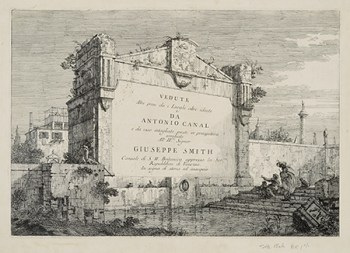
Canaletto (Giovanni Antonio Canal), Title Plate, Vedute Series, ca. 1744, etching on laid paper (Hood Museum of Art, Dartmouth College: Gift of Jean Weil in memory of Adolph Weil Jr., Class of 1935; PR.997.5.22)
In the early 1740s, Canaletto embarked on a project to create a series of etchings dedicated to (and most likely financed by) Joseph Smith, the British consul to the Venetian Republic, who acted as his agent on behalf of foreign collectors. Unlike his painted views of Venice, the Vedute prints present an unexpected side of the artist and offer an alternate window into eighteenth-century Venetian life. Creative and at times whimsical, the scenes are often pastiches of real places and imaginary views. With few exceptions, they are not of the expected landmarks but show the more humble, everyday aspects of the city, such as modest dwellings and little byways; others are fantasies, ranging from elaborate caprices to intimate backyard scenes and wild landscapes. The Vedute prints thus reveal an unknown artist and a hidden city and its environs, beyond the vision packaged for tourists and outsiders.
Canaletto, after years of precisely transcribing the glory of Venetian tourist sites, clearly delighted in the creative freedom of this project, combining disparate elements to create a romantic portrait of the Venice he knew so well. With unfamiliar etching tools in hand, he flourished with newfound spontaneity and economy of line. Even in the few recognizable Venetian scenes included in the series—La Libreria, for example—Canaletto downplays the soaring architecture to focus on the activities of everyday Venetian life, such as children playing, nuns promenading, and merchants haggling.
Offering creative combinations of fantasy and reality, inventive conflations of the romantic past with a precarious present, and a peek at the domestic side of Venice, the Vedute represent a significant departure from Canaletto’s previous work. Equally, they reveal an unexpected virtuosity in a medium that was entirely new to the artist. The reason for Canaletto’s shift to printmaking at the peak of his fame as a landscape painter remains unclear. In part, the Vedute prints may have been an answer to the artist’s critics and detractors, who favored a more imaginative, rather than topographical, approach. For all of their inventiveness and skillful yet spontaneous execution, they are now considered some of the finest examples of etching of the eighteenth century.
The Canaletto exhibition is complemented by an installation of eight late nineteenth- and early twentieth-century American etchings of Venice by James McNeill Whistler and his circle, all of them drawn from the Hood’s collection. Whistler, who greatly admired Canaletto, was a major influence in the development of the late nineteenth-century American etching revival.
Canaletto’s Vedute Prints will be on view at the Hood from August 1 through December 6, 2015. It is accompanied by a twenty-page booklet with essays by former Hood Assistant Curator for Special Projects Sarah G. Powers and Montgomery Museum of Fine Arts Curator of Collections Margaret Lynne Ausfeld. The booklet was co-published with the Montgomery Museum of Fine Arts, located in Mr. Weil’s hometown of Montgomery, Alabama, where a version of the exhibition was on view in the spring of 2015. The MMFA also benefited from donations from Mr. Weil’s outstanding collection of prints, including several impressions of Canaletto’s Vedute etchings.
To celebrate the exhibition, Frederick Ilchman, Chair, Art of Europe, Museum of Fine Arts, Boston, will deliver a lecture titled “Viewing Eighteenth-Century Venice with Canaletto and Casanova” in the Hood Museum of Art Auditorium on Friday, October 23, at 5:00pm. A reception will follow in Kim Gallery. Dartmouth College Studio Art Professor Louise Hamlin will also give a lunchtime gallery talk titled “Canaletto from an Artist’s Perspective” in the exhibition gallery on Tuesday, October 6, at 12:30pm.
This exhibition was organized by the Hood Museum of Art and the Montgomery Museum of Fine Arts, Montgomery, Alabama, and generously supported by the William Chase Grant 1919 Memorial Fund.
Exhibition | Élisabeth Louise Vigée Le Brun (1755–1842)
Opening next month in Paris at the Grand Palais:
Élisabeth Louise Vigée Le Brun (1755–1842)
Grand Palais, Paris, 23 September 2015 — 11 January 2016
The Metropolitan Museum of Art, New York, 9 February — 15 May 2016
National Gallery of Canada, Ottawa, 10 June — 12 September 2016
Curated by Joseph Baillio and Xavier Salmon
This first retrospective devoted to the works of Elisabeth Louise Vigée Le Brun presents an artist whose life stretched from the reign of Louis XV to that of Louis-Philippe—one of the most eventful and turbulent periods in European and above all French history of modern times.
 Self-portraits by Vigée Le Brun abound: paintings, pastels and drawings that elegantly associate feminine grace and pride. With the Ancien Régime and its School of Fine Arts coming to an end, she supplanted most of her rival portrait artists. Vigee Le Brun used self-portraits to assert her status, circulate her image and show people the mother she had become despite the constraints of a career.
She made her greatest coup de force at the 1787 Exhibition where she presented two paintings that cannot be dissociated. First, a Portrait of Queen Marie-Antoinette posing for a portrait surrounded by her children in an attempt to rectify the image of an extravagant libertine; secondly, the portrait of a female artist hugging her daughter Julie to her chest in an effusive Raphael-like manner. The latter is one of the finest and most popular of the many works by this painter owned by the Louvre and has remained the emblem of «maternal tenderness» since it was first exhibited to the public. The culture of the Enlightenment and the influence of Rousseau obliged the artist to take on this role, which she did happily and with resounding success. As a counterpoint, she painted the Portrait of Hubert Robert. These paintings are absolute icons illustrating the joy of life and creative genius, complementing and communicating with each other.
What is even more remarkable was her determination to overcome obstacles hindering her career. Born in Paris in 1755, she came from a relatively modest background, her mother a hairdresser and her father a talented portrait artist. Her father died when she was a young adolescent. Drawing inspiration from his example, the brilliant young artist was accepted as a master painter at the Academy of Saint-Luc. In 1776, she married the most important art dealer of her generation, Jean Baptiste Pierre Le Brun (1748–1813), but this prevented her from being accepted at the Royal Academy of Painting and Sculpture because its regulations formally forbid any contact with mercantile professions. However, this union had a beneficial effect on her career. When the price of Flemish paintings soared, she learnt how to master the magic of colours and the fine craftsmanship of Rubens and Van Dyck. Her clientèle had mainly been the bourgeoisie but in 1777, she started working for the aristocracy, descendants of royal blood and finally Queen Marie-Antoinette. However, it was not until 1783 and the intervention of the Queen’s husband, Louis XVI, that the portrait artist was able to join the Royal Academy of Painting after much polemic.
Organized by the Réunion des musées nationaux/Grand Palais in Paris, The Metropolitan Museum of Art in New York, and the National Gallery of Canada in Ottawa.
The exhibition booklet is available here»
Details on the catalogue to follow later.
Display | Jonathan Richardson by Himself
Now on view at The Courtauld:
Jonathan Richardson by Himself
The Courtauld Gallery, London, 24 June — 20 September 2015
Curated by Susan Owens

Jonathan Richardson, Self-Portrait, ca. 1738 (London: The Courtauld Gallery)
Jonathan Richardson the Elder (1667–1745) was one of the most influential figures in the visual arts of 18th-century England. A leading portrait painter, Richardson was also a theorist and an accomplished poet and amassed one of the great collections of drawings of the age.
Towards the end of his life Richardson created a remarkable but little known series of self-portrait drawings. They show Richardson adopting a wide range of poses, guises and dress, in some cases deliberately evoking other artists, such as Rembrandt, whose work he owned. These remarkable drawings show Richardson considering and making visual the different aspects of himself. But much more than this, they were the means with which he reviewed his life and achievements.
Emma Crichton-Miller provides a review of the exhibition for Apollo Magazine’s Muse Room (27 July 2015). . .
Richardson’s habit of self-portraiture, charting his declining physical appearance, was married over a decade to a discipline of almost daily poems, where he examined his state of mind. Indeed as interesting as the images themselves is the intellectual and philosophical hinterland they suggest, which drove this self-made man, an admirer of Milton, who apparently turned down royal patronage, to pursue this humanist practice. . .
The full review is available here»
◊ ◊ ◊ ◊ ◊
From Paul Holberton:
Susan Owens, Jonathan Richardson By Himself (London: Paul Holberton, 2015), 64 pages, ISBN: 978-1907372841, £13.
Jonathan Richardson (1667–1745) was one of 18th-century England’s most significant cultural figures. A leading portrait painter and influential art theorist, he also amassed one of the period’s greatest collections of drawings. But there was another, highly unusual dimension to his pursuits. In 1728, at the age of 61 and shortly before his retirement from professional life, Richardson began to create a remarkable series of self-portrait drawings. Not intended for public display, these works were unguarded explorations of his own character.
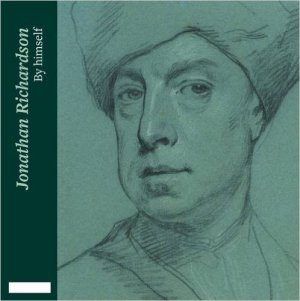 In one of the most astonishing projects of self-examination ever undertaken by an artist, for over a decade Richardson repeatedly drew his own face. His self-portrait drawings are usually dated precisely, and they document, from month to month, his changing state of mind as much as his appearance. Many were drawn in chalks on large sheets of blue paper, from his reflection in the mirror. Some of these are bold and psychologically penetrating, while others, in which he regards his ageing features with gentle but unflinching scrutiny, are deeply touching. A further group of self-portraits is drawn with graphite on small sheets of fine vellum, and in these Richardson often presents himself in inventive and humorous ways, such as in profile, all’antica, as though on the face of a coin or medal; or crowned with bays, like a celebrated poet. Sometimes, too, he copies his image from oil paintings made decades earlier, in order to recall his appearance as a younger man. In this extraordinary series of self-portraits, Richardson offers a candid insight into his mind and personality. Together, these drawings create nothing less than a unique and compelling visual autobiography.
This publication—which accompanies the first ever exhibition devoted to Richardson’s self-portrait drawings, held in the new Gilbert and Ildiko Butler Drawings Gallery at the Courtauld—tells the story of these remarkable works and puts them into the context of his other activities at this period of his life, in particular the self-searching poems he wrote during the same years and often on the same days as he made the drawings. An introductory essay is followed by focused discussions of each work in the exhibition. This part of the book explores the materials and techniques Richardson used, whether working in chalks on a large scale or creating exquisitely refined drawings on vellum. It will also reveal how Richardson modeled some of his portraits on old master prints and drawings, including works in his own collection by Rembrandt and Bernini. The publication brings together the Courtauld Gallery’s fine collection of Richardson’s drawings with key works in the British Museum, the National Portrait Gallery and the Fitzwilliam Museum.
Exhibition | Pompeii and Europe, 1748–1943
Now on view in Naples:
Pompeii and Europe, 1748–1943
Museo Archeologico Nazionale Naples, 27 May — 2 November 2015
Curated by Massimo Osanna
 Pompeii and Europe recounts the fascination that the archaeological site of Pompeii held for artists and the European imagination, from the start of excavations in 1748 to its dramatic bombing in 1943. The exhibition—devised by Massimo Osanna, the Superintendent for Pompeii, Herculaneum and Stabiae—unfolds along a twofold route at the National Archaeological Museum in Naples and simultaneously at the Amphitheater in Pompeii, and joins the program of events planned for Expo Milano 2015 in importance and prestige.
The exhibition evokes the history of the Vesuvian city, an inexhaustible source of inspiration, in a constant comparison between the arts and the excavations; a dialogue between archaeologists and historians of art, architecture and literature, all called on to recount the unique story of the rediscovery of Pompeii.
Promoted by the Superintendency for Pompeii, Herculaneum and Stabiae and the Directorate General of the Great Pompeii Project, with the National Archaeological Museum in Naples, the exhibition—organized by Electa with an exhibition installation by Francesco Venezia—is structured as a true journey, grand and complex, in which Antiquity enters into a dialogue with Modernity, and nature with the arts and archaeology.
◊ ◊ ◊ ◊ ◊
The catalogue is available in English from Artbooks.com:
Massimo Osanna, et al., Pompei and Europe, 1748–1943 (Milan: Electa, 2015), 350 pages, ISBN: 978-8891803627, $75.










leave a comment