Exhibition | Transparent Art: Rock Crystal Carving
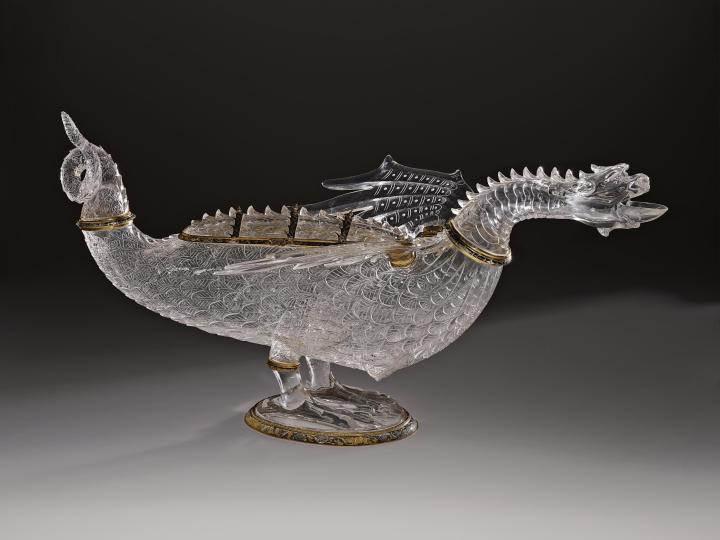
Vase in the shape of a dragon or ‘caquesseitão’; Milan, workshop of the Miseroni, possibly Gasparo Miseroni (act. 1550–70) (?) Rock crystal; second half of the 1500s (Madrid: Museo Nacional del Prado)
◊ ◊ ◊ ◊ ◊
Now on view at the Prado, this exhibition of sixteenth-century carved rock crystal includes items from the collection of the Grand Dauphin (1661–1711). The show also provides a convenient occasion to draw attention to the Prado’s newly designed website, which particularly showcases images. While such a feature might seem obvious for a museum website, it’s hardly been true in most cases to date (the press release detailing the site’s key features is available here).
From the Prado:
Transparent Art: Rock Crystal Carving in Renaissance Milan
Museo Nacional del Prado, Madrid, 14 October 2015 — 10 January 2016
Curated by Letizia Arbeteta Mira
The present exhibition offers visitors a unique opportunity to see a little known chapter in art history, namely that of carving hyaline quartz or rock crystal, a technique for which Milan was particularly celebrated in the second half of the 16th century. Due to their value, both material and artistic, these works were only within the reach of monarchs and the highest ranks of the European aristocracy.
 The exhibition includes six magnificent examples loaned from two of the most important historical collections: that of the Medici, now in the Museo degli Argenti in Florence, and the collection of Louis XIV, now in the Musée du Louvre in Paris. Another fourteen splendid pieces, now in the Prado, come from the collection assembled by the Grand Dauphin of France, son of Louis XIV, which was in part inherited by Philip V, the first Spanish Bourbon monarch, in 1711. The latter group, known as ‘The Dauphin’s Treasure’, entered the Prado in 1839. Although somewhat reduced over the course of its eventful history, it still includes important objects, particularly those in rock crystal. In total it has 47 hyaline quartz vessels, 2 in citrine quartz and 1 in smoky quartz. Various academic studies have attributed these pieces to leading workshops and masters, almost all of them Milanese.
Letizia Arbeteta Mira, Arte transparente: La talla del cristal en el Renacimiento milanés (Madrid: Museo del Prado, 2015), 160 pages, ISBN: 978-8484803362, 39€.
Exhibition | Drawn from Courtly India
Press release (6 November 2015) from the Philadelphia Museum of Art:
Drawn from Courtly India: The Conley Harris and Howard Truelove Collection
Philadelphia Museum of Art, 6 December 2015 — 27 March 2016
Curated by Ainsley Cameron
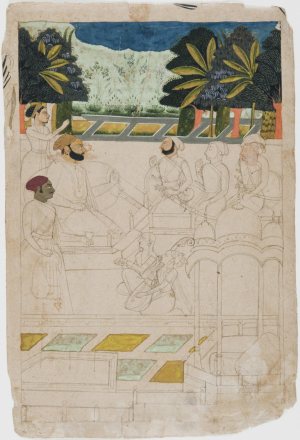
A Prince and Courtiers in a Garden, ca. 1720–30, with later additions, India (Jodhpur or Bikaner, Rajasthan) (Philadelphia Museum of Art, 2013-77-31).
The Philadelphia Museum of Art presents an exhibition of rare and masterful drawings created in the workshops of royal Indian courts over the course of four centuries. Drawn from Courtly India: The Conley Harris and Howard Truelove Collection features a wide range of sketches, preparatory studies, and compositional drawings that vividly depict mythological themes, verdant landscapes and architectural settings, portraits of prominent rulers, and scenes from the lives of Indian nobility. The Museum acquired these important works in 2013, many as a gift, and is presenting the collection in this exhibition for the first time.
While Indian paintings have long been sought after by museums and individual collectors, there has been only a limited interest in drawings. Yet drawings may be wonderful works of art in their own right, yielding a remarkable amount of information about workshop practices and artistic process. Conley Harris, a landscape painter, and the late Howard Truelove, an architectural designer, shared a passion for drawing. They began collecting Indian drawings after being inspired by their travels throughout that country. The collection they assembled over the course of more than a decade provides new insights into the artistic practices of the royal workshops that developed over generations, and offers fresh perspectives on Indian painting. Many of the works to which these collectors were drawn were created during the eighteenth century in the Hindu courts of western India and the Himalayan foothills, an area including the present-day states of Rajasthan, Himachal Pradesh and Jammu-Kashmir.
Timothy Rub, the George D. Widener Director and CEO, stated: “The ongoing development of the Museum’s collection has always represented our partnership with great collectors who have been as passionate as we are about sharing with everyone the finest works of art. In this regard we are especially fortunate to have acquired the marvelous collection assembled by Conley Harris and Howard Truelove, and we are enormously grateful to the collectors. This collection adds a new and important dimension to our holdings of Indian art, which is one of the most important in the country. It also enables us to bring to a broader audience this fascinating and delightful aspect of South Asia’s artistic heritage.”
The first section of the exhibition will feature a group of finished drawings and explore the relationship between court artists and their royal patrons. A second will focus on the innovative workshop process, examining how artists developed and revised drawings through techniques such as white wash corrections, color notations, and pouncing. The drawings in this section will highlight not only the artists’ adept handling of the medium, they will also testify to the collaboration of artists employed within a hierarchical workshop structure, demonstrating how skills were conveyed from master to apprentice. A third section, dedicated to the key moment when brush first meets paper, calls attention to the expressive power of the expert brushstroke. The fourth and final section of the exhibition invites visitors to respond to the works on display by creating their own drawings using workshop techniques.
The exhibition is organized by Ainsley M. Cameron, the Museum’s Ira Brind and Stacey Spector Assistant Curator of South Asian Art. She stated: “These works offer new ways of looking and thinking about Indian courtly drawing. People tend to approach the study of paintings or drawings from the perspective of the patron because so many of the artists’ names are unknown, but we are exploring the perspective of the artist, as maker—the gesture of an artist’s hand, the spontaneity of line, and the process through which ideas are born.”
About Conley Harris and Howard Truelove
Based in Boston, artist Conley Harris (born 1945) is a former faculty member of the department of art and art history at the University of New Hampshire. Harris is known for his lyrical landscapes of New England and the American West. Howard Truelove (1946–2012) was an architectural designer and vice president of design at the firm KlingStubbins in Cambridge, Massachusetts. His interior-design work ranged from public spaces in major office buildings to universities and museums. Harris often uses works in their collection as a source of inspiration, creating paintings that not only absorb motifs from South Asian and Persian miniature paintings, but also play with the idea of multiple layers, the palimpsest found in artists’ working sketches and so creatively reinterpreting the historical drawings for a new generation.
◊ ◊ ◊ ◊ ◊
The catalogue is distributed by Yale UP:
Ainsley Cameron, with an essay by Darielle Mason, Drawn from Courtly India: The Conley Harris and Howard Truelove Collection (Philadelphia: Philadelphia Museum of Art, 2015), 160 pages, ISBN: 978-0300215250, $35.
 This publication presents the first in-depth survey of the Conley Harris and Howard Truelove Collection of Indian Drawings, which was recently acquired by the Philadelphia Museum of Art. This exceptional collection consists of 65 works on paper created between the 16th and 19th centuries. The Harris-Truelove Collection is uniquely and tightly focused on works from the royal courts of North India, and the majority of these drawings served as preparatory material for the opaque watercolor illustrations that have been widely collected and studied. This catalogue celebrates the assured line of the Indian draftsman and recognizes these drawings as accomplished works of art in their own right. The text details the process and technique involved in their production, and explores what can be revealed by the artist’s hand. The catalogue also contextualizes the role of art production in court culture, and reveals the intricacies of artistic workshop practice.
Ainsley Cameron is the Ira Brind and Stacey Spector Assistant Curator of South Asian Art, and Darielle Mason is the Stella Kramrisch Curator of Indian and Himalayan Art, both at the Philadelphia Museum of Art.
Exhibition | Schalcken: Painted Seduction
Press release for the exhibition now on view at the Wallraf-Richartz Museum:
Schalcken: Gemalte Verführung / Painted Seduction
Wallraf-Richartz-Museum & Fondation Corboud, Cologne, 25 September 2015 — 24 January 2016

Godefridus Schalcken, Self-Portrait, 1694 (Leamington Spa Art Gallery and Museum)
A lady looking into a mirror in the soft candlelight, proud, a little pert perhaps, but certainly enigmatic. Few artists have matched the ability of Godefridus Schalcken (1643–1706) to capture such magical moments on canvas so powerfully that they still compel attention three centuries later. In autumn 2015 the Wallraf-Richartz-Museum & Fondation Courboud launched in cooperation with the Dordrechts Museum the first-ever exhibition to survey Schalcken’s oeuvre as a whole, inviting a reassessment of this unique painter and seducing visitors to have a detailed look at the charming and enchanting art of Schalcken. More than eighty loans from public and private collections worldwide are on show, a third of his known painted oeuvre. Lenders include the Leiden Collection, New York, The Rose-Marie and Eijk van Otterloo Collection, Naples, Uffizi Florence, Rijksmuseum Amsterdam, Mauritshuis The Hague, National Gallery London, Národní galerie in Prague, Statens Museum Copenhagen, National Gallery of Scotland, Edinburgh, National Gallery of Ireland, Dublin, Ashmolaen Museum, Oxford, Städel Museum, Frankfurt, Hamburger Kunsthalle, Gemäldegalerie Dresden, Staatliche Kunsthalle Karlsruhe and Gemäldegalerie Alte Meister Kassel.
Schalcken will not have seemed predestined for an artistic career when he was born in 1643 into a family headed by a Protestant pastor. At the age of nineteen, following an apprenticeship with Samuel van Hoogstraten, a pupil of Rembrandt, he entered the workshop of Gerrit Dou, the celebrated founder of the school of artists known as the Leiden ‘fine’ painters. Dordrecht, London, The Hague and Dusseldorf were further stages in his impressive career. Despite the political and economic turmoils and an ailing art market: Schalcken established himself as a “self-branded artist”. His paintings fetched top prices and entered the most illustrious collections. Royal clients, such as Florence’s Grand Duke Cosimo III de’ Medici and Elector Palatine Johann Wilhelm in Dusseldorf, helped Schalcken to international fame.
As a master of light, especially candlelight, Schalcken entered the canon of art history and was lauded by art lovers—including even Johann Wolfgang von Goethe. First with the changes in taste that came in the nineteenth century did the ‘typically Dutch’, bourgeois art by painters like Vermeer, Rembrandt and Frans Hals gain in preference. Schalcken’s elegantly painted aristocratic gems languished in obscurity. With the consequence that the artist ranks today among the great unknowns of the Golden Age of Netherlandish painting.
Here in the first ever exhibition of his work, we are invited to set out on a journey of rediscovery. With rarely shown masterpieces, including many works from private collections, it opens up the painter’s rich world of imagery. A world that captivates by its wide range of genres and subjects, its tromp-l’oeil illusionism, and the gallant conversations that Schalcken invites us viewer to join.
The exhibition catalogue, with essays and extensive entries by Guido M.C. Jansen, Wayne Franits, Anja K. Sevcik, Nicole Elizabeth Cook, Eddy Schavemaker, Sander Paarlberg and Marcus Dekiert aims to update the meritorious catalogue raisonée by Thierry Beherman of 1988.
Wayne Franits, et al., Schalcken: Gemalte Verführung (Stuttgart: Belser Verlag, 2015), 312 pages, ISBN: 9783763027217, $88.
Exhibition | Pearls on a String
Press release (24 July 2015) for the exhibition now on view at The Walters:
Pearls on a String: Artists, Patrons, and Poets at the Great Islamic Courts
The Walters Art Museum, Baltimore, 8 November 2015 — 31 January 2016
Asian Art Museum, San Francisco, 25 February — 8 May 2016
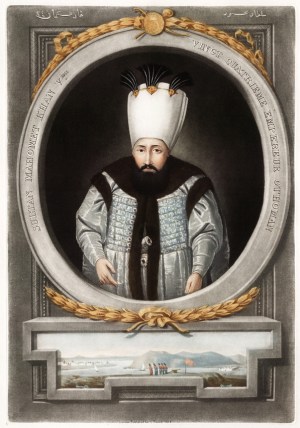
Portrait of Ottoman Sultan Mahmud I, 1815 (Baltimore: The Walters Art Museum)
The great Mughal, Safavid, and Ottoman empires flourished during a time of rapid change and artistic innovation in the Islamic world, as people, ideas, and technologies spread across Europe and Asia. At the heart of the empires’ courts were networks of individuals—writers, poets, artists, craftsmen— who produced extraordinary works of art for the ruling elite. From November 8, 2015, through January 31, 2016, the Walters Art Museum will present Pearls on a String: Artists, Patrons, and Poets at the Great Islamic Courts, the first major exhibition to focus on these influential and often charismatic individuals. The free exhibition features more than 120 works including paintings, calligraphy, textiles, ceramics, and jeweled luxury objects. Dating from the 16th to the 18th century, these exquisite works of art were created in historic India, Iran, and Turkey, a vast geographic area that extends from the Bay of Bengal to the Mediterranean Sea.
“Pearls on a String seeks to broaden public engagement with the cultural histories of Muslim societies by demonstrating how human imagination and collaboration can ignite extraordinary artistic creativity,” said Amy Landau, curator of the exhibition.
Three Vignettes
Pearls on a String is organized in a series of vignettes that spotlight a 16th-century writer, a 17th-century artist, and an 18th-century patron. Through poignant quotes, startling juxtapositions of artwork, and subtle references to the protagonists’ architectural surroundings, the exhibition will offer a rare glimpse into their worlds. The individuals also inform the exhibition’s poetic title: viewed independently, each is a gleaming ‘pearl’, yet collectively they constitute an even more vibrant ‘string of pearls’.
• Writer Abu’l Fazl (1551–1602): A prolific writer, visionary historian and intimate at the court of the third Mughal emperor Akbar in India, he was the most powerful voice in defining Akbar’s policies of political inclusion in the context of a demographically diverse empire.
• Painter Muhammad Zaman (c. 1650–1700): At the court of Safavid ruler Shah Sulayman, this imperial artist radically changed the course of Persian painting by introducing farangi-sazi, a European style, into the Persian tradition.
• Patron Sultan Mahmud I (1696–1754): An Ottoman ruler and active patron of the arts and architecture, this once-forgotten sultan commissioned fanciful jeweled objects as well as lavish libraries and mosques that define Istanbul’s skyline to this day.
“The Walters’ initiative to organize its first international loan exhibition dedicated to Islamic art springs from the quality of the museum’s collection, its intellectual resources and its dedication to providing free access,” said Julia Marciari-Alexander, the Andrea B. and John H. Laporte Director of the Walters Art Museum.
Loans and Support
Loans from national and international institutions include the Victoria and Albert Museum, London; the British Library, London; the Aga Khan Museum, Toronto; the Metropolitan Museum of Art, New York; and the National Gallery of Art, Washington, D.C. Approximately a third of the works are from the collection of the Walters Art Museum, which has one of the most comprehensive collections of Islamic art in North America. The exhibition was organized by the Walters Art Museum in partnership with the Asian Art Museum, and will be on view at the Asian Art Museum in San Francisco February 25 through May 8, 2016.
Pearls on a String has been generously supported by the National Endowment for the Humanities: Celebrating Fifty Years of Excellence; the Institute of Museum and Library Services; the National Endowment for the Arts; the Gary Vikan Exhibition Endowment Fund; Ellen and Edward Bernard; Douglas and Tsognie Hamilton; the Herb Silverman Fund; the Maryland Humanities Council and several anonymous donors.
◊ ◊ ◊ ◊ ◊
The catalogue is distributed by the University of Washington Press:
Amy Landau, ed., Pearls on a String: Artists, Patrons, and Poets at the Great Islamic Courts (Baltimore: Walters Art Museum, 2015), 256 pages, ISBN: 978-0295995243, $60.
 Pearls on a String presents the arts of historical Islamic cultures by focusing on specific people and relationships among cultural tastemakers, especially painters, calligraphers, poets, and their patrons. Through a series of chapters, the book spotlights certain historical moments from across the Islamic world. Each chapter pivots around patrons and their social networks. These independent sections allow different voices and perspectives to emerge, enabling the reader to see that Islamic societies are not monolithic but made up of a tapestry of individuals with distinct and varying views. Pearls on a String pays particular attention to individuals from different sectors of society, giving voice to anonymous artists and translators, merchants, and women of the harem. Islamic historical sources reinforce the book’s themes of writing in Islamic societies, artistic patronage, biographical traditions, and human connectivity.
Amy Landau is associate curator of Islamic and South Asian Art at the Walters Art Museum, Baltimore. Contributors include Paul Losensky, Sussan Babaie, Avinoam Shalem, Glaire Anderson, Mariam Rosser-Owen, Persis Berlekamp, Vivienne Lo, Wang Yidan, Willem Flinterman, Jo Van Steenbergen, David Roxburgh, Qamar Adamjee, Audrey Truschke, Bora Keskiner, Unver Rustem, and Tim Stanley.
Exhibition | Artist and Empire: Facing Britain’s Imperial Past
Opening this week at Tate Britain:
Artist and Empire: Facing Britain’s Imperial Past
Tate Britain, London, 25 November 2015 — 10 April 2016
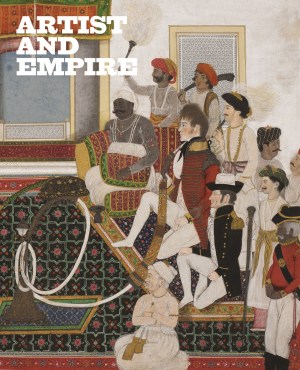 This autumn Tate Britain presents a major exhibition of art associated with the British Empire from the 16th century to the present day. In 21st-century Britain, ‘empire’ is highly provocative. Its histories of war, conquest and slavery are difficult and painful to address but its legacy is everywhere and affects us all. Artist and Empire will bring together extraordinary and unexpected works to explore how artists from Britain and around the world have responded to the dramas, tragedies and experiences of the Empire. Featuring a vast array of objects from collections across Britain, including maps, flags, paintings, photographs, sculptures and artefacts, the exhibition examines how the histories of the British Empire have shaped art past and present. Contemporary works within the exhibition suggest that the ramifications of the Empire are far from over. The show raises questions about ownership, authorship and how the value and meanings of these diverse objects have changed through history, it also asks what they still mean to us today.
Historic works by artists such as Joshua Reynolds and George Stubbs are shown with objects including Indian miniatures and Maori artefacts, as well as contemporary works by Hew Locke and Sonia Boyce. Through this variety of artworks from a complex mix of traditions, locations and cultures the fragmented history of the Empire can be told.
Alison Smith, David Blayney Brown, Carol Jacobi, Artist and Empire: Facing Britain’s Imperial Past (London: Tate, 2015), 240 pages, ISBN: 978-1849763431, $65.
◊ ◊ ◊ ◊ ◊
From Tate Britain:
Artist and Empire: New Dynamics, 1790 to the Present Day
Tate Britain, London, 24–26 November 2015
Tate Britain’s major conference, held in collaboration with Birkbeck, University of London and culture at King’s College London, marks the opening of the exhibition Artist and Empire. Scholars, curators and artists from around Britain and the world consider art created under the conditions of the British Empire, its aftermath, and its future in museum and gallery displays.
Scholarship of art associated with the British Empire has expanded over the last two decades, across a huge span of disciplines and locations. This conference takes the historic opportunity of the exhibition, featuring diverse artists from the sixteenth century to the present day, to bring together people to meet and share the latest research being developed around this subject. The papers, roundtables and audience discussions will consider the cosmopolitan character of objects and images, and the way geographical, cultural and chronological dislocations have in many instances obscured, changed or suppressed their history, significance and aesthetics. We will also explore how approaches to contemporary art, archives, curation and collecting can help develop new ways to look at them now.
T U E S D A Y , 2 6 N O V E M B E R 2 0 1 5
18.00 Opening Conversation
Introduction by Nicholas Serota, Director, Tate
Frank Bowling OBE, Artist and Writer, with Zoe Whitley, Curator, International Art, Tate Modern
W E D N E S D A Y , 2 5 N O V E M B E R 2 0 1 5
9.00 Registration and refreshments
9.30 Introduction
9.40 Panel 1 | Displaced Practices: Artists and Exchanges
Chaired by Felix Driver, Professor of Human Geography at Royal Holloway
• Michael Rosenthal (Emeritus Professor of Art History at the University of Warwick), Augustus Earle: Seeing Straight
• Geoff Quilley (Professor of Art History at the University of Sussex), Inside Empire Looking Out: The View from Dent’s Veranda
• Partha Mitter (Emeritus Professor of Art History at the University of Sussex), Art Education in India
11.20 Refreshment break
11.40 Panel 2 | Moving Objects: Collecting, Archives, Display
Chaired by John Mack, Professor of World Art Studies at the University of East Anglia and Chairman of the Sainsbury Institute for Art
• Alison Inglis (Associate Professor in Art History at the University of Melbourne), Collecting and Displaying British Art in the Australian Colony
• Zachary Kingdon (Curator of the African Collections at the World Museum in Liverpool), Unofficial Exchanges: Investigating West Africans’ Gifts to UK Museums in the Early Colonial Period
• Nick Thomas (Director of the Museum of Archaeology and Anthropology, Cambridge), Artefacts of Encounter: Rethinking Objects and Collections
13.20 Lunch break
14.00 Panel 3 | Face to Face: Figures, Portraits and Identities
Chaired by Elizabeth Edwards, Research Professor in Photographic History and Director of Photographic History Research Centre, De Montfort University
• Temi Odumosu (Marie Curie Postdoctoral Fellow at Copenhagen University), This Is How You See Her? Rachel Pringle of Barbados by Thomas Rowlandson’s Hand
• Gillian Forrester (Senior Curator of Prints and Drawings at the Yale Center for British Art), Noel B. Livingston’s Gallery of Illustrious Jamaicans
• Ruth Phillips (Canada Research Chair in Modern Culture and Professor of Art History at Carleton University), Sir Henry Acland Mi’kmaq Woman from Nova Scotia and a Mi’kmaq Dressed Doll: The Tensions of Imperialism and Indigenous Survivance and Resistance
15.40 Refreshment break
16.00 Plenary: Reflecting on the Future
Chaired by Augustus Casely-Hayford, Historian, Writer and Curator
Catherine Hall, Professor of Modern British Social and Cultural History at University College London
Zareer Masani, Historian and Writer
T H U R S D A Y , 2 6 N O V E M B E R 2 0 1 5
9.00 Registration and refreshments
9.30 Introduction
9.40 Panel 4 | Confronting Empire: Curating Artistic Legacies
Chaired by Sarah Victoria Turner, Assistant Director for Research at the Paul Mellon Centre
• Elisabeth Lalouschek (Artistic Director of the October Gallery)
• Devika Singh (Smuts Research Fellow at the Centre of South Asian Studies, Cambridge University)
10.55 Refreshment break
11.15 Panel 5 | Archived Futures: Mediating Collections and Archives
Chaired by Hammad Nasar, Head of Research and Programmes at the Asia Art Archive in Hong Kong
• Brook Andrew (Artist), Re-envisioning Archives and Aboriginal Culture
• Caroline Bressey (Director of the Equiano Centre, Department of Geography at UCL)
• Shaheen Merali (Writer, Curator and Co-founder of Panchayat), Panchayat
12.55 Lunch break
13.35 Panel 6 | Curating in Transnational Contexts in London
Chaired by Professor Paul Goodwin, Director of the Research Centre for Transnational Art, Identity and Nation (TrAIN) at the University of the Arts London
• The India Festival (Victoria and Albert Museum, June 2015 — March 2016)
Kriti Kapila, Lecturer in Social Anthropology and Law at King’s College, London
• West Africa: Word, Symbol, Song (British Library, October 2015 — February 2016)
Toby Green, Lecturer in Lusophone African History and Culture at King’s College, London, Marion Wallace, Lead Curator, African Collections, British Library, Co-curator
• Artist and Empire: Facing Britain’s Imperial Past (Tate Britain, November 2015 — April 2016)
Javed Majeed, Professor of English and Comparative Literature at King’s College London, Alison Smith, Senior Curator of British Art at Tate Britain
14.50 Refreshment break
15.10 In Conversation: Reflecting on Artists and Empire
Chaired by Achim Borchardt-Hume, Director of Exhibitions, Tate Modern
• Lubaina Himid, MBE (Artist, Curator, Professor of Contemporary Art at the School Art, Design and Fashion University of Central Lancashire)
• Yinka Shonibare, MBE (Artist and Curator)
16.05 Plenary: Reflecting on the Future
Chaired by Paul Gilroy, Professor of American and English Literature, King’s College London
Baroness Lola Young of Hornsey OBE
Mike Phillips, Novelist, Historian and former curator at Tate
Panellist TBC
Exhibition | Italian Dreams: Watteau and French Landscape Painting
From the website for Valenciennes:
Réveries Italiennes: Watteau et les paysagistes français au XVIIIe siècle
Italian Dreams: Watteau and French Landscape Painting in the Eighteenth Century
Musée des Beaux-Arts, Valenciennes, 25 September — 17 January 2016
Curated by Martin Eidelberg
 La Ville de Valenciennes a la chance d’avoir vu naître l’un des artistes français les plus illustres : Jean Antoine Watteau (1684–1721). La réouverture de son musée des Beaux-Arts, qui conserve un ensemble d’œuvres du peintre, est couronnée par le don exceptionnel d’une œuvre tout récemment redécouverte d’Antoine Watteau, La Chute d’eau, rare paysage du peintre des fêtes galantes inspiré des cascades de Tivoli près de Rome, qui témoigne de la fascination de l’artiste pour l’Italie, pays où il n’eut pourtant jamais l’occasion de se rendre !
L’exposition Rêveries italiennes, propose ainsi de souligner les emprunts que le maître fit tout au long de sa carrière au modèle italien, soit à travers l’exemple des peintres vénitiens du XVIe siècle qui constituèrent pour l’artiste une source importante d’inspiration, soit à travers le filtre des œuvres réalisées à Rome par ses contemporains. Autour d’un ensemble de peintures et de dessins d’Antoine Watteau, des œuvres des XVIe, XVIIe et XVIIIe siècles montreront comment ce peintre des songes puisa dans la culture artistique européenne pour créer des œuvres qui ouvriront la voie à une nouvelle école de paysage, née au siècle des Lumières, autour de Natoire, Boucher, Fragonard et Hubert Robert. À partir des rêveries italiennes de Watteau, l’exposition valenciennoise souhaite ainsi éclairer sous un jour nouveau la fécondité d’un modèle artistique qui, bien au-delà d’une iconographie séduisante, mena à l’éclosion du Romantisme.
L’exposition s’intègre dans la programmation liée à l’élection de la cité voisine belge de Mons comme capitale européenne de la culture pour l’année 2015. Elle bénéficie également du soutien exceptionnel du Musée du Louvre, qui a accordé pour l’occasion un prêt conséquent d’œuvres et a proposé, dans le cadre de la programmation du Louvre Lens, une exposition venant en écho à l’initiative valenciennoise, consacrée à Antoine Watteau et la fête galante, Dansez, embrassez qui vous voudrez. Fêtes et plaisirs d’amour au siècle de Mme de Pompadour, du 5 décembre 2015 au 29 février 2016.
Commissariat scientifique
Martin Eidelberg, Professeur émérite d’Histoire de l’Art, Rutgers University
Commissariat général
• Emmanuelle Delapierre, anciennement conservatrice du musée des Beaux-Arts de Valenciennes, actuelle conservatrice du musée des Beaux-Arts de Caen
• Vincent Hadot, directeur du musée des Beaux-Arts de Valenciennes
• Virginie Frelin-Cartigny, Attachée de conservation du Patrimoine, musée des Beaux-Arts de Valenciennes
Martin Eidelberg, Réveries Italiennes: Watteau et les paysagistes français au XVIIIe siècle (Heule: Snoeck, 2015), 163 pages, ISBN: 978-9461612397, 29€ / $55.
More information is available at Culture.Fr, and the press release is available as a PDF file here»
New Book | The Frick Collection: Decorative Arts Handbook
Press release (10 June 2015) from The Frick:
Charlotte Vignon, The Frick Collection: Decorative Arts Handbook (New York: The Frick Collection in association with Scala Arts Publishers, 2015), 172 pages, ISBN: 978-1857599398 $25.
 The unique atmosphere of The Frick Collection has as much to do with the decorative arts as with the old master paintings that line the museum’s walls. Indeed the enamels, clocks and watches, furniture, gilt bronzes, porcelain, ceramics, silver, and textiles far exceed in number, and are the equal in quality, of the works on canvas and panel. The institution announces the publication of the first handbook devoted to the decorative arts in the collection. This long overdue book will help convey the balance among the various art forms represented in the house and provide a valuable introduction to this area. Comments Director Ian Wardropper, “Despite the manifest importance of decorative arts at the Frick, until recently our small staff did not include a specialist in the field. Thanks to an endowment campaign and the generosity of a number of supporters a permanent curatorial position was created in September 2009. With energy and imagination, the first incumbent of this curatorship, Charlotte Vignon, has initiated a series of exhibitions that highlight this aspect of the collection. The present handbook is another indication of her scholarly dedication to the decorative arts.”
The Frick Collection: Decorative Arts Handbook offers fresh insight on various works long in the museum’s holdings and also includes commentary on more recently acquired examples. Exquisitely illustrated with new photography, this paperback volume is available in English and French editions.
Henry Clay Frick: Developing a Decorative Arts Collection
Acquiring paintings preoccupied Henry Clay Frick when he moved to New York in the first years of the twentieth century. While renting William H. Vanderbilt’s mansion at Fifth Avenue and 51st Street, he devoted his attention to collecting masterpieces by Rembrandt, Velázquez, and other masters. As the sumptuous house he constructed at 70th Street took shape between 1912 and 1914, he recognized the need for furnishings of a caliber that matched his painting collection. Interestingly, most of his purchases in this area were made just before or after he began to occupy the house and in a very concentrated period of time.
A trip to London and Paris in the spring of 1914 inspired many of the choices Frick would make for his New York mansion. After meeting Victor Cavendish, the ninth Duke of Devonshire, at Landsdowne House in London and his country house at Chatsworth, Frick acquired from him a suite of tapestry furniture thought to be eighteenth-century Gobelins. Impressed by the Wallace Collection and wishing to emulate it, he set out to acquire high-quality decorative arts of different periods and materials, especially porcelain, oriental carpets, and French Renaissance enamels and furniture, such as pieces made by André-Charles Boulle, with their distinctive turtle-shell and brass veneers. In Paris, through the intermediary of the American decorator Elsie de Wolfe, he purchased French furniture from the collection of Sir John Murray Scott (inherited from Lady Wallace, the widow of the founder of the Wallace Collection). In a single month, he spent more than $400,000, more than he had ever spent on collecting in this field.
In some cases, furniture and decorative arts were assembled to complement specific rooms of the house. Elsie de Wolf, for example, counseled the acquisition of a desk by the great French eighteenth-century cabinetmaker Jean-Henri Riesener together with Sèvres porcelain for Adelaide Frick’s second-floor dressing room, which was lined with wall panels painted by François Boucher’s workshop. The room and its furnishings were transferred to the first floor in 1935. Other great eighteenth-century French furnishings for Adelaide’s dressing room came through Joseph Duveen, then the head of Duveen Brothers. After Fragonard’s cycle of paintings was installed in the drawing room in 1915–16, Duveen sold Frick many more works to embellish its decor. French Renaissance furniture was bought to complement the collection of sixteenth-century enamels acquired in 1916; Henry’s office was transformed into a gallery for its display. The Italian Renaissance cassoni were always intended to be placed beneath masterpieces of painting in the West Gallery or elsewhere.
Carefully selected blocs of decorative arts, such as the forty-six pieces of Limoges enamel Frick acquired through Duveen from the estate of J. Pierpont Morgan, were one means by which the collection grew quickly. Morgan’s death in 1913 gave Frick the opportunity to choose from one of the finest and largest collections in the world just when he was seeking to expand in this area. Another example was the group of fifty Chinese porcelain jars and vases that Duveen had also acquired from Morgan’s estate. Apart from the windfall of the availability of the Morgan collection, Duveen’s own stock was so extensive and of such quality that Frick could buy from him French royal commissions, such as Gilles Joubert’s chest of drawers, which was among some twenty-five pieces of furniture that arrived at Fifth Avenue and 70th Street during the year 1915.
Later Acquisitions
Generous gifts from members of the Frick family and other donors have continued to enrich the decorative arts collection. The founder’s son, Childs, gave about two hundred pieces of Chinese blue-and-white porcelain in 1965, considerably augmenting those works his father had purchased fifty years earlier. In 1999, Winthrop Kellogg Edey’s extraordinary collection of some forty clocks and watches arrived at the Frick. Henry Arnhold has recently given us the Great Bustard from his distinguished and comprehensive collection of Meissen porcelain, and another one hundred and thirty-five works are pledged to the Frick as a bequest. Individual objects of great merit are prized additions to our holdings. Diane Modestini gave us our first piece of Italian majolica in honor of her husband Mario Modestini in 2008. On occasion, acquisitions are also made, such as the unusual vase japon, purchased in 2011.
Exhibition | The Luxury of Time: European Clocks and Watches
From The Met:
The Luxury of Time: European Clocks and Watches
The Metropolitan Museum of Art, New York, 16 November 2015 — 27 March 2016

Clockmaker: Ferdinand Berthoud (French, 1727–1807); Case maker: Balthazar Lieutaud (French, ca. 1720–1780, master 1749). Longcase astronomical regulator (detail), ca. 1768–70. Case: oak veneered with ebony and brass, with gilt-bronze mounts; Dial: white enamel; Movement: gilded brass and steel; Height: 90.5 in. (229.9 cm). The Metropolitan Museum of Art, New York, (1982.60.50).
Time is all around us, displayed on our phones and computers. Today, almost nobody needs to own a watch or a clock to tell the time. Access to the right time is not the luxury it once was. Yet the fascination with clocks and watches persists, and the thriving market for mechanical timekeepers is deeply aware of their history. Clocks and watches have always been about more than just telling time: they have been treasured as objects of desire and wonder, personal items imbued with value that goes beyond pure functionality. As works of art, they represent the marriage of innovation and craftsmanship.
This exhibition explores the relationship between the artistry of the exterior form of European timekeepers and the brilliantly conceived technology that they contain. Drawn from the Museum’s distinguished collection of German, French, English, and Swiss horology from the sixteenth through the nineteenth century, the extraordinary objects on view show how clocks and watches were made into lavish furniture or exquisite jewelry.
The creation of timekeepers required that clockmakers work with cabinetmakers, goldsmiths and silversmiths, enamelers, chasers and gilders, engravers, and even those working in sculpture and porcelain. These craftsmen were tasked with accommodating internal mechanisms by producing cases that, in both shape and function, adapted to timekeeping technologies. Their exteriors are often as complicated as the movements they house. Examining the dialogue between inside and out, adornment and ingenuity, The Luxury of Time
reveals the complex evolution of European clockmaking and
the central place of timekeepers in the history of decorative arts.
◊ ◊ ◊ ◊ ◊
The catalogue is scheduled for publication in February. From Yale UP:
Clare Vincent and Jan Hendrik Leopold, with Elizabeth Sullivan, European Clocks and Watches in The Metropolitan Museum of Art (New York: The Metropolitan Museum of Art, 2016), 288 pages, ISBN: 978-1588395795, $65.
 Among the world’s great technological and imaginative achievements is the invention and development of the timepiece. Examining for the first time the Metropolitan Museum’s unparalleled collection of European clocks and watches created from the early middle ages through the 19th century, this fascinating book enriches our understanding of the origins and evolution of these ingenious works. It showcases 54 extraordinary clocks, watches, and other timekeeping devices, each represented with an in-depth description and new photography showing the exterior as well as the inner mechanisms. Included are an ornate celestial timepiece that accurately predicts the trajectory of the sun, moon, and stars and a longcase clock by David Roentgen that shows the time in the ten most important cities of the day. These works, created by clockmakers, scientists, and artists in England, Germany, France, Italy, and the Netherlands, have been selected for their artistic beauty and design excellence, as well as for their sophisticated and awe-inspiring mechanics. Built upon decades of expert research, this publication is a long-overdue survey of these stunning visual and technological marvels.
Clare Vincent is associate curator, European Sculpture and Decorative Arts, The Metropolitan Museum of Art. J. H. Leopold was former assistant keeper in charge of the horological collections at The British Museum. Elizabeth Sullivan is research associate, European Sculpture and Decorative Arts, The Metropolitan Museum of Art.
Exhibition | Living for the Moment: Japanese Prints
Press release (5 October 2015) from LACMA:
Living for the Moment: Japanese Prints from the Barbara S. Bowman Collection
Los Angeles County Museum of Art, 11 October 2015 — 1 May 2016

Suzuki Harunobu, Lucky Dream for the New Year: Mt. Fuji, Falcon, and Eggplants, ca. 1768–69 (promised gift of Barbara S. Bowman, Museum Associates/LACMA).
The Los Angeles County Museum of Art (LACMA) presents Living for the Moment: Japanese Prints from the Barbara S. Bowman Collection. The exhibition features over 100 prints of transformative promised gifts of Japanese works to LACMA, representing the work of 32 artists. Included are examples of rare early prints of the ukiyo-e genre (pictures of the floating world); works from the golden age of ukiyo-e at the end of the eighteenth century by Suzuki Harunobu, Kitagawa Utamaro, and Katsukawa Shunshō; and nineteenth-century prints by great masters such as Utagawa Hiroshige, Katsushika Hokusai, Utagawa Kuniyoshi, and others.
Barbara S. Bowman (née Safan) was born in Los Angeles in 1925 and attended the University of Southern California (USC) for a degree in fine art. Barbara became captivated by Japanese woodblock prints early on after receiving two prints as a gift from her mother. She and her husband Morton visited Japan for the first time in 1962, and by 1978 she began actively collecting Japanese woodblock prints. Never intending to have an encyclopedic collection, Barbara sought out scenic designs in superb condition with stellar impressions, as she held the printing process in high esteem. The power of line and the importance of color were and remain defining factors of the collection. Assembled over 35 years, the Barbara S. Bowman Collection includes some of the finest impressions available.
“Living for the Moment represents a momentous gift to the Japanese Art Department of LACMA, in that we can now present the history of Japanese prints with high-quality works of art,” remarks Hollis Goodall, Curator of Japanese Art at LACMA.
Living for the Moment is presented in two locations at LACMA. Commercially printed ukiyo-e, mostly produced in Edo (modern Tokyo), will be displayed chronologically and by artistic group in the Ahmanson Building, level 2. Privately published surimono and theatrical prints of Osaka are installed in the Pavilion for Japanese Art, level 3.
Ukiyo-e developed as an independent genre in painting and book illustration by the late 1600s. The idea of the ‘floating world’ (ukiyo), initially based on a Buddhist phrase referring to the transience of life, was adopted by popular writers to evoke fleeting moments of beauty and pleasure that provided distraction from the cares of a regimented society. Book illustrations on these topics gained such popularity that artists began creating single-sheet woodblock prints to sell. Edo became the center for the production of ukiyo-e prints. In response to government restrictions placed on floating world subject matter in the early 1800s, artists explored new topics such as travel and heroes of ancient lore. Prints were also a perfect medium for artistic experimentation. After a breakthrough by Suzuki Harunobu in 1765, which allowed the production of multiblock color prints, artists explored realism, nature, perspective, framing, and light with a level of intensity that spread their influence not only across Japan but also, after the country opened to foreign trade in 1868, to Europe. There, the Impressionists, struck by the Japanese printmakers’ use of color, atmosphere, and composition, created a watershed style embarking upon Modernism.
The artist Utagawa Hiroshige (1797–1858) was from a samurai family with an inherited position as a fire man in Edo Castle. In 1823 he passed on this job to a relative and became a full-time artist, having been trained by the Utagawa school master, Toyohiro (1773–1828). Hiroshige excelled at evoking the human experience of the landscape, with its varying seasons, times of day, and weather events. His sensitivity toward shifting light is best seen in early impressions of prints where he supervised color choice, as exemplified by his finest print in the Bowman collection entitled, Minowa, Kanasugi, and Mikawashima (1857). In this print, a broad strip of pink marks the horizon. The still-dark middle ground indicates light at daybreak which has not reached the nearby plains, and roofs in the distance already reflect the growing daylight. In his late years, Hiroshige developed a unique viewpoint, looking beyond an object set close at hand to a landscape which receded into deep distance. His framing of subjects directly influenced the Impressionists and Post- Impressionists in Europe, and later Frank Lloyd Wright in the United States.
The majority of ukiyo-e prints were produced by publishers for general sale. Government censors enforced laws restricting the subject matter of prints and their price, by limiting the number of blocks and quality of pigments. These laws were not applied to private groups, who made prints called surimono (printed things) for distribution to a specified clientele. These groups mostly consisted of poets of kyōka (mad verse), which was based on courtly poetry but played with the rules of language and content. Fan clubs for musicians and actors also occasionally commissioned surimono. The heyday of surimono lasted from the late 1700s through the first third of the 1800s, with the majority produced after 1800. These prints were most frequently distributed at the New Year to kyōka group members and would often bear poems related to that season. Printed on thick, luxurious paper, surimono often featured richly hued dyes too expensive for general use and metals such as brass, tin, and copper. Viewing these prints closely, one may also detect exquisite embossed details and areas that mimic the appearance of lacquer.
Surimono artists, led by Katsushika Hokusai (1760–1849), his followers, and contemporaries, drew designs based on the poetry to be printed on the surimono, either portraying, embellishing, or playfully skewing the content with their illustrations. The design was there for the enhancement of the poetry, rather than vice versa. Hokusai’s Salt Shells (Shiogai) from 1821, for example, is a still life that depicts a box of open salt cakes, a pipe case and tobacco pouch attached to a netsuke container, and a small pine tree planted in a bowl. The work is from a series of 36 surimono that included verse by many followers of the noted contemporary poet Yomo no Magao. The series title and poem refer to the New Year game of matching bifurcated shells, each containing a segment of the same poem.
◊ ◊ ◊ ◊ ◊
The catalogue is published by Prestel:
Hollis Goodman with an essay by Joan B. Mirviss, Living for the Moment: Japanese Prints from the Barbara S. Bowman Collection (London: Prestel, 2015), 184 pages, ISBN: 978-3791354729, $65 / £35.
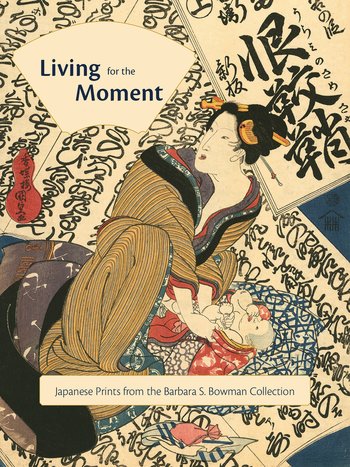 Spanning the late 18th and early 19th centuries, the exquisite examples of Japanese prints included in this book offer insights into the history of an art form and vision that is distinctively Japanese and was highly inspirational to later European painters. Polychrome prints, or ukiyo-e, first appeared in Japan in the late 18th century. Delicately hued and intricate, they depicted landscapes, scenes, and figures that epitomized the country’s idea of ‘the floating world’: a place whose denizens lived for the moment and appreciated the pleasures of the natural world. This volume surveys the prominent Barbara S. Bowman collection of prints notable for a number of reasons: an excellently preserved print of Lucky Dream for the New Year: Mount Fuji, Falcon, and Eggplants by Suzuki Harunobu; a number of surimono, or privately published prints that were created with unusually luxurious materials; and numerous works by Hiroshige and Hokusai, who are considered the masters of the art form. Each of the over one hundred prints in this book is reproduced in large color plates that highlight their subtle beauty and charm and are accompanied by extensive analysis of the pieces’ remarkable qualities. This comprehensive overview of the collection by LACMA curator Hollis Goodall addresses the significance and history of the Bowman collection and the many ways it enhances the museum’s extensive holdings of Japanese art.
Hollis Goodall is curator of Japanese art at the Los Angeles County Museum of Art.
Exhibition | Dangerous Liaisons: The Art of the French Rococo

◊ ◊ ◊ ◊ ◊
Now on view at the Liebieghaus Skulpturensammlung:
Gefährliche Liebschaften: Die Kunst des französischen Rokoko
Dangerous Liaisons: The Art of the French Rococo
Liebieghaus Skulpturensammlung, Frankfurt, 4 November 2015 — 28 March 2016
Curated by Maraike Bückling
Featuring more than eighty outstanding works on loan, the show entitled Dangerous Liaisons focuses on the newly emerging concept of sentimental love and its preferred style of representation in French art around 1750, vividly illustrating the seductive powers of the Rococo. On view will be sculptures, biscuit-porcelain statuettes, paintings, and prints as well as arts-and-crafts objects from renowned international lenders such as the Rijksmuseum, the Musée du Louvre, the British Museum, the Victoria and Albert Museum, the Museo Thyssen-Bornemisza, the Wallraf-Richartz Museum & Fondation Corboud, and Munich’s Alte Pinakothek.
During the reign of French king Louis XV, not only art theoreticians and writers, but also visual artists began to reassess the meaning of passions and emotions. While formulaic enunciations of sentiments had still been commonplace in the seventeenth century, such preset expressions of passion lost the more of their significance in the first half of the eighteenth century, the more love came to be understood as an individual emotion that was glorified as giving meaning to life. New models of love and—along with them—nature as a courtly Arcadia informed the representational vocabulary of the fine arts. What is in the foreground of works by sculptors Étienne-Maurice Falconet (1716–1791) and Jean-Baptiste Pigalle (1714–1785) as well as painters Jean-Antoine Watteau (1684–1721), Nicolas Lancret (1690–1743), and François Boucher (1703–1770) and of porcelain sculptures by Johann Joachim Kaendler (1706–1775) is an artistic conception of naturalness. In addition, one room in the exhibition recreates, with mirrors, furniture, paintings, prints, and porcelain, the look of a typical eighteenth-century salon.
“The art of the French Rococo polarizes and enthralls. Back then, like today, it prompted widely diverse responses between fascination and repudiation, admiration and incomprehension. Thanks to noted works on loan from the most important collections of the world our large-scale exhibition at the Liebieghaus is able to convey the style-defining power of this unique epoch with its new ideas about love and the idealization of rural life by the aristocracy,” Max Hollein, director of the Liebieghaus Skulpturensammlung, explains.
“In the eighteenth century, artists like Jean-Antoine Watteau, François Boucher, Étienne-Maurice Falconet, Jean-Baptiste Pigalle, or Jean-Honoré Fragonard discovered quiet and serene loves scenes as their subject matter. Yet only a few years later, their pictures full of naturalness and the comforts of love were denounced as reprehensible, devoid of truth, and even dangerous by critics like Choderlos de Laclos. That they nevertheless count among the most beautiful works of Rococo art is what we want to show in this exhibition,” says Maraike Bückling, curator of the exhibition and head of the departments Renaissance to Neoclassicism at the Liebieghaus Skulpturensammlung.
In the early eighteenth century, love was considered to be the most common of feelings, which all people were capable of. Drawing on theater plays, fables, operas, and narratives, visual artists like Jean-Antoine Watteau or François Boucher gave pictorial expression to the new concepts of love. Love scenes no longer showed the destructive passions of gods and heroes, but depicted tender affection between individuals. By and by, the divine personages transformed into characters of the pastoral, the bucolic play. Genre scenes of shepherds and gardeners become almost paradigmatic of the portrayals of a more tranquil, tender love in the Arcadian courtly settings of the period. The aristocracy’s enthusiasm for these scenes with their leisurely casualness and naturalness also found its expression in their self-fashioning. Costume plays arranged around the shepherd and the shepherdess were highly popular. This fascination even led to the setting-up of idealized fake farmsteads, for example in the parks of Versailles, most of them lavishly furnished with exquisite wall coverings and porcelain services especially made in Sèvres. Given this enthusiasm for bucolic themes, it is quite unsurprising that they soon gained ground in all art genres. The sculptors Étienne-Maurice Falconet and Jean-Jacques Bachelier (1724–1806) also took to developing pastoral scenes, as for example in the biscuit groups Annette et Lubin (1764, Düsseldorf, Hetjens-Museum – German Museum of Ceramics) or La fée Urgèle (1767, Sèvres, Cité de la Céramique – Sèvres et Limoges, Musée national de Céramique). Like their painter colleagues, they drew on models from literature. Johann Joachim Kaendler, Laurentius Russinger (1739–1810), and Johann Peter Melchior (1747–1825) created entire countrified theme worlds for the porcelain manufactories in Meißen and Höchst. Without exception, these pastoral couples are depicted in the outdoors, in a nature that appears not at all pristine or uncultivated: rather, the lovers—always looking elegant and more like aristocratic figures in their rustic garb—are seen strolling through gardens or enchanted overgrown park landscapes.
While the Académie royale de peinture et de sculpture, founded in 1648, still only knew formulaic patterns for the representation of emotions, artists eventually discarded the seventeenth-century rulebook in turning toward spheres of more individualized emotions. The fact that the viewer’s gusto was increasingly seen as a valid critical category finally led to the abandonment of traditional precepts and guidelines. The goal was to move viewers. And this was to be effectuated through works that tapped into their own world, their living environment and emotional sphere. Rococo painting and porcelain sculpture did not depict high-flown ideals of virtue or admirable heroic exploits. Rather, the figures are characterized by mild manners and tenderness and, whether it is pastoral themes or scenes from ancient mythology, appear in graceful everyday postures.
 In the opening section of the exhibition Dangerous Liaisons: The Art of the French Rococo viewers are given an idea of the character of a Rococo salon. The first room shows a set of furnishings, as is typical of the time around 1750. Wall coverings, paintings, armchairs, chests of drawers, mirrors, candelabra, porcelain, tapestries—all details were carefully matched with one another so as to create a harmonious overall picture at that time. Following the model of literature and painting, different artisans also devoted themselves to genre scenes. This connection is illustrated by the coverings of two armchairs from the Munich Residency which were made after children’s portraits of François Boucher. These ‘Enfants Boucher’ were very popular in the mid-eighteenth century, also as motifs of porcelain groups.
Costumes are shown in the passageway from the first room to Villa Liebieg. These are garments made for a production of Un ballo in maschera by Guiseppe Verdi (1813–1901) at the Frankfurt Opera House. They correspond to historical Rococo attire and convey a specific idea of the life-world of the period. French Rococo fashion was informed by courtly taste. One type of gown that was particularly in vogue was the ‘Robe à la française’ which accentuated the female back with full-length pleats from the neckline down to the floor; a fashion detail that was given special attention by Jean-Antoine Watteau and his successors, so that it later came to be known as ‘Watteau pleat’.
After the prologue introducing visitors to the Rococo lifestyle, the adjoining room features one of the most celebrated works by sculptor Étienne-Maurice Falconet. His Menacing Love (Amour menaçant) of 1757 (Rijksmuseum, Amsterdam), created for Madame de Pompadour (1721–1764), ushers in the theme of love in the presentation. The marble sculpture marks a change of style in Falconet’s oeuvre, as the Seated Cupid, as its also called, is the first instance that he addresses what appears to be a lighter, less grave theme. The secretive look and the raised finger commanding silence make the viewer a confidant let in on the love god’s secret plans. With his other hand, the little boy is already pulling an arrow from his quiver. The poignancy with which Falconet engages the viewer in the work is reminiscent of the dramatic and theatrical stylistic devices of Roman Baroque.
 In the subsequent rooms the presentation is continued with a number of paraphrases and variants of sentimental love. An extraordinary couple of lovers Pygmalion and Galathea (1763, Paris, Musée du Louvre) by Falconet is juxtaposed with suggestive scenes such as The See-Saw (around 1755, Madrid, Museo Thyssen-Bornemisza) by Jean-Honoré Fragonard (1732–1806), Falconet’s biscuit pieces The Kiss (1765, London, British Museum) and La Feuille à l’envers (1760, Sévres, Cité de la Céramique-Sèvres et Limoges) or Les Trois Contents (1765, Munich, Bavarian National Museum).
Around the mid-eighteenth century, visual artists frequently took the inspiration for their modern ideas of naturalness and love from fables and theater plays. The pastoral works of, for example, François Boucher enjoyed such popularity that his compositions were mass-reproduced as prints and disseminated throughout Europe. So, eventually, Boucher’s renditions of motifs from popular tales, plays, or operas came to grace tableware services, tapestries, furniture, and porcelain statuettes. The exhibition juxtaposes a number of etchings illustrating a play entitled Grape Harvest in the Vale of Tempe with pastoral porcelain statuettes, including, for example, The Flute Lesson (c. 1752, Paris, Musée Jacquemart-André) after René Gaillard (c. 1719–1790) and The Grape Eaters (c. 1766–1772, Hamburg, Museum of Arts and Crafts) by Jean-Jacques Bachelier, both after François Boucher.
The predilection for the cutely small and intimate inherent in those pastoral motifs is carried on in Boucher’s work in a turn toward children’s figures, which is illustrated in the final section of the exhibition. Sculptors like Falconet and Bachelier soon followed the example of the painter and also produced children’s statuettes. Mostly acting like grown-ups, these children appear as street musicians, macaroon sellers, milkmaids, or organ grinders.
A different matter are the almost life-size marble statues created by both Pigalle and Falconet. The sculpture Boy with a Birdcage (1749, Musée du Louvre) is a much closer rendering of childlike physiognomy and agility. Pigalle very precisely brings out the fleshiness of the child, which gives the piece an appearance somewhere between putto, allegory, and portrait.
Dangerous Liaisons: The Art of the French Rococo is supported by Kulturfonds Frankfurt RheinMain gGmbH and the Georg und Franziska Speyer’sche Hochschulstiftung.
Mareike Bückling, ed., Gefährliche Liebschaften: Die Kunst des französischen Rokoko (Munich: Hirmer, 2015), 280 pages, ISBN: 978-3777424637, 45€.










leave a comment