Exhibition | Sir Hans Sloane’s Plants on Chelsea Porcelain
From the press release:
Sir Hans Sloane’s Plants on Chelsea Porcelain: A Loan Exhibition
Stockspring Antiques, London, 2–16 June 2015
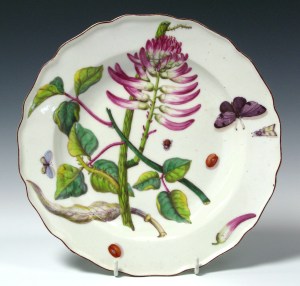
Chelsea plate with a wavy brown-edged rim, painted with a Corallodendron flower, leaves, floret, seed pod and seeds, and two butterflies, ca. 1753–56; Mark: red anchor over 34;
24.5 cm (Private Collection)
The exhibition Sir Hans Sloane’s Plants on Chelsea Porcelain aims to identify the plants on Chelsea porcelain botanical wares and link them to their source drawings and prints—many of which were by G. D. Ehret and were published by Philip Miller in Figures of the most Beautiful, Useful, and Uncommon plants described in the Gardeners Dictionary and other botanical publications of the period. The catalogue includes chapters on Sir Hans Sloane, the Chelsea Physic Garden, and Philip Miller’s role in receiving and propagating the imported plants and seeds from the New World, Africa, and Asia, as well as his influence on garden planting and design in Britain. The exhibition comprises of the loan of over 70 pieces of Chelsea porcelain from private and museum collections, which are shown with their relevant source engravings. Previously only about 10 plants on Chelsea porcelain had been correctly identified and linked to botanical engravings; so the exhibition includes significant new research.
The catalogue by Sally Kevill-Davies is generously sponsored by the Cadogan Estate (email stockspring@antique-porcelain.co.uk to order a copy, £30 + p&p). The exhibition is on view at Stockspring Antiques, 114 Kensington Church St., London W8 4BH, weekdays 10–5.30 and Saturdays 10–4; closed on Sundays.
Sally Kevill-Davies, Sir Hans Sloane’s Plants on Chelsea Porcelain (London: 2015), 229 pages, ISBN: 978-0956570222, £30.
Exhibition | Bread and Wine
From the exhibition press release:
Bread and Wine: Traces of the Eucharist Mystery, 16th–18th Centuries
Pane e vino: Tracce del mistero eucaristico nella pittura a Como dal XVI al XVIII secolo
Cathedral of Como, 9 May — 31 October 2015
Curated by Eugenia Bianchi and Andrea Straffi
 La mostra Pane e vino: Tracce del Mistero eucaristico nella pittura a Como dal XVI al XVIII secolo, visitabile dal 9 maggio al 31 ottobre 2015 presso la cattedrale di Como, è uno dei fulcri del progetto Pane e vin non ci mancava: Uomini e merci in movimento tra campi, botteghe e chiese nel Comasco, promosso dal Centro studi ‘Nicolò Rusca’ in occasione di EXPO 2015. Con un allestimento appositamente ideato per gli spazi della cattedrale e un ricco apparato di testi e immagini, vengono illustrate trenta opere—tra dipinti e affreschi dal XVI al XVIII secolo—scelte all’interno del patrimonio artistico comasco per il loro contenuto esplicitamente eucaristico o per la presenza di segni e simboli che rimandano a quel Mistero. La tematica dominante della mostra è infatti l’Eucaristia, come si trova rappresentata o evocata nei dipinti che arricchiscono le chiese di Como e della sua provincia, a memoria di un popolo di fedeli desiderosi di abbellire e impreziosire i propri luoghi di culto con immagini di profondo significato teologico.
Non si tratta però di una mostra esclusivamente iconografica. Il valore aggiunto di questa iniziativa è offerto dai risultati delle ricerche storico-artistiche, che hanno permesso di aggiornare lo stato delle conoscenze su opere già note e di recuperare dall’oblio opere mai valorizzate e collocate spesso in contesti defilati rispetto ai più tradizionali circuiti turistici. Del Gonfalone di sant’Abbondio, realizzato da Morazzone per la confraternita del Santissimo Sacramento in cattedrale, si è trovata, ad esempio, la fonte iconografica (il testo di Nicola Laghi, I Miracoli del Santissimo Sacramento, Venezia 1597); nell’oratorio della Madonna Nera di Einsiedeln a Rogaro di Tremezzo si è scoperta una coppia di tele del valsesiano Giuseppe Antonio Pianca, artista originalissimo nel contesto barocchetto lombardo, di cui finora non si conosceva alcuna opera comasca; il San Carlo Borromeo comunica gli appestati della parrocchiale di San Gerardo a Olgiate Comasco dà invece un volto a Ludovico Mascarone, pittore probabilmente milanese noto solo a livello documentario. Ancora, è emersa a Bregnano una tela di Francesco Innocenzo Torriani e trova un’attribuzione più verosimile il ciclo con le Storie di san Rocco della chiesa di San Giacomo a Livo, da riferire al solo Ambrogio Arcimboldi e alla sua bottega.
La mostra non vuol essere un’iniziativa fine a sé stessa. Piuttosto è un caloroso invito a percorrere un ‘viaggio’ nei luoghi indicati, per prendere visione delle opere nel loro contesto, così da “toccare con mano” quell’imprescindibile rapporto, tra manufatto e luogo sacro, che va inevitabilmente a perdersi quando la fruizione avviene in un museo. Solo in questo modo prende effettivo risalto quell’hic et nunc che è insito nel ‘visibile parlare’ adottato dalla Chiesa nella sua storia millenaria al fine di diffondere e rendere comprensibile a tutti le verità del Vangelo.
Contestualmente alla mostra e per tutta la sua durata, sarà possibile visitare la Sacrestia dei Mansionari, eccezionalmente aperta per l’occasione. Sotto il suggestivo affresco con l’Incoronazione della Madonna di Morazzone e circondati da alcuni dipinti della collezione donata nel 1683 alla cattedrale di Como dal nobile comasco Giacomo Gallio, verranno esposte alcune antiche suppellettili legate alla liturgia eucaristica (calici, ostensori, pissidi, ecc. dal XVI al XIX secolo) e documenti della Confraternita del Santissimo Sacramento esistente in cattedrale.
◊ ◊ ◊ ◊ ◊
The catalogue is available from artbooks.com:
Eugenia Bianchi and Andrea Straffi, Pane e Vino: Tracce del Mistero eucaristico nella pittura a Como dal XVI al XVIII secolo (Milan: Silvana: 2015), 144 pages, ISBN: 978-8836631339, $45.
 Il catalogo della mostra Pane e vino: Tracce del mistero eucaristico nella pittura a Como dal XVI al XVIII secolo è dedicato a trenta opere—tra dipinti e affreschi dal XVI al XVIII secolo—scelte all’interno del patrimonio artistico comasco per il loro contenuto esplicitamente eucaristico o per la presenza di segni e simboli che rimandano a quel mistero. Il filo conduttore del volume è infatti l’eucarestia, come si trova rappresentata o evocata nei dipinti che arricchiscono le chiese di Como e della sua provincia, a memoria di un popolo di fedeli desiderosi di abbellire e impreziosire i propri luoghi di culto con immagini ricche di significato teologico.
Exhibition | Canaletto: The Triumph of Light

Canaletto, Capriccio, A Palladian Design for the Rialto Bridge, with Buildings, 1744, 90 x 130 cm (London: The Royal Collection, RCIN 404029) © Her Majesty Queen Elizabeth II 2014.
◊ ◊ ◊ ◊ ◊
From the Centre d’Art de l’Hôtel de Caumont:
Canaletto, Rome—Londres—Venise: Le Triomphe de la Lumière
Centre d’Art de l’Hôtel de Caumont, Aix-en-Provence, 6 May — 13 September 2015
Curated by Bozena Anna Kowalczyk
Giovanni Antonio Canal, known as Canaletto (1697–1768), is recognised as the emblematic figure of the veduta genre, the most admired Venetian artistic creation of the 18th century in Europe. This inaugural exhibition at the art centre of the Hôtel de Caumont aims to provide new insights into the complete works of Canaletto, with a particular interest in the treatment of light in the Venetian master’s paintings. Fifty paintings and drawings from international public and private collections will present Canaletto the man and the different phases of his artistic career, in Rome, London and Venice.
We initially discover Canaletto’s first activity, as a painter of theatre scenery, carried out in collaboration with his father Bernardo Canal and his brother Cristoforo. Opera librettos on which Canaletto’s name appears will be exhibited alongside his first capricci, full of musical influences, painted in 1720–1722, and the first views of Venice, composed according to the criteria for staging.
The exhibition continues with a presentation of the major undertakings of Canaletto’s youth: the views of Venice commissioned by Joseph Smith (1722–1723), Joseph Wenzel of Liechtenstein (1723) and Stefano Conti (1725–1726), are large scale canvases that bear witness to the skill of the young painter.
Canaletto’s visit to England, his contact with new landscapes and the light of the Thames, led to changes in his palette and his touch. A series of paintings and drawings show the new solutions he adopted to capture the atmosphere and spirit of England. Canaletto painted London and lingered over Westminster Bridge, the second bridge over the Thames, then under construction. He also painted the English countryside, travelling as far as outskirts of Scotland to depict Alnwick Castle, home of the Duke of Northumberland.
A special section is devoted to technical experiments conducted by the artist throughout his career. Canaletto conceived a systematic and scientific way to rework drawings that had been made outdoors by means of a camera obscura (dark chamber). An example of the camera obscura used by the painter is presented next to a facsimile that allows the visitor to visualise for himself what the painter would see when using this device. A reproduction of pages from his sketchbook, as well as a film, illustrate the technical work of the artist during his portrayal of views of Venice.
This exhibition is also the occasion to conduct for the first time a comprehensive study of the last years of Canaletto in Venice. The works accomplished after his return from London at the end of 1755 illustrate Canaletto’s new interests and his response to the new artistic climate in Venice, where Francesco Guardi (1712–1793) was making a name for himself. Particular attention is devoted to the artist’s tireless passion for the study of new effects of light and atmosphere. The greatest international museums have granted their support. Among them: the Royal Collection and the National Gallery of London, the Metropolitan Museum of New York, the Uffizi Gallery of Florence as well as the Ca’Rezzonico of Venice.
◊ ◊ ◊ ◊ ◊
From artbooks.com:
Bozena Anna Kowalczyk, ed., Canaletto, Rome—Londres—Venise: Le Triomphe de la Lumière (Antwerp: Mercatorfonds, 2015), 224 pages, ISBN: 978-9462300835, 45€ / $85.
 For the inaugural exhibition at the Centre d’Art de l’Hôtel de Caumont in Aix-en-Provence, Mercatorfonds presents the first French monograph on Canaletto, and the first worldwide following the Metropolitan Museum’s publication in 1989. Numerous recent shows, focusing on specific aspects of Canaletto’s work or simply on his depictions of Venice, are a clear indication of the public’s interest in the painter’s oeuvre. This volume introduces the reader to Canaletto and, by tracing the various phases of his artistic path, provides a complete overview of his work. To highlight the development of Canaletto’s tastes, his reactions to Venice’s artistic and cultural trends and the atmosphere of England—where he worked for nine years—the paintings and drawings shown here have been selected from among the artist’s most remarkable pieces.
Exhibition | Made in the Americas: The New World Discovers Asia
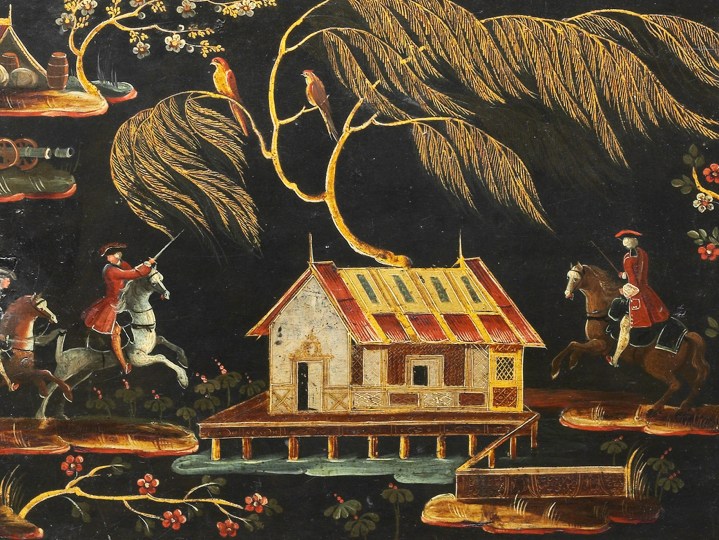
José Manuel de la Cerda, Desk-on-stand (detail), Pátzcuaro, Mexico, 18th century. Lacquered and polychromed wood with gilt decoration. On loan from The Hispanic Society of America, New York.
◊ ◊ ◊ ◊ ◊
From the MFA:
Made in the Americas: The New World Discovers Asia
Museum of Fine Arts, Boston, 18 August 2015 — 15 February 2016
Winterthur, Wilmington, Delaware, 26 March 2016 — 8 January 2017
Exquisite objects tell the story of the influence of Asia on the arts of colonial America.
Within decades of the ‘discovery’ of America by Spain in 1492, goods from Asia traversed the globe via Spanish and Portuguese traders. The Americas became a major destination for Asian objects and Mexico became an international hub of commerce. The impact of the importation of these goods was immediate and widespread, both among the European colonizers and the indigenous populations, who readily adapted their own artistic traditions to the new fashion for Asian imports.
Made in the Americas is the first large-scale, Pan-American exhibition to examine the profound influence of Asia on the arts of the colonial Americas. Featuring nearly 100 of the most extraordinary objects produced in the colonies, this exhibition explores the rich, complex story of how craftsmen throughout the hemisphere adapted Asian styles in a range of materials—from furniture to silverwork, textiles, ceramics, and painting. Exquisite objects from Mexico City, Lima, Quito, Quebec City, Boston, New York, and Philadelphia, dating from the 17th to the early 19th centuries, include folding screens made in Mexico in imitation of imported Japanese and Chinese screens, blue-and-white talavera ceramics copied from imported Chinese porcelains, and luxuriously woven textiles made to replicate fine silks and cottons imported from China and India.
The timing of the exhibition marks the 450th anniversary of the beginning of the Manila-Acapulco Galleon trade between the Philippines and Mexico, which was inaugurated in 1565 and ended in 1815, two and a half centuries later.
◊ ◊ ◊ ◊ ◊
From the MFA:
Dennis Carr, with contributions by Gauvin Alexander Bailey, Timothy Brook, Mitchell Codding, Karina H. Corrigan, and Donna Pierce, Made in the Americas: The New World Discovers Asia (Boston: Museum of Fine Arts, 2015), 160 pages, ISBN: 978-0878468126, $50.
 Made in the Americas reveals the largely overlooked history of the profound influence of Asia on the arts of the colonial Americas. Beginning in the sixteenth century, European outposts in the New World, especially those in New Spain, became a major nexus of the Asia export trade. Craftsmen from Canada to Peru, inspired by the sophisticated designs and advanced techniques of these imported goods, combined Asian styles with local traditions to produce unparalleled furniture, silverwork, textiles, ceramics, lacquer, painting, and architectural ornaments.
Among the exquisite objects featured in this book, from across the hemisphere and spanning the seventeenth to the early nineteenth centuries, are folding screens made in Mexico, in imitation of imported Japanese and Chinese screens; blue-and-white talavera ceramics copied from Chinese porcelains; luxuriously woven textiles, made to replicate fine silks and cottons from China and India; devotional statues that adapt Buddhist gods into Christian saints; and japanned furniture produced in colonial Boston that simulates Asian lacquer finishes. The stories these objects tell, compellingly related by leading scholars, bring to life the rich cultural interchange and the spectacular arts of the first global age.
Dennis Carr is Carolyn and Peter Lynch Curator of American Decorative Arts and Sculpture, Museum of Fine Arts, Boston.
Gauvin Alexander Bailey is Professor and Alfred and Isabel Bader Chair in Southern Baroque, Department of Art History and Art Conservation, Queen’s University, Kingston, Ontario.
Timothy Brook holds the Republic of China Chair in the Department of History and Institute of Asian Research, University of British Columbia, Vancouver.
Mitchell Codding is Executive Director, The Hispanic Society of America, New York.
Karina H. Corrigan is H. A. Crosby Forbes Curator of Asian Export Art, Peabody Essex Museum.
Donna Pierce is Frederick & Jan Mayer Curator of Spanish Colonial Art, Denver Art Museum.
Exhibition | Turner’s Wessex: Architecture and Ambition
Press release for the exhibition now on view at Salisbury:
Turner’s Wessex: Architecture and Ambition
The Salisbury Museum, 22 May — 27 September 2015
Curated by Ian Warrell

J.M.W. Turner, The Choir of Salisbury Cathedral, 1797, watercolour, 65 x 51 cm (The Salisbury Museum)
Visitors to The Salisbury Museum this summer will be treated to a highly original and fascinating exhibition on J.M.W. Turner. Newly discovered facts and a wealth of material never previously assembled together revises the traditional outline of Turner’s formative years. Turner’s Wessex: Architecture and Ambition reveals new insights into Turner’s ambitious and innovative work as a very young man and his complex relationships with extremely wealthy patrons. “We are astonished to discover that Turner began his career here in Salisbury, painting the town, its magnificent cathedral and the extraordinary Fonthill Abbey nearby,” said Adrian Green, Director of The Salisbury Museum.
Building on recent successes with Constable and Cecil Beaton exhibitions, The Salisbury Museum showcases J.M.W. Turner’s meteoric rise at the turn of the nineteenth century, working for two of England’s wealthiest men as they embarked on extravagant building projects and historical research on a very grand scale in the Wessex region.
Salisbury is likely to be a magnet for visitors throughout 2015, as across the green from the museum at Salisbury Cathedral the Magna Carta celebrates its 800th anniversary. Exceptional National Trust properties such as Stourhead will be open to visitors nearby, and 20 minutes away the ancient monument of Stonehenge continues to cast its mysterious spell.
Turner first visited Salisbury in 1795 when he was 20 years old. As his career developed, he returned to paint Stonehenge and its surrounding landscape. Set in the vast Wessex plains, his depictions of the ancient stones proves to be among his most hauntingly atmospheric works.
The first of Turner’s patrons in the Salisbury area was Sir Richard Colt Hoare, a gentleman-antiquarian who inherited the Stourhead estate in 1784. In the late 1790s when Turner was barely out of his teens, Sir Richard commissioned him to paint a series of watercolours of Salisbury and its newly restored cathedral, which was then the subject of much controversy. Wiltshire owes much to Colt Hoare for his involvement in the first archaeological survey of the landscape around Salisbury and the books he published on the history of Ancient and Modern Wiltshire.
But it was another local patron, William Beckford, described by Byron as “England’s wealthiest son,” who from 1798 gave Turner his most valuable early commissions, and engaged him to paint the gothic folly he was building at Fonthill Abbey. With characteristic bravado, Turner worked on the largest sheets of paper available, bringing all his daring experimental skill to bear, always pushing at the boundaries of technical achievement. His depictions of Beckford’s legendary tower—part of which fell down in 1800—provide a unique record of its construction. The exhibition includes a series of sketches Turner made on site, usually held in the Tate archive.
The third part of the exhibition charts Turner’s delightful work in the wider Wessex region—spanning Wiltshire, the Dorset coast, Hampshire and the Isle of Wight. It includes surprising images such as his exquisite watercolours of fish, and witty caricatures made along with other members of the Houghton Club. Many of the waterolours relate to Turner’s popular topographical views, which reached a wide audience as engraved prints and continue to do so today. The exhibition culminates in a record of the historic visit made by the French King Louis Philippe to Queen Victoria in 1844—the first visit by a French King to England in roughly 500 years.
The exhibition has been selected by the distinguished Turner scholar Ian Warrell, working in collaboration with the team at Salisbury Museum, and builds a vibrant and dramatic picture of the brilliant young artist, driven by self-belief and limitless ambition, grafting his way in a complex world. The Salisbury Museum is proud that the unmatched collection of Turner watercolours of Salisbury cathedral at the heart of the exhibition is being seen together for the first time since 1883. The exhibition offers a unique view into how Wiltshire’s great patrons provided a crucial springboard to the career of one of England’s best-loved artists.
◊ ◊ ◊ ◊ ◊
From Scala:
Ian Warrell, Turner’s Wessex: Architecture and Ambition (London: Scala, 2015), 208 pages, ISBN: 978-1857599305, £25/ $40.
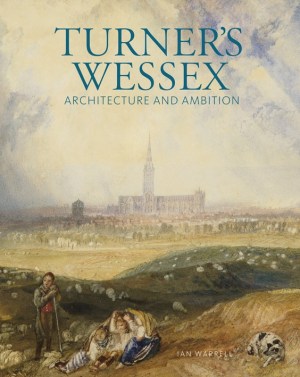 Turner was only 20 in 1795 when he first visited Salisbury. This book focuses on the important commissions that resulted from his contact with the region, which provided the foundations for his success. Reunited here are his inventive watercolours of Salisbury Cathedral painted for Sir Richard Colt Hoare, widely dispersed since 1883. Turner’s matchless ability to depict architecture also attracted the attention of the eccentric art lover and writer, William Beckford. The problematic construction of Beckford’s legendary but short-lived neo-gothic abbey at Fonthill was uniquely recorded in Turner’s sketches and watercolours.
As his career developed, Turner repeatedly revisited an area that captivated him. His depictions of Stonehenge, in particular, proved to be among his most hauntingly atmospheric works. In this beautifully illustrated book many rarely seen works are brought together, illuminating this formative and fascinating period in Turner’s output.
Ian Warrell is an independent curator, specialising in British art of the nineteenth century. He is the author of many books on Turner, most recently Turner’s Sketchbooks.
Exhibition | Korea Mania: A Traveller’s Tale
On view in Sèvres:
Corée Mania: Roman d’un Voyageur
Cité de la Céramique, Sèvres, 21 January — 20 July 2015
Curated by Stéphanie Brouillet
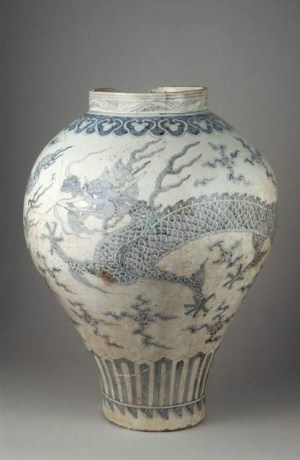
Dragon Jar, Korean, 18th century (MNC28154 Sèvres – Cité de la céramique / RMN)
Cité de la céramique célébre en 2015 les Années croisées France-Corée, en organisant deux expositions: l’une patrimoniale avec Roman d’un voyageur, l’autre contemporaine à travers la présentation des œuvres de Yik-Yung Kim et Yeun-Kyung Kim.
Du 21 janvier au 20 juillet, l’exposition Roman d’un voyageur s’articule autour de la figure emblématique du diplomate Victor Collin de Plancy (1853–1922), premier consul de France en Corée qui collecta de nombreux objets et œuvres d’art coréens. L’exposition invite à un double voyage : celui vers la péninsule coréenne, au cœur de l’Extrême-Orient, à la découverte d’une culture ancienne et raffinée, et l’autre sous la forme d’une plongée dans le temps, vers le « royaume ermite » de la fin de l’époque Choson, à la fin du XIXe siècle.
De nombreuses céramiques dont certaines exceptionnelles du 1er siècle de notre ère à nos jours, dont la grande jarre à décor de dragon du XVIIIe siècle, considérée comme un chef-d’oeuvre des collections nationales conservées par l’établissement, sont présentées ainsi que du mobilier, des instruments de musique, des objets quotidiens, des photographies, des peintures, des documents d’archives qui évoquent le pays et son art de vivre.
Une journée d’étude sur le céladon, à la fois sous l’angle historique mais aussi scientifique, prévue à l’automne, viendra ponctuer cette saison coréenne à la Cité de la céramique.
Le commissariat est assuré par Stéphanie Brouillet, conservatrice du patrimoine chargée des céramiques asiatiques à Sèvres. La scénographie est confiée au designer Vincent Dupont-Rougier.
A summary in English is available from the Asia Europe Museum Network (ASEMUS):
◊ ◊ ◊ ◊ ◊
The catalogue is published by Loubatières:
 Roman d’un Voyageur, Victor Collin de Plancy: L’histoire des Collections Coréennes en France (Carbonne: Loubatières, 2015), 263 pages, ISBN: 978-2862667195, 39€.
Victor Collin de Plancy fut le premier représentant de la France en Corée entre 1888 et 1906. Interprète puis diplomate, il se passionna pour l’histoire et l’art de ce pays resté longtemps fermé pour les Occidentaux. Désireux de le faire connaître en France, il rassembla un grand nombre d’objets—céramiques, manuscrits, livres, meubles ou costumes—dont il fit don à des institutions françaises au rang desquelles figure le Musée national de la céramique. Il fut également au cœur d’un petit groupe de voyageurs passionnés par la Corée qui, à leur tour, enrichirent les collections françaises.
A preview of the catalogue is available here»
The Burlington Magazine, May 2015
The eighteenth century in The Burlington:
The Burlington Magazine 157 (April 2015)
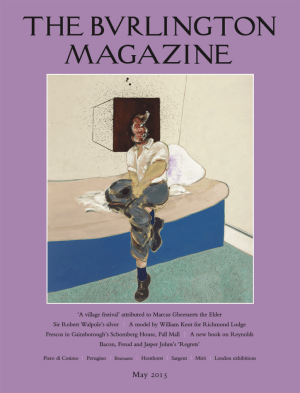 A R T I C L E S
• Tessa Murdoch, “Power and Plate: Sir Robert Walpole’s Silver,” pp. 318–24.
• Julius Bryant, “Queen Caroline’s Richmond Lodge by William Kent: An Architectural Model Unlocked,” pp. 325–30.
R E V I E W S
• Duncan Robinson, Review of Mark Hallet, Reynolds: Portraiture in Action (The Paul Mellon Centre for Studies in British Art, 2014), pp. 341–47. Available at The Burlington website for free.
• Stephen Lloyd, Review of Cory Korkow with Jon Seydl, British Portrait Miniatures: The Cleveland Museum of Art (D. Giles, Ltd., 2013), pp. 349–50.
• Richard Wolfe, Review of the exhibition Shifting Patterns: Pacific Barkcloth Clothing (British Museum, 2015), pp. 361–62.
• Jamie Mulherron, Review of two exhibitions: Charles de La Fosse: Le Triomphe de la Couleur (Versailles and Nantes, 2015) and Bon Boullogne (1649–1717): Un chef d’école au Grand Siècle (Dijon, 2014–15), pp. 365–67.
New Book | Ireland: Crossroads of Art and Design, 1690–1840
In connection with the exhibition now on view the Art Institute of Chicago, Yale University Press is distributing the catalogue (congratulations, Ireland, on an inspiring weekend). –CH
William Laffan and Christopher Monkhouse, eds., with Leslie Fitzpatrick, Ireland: Crossroads of Art and Design, 1690–1840 (New Haven: Yale University Press, 2015), 288 pages, ISBN: 978-0300210606, $50.
 This groundbreaking book captures a period in Ireland’s history when countless foreign architects, artisans, and artists worked side by side with their native counterparts. Nearly all of the works within this remarkable volume—many of them never published before—have been drawn from North American collections. This catalogue accompanies the first exhibition to celebrate the Irish as artists, collectors, and patrons over 150 years of Ireland’s sometimes turbulent history.
Featuring the work of a wide range of artists—known and unknown—and a diverse array of media, the catalogue also includes an impressive assembly of essays by a pre-eminent group of international experts working on the art and cultural history of Ireland. Major essays discuss the subjects of the Irish landscape and tourism, Irish country houses, and Dublin’s role as a center of culture and commerce. Also included are numerous shorter essays covering a full spectrum of topics and artworks, including bookbinding, ceramics, furniture, glass, mezzotints, miniatures, musical instruments, pastels, silver, and textiles.
William Laffan is an art historian and author, and former editor of Irish Architectural and Decorative Studies: The Journal of the Irish Georgian Society. Christopher Monkhouse is the chair and Eloise W. Martin Curator, Department of European Decorative Arts, at the Art Institute of Chicago.
Exhibition | Unbuttoning Fashion

◊ ◊ ◊ ◊ ◊
Now on view at Les Arts Décoratifs:
Déboutonner la mode
Les Arts Décoratifs, Paris, 10 February — 19 July 2015
For the first time, the Déboutonner la mode exhibition at Les Arts Décoratifs is unveiling a collection of over 3,000 buttons unique in the world, and also featuring a selection of more than 100 female and male garments and accessories by emblematic couturiers such as Paul Poiret, Elsa Schiaparelli, Christian Dior, Jean Paul Gaultier and Patrick Kelly. Acquired in 2012, this collection was classified as a Work of Major Heritage Interest by the Consultative Commission on National Treasures.

Button, late eighteenth century, wax on painted metal
(Paris: Les Arts Décoratifs)
Although small in size, the priceless materials and skills involved in making these pieces dating from the 18th to the 20th century can make them fully-fledged objets d’art. Produced by artisans ranging from embroiderers, soft furnishers, glassmakers and ceramicists to jewellers and silversmiths, they crystallise the history and evolution of these skills. The button has also fascinated famous painters, sculptors and creators of jewellery, inspiring them to produce unique miniature creations for the great couture houses.
This collection, gathered by Loïc Allio, is exemplary in its variety, richness and eclecticism. Its exceptional pieces include a portrait of a woman in the Fragonard manner, a trio of buttons inspired by La Fontaine’s fables by the silversmith Lucien Falize, a set of eight birds painted on porcelain by Camille Naudot, and a series of 792 pieces by the sculptor Henri Hamm. The jewellers Jean Clément and François Hugo and the artists Jean Arp and Alberto Giacometti all produced pieces for the famous fashion designer Elsa Schiaparelli, as did Maurice de Vlaminck for the couturier Paul Poiret. Couture houses such as Dior, Balenciaga, Mme Grès, Givenchy, Balmain and Yves Saint Laurent enlisted the talents of the jewellers Francis Winter and Roger Jean-Pierre, and the exhibition also features creations by Sonia Delaunay and Line Vautrin.
Structured chronologically, the exhibition reveals the incredible history of the button, showing via this extraordinary collection how it perfectly reflects the creativity and humour of a period. Pictures, engravings, drawings and fashion photographs emphasize its importance on the garment and how crucial it is in creating the balance of a silhouette.

Button, attributed to Fragonard, late eighteenth century, miniature on ivory (Paris: Les Arts Décoratifs)
Since its appearance in the 13th century, the button has maintained its key role on the garment. Its production and use gradually developed but the golden age of the button in France did not come until the late 18th century, when it became a luxury item often more expensive than the garment itself. More than a mere ornament, it was also a means of conveying penchants and opinions, via humorous, intimate and even political messages (portraits of the royal family, scenes showing storming of the Bastille, etc.). However, not until around 1780 and the French craze for all things English, did the button appear in female fashion, on dresses and bodices with cuts inspired by male garments.
In the 19th-century male wardrobe the art of the button gave way to the art of buttoning. Now smaller and more discreet, the button came to denote the degree of refinement of a garment or level of distinction of its wearer. The attention paid to its positioning is particularly apparent on that most essential component of the male wardrobe, the waistcoat. With the industrial revolution in the second half of the 19th century button manufacturing developed into a full-scale industry mass-producing all sizes and colours of buttons for every type of garment and accessory.
Women’s buttons remained much more modest in size but their number increased. They now also appeared on ankle boots, gloves and eventually lingerie as the number of undergarments increased around 1850. Their number was precisely noted in fashion magazines and their description in contemporary literature established them as objects of coquetry and even seduction. In parallel, silversmiths and jewellers created valuable buttons, sometimes presented in caskets like jewellery and reflecting the artistic movements of the period, especially Art Nouveau.
The first floor of the exhibition ends with the 1910s and the return of the so-called ‘Empire’ line under the influence of the avant-garde-inspired couturier Paul Poiret, for whom the importance of a detail, for instance a button and its precise positioning, is dictated by a “secret geometry that is the key to aestheticism.”
The exhibition continues with the fashion of the 20s, featuring Art Deco buttons and the emergence of the paruriers, creators of accessories, jewellery and buttons, each with their own style and preference for different materials. Their close collaborations with the great couturiers are highlighted in a display featuring creations for Elsa Schiaparelli, Jean Clément and Jean Schlumberger. François Hugo’s designs for Schiaparelli include uncut stones set in bent and compressed metal. He also enlisted the talents of artists such as Pablo Picasso and Jean Arp for original creations. The decline of the button began in the 80s as couturiers returned to more minimal creations in which the button regained its original use.
In counterpoint to creations by artists, the exhibition emphasizes the manner in which certain couturiers creatively used and interpreted the button in their own way, ranging from Gabrielle Chanel and Christian Dior to Cristobal Balenciaga and the ‘jewellery buttons’ of Yves Saint Laurent. And of course there are also exquisite 21st-century examples, notably Jean Paul Gaultier’s trouser suit entirely covered with small mother-of-pearl buttons, and the coats by Céline subtly revisiting double-breasted buttoning.
Despite the emergence and increasing use of new types of fastenings such as the zip, the pressure button and velcro, the button is ever-present and still has many years to come.
◊ ◊ ◊ ◊ ◊
From Les Arts Décoratifs:
Véronique Belloir, ed., Déboutonner la mode (Paris: Les Arts Décoratifs, 2015), 164 pages, ISBN: 978-2916914541, 45€.
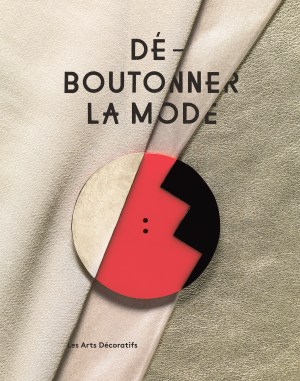 Il est des objets avec lesquels nous entretenons des rapports tout en délicatesse, entre conscience et émotion. À plus d’un titre, le bouton est de ceux-là, de ceux que l’on conserve parfois, sans bien savoir pourquoi, au fond d’une poche ou dans une boîte. Sur un vêtement, qu’il soit masculin ou féminin, son rôle est loin d’être anodin : élément structurant l’équilibre des formes, il entre en résonance avec une ligne, celle d’une boutonnière, d’une couture ou celle du vêtement lui-même. L’histoire du bouton révèle bien d’autres aspects méconnus. Qu’il soit modeste et utile ou précieux et décoratif, sa place évolue au fil du temps en fonction des convenances, des règles de savoir-vivre ou des variations de mode.
Sous la direction de Véronique Belloir, chargée de collections au musée Galliera. Auparavant conservatrice au musée des Arts décoratifs, en charge des collections mode 1800-1940, elle a fait classer la collection de boutons de Loïc Allio en 2012. Textes de Loïc Allio, Véronique Belloir, Raphaèle Billé, Farid Chenoune, Michèle Heuzé, Geoffrey Martinache, Sophie Motsch, Hélène Renaudin. Photographies de Patrick Gries. Référence dans le milieu de l’édition d’art, il excelle dans la photographie d’objets complexes, monumentaux ou minuscules, en répondant à de nombreuses commandes pour le monde du luxe, du design et de l’art contemporain.
Exhibition | Costumes by Bellange and Berain
From Chantilly:
Fastes de cour au XVIIe siècle: Les costumes de Bellange et Berain
Château de Chantilly, 13 May — 13 August 2015
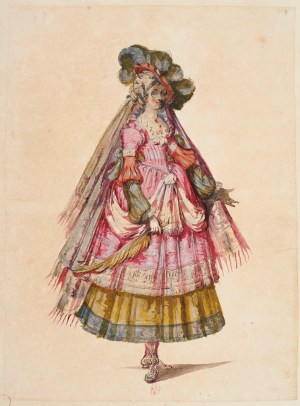 This exhibition is the first public showcasing of a portfolio acquired by the Duke of Aumale in 1854, which is now kept in the Condé museum in Chantilly. The portfolio features 23 exceptional drawings by Jacques Bellange (c. 1575–1616), depicting the Lorraine region festivities for the wedding of Henri de Bar and Marguerite de Gonzague (1606), as well as a series of 34 prints by Jean Berain (1640–1711) featuring watercolour, gold and silver highlights and magnificently depicting the splendours of the courts of Lorraine and France from the beginning to the end of the 17th century.
Paulette Choné and Jérôme de La Gorce, Fastes de cour au XVIIe siècle: Les costumes de Bellange et Berain (Saint-Remy-en-l’Eau: Éditions Monelle Hayot, 2015), 264 pages, ISBN: 978-2903824945, 49€.
Paulette Choné, professeur émérite des Universités, a enseigné l’histoire de l’art moderne à l’Université de Bourgogne. Philosophe, spécialiste de la civilisation des XVIe et XVIIe siècles, elle a consacré une large partie de ses travaux à l’art lorrain, aux fêtes de cour, aux études emblématiques qu’elle a contribué à mettre à l’honneur en France.
Jérôme de La Gorce est directeur de recherche au CNRS, historien d’art et musicologue. Auteur de plusieurs livres, il s’est spécialisé dans les arts de l’éphémère en étudiant notamment les dessins relatifs aux fêtes, aux spectacles et aux cérémonies aux XVIIe et XVIIIe siècles.










leave a comment