Exhibition | A Golden Age of China: Qianlong Emperor, 1736–1795

Jin Tingbiao, Chinese active (c. 1750–68), and Giuseppe Castiglione (attributed to), Italian 1688–1766, worked in China 1714–66, The Qianlong Emperor Enjoying the Pleasures of Life, poem inscribed by Qianlong Emperor in the spring of 1763, coloured inks on silk, 168 x 320 cm (The Palace Museum, Beijing, Gu5278)
◊ ◊ ◊ ◊ ◊
From the press release (26 March 2015) for the exhibition:
A Golden Age of China: Qianlong Emperor, 1736–1795
National Gallery of Victoria, Melbourne, 27 March — 21 June 2015
Hidden treasures from Beijing’s Palace Museum in the Forbidden City have come to Melbourne for the first time, in an Australian exclusive exhibition. A Golden Age of China: Qianlong Emperor, 1736–1795 tells the story of China’s foremost art collector Qianlong Emperor, one of China’s most successful rulers, fourth emperor of the Qing dynasty (1644–1911) and longest living emperor in Chinese history.
This exhibition provides an unprecedented opportunity to explore a rich concentration of more than 120 works from the Palace Museum’s art collection, which is built on the imperial collection of the Ming and Qing dynasties and holds some of China’s most rare and valuable works of art in its collection. . . .

Giuseppe Castiglione, Portrait of Qianlong Emperor in Ceremonial Court Robe, 1736, coloured inks on silk, 239 x 179 cm (The Palace Museum, Beijing, Gu6464)
The Qianlong Emperor’s long 60-year reign (1736–1795) was a particularly fascinating time in China’s history. Under his rule, China was the wealthiest and most populous nation in the world. Qianlong’s ability to preserve and foster his Manchu warrior-huntsman traditions whilst adopting the Confucian principles of political and cultural leadership, resulted in the successful governing of 150 million Chinese people.
It was his ability to adopt Chinese ways, yet honour his Manchu traditions that made him one of the most successful emperors of the Qing dynasty. He studied Chinese painting, loved to paint, and particularly loved to practice calligraphy. He was a passionate poet and essayist, and over 40,000 poems and 1300 pieces of prose are recorded in his collected writings. Qianlong wrote more poetry in his lifetime than all the poets in the Tang dynasty (618–906) combined, a dynasty known for its golden age of poetry. Aside from his own art practice, Qianlong combined his passion for collecting art with his role as preserver and restorer of Chinese cultural heritage. He also embraced the arts of other cultures: European, Japanese and Indian. Giuseppe Castiglione, an Italian Jesuit brother, exerted a great deal of influence over the arts in the court
academy of the Qianlong Emperor.
The exhibition puts the spotlight on Qianlong’s reign and art in five separate sections: Manchu Emperor, Son of Heaven, Imperial art under the Emperor’s patronage, Imperial art of religion and Chinese scholar, art connoisseur and collector. Visitors can enjoy a lavish display of paintings on silk and paper, silk court robes, precious-stone inlayed objet d’art and portraits of the Qianlong Emperor, Empress and imperial concubines; paintings of hunting scenes, court ceremonies and the private life of the Qianlong Emperor; and paintings of the Emperor as scholar and art collector. The exhibition also presents paintings and calligraphy by the Emperor himself as well as classical paintings in his collection. The exhibition includes a sumptuous display of ceremonial weapons of swords, bows and arrows, a chair made of antlers’ horns, silk court robes and ceremonial hats, amongst other ceremonial and palace treasures.
Exhibition | Thé, Café ou Chocolat?
From the Musée Cognacq-Jay:
Thé, Café ou Chocolat? l’essor des boissons exotiques au XVIIIe siècle
Tea, Coffee, or Chocolate? The Boom of Exotic Drinks in the Eighteenth Century
Musée Cognacq-Jay, Paris, 26 May — 27 September 2015
Curated by Rose-Marie Herda-Mousseaux
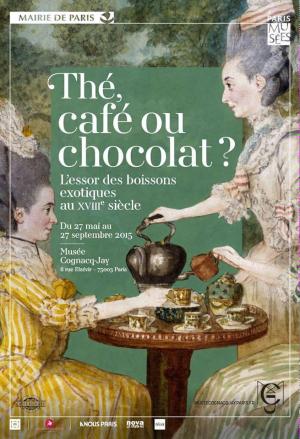 Praised for their medical and therapeutic virtues, the ‘exotic’ beverages, introduced to Europe in the 17th century became a real cornerstone of pleasure and social life during the 18th century. Drinks made with cocoa, coffee and tea—plants not grown in Europe—became an integral part of aristocratic and the upper middle class society following their official introductions to the courts of Europe. As an imported material, their high purchase price in the 17th and 18th centuries classed tea, coffee and chocolate as luxury goods and enhanced their prestigious. This was reflected in items of furniture and tableware designed for the consumption of these new drinks. Porcelain tea sets and other beautiful and luxurious pieces were produced in specialised manufactories. The rise of these products also created a new need for places designed for the public consumption of these drinks, such as cafes, and new mealtime additions such as at breakfast and afternoon tea, that spread throughout society. This exhibition offers a new overview of these beverages and their entry into the rituals of everyday life, presenting works by many iconic 18th-century artists such as Boucher and Chardin.
Louées pour leurs vertus médicales et thérapeutiques, les boissons dites « exotiques », introduites au XVIIe siècle en Europe, ont été associées aux plaisirs et aux sociabilités du XVIIIe siècle. Les boissons issues du cacaoyer, du caféier et du théier—plantes exogènes à l’Europe—ont fait partie intégrante des sociabilités de l’aristocratie et de la haute bourgeoisie dès leurs introductions officielles auprès des cours d’Europe. En tant que matière importée, leur coût d’achat classe au XVIIe et au XVIIIe siècles le thé, le café et le chocolat parmi les produits de luxe et ajoute à leur consommation celle de l’image affichée du prestige. Leur consommation s’est matérialisée dans l’apparition de mobiliers et de nécessaires ou services produits dans les manufactures. Elle a aussi permis l’existence de lieux de consommation publique, les cafés, et de nouvelles pratiques de table, telles le petit déjeuner et le goûter, qui se diffusent progressivement dans la société. Organisée autour de trois axes—« Vertus et dangers des boissons exotiques », « Cercles de consommation » et « Nouveaux services »—cette exposition propose une nouvelle lecture de ces boissons entrées dans les rituels du quotidien, en présentant des oeuvres de nombreux artistes emblématiques du XVIIIe siècle comme Boucher ou Chardin.
Commissaire: Rose-Marie Herda-Mousseaux, conservateur du patrimoine et directrice du musée Cognacq-Jay, avec la collaboration scientifique de Patrick Rambourg, chercheur et historien spécialiste de la cuisine et de la gastronomie, et de Guillaume Séret, docteur en histoire de l’art, spécialiste de la porcelaine de Sèvres.
Rose-Marie Herda-Mousseaux, Patrick Rambourg, Guillaume Séret, Thé, Café ou Chocolat? l’essor des boissons exotiques au XVIIIe siècle (Paris Musées, 2015), 176 pages, ISBN: 978-2759602834, 35€.
The press release (a 14-page PDF file) is available here»
Exhibition | Drawn from the Antique: Artists and the Classical Ideal
From the Teylers Museum:
Drawn from the Antique: Artists and the Classical Ideal
Teylers Museum, Haarlem, 11 March – 31 May 2015
Sir John Soane’s Museum, London, 25 June — 26 September 2015
Curated by Adriano Aymonino and Anne Varick Lauder
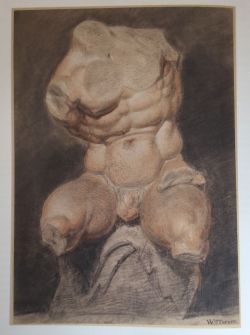
J.M.W. Turner, Study of the Belvedere Torso, black, red, and white chalks (London: V&A)
Famous statues from classical antiquity such as the Apollo Belvedere, the Laocoön and the Venus Pudica were for many centuries the chief attractions of Rome. These ‘heroes’, or plaster copies of them, were depicted in innumerable paintings, drawings and prints. It was above all the heroic nude from antiquity that inspired artists from all over Europe to produce new—in some cases trail-blazing—creations. Young artists depicted antique sculptures, or copies of them, as part of their training: this was believed to be the best way of learning how to render the classical ideal. The exhibition will include paintings and drawings of academies of art, workshops, and individual studios in which artists are hard at work vying with the ancients.
The works on display are of outstanding quality. Some of them have never been exhibited before. For this exhibition, the private collector and art dealer Katrin Bellinger has provided on loan a substantial proportion of her collection of works featuring artists’ studios. Bellinger, whose husband is the well-known entrepreneur Christoph Henkel, is a leading actor in the international art trade, specialising in old drawings. Besides the works from Katrin Bellinger’s private collection, the exhibition also includes loans from museums including the British Museum, the Rijksmuseum, and the Victoria and Albert Museum.
A useful review is available at Lowell Libson, Ltd.
◊ ◊ ◊ ◊ ◊
The catalogue will be available from Artbooks.com:
Adriano Aymonino and Anne Varick Lauder, Drawn from the Antique: Artists and the Classical Ideal (London: Sir John Soane’s Museum, 2015), 256 pages, ISBN: 978-0957339897, $50.
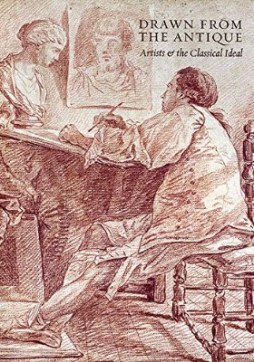 This exhibition and the accompanying catalogue examine one of the most important educational tools and sources of inspiration for Western artists for over five hundred years: drawing after the Antique. From the Renaissance to the nineteenth century, classical statues offered young artists idealised models from which they could learn to represent the volumes, poses and expressions of the human figure and which, simultaneously, provided perfected examples of anatomy and proportion. For established artists, antique statues and reliefs presented an immense repertory of forms that they could use as inspiration for their own creations. Through a selection of thirty-nine drawings, prints and paintings, covering more than four hundred years and by artists as different as Baccio Bandinelli, Federico Zuccaro, Hendrick Goltzius, Peter Paul Rubens, Michael Sweerts, Charles-Joseph Natoire, Henry Fuseli and Joseph Mallord William Turner, this catalogue provides the first overview of a phenomenon crucial for the understanding and appreciation of European art.
Exhibition | Drawn with Spirit: Pennsylvania German Fraktur
The exhibition at the Philadelphia Museum of Art closed last week; the catalogue is distributed by Yale UP:
Lisa Minardi, with an interview by Ann Percy, Drawn with Spirit: Pennsylvania German Fraktur from the Joan and Victor Johnson Collection (New Haven: Yale University Press, 2015), 364 pages, ISBN: 978-0300210521, $65.
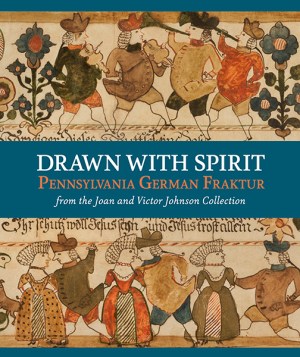 Among the most beloved forms of American folk art, fraktur is a Germanic tradition of decorated manuscripts and printed documents noted for its use of bold colors and whimsical motifs. This publication makes a landmark contribution to the study of Pennsylvania German fraktur, and offers the most comprehensive study of the topic in over 50 years. The featured objects, most of which have never been published, accompany significant new information about the artists who made these works and the people who owned them. An introductory essay sets the renowned Johnson Collection within the context of collecting and scholarship on Pennsylvania German folk art and then highlights major new discoveries, including connections between fraktur and related examples of furniture and prints. An interview with the collectors offers valuable insights into the formation of this special group of objects, which includes birth and baptismal certificates, bookplates, religious texts, writing samples, house blessings, cutworks, and printed broadsides. The splendid color illustrations reveal schools of artistic and regional influence, giving a nuanced understanding of how artists took inspiration from one another and how designs were transferred to new locations. Detailed catalogue entries include extensive information about each piece as well as complete translations.
Lisa Minardi is an assistant curator at Winterthur Museum and a specialist in Pennsylvania German art and culture.
Exhibition | Pope Pius VII and Napoleon at Fontainebleau
From Napoleon.org and the Château de Fontainebleau:
Pie VII Face à Napoléon: La Tiare dans les Serres de l’Aigle
Château de Fontainebleau, 28 March — 29 June 2015
Curated by Christophe Beyeler and Jean Vittet
The Château of Fontainebleau hosted Pope Pius VII twice: first as a guest as he travelled to Napoleon’s coronation in 1804 and then as prisoner between 1812 and 1814. From 1796 until 1814, Rome and Paris were most notably embroiled in a bitter struggle over iconography. The exhibition at Fontainebleau looks at their diplomatic gifts, stolen artistic treasures, and the official French propaganda celebrating the Concordat of 1801 and defending the invasion of the Papal States in 1808 and the arrest of Pius VII in 1809. Napoleon I and Pius VII finally came head-to-head in 1812 at Fontainebleau. The exhibition contains nearly 130 items, some never displayed before, including loans from the Vatican museum and the papal sacristy.
◊ ◊ ◊ ◊ ◊
Le château de Fontainebleau a accueilli par deux fois le pape Pie VII, comme hôte sur le chemin du sacre en 1804, puis comme prisonnier entre 1812 et 1814. L’appartement des Reines-Mères, baptisé depuis lors « appartement du Pape », en conserve aujourd’hui le souvenir.
 Fontainebleau est à cet égard l’un des lieux qui incarne le mieux les relations tumultueuses entre Rome et Paris, dont l’une des expressions est la « guerre d’image » que se livrent les deux puissances, de 1796 à 1814.
L’exposition évoque d’abord la mainmise des Français sur quelques-uns des trésors de la collection pontificale, la célébration du concordat de 1801 par l’imagerie officielle ou encore l’iconographie subtile des cadeaux diplomatiques lors du sacre de 1804. La guerre de propagande, qui atteint son paroxysme avec l’invasion des États pontificaux en 1808 et l’arrestation de Pie VII en 1809, est ensuite décryptée à travers l’image d’une Rome antique renaissant grâce au « César moderne ». Le Pape, retenu à Savone depuis 1809, est conduit à Fontainebleau en 1812, où les deux protagonistes s’affrontent. L’Empereur parvient à arracher en janvier 1813 un éphémère concordat au Pape qui, libéré en 1814, est accueilli à Rome par une imagerie triomphaliste.
Près de 130 œuvres, parmi lesquelles des acquisitions inédites, ainsi que des prêts exceptionnels des musées du Vatican ou de la Sacristie pontificale, illustrent un affrontement où se combinent enjeux religieux, politiques et artistiques. En écho, sur les lieux mêmes de sa détention, les éléments retrouvés et restaurés du mobilier qu’a connu Pie VII sont rassemblés pour la première fois depuis le Premier Empire.
The 13-page press package is available here»
◊ ◊ ◊ ◊ ◊
The catalogue is available from Dessin Original:
Christophe Beyeler, ed., Pie VII Face à Napoléon: La Tiare dans les Serres de l’Aigle (Paris: RMN, 2015), 248 pages, ISBN: 978-2711862474, 39€.
The Burlington Magazine, April 2015
The eighteenth century in The Burlington:
The Burlington Magazine 157 (April 2015)
 A R T I C L E S
• Marie-Anne Dupuy-Vachey, “Fragonard’s ‘Fantasy Figures’: Prelude to a New Understanding,” pp. 241–47.
• Yuriko Jackall, John K. Delaney, and Michael Swicklik, “Portrait of a Woman with a Book: A Newly Discovered ‘Fantasy Figure’ by Fragonard at the National Gallery of Art, Washington,” pp. 248–54.
R E V I E W S
• Richard Wrigley, “Reassessing François-André Vincent,” — Review of recent exhibitions of Vincent’s work at Montpellier, Tours, and Paris and two books: Jean-Pierre Cuzin, François-André Vincent, 1746–1816: Un Peintre entre Fragonard et David (Arthéna, 2013) and Elizabeth Mansfield, The Perfect Foil: François-André Vincent and the Revolution in French Painting (University of Minnesota Press, 2012), pp. 265–68.
• François Marandet, Review of Christian Michel, L’Académie Royale de Peinture et de Sculpture (Librairie Droz, 2012), p. 276.
• Julia Poole, Review of Joanna Gwilt, Vincennes and Early Sèvres Porcelain from the Belvedere Collection (V&A Publishing, 2014), pp. 276–77.
• Stephen Duffy, Review of France Nerlich and Alain Bonnet, eds., Apprendre à Peindre: Les ateliers Privés à Paris, 1780–1863 (Université Francois Rabelais, 2013), p. 277.
• Reinier Baarsen, Review of the exhibition Eighteenth Century, Birth of Design, Furniture Masterpieces, 1650–1789 / 18e, aux sources du design, chefs-d’œuvre du mobilier 1650 à 1790 (Château de Versailles, 2014–15), pp. 285–86.
• Gauvin Alexander Bailey, Review of the exhibition With Body and Soul / Mit Leib und Seele (Munich: Kunsthalle, 2014–15), pp. 286–88. Available at The Burlington website for free.
• Xavier Salomon, Review of the exhibition Goya’s Tapestry Cartoons in the Context of Court Painting / Goya en Madrid: Cartones para Tapices (Madrid: Prado, 2014–15), pp. 290–91.
• Catherine Whistler, Review of the exhibition, The Poetry of Light: Venetian Drawings from the National Gallery of Art, Washington / La Poesia della Luce: Disegni Veneziani dalla National Gallery of Art di Washington (Venice: Museo Correr, 2014–15), pp. 293–94.
Exhibition | George Morland: In the Margins
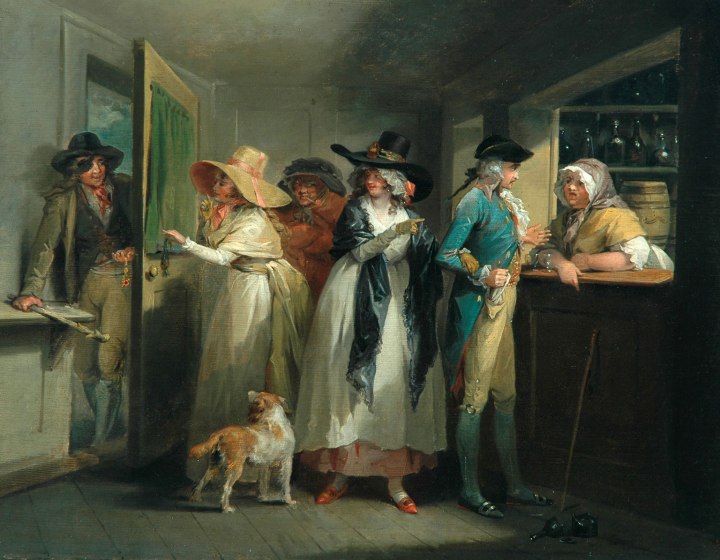
George Morland, Easy Money, 1788 (Huddersfield Art Gallery)
◊ ◊ ◊ ◊ ◊
Now on view at the University of Leeds:
George Morland: In the Margins
The Stanley & Audrey Burton Gallery, University of Leeds, 18 March — 11 July 2015
Curated by Nicholas Grindle
This exhibition looks at migrants and margins in the work of the painter George Morland (1763–1804), a popular painter whose lifestyle and early death earned him lasting notoriety. Over 250 of his works are held by public collections in the UK and US alone. His paintings of smugglers, gypsies, pedlars, soldiers, and families, which represent some of his best compositions, as well as how they mirrored his own life, raise compelling questions about who, and where, is ‘marginal’ in society. There has been no exhibition of his work since a small show in Reading in 1975 and no substantial discussion of his work since a thesis written in Stanford in 1977 and a chapter in John Barrell’s book Dark Side of the Landscape in 1980. His pictures resonate with contemporary issues such as migration and marginality in a way that was not evident thirty years ago.
The exhibition will run at The Stanley & Audrey Burton Gallery from 18 March 2015 until 11 July 2015, with a possible UK tour from August 2015 onwards.
◊ ◊ ◊ ◊ ◊
A symposium is scheduled for the end of May:
Bohemians and Marginal Communities in the 18th Century: George Morland in Context
The Stanley & Audrey Burton Gallery, University of Leeds, 29 May 2015
The Stanley & Audrey Burton Gallery presents a free symposium, bringing together academic discussion of the work of late 18th-century English painter George Morland. To coincide with our current exhibition George Morland: In the Margins, the Gallery is delighted to welcome experts and academics from a range of fields, to discuss the wider context of Morland’s work. These speakers will include the exhibition’s guest-curator Dr Nick Grindle (UCL); Professor of History of Art at Oxford Brookes University, Christiana Payne; social geographer, Dr Martin Purvis; independent art historian, Dr Anthony Lynch; and UEA MPhil student Francesca Bove.
The speakers will address representations of social margins in Morland’s artistic output and look at the parallels between his life and works. What can his representation of gypsies, smugglers, pedlars and families tell us about the societal conditions of the late 1800s and how do they reflect our own times? Morland was living on the brink of industrialisation, witnessing an increasingly capitalist culture and significant, sudden movements of people around the country; conditions which are still relevant to modern-day Britain. The worries of Morland’s contemporaries about the moral character and palatability of his works raises questions surrounding class relations and art’s role as social commentary and criticism.
Friday, 29 May 2015, 9:00–17:00. Free, though booking is essential. This event is kindly supported by the Paul Mellon Centre for Studies in British Art.
More information about programming for the exhibition is available here»
◊ ◊ ◊ ◊ ◊
The catalogue is available from the University of Leeds online bookstore:
Nicholas Grindle, ed., with essays by David Alexander, Kerry Bristol, Sue Ecclestone, Nicholas Grindle, and Martin Purvis, George Morland: Art, Traffic and Society in Late Eighteenth-Century England (Leeds: The Stanley & Audrey Burton Gallery, 2015), 99 pages, ISBN: 978-1874331544, £12.
 George Morland: Art, Traffic and Society in Late Eighteenth-Century England looks at the life and work of popular painter George Morland (1763–1804), whose remarkable talent, prodigious output, bohemian lifestyle and early death earned him lasting notoriety. Morland was the most infamous artist in Britain at the time of his death in 1804. His paintings enjoyed a stellar reputation, which was enhanced by stories about his fabulous earnings, prodigal spending, legendary drinking, and staggering debt. He was renowned for his associations with smugglers, gypsies and pugilists, as well as his constant attempts to evade his creditors. His best work is breathtaking in its ambition and execution, while the popularity of his drawings, paintings, and the prints after his work rose throughout his lifetime. Within months of his death, no fewer than four books had been published packed with anecdotes—many apocryphal—about his life and work. No other artist of the late eighteenth and early nineteenth centuries commanded such a profile.
Morland was reputed to have painted thousands of canvases and made hundreds of drawings. But in spite of his immense popular and critical stature, recent scholarly attention has been patchy, and this is the first publication to seriously review the artist in over thirty years. It includes five new essays which use recent perspectives in historical geography and studies of print and exhibition culture to help us look in new ways at his work and practice, as well as catalogue entries that bring scholarship on his paintings up to date.
Exhibition | El Retrato en las Colecciones Reales

◊ ◊ ◊ ◊ ◊
Now in its final weeks, this portrait exhibition contains over 100 objects spanning the past five hundred years. Rocío Martínez provides an extremely useful review (in English) for the Royal Studies Journal Blog. The exhibition website provides one of the finest virtual experiences I’ve ever encountered in terms of documenting an exhibition visually. Finally, thanks to Jennifer Germann for pointing all of this out to me (my apologies that it didn’t appear back in December!). –CH
El Retrato en las Colecciones Reales: De Juan de Flandes a Antonio López
The Portrait in the Royal Collections: from Juan de Flandes to Antonio López
Royal Palace, Madrid, 4 December 2014 — 19 April 2015
Curated by Carmen García-Frías Checa and Javier Jordán de Urríes
La exposición El Retrato en las Colecciones Reales. De Juan de Flandes a Antonio López ofrece una visión general del retrato de corte en España, tanto en tiempos de la Casa de Austria como de la Casa de Borbón, desde el siglo XV al XXI, trazando un recorrido por la evolución de la imagen de los monarcas en ese largo medio milenio. Un itinerario jalonado por obras maestras de la pintura y del género del retrato, con los mejores ejemplos conservados en las colecciones de Patrimonio Nacional, que se exponen en doce salas de la planta baja del Palacio Real de Madrid, con el acompañamiento de algunas esculturas, pequeños bronces, varios dibujos y grabados, y un par de tapices-retrato. La exposición se estructura en dos grandes secciones, Casa de Austria y Casa de Borbón, con diferentes apartados que siguen un orden cronológico por reinados.
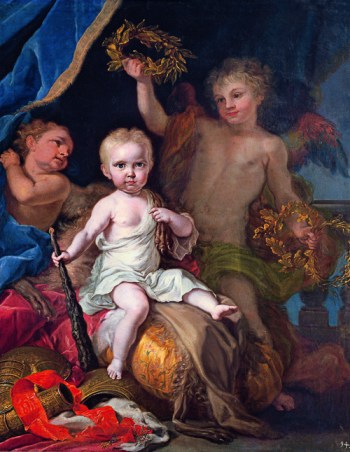
Giuseppe Bonito, Carlos Antonio de Borbón as the Child Hercules, 1748, oil on canvas, 128.5 x 102.5 cm (Madrid: Royal Palace)
La primera sección abre con los inicios de la dinastía habsbúrgica en España, mostrando como antecedentes retratos fundamentales de sus antepasados, el Retrato del duque de Felipe el Bueno del taller de Rogier Van der Weyden (de la Casa de Borgoña) y la imagen más fidedigna de la reina Isabel la Católica de Juan de Flandes (de la Casa de los Trastámara). A los grandes retratos oficiales de Carlos V de Jakob Seisenegger y de Felipe II en versión pictórica de Antonio Moro y escultórica de Pompeo Leoni, se une una importantísima muestra de retratos familiares por los pintores más famosos de la corte española de los siglos XVI y principios del siglo XVII, como Alonso Sánchez Coello, Joris Van der Straeten, Juan Pantoja de la Cruz, Bartolomé González o Rodrigo de Villandrando, así como de otras cortes europeas, como Frans Pourbus el Joven o Marcin Kover. Ya en pleno siglo XVII, la magnífica miniatura del conde-duque de Olivares de Diego Velázquez, o el grandioso retrato ecuestre de Juan José de Ribera, sin olvidar a los dos grandes retratistas del reinado de Carlos II, con varios ejemplares de Juan Carreño de
Miranda y Claudio Coello.
En la segunda sección dedicada a la Casa de Borbón desde el siglo XVIII hasta el presente, se exponen los mejores ejemplos del retrato borbónico en Patrimonio Nacional, como el monumental retrato ecuestre de Felipe V, por Louis-Michel van Loo; el de Carlos III con el hábito de su Orden, por Mariano Salvador Maella, también retratos de Giuseppe Bonito y Anton Raphael Mengs; una de las parejas de Carlos IV y María Luisa de Parma, por Francisco de Goya, la espléndida del rey de cazador y la reina con mantilla; destacados ejemplos del retrato decimonónico, con obras de Vicente López, Federico de Madrazo o Franz Xaver Winterhalter, y, finalmente, retratos de Alfonso XIII por Ramón Casas y Joaquín Sorolla para llegar al reinado de Juan Carlos I con El Príncipe de ensueño de Salvador Dalí y el retrato de La familia de Juan Carlos I pintado por Antonio López, que se presenta al público con motivo de esta exposición.
Junto a esas obras maestras de la pintura se exhiben, como complemento, algunos pequeños bronces, un par de tapices-retrato y destacadas esculturas, desde un Felipe II por Pompeo Leoni hasta el retrato doble de los reyes Alfonso XIII y Victoria Eugenia, por Mariano Benlliure. Esas piezas entran así en relación con la pretensión de tridimensionalidad de la pintura.
◊ ◊ ◊ ◊ ◊
The catalogue is available from ArtBooks.com:
Carmen García-Frías Checa and Javier Jordán de Urríes, eds., El Retrato en las Colecciones Reales: De Juan de Flandes a Antonio López (Madrid: Patrimonio Nacional, 2014), 536 pages, ISBN: 978-8471204981, $85.
 Fundación Banco Santander colabora con Patrimonio Nacional en la preparación de esta muestra títulada El retrato en las Colecciones Reales. De Juan de Flandes a Antonio López. La importancia del género retratístico en las Colecciones Reales se comprende fácilmente, teniendo en cuenta que los mejores artistas de cada momento, han sido grandes retratistas de la Monarquía Española, por lo que las grandes obras de estos excelentes pintores forman parte de los fondos de Patrimonio Nacional. En este exposición contaremos con artistas de la talla de Juan de Flandes, Sánchez Coello, Rubens, Velázquez, Goya, Sorolla, Dalí o Antonio López.
Exhibition | Landscapes of the Mind: British Landscapes

Joseph Wright of Derby, Sir Brooke Boothby, 1781 (London: Tate)
◊ ◊ ◊ ◊ ◊
As noted at ArtDaily:
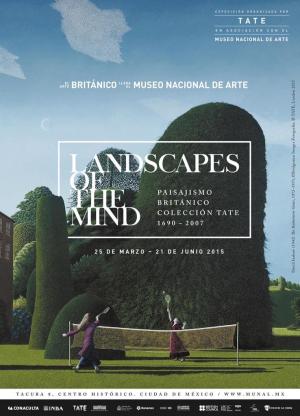
Landscapes of the Mind: British Landscapes from the Tate Collection, 1690–2007 / Paisajismo británico. Colección Tate, 1690–2007
Museo Nacional de Arte, Mexico City, 25 March — 21 June 2015
On March 25th Landscapes of the Mind: British Landscape Painting, Tate Collection, 1690–2007 was presented for the first time ever in Mexico City, an exhibition organized by Tate in association with Museo Nacional de Arte, as part of the celebrations of the Dual Year between Mexico and the United Kingdom. The exhibition presents 111 artworks by British and European artists, with a plurality of techniques (painting, drawing, printmaking, photography, sculpture/installation, etc.) which ponder the evolution of British landscape in art history. The term ‘Britain’ is understood as the geographical entity of the British Isles, i.e., the archipelago that includes England, Wales, Scotland and Ireland, before the independence of the latter in 1921.
 This genre was explored in Britain during the 16th century with the use of documents describing the topography, geology, history, and legends of the said land. It gained popularity throughout the 17th century, with the discoveries of explorers, naturalists, and merchants who helped expand the limits of the British nation to the four parts of the world. By the late 18th century, the landscape genre had become a dominant trend in Britain.
According to Nicholas Serota, Director of Tate, “the reasons for the predominance of landscape in British visual culture are many and varied: the extraordinary diversity of physical landscapes in such a relatively small geographic area; acute sense of loss of a pastoral and rural ideal world because of rapid industrialization during the 18th and 19th centuries; identification of the aristocracy of classical culture field; the immense impact of the natural sciences, and at the same time, the belief that close observation revealed both the moral and the hidden spiritual truth behind appearances”.
The nine topics developed by curator Richard Humphreys aim to introduce British culture through great classical painters of the 18th century such as Thomas Gainsborough; continuing with artworks of romantic and impressionist artists of the 19th century, like John Constable, J.M.W. Turner, John Martin, John Singer Sargent and James Tissot; and finally addressing modern and contemporary landscapes by artists such as David Inshaw, Sir Stanley Spencer, and Paul Nash.
Considering the importance of a current view on the history of landscape and the need for a continued dialogue between the ages; in addition to meeting the great interest of a younger generation in discovering the artistic production of its own time, Dr. Agustín Arteaga, Director of the Museo Nacional de Arte, managed the incorporation of David Hockney’s Bigger Trees Near Warter or /ou Peinture sur le Motif pour le Nouvel Age Post- Photographique. In 1984, Museo Tamayo presented the traveling exhibition Hockney Paints the Stage, an exhibit shown after the failed attempt to include a graphic series of nudes during the Cultural Olympiad in 1968, which were eventually censored. After visiting Mexico City in 1984, Hockney traveled to the state of Oaxaca, where he produced a series of paintings and graphics inspired by a hotel in Acatlán. Tate preserves in its collection some works from this series. Nearly 30 years after, Hockney returns to Mexico with his biggest artwork accomplished so far: a picture of monumental proportions, more than 4.5 by 12 meters, consisting of 50 paintings, done in six weeks in 2007 for the Summer Exhibition of the Royal Academy of London, and donated to Tate the following year, along with two digital reproductions. The image depicts a landscape of East Yorkshire, a region where the artist lived, shortly before the arrival of spring when the trees begin to sprout.
Alongside Landscapes of the Mind, a comparative exercise linking landscape tradition in Britain and Mexico is included, this latter is exhibited as a dialogue with the newly renovated galleries of the Museo Nacional de Arte in the permanent exhibit. The relationship was established through the canvas Mexico Valley (1837) of the London traveler artist Daniel Thomas Egerton. His work coexists with a selection of paintings by the Mexican artist José María Velasco.
The exhibition is accompanied by a bilingual catalog print run of 2,000 copies, consisting of 142 black/white and color images, with texts by curator Richard Humphreys and edited by Museo Nacional de Arte. As part of the show, Museo Nacional de Arte offers an Academic Program aimed at a wide audience, including a lecture every Thursday at 17:00 with varied presentations including one by the curator Richard Humphreys; a commented film series of the best of British cinematography; weekend and specialized workshops; interpretive materials downloadable via the website, as well as guided tours.
Exhibition | Canaletto: Celebrating Britain

Canaletto (Giovanni Antonio Canal), London: The Thames from Somerset House Terrace towards the City
(Royal Collection Trust/© Her Majesty Queen Elizabeth II 2014)
◊ ◊ ◊ ◊ ◊
News of this exhibition appeared here at Enfilade in January, but the posting addressed only the Kendal venue (where it will have a slightly different title). Here’s the expanded version:
Press release from Compton Verney:
Canaletto: Celebrating Britain
Compton Verney, Warwickshire, 14 March — 7 June 2015
Holburne Museum, Bath, 27 June — 4 October 2015
Abbot Hall Art Gallery, Kendal, Cumbria, 22 October 2015 — 14 February 2016
This is the first time that these magnificent paintings and drawings by Canaletto have been brought together to provide an overview of Canaletto’s work created between 1746 and 1755, whilst he was visiting Britain. During his nine-year stay in Britain he documented not just traditional or established views and landmarks but also his (and his patrons’) latest achievements in architecture and engineering. The depictions of these new building works and projects, whether couched in Palladian, Baroque or Gothic styles, celebrate the new-found wealth and assurance of the British nation, reflecting contemporary developments in popular culture such as the rediscovery of Shakespeare; the success of Handel’s Messiah and the cult of King Alfred—which in turn spawned Arne’s immortal Rule Britannia.
Set into context, by 1750 the first generation of Palladian architects and patrons (Burlington, Campbell and Kent) were dead, and the nation was ready for a more liberal attitude to architectural design. Britain itself was a more stable and confident place than it had been even thirty years before. During the recent War of the Austrian Succession, the nation had held onto its new colonial gains and had succeeded in forcing Spain to open up South America to its traders. The economy was booming and the Jacobite threat had evaporated. Accordingly, a new, more confident generation, profiting from the ‘Georgian Revolution’ and increasingly assured by Britain’s status as a major world power, was prepared to be less regimented by Palladian rules and more eclectic in its architectural patronage seeking cultural inspiration not just from the Mediterranean but also from their own history.
This new found confidence signalled through the architecture of Baroque masters such as Wren (at St Paul’s and St Mary’s, Warwick), Hawksmoor (at Westminster Abbey’s west towers) and the Gothic revival marks Britain out as the new Venice, which was the real subject of Canaletto’s great canvases on display in this exhibition.
Information regarding programming at Compton Verney is included in the press release.
◊ ◊ ◊ ◊ ◊
From Paul Holberton:
Steven Parissien, Pat Hardy, Jacqueline Riding and Oliver Cox, Celebrating Britain: Canaletto, Hogarth, and Patriotism (London: Paul Holberton Publishing, 2015), 128 pages, ISBN: 978-1907372780, £25.
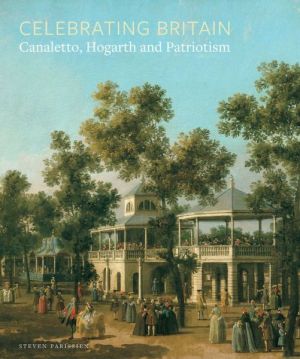 By 1750 Britain was—as Jacqueline Riding shows—at peace with her traditional enemy, France, and had finally extinguished the threat from the Catholic Jacobites. The art of William Hogarth—particularly his great canvas O The Roast Beef of Old England of 1749—duly reflected this new sense of security and pride in being British. The economy was booming. Trade was expanding. And newly-confident Britons were no longer looking to Italy or France for their cultural exemplars, particularly in the field of architectural design.
It was the ferment of activity, the eclectic building boom which underlines Britain’s wealth and optimism and which marks the nation out as the new Venice, which is the real subject of Canaletto’s great canvases. Almost all of Canaletto’s views focused on a new architectural commission or a recent urban development, and were specifically designed to celebrate the latest achievements of British architecture and engineering. The Italian master was not alone. The vigorous and infectious patriotism of his works mirrored emerging nationalistic trends in popular culture during the 1740s, a decade which witnessed the canonization of William Shakespeare as a British hero, the creation of Handel’s Messiah and Arne’s immortal Rule Britannia, and, as Oliver Cox shows, the propagation of the nationalistic cult of King Alfred—and, more bizarrely, of the ‘flying king’ Bladud in Bath.
As Pat Hardy explains, the presence of a significant group of artists working in London prior to Canaletto’s arrival, led by Samuel Scott, along with the strength of existing artistic practices and traditions and the vibrant print market for maps and surveys of London, suggests that the impact of the arrival of Canaletto was more complicated than may have previously been perceived. At the same time, Canaletto’s legacy survived throughout the eighteenth century, in the hands of native artists such as William Marlow.
◊ ◊ ◊ ◊ ◊
Press release (November 2014) from Abbot Hall:
Abbot Hall was built in the Palladian style just three years after Canaletto left England for the last time. In 1746, by then in his late 40s, he first arrived for a prolonged stay in London. He was to remain for most of the following 10 years.
Already a well established artist, his work had proved very popular with aristocratic Englishmen doing their Grand Tour of Europe. In the 1720s, having started his career as a theatrical scene painter, Canaletto started painting his distinctive views of Venice, frequently featuring the many major churches designed for it by Palladio. One of his clients was Joseph Smith, an English merchant banker who lived in Venice for 70 years, for 16 of which he was the British consul there. Smith bought many Canaletto works for himself, and also helped arrange commissions from wealthy English collectors—by the late 1720s his works were already in the collections of Goodwood, Chatsworth, Woburn and of the Prime Minister, Sir Robert Walpole. Smith himself owned by far the largest collection of works, including 52 oil paintings and over 140 drawings, which he eventually sold to George III in 1762 for £10,000—half the sum the latter paid the previous year for Buckingham Palace.

Canaletto (Giovanni Antonio Canal), Portrait of Canaletto with St Paul’s in the Background at Anglesey Abbey, Cambridgeshire (National Trust Images/Hamilton Kerr Inst/Chris Titmus)
Canaletto came to London as an indirect result of the War of the Austrian Succession, which started in 1741. This had made continental travelling difficult for his wealthy English patrons, severely reducing his income. He therefore decided to move himself to London, setting up his studio near Golden Square. He arrived a month after Culloden, the last pitched battle fought on British soil, and at the beginning of a period of unprecedented domestic peace and prosperity, which saw London turning into the world’s richest and largest city.
Although the bulk of the works with English subjects were of London scenes, with the Thames a frequent presence, he was also a regular visitor to the countryside, often at the invitation of his rich patrons, and painted several views of Warwick Castle, as well as of Alnwick, Badminton, Eton and Walton.
The rapid change of London’s architecture during his time here is also documented. In The Old Horse Guards from St James’ Park of 1749, he caught the Horse Guards Parade ground, complete with parading soldiers, as well as men peeing against the wall of Downing Street, and dozens of people promenading, showing the artist’s interest in depicting scenes of daily life. Within a couple of years, from almost exactly the same spot, he was back painting the new Horse Guards parade, the one that is still there today—it can be dated very precisely to 1752–53, as the clock tower still has scaffolding on it, while the south wing had yet to be constructed.
Canaletto is often accused of depicting London whilst using bright Venetian lighting. However, in both his pictures of the Horse Guards, the light is soft and diffused. In A View of Walton Bridge the sky is even more typically ‘English’—and un-Venetian—with the sun competing with storm clouds brewing overhead. The picture also includes a portrait of Thomas Hollis, who commissioned 5 works from Canaletto, as well as a rare self-portrait of the artist, shown painting the scene. The bridge was regarded at the time as an advanced feat of engineering. The contrasting stately bulk of Westminster Bridge and the views from it was evidently something that fascinated Canaletto, who clearly would have agreed with Wordsworth’s later opinion that “earth hath not anything to show more fair.” The bridge was under construction during his time here, and he painted and sketched it repeatedly. In one of the pictures from the Royal Collection, he frames a view of the Thames, St Paul’s and the City as if he had drawn the scene from under one of the new arches of the bridge, while others show it still under construction.
It is easy to forget that Canaletto continued to paint Venetian scenes throughout his time in London. Worked up from his sketches, or done from memory, these provided him with a significant proportion of his income whilst in London, as his more conservative patrons demanded work that they were familiar with, rather than venturing into the new views that the artist was confronting. For example, his Bucintoro at the Molo on Ascension Day, showing the state barge after the annual ‘marriage’ of Venice with the sea—which, when it sold for $20,000,000 in 2005, was briefly his most expensive painting sold at auction—was painted in London in 1754.
Ruskin had a particular down on Canaletto. It is, however, unclear quite how familiar the ascerbic critic was with genuine works by the Venetian. As a hugely popular artist, his work was widely forged and copied both during his lifetime and afterwards. It is possible that Ruskin was sometimes writing about Canaletto pupils and assistants, when he thought he was writing about Canaletto himself. In “Notes on the Louvre”, writing about a picture of the Salute and the entrance to the Grand Canal, he said that it is “cold and utterly lifeless—truth is made contemptible” and that “boats and water he could not paint at all.” The picture has since been re-attributed to Canaletto’s pupil Michele Marieschi. Similarly the “bad landscape” he saw in Turin is almost certainly a work by Bernardo Bellotto, Canaletto’s nephew. Writing about Canaletto’s “vacancy and falsehood” in Modern Painters, he refers to a painting in the Palazzo Manfrin—Augustus Hare, who visited it at about the same time, noted that the palazzo “has a picture gallery which is open daily, but contains nothing worth seeing, all the good pictures having been sold.” It is unclear which work Ruskin was referring to when he said that Canaletto’s depiction of architecture was “less to be trusted in its renderings of details than the rudest and most ignorant painter of the 13th century.” Certainly that is not the view of most modern critics of most properly authenticated works by Canaletto, but Ruskin was never one to allow the facts to affect his pet prejudices.










leave a comment