Exhibition | On the Road to Italy: Robert to Corot
Now on view at Amiens:
Sur la route d’Italie: Peindre la nature d’Hubert Robert à Corot
Musée d’Art et d’Archéologie d’Évreux, 26 April — 21 September 2014
Musée de Picardie, Amiens 13 February — 31 May 2015
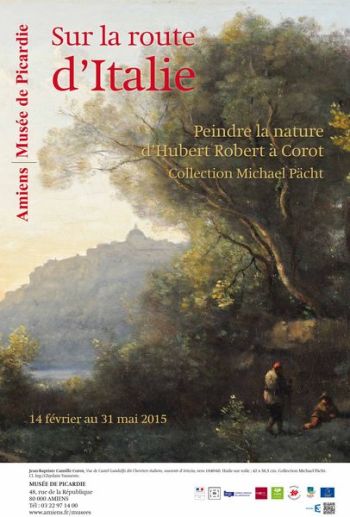 Pour la première fois, la collection de paysages français de l’éditeur Michael Pächt est présentée au public dans une exposition événement organisée en partenariat avec l’Institut national du patrimoine et le musée d’Art et d’Archéologie d’Evreux. Fasciné par le paysage français de la fin du XVIIIe siècle et de la première moitié du XIXe siècle, grand admirateur de Corot, dont il a rassemblé quelques-unes des plus belles pages peintes sur le motif, Michael Pächt a retracé, au gré d’achats guidés par la passion de l’amateur, une chaîne iconographique, stylistique et humaine, dont les relations maître-élève et les amitiés constituent les maillons. Les affinités électives entre artistes, les parentés, les héritages et les ruptures reprennent vie, introduisant le visiteur dans l’intimité qui se crée entre le peintre et la Nature.
D’Hubert Robert à Corot en passant par Michallon, Bidault, Granet et Rousseau, la collection Pächt nous plonge dans la grande aventure de la peinture de plein air à travers les oeuvres de ceux qui firent le voyage en Italie avant de trouver une terre d’élection dans la forêt de Fontainebleau, en Picardie ou dans le Sud de la France. Une centaine d’oeuvres, peintures, dessins, estampes, ainsi que quelques rares clichés-verre de Corot et de Rousseau, viennent animer la Galerie Puvis de Chavannes le temps d’un partage entre un amateur et un public auquel il livre un peu de sa passion.
Paysages français des collections du Musée de Picardie
L’exposition se prolonge avec une sélection de peintures choisies dans les réserves parmi les plus grands chefs-d’oeuvre du musée. Cet accrochage met également à l’honneur les esquisses inédites de Charles Larivière et d’Albert Maignan qui laissèrent de leur séjour en Italie, aux deux extrémités du XIXe siècle, des toiles imprégnées de la lumière du Sud.
Commissariat général
Olivia Voisin, conservateur du patrimoine, chargée du département Beaux-Arts
Florence Calame-Levert, directrice du musée d’Évreux
François Bridey, directeur adjoint du musée d’Évreux
Commissariat scientifique
Gennaro Toscano, directeur du département des conservateurs, Institut national du patrimoine, Paris
◊ ◊ ◊ ◊ ◊
Published by Gourcuff Gradenico and available from Artbooks.com:
Gennaro Toscano, Sur la route d’Italie: Peindre la nature d’Hubert Robert à Corot (Montreuil, Gourcuff Gradenico, 2014), 180 pages, ISBN: 978-2353401789, 29€.
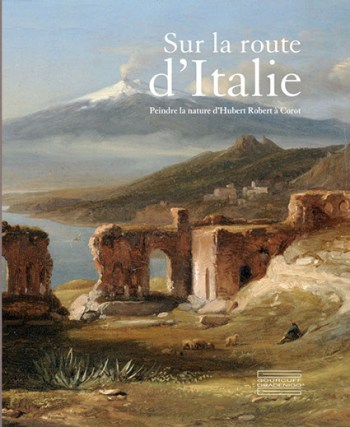 Cet ouvrage présente un ensemble extraordinaire de paysages d’artistes français ayant effectué le voyage en Italie (fin XVIIIe et xixe siècle). Les quelque 26 artistes renommés (Hubert Robert, Granet, Constantin d’Aix, Bertin, Michallon, Corot, Coignet, Rousseau Harpignies…) présents dans la collection ont la caractéristique commune d’avoir peint la nature en plein air en France et en Italie. Montée en partenariat avec l’Institut national du patrimoine (Inp), une exposition se déroulera du 26 avril au 14 septembre 2014 au musée d’Art, Histoire et Archéologie d’Évreux, puis au printemps 2015 au musée de Picardie à Amiens. Cet ensemble de paysages peints en France et en Italie est pour la première fois présenté au public et permet de s’interroger sur la constitution d’une collection particulièrement riche.
En marge de l’exposition, les services de la direction de la culture et de la ville d’Evreux et d’Amiens métropole s’associent pour programmer une «saison italienne». Plusieurs événements verront donc le jour au musée et dans d’autres institutions italiennes, permettant d’explorer la thématique du voyage en Italie ou d’éclairer les relations artistiques entre la France et l’Italie (littérature, Beaux-Arts, musique). Richement illustrée cette publication, solide du point de vue scientifique, s’adresse aussi à un public large et constitue une réflexion sur la peinture de paysage du XVIIIe au xixe siècle.
Exhibition | Europe in Vienna: The Congress of Vienna 1814/15

Johann Nepomuk Höchle, Redoute paré during the Congress of Vienna, ca. 1815
(Vienna: Österreichische Nationalbibliothek)
◊ ◊ ◊ ◊ ◊
Press release for the exhibition:
Europe in Vienna: The Congress of Vienna 1814/15
Europa in Wien: Der Wiener Kongress 1814/15
Lower Belvedere and the Orangery, Vienna, 20 February — 21 June 2015
Curated by Sabine Grabner and Werner Telesko
The Congress of Vienna is one of the most important international mega events in European history. Two hundred years ago, Vienna became Europe’s political, cultural, and social hub for a period of several months. The Congress was hosted by Emperor Francis I of Austria. All of the major European powers sent their delegates in order to confer together about how to reorganise the continent, which had lost its stability during the Napoleonic Wars. Austria was represented by the Prince of Metternich, who also functioned as the president of the Congress. Its declared goal was to achieve peace in Europe and secure order on a long-term basis. The diplomatic negotiations were accompanied by a number of social events and various entertainments, the enormous splendour of which has been captured in numerous written and pictorial documents. Vienna was flourishing as a centre of cultural life, with many artists coming to the imperial capital and inspiring all genres of domestic art production.

Exhibition view Europe in Vienna: The Congress of Vienna 1814/15. Photo by Eva Würdinger.
Europe in Vienna: The Congress of Vienna 1814/15 will highlight both the political and social aspects of this extraordinary event, which kept all Europe on tenterhooks over several months. There is hardly another political, diplomatic and social event of the nineteenth century that was documented by such a great diversity of materials like the Congress of Vienna, which turned the metropolis on the River Danube into the hotspot of Europe for a brief period of time. When preparing the objects for the exhibition, the curators Sabine Grabner and Werner Telesko were confronted with the challenge of how to vividly present a diplomatic and historical process that was mainly perceived as a social event. The exhibits, which come from numerous different countries, range from reportage prints and caricatures to history paintings and portraits in various dimensions and media—from miniature to sculpture and life-sized oil paintings. The scope of the Congress of Vienna as a phenomenon of social and artistic ramifications will primarily be displayed in the form of artistic masterpieces from all genres. The thematic spectrum will take into account both the exciting chronology of events—from the European Wars of Liberation and the occupation of Vienna in 1805 and 1809 to the Battle of Leipzig of 1813—and an adequate representation of their protagonists, who came from the aristocracy and the bourgeoisie alike.

François Pascal Simon Gérard, The Imperial Count Moritz Christian Fries with His Wife Maria Theresia Josepha von Fries (née Princess of Hohenlohe-Waldenburg-Schillingsfurst) and Their Son Moritz, ca. 1805 (Vienna: Belvedere)
“For the Belvedere it was particularly important to illustrate the epochal event of the Congress of Vienna as comprehensively as possible, both as to its historical and political and its social and cultural implications,” says Agnes Husslein-Arco, Director of the Belvedere and 21er Haus. “It was seemed essential to us to vividly capture the cultural impact of the Congress and the atmosphere that prevailed in those days through private loans, which we mostly found in the surroundings of direct descendants of the diplomats and aristocrats involved. Besides such personal souvenirs as medals and snuffboxes, we will also present the portrait of Princess Dorothea of Courland, the Duchess of Dino, Talleyrand-Périgord and Sagan, by François Gérard and the portrait of Prince Charles Philip of Schwarzenberg I by Johann Peter Krafft. I am particularly delighted that we succeeded in receiving Ludwig van Beethoven’s score for his Eroica symphony from the archives of the Gesellschaft der Musikfreunde in Wien, as well as the elaborately designed final act of the Congress of Vienna, which will naturally be the exhibition’s centrepiece,” Agnes Husslein-Arco adds.
Among the exhibition’s further highlights will be the portrait of Prince Clement Wenceslas Lothar von Metternich, then foreign minister of the Austrian Empire and its future chancellor, by the period’s leading English painter Sir Thomas Lawrence, as well as the more-than-lifesized portrait of Emperor Alexander I of Russia by François Gérard from the Château de Malmaison near Paris, which is hardly ever allowed to travel abroad.
The Congress of Vienna as a Junction of Politics and Culture

Johann Nepomuk Schaller, Bust of Empress Maria Ludovica Beatrix, 3rd wife of Emperor Franz I of Austria, 1814 (Vienna: Belvedere)
The Congress of Vienna as a historic diplomatic event whose consequences affected Europe as a whole was generally perceived by the public as a social spectacle. Yet those in charge and the organisers at the Viennese court were well aware from the very outset that there was a close connection between its political and diplomatic dimension on the one hand and its abundance of diverse court festivities (fireworks, dances, masked balls, carousels, tournaments, ethnic festivals, hunts, sleigh rides, theatre performances, etc.) and private fêtes on the other, which boils down to the fact that it was easier to arrive at relevant political results with the protagonists discussing unsettled or delicate issues in a relaxed atmosphere behind the scenes.
“The special challenge about the Congress of Vienna as a theme lies in the interdependence between history and event culture. What makes it even more difficult is that then there was no sense of documentation as it exists today, which means that many events have come done to us in the form of narrative but cannot be visualised in the form of images,” says curator Sabine Grabner.
As to the pictorial representation of the event it is characteristic that the image or images of the Congress of Vienna do not exist—except for the famous engraving based on a work by Jean-Baptiste Isabey (1819), which in our textbooks at school was still used as the illustration of the Congress of Vienna, although it actually visualises a fictitious conference of diplomats.
The Congress of Vienna as a Major Society Event

Exhibition view Europe in Vienna: The Congress of Vienna 1814/15. Photo by Eva Würdinger.
Initially the official entertainment programme of the Congress of Vienna comprised primarily military festivities. Various military parades, military church parades, and manoeuvres were intended to demonstrate to the high-ranking guests the strength and splendour of the imperial army. In addition, however, numerous court festivities were held, including balls and concerts that took place at the imperial palace or in the residences of influential members of the higher aristocracy, such as Rasumofsky or Metternich. The programme also included hunts, fireworks, and sleigh rides. For the huge balls at the Hofburg, which were attended by as many as 10,000 guests, the Winter Riding School was transformed into a gigantic dance floor and connected to the Hofburg’s two ballrooms by an outside staircase. ‘In order to do justice to the essential qualities of the Congress as a historic and diplomatic event on the one hand and as a point of attraction for European society on the other, the exhibition deliberately concentrates on the numerous intersections between art and cultural history,’ guest curator Werner Telesko, Director of the Department of Studies in Art and Music History at the Austrian Academy of Sciences, points out.
The Congress of Vienna as an Epochal Political Event

Exhibition view Europe in Vienna: The Congress of Vienna 1814/15. Photo by Eva Würdinger.
As to the significance of the Congress for posterity, one must not neglect the dramatic political developments of the year 1815. For Napoleon’s flight from the island of Elba and the subsequent declaration against him, which was signed by all of the European states on 13 March 1815, seem to have contributed considerably to the pressure of the Congress to succeed. As of this day, the political fate of Napoleon was sealed in the form of this hitherto unprecedented closing of ranks of the major European nations and eventually turned out to be final in the legendary and decisive Battle of Waterloo in June 1815 All in all, the Congress proved a remarkable political success. The borderlines between the individual European powers were redefined on a long-term basis. Especially the power equilibrium that had been achieved in Vienna had a far-reaching impact on the entire continent. The negotiations helped settle a number of conflicting interests and tensions. For almost forty years, no further martial conflicts occurred on a European level, due to the stability that had been brought about. Initially, Russia, Austria, Prussia, and Great Britain had decided that France, Spain, and the lesser powers should not have a voice in the decision processes. Yet the experienced French diplomat Charles-Maurice de Talleyrand eventually succeeded in getting France to participate in the deliberations of the major powers, so that he was able to secure the political influence of the ‘Grande Nation’.
On the Conception of the Exhibition and Catalogue
The Belvedere’s exhibition intends to confront visitors with the epochal event of the Congress of Vienna within a comprehensive historical review spanning the period from Napoleon’s appearance on the European stage to the Battle of Waterloo. Works of art serve to present an important historical episode as a narrative marked by a high degree of drama and fascinating personalities. The exhibition concept refrains from treating the individual genres and themes separately but seeks to offer exciting multimedia crossovers. It is only on such a basis that the interdependencies between social life and cultural boom as central aspects of the Congress can be properly experienced and understood. The catalogue and the exhibition complement each other and should therefore be seen as a conceptual unity. The contributions to this opulently designed publication offer essential information about the most important historical and art historical facts and their connections, some of which are difficult or even impossible to convey in the exhibition. The exhibition, on the other hand, is meant as a guide through historical developments alongside which it visualises the highlights of social life and cultural accomplishments. With its thematic approach, Europe in Vienna is the only exhibition that recognises this complex event in its entirety on the occasion of the 200th anniversary of the Congress of Vienna in 2014/15.
“You have come in time to see great things happen. Europe is in Vienna.” This is how the French nobleman Charles Joseph de Ligne welcomed Count Auguste de La Garde, one of the famous chroniclers of the Congress. De Ligne’s assessment is not an invention or justification conjured up in retrospect but is confirmed by many contemporary sources. Because of its uniquely telling combination of Europe and Vienna, his wording has given the Belvedere’s exhibition its title.
◊ ◊ ◊ ◊ ◊
Published by Hirmer, the catalogue is distributed by The University of Chicago Press:
Agnes Husslein-Arco, ed., Europe in Vienna: The Congress of Vienna 1814/15 (Munich: Hirmer Publishers, 2015), 448 pages, ISBN: 978-3777423241, $65.
 From September 1814 to June 1815, Vienna was the undisputed center of Europe. As the Congress of Vienna convened, the city saw an unprecedented gathering of crowned heads and their ambassadors. Among them were a tsar, an emperor, and no fewer than five kings as the leaders of Europe attempted to remake the continent in the wake of the Napoleonic wars. In total, two hundred European countries came together to discuss the future of the European continent. And while the diplomats worked during the day, in the evening, Viennese society blossomed: there were balls, parties, sleigh rides, receptions, theatrical performances, musical events, and much more. Vienna was suddenly the heart not just of European diplomacy, but of European social life as well.
This book draws on an astonishing trove of documents, including historical photographs and paintings, to re-create the atmosphere of the Congress of Vienna. The incredible images and documents are supported by essays that shed light on the political, cultural, and social aspects of the gathering. The resulting volume not only takes readers to an unforgettable moment in the past, but also highlights the continuing effects of this historic gathering for Europe and the entire world.
Agnes Husslein-Arco is an art historian and director of the Belvedere Gallery in Vienna.
Exhibition | Indigenous Australia: Enduring Civilisation
Press release (January 2015) for The British Museum exhibition:
Indigenous Australia: Enduring Civilisation
The British Museum, London, 23 April – 2 August 2015
National Museum of Australia, Canberra, Fall 2015

Kunmanara Hogan, Tjaruwa Woods, Yarangka Thomas, Estelle Hogan, Ngalpingka Simms and Myrtle Pennington, Kungkarangkalpa, acrylic on canvas, 2013. © The artists, courtesy Spinifex Arts Project.
In April 2015 the British Museum will open a major exhibition presenting a history of Indigenous Australia, the first exhibition in the UK devoted to the history and culture of Indigenous Australians: both Aboriginal peoples and Torres Strait Islanders. Drawing on objects from the British Museum’s collection, accompanied by important loans from British and Australian collections, the show will present Indigenous Australia as a living culture, with a continuous history dating back over 60,000 years. The objects in the exhibition will range from a shield believed to have been collected at Botany Bay in 1770 by Captain Cook or one of his men, a protest placard from the Aboriginal Tent Embassy established in 1972, contemporary paintings, and specially commissioned artworks from leading Indigenous artists. Many of the objects have never been on public display before.
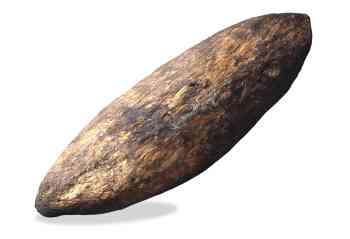
Shield collected at Botany Bay during Captain Cook’s visit, 1770 (London: The British Museum).
The objects displayed in this exhibition are immensely important. The British Museum’s collection contains some of the earliest objects collected from Aboriginal people and Torres Strait Islanders through early naval voyages, colonists, and missionaries dating as far back as 1770. Many were collected at a time before museums were established in Australia and they represent tangible evidence of some of the earliest moments of contact between Aboriginal people, Torres Strait Islanders and the British. Many of these encounters occurred in or near places that are now major cities such as Sydney, Melbourne, Adelaide, and Perth. As a result of collecting made in the early 1800s, many objects originate from coastal locations
rather than the arid inland areas often associated with
Indigenous Australia in the popular imagination.
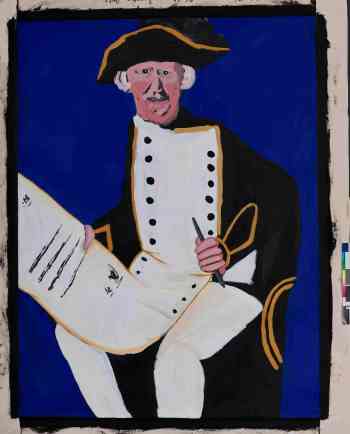
Vincent Namatjira, James Cook—with the Declaration, 2014. © Vincent Namatjira
The exhibition will present not only Indigenous ways of understanding the land and sea but also the significant challenges faced by Indigenous Australians from the colonial period until to the present day. In 1770 Captain Cook landed on the east coast of Australia, a continent larger than Europe. In this land there were hundreds of different Aboriginal groups, each inhabiting a particular area, and each having its own languages, laws and traditions. This land became a part of the British Empire and remained so until the various colonies joined together in 1901 to become the nation of Australia we know today. In this respect, the social history of 19th-century Australia and the place of Indigenous people within this is very much a British story. This history continues into the twenty first century. With changing policies towards Indigenous Australians and their struggle for recognition of civil rights, this exhibition shows why issues about Indigenous Australians are still often so highly debated in Australia today.
The exhibition brings together loans of special works from institutions in the United Kingdom, including the British Library, the Pitt Rivers Museum and the Cambridge Museum of Archaeology and Anthropology. A number of works from the collection of the National Museum of Australia will be shown, including the masterpiece ‘Yumari’ by Uta Uta Tjangala. Tjangala was one of the artists who initiated the translation of traditions of sand sculptures and body painting onto canvas in 1971 at Papunya, a government settlement 240km northwest of Alice Springs in the Northern Territory. Tjangala was also an inspirational leader who developed a plan for the Pintupi community to return to their homelands after decades of living at Papunya. A design from ‘Yumari’ forms a watermark on current Australian passports.
This exhibition has been developed in consultation with many Aboriginal and Torres Strait Islander individuals, Indigenous art and cultural centres across Australia, and has been organised with the National Museum of Australia. The broader project is a collaboration with the National Museum of Australia. It draws on a joint research project, funded by the Australian Research Council, undertaken by the British Museum, the National Museum of Australia and the Australian National University. Titled Engaging Objects: Indigenous communities, museum collections and the representation of Indigenous histories, the research project began in 2011 and involved staff from the National Museum of Australia and the British Museum visiting communities to discuss objects from the British Museum’s collections. The research undertaken revealed information about the circumstances of collecting and significance of the objects, many of which previously lacked good documentation. The project also brought contemporary Indigenous artists to London to view and respond to the Australian collections at the British Museum.
Neil MacGregor, Director of the British Museum said, “The history of Australia and its people is an incredible, continuous story that spans over 60,000 years. This story is also an important part of more recent British history and so it is of great significance that audiences in London will see these unique and powerful objects exploring this narrative. Temporary exhibitions of this nature are only possible thanks to external support so I am hugely grateful to BP for their longstanding and on-going commitment to the British Museum. I would also like to express my gratitude to our logistics partner IAG Cargo and the Australian High Commission who are supporting the exhibition’s public programme.”
Peter J. Mather, Group Regional Vice President, Europe and Head of Country, UK, BP: “BP is extremely pleased to support The BP Exhibition Indigenous Australia: Enduring Civilisation, part of our five year commitment to the museum’s special exhibitions programme. BP has had a presence in Australia for almost 100 years and our support for this exhibition is part of BP’s wider contribution to the societies where we operate, enabling audiences to connect with a variety of different cultures. We are delighted to continue our long-standing relationship with the British Museum by supporting this exhibition which we hope will inspire interest in Australia’s indigenous people and culture for many thousands of visitors.”
Dr Mathew Trinca, National Museum of Australia Director, welcomed the British Museum exhibition: “We are delighted to support this major exhibition in London with the loan of some key objects from our collection. We look forward to continuing our work together to realise our ambition for an exhibition of these artefacts in Canberra in late 2015.”
Patron: HRH The Prince of Wales
Supported by BP
Organised with the National Museum of Australia
Logistics partner IAG Cargo
Public programme supported by the Australian High Commission
Gaye Sculthorpe, John Carty, Howard Morphy, Maria Nugent, Ian Coates, Lissant Bolton, and Jonathan Jones, Indigenous Australia: Enduring Civilisation (London: The British Museum Press, 2015), 272 pages, ISBN: 978-0714126944, £30.
This ground-breaking publication explores the unique and ongoing relationship that Aboriginal people and Torres Strait Islanders have to place and country. It also explores the profound impact and legacy of colonialism, the nature of collecting and the changing meaning of objects now in the collection of The British Museum.
Exhibition | Spirits of the Passage: The Transatlantic Slave Trade
From the press release for the exhibition:
Spirits of the Passage: The Story of the Transatlantic Slave Trade
The Frazier History Museum, Louisville, Kentucky, February 2 through June 16, 2013
The DuSable Museum of African American History, Chicago, 19 September 2014 — 4 January 2015
Reading Public Museum, Reading, Pennsylvania, 24 January — 3 May 2015

Slave Shackles from The Henrietta Marie, ca. 1700 (Key West: The Mel Fisher Maritime Museum)
The Reading Public Museum invites guests to the new exhibition, Spirits of the Passage: The Story of the Transatlantic Slave Trade, exploring the transatlantic slave trade through a display of nearly 150 historical objects, many salvaged from sunken ships. This exhibition, sponsored locally by The Historic Abraham Lincoln Hotel, was developed in conjunction with the 150th anniversary of Abraham Lincoln’s 1863 Emancipation Proclamation and the turning point it represented for thousands of enslaved people at a pivotal point in the American Civil War. It’s the first exhibit of its kind to examine the entire history of the Transatlantic Slave Trade from the 16th through 19th centuries, while also presenting the most up-to-date research and discoveries to the public. These include the latest marine archaeological discoveries from the Mel Fisher Maritime Museum, new research on key African societies, and an exploration of the slave trade’s modern day legacies.
Spirits of the Passage allows guests to see authentic artifacts from the wreck of an actual slave ship, such as restraints, tools, plates and trade goods, as well as dozens of other objects from West African societies that show the uniqueness of the individual cultures they represent. These include religious objects, bronze- and beadwork, pottery, and jewelry. These compelling artifacts create a provocative picture of this tragic era, while also engendering a sense of pride in the legacy of strength these enslaved people left behind.
Spirits of the Passage was produced in partnership by The Mel Fisher Maritime Museum in Key West, Florida and The Frazier History Museum in Louisville, Kentucky.
◊ ◊ ◊ ◊ ◊
The 1972 discovery of The Henrietta Marie occasioned this 1997 book:
Madeleine Burnside and Rosemarie Robotham, with a foreword by Cornell West, Spirits of the Passage: The Transatlantic Slave Trade in the Seventeenth Century (New York: Simon & Schuster, 1997), 192 pages, ISBN: 978-0684818191.
 In a watery grave off the coast of Florida lies the earliest slave ship ever recovered. The English-owned Henrietta Marie plied the waters from Europe to Africa and the New World, sinking in the year 1700. She has waited three hundred years to reveal her story. Taking the wreck of the ship as its dramatic heart, Spirits of the Passage presents the first general-interest history of the early years of the slave trade. Told in part from the decks and the cargo hold of a single merchant slaver, this powerful and fascinating story covers a period that has heretofore been largely the territory of scholars—the late seventeenth century, when the slave trade began a period of explosive growth.
Spirits of the Passage describes the story of the largest forced migration in human history, with a powerful text that personalizes the experience of slavery in the most gripping way. Richly illustrated with artifacts found in the wreck along with etchings and paintings of the time, the book documents a tragic tale of human misery even as it reveals the strength of spirit that made survival possible for enslaved Africans. Included throughout are narratives of resistance and survival, many of them never before told. The mosaic of profiles breathes life into stories from all sides of the trade, stories that will contribute to a more complete understanding of the dilemmas of the time. As integral parts of this important volume, profiles, anecdotes, illustrations, and incisive narrative all combine to create a compelling account of one of history’s most important, and shattering, moments.
Exhibition | Bonaparte and the British: Prints and Propaganda

James Gillray, Maniac Ravings, 1803, hand-coloured etching on paper
(London: The British Museum)
◊ ◊ ◊ ◊ ◊
From The British Museum:
Bonaparte and the British: Prints and Propaganda in the Age of Napoleon
The British Museum, London, 5 February — 16 August 2015
This exhibition focuses on the printed propaganda that either reviled or glorified Napoleon Bonaparte, on both sides of the English Channel. It explores how his formidable career coincided with the peak of political satire as an art form. 2015 marks the 200th anniversary of the Battle of Waterloo—the final undoing of brilliant French general and emperor Napoleon Bonaparte (1769–1821). The exhibition will include works by British and French satirists who were inspired by political and military tensions to exploit a new visual language combining caricature and traditional satire with the vigorous narrative introduced by Hogarth earlier in the century.
The print trade had already made the work of contemporary British artists familiar across Europe. Continental collectors devoured the products of the London publishers, and artists across Europe were inspired by British satires. This exhibition includes work by James Gillray, Thomas Rowlandson, Richard Newton and George Cruikshank, some of the most thoughtful and inventive artists of their day. The range and depth of the British Museum’s collection allows the satirical printmakers’ approach to be compared with that of portraitists and others who tended to represent a more sober view of Napoleon.
The exhibition begins with portraits of the handsome young general from the mid-1790s and ends with a cast of his death mask and other memorabilia acquired by British admirers. Along the way, the prints will examine key moments in the British response to Napoleon—exultation at Nelson’s triumph in the Battle of the Nile in 1798, celebration of the Peace of Amiens in 1802, fear of invasion in 1803, the death of Nelson at the Battle of Trafalgar in 1805, and Napoleon’s triumph at Austerlitz, delight at his military defeats from 1812 onwards, culminating in his exile to Elba in 1814. 1815 sees triumphalism after Waterloo and final exile to St Helena, but some prints reflect an ambiguous view of the fallen emperor and doubts about the restoration of the French king Louis XVIII.
◊ ◊ ◊ ◊ ◊
From The British Museum Press:
Tim Clayton and Sheila O’Connell, Bonaparte and the British: Prints and Propaganda in the Age of Napoleon (London: The British Museum Press, 2015), 256 pages, ISBN: 9780714126937, £25.
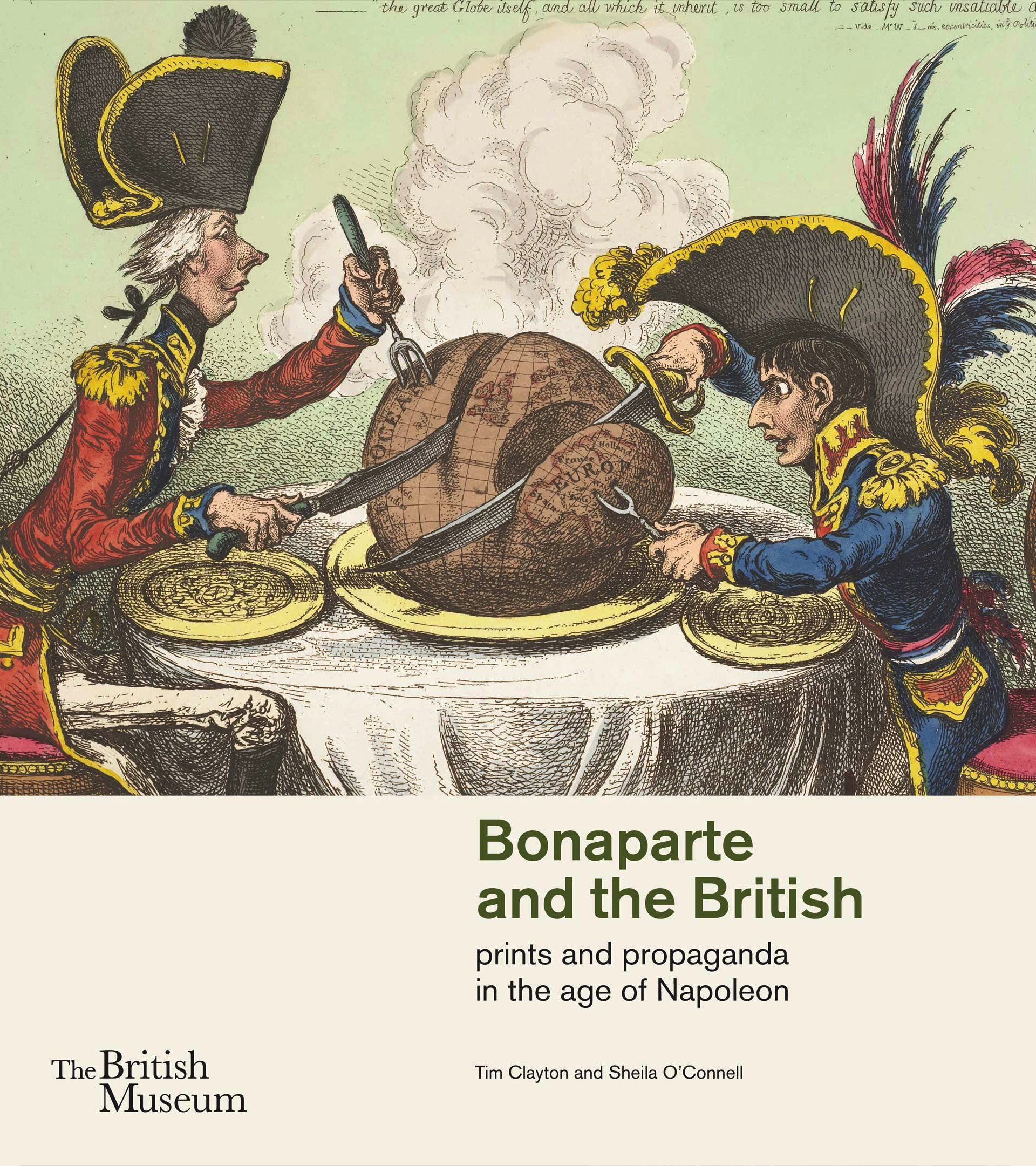 This fascinating book explores through contemporary prints how Bonaparte was seen from across the English Channel where hostile propaganda was tempered by admiration for his military and administrative talents. Featuring works from The British Museum’s world-renowned collection of political satires, including examples by the greatest masters of the genre, James Gillray, Thomas Rowlandson and George Cruikshank, the authors examine in detail these fascinating and humorous prints.
Attitudes to Bonaparte were coloured by political tensions in Britain as highlighted in satires of Charles James Fox, Richard Brinsley Sheridan, Lord Holland and other radicals. French, German, Russian and Spanish copies of British prints demonstrate the wide dissemination of prints and the admiration of continental artists for British satirists. From portraits of the handsome young general to the resplendent Emperor to the cast of his death mask, this book explores crucial events of Bonaparte’s career and the period. French satires showing the British in relation to Bonaparte are also included alongside portraits of Bonaparte and his family made for the British market. This richly illustrated title reveals the stories behind the prints, explaining how satire was used as propaganda and how the artists worked. It features intricately detailed prints in full colour, bringing to life a key period in European history.
Tim Clayton is a leading authority on British prints of the period and the author of several critically acclaimed military histories. Sheila O’Connell is curator of British prints before 1900 at The British Museum.
Exhibition | Vanishing Ice: Alpine and Polar Landscapes in Art

William Hodges, The Resolution and Adventure, 4 January 1773, Taking Ice for Water, Latitude 61 Degrees South, ink and wash on paper; 14 x 22″ (Mitchell Library, State Library of New South Wales).
Click here for more information.
◊ ◊ ◊ ◊ ◊
From the McMichael press release (9 December 2014) for the Vanishing Ice exhibition:
Vanishing Ice: Alpine and Polar Landscapes in Art, 1775–2012
Whatcom Museum, Bellingham, Washington, 3 November 2013 — 16 March 2014
El Paso Museum of Art, 1 June — 24 August 2014
Glenbow Museum, Calgary, Alberta, 27 September 2014 — January 4, 2015
McMichael Canadian Art Collection, Kleinburg, Ontario, 31 January — 26 April 2015
On January 31, 2015, the powerful and provocative exhibition Vanishing Ice: Alpine and Polar Landscapes in Art, 1775–2012 opens at the McMichael Canadian Art Collection. Since debuting in 2013 at the Whatcom Museum in Bellingham, Washington, the exhibition has garnered attention for its unique interweaving of art, history, and science. Showcasing the beauty and fragility of Earth’s frozen frontiers through the eyes of artists, writers, and naturalists over a period of more than 200 years, the exhibition offers a unique take on the timely subject of climate change.
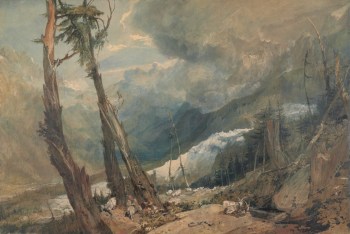
Joseph Mallord William Turner, Mer de Glace, in the Valley of Chamouni, Switzerland, 1803, watercolor, graphite, gum, 28 x 41″ (New Haven: Yale Center for British Art, Paul Mellon Collection)
Vanishing Ice features over seventy works including drawings, prints, paintings, photographs, videos, and installations by fifty artists from twelve countries. Among these historical and contemporary artists are: Ansel Adams, Lita Albuquerque, James Balog, Thomas Hart Benton, David Buckland, Gustave Doré, Lawren Harris, Isaac Julien, Kahn & Selesnick, Rockwell Kent, Paul D. Miller (aka DJ Spooky), Alexis Rockman, Camille Seaman, and Spencer Tunick. The exhibition unfolds thematically, geographically, and chronologically, moving from alpine to Arctic and Antarctic landscapes.
The idea for Vanishing Ice grew out of curator Barbara Matilsky’s doctoral dissertation, written thirty years ago about the sublime landscapes of French artist-naturalist-explorers who were among the first to depict the poles and mountain glaciers. As Matilsky became aware of the increasing number of contemporary artists who were venturing to the Arctic and Antarctic, she saw an opportunity to compare historical and contemporary depictions of these rapidly changing landscapes, as epitomized by the juxtaposition of Arthur Oliver Wheeler’s 1917 image of the Athabasca Glacier in Jasper National Park and Gary Braasch’s 2005 photograph of the same location.
“I am hoping that Vanishing Ice will stimulate a new appreciation for alpine and polar landscapes by revealing their significance for both nature and culture,” said exhibition curator Barbara Matilsky from the Whatcom Museum. “In the past, artists and naturalists expanded the public’s awareness of Earth’s icy frontiers. Today, artists continue to collaborate with scientists, motivated by the belief that art will help people to visualize the accelerating effects of climate change. They awaken the world to both the beauty and increasing vulnerability of ice, which is critical for biological and cultural diversity. Their work will hopefully inspire activism on the regional and national levels to make the requisite policy changes that will bring Earth back into balance.”
The McMichael is the exhibition’s final stop on a tour that included the Whatcom Museum; the El Paso Museum in Texas; and most recently the Glenbow Museum in Calgary.
“The McMichael nurtures a special interest in exploring the intersection of art and nature, and encouraging meaningful dialogue about the environment,” said Dr. Victoria Dickenson, Executive Director and CEO of the McMichael. “Vanishing Ice is both a beautiful glimpse of some of the most remote and fragile ecosystems, and a call to action on what many people hold to be the defining issue of this generation.”
Vanishing Ice, which will span the McMichael’s upper level of gallery spaces, will be complemented by an exhibition based on the McMichael’s permanent collection of works related to the Arctic, opening on February 14, 2015. The installation will include paintings and drawings by members of the Group of Seven, including Lawren Harris—famed for his depiction of icebergs and glaciers—and works by Inuit artists, including Tim Pitsiulak.
Vanishing Ice: Alpine and Polar Landscapes in Art, 1775–2012 is organized by the Whatcom Museum. Major funding for the exhibition has been provided by the Paul G. Allen Family Foundation and the National Endowment for the Arts with additional support from the Norcliffe Foundation, the Washington State Arts Commission, and the City of Bellingham.
From the University of Washington Press:
◊ ◊ ◊ ◊ ◊
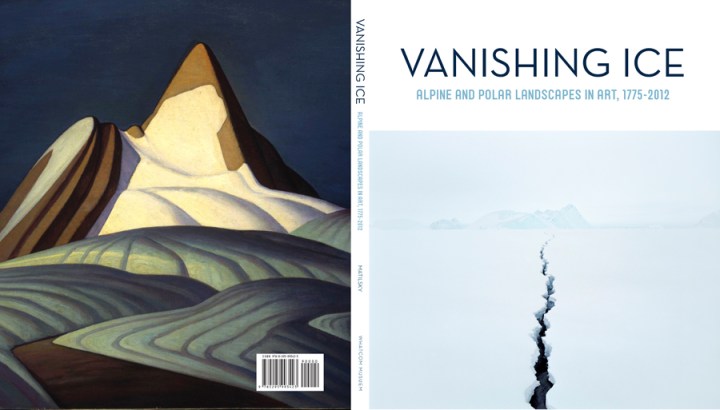
Barbara C. Matilsky, Vanishing Ice: Alpine and Polar Landscapes in Art, 1775–2012 (Seattle: University of Washington Press, 2013), 144 pages, ISBN: 978-0295993423, $40.
Vanishing Ice introduces the rich artistic legacy of the planet’s frozen frontiers now threatened by a changing climate. Tracing the impact of glaciers, icebergs, and fields of ice on artists’ imaginations, this interdisciplinary survey explores the connections between generations of artists who adopt different styles, media, and approaches to interpret alpine and polar landscapes.
Beginning in the eighteenth century, collaborations between the arts and sciences contributed to a deeper understanding of snowcapped mountains, the Arctic, and Antarctica. A resurgence of interest in these environments as dramatic indicators of climate change galvanizes contemporary expeditions to the glaciers and the poles. Today, artists, writers, and scientists awaken the world to both the beauty and increasing vulnerability of ice.
Barbara C. Matilsky is curator of art at the Whatcom Museum, Bellingham, Washington. She is the author of numerous books, including Fragile Ecologies: Contemporary Artists’ Interpretations and Solutions.
C O N T E N T S
Director’s Foreword
Prologue
From the Sublime to the Science of a Changing Climate
Voyage to Glacial Peaks
Magnetic Attraction: The Allure of the Poles
Elegy: The Open Polar Sea
Timeline
Checklist of the exhibition
Exhibition | Shoes: Pleasure and Pain

Pale-blue shoes, silk satin with silver lace and braid, diamond and sapphire buckles, England, 1750s (London: V&A: T.70+A—1947; M.48+A—1962). Photographed on the mantelpiece in The Norfolk House Music Room, the British Galleries at the V&A.
◊ ◊ ◊ ◊ ◊
Press release from the V&A:
Shoes: Pleasure and Pain
Victoria & Albert Museum, London, 13 June 2015 — 31 January 2016
The Bowes Museum, Barnard Castle, County Durham, 11 June — 9 October 2016
Peabody Essex Museum, Salem, Massachusetts, 9 November 2016 — 12 March 2017
Savannah College of Art and Design, Savannah, Georgia, March — June 2017
Curated by Helen Persson
The transformative power of extreme footwear will be explored in the V&A’s summer 2015 fashion exhibition, Shoes: Pleasure and Pain. More than 200 pairs of historic and contemporary shoes from around the world will be on display, many for the first time. The exhibition will explore the agonizing aspect of wearing shoes as well as the euphoria and obsession they can inspire.
The V&A’s shoe collection is unrivalled, spanning the globe and over 2000 years. For Shoes: Pleasure and Pain, curator Helen Persson has delved into this, other international collections and the wardrobes of private individuals to select an exceptional range of shoes from a sandal decorated in pure gold leaf originating from ancient Egypt to futuristic looking shoes created using 3D printing.
 Shoes worn by or associated with high profile figures including Marilyn Monroe, Queen Victoria, Sarah Jessica Parker, and the Hon Daphne Guinness will be shown as well as famous shoes, such as the ballet slippers designed for Moira Shearer in the 1948 film The Red Shoes. Footwear for men and women by 70 named designers including Manolo Blahnik, Christian Louboutin, Jimmy Choo, and Prada will be on display. Historic lotus shoes made for bound feet and 16th-century chopines, silk mules with vertiginous platforms designed to lift skirts above the muddy streets, will also feature.
Exhibition curator, Helen Persson, said: “Shoes are one of the most telling aspects of dress. Beautiful, sculptural objects, they are also powerful indicators of gender, status, identity, taste and even sexual preference. Our choice in shoes can help project an image of who we want to be.”
The exhibition will be shown over two floors. The luxurious, boudoir design of the ground floor gallery will examine three themes: transformation, status, and seduction.
‘Transformation’ will present shoes that are the things of myth and legend, opening with different cultural interpretations of the Cinderella story from across the globe. It will explore the concept of shoes being empowering as passed down through folklore, illustrated by the Seven League Boots from the ‘Hop o’ My Thumb’ tale, and how this feeds into contemporary marketing for such things as football boots and the concept of modern-day, fairy-tale shoemakers, whose designs will magically transform the life of the wearer.
‘Status’ will reveal how impractical shoes have been worn to represent privileged and leisurely lifestyles—their design, shape and material can often make them unsuitable for walking—and how shoes also dictate the way in which the wearer moves, how they are seen and even heard. Shoes on display will include Indian men’s shoes with extremely long toes, noisy slap-sole shoes worn in Europe during the 17th century and the now infamous Vivienne Westwood blue platforms worn by Naomi Campbell in 1993. ‘Status’ will also demonstrate how historically shoe fashions originated from the European royal courts, while today the focus has shifted to famous shoe designers. Desirable shoes such as the ‘Pompadour’, worn by trend-setting women in the 18th-century French court will sit together with designs by the some of the most well-known names in fashion today, including Alexander McQueen and Sophia Webster.
Within ‘Seduction’, the shoes represent an expression of sexual empowerment or a passive source of pleasure. Like feet, shoes can be objects of fetishism. High Japanese geta, extreme heels, and tight-laced leather boots will be on display as well as examples of erotic styles channeled by mainstream fashion in recent years.
In contrast, the laboratory style setting of the first floor gallery is dedicated to dissecting the processes involved in designing and creating footwear, laying out the story from concept to final shoe. This will be enhanced by films and animations that peel back the layers of a shoe and reveal how they are made. The displays will show how makers combine traditional craftsmanship with technological innovation and how they unite function with art.
Designer sketches, materials, embellishments and shoe lasts, such as the lasts created by H. & M. Rayne for Princess Diana, will be on show, alongside ‘pullovers’ from Roger Vivier for Christian Dior. The section will highlight the makers’ ingenuity in creating innovative styles and dealing with the structural challenges of creating ever higher heels and more dramatic shapes and will feature filmed interviews with five designers and makers.
The exhibition will go on to examine shifts in consumption and production—with examples from an 18th-century ‘cheap shoe warehouse’, one-off handmade men’s brogues and trainers made in China. It will also look at the future of shoe design, with experiments of material and shapes, moulding and plastics. On display will be footwear that pushes the boundaries of possibility, including the form-pressed ‘Nova’ shoes designed by Zaha Hadid with an unsupported 16cm heel and Andreia Chaves’ ‘Invisible Naked’ shoes that fuse a study of optical illusion with 3D printing and high quality leather making techniques. The last section of the exhibition will look at shoes as commodities and collectibles. Six different people’s collections will be presented from trainers to luxury footwear.
Sponsored by Clarks, supported by Agent Provocateur, with additional thanks to the Worshipful Company of Cordwainers
Note (added 14 June 2016) — Venues updated to reflect the latest schedule.
◊ ◊ ◊ ◊ ◊
A preview of the accompanying publication is available via Issuu:
Helen Perrson, ed., Shoes: Pleasure and Pain (London: V&A Publishing, 2015), 176 pages ISBN: 978-1851778324, £25 / $40.
 Beautiful, sculptural objects, shoes are powerful indicators of gender, status, identity, taste, and even sexual preference. Our choice in shoes can be aspirational, even fantastical—and projects an image not just of who we are, but who we want to be. Feet are made for walking, but shoes may not be. Featuring extensive new photography, this is a beautiful and authoritative guide to the history and culture of footwear. Iconic creations by celebrated designers sit alongside masterpieces by unknown craftsmen in this book.
Embracing both men’s and women’s footwear, from the Chinese lotus shoe to laser-printed contemporary shoes-as-sculpture, Shoes: Pleasure and Pain engages with the cultural significance of shoes—the source of their allure, how they are made, and the people who buy and wear them. Contributors from a wide range of disciplines consider subjects as diverse as ballet slippers and fetishism, shoes and ceramics, traditional shoemaking, and the obsessive shoe collector. The book also includes a comprehensive discussion of the history of shoe design, and case studies including Marie-Antoinette’s shoe collection and the footwear of the Maharajas.
Helen Persson is curator of Chinese textiles and dress in the V&A’s Asian Department.
◊ ◊ ◊ ◊ ◊
C O N T E N T S
Helen Persson, Introduction
Part 1: The Lure of Shoes
Hilary Davidson, Shoes and Magical Objects
Elizabeth Semmelhack, The Allure of Height
Rowan Bain, Status and Power in the Hamam
Divia Patel, Bling: Footwear of the Maharajas
Cassie Davies-Strodder, Shoes and Sex
Valerie Steele, Ballet Shoes and Fetishism
Rowan Bain, The Shoe and the Body
Part 2: Art and Innovation
Naomi Braithwaite, Shoe Design: Creativity and Process
Helen Persson, The Beauty of Shoemaking
Jana Scholze, Extreme Future
Sonia Solicari, The Shoemaker and the Ceramicist
Joanne Hackett, Plastic Galore
Christopher Breward, Men in Heels
Part 3: Shoe Obsession
Cally Blackman, The Rise of the Celebrity Shoe Designer
Giorgio Riello, Production for Consumption
Kirstin Kennedy, Cracowes and Duckbills
Helen Persson, Lotus Shoes for the Masses
Kimberly Chrisman-Campbell, Marie Antoinette’s Love of Shoes
Karin M. Ekström, The Show Cabinet: Collectors Case Study
Notes
Bibliography
Parts of a Shoe
Glossary
Index
Acknowledgements
Picture Credits
Exhibition | Fashioning the Body: An Intimate History of the Silhouette
Press release for the upcoming exhibition at the BGC:
Fashioning the Body: An Intimate History of the Silhouette
Musée des Arts Décoratifs, Paris, 5 July — 24 November 2013
Bard Graduate Center, New York, 3 April — 26 July 2015
Curated by Denis Bruna
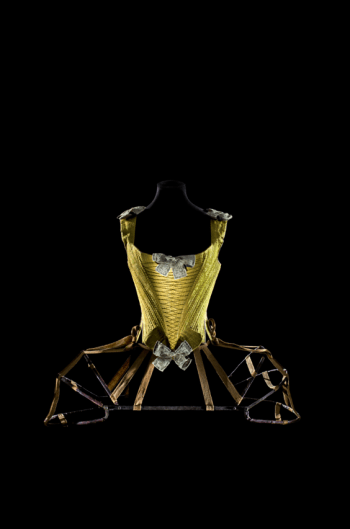
Whalebone corset. France, ca. 1740–60. Silk satin damask, braided silk, linen bows covered in silk and decorated with metallic thread, whalebone, linen lining. Les Arts Décoratifs, PR 995.16.1. Articulated pannier. France, ca. 1770. Iron covered with leather, fabric tape. Les Arts Décoratifs, depot du musée national du Moyen Âge-Thermes et hotel de Cluny 2005, Cluny 7875. Photographer: Patricia Canino.
Having garnered high acclaim at the Musée des Arts décoratifs in Paris in 2013, the exhibition Fashioning the Body: An Intimate History of the Silhouette will be on display at the Bard Graduate Center from April 3 through July 26, 2015. The exhibition will present the many devices and materials that women and men have used to shape their silhouettes from the seventeenth century to today, including panniers, corsets, crinolines, bustles, stomach belts, girdles, and push-up brassieres. The exhibition will also look at how lacing, hinges, straps, springs, and stretch fabrics have been used to alter natural body forms.
Curated by Denis Bruna, curator of pre-19th-century fashion and textile collections at the Musée des Arts décoratifs and professor at the École du Louvre, the exhibition will explore the history of what has long been ‘behind the scenes’ in clothing and fashion—far beyond the corset, the best-known device for shaping the figure. This show, which draws heavily on the Paris museum’s unrivaled costume collection, is the first of its kind, and the Bard Graduate Center will be its only venue in North America.
Although a broad array of silhouette-shaping garments has evolved over the course of fashion history, and techniques have been refined, the purpose of such garments has remained consistent: to flatten the stomach, compress the waist to the point of hollowing it out, support the bust, lift the breasts (and sometimes flatten them), and add curves to the hips. In short, comfort was superseded by appearance until about 1900, when couturiers such as Paul Poiret launched, however fleetingly, a vogue for ‘natural’ lines.
The tricks for fashioning women’s bodies have always confounded belief, from the earliest boned bodices through today’s push-ups. Spread across three floors of the Bard Graduate Center Gallery’s townhouse, Fashioning the Body opens with the seventeenth-century silhouette, exemplified by a rare women’s Spanish doublet, which was internally reinforced to be more rigid. Structured with armatures and other mechanisms, the garments of the eighteenth century enforced the erect posture prized first by the aristocracy and later by an influential bourgeoisie in order to convey a sense of superiority through the display of an idealized physical form. The epitome of the transformed female silhouette is the late eighteenth-century formal or court dress, examples of which will be on display alongside the undergarments that molded their distinctive silhouettes. In men’s fashion, the exhibition explores how padded jackets provoked arched torsos; how calf enhancers, stomach belts, and codpieces were worn; and how variations on these enhancements continued into the nineteenth century and beyond. The exhibition will also include garments for children, who wore corsets beginning in the seventeenth century.
Fashioning the Body continues into the nineteenth century, in which the corset held tyrannical sway, embodying the voguish insistence on a ‘wasp waist’, accentuated by the excessive ballooning of crinoline. After 1870 this kind of boned hoopskirt disappeared and was replaced by the bustle—also known as the faux-cul (fake buttocks), ‘shrimp tail’, or strapontin (jump seat)—which gave women an odd and sinuous profile reminiscent of a goose. Undergarments were never as abundant or as concealed as they were in the nineteenth century. The exhibition will continue with the brassiere and girdle, including examples used by men, and eventually the bust-enhancing and push-up bras of today. These devices were designed to create a plunging look for even the slimmest figures, reflecting the dictates of the canons of beauty at a time when bodies are modeled more by diets, body building, and surgery than by clothing.
In addition to complete outfits shaped by these hidden structural contraptions, the exhibition will also feature moving mannequins wearing mechanized reconstructions of panniers, crinolines, and bustles in order to show how the undergarments worked. The exhibition space will also include an area where visitors can try on specially made replicas of corsets, eighteenth-century panniers, and crinolines in order to understand the workings of these structures, which have played such an important role in the history of fashion.
Denis Bruna has a doctorate in history from the University of Paris I Panthéon-Sorbonne. He joined Les Arts Décoratifs in 2011 as curator of textile and fashion collections before the nineteenth century. He is also a professor and director of research in the history of fashion, costume, and textiles at the École du Louvre. His research focuses on the history and iconography of the costume, dress, and customs of the body. He has published several books and was the curator of the 2012 exhibition Fashioning Fashion: Two Centuries of European Fashion 1700–1915.
The Bard Graduate Center is a graduate research institute in New York City. The Center’s Gallery exhibitions and publications, MA and PhD programs, and research initiatives explore new ways of thinking about decorative arts, design history, and material culture. Founded in 1993, the BGC is an academic unit of Bard College. Fashioning the Body is the third in a series of collaborations between the Musée des Arts décoratifs and the Bard Graduate Center, which included Chinese Cloisonné (2011) and Discovering the Secrets of Soft-Paste Porcelain at the Saint-Cloud Manufactory, ca. 1690–1766 (1999).
The Musée des Arts décoratifs, housed in the Louvre building, is a unique, private institution composed of a specialized library, teaching facilities, and an ensemble of prestigious museums, including the Musée Nissim de Camondo and the Musée des Arts décoratifs. The Musée des Arts décoratifs fulfills a unique role in the French cultural landscape. Its six thousand objects on view in 10,000 square meters of exhibition space highlight the skills of craftsmen through the centuries, the evolution of styles, technological innovation, and the creativity of artists in enriching our day-to-day environ- ment. It is the only museum able to pay tribute to all the great names that have forged the history of French taste, from Boulle, Sèvres, Aubusson, Christofle, Lalique, and Guimard to Mallet Stevens, Le Corbusier, Perriand, and Starck. The museum’s chronological itinerary guides visitors through all the major styles and movements, from Gothic to Louis XVI, Art Nouveau, Art Deco, and modern design. Les Arts Décoratifs also boasts exceptional fashion and textile collections, among the finest in the world, and a vast collection of advertising posters, films, and objects. The wealth of these collections enables Les Arts Décoratifs to run a program of ten to fifteen thematic and monographic exhibitions covering every historic and contemporary aspect of the decorative arts.
◊ ◊ ◊ ◊ ◊
The Bard Graduate Center, in collaboration with Yale University Press, will publish an English-language version of the book that accompanied the exhibition in Paris, which is now out of print:
Denis Bruna, ed., with photographs by Patricia Canino, Fashioning the Body: An Intimate History of the Silhouette (New Haven: Yale University Press, 2015), 272 pages, ISBN: 978-0300204278, $50.
 This unique survey offers fascinating insights into the convoluted transformations employed by both men and women to accommodate the fickle dictates of fashion. With high design, wit, and style, Fashioning the Body tracks the evolution of these sartorial devices—from panniers, crinolines, and push-up bras to chains, zippers, and clasps—concealed beneath outer layers in order to project idealized figures. Women’s corsets constricted waists; exaggerated buttocks and hips counterbalanced jutting bust lines; and chic, aerodynamic silhouettes compressed breasts and flattened bellies. Yet masculine fashion has been no stranger to these tortuous practices. Men flaunted their virility by artificially broadening their shoulders, applying padding to their chests, and slipping codpieces over their groins. With more than 200 beautiful illustrations—including reproductions of superb historic advertisements—Denis Bruna reveals the industry and art of these contrivances meant to entice and beguile as well as assert status and power. Contemporary haute-couture designers Thierry Mugler, Jean Paul Gaultier, Rei Kawakubo for Comme des Garçons, Christian Lacroix, and Vivienne Westwood are featured in this indiscreet tour of intimate fashion history.
Exhibition | Fantastical Worlds: Adam Friedrich von Löwenfinck
From the Staatliche Kunstsammlungen Dresden:
Fantastical Worlds: Painting on Meissen Porcelain
and German Faience by Adam Friedrich von Löwenfinck (1714–1754)
Zwinger, Dresden, 1 October 2014 — 22 February 2015

Adam Friedrich von Löwenfinck, Meissen, 1734
To mark the 300th anniversary of the birth of Adam Friedrich von Löwenfinck, the Porzellansammlung of the Staatliche Kunstsammlungen Dresden presents a comprehensive exhibition of this artist’s oeuvre, bringing together around 100 selected porcelain and faience exhibits from the Dresden Porzellansammlung, private collections and renowned museums, including the Metropolitan Museum of Art, New York, the Rijksmuseum, Amsterdam, the Reiss-Engelhorn Museum, Mannheim, and the Museum für Kunst und Gewerbe, Hamburg.
Adam Friedrich von Löwenfinck (1714–1754) was one of the most important ceramic painters of the eighteenth century. He began his career at the Meissen Porcelain Manufactory in 1728, but by 1736 had fled to escape restrictions on his artistic development and difficult working conditions in the painters’ workshops. His life then took an adventurous path to a succession of faience manufactories, starting with Bayreuth and moving on by way of Fulda to Strasbourg-Haguenau. Due to his exceptional artistic abilities, but also to his guile and lack of scruples, Löwenfinck eventually rose from lowly journeyman painter to manufactory director.
Inspired by the painted decoration on Chinese and Japanese porcelain in the collection of August the Strong, he created a fantastic world inhabited by vibrantly colourful, fabulous creatures. He later took these exotic motifs, as well as his knowledge of both East Asian and European flower painting, with him as he travelled, transferring them from one workplace to the next. As Löwenfinck did not sign his works, for a long time it was impossible to attribute them with any certainty: as a result, his oeuvre long remained completely unrecognised, even among specialists.
The life and works of this exceptional artist were the focus of several years of research conducted by the Porzellansammlung of the Staatliche Kunstsammlungen Dresden. The results of this project are now presented in a comprehensive anniversary exhibition. Systematic evaluation of archive sources, including manufactory reports and case files, shed light on previously little known aspects of social conditions in the porcelain and faience manufactories of the time, and enabled a fundamental and thorough reassessment of his work.
◊ ◊ ◊ ◊ ◊
◊ ◊ ◊ ◊ ◊
From Arnoldsche Art Publishers:
Ulrich Pietsch, Phantastische Welten: Malerei auf Meissener Porzellan und deutschen Fayencen von Adam Friedrich von Löwenfinck, 1714–1754 (Stuttgart: Arnoldsche Art Publishers, 2014), 384 pages, ISBN: 978-3897904200, 78€.
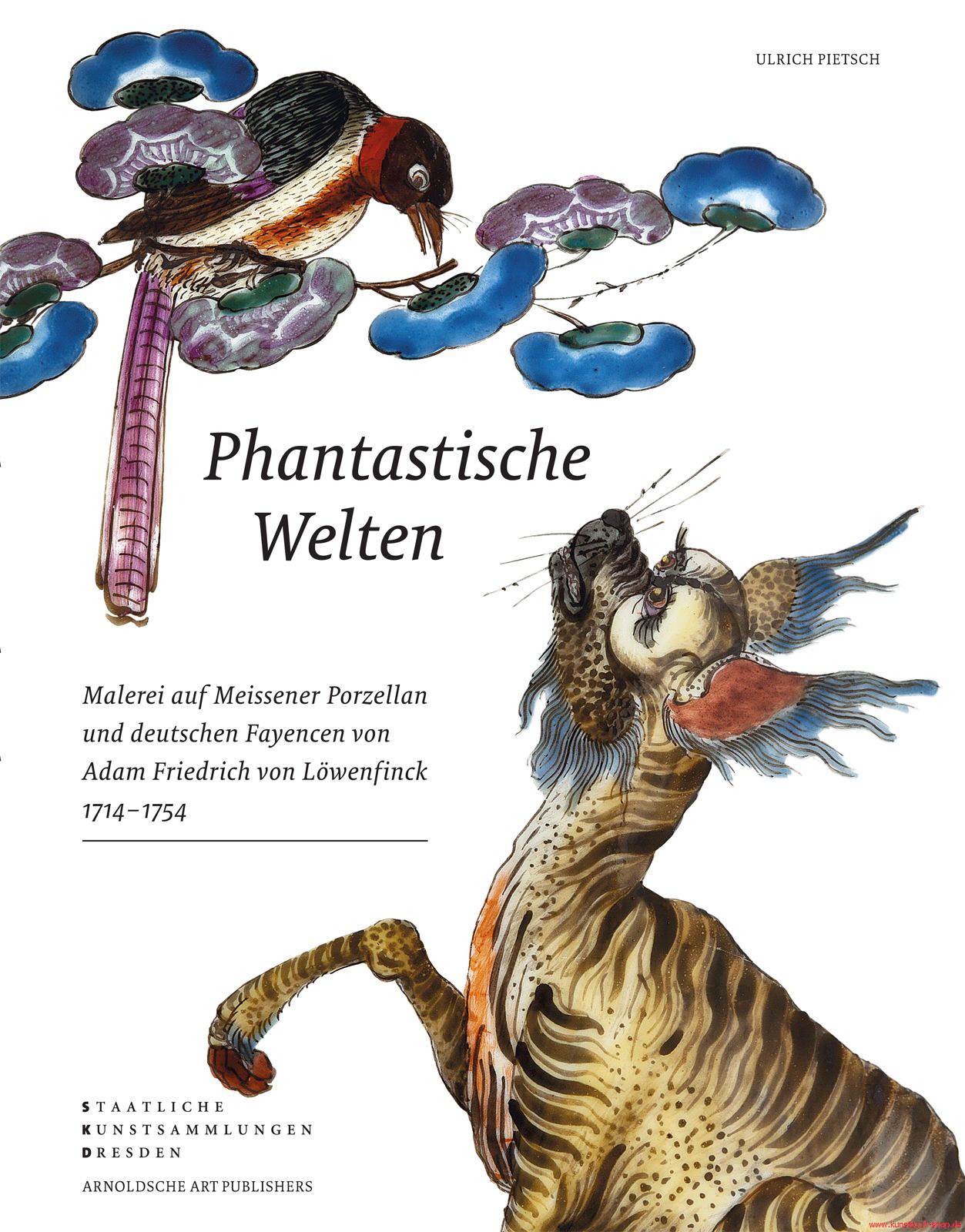 Adam Friedrich von Löwenfinck (1714–1754) war einer der bedeutendsten Keramikmaler des 18. Jahrhunderts. Er begann seine Karriere 1728 in der Porzellan-Manufaktur Meissen, die er wenige Jahre später wieder verließ, um der Einschränkung seiner künstlerischen Entfaltung und den schwierigen Arbeitsbedingungen in den Malerstuben zu entfliehen. Sein abenteuerlicher Lebensweg führte ihn in verschiedene Fayence-Manufakturen, darunter Bayreuth, Ansbach, Fulda, Höchst und Straßburg-Haguenau. Aufgrund seiner außergewöhnlichen künstlerischen Fähigkeiten, aber auch durch Geschick und Skrupellosigkeit stieg Löwenfinck schließlich vom einfachen Malergesellen in die Position eines Manufakturdirektors auf. Löwenfinck ist bekannt für seine fantastische Welt bunt schillernder und märchenhafter Fabeltiere. Er beeinflusste und prägte nachhaltig die Keramikmalerei seiner Zeit und wirkte stilprägend auf viele andere Manufakturen des 18. Jahrhunderts in Europa. Aufgrund fehlender Künstlersignaturen ist sein Werk umstritten und wurde bislang kontrovers diskutiert.
Die vorliegende Publikation ist das Ergebnis eines mehrjährigen Forschungsprojektes der Porzellansammlung Dresden, mit der nun erstmals eine grundlegende Untersuchung der Biografie und des OEuvres Adam Friedrich von Löwenfincks vorgelegt wird.
Exhibition | Jean-Etienne Liotard
On this summer at the Scottish National Gallery (more information to come in the spring). . .
Jean-Etienne Liotard
Scottish National Gallery, Edinburgh, 4 July — 13 September 2015
Royal Academy, London, 24 October 2015 — 31 January 2016
Curated by MaryAnne Stevens, William Hauptman, and Christopher Baker

Jean Étienne Liotard, Laura Tarsi, ‘A Grecian Lady’, watercolour and bodycolour on ivory, ca 1745–49 (Cambridge: Fitzwilliam Museum)
A stunning exhibition celebrating one of the greatest artists of the eighteenth century. The work of Jean- Étienne Liotard (1702–89) has been rarely exhibited, and this is the first time it will be comprehensively celebrated in Britain.
Liotard enjoyed a long career, and his finest portraits display an astonishing hyper-realism achieved through a combination of incredible, intense observation and remarkable technical skills. He excelled at the delicate art of pastel, but also drew, painted in oil, created enamels, and was a refined miniaturist and printmaker. His activity was prodigious: Liotard wrote a treatise on painting, was a collector, a dealer, a traveller and an artistic innovator. In the age of Mozart and Casanova, he was a key international figure whose achievement deserves to be better known. Highlights of this important show include famous portraits, startling self-portraits, and brilliant experiments with genre and still-life subjects from the end of his career.
◊ ◊ ◊ ◊ ◊
Update (added 5 July 2015) — From the press release:
The National Galleries of Scotland is delighted to announce a major exhibition in the summer of 2015 celebrating one of the greatest yet little- known artists of the eighteenth century. The work of Jean-Étienne Liotard (1702–1789) has rarely been exhibited and this is the first time it will be comprehensively celebrated in Britain. Liotard enjoyed a long career and his finest portraits display an astonishing hyper-realism achieved through a combination of incredible, intense observation and remarkable technical skills.
Liotard was one of the most sophisticated artists of eighteenth-century Europe; a brilliant, witty portraitist, he excelled at the delicate art of pastel, but also drew, painted in oil, created enamels and was a refined miniaturist and printmaker. According to his contemporary Horace Walpole “Truth prevailed in all his works.” In some respects he also displayed striking modernity as a highly accomplished self-publicist, formulating a powerful ‘eastern’ image of himself following his period in Constantinople, by wearing exotic clothes and growing a long beard, which became as much a focus of curiosity as his portraits. His activity was prodigious: Liotard wrote a treatise on painting, was a collector, a dealer, a traveller and an artistic innovator. In the age of Mozart and Casanova, he was a key international figure, whose achievement deserves to be better known.
Born in Geneva, he travelled extensively, working in Amsterdam, The Hague, Venice, Rome and Naples. He spent four years in Constantinople depicting foreign residents in the city and developed a fascination with near- eastern fashions and customs. His career also took him to the courts of Vienna, Paris and London, where he portrayed the families of Empress Maria Theresa, King Louis XV and Augusta, Princess of Wales, creating images of great candour and charm.
Christopher Baker, Director of the Scottish National Portrait Gallery, and one of the exhibition’s curators commented: “This exhibition will be a revelation to many visitors who are unfamiliar with Liotard’s dazzling achievement. He was undoubtedly one of the most remarkable and idiosyncratic artists of the eighteenth century, and his work and career are fascinating, as they touch on themes such a travel, orientalism, court art, fashion and technical experimentation.”
Liotard depicted a number of important British patrons, in addition to members of the Royal family, such as the actor David Garrick, and some of his key works remain in U.K. public and private collections. Highlights of the exhibition will also include a selection of his startling self-portraits and brilliant experiments with genre and still life subjects that date from late in his career.
◊ ◊ ◊ ◊ ◊
Christopher Baker, Duncan Bull, Marc Fehlmann, William Hauptman, Neil Jeffares, Aileen Ribeiro, MaryAnne Stevens, Jean-Etienne Liotard (London: Royal Academy Publications, 2015), 224 pages, ISBN: 978-1907533990, £35.
 Renowned during the eighteenth century for his exquisite portraits and works in pastel, not to mention his outlandish Orientalist outfits, Jean-Etienne Liotard (1702–1789) painted some of the most significant rulers and aristocrats in Europe, including the entire British Royal Family. A peripatetic artist who worked in the Near East as well as in major European capitals, Liotard was born in Geneva and studied in Paris, before travelling to Italy and then on to Constantinople, in the company of Lord Duncannon. While there he painted the local residents as well as the British community, and adopted the eccentric style of dress that, when he later visited London, saw him become known as ‘The Turk’. This volume, accompanying the first exhibition of his works to be shown in the United Kingdom, illuminates the career of this unique artist, showcasing a variety of his extraordinary works, including portraits, drawings
and enamels.
Christopher Baker is Director of the Scottish National Portrait Gallery.
Duncan Bull is Curator of Foreign Paintings at Rijksmuseum, Amsterdam.
Marc Fehlmann is Associate Professor of Archaeology and Art History at Eastern Mediterranean University, Northern Cyprus.
William Hauptman is an independent scholar.
Neil Jeffares is an art historian with a particular interest in eighteenth-century pastels.
Aileen Ribeiro is Emeritus Professor at the Courtauld Institute of Art.
Mary-Anne Stevens, an independent curator, worked as Director of Academic Affairs at the Royal Academy for 29 years.
◊ ◊ ◊ ◊ ◊
Note (added 17 January 2016) — Neil Jeffares has compiled an extensive errata for the catalogue, available at his website.










leave a comment