Exhibition | Tiepolo: I Colori del Disegno

Giandominico Tiepolo, The Three Angels Appearing to Abraham
(Venice: Accademia)
◊ ◊ ◊ ◊ ◊
Now on at the Capitoline Museum (with caveats concerning an English translation in this particular case) . . .
Tiepolo: The Colours of Drawings / I Colori del Disegno
The Capitoline Museum, Rome, 3 October 2014 — 18 January 2015
Curated by Giorgio Marini with Massimo Favilla and Ruggero Rugolo
For the first time in Rome, the work of one of the greatest painters and printmakers of the eighteenth-century Venice, Giambattista Tiepolo. In the history of European figurative art, the impressive quantity and variety of designs produced by Tiepolo stands out as a great monument of eighteenth-century graphic representation.
 The history of European figurative culture is remarkably marked by a huge amount and variety of drawings of the Tiepolos, which stand out as a magnificent monument of Eighteenth-century graphics. Indeed, drawing is the basic element of Giambattista Tiepolo’s genial art and is where he was the most prolific. Similarly, drawing characterized the exceptional and unique production of his family-owned original atelier, where he guided the graphical activity of his sons, Giandomenico and Lorenzo, in the last example of a very old Venitian tradition. Such an inexhaustible narrative vein, mainly intended as an independent exercise, is made of an extensive variety of registers that the artist used to adjust to the different functionalities of his production. Thus, the various typologies, techniques and themes give rise to a ‘colour of drawing’. This occasion is dedicated to this peculiar perspective on the many-sided world of Tiepolo and finds its reason in the lucky chance of gathering a selection of works coming from Italian collections, unfamiliar to the great public, with sheets that have been hardly ever exhibited before.
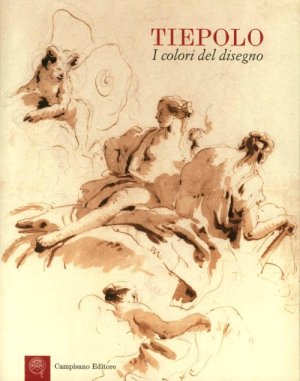 The four sections of the exhibition feature drawings and a selection of etchings according to prominent thematic clusters, but still arranged according to the range of their techniques: from the project to the early sketches, from ‘memories’ to ‘amusements’ and to the replicas of Giandomenico and Lorenzo, as an emulation of their father’s works. A measured selection of paintings is also exhibited in order to introduce and somehow represent the painting outcomes of every graphical typology. Some are well known, others have re-emerged or have been recognized only by the most recent research activities—even in the preparation of this exhibition—but they all contribute to grasp the dynamics of Tiepolo’s language, whose exceptional imaginative fertility does not exclude a constant innovation in the iteration of models.
The catalogue is available from ArtBooks.com:
Giorgio Marini et al., Tiepolo: I Colori del Disegno
(Rome: Campisano Editore, 2014), 192 pages, ISBN:
978-8898229338, $78.
Exhibition | Painting Paradise: The Art of the Garden
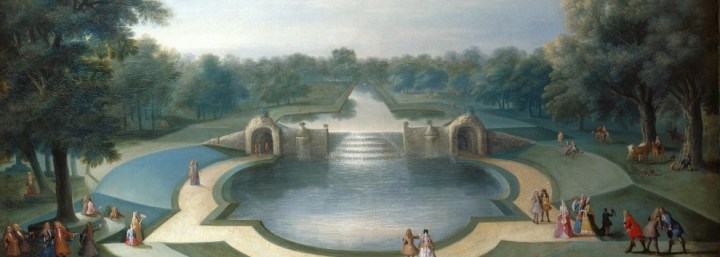
Studio of Marco Ricci, A View of the Cascade, Bushy Park Water Gardens (detail),
ca. 1715 (Royal Collection Trust)
◊ ◊ ◊ ◊ ◊
Press release (9 October 2014) from the Royal Collection Trust:
Painting Paradise: The Art of the Garden
The Queen’s Gallery, Buckingham Palace, 20 March — 11 October 2015
The Queen’s Gallery, Palace of Holyroodhouse, Edinburgh, 5 August 2016 — 26 February 2017
Curated by Vanessa Remington
Whether a sacred sanctuary, a place for scientific study, a haven for the solitary thinker or a space for pure enjoyment and delight, gardens are where mankind and nature meet. A new exhibition at The Queen’s Gallery, Buckingham Palace will explore the many ways in which the garden has been celebrated in art through over 150 paintings, drawings, books, manuscripts and decorative arts from the Royal Collection, including some of the earliest and rarest surviving records of gardens and plants. From spectacular paintings of epic royal landscapes to jewel-like manuscripts and delicate botanical studies, Painting Paradise: The Art of the Garden reveals the changing character of the garden and its enduring appeal for artists from the 16th to the early 20th century, including Leonardo da Vinci, Rembrandt van Rijn and Carl Fabergé.
The idea of an earthly paradise—an enclosed space with orchards, flowing water, shade and shelter—can be traced back to Persia in the 6th century BC. The painted miniature Seven Couples in a Garden, c.1510, from the earliest illustrated Islamic manuscript in the Royal Collection, shows a beautiful Persian garden with an octagonal pool, plane and cypress trees, and elaborately tiled pavilions laid with floral carpets.
Before the 15th century, most European images of gardens appeared in illuminated religious manuscripts. The Book of Genesis, with its references to the Tree of Life, Tree of Knowledge and Four Rivers, provided a framework for artists to create images of Eden, as in Hartmann Schedel’s woodcut of 1493. In Adam and Eve in the Garden of Eden, 1615, Jan Brueghel the Elder relegates the main protagonists and the Tree of Knowledge to the middle distance in an abundant woodland landscape rich in flora and fauna. As court painter to the Habsburg Archdukes Albert and Isabella, Breughel was able to study botanical specimens in the palace garden in Brussels.
Until the 16th century, gardens in paintings and manuscripts remained largely those of the imagination. Henry VIII’s Great Garden at Whitehall Palace, seen in the background of the painting The Family of Henry VIII, c.1545, is the first real garden recorded in British art. By the Renaissance, gardens had become status symbols to be employed in royal propaganda. The wealth of a garden’s owner could be demonstrated through elaborate horticultural features such as obelisks, pergolas, knot designs and topiary. Although in the painting Pleasure Garden with a Maze by Lodewijk Toeput (Pozzoserrato), c.1579–84, the water labyrinth is the artist’s invention, it is inspired by contemporary descriptions of 16th-century Italian formal gardens.
By the 17th century, aristocratic gardens were created on a previously unimaginable scale. The intense rivalry between the French and English kings, Louis XIV and William III, produced two of the largest and most elaborate royal gardens ever made. The exhibition includes a panoramic view by Jean-Baptiste Martin of the French king’s gardens at Versailles, c.1700, and A View of Hampton Court, by Leonard Knyff, c.1702–14, the greatest surviving Baroque painting of an English garden.
With their amphitheatres, cascades and fountains, statuary, exotic birds and aviaries, Baroque gardens offered much to engage artists. The only surviving pair of sundials by the great 17th-century horologist, Thomas Tompion, are shown in the exhibition. The fashion for parterres (ornamental flower gardens) is reflected in An Exact Prospect of Hampton Court, an etching by Sutton Nicholls, c.1700, while A View of Bushy Park Water Gardens by the studio of Marco Ricci, c.1715, shows a large cascade, a rare feature in an English landscape.
By the 18th century, gardens took on a more natural, informal style, inspired in part by the poet John Milton’s romantic description of a wild and untamed Eden in Paradise Lost, 1667. An oil painting of Kew by the Swiss artist Johan Jacob Schalch, 1759, is from a series of views of the gardens designed for Frederick, Prince of Wales by William Kent and William Chambers. The distant pagoda is the only obvious sign of human intervention among the gently sloping hills, grazing sheep and lake.
In the 19th century the garden became a symbol of wholesome and virtuous family life, and a necessary ingredient of ordered domestic harmony. In a portrait of Queen Victoria and Prince Albert by Edwin Landseer, commissioned only two months after their marriage in 1840, the royal couple are set against a view of the East Terrace garden at Windsor Castle. William Leighton Leitch’s 1855 watercolour of the Swiss Cottage, created by Prince Albert for his children in the garden of Osborne House, reflects the informal and private existence enjoyed by the family on the Isle of Wight.
The 16th and early 17th centuries saw the birth of botanical illustration, florilegia (flower books) and still-life painting. Leonardo da Vinci was the first artist to produce true botanical studies, and the exhibition includes a number of exquisite examples by the artist. The only surviving painted flower book from 17th-century England is by the English gardener and botanical artist Alexander Marshal. Produced over a period of 30 years, it includes rare specimens, such as Auriculas (Primula x pubescens), grown only in the finest gardens of the time.
Flower designs on porcelain, silver, furniture and textiles, such as the vine-covered tapestry of a pergola by Jacob Wauters, c.1650, brought the garden inside the home. In the 19th century, the ‘language of flowers’ was translated into precious luxury items, such as the brooch presented by Prince Albert to Queen Victoria in celebration of their betrothal in 1839. In the form of orange blossom, symbolising chastity, it was the first of a suite of flower jewellery given to the Queen over several years. The skill of replicating the charm and beauty of flowers in three-dimensional objects reached new heights in the workshops of Carl Fabergé, the great Russian jeweller and goldsmith. Fabergé’s Bleeding Heart, c.1900, carved in nephrite, rhodonite and quartzite, has its flowers suspended from gold stems, so that they can move gently, as if blown by the wind.
◊ ◊ ◊ ◊ ◊
Published by the Royal Collection and distributed by The University of Chicago Press:
Vanessa Remington, Painting Paradise: The Art of the Garden (London: The Royal Collection Trust, 2015), 312 pages, ISBN: 9781909741089, $75.
 The garden is of perennial interest to artists. Yet, as cultural attitudes toward the garden and how we enjoy it have changed, so too have the ways in which it has been represented in art. From a space for solitary communion with nature to the backdrop for a budding romance, and from a place for scientific study to the source of the foods we eat, Painting Paradise looks at why the garden has remained such a seductive artistic subject.
For centuries, gardens have prompted reflection on the relationship between nature and man. They have also been considered representations of the divine, as in Flemish master Jan Brueghel’s famous Adam and Eve in the Garden of Paradise. Their ability to carry messages about their creator’s status will be clear to all who have had the pleasure of walking the grounds of meticulously manicured palaces or stately homes, but they are also evocative of prevailing cultural values and a desire to better understand, classify, and collect elements of the natural world. By the sixteenth century, artists were also attempting to bring the garden indoors as a source of design elements in the decorative arts, from seventeenth-century Flemish Pergola tapestries to handcrafted flowers from the Russian House of Fabergé.
Tracing these and other themes that attracted the attention of artists from the fifteenth to the early twentieth century, Painting Paradise explores how these ideas came to be expressed in ways characteristic to a particular place and time, including works in both the Eastern and Western traditions. The curator of an accompanying exhibition opening at Buckingham Palace, Vanessa Remington has weeded through the Royal Collection to cultivate a selection of paintings, drawings, manuscripts, tapestries, and jewelry of exceptional value and extraordinary beauty. With more than three hundred color illustrations—including many treasures that have been previously unpublished—the book will be of great interest to artists, art and design historians, and all who find inspiration in the beauty of the garden.
Vanessa Remington is Senior Curator of Paintings, Royal Collection Trust, and the author of several books highlighting its collection, including Victorian Miniatures in the Collection of Her Majesty The Queen.
Exhibition | Prints after Veronese
From the Remondini Museum in Bassano:
Veronese Inciso: Stampe da Veronese dal XVI al XIX Secolo
Museo della Stampa Remondini, Bassano del Grappa, 14 September 2014 — 19 January 2015
Curated by Giuliana Ericani
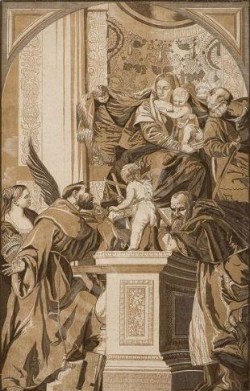 Si inserisce nell’itinerario Scopri il Veneto di Paolo Veronese con altre 5 mostre e 32 siti intitolati al grande artista del Cinquecento Veneto la mostra che i Musei civici di Bassano del Grappa dedicheranno a settembre alla fortuna di Veronese nella stampa “di traduzione.” Sarà così segnalata con larga evidenza l’enorme fama dell’artista e le capacità tecniche degli incisori di rendere con i tratti segnati sulla lastra la felicità e l’esuberanza del colore del Caliari.
La scelta di 58 fogli consente di riconoscere quasi tutti i capolavori del grande artista, alcuni irrimediabilmente perduti, opere riprodotte tra acqueforti e xilografie, tra la fine del Cinquecento fino a tutto il Settecento, a partire dalle acqueforti contemporanee di Agostino Carracci. Un paio di secoli più tardi, in pieno Neoclassicismo, la produzione più corrente dei Remondini non esita a tradurre nei segni fortemente inchiostrati la magniloquenza del disegno più che la felicità del colore, documentando per il mercato un artista la cui fama, complici il barocco e Tiepolo, non aveva mai visto flessioni.
Nella seconda metà del Settecento Giuseppe Remondini raccoglie una consistente collezione di incisioni a paragone, modello e supporto tecnico della produzione calcografica e tipografica della più grande stamperia dell’epoca, prima in Europa—è l’Encyclopédie a ricordarlo—per numero di addetti e quantità della produzione. Tale fondo, donato nel 1847 alla città dall’ultimo erede, Giambattista, è il nucleo fondante per il più recente tra gli antichi musei bassanesi—premio ICOM 2010—prezioso giacimento di questa e delle altre mostre che il Museo della stampa Remondini va via via proponendo dal 2007.
Posto d’onore in mostra per i legni xilografici incisi, con tecnica da lui inventata, dall’inglese John Baptist Jackson, tutti ceduti a Giuseppe Remondini, che saranno esposti assieme ad una selezione dei fogli da lui eseguiti sulle opere di Veronese. Una chicca che, in mezzo a stampe multiple, da sola vale il viaggio a Bassano, per gli addetti ai lavori e per chi vuole capire come le immagini si propaghino grazie alla forza espressiva delle immagini stesse.
Giuliana Ericani, ed., Veronese Inciso: Stampe da Veronese dal XVI al XIX Secolo (Naples: Arti Grafiche Zaccaria, 2014), 90 pages, ISBN: 978-8885821446, €10.
Writing for The Burlington 156 (December 2014), Xavier Salomon judges the catalogue “an essential contribution to the subject and complements Paolo Ticozzi’s catalogue of 1977” (p. 843).
Exhibition | Marks of Genius: Drawings from the MIA
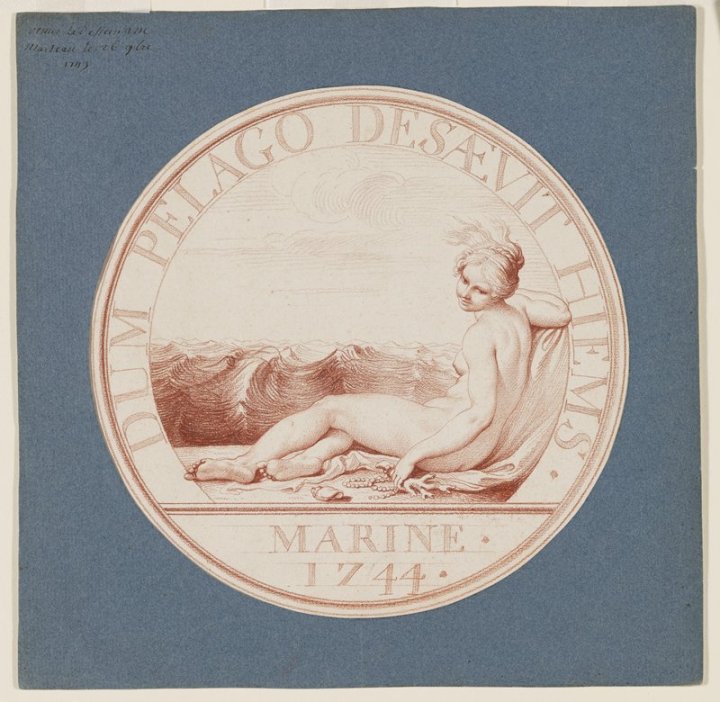
Edme Bouchardon, Design for a Token: Marine, 1744,
ca. 1743, red chalk (Minneapolis Institute of Arts)
◊ ◊ ◊ ◊ ◊
Press release (7 May 2014) from the MIA:
Marks of Genius: 100 Extraordinary Drawings from the Minneapolis Institute of Arts
Minneapolis Institute of Arts, 13 July — 21 September 2014
Grand Rapids Art Museum, 26 October 2014 — 18 January 2015
North Carolina Museum of Art, Raleigh, TBA
Joslyn Art Museum, Omaha, Nebraska, TBA
Curated by Rachel McGarry
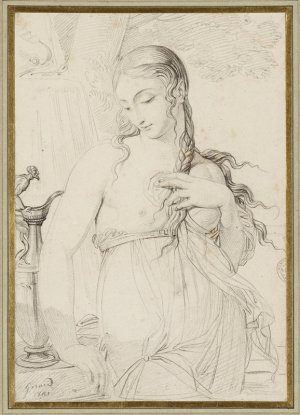
Louis Lafitte, Young Woman in Classical Dress, Study for the Month of Thermidor, ca. 1804–05, black chalk, partially incised (Minneapolis Institute of Arts).
This summer, the Minneapolis Institute of Arts (MIA) showcases an exemplary selection of its rarely seen, superb drawings collection in Marks of Genius: 100 Extraordinary Drawings from the Minneapolis institute of Arts. This special exhibition marks the first time this selection of drawings, which spans over 500 years, will be seen together by the public. Featured artist include celebrated masters such as Ludovico Carracci, Guercino, Thomas Gainsborough, Eugène Delacroix, Edgar Degas, Gustav Klimt, Egon Schiele, René Magritte, and Georgia O’Keeffe. Marks of Genius opens at the MIA and will then travel to the Grand Rapids Art Museum in Michigan, the North Carolina Museum of Art, Raleigh, and the Joslyn Art Museum in Omaha, Nebraska. A fully illustrated catalogue.
“Due to their sensitivity to light, drawings are exhibited for only short periods of time and are otherwise kept in dark storage,” says exhibition curator Rachel McGarry. While works from the museum’s large paper collection—over 40,000 prints and drawings—can be seen by appointment in the Herschel V. Jones Print Study, Marks of Genius is a rare opportunity for the public to see the cream of this collection.

Nicolas-Bernard Lépicié, Standing Male Nude, 1760s–80s, red chalk (Minneapolis Institute of Arts)
Marks of Genius is exhibited at an apropos time. The MIA’s ‘treasury’ of drawings, which includes over 2,600 works, has increased by 20 percent since 2009. Several of these recent additions will be on view for the first time in this show. The exhibition brings to life the immediacy of drawings and explores its multiple roles as a means of study, observation, problem solving, a record of the artist’s imagination, and a medium for creating finished works of art.
The thematic display highlights these different aspects of drawing:
• Spark of Creation features ‘first draft’ sketches and inventions. This portion of the exhibition, showcasing the immediacy of the artistic process, features works such as Giuseppe Bazzani’s Pan and Syrinx, c. 1760, and George Romney’s Study for ‘The Lapland Witch,’ completed c. 1775–77.
• From Life is a section which features various observational studies drawn from nature throughout history. Notable works include Käthe Kollwitz’s c. 1903 Two Studies of a Woman’s Head and Pierre-Joseph Redouté’s Amaryllis lutea. c. 1800-06.
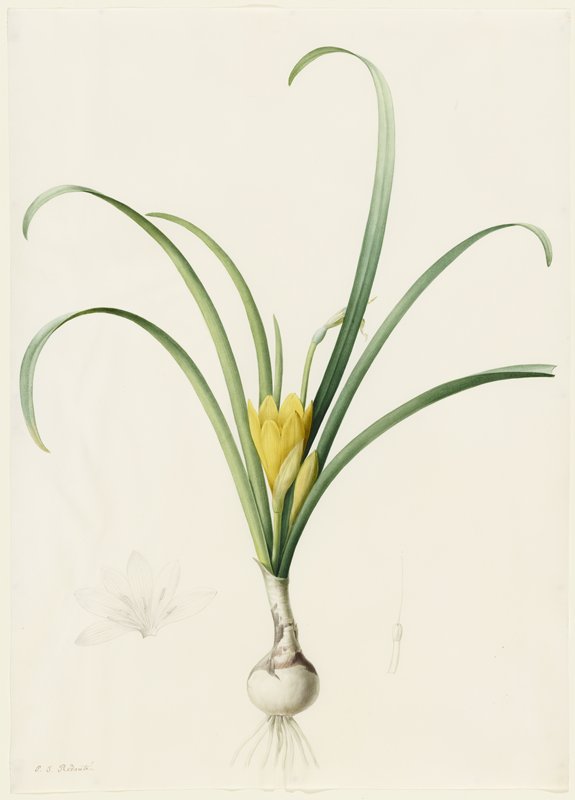
Pierre-Joseph Redouté, Amaryllis lutea, ca. 1800–06, watercolor and graphite on vellum (Minneapolis Institute of Arts)
• Portrait Drawings presents works such as Lovis Corinth’s Self-Portrait completed in 1908 and Egon Schiele’s Standing Girl, c. 1910.
• Figural Abstraction a section which documents artists’ studies of human forms and expression. Works featured in this section include Guercino’s Hercules, (1641–42) and Ernst Kircher’s Seated Woman in the Studio, completed in 1909.
• Storytelling presents drawings with a narrative theme, such as Arthur Rackham’s Little Red Riding Hood, 1909, and Ludovico Carracci’s Judith Beheading Holoferenes, c. 1581–85.
• Other themes include Sense of Place with Emil Nolde’s Heavy Seas at Sunset, c. 1930–35, and Appropriation with Roy Lichtenstein’s 1962 Bratatat!
◊ ◊ ◊ ◊ ◊
From the MIA@Artbook:
Rachel McGarry and Thomas Rassieur, Master Drawings from the Minneapolis Institute of Arts (Minneapolis: Minneapolis Institute of Arts, 2014), 300 pages, ISBN: 978-0989371841, $60.
 This lavishly illustrated book presents one hundred significant drawings from the 15th to the 21st century, including new discoveries and works by both celebrated masters and others who deserve to be better known. Among the artists represented are Annibale and Ludovico Carracci, Guido Reni, Giovanni Domenico Tiepolo, Antoine Watteau, Jean-Honoré Fragonard, Pierre-Paul Prud hon, Thomas Gainsborough, George Romney, Edgar Degas, Henri Matisse, Lovis Corinth, Ernst Ludwig Kirchner, Käthe Kollwitz, Otto Mueller, Emil Nolde, Egon Schiele, Edward Hopper, John Marin, Grant Wood, Roy Lichtenstein, Jasper Johns, Andy Warhol, and Edward Ruscha.
Catalogue entries for each drawing include complete documentation, provenance, and bibliography. The text provides important new scholarship and attributions; examines a variety of themes, such as connoisseurship, patronage, materials and techniques, watermarks, and collectors’ stamps; and discusses how a work fits into the artist’s oeuvre or represents larger developments in artistic movements or trends in artistic production
Exhibition | Treasures from India: Jewels from the Al-Thani Collection
Press release (21 October 2014) from The Met:
Treasures from India: Jewels from the Al-Thani Collection
The Metropolitan Museum of Art, New York, 28 October 2014 — 25 January 2015
Curated by Navina Haidar

Flask, 1650–1700, North India, Rock crystal, inlaid with gold wire, rubies, and emeralds, with gold collar, stopper, and foot, 9.2 x 5.5 cm (The Al-Thani Collection).
Some 60 jeweled objects from the private collection formed by Sheikh Hamad bin Abdullah Al-Thani will be presented at The Metropolitan Museum of Art in the exhibition Treasures from India: Jewels from the Al-Thani Collection, opening October 28. The presentation will provide a glimpse into the evolving styles of the jeweled arts in India from the Mughal period until the early 20th century, with emphasis on later exchanges with the West. The exhibition will be shown within the Metropolitan Museum’s Islamic art galleries, adjacent to the Museum’s own collection of Mughal-period art.
“It is with great delight that we present to the public this selection of works representing several centuries of tradition and craftsmanship in the jeweled arts—from India’s Mughal workshops to the ateliers of Paris,” Thomas P. Campbell , Director and CEO of the Metropolitan Museum, said when announcing the exhibition.
Sheikh Hamad stated: “The jeweled arts of India have fascinated me from an early age and I have been fortunate to be able to assemble a meaningful collection that spans from the Mughal period to the present day. I am delighted that The Metropolitan Museum of Art will be exhibiting highlights from the collection, making the subject known to a wider audience.”

Box (dibbi), 1740–80, North India; Jade, inlaid with gold wire, rubies, emeralds, and crystal, 4.2 x 10.8 x 10.2 cm (The Al-Thani Collection)
The display will include historical works from the Mughal period in the 17th century and from various courts and centers of the 18th and 19th centuries, including Hyderabad; a group of late 19th- and 20th-century jewels made for India’s Maharajas by Cartier and other Western firms; and contemporary commissions inspired by traditional Indian forms. On view will be several antique gems that were incorporated into modern settings by Maison Cartier, jewelry designer Paul Iribe, and others. Contextual information will be provided through historical photographs and portraits of Indian royalty wearing works similar to those on view.
India has been a vibrant center for the jeweled arts for many centuries, with its own mines yielding gold, diamonds, and many other precious and semiprecious stones. India’s Mughal rulers and their successors appreciated ceremonial and functional objects made of luxury materials. Among the Mughal works will be an elegant jade dagger originally owned by two emperors—the hilt was made for Jahangir and it was re-bladed for his son Shah Jahan, builder of the Taj Mahal. In the 19th century, the dagger was in the collection Samuel F. B. Morse, inventor of the Morse code. The hilt features a miniature sculpture—a European-style head.
Historically, the gem form favored throughout India has been the cabochon. In the traditional kundan technique, a gem is set within a bed of gold, and often backed in foil to enhance its color. Another highlight of the exhibition will be a gem-set tiger head finial originally from the throne of Tipu Sultan (1750–1799), which incorporated numerous cabochon diamonds, rubies, and emeralds in a kundan setting.

Huqqa Mouthpiece, 1750–1800, North India, Jade, inlaid with gold, rubies, and emeralds; 7.1 x 1.9 cm (The Al-Thani Collection)
Also on view will be several examples of North Indian sarpesh and jigha (turban ornaments) from 1875–1900, brought together in a display that traces their evolution from traditional plume-inspired forms and techniques toward more Western shapes and construction. Silver foil backing was used; however, the diamonds were set using a Western-style claw or coronet, rather than the kundan setting. And a work designed by the artist Paul Iribe and made by goldsmith Robert Linzeler in 1910 in Paris recalls the kind of aigrette (decorative pin) that would have ornamented the turban of a Maharaja or Nizam. At the center is a large emerald, carved in India between 1850 and 1900.
The exhibition is organized by Navina Haidar, Curator, Islamic Art Department. Exhibition design is by Michael Batista, Exhibition Design Manager; graphics are by Sophia Geronimus, Graphic Design Manager; and lighting is by Clint Ross Coller and Richard Lichte, Graphic Design Managers, all of the Museum’s Design Department. The exhibition is made possible by Cartier.
The exhibition will be accompanied by a catalogue published by the Metropolitan Museum and distributed by Yale University Press. Written by Navina Haidar, with a foreword by Sheila Canby, the Patti Cadby Birch Curator in Charge of the Department of Islamic Art, and contributions from Courtney Stewart, Senior Research Assistant, it draws on a study of the collection called Beyond Extravagance, edited by Amin Jaffer, that was printed by Assouline Publishing in 2013.
◊ ◊ ◊ ◊ ◊
From Yale UP:
Navina Najat Haidar and Courtney Ann Stewart, Treasures from India: Jewels from the Al-Thani Collection (New York: The Metropolitan Museum of Art, 2014), 144 pages, ISBN: 978-0300208870, $40.
 India’s rich tradition of jeweled arts has produced extravagant and opulent creations that range from ornaments for every part of the body to ceremonial court objects such as boxes, daggers, and thrones. Starting with the Mughal rulers of India (1526–1858) and continuing to the present day, this artistic practice is characterized by an abundance of costly materials such as gold, ivory, jade, and precious stones of astounding size and quality, which artists have used to create unique and valuable works.
Treasures from India presents 60 iconic works from the world-renowned Al-Thani collection, accompanied by a text that introduces readers to their significance within the history of Indian jeweled arts. Included are some of the earliest pieces created for the imperial Mughals in the 16th century, others made for Maharajahs of the 18th through 20th centuries, and later Indian-inspired works created by Cartier in the 20th century. These examples represent the range and scope of the finest expression of the jeweled arts in India, and stand among the highest expressions of Indian culture and artistry.
Navina Najat Haidar is curator and administrator, and Courtney Ann Stewart is senior research assistant, both in the Department of Islamic Art at The Metropolitan Museum of Art.
Exhibition | Ornements: Chefs-d’oeuvre de la Collection Jacques Doucet
From INHA:
Ornements, XVe-XVIIIe Siècles: Chefs-d’oeuvre de la Collection Jacques Doucet
Institut national d’histoire de l’art, Galerie Colbert, Paris, 2 October — 31 December 2014
 La Bibliothèque de l’Institut national d’histoire de l’art, héritière de la Bibliothèque d’art et d’archéologie créée par le couturier Jacques Doucet (1853–1929) à partir de 1908, est aujourd’hui riche de plus de 25 000 estampes d’ornement, réunies en près de 700 volumes. Son fonds d’estampes couvre la production, tant française qu’italienne ou allemande, du XVIe au XVIIIe siècle. Sources importantes pour les historiens des arts décoratifs, de l’architecture, de l’estampe, ces œuvres ont fait l’objet d’un catalogage informatisé et d’une numérisation, dans le cadre du programme « Histoire de l’ornement » de l’INHA. L’exposition, organisée dans la salle Roberto Longhi de la Galerie Colbert, correspond à l’achèvement de ce programme et à la parution d’un livre consacré à la collection d’estampes d’ornement de l’INHA, publié en coédition par Mare et Martin et l’INHA.
À travers la présentation d’une cinquantaine d’estampes, où se déploie une multiplicité de motifs (rinceaux, frises, fleurs, volutes, grotesques, trophées, cuirs…), l’exposition permet d’éclairer les fonctions de l’estampe d’ornement, mais aussi le contexte de sa production et de sa diffusion, et enfin, son statut d’objet d’étude et de collection. Sont particulièrement mis en valeur les points forts de la collection Doucet, telles les estampes allemandes des XVIe–XVIIe siècles (Martin Schongauer, Virgil Solis, Albrecht Dürer), les gravures d’orfèvres « cosses de pois » du premier XVIIe siècle (Jean Toutin), mais aussi les estampes françaises du XVIIIe siècle représentant rocailles et chinoiseries (Pillement, Huquier), ainsi que leurs copies européennes. Des objets d’art permettent de resituer la place de l’estampe au sein du processus de création. Enfin, reliures remarquables, états rares, épreuves coloriées, illustrent l’histoire des praticiens, amateurs ou collectionneurs de ces estampes, tel Edmond Foulc, dont la collection fut acquise par Jacques Doucet en 1914.
Commissariat
Michaël Decrossas, Lucie Fléjou
Remerciement
Jérémie Cerman, Rose-Marie Chapalain, Sophie Derrot, Elli Doulkaridou, Ludovic Jouvet, Léonie Marquaille, Étienne Tornier, Céline Ventura-Teixeira, qui par leur travail de catalogage des recueils d’ornement des collections Jacques Doucet de la Bibliothèque de l’INHA permettent aujourd’hui cette exposition. Ainsi que la Cité de la céramique, Sèvres & Limoges, musée national de Sèvres et Les Arts Décoratifs pour leurs prêts.
◊ ◊ ◊ ◊ ◊
From INHA:
Michaël Decrossas and Lucie Fléjou, eds, Ornements, XVe–XIXe Siècles: Chefs-d’œuvre de la Bibliothèque de l’INHA, Collections Jacques Doucet (Paris: INHA-Mare & Martin, 2014), 384 pages, ISBN: 979-1092054378, 37€.
 Marquant l’aboutissement d’un programme de recherche porté par l’Institut national d’histoire de l’art depuis 2010, cet ouvrage réunit vingt-six essais abordant quelques-unes des questions les plus intéressantes posées par l’ornement entre le XVIe et le XIXe siècle, et sa place dans l’histoire de l’art, qu’il s’agisse des estampes d’ornement ou des styles d’ornement (rococo, rocaille, « à l’antique »), ou encore d’artistes comme Jean Lemoyne, Gabriel Huquier, Charles Percier et Pierre-François-Léonard Fontaine. Un chapitre de l’ouvrage est consacré à Jacques Doucet, le grand couturier collectionneur qui est à l’origine de la Bibliothèque de l’INHA, laquelle conserve un fonds exceptionnel d’environ 25 000 estampes d’ornement.
Avec la collaboration de Jean-François Bédard (Syracuse University, New York), Michèle Bimbenet-Privat (musée du Louvre), Jean-Gérald Castex (Cité de la céramique – Sèvres & Limoges), Jérémie Cerman (université Paris-Sorbonne), Catherine Chédeau (université de Franche-Comté), Michaël Decrossas (INHA), Marzia Faietti (Galleria degli Uffizi), Lucie Fléjou (INHA), Rossella Froissart (université de Provence), Jean-Philippe Garric (université Paris 1 Panthéon-Sorbonne), Marianne Grivel (université Paris-Sorbonne), Caroline Heering (université catholique de Louvain), Rémi Labrusse (université Paris Ouest Nanterre La Défense), Corinne Le Bitouzé (Bibliothèque nationale de France), Guy-Michel Leproux (École pratique des hautes études), Estelle Leutrat (université de Rennes 2), Marie-Pauline Martin (université de Provence), Véronique Meyer (université de Poitiers), Christian Michel (université de Lausanne), Odile Nouvel-Kammerer (musée des Arts décoratifs), Anne Perrin-Khelissa (université de Toulouse II – Le Mirail), Antoine Picon (Harvard University), Sébastien Quéquet (musée des Arts décoratifs), Kristel Smentek (MIT, Massachusetts), Carsten-Peter Warncke (Georg-August-Universität Göttingen)
Exhibition | Treasures of British Art 1400–2000: The Berger Collection

George Stubbs, A Saddled Bay Hunter, detail, oil on panel, 22 x 28 inches (The Berger Collection at the Denver Art Museum)
◊ ◊ ◊ ◊ ◊
From the PMA:
Treasures of British Art, 1400–2000: The Berger Collection
Portland Museum of Art, Portland, Maine, 2 October 2014 — 4 January 2015
Dixon Gallery & Gardens, Memphis, Tennessee, 25 January — 19 April 2015
Brigham Young University Museum of Art, Provo, Utah, 14 August 2015 — 5 January 2016
Taft Museum of Art, Cincinnati, Ohio, 10 June — 1 October 2017
Joslyn Art Museum, Omaha, Nebraska 2 June — 9 September 2018
This fall, the Portland Museum of Art (PMA) will showcase a rich survey of British art spanning six centuries in the exhibition Treasures of British Art 1400–2000: The Berger Collection. Organized by the Denver Art Museum, the exhibition will feature 50 masterworks of British art by luminaries including Hans Holbein the Younger, Sir Anthony van Dyck, Thomas Gainsborough, Sir Thomas Lawrence, John Constable, Angelica Kauffman, and George Stubbs. The Berger Collection is one of the most impressive collections of British art in America, and this exhibition provides audiences the rare opportunity to see such a significant body of paintings in this region. The PMA is the first venue in this traveling show, which will be on view in Portland October 2, 2014 through January 4, 2015.
![00 3095 Berger Collection jacket [JW 5-29].indd](https://enfilade18thc.com/wp-content/uploads/2014/11/loadlarge-aspx.jpeg?w=310&h=378) With its diverse array of subjects and styles spanning six centuries of artistic practice, Treasures of British Art traces key developments in British art and culture through a chronological presentation of works. The earliest picture, a gilded altarpiece with a Crucifixion scene from circa 1395, is also an extremely rare surviving example of late Medieval religious painting—the type of object that was systematically destroyed in England when King Henry VIII broke away from the Roman Catholic Church. Portraiture has long been an important genre in British art, and this tradition is well-represented in the exhibition from the linear, decorative style of 16th-century portraits of Tudor royals and nobility, to the loosely brushed naturalism ushered in by Sir Anthony van Dyck and found in 17th- and 18th-century portraiture, to the expressionistic 21st-century image of the artist David Hockney by Adam Birtwistle. Marine paintings and landscapes of faraway places—including a monumental naval battle painting by Adriaen van Diest and a luminous harbor scene by John Constable—reflect not only shifting aesthetic approaches to the natural world, but also the importance of maritime life and overseas exchange in the history of the British Isles. History paintings, equestrian subjects, and other important genres of the British school in styles ranging from the traditional to modern round out the expansive breadth of the exhibition.
With its diverse array of subjects and styles spanning six centuries of artistic practice, Treasures of British Art traces key developments in British art and culture through a chronological presentation of works. The earliest picture, a gilded altarpiece with a Crucifixion scene from circa 1395, is also an extremely rare surviving example of late Medieval religious painting—the type of object that was systematically destroyed in England when King Henry VIII broke away from the Roman Catholic Church. Portraiture has long been an important genre in British art, and this tradition is well-represented in the exhibition from the linear, decorative style of 16th-century portraits of Tudor royals and nobility, to the loosely brushed naturalism ushered in by Sir Anthony van Dyck and found in 17th- and 18th-century portraiture, to the expressionistic 21st-century image of the artist David Hockney by Adam Birtwistle. Marine paintings and landscapes of faraway places—including a monumental naval battle painting by Adriaen van Diest and a luminous harbor scene by John Constable—reflect not only shifting aesthetic approaches to the natural world, but also the importance of maritime life and overseas exchange in the history of the British Isles. History paintings, equestrian subjects, and other important genres of the British school in styles ranging from the traditional to modern round out the expansive breadth of the exhibition.
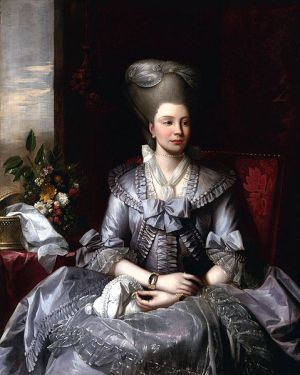
Benjamin West, Queen Charlotte, oil on canvas, 50 x 40 inches (The Berger Collection at the Denver Art Museum)
The Berger Collection is a major private collection largely of British art with a small but significant group of works by artists of other schools, including the French artist François Boucher and the American Winslow Homer. The late William M. B. Berger and his wife Bernadette Johnson Berger began amassing this collection in the mid-1990s out of their dual passion for British culture and for art’s potential to educate. Now owned by the Berger Collection Educational Trust and placed on long-term loan at the Denver Art Museum, the collection continues to expand through new acquisitions. The British paintings, drawings, and art objects number approximately 200 works and span more than six centuries—from the 14th to the 21st century. The very best paintings from this extraordinary collection have been selected for the traveling exhibition to fulfill the Berger family’s mission of sharing these masterpieces with a wide public audience.
The catalogue is available from ArtBooks.com:
Kathleen Stuart, Treasures of British Art, 1400–2000: The Berger Collection (Denver: Denver Art Museum, 2014), 120 pages, ISBN: 9780914738923, $50.
The exhibition is accompanied by a catalogue authored by Kathleen Stuart, Curator of the Berger Collection, with full-color plates and detailed entries on each of the works in the exhibition.
◊ ◊ ◊ ◊ ◊
Note (added 18 December 2014) — The original posting failed to include the Memphis and Provo venues.
Note (added 3 June 2018) — Earlier versions of the posting failed to include the Cincinnati and Omaha venues.
Exhibition | Gold

Gold tiger’s head ornament from Tipu Sultan’s throne, 1785–93; made from gold sheet over a wooden core with finely chased and punched decoration, set with rock crystal eyes, rock crystal teeth, and a hinged gold tongue, the mouth open as if roaring. Presented to William IV by the East India Company in 1831 (Royal Collection, inventory 67212)
◊ ◊ ◊ ◊ ◊
Press release (8 August 2014) from The Royal Collection:
Gold
The Queen’s Gallery, Buckingham Palace, London, 7 November 2014 — 22 February 2015
The beauty and symbolism of gold, from the Early Bronze Age to the 20th century, is celebrated in an exhibition opening at The Queen’s Gallery, Buckingham Palace in November. Through 50 items drawn from across the entire breadth of the Royal Collection, Gold explores the distinctive qualities that make this rare and precious metal an enduring expression of the highest status, both earthly and divine.
Over millennia and across diverse cultures, gold has been used to represent and reflect royal wealth and power. Among the most striking examples in the exhibition are the Rillaton gold cup, from a Bronze Age burial around 1700–1500 BC, a gold crown from Ecuador that pre-dates the Inca invasion, and a tiger’s head in gold and rock crystal from the throne of Tipu Sultan (1785–93), ruler of Mysore in India.
Many of the sacred and ceremonial items associated with the coronations of British monarchs incorporate gold. The exhibition includes a design from 1760 by Sir William Chambers and Giovanni Battista Cipriani for the Gold State Coach, the most expensive coach ever made, which has been used at every coronation since that of George IV. John Whittaker’s illustrated account of the Ceremonial of the Coronation of King George IV in the Abbey of St. Peter’s Westminster, 1823, is printed entirely in gold. Only six copies of the book were ever produced, and the project bankrupted the author. The painting Queen Victoria Receiving the Sacrament at her Coronation, 28 June 1838 by Charles Robert Leslie shows the Queen dressed in the shimmering Dalmatic Robe standing in a pool of golden sunlight.
Highly malleable and versatile, gold has been used to decorate every possible surface, from paper and silk to wood and silver. The exhibition shows gold incorporated into lacquer on a pair of 18th-century Japanese bowls and applied over carved gesso on a table by James Moore, who created furniture for Queen Anne and George I. A cigarette case by Carl Fabergé, presented to King Edward VII by the Dowager Tsarina of Russia in 1903, is made from three colours of gold that have been produced by mixing gold with other metals for a spectacular decorative effect.
The Padshahnama (Chronicle of the King of the World), 1656–57, is the finest Islamic manuscript in the Royal Collection. Written on paper flecked with gold, it forms an official record of the first ten years of the reign of Shah-Jahan, fifth Mughal emperor and builder of the Taj Mahal. Every year an amount equal to the Emperor’s weight in gold, silver and other precious items was distributed as alms, to prevent him suffering any corporeal or spiritual catastrophes. In a page from the manuscript in the exhibition, Shah-Jahan sits cross-legged in the pan of a set of golden scales.
Among other highlights of the exhibition are an early 16th-century Book of Hours illustrated with gilded miniatures by Jean Pichore, Simon van de Passe’s engraved gold portrait medallion of Elizabeth I, and two landscapes by the 17th-century artist Pier Francesco Cittadini which are drawn in pen and ink on paper covered in gold leaf. William Nicholson’s still life Gold Jug, 1937, is from the artist’s small series of works looking at the play of light on metallic surfaces.

Sir William Chambers, Pen and ink and watercolour design for the King’s State Coach, 1760; made for George III, bought from Colnaghi by the Prince Regent (later George IV), 12 June 1811 (Royal Collection, Inventory 917942)
◊ ◊ ◊ ◊ ◊
From the Royal Collection Trust and distributed by The University of Chicago Press:
Kathryn Jones, Lauren Porter, and Jennifer Scott, Gold (London: Royal Collection Trust, 2014), 120 pages, ISBN 978-1909741102, £25 / $40.
 Gold is the most coveted of metals, its rarity and radiant natural beauty making imbuing it with rich meaning throughout human history. For artists, gold has long been associated with the divine. For monarchs, it has been a means of symbolizing status and wealth. With Gold, Kathryn Jones, Lauren Porter, and Jennifer Scott have written a lively and highly informative cultural history of gold in the Royal Collection, one that explores its many manifestations throughout history and its use in promoting messages of power and wealth.
Drawing on the Royal Collection’s unparalleled collection of paintings, miniatures, jewelry, gold boxes, and drawings in and on gold, the book takes readers through the possibilities of this noble metal. Organized thematically, chapters include ‘Divinity’, which covers gold in devotional art; ‘Power’, which explores the role of gold as a symbol of status and wealth; and ‘Art’, which presents the craftsmanship and indestructible quality of gold objects. From Fabergé’s astonishing gold-mounted boxes to the nearly-four-thousand-year-old Rillaton Gold Cup and drawings in gold paint by Edward Burne-Jones, this lavish book—in its own gold binding—presents this most precious substance throughout history in one hundred full-color illustrations.
Exhibition | Rubens and His Legacy

François Boucher, Pan and Syrinx, 1759
(London: National Gallery)
◊ ◊ ◊ ◊ ◊
Press packet from BOZAR:
Sensation and Sensuality: Rubens and His Legacy
BOZAR (Centre for Fine Arts), Brussels, 25 September 2014 — 4 January 2015
Royal Academy of Arts, London, 24 January — 10 April 2015
Peter Paul Rubens was one of the most innovative painters in the history of art. His impact on subsequent generations has been immense. For the first time, the Royal Museum of Fine Arts Antwerp (KMSKA), the Royal Academy of Arts in London, and BOZAR in Brussels have joined forces to look at Rubens as a role model. The exhibition Sensation and Sensuality: Rubens and his Legacy brings together some 160 works, including some iconic paintings by Rubens himself and, more particularly, works by his artistic heirs.
It is a paradox that Peter Paul Rubens (1577–1640) is both inimitable and has served, for four centuries now, as the great model for painters such as Rembrandt, Murillo, Watteau, Fragonard, Gainsborough, Reynolds, Delacroix, Cézanne, Renoir, Kokoschka, and many others, often far beyond the frontiers of Europe. Even in the work of Picasso, we encounter his visual language. The international exhibition Sensation and Sensuality: Rubens and His Legacy looks at this phenomenon and brings works by these celebrated artists to the world-renowned Flemish master’s homeland.
Sensational and Sensual

Thomas Gainsborough, after Rubens, The Descent from the Cross, 1766–69 (Sudbury: Gainsborough’s House)
Many Rubens works are sensational: loud, forceful, and sometimes violent, created in the service of Catholic propaganda and of absolutist rulers. With his almost cinematographic depiction of aggression, fighting, and barbaric scenes, Rubens could be called the Quentin Tarantino of his time. But he is also a sensual painter in his informal family portraits, landscapes and pastoral scenes, peasant dances and gardens of love, in which he was a precursor of Rococo, Romanticism, and Impressionism. Rubens was so many-sided that he appealed to artists of every nationality. Their interest was often selective. Spaniards preferred his religious works. The English were inspired by his portraits and landscapes. French painters were attracted, above all, by the eroticism and poetry in his work. German and Austrian artists admired his vitality and vigour. A great many talented artists were captivated by his use of composition, colour, and technique and developed flourishing careers by following his example. After meeting Rubens, Velázquez began to paint in a different way;
following his counsel, he used a lighter undercoat.
160 Works of Art, 6 Themes
The Sensation and Sensuality exhibition presents more than 160 works of art and takes the visitor through six fascinating themes that explore different aspects of life and of the painter’s art: violence, power, lust, compassion, elegance, and poetry. Each of these chapters demonstrates the links between masterpieces by Rubens and the work of artists who came after him. The Tiger Hunt from the Musée des Beaux-Arts in Rennes hangs alongside the Delacroix Lion Hunt from Stockholm and the voluptuous Pan and Syrinx from the Gemäldegalerie in Kassel alongside Boucher’s work of the same name from the National Gallery in London; the portrait of Marchese Maria Grimaldi and Her Dwarf from Kingston Lacy is juxtaposed with A Genoese Noblewoman and Her Son from Washington, by Rubens’s famous pupil van Dyck; and Manet’s Rubens pastiche Fishing from the Metropolitan Museum in New York can be seen alongside The Bacchanalia on Andros by Rubens, from the Nationalmuseum in Stockholm.
The 20 paintings, 6 oil sketches, 8 drawings, and 10 prints by Rubens himself are presented in a dialogue with works by his artistic heirs, including Böcklin, Carpeaux, Constable, Corinth, Coypel, Daumier, Delacroix, Fragonard, Gainsborough, Géricault, Jordaens, Klimt, Kokoschka, Le Brun, Makart, Murillo, Picasso, Rembrandt, Renoir, Reynolds, Sandrart, Turner, Watteau, and others.
Prestigious Loans
Exceptionally, one of the jewels of the Prado collection in Madrid, Rubens’s Garden of Love, will travel to Brussels, where it will be brought together with preparatory sketches from the Amsterdam Museum and two drawings that Rubens made of his painting for a superb print (Metropolitan Museum, New York). Bringing these pieces together allows us to see how this famous composition took shape, from idea to reproduction. As well as those already mentioned, major foreign lending institutions contributing include Tate Britain (London), the Neue Pinakothek (Munich), the Nasjonalgalleriet (Oslo), Her Majesty Queen Elizabeth II, and a number of private collections.
International Cooperation
Sensation and Sensuality is an exhibition organised by the Royal Museum of Fine Arts Antwerp (KMSKA), the Royal Academy of Arts, London, and BOZAR (Centre for Fine Arts), Brussels. After the show at the Centre for Fine Arts Brussels the exhibition will travel to the Royal Academy of Arts in London (24.01 – 10.04.2015)
Multidisciplinary Programme
This autumn, BOZAR pays homage to Rubens and shows how the Antwerp master has also inspired artists in other artistic disciplines.
BOZAR MUSIC is presenting a concert series, The Musicall Humors of Rubens, with music of the painter’s time; the highlight will be the concert on 6 December 2014, The Ear of Rubens, performed by the Huelgas Ensemble. Besides, BOZAR MUSIC and Ricercar (Outhere) present a CD with examples of the major musical genres that Rubens would have heard during his travels in Europe.
BOZAR LITERATURE has invited six writers—David Bosch, Annemarie Estor, Lydia Flem, Peter Holvoet-Hanssen, Pjeroo Roobjee, and Jean-Philippe Toussaint—to draw inspiration from a work by Rubens: you can read the results in the visitor’s guide or listen to them on a videoguide.
BOZAR CINEMA, moreover, is screening the art film that Henri Storck made about Rubens in 1948. There will also be two multimedia installations on show during the BOZAR NIGHT and the BEAF: Ingrid Van Wantoch Rekowski will present her video installation Rubens-Metamorfoses during the BOZAR NIGHT (10 November 2014); during the BEAF (25–27 September 2014), the video artist Quayola will show his installation Strata #4, a—literally—penetrating look at the great altarpieces of Rubens and van Dyck via high-resolution images.
◊ ◊ ◊ ◊ ◊
From
Tim Barringer, Arturo Galansino, Gerlinde Gruber, and Nico van Hout, David Howarth, and Alexis Merle du Bourg, Rubens and His Legacy (London: Royal Academy Publications, 2014), 352 pages, ISBN: 978-1907533778, $75.
 Peter Paul Rubens (1577–1640) is undoubtedly the most influential of all Flemish painters. Himself indebted to Titian, Rubens became a role model to Van Dyck, Rembrandt, and Velázquez, and influenced artists well beyond his time, including figures such as Cézanne, Picasso, Bacon, and Freud. This sumptuous new volume explores Rubens’s legacy thematically, through a series of sections devoted to violence, power, lust, compassion, elegance, and poetry. Each section will link artists across the centuries in their references to Rubens, from Van Dyck and Watteau to Manet, Daumier, Renoir, and Van Gogh, as well as Gainsborough, Constable, and Turner.
Tim Barringer is Paul Mellon Professor of the History of Art at Yale University. Arturo Galansino is curator at the Royal Academy of Arts, London. Gerlinde Gruber is curator for Flemish Baroque paintings at the Kunsthistorisches Museum in Vienna. Nico van Hout is a member of the collections research team at the Royal Museum of Fine Arts Antwerp. David Howarth is professor of history of art at the University of Edinburgh. Alexis Merle du Bourg is an art historian and a Rubens specialist.
Exhibition | Out of the Ordinary: Living with Chinese Export Porcelain
From Jorge Welsh:
Out of the Ordinary: Living with Chinese Export Porcelain
Jorge Welsh, London, 1–8 November 2014
Jorge Welsh, Lisbon, 14 November — 6 December 2014
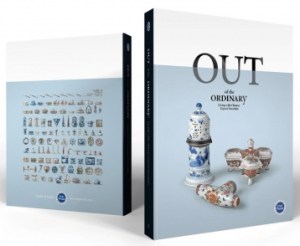 The exhibition Out of the Ordinary: Living with Chinese Export Porcelain will take place at the newly refurbished London gallery from the 1st of November, coinciding with the late night opening of Asian Art in London. The exhibition then travels to our Lisbon gallery, where it will be on view from the 14th of November until the 6th of December.
The exhibition and catalogue will focus on the most unusual forms of Chinese export porcelain produced in the late 17th and 18th centuries. Truly out of the ordinary, most of these items were copied from Western prototypes made in metal, wood, ceramics or glass. Jorge Welsh will present more than 100 objects including egg cups, strainers, cutlery handles, pudding moulds, custard pots, ladles, funnels, bulb pots, snuff boxes, cane handles, barber’s bowls and chamber pots, amongst others. Commissioned according to the latest fashions, they provide an insight into the scope of the European orders and the sophistication of contemporary consumer society in Europe at this time.
Out of the Ordinary: Living with Chinese Export Porcelain (London: Jorge Welsh Books, 2014), 344 pages, ISBN 978-0957354715, £100.










leave a comment