Exhibition | A Handsome Cupboard of Plate: Early American Silver
From ACC Distribution:
A Handsome Cupboard of Plate Early American Silver in the Cahn Collection
Minneapolis Institute of Arts, 1 December 2012 — 24 March 2013
Nelson-Atkins Museum of Art, Kansas City, 20 April — 3 November 2013
Missouri History Museum, St Louis, 23 November 2013 — 2 March 2014
The DeWitt Wallace Decorative Arts Museum, Colonial Williamsburg, 3 May 2014 — 25 May 2015
Deborah Dependahl Waters, A Handsome Cupboard of Plate Early American Silver in the Cahn Collection (Cambridge: John Adamson, 2013), 128 pages, ISBN: 978-1898565116, $40.
 Strength in design and fineness of craftsmanship unify the early American domestic and presentation silver assembled by Paul and Elissa Cahn and published together for the first time. Beginning in Boston with a caudle cup marked by Jeremiah Dummer, America’s first native-born silversmith, and objects from the shop of patriot silversmith Paul Revere, the book then focuses on New York, where a distinctive style reflecting the Dutch heritage of that region emerged, and afterward on Philadelphia, where generations of the Quaker Richardson family supplied goods of the “best sort, but plain.”
Pride of place is given to the work of New York Jewish silversmith Myer Myers and his shop, including a presentation waiter made for Theodorus Van Wyck. Accompanying a touring exhibition of the Cahn collection, the book encapsulates some of the ethnic, religious, and political diversity of early America and sets
the silver in its social and historical context.
C O N T E N T S
Foreword by Kaywin Feldman, Director and President, Minneapolis Institute of Arts
The Cahn Collection of Early American Silver – An Appreciation by David L. Barquist, The H. Richard Dietrich Jr. Curator of American Decorative Arts, Philadelphia Museum of Art
A Handsome Cupboard of Plate: Early American Silver and Silversmiths – An Introductory Essay
Catalogue
I: Boston
II: New York
III: Philadelphia
Frequent Bibliographical References and Note on Digital Resources
Index
Deborah Dependahl Waters is an independent historian of American decorative arts, specializing in silver and furniture of the Mid-Atlantic region. Since 1987 she has been a member of the part-time teaching faculty for the Parsons-Cooper-Hewitt M.A. Program in the History of Decorative Arts and Design, and is currently president of New York Silver Society, Inc. She is the editor and an author of Elegant Plate: Three Centuries of Precious Metals in New York City (2000), and a contributor to Art in the Empire City: New York, 1825-1861 (2000), and Silversmiths to the Nation: Thomas Fletcher and Sidney Gardiner, 1808-1842 (2007), as well as lead author of The Jewelry and Metalwork of Marie Zimmermann (2011).
Exhibition | Charles Jennens: The Man behind Handel’s ‘Messiah’
From The Handel House Museum:
Charles Jennens: The Man behind Handel’s Messiah
The Handel House Museum, London, 21 November 2012 — 14 April 2013
Curated by Ruth Smith
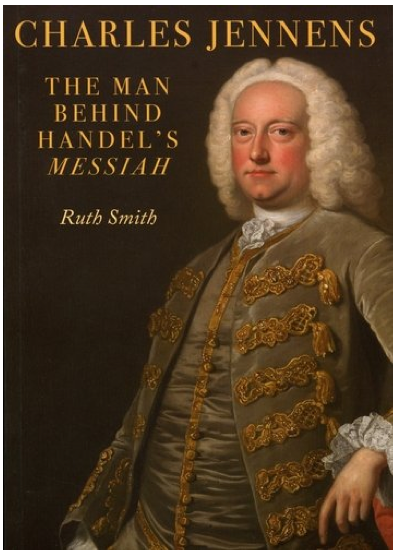 In a major new exhibition the Handel House Museum explores the life, work and character of Handel’s great collaborator Charles Jennens.
An enigmatic character, Jennens had an enormous influence on Handel’s life and work. As librettist for the oratorios Saul and Belshazzar, he provided the composer with words that inspired some of his most challenging and exciting music. His carefully chosen scripture selection for Messiah was to inspire Handel to even greater creative heights, and together these two men created one of the greatest musical works of all time.
The exhibition examines this relationship in detail, alongside other elements of Jennens’s life as a great landowner; the builder of a fine country house with extensive grounds; a major art collector; a Christian philanthropist; a devout defender of revealed religion; an encourager of other authors and composers; a loyal friend; and a forward-looking editor of Shakespeare.
Bringing together exhibits from throughout the UK and beyond, for the first time this landmark exhibition unites all known oil portraits of Jennens to stand beside Handel House’s own magnificent portrait by Thomas Hudson.
The exhibition’s curator is Dr Ruth Smith, author of Handel’s Oratorios and Eighteenth-Century Thought (Cambridge University Press), who has made a particular study of the life and work of Charles Jennens.
Ruth Smith, Charles Jennens: The Man behind Handel’s Messiah (London: Gerald Coke Handel Foundation, 2012), 71 pages, ISBN: 978-0956099822, £8.50.
◊ ◊ ◊ ◊ ◊
Jonathan Keates provides a review for the TLS (11 January 2013):
. . . Unfolding the mystery of Charles Jennens for us, this fine new exhibition, which also has a related walking tour and a series of talks and concerts, is the best so far within the Handel House’s limited space; it was mounted under the guidance of Ruth Smith, whose illuminating survey of his achievement accompanies the show. Besides evoking our admiration for him as aesthete, connoisseur, charitable patron, landscape gardener or devoted friend, she celebrates his work as the earliest variorum editor of Shakespeare’s plays. . . .
Exhibition Review | Versailles and the Antique
Reviewed for Enfilade by Hélène Bremer
Versailles et l’Antique
Château de Versailles, 13 November 2012 — 17 March 2013
Curated by Alexandre Maral, Geneviève Bresc-Bautier, Jean-Luc Martinez, and Nicolas Milovanovic, with scenography by Pier Luigi Pizzi

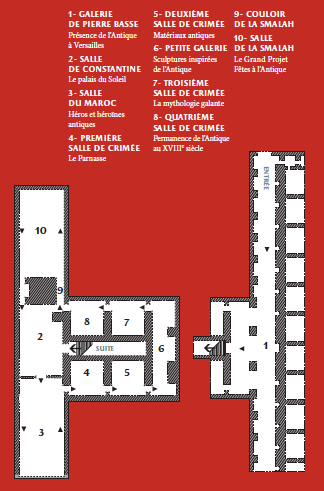
Galerie de Pierre basse (Room 1) Versailles et l’Antique
© EPV / Th. Garnier
The entrance through the Gallerie de Pierre Basse (Room 1) of the Palace of Versailles has been changed dramatically for the exhibition Versailles and Antiquity. The public is usually barred from this part of the palace, allowed only to peek down a rather dark hallway containing a collection of sculpture dedicated to heroes of French history. Instead, for now, these statues are discretely draped with white tissue, and the public enters alongside a selection of masterpieces from Louis XIVth’s sculpture garden. The finest marble sculpture from the collections of the French court, now in the collections of the Louvre and the Palace of Versailles, suggest a new Rome, created at Versailles by the Sun King and presently revived by the exhibition curators. This exceptionally ambitious show brings together not only marbles, but also bronzes, tapestries, paintings, drawings, decorative and ephemeral objects to explore the relationship between Versailles and Antiquity.
 The renowned opera-stage-designer Pier Luigi Pizzi is responsible for the scenography of the installation. He has described the exhibition as a play in which the works of art are the characters and the stage breathes the spirit of the seventeenth-century French court. The subject of the play is the taste of the insatiable collector, Louis XIV. Within the spaces of the palace, Pizzi has managed to accommodate these ‘actors’, which here communicate with each other and invite visitors to follow along, from one spectacular scene to the next (though I imagine many may fail to appreciate the full production with not a single explanatory panel to be found in the whole exhibition).
In early modern Europe, all important courts collected antiquities in order to suggest their magnificence. Materials like porphyry, marble, alabaster, and bronze enhanced the prestige of such collections while tapestries and paintings comparing sovereigns with Classical gods and goddesses symbolized the court’s power.
In France this mode of collecting began with François I. After he failed to acquire the Laöcoon group in 1515 (and again in 1520) from Pope Leo X, his agent Francesco Primaticcio finally gained permission to make casts from the work, and a bronze copy was made for the Palace at Fontainebleau. The French collection of antiques grew only slowly under Henry II, who received the sculpture of Diane chasseresse from Pope Paul IV in 1556 (it serves as the emblem of the exhibition), and subsequent sovereigns largely lost interest altogether. In the seventeenth century, however, cardinals Richelieu and Mazarin assembled large collections of antiquities, most of which eventually entered the collection of Louis XIV. While the king had long been interested in collecting antiquities (under the guidance of Mazarin), his ambitions were fueled by a remark made by Bernini in 1665 during the sculptor’s visit to France. After Louis XIV showed him the royal collection, Bernini judged that it consisted of “ornaments for ladies.” Embarrassed, the king hurried to improve the collection, adding important, large, masculine (read powerful) sculpture. At the time it was not necessary to display genuine antique marbles; but instead, reassembled works and contemporary sculpture inspired by the antique could do as well. Within a short time, the collection at Versailles grew steadily, and the newly built Hall of Mirrors was adorned with gods and goddesses in marble, vases in porphyry as well as with classically-themed ceiling and wall paintings. References to antiquity intensified among all art forms, with Versailles celebrated as the new Rome.

Salle du Maroc (Room 3) Versailles et l’Antique
© EPV / Th. Garnier
This exhibition claims to reconstruct a Versailles not seen since the French Revolution. On offer is not, however, a display of antiquities as they appeared at the court of Louis XIV, but the creation of an ambiance. Walking from the sculpture garden in the Gallerie Basse up the stairs to the Salle de Constantine (Room 2) with its reconstructed Palais de Soleil would have been a rather different experience in the seventeenth century. The importance of antiquity is nonetheless clear from the enormous quantity of objects on display. Using the rooms of the palace instead of temporary exhibition spaces preserves the court’s atmosphere. One wanders from intimate cabinets (Rooms 4 and 5) filled with precious objects and paintings, into a light-filled sculpture gallery dedicated to the gardens of Marly (Room 6), to rooms containing mythological paintings (Rooms 7 and 8). The exhibition includes a historical sequence, and dixhuitièmists will be especially interested in the Quatrième Salle de Crimée (Room 8) dedicated to the persistence of antiquity in the eighteenth century. In particular, the room examines eighteenth-century taste through paintings by Nattier and Drouais of court ladies disguised as Diana or Flore, along with the changing relationship between politics and aesthetics.
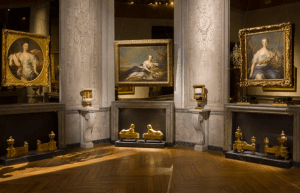
Quatrième salle de Crimée (Room 8) Versailles et l’Antique
© EPV / Th. Garnier
Near the show’s conclusion (Room 9), the presentation of the grand projet to reconstruct the palace during the eighteenth century is interesting for its references to the antique (especially to the monuments of Rome), but this architectural departure is probably a bit much for the average visitor at the close of such an extensive exhibition (180 of the 200 objects on display have already asked a lot of viewers’ attention). Showing this material in a separate venue may have helped insure it receives the attention it merits.
Finally, the Salle de la Smalah (Room 10), dedicated to the Fêtes à l’antique, displays an impressive table ornament in the form of a antique colonnade in front of a sculpture of Apollo, in turn flanked by an enormous barometer made for Louis XV and XVI. Rather, however, than providing a satisfying finale to the proposed play, this last installation left me feeling oddly alone on the middle of the stage, longing for a re-enactment.
◊ ◊ ◊ ◊ ◊
Alexandre Maral and Nicolas Milovanovic, eds., Versailles et l’Antique (Paris: Artlys, 2012), 336 pages, ISBN: 978-2854955125, 49€ / $95.
 Versailles was a new Rome in several ways: in its grandiose size, in its ambition to endure through the centuries, and in the many references to the great models of Antiquity. In the 17th century, Antiquity was an incomparable absolute, which the most ambitious sovereigns wished to rival: Louis XIV created Versailles as the seat of power to bring back the grandeur of Antiquity. The exhibition examines the presence of Antiquity in Versailles from two angles: the acquisition of antique fragments and commissions of copies by the kings, and the re-appropriation of antique models and figures by artists. It brings back to Versailles about fifty antiques that it possessed during the Ancien Régime. The interpretation of Antiquity and its mythology are evoked through about two hundred works from the principal French and foreign collections (the Louvre, Bibliothèque nationale de France, Musée des Beaux-Arts de Besançon, Uffizi Gallery of Florence, Archaeological Museum of Naples, etc.): sculptures, paintings, drawings, engravings,
tapestries, pieces of furniture, objets d’art.
Available from ArtBooks.com»
◊ ◊ ◊ ◊ ◊
The website of the Palace of Versailles provides additional information, including a series of videos. Full descriptions of each section of the exhibition are available as a PDF file here»
Exhibition | Peru: Kingdoms of the Sun and Moon
Press release (26 October 2012) from the MMFA:
Peru: Kingdoms of the Sun and Moon: Identities and Conquest
in the Early, Colonial and Modern Periods
Montreal Museum of Fine Arts, 2 February — 16 June 2013
Seattle Art Museum, 17 October 2013 — 5 January 2014
Curated by Victor Pimentel

Mochica, North Coast, possibly La Mina, Forehead ornament with feline head and octopus tentacles ending in catfish heads (100 – 800 A.D.), Gold, chrysocolla, and shells. 28.5 x 41.4 x 4.5 cm (Museo de la Nación, Lima. Photo: Daniel Giannoni)
Organized by the Montreal Museum of Fine Arts, Peru: Kingdoms of the Sun and Moon will display an extensive collection of pre-Columbian treasures and masterpieces from the colonial era to Indigenism, including over 100 pieces that have never before been seen outside of Peru. With more than 350 works of art (paintings, sculptures, gold and silver ornaments, pottery, photograph, works on paper, and textiles) on loan from public and private collections in Peru, Canada, United States, France, and Germany, this exhibition covers roughly 3,000 years of history, including archaeological discoveries in recent decades.
“In conceiving this exhibition on the question of identity in Latin America following our exhibition Cuba! Art and History from 1868 to today presented in 2008, I was fascinated to discover the extent to which archaeology has revealed this birthplace of civilization – one of six such in the world – only recently in the course of the 20th century” explains Nathalie Bondil, Director and Chief Curator of the MMFA. “This exhibition demonstrates how the retrospective view of history shifted from a colonial interpretation to a new nationalist feeling in the course of the modern era. This complex project brings together numerous loans, both public and private, from Peru, some of which have not been exhibited before. Above all, the display features paintings of the era subsequent to the Spanish Conquest and, for the first time outside Peru, of the Indigenist period after independence. The constant elements of a civilization built up over millennia open up perspectives never before opened,” she added.
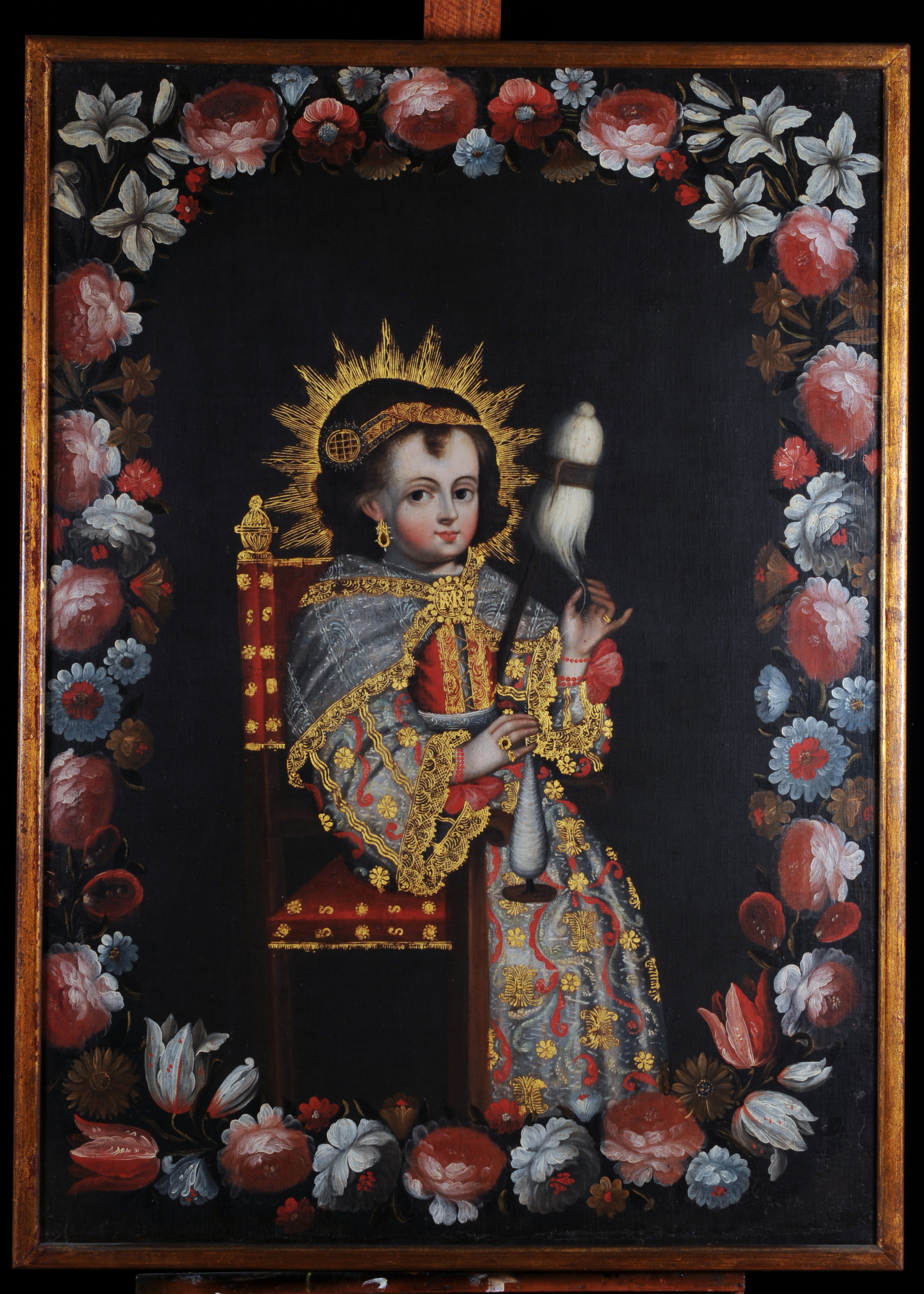
Anonymous, Cuzco School, Virgen Niña Hilando (Young Virgin Spinning), second third of the 18th century, oil on canvas, gold leaf. 112.5 x 80.5 cm
(Lima: Museo Pedro de Osma. Photo: Joaquín Rubio)
Mythical Peru, cradle of Andean civilization, and its pre-Hispanic, colonial and modern history will be examined in the four sections of the exhibition as follows:
• Section 1 (introduction) will explain how archaeology rewrote the national history beginning with the discovery, in 1911, of Machu Picchu to the recent restitution of artworks.
• Section 2 will focus on the myths and rituals of the early civilizations of the Andes, highlighting their role in forming and shaping Peruvian identity during the pre-Columbian era.
• Section 3 will illustrate the perpetuation, concealment, and hybridization of the indigenous culture during the colonial period.
• The last section will highlight the rediscovery of this culture in the 20th century and the revalorization of ancient symbols of identity in contemporary Peruvian iconography.
Adds Exhibition Curator Victor Pimentel, Curator of Pre-Columbian Art at the MMFA, “Through the representation and reinterpretation of myths, rituals and other primordial symbols of identity captured by different artistic traditions, the exhibition will illustrate how the evocative power of images have influenced the history of pre-Hispanic, colonial and modern Peru.”
Illustrating the beliefs and rituals of pre-Columbian societies
The relationship with death, particularly the constant dialogue between the world of the living and the world of the dead, is an essential component of Andean spirituality. Among the Mochicas, ceremonial sacrifices contributed to the perpetuation of the supernatural and social orders, while ancestor worship held significant importance to the Lambayeque and Chimú cultures.
In order to illustrate the beliefs and rituals that dominated the life of pre-Columbian societies, the exhibition will focus on objects associated with the sacrificial ceremony of the Mochica people (200 B.C. to 800 A.D.) and the funerary rites of the Chimú and Lambayeque cultures (11th to 15th century A.D.), by presenting some of the most complete depictions of these rituals. On display will be important objects in gold, silver, and turquoise from the royal tombs of Sipán, discovered in 1987 by archaeologist Walter Alva, constituting the most significant find made in Peru since that of Machu Picchu. They include:
• A gold ear disc depicting the Lord of the place, the Mochica governor
• A Mochica ornament in the shape of a half-feline, half-octopus recently repatriated and exhibited for the first time
outside of Peru
• Funerary jewelry (crown, ear discs, necklace, pectoral and shoulder-pieces) including a masterpiece of Chimú gold work
• A rare headboard of a Lambayeque litter depicting figures officiating at a ceremony, unique in the complexity of its ornamentation
Religion in Many Forms
The Spanish conquest of Peru in the 16th century led to the hybridization of the Peruvian culture expressed through reinterpretations of mostly religious European art. Paintings of the School of Cuzco – established by the Spanish as a means of converting the Incas to Catholicism – showing Christ, miraculous Virgins, archangels and defenders of the Catholic faith, testify to the powerful role played by images in the campaign to evangelize the Native peoples of the Andes. Included among the examples of paintings mainly by Native artists resulted from this hybridization are:
A Nativity Chest dating from the 18th century, painted with a number of Biblical stories including Adam and Eve, the Annunciation, the Nativity and the visit of the Magi. This three-dimensional illustrated catechism was used to spread Catholicism throughout the Andes.
Among the ceremonial objects on view illustrating the importance of imagery relating to the celebration of the Eucharist in the Andes is a silver Eucharistic urn in the shape of a Pelican, a bird traditionally associated with Christ’s sacrifice. It is widely considered a masterpiece of the liturgical metalwork from the Latin-American Baroque period.
A particularly popular image in art during the Viceroyal period is that of the Virgin. Symbolic representations of the virtuous life of the Virgin Mary on view, such as Young Virgin Spinning, recalls the acllas, the Virgins of the Sun in the Inca empire, whose principal occupation was making garments for the Inca and for religious rites.
Processions also played an important role in the elaboration of a Peruvian identity both as a collective expression of Christian faith and as a means of reinforcing the socio-political positions of the participants. An 18th-century depiction of a splendid Corpus Christi procession, one of the first Christian celebrations to be performed in the colony and still performed to this day, attests to the multi-ethnic nature of the city of Cuzco, the ancient capital of the Inca empire. Coinciding with the celebration of the Inti Raymi, an Inca festival dedicated to the Sun God, Corpus Christi was the most important feast day in the colonial liturgical calendar.
Peruvian art in the 19th and 20th centuries
By 1821, Peruvians had achieved their independence and had formed an indigenous collective memory that combined the idealisation of the pre-Hispanic past, particularly the Inca Empire, with an interest in local subjects. A typical work of Peruvian art of the mid-19th century, Habitante de las cordilleras del Perú (Inhabitant of the Peruvian Highlands) by Francisco Laso, portrays the indigenous peasant as a national symbol for the new Peruvian republic, and heralds the direction that Peruvian cultural nationalism was to take in the next century.
At the beginning of the 20th century, Indigenism flourished as an artistic and intellectual movement based on revalorising and reaffirming Peru’s indigenous heritage. Paintings depicting scenes of Native life and the idyllic landscapes of the Peruvian countryside and highlands such as Pastoras (Shepherdesses) by Leonor Vinatea Cantuarias were to transform the visual culture of Peru in the modern era. This movement is represented in the exhibition by a wide selection of works by José Sabogal, Camilo Blas, Julia Codesido, and Enrique Camino Brent. Widely praised for his documentation of indigenous culture, the only Amerindian included among the major artists associated with the movement is the photographer and portraitist Martín Chambi. Works by Chambi on view include Tristeza andina, La Raya (Andean sadness, La Raya).
An exhibition checklist (PDF) is available here»
◊ ◊ ◊ ◊ ◊
From Abrams:
Victor Pimentel, ed., Peru: Kingdoms of the Sun and the Moon (Milan: 5 Continents Editions, 2013), 384 pages, ISBN: 978-8874396290, $65.
 A new publication featuring essays by the foremost experts on the art of Peru The MMFA will produce an accompanying 384-page catalogue co-published in English and in French by the MMFA and 5 Continents Editions in Milan. This fully-illustrated volume (450 illustrations) comprises essays by eminent curators and specialists and interviews with leading figures and experts on Peruvian archaeology, art history, and literature such as the novelist Mario Vargas Llosa.
Victor Pimentel is curator of pre-Columbian art at the Montreal Museum of Fine Arts.
Exhibition | Nicolas Colombel: L’Idéal et la grâce
Now on at the Musée des Beaux-Arts in Rouen:
Nicolas Colombel: L’Idéal et la grâce
Musée des Beaux-Arts, Rouen, 9 November 2012 — 24 February 2013
 This is the first monographic exhibition to be devoted to this figure long forgotten French painter of the Grand Siècle, Nicolas Colombel (ca. 1644-1717). The exhibition at the Museum of Fine Arts in Rouen brings us an important rediscovery. This artist born in Sotteville-lès-Rouen in approximately 1644 worked in Rome and Paris, developing a unique style which combines sensuality and idealism in the grand tradition of Poussin.
Bringing together over half of the artist’s known works today, dating from the 1680s until 1712, the exhibition offers a unique opportunity to discover Colombel’s unusual career. He was the only French painter of his generation to be successful in Rome before continuing a career in Paris at the Royal Academy of Painting and Sculpture during the reign of Louis XIV. The exhibition brings together exceptional loans from the most important collections in Europe and the United States.
◊ ◊ ◊ ◊ ◊
From the press materials:
Première exposition monographique consacrée à cette figure longtemps méconnue de la peinture française du Grand Siècle, l’exposition du musée des Beaux-Arts de Rouen consacre une redécouverte importante : celle d’un artiste né à Sotteville-lès-Rouen vers 1644, qui a fait carrière à Rome puis à Paris, concevant un style très singulier qui conjugue idéalisme et sensualité, dans la grande tradition de Poussin. Rassemblant plus de la moitié des oeuvres aujourd’hui connues, depuis les années 1680 jusqu’à 1712, l’exposition offre une occasion unique de découvrir le parcours atypique du seul peintre français de sa génération à rencontrer le succès à Rome, avant de faire carrière à Paris au sein de l’Académie royale de Peinture et de Sculpture, à la fin du règne de Louis XIV.
Nombre des tableaux de l’artiste n’ont été redécouverts que récemment : très recherchés des collectionneurs de peinture ancienne, ils sont aujourd’hui dispersés à travers le monde et la plupart sont conservés hors de France. L’exposition réunit des prêts exceptionnels venus des plus grandes collections d’Europe et des États-Unis. Elle marque également l’occasion de publier le catalogue raisonné de l’oeuvre de Nicolas Colombel.
Le parcours de l’exposition présente les principaux aspects de la carrière de Nicolas Colombel, articulés autour de deux axes : ses débuts à Rome, où il acquiert une notoriété auprès du public italien mais également français, puis sa carrière académique à Paris, lorsqu’il intègre l’Académie royale de Peinture et de Sculpture et développe, parallèlement à ses productions religieuses et à la peinture tirée de l’histoire ancienne, une peinture mythologique, aux tons éclaircis et accents de fable galante. Les débuts romains sont illustrés par la peinture religieuse marquée
par l’art de Nicolas Poussin ; Colombel est alors attaché à un classicisme rigoureux.
Les commandes réalisées à Rome pour les ordres religieux français démontrent qu’au-delà de l’exemple de Poussin, Colombel usa de références variées et retint les leçons de peintres tels que Philippe de Champaigne ou le Dominiquin. Les portraits de personnalités françaises peints à Rome révèlent que son activité de portraitiste
se développe suivant une ligne toute personnelle et qu’il développe en Italie un véritable réseau social français. L’italianisme dans la production de Colombel à Rome touche l’ensemble de sa production, les épisodes mythologiques, les scènes tirées de la littérature ou de l’histoire ancienne, comme celles issues de l’Ancien et du Nouveau Testament. Colombel tire ses modèles de Giacinto Gimignani, des Carrache, de Guido Reni.
Le retour à Paris est marqué par la réalisation de son morceau de réception à l’Académie royale qui dénote l’influence de Pierre Mignard, directeur de l’Académie royale, sur l’art de Colombel une fois qu’il intègre l’Académie. Les premières années de sa carrière parisienne doivent en effet beaucoup au modèle de Pierre Mignard, directeur de l’Académie royale, en particulier dans le genre du portrait mythologique dont Colombel fi t l’une de ses spécialités tout en continuant à offrir des compositions religieuses ou historiques. Sa compréhension de l’art bolonais, celui des élèves des Carrache, qu’il adapte aux attentes du public français dans des compositions mythologiques aux coloris clairs, à la ligne épurée et à la délicate sensualité font alors de lui l’un des artistes à la manière la plus séduisante au tournant du siècle.
◊ ◊ ◊ ◊ ◊
Catalogue: Karen Chastagnol, et al, Nicolas Colombel (vers 1644 – 1717): L’Idéal et la grâce (Paris: Éditions Nicolas Chaudun, 2012), 232 pages, ISBN: 978-2350391472, 39€ / $75. [available from ArtBooks.com]
 L’exposition réunit plus de la moitié des peintures de Colombel aujourd’hui conservées, ainsi que la plupart de ses dessins. Elle est l’occasion de publier un catalogue raisonné accompagné d’une biographie détaillée, rédigés par Karen Chastagnol, et complétés par plusieurs essais qui éclairent aussi bien les sources du peintre que le contexte romain des années 1680-1690.
Auteurs: Catalogue établi sous la direction de Karen Chastagnol avec des contributions de Pierre Rosenberg, Liliana Barroero et Diederik Bakhuÿs.
Exhibition | Johann Georg Pinsel: An 18th-Century Sculptor in Ukraine
From the Louvre:
Johann Georg Pinsel: Un Sculpteur Baroque en Ukraine au XVIIIe Siècle
Musée du Louvre, Paris, 22 November 2012 — 25 February 2013
Curated by Guilhem Scherf
 En étroite collaboration avec les institutions ukrainiennes, le musée du Louvre organise une exposition consacrée à Johann Georg Pinsel, un important sculpteur de l’époque baroque actif au milieu du XVIIIe siècle en Galicie, la partie occidentale du pays alors territoire polonais.
L’exposition s’appuie principalement sur les collections du musée Pinsel de Lviv, avec des emprunts venant d’autres musées de Galicie et aussi de Pologne (Wroclaw) et de Munich. Une trentaine de sculptures parmi les plus spectaculaires de l’artiste, majoritairement en bois (certaines avec polychromie ou dorure), seront présentées.
Le style de Pinsel, très brillant, proche de celui des grands sculpteurs de l’âge d’or du baroque germanique, témoigne d’une esthétique rarement montrée en France. L’artiste se distingue de ses contemporains par une personnalité propre : une gestuelle extravertie démonstrative, une expressivité prononcée, une caractérisation très personnelle des draperies.
◊ ◊ ◊ ◊ ◊
Jan K. Ostrowski and Guilhem Scherf, eds., Johann Georg Pinsel: Un sculpteur baroque en Ukraine au XVIIIe siècle (Paris: Coédition Louvre éditions/Snoeck éditions, 2012), 173 pages, ISBN: 978-9461610485, 32€.
Le catalogue, comprenant textes et notices d’oeuvres, est écrit par les spécialistes du sculpteur Jan Ostrowski, Boris Voznitsky, Oxana Kozyr-Fedotov avec également des essais de Claude Michaud et Guilhem Scherf. C’est le premier ouvrage sur Pinsel disponible en français.
◊ ◊ ◊ ◊ ◊
Didier Rykner reviewed the exhibition for La Tribune de l’Art (2 January 2013).
C’est à une vraie découverte que nous convie le département des sculptures du Musée du Louvre. Car qui, en France, pouvait se targuer d’avoir jamais entendu parler de Johann Georg Pinsel ? Ce sculpteur fut actif en Galicie, c’est-à-dire dans une région d’Europe de l’Est aux confins de la Pologne et de l’Ukraine, deux pays entre lesquels elle se partage aujourd’hui. Plus précisément, Pinsel exerça son art autour de Lviv (autrefois plutôt connue sous le nom de Lvov), un territoire faisant aujourd’hui partie de l’Ukraine, et aux populations mêlées, ainsi qu’aux religions diverses (catholiques romains, uniates – c’est-à-dire catholiques grecs, et orthodoxes). . . .
◊ ◊ ◊ ◊ ◊
Conference | European Portrait Miniatures
European Portrait Miniatures: Artists, Functions and Collections
Celle Castle, Celle, Germany, 25-27 January 2013
 The conference is being held on the occasion of the opening of the fifth exhibition of the Tansey Collection and the publication of the accompanying catalogue Miniatures from the Time of Marie-Antoinette in the Tansey Collection on 25 January 2013.
Admission is free. Celle Castle as well as the Bomann-Museum nearby are within walking distance (20 minutes) from Celle railway station. Trains from Hannover take approximately 25 to 45 minutes (Deutsche Bahn, Metronom or S-Bahn). For more information and for registration, please contact bernd.pappe@miniaturen-tansey.de.
◊ ◊ ◊ ◊ ◊
F R I D A Y , 2 5 J A N U A R Y 2 0 1 3
16:30 Opening of the exhibition Miniatures from the Time of Marie-Antoinette in the Tansey Collection
18:00 Visit of the exhibition and reception at the Bomann-Museum Celle
19:30 Dinner
S A T U R D A Y , 2 6 J A N U A R Y 2 0 1 3
Objects, Agencies, and Social Practices
9:00 Marcia POINTON (Manchester), Intimacy, Exclusion and Revelation: The Portrait Miniature as Image and Object, ca. 1640-1800
9:30 Bert WATTEEUW (Antwerp), Miniature Dramas: The Portrait Miniature as a Literary Motif in Early Modern European Drama
10:00 Discussion
10:15 Coffee
Politics and Representation
10:45 Vanessa REMINGTON (London), ‘Philistines or Connoisseurs?’: The Collecting of Miniatures by the Early Hanoverians at the English Court, 1714-1760
11:15 Karin SCHRADER (Bad Nauheim), Between Representation and Intimacy: The Portrait Miniatures of the Georgian Queens
11:45 Friederike DRINKUTH (Schwerin), Intimacy and Ancestry: A Dynastic Souvenir for Queen Charlotte
12:15 Discussion
12:30 Lunch
13:45 Laurent HUGUES (Nîmes), The Commissions of Miniatures of the Royal Family from France According to the Archival Sources, 1725-1792
14:15 Sarah GRANT (London), Miniatures of the Princesse de Lamballe (1749-1792): The Portraiture, Patronage and Politics of a Royal Favourite
14:45 Sigrid RUBY (Gießen/Saarbrücken), Love Affairs with the Founding Father: Portrait Miniatures of George Washington – Modes of Creation and Display
15:15 Discussion
15:30 Coffee
European Miniature Collections (part I)
16:00 Stephen LLOYD (Edinburgh), A Group of Miniatures by Jacob van Doordt (fl. 1606 – d. 1629) in the Buccleuch Collection
16:30 Thierry JAEGY (Paris), Masterpieces of Miniature Painting in French Private Collections
17:00 Markus MILLER (Eichenzell), The Collection of Portrait Miniatures of the Landgraves and Grand Dukes of Hesse-Darmstadt
Andreas DOBLER (Eichenzell), The Miniature Collection of Empress Friedrich in Castle Fasanerie
17:45 Discussion
19:30 Dinner
S U N D A Y , 2 7 J A N U A R Y 2 0 1 3
European Miniature Collections (part II)
9:00 Elizaveta ABRAMOVA (Saint Petersburg), The Collection of Miniatures from the State Hermitage, Saint Petersburg
9:30 Izabela WIERCZINSKA (Warsaw), The Enchantment of History: Selected Masterpieces from the Miniatures Collection of the Great Dukes of Hesse and by Rhine
10:00 Discussion
10:15 Coffee
10:45 Astrid SCHERP (Munich), The Collection of Portrait Miniatures of Elector Palatine Johann Wilhelm von der Pfalz (1658-1716)
11:15 Lucyna LENCZNAROWICZ and Danuta GODYN (Cracow), The Highlights of the Miniatures Collection at the National Museum in Cracow
11:45 Discussion
12:00 Lunch
Techniques and Materials
13:15 Emma RUTHERFORD (London), The Plumbago Portrait in Britain
13:45 Julia SEDDA (Berlin), Silhouettes: The Fashionable Paper Portrait Miniature around 1800
14:15 Discussion
Miniature Painters
14:30 Nathalie LEMOINE-BOUCHARD (Paris), Charles-Paul-Jérôme de Bréa (1739-1820) and his Work in Miniature
15:00 Coffee
15:30 Catherine DE LEUSSE (Paris), Mme. Herbelin, a Miniaturist of the July Monarchy and of the Second Empire
16:00 Roger and Carmela ARTURI PHILLIPS (Ferndown, Dorset), Miniature Painting in the 20th Century
16:30 Discussion
16:45 Closing Remarks
◊ ◊ ◊ ◊ ◊
From Artbooks.com:
Catalogue: Juliane Schmieglitz-Otten and Bernd Pappe, Miniaturen der Zeit Marie Antoinettes aus der Sammlung Tansey / Miniatures from the Time of Marie Antoinette in the Tansey Collection (Munich: Hirmer, 2013), 500 pages, ISBN: 978-3777490212, $105.
The Tansey miniatures, now housed in the Bomann Museum in Celle, form one of the most significant collections of European miniature paintings. Miniatures from the Time of Marie Antoinette in the Tansey Collection is the fifth book in a series exploring this collection by key periods; 168 works, mostly by French artists, are examined in actual size using the outstanding photographs of Birgitt Schmedding. The final 50 years of the 18th century constituted one of the most magnificent periods in the art of miniature painting, with regard to both style and technique. The artists, who produced these portraits for private gifts, not only excelled in applying watercolours to ivory, but also expressed great ingenuity in their representations of affection and love. The authors Bernd Pappe and Juliane Schmieglitz-Otten, both renowned connoisseurs in this field, detail and analyse each work. Introductory essays by leading specialists provide further insights into this fascinating time for miniature painting. The Tansey Collection, started about thirty years ago by the German-American couple Lieselotte and Ernest Tansey, was donated in part to the Bomann Museum in Celle 1997.
Exhibition | The Patina of Time
From the Musée Cognacq-Jay:
La Patine du Temps: Conservation et restauration des oeuvres d’art
Musée Cognacq-Jay, Paris, 11 September — 30 December 2012
 Le musée Cognacq-Jay conserve essentiellement des œuvres du XVIIIe siècle et certaines sont plus anciennes encore : elles ont donc plusieurs siècles d’âge et toutes n’ont pas traversé le temps sans dommage. Sous le titre La Patine du temps, un parcours est proposé au visiteur, dans les salles-mêmes du musée, pour lui permettre de comprendre la fragilité des œuvres d’art, la manière dont elles vieillissent, ce que l’on peut faire pour freiner ce vieillissement ou ce que l’on doit attendre d’une restauration. Quatorze panneaux pédagogiques scandent la visite : À quoi ressemble un tableau en bon état ? Que faire d’une sculpture cassée ? figurent ainsi parmi les questions qui sont abordées.
Des restaurations récemment effectuées sur L’Ânesse de Balaam de Rembrandt et Le Retour de chasse de Diane de François Boucher, deux peintures majeures du musée Cognacq-Jay, font l’objet d’une étude plus minutieuse. Mais la conservation et la restauration des pastels, des sculptures ou du mobilier sont aussi évoquées en prenant des exemples éclairants parmi les œuvres du musée. De fait, ce sont aussi aux techniques de fabrication des
œuvres que le visiteur est initié.
Ce parcours fait suite à l’ouvrage publié sous le même titre en 2011, La Patine du temps, rédigé par Georges Brunel, directeur honoraire, et José de Los Llanos, actuel directeur du musée Cognacq-Jay.
◊ ◊ ◊ ◊ ◊
Catalogue: Georges Brunel and José de Los Llanos, La Patine du Temps (Paris: Paris-Musées, 2011), 71 pages, ISBN: 978-2759601547, 12€.
Techniques « Tous les êtres ont leur histoire : toi et moi en avons une, les oeuvres d’art aussi. L’histoire, c’est toute l’épaisseur du temps écoulé depuis que l’on est venu au monde. Il s’est pour ainsi dire condensé dans des craquelures, des accidents de surface, un changement des teintes… » Avec ce douzième titre de la collection « Petites Capitales », le lecteur est confronté aux questions délicates soulevées par la restauration des oeuvres d’art. Le temps ne se remonte pas… Comment présenter son passage sous le jour le plus favorable ? Beau sujet de débat entre Fiordiligi et Dorabella, deux jeunes Italiennes en visite au musée Cognacq-Jay. La vivacité de leur dialogue nous entraîne dans une méditation sur l’oeuvre et le temps, sur l’évolution du goût, à partir des restaurations exemplaires du Retour de chasse de Diane de Boucher et de L’Ânesse du prophète Balaam de Rembrandt, deux chefs d’oeuvre du musée Cognacq Jay. Rendre compte de la richesse du patrimoine parisien, de ses deux mille ans d’histoire et de la diversité des collections de la Ville de Paris, voilà l’ambition de la collection « Petites Capitales ». Le principe de chaque ouvrage est de rassembler une trentaine d’oeuvres emblématiques – peintures, dessins, sculptures, photographies, archives – autour d’un thème, en privilégiant le détail révélateur ; en regard de chaque illustration, des textes et de brefs commentaires créent un jeu de correspondances toujours éclairantes, sur le mode d’une érudition sensible et accessible à tous.
◊ ◊ ◊ ◊ ◊
Bénédicte Bonnet Saint-Georges reviewed the exhibition for The Art Tribune (available in English and French) . . .
The Musée Cognac-Jay is inviting visitors to rediscover their collections by taking a close look at the patina of time. Painting on canvas or wood, marquetry or upholstered furniture, terracotta sculpture…each object presents specific conservation, renovation and restoration problems. Though restorations must be reversible, legible and not alter the nature of the work since the signing of the Venice Charter in 1964, this has not always been the case.
Fourteen explanatory panels dealing with these various problems are scattered throughout the museum using examples of objects on view in the respective rooms. The didactic theme addresses the general public as does the publication behind this hang : written by Georges Brunel and José de Los Llanos, it is in the form of a dialogue between two women visiting the Musée Cognac-Jay. . . .
The full review is available here»
Exhibition | Canova: The Sign of the Glory
I’ve long admired Lucy Vivante’s blog Vivante Drawings. I rarely reference the site here simply because entries tend to address the sixteenth and seventeenth centuries. But Enfilade readers may be interested in Vivante’s coverage of the Canova exhibition now on display in Rome (another description in English is available here). I include the exhibition press release (4 December 2012) below.
◊ ◊ ◊ ◊ ◊
Canova, Il Segno della Gloria: Disegni, Dipinti e Sculture
Museo di Roma Palazzo Braschi, 5 December 2012 — 7 April 2013
Curated by Giuliana Ericani
 Sarà il Museo di Roma Palazzo Braschi ad ospitare dal 5 dicembre 2012 al 7 aprile 2013 la mostra Canova. Il segno della gloria. Disegni, dipinti e sculture. I 79 disegni sono stati selezionati dai 1800 circa che costituiscono la più grande raccolta al mondo di disegni di un artista, donata a metà Ottocento all’appena inaugurato Museo Civico di Bassano da Giambattista Sartori Canova, fratellastro dell’artista ed erede universale. I disegni sono accompagnati da 15 acqueforti delle opere realizzate, 6 modelli originali in gesso, da 4 tempere, un dipinto ad olio, due terrecotte e due marmi che consentono di visualizzare il passaggio dalla fase ideativa alla realizzazione dell’opera. Una scelta che offre un quadro storico ineguagliabile dell’Europa tra Settecento ed Ottocento, chiarendo il ruolo di Canova come primo artista della modernità.
 Una mostra – promossa da Roma Capitale, Assessorato alle Politiche Culturali e Centro Storico – Sovraintendenza ai Beni Culturali e dal Comune di Bassano del Grappa con la cura di Giuliana Ericani, Direttrice del Museo Biblioteca Archivio di Bassano del Grappa e organizzata da Metamorfosi e Zètema Progetto Cultura – che affronta per la prima volta lo studio del disegno di Canova da due punti di vista: quello stilistico, affrontando le sue caratteristiche e il rapporto con gli artisti contemporanei e quello di prima idea per l’opera realizzata. Metamorfosi, nel suo lavoro di qualità di affiancamento di prestigiose istituzioni culturali, con questa mostra inizia una collaborazione con Museo Civico di Bassano del Grappa, volto a valorizzare lo straordinario patrimonio culturale lì conservato.
Una prima sezione della mostra seleziona dall’intera produzione grafica di Antonio Canova fogli che raccontano perfettamente la varietà del suo segno e dei metodi di progettazione. Partendo poi dal disegno, l’esposizione individua due principali percorsi di lettura dell’opera canoviana: il rapporto con la scultura antica delle collezioni romane e con i personaggi storici e della cultura del suo tempo. Qui sarà possibile ammirare i disegni per i monumenti e le sculture di Clemente XIV, Napoleone Bonaparte, Maria Luisa d’Asburgo, Maria Cristina d’Austria, Carlo III e Ferdinando I di Borbone, George Washington, Vittorio Alfieri, Orazio Nelson, e Paolina Borghese Bonaparte e opere commissionate da Giorgio IV re d’Inghilterra e Joséphine de Beauharnais Bonaparte. In questa sezione sono accostate le incisioni fatte eseguire da Canova per offrire l’immagine dell’opera realizzata ed alcune opere, cinque bozzetti in gesso e in terracotta e due dipinti, parte integrante dell’iter della realizzazione. Completano e arricchiscono la mostra i disegni per tre importanti opere realizzate, la Venere Italica, il Creugante e Damosseno per Pio VII e l’Ercole e Lica per il banchiere Torlonia.
 Canova “solea gittare in carta il suo pensiero con pochi e semplicissimi tratti, che più volte ritoccava e modificava”: nelle parole dello storico dell’arte Leopoldo Cicognara si misura l’urgenza della trasposizione del pensiero e dell’immagine sulla carta e la funzione personale e segreta di questi segni, indice di una modernità esistenziale e di prassi esecutiva che crea continuamente sorpresa e meraviglia in chi vi si accosta. Nel 1858 il bassanese Gian Jacopo Ferrazzi, nel commemorare il donatore sottolineava la grande eredità canoviana del Museo di Bassano e il ruolo che il disegno aveva avuto nell’iter realizzativo delle sue sculture: “Noi siamo gli avventurati possessori della storia del suo pensiero.” Ed è proprio l’identificazione del disegno con il pensiero che viene ripetutamente riproposta dalle fonti contemporanee. “Pensieri delineati a lapis,” la sintetica ma efficace descrizione dei disegni dell’illustre fratello da parte di Giambattista Sartori, interpreta i tratti canoviani come la prima fase dell’ ”invenzione” e consente di seguire attraverso la loro lettura tutte le fasi della nascita delle opere. Il ruolo del disegno nella sua opera è segnalato dal suo biografo, Melchior Missirini (1824) come pari allo scalpello, quali “istrumenti che guidano all’immortalità.”
Un fondo, quello bassanese, costituito da 10 grandi album e 8 taccuini non omogenei nella struttura, comprendenti fogli di differenti dimensioni, da più di 500 ad una decina di millimetri, disegni finiti di accademia e schizzi di getto, progetti interi e parziali per bassorilievi in gesso e grandi sculture a tutto tondo.
Il disegno come “pensiero” dell’opera realizzata ma anche come “ricordo” di esperienze di vita, di studio e di lavoro, si trasforma nella mostra in strumento percomprendere la complessità della personalità e dell’opera di questo grande scultore veneto, che si formò nelle terre della sua nascita per affermarsi poi nella culla della scultura classica e barocca, a Roma, in un periodo storico di grandi cambiamenti che introduce all’Età moderna.
◊ ◊ ◊ ◊ ◊
From Palombi Editori:
Catalogue: Giuliana Ericani and Francesco Leone, Canova, Il Segno della Gloria: Disegni, Dipinti e Sculture (Rome: Palombi Editori, 2012), 288 pages, ISBN: 978-8860604897, €29.
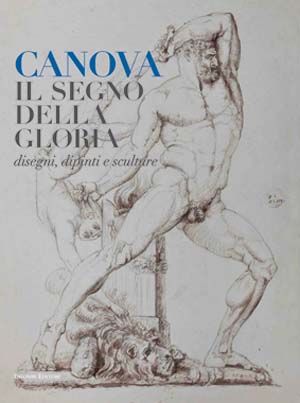 Dall’ispirazione all’opera. é un percorso sulle tracce dell’idea quello della mostra dedicata ad Antonio Canova. Viaggio nell’intuizione estetica del genio e nella sua realizzazione, ma anche nella percezione che di quelle stesse concretizzazioni ha poi il genio stesso, a lavoro finito. Questione di studio prima, di documentazione poi. Nel mezzo, l’emozione dell’opera. L’esposizione capitolina dunque punta l’attenzione sulla “costruzione” delle opere da parte di Canova, attraverso disegni, modelletti in terracotta, calchi e modelli originali in gesso, dipinti, marmi e acqueforti, selezione d’eccellenza nella ricchissima raccolta di disegni – circa 1800 – che tra il 1849 e il 1857 fu oggetto di una donazione da parte del fratellastro dell’artista, Giovan Battista Sartori Canova.
Exhibition | Laurent Pécheux: A French Painter in Italy
Exhibition press release from the Musée des Beaux-Arts de Dole:
Laurent Pécheux: A French Painter in the Italian Enlightenment
Musée des Beaux-Arts de Dole, 27 June — 30 September 2012
Musée des Beaux-Arts de Chambéry, 24 October 2012 — 20 January 2013
Curated by Sylvain Laveissière with Sylvie de Vesvrotte and Anne Dary
 Rome au XVIIIe siècle : foyer artistique fécond où l’Europe entière vient s’instruire, admirer, mais aussi créer. L’Antique, exhumé, restauré, collectionné, est l’objet d’approches nouvelles avec Piranèse, défenseur de la création étrusque et romaine, et Winckelmann, théoricien du « beau idéal » dans l’art grec. Les deux peintres les plus en vue sont l’allemand Anton Raphaël Mengs (1728-1779), et Pompeo Batoni (1708-1787), le portraitiste obligé des jeunes lords accomplissant leur « Grand Tour » d’Europe. Arrivé de Lyon à Rome en 1753, Laurent Pécheux est d’emblée en contact étroit avec ces deux maîtres éminents : Mengs qui le conseille, et Batoni avec lequel il sera associé pour certaines commandes. Il s’affirme comme l’un des représentants les plus accomplis de la peinture d’histoire romaine, au moment
où s’élabore ce qu’on devait plus tard nommer le Néoclassicisme.
Carrière exceptionnellement riche que la sienne. Après avoir travaillé vers 1757 pour un lord écossais, puis pour des couvents et des particuliers de Lyon, sa ville natale, il est reçu à la prestigieuse Académie romaine de Saint-Luc en 1762. Il est bientôt appelé à Parme en 1765 pour y portraiturer avec succès la future reine d’Espagne, et les plus grandes familles romaines lui confient les plafonds de leurs palais urbains (Borghèse, Barberini). Il travaille pour des amateurs français, pour le grand-maître de l’ordre de Malte, le pape Pie VI, ainsi que la Grande Catherine. En 1777, il quitte Rome pour Turin, où le roi de Piémont-Sardaigne, Victor Amédée III, l’a choisi comme premier peintre et directeur d’une Académie tombée en léthargie. Son activité de peintre de cour, qui lui vaut de décorer le palais royal de Turin, ne l’empêche pas d’assurer de prestigieuses commandes privées, tel le plafond de la salle du Gladiateur à la Villa Borghèse à Rome, dont la décoration est la plus fameuse entreprise picturale de l’époque.
Il n’a suscité jusqu’à présent aucune exposition monographique. Les villes de Dole et Chambéry possèdent un ensemble remarquable de ses oeuvres. A Dole se trouve un cycle de douze tableaux sur la vie du Christ commandé pour la collégiale et récemment restauré, dont huit esquisses sont conservées au musée des Beaux-Arts. L’exposition présente 115 oeuvres, prêtées par des collections publiques et privées françaises ainsi qu’italiennes, et sera accompagnée d’une importante monographie. Celle-ci étudie, au-delà des oeuvres exposées, l’ensemble de la production de cet artiste aux dons multiples, l’un des derniers de sa stature qui restaient à découvrir.
◊ ◊ ◊ ◊ ◊
From Dessin Original books:
Catalogue: Sylvain Laveissière, Sylvie de Vesvrotte, Vittorio Natale, Bénédicte Gaulard, Laurent Pécheux (1729-1821): Un peintre français dans l’Italie des Lumières (Silvana, 2012), 192 pages, ISBN: 978-8836623174, 28€.
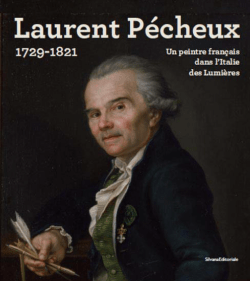 Publié à l’occasion de l’exposition des musées des Beaux-Arts de Dole et de Chambéry, cet ouvrage est le premier, depuis l’étude de Luigi Bollea parue en 1942, à être consacré à ce peintre, dont l’importance commence seulement à être reconnue.
D’origine Lyonnaise, Laurent Pécheux effectue l’ensemble de sa carrière en Italie, à Rome, puis à Turin, où il devient peintre officiel du roi de Piémont-Sardaigne. Sa carrière fut exceptionnellement riche : après avoir travaillé vers 1755 pour des clients lyonnais ou écossais, il est reçu à l’Académie romaine de Saint-Luc en 1762. Il est bientôt appelé à Parme en 1765 pour y portraiturer avec succès la future reine d’Espagne et les plus grandes familles romaines lui confient les plafonds de leurs palais. Il travaille également pour des amateurs français. En 1777, il quitte Rome pour Turin, où le roi de Piémont-Sardaigne l’a choisi comme premier peintre. Son activité de peintre de cour, qui lui vaut de décorer le palais royal de Turin, ne l’empêche pas d’assurer de prestigieuses commandes privées (par exemple : plafond de la salle du Gladiateur à la villa Borghèse, le plus fameux ensemble décoratif de Rome à l’époque ; suite de douze grands tableaux de la Vie du Christ pour la collégiale de Dole, auxquels une restauration exemplaire vient de rendre leur éclat et plusieurs chefsd’oeuvre conservés à Chambéry : Mort d’Epaminondas, Vénus, Narcisse, etc.). Cet ouvrage étudie, au-delà des oeuvres exposées, l’ensemble de la production de cet artiste aux dons multiples, l’un des derniers de sa stature qui restaient à découvrir.
◊ ◊ ◊ ◊ ◊
Didier Rykner reviewed the exhibition for The Art Tribune (21 August 2012) . . .
An artist from Lyon who spent most of his career in Italy, first Rome then Turin where he became official painter to the King of Piemonte-Sardegna, Laurent Pécheux is however not very well known outside of the restricted circle of art historians. The first retrospective highlighting his oeuvre, organized by the Musée des Beaux-Arts in Dole, which will then travel to Chambéry, now reveals a first rate artist, a pioneer of European Neo-Classicism though he maintained, in certain works, a Baroque spirit or even, if we adopt the term now used for some paintings corresponding to the second half of the 19th century, “Neo-Baroque” . . .
The full review (in English or French) is available here»










 Enfilade
leave a comment