Everyday Objects Symposium
Everyday Objects: Art and Experience in Early Modern Europe
Courtauld Institute Inaugural Early Modern Symposium, London, 21 November 2009
Through a focus on the everyday object, this one-day symposium explores both the experience of visual culture in everyday life and the phenomenon of the everyday in visual culture. Drawing on theories of the everyday from such fields as anthropology, phenomenology and sociology, papers will examine the seemingly banal things that formed the culture of daily life, asking: what constitutes an everyday object? How were everyday objects experienced, represented or collected? And how does their study enhance our understanding of the cultural history of early modernity?
Papers by established and emerging scholars will explore the theme of the everyday object in a variety of media, including sculpture, painting, dress, furniture and the graphic arts. Presentations will investigate ephemeral objects, quotidian spaces and habitual activities — from the social rituals of marriage, food consumption and waste disposal, to overlooked ‘things’ like taxidermy, miniature furniture and clothing accessories.
Organised by Edward Payne and Hannah Williams. To book a place, please send a cheque for £15 (£10 students) made payable to ‘Courtauld Institute of Art’ to Research Forum Events Co-ordinator, Research Forum, The Courtauld Institute of Art, Somerset House, Strand, London WC2R 0RN — clearly stating that you wish to book for the Everyday Objects Conference. For credit card bookings, call 020 7848 2785/2909. For further information, send an email to ResearchForumEvents@courtauld.ac.uk, or visit the Institute’s website.
Introduction – Edward Payne & Hannah Williams
Session 1 – Chair: Edward Payne
- Samuel Bibby (University College London), “The Triumph of the Everyday: Sculpture, Marriage, and Memory in Fifteenth-Century Florence”
- Joanna Woodall (The Courtauld Institute of Art), “Laying the Table. The Procedures of Still-life”
Session 2 – Chair: Hannah Williams
- Katie Scott (The Courtauld Institute of Art), “Cochin’s Handkerchiefs”
- Ariane Fennetaux (Université Paris-Diderot), “What’s in a Pocket? The Contribution of Material Culture to the Cultural and Social History of Eighteenth- and Nineteenth-Century Britain”
Session 3 – Chair: David Solkin
- Paula Radisich (Whittier College), “Theorizing ‘Things’ in French Genre Painting of the 1740s”
- Melinda Rabb (Brown University), “Mimesis Reconsidered: Everyday Objects in Miniature”
Session 4 – Chair: Sheila McTighe
- Beth Fowkes Tobin (Arizona State University), “Women, Decorative Arts, and Taxidermy”
- Olivia Fryman (Kingston University and Historic Royal Palaces), “‘Necessary Stooles’ and Necessary Women: Dealing with Royal Dirt, 1660-1714”
Broadside Symposium in Oxford
Taking Sides: The Printed Broadside 1450-1830
Merton College (Mure Room), University of Oxford, Saturday, 14 November 2009
In association with Merton College, The Centre for the Study of the Book at the Bodleian Library, University of Oxford is holding a symposium on the early-modern broadside in the age of its digital reproduction. Printed for display purposes (typically on one side of a single sheet), the broadside arguably addressed a wider audience than any other publication of the handpress period. Broadsides were advertisements, religious indulgences, political addresses, civic discourses, teaching aids, ballads and other forms of entertainment. This symposium will explore how the broadside demarcated or connected both public and private worlds and popular and learned cultures. What is recovered of the broadside and its world through digitization, and what remains to be reconstructed? What is its place in histories of collecting, literacy, popular culture and antiquarianism?
- Falk Eisermann (Berlin State Library), “Medium of the Masses? Some Observations on Press Runs and Audiences of 15th-Century Broadsides”
- Susanna Berger (University of Cambridge), “Pedagogical Broadsides and the Study of Aristotelian Logic”
- Richard Sharpe (University of Oxford), “The Vending of Books: Sheldonian Sales-catalogues 1694 to 1720”
- Angela McShane (Victoria and Albert Museum/Royal College of Art), “Cultural Economics in the Broadside Trade: ‘Commissioned’ and ‘Retail’ Broadsides”
- Eric Nebeker (University of California, Santa Barbara), “Musical Broadsides and Their Audiences in the Seventeenth Century”
- Sara Mori (Gabinetto Vieusseux, Florence), “Between Censorship and Permission: Tuscan Broadsides at the Beginning of the 19th Century”
- E. Wyn James (Cardiff University), “Illustrating Welsh Broadsides”
- John Bidwell (Morgan Library and Museum), “Broadside Editions of the Declaration of Independence”
Supported by Merton College, All Souls College, Bodleian Library Centre for the Study of the Book and The Bibliographical Society. Graduate student travel bursaries are available, generously funded by The Bibliographical Society. E-mail for information: giles.bergel@merton.ox.ac.uk / alexandra.franklin@bodley.ox.ac.uk
Dr. Giles Bergel
JPR Lyell Research Fellow in the History of the Book
Merton College, University of Oxford
A Dutch Collection in New York
Dutch New York between East and West: The World of Margrieta van Varick
Bard Graduate Center, New York, 18 September 2009 — 3 January 2010
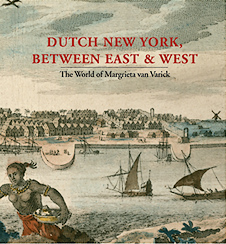
Edited by Deborah Krohn and Peter Miller with Marybeth De Filippis, $75
This autumn the Bard Graduate Center will participate in a state-wide celebration of the 400th anniversary of Henry Hudson’s voyage and the legacy of Dutch culture in New York with a landmark exhibition, Dutch New York Between East and West: The World of Margrieta van Varick. Organized by the BGC and the New-York Historical Society and curated by Marybeth De Filippis and Deborah Krohn, Dutch New York will make a major contribution to the quadricentennial and to the scholarship of colonial New York by focusing on the life and times of a woman who during the seventeenth century lived in the rural village of Flatbush on eastern Long Island, a neighborhood still known by that name in the borough of Brooklyn today. The exhibition helps elucidate what the historian Russell Shorto has called the “forgotten colony” in his book The Island at the Center of the World. Indeed, the British roots of New York City are recognized far more widely than the Dutch, despite the city’s visible connections to the Dutch founders, most evident in street names such as Amsterdam Avenue and Varick Street.

Covered Bowl from Batavia (present-day Jakarta, Indonesia), early 18th century, silver (Gemeentemuseum, The Hague)
Dutch New York offers an innovative approach to exhibition practice by using the probate inventory of Margrieta van Varick’s possessions compiled in 1696 as a means of examining life and culture in colonial New York. Born in Amsterdam in 1649, Margrieta spent several years at the other end of the Dutch colonial world in the Far East, primarily in Malacca (present day Malaysia) before returning to The Netherlands with her minister husband Rudolphus. In 1686 Margrieta and her family crossed the Atlantic to settle in Flatbush where Rudolphus was minister of the Dutch Reform Church and where she opened a textile shop, having brought with them an astonishing array of Eastern and European goods.
This exhibition is organized in five sections, each delineating a theme relevant to Margrieta van Varick’s life as well as exploring the wide range of goods in her possession when she died in late 1695. The exhibition first examines the inventory as a document of historical research and curatorial practice. A digital film (also available online) features an interview with renowned historian Natalie Zemon Davis in which she considers the various challenges confronting historians who use inventories for research purposes, as well as the role of women in the seventeenth century.
For the full description of the exhibition, click here»
◊ ◊ ◊ ◊ ◊
Lecture — Inventory: Text and Context, Bernard Herman
Thursday, 19 November 2009, 6-8 pm ($25 / $17)
RSVP required to 212.501.3011, programs@bgc.bard.edu
What can an inventory tell us? How can we use an artifact of the legal system to tease out relationships between people and their relationship to things? How does such a document translate into an exhibition? Bernard Herman, a leading scholar of American material culture, will draw on his vast knowledge of both things and people in a conversation with cultural historian Catherine Whalen and exhibition co-curator Deborah Krohn. The conversation will be followed by an exhibition viewing and reception. Bernard Herman is Edward F. and Elizabeth Goodman Rosenberg Professor of Art History, University of Delaware. Deborah Krohn is associate professor and coordinator for history and theory of museums at the Bard Graduate Center as well as co-curator of the Dutch New York exhibition. Catherine Whalen is assistant professor at the Bard Graduate Center.
◊ ◊ ◊ ◊ ◊
Study Day — Reflecting on Silver: Manufacture, Markets, and Meaning in Early New York
Friday, 20 November 2009 ($125 / $100 discount)
RSVP required to 212.501.3011, programs@bgc.bard.edu
This study day will focus on silver in New York in the late seventeenth and early eighteenth centuries, as an object signifying wealth, cultivation, and mastery. Concentrating on works by silversmiths Benjamin Wynkoop, Cornelius Kierstede, and Peter Van Dyck, curators Marybeth De Filippis, Beth Carver Wees, and Debra Schmidt Bach will consider aspects of stylistic influence, marketing of silver, and workshop practices. A visit to the studio of master silversmith Ubaldo Ubaldo “>Ubaldo “>Vitali in Maplewood, New Jersey, will provide an examination of the technical knowledge and cultural influences surrounding the production of silver through the centuries. Admission to the study day includes lunch and round-trip transportation to the Ubaldo Vitale studio. Marybeth De Filippis is assistant curator of American art at the New-York Historical Society as well as co-curator of the Dutch New York exhibition. Beth Carver Wees is curator in the Department of American Decorative Arts at the Metropolitan Museum of Art. Debra Schmidt Bach is assistant curator of decorative arts at the New-York Historical Society and a PhD candidate at the BGC. Ubaldo Vitali is a fourth-generation Roman silversmith, conservator, and art historian.
◊ ◊ ◊ ◊ ◊
A helpful article about the exhibition written by Marybeth De Filippis appears in the September issue of The Magazine Antiques.
Furniture at the Wallace
The Wallace Collection highlights the cabinet-maker, Johann Gottlob Fiedler with a small exhibition and study day. From the museum’s website:
Study Day: Johann Gottlob Fiedler, Eighteenth-Century German Cabinet Maker
Wallace Collection, London, Thursday 15 October 2009 (£7)
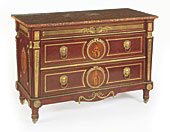
Johan Gottlob Fiedler, Commode, ca. 1786 (Wallace Collection)
Achim Stiegel, Curator of Furniture at the Kunstgewerbe Museum Berlin, will present latest research on the cabinet making of Johann Gottlob Fiedler and the small group of cabinets made for patrons such as Crown Prince Friedrich Wilhelm of Prussia, later King Friedrich Wilhelm II. Jürgen Huber, Senior Furniture Conservator, Wallace Collection, will discuss the recent conservation of the Collection’s superb Fiedler commode from c.1786 and the innovative features in its construction. See the commode in a special exhibition in the Conservation Gallery,
Vorsprung durch Technik: The Innovative Work of the Cabinet-maker Johann Gottlob Fiedler (6 June – 29 November 2009).
Conference on Sexuality and Gender Identity
Before Sex
Rutgers University, New Brunswick, NJ, 23 October 2009
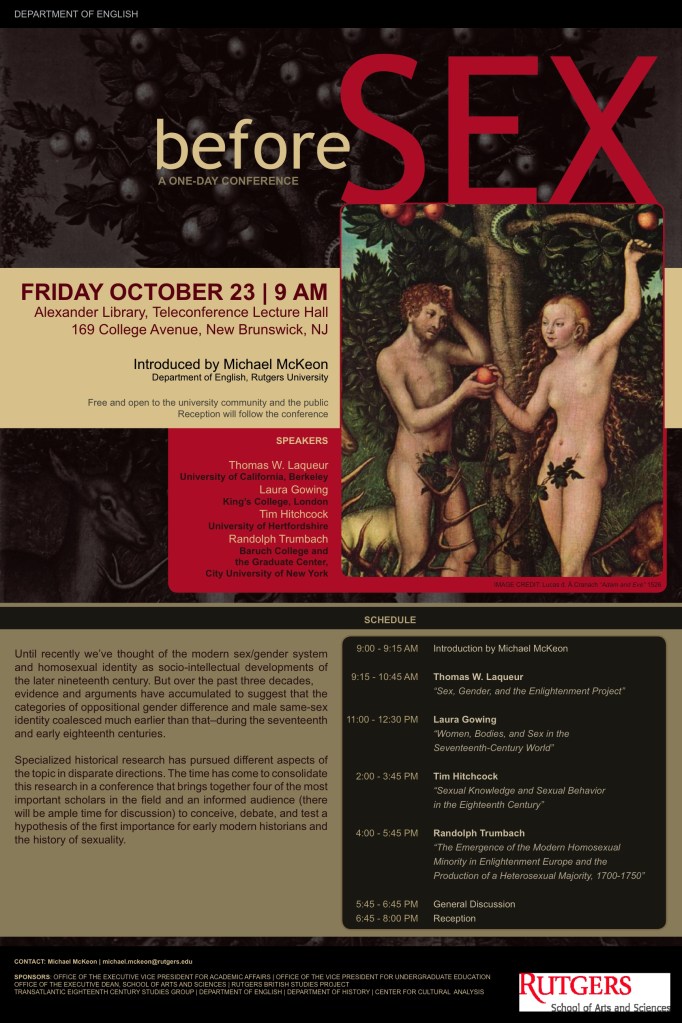 Until recently we’ve thought of the modern sex/gender system and homosexual identity as socio-intellectual developments of the later nineteenth century. But over the past three decades, evidence and arguments have accumulated to suggest that the categories of oppositional gender difference and male same-sex identity coalesced much earlier than that–during the seventeenth and early eighteenth centuries. Specialized historical research has pursued different aspects of the topic in disparate directions. The time has come to consolidate this research in a conference that brings together four of the most important scholars in the field and an informed audience (there will be ample time for discussion) to conceive, debate, and test a hypothesis of the first importance for early modern historians and the history of sexuality.
Thomas Laqueur (University of California-Berkeley), “Sex, Gender, and the Enlightenment Project”
Laura Gowing (King’s College, London), “Women, Bodies, and Sex in the Seventeenth-Century World.”
Tim Hitchcock (University of Hertfordshire), “Sexual Knowledge and Sexual Behavior in the Eighteenth Century.”
Randolph Trumbach (Baruch College and the Graduate Center, City University of NY), “The Emergence of the Modern Homosexual Minority in Enlightenment Europe and the Production of a Heterosexual Majority, 1700-1750.”
The conference begins at 8:30am and last throughout the day in the Teleconference Room of the Alexander Library (4th floor), 169 College Avenue. For more information contact Michael McKeon, michael.mckeon@rutgers.edu
Conference on Scottish Craftsmanship in the Americas
As noted by The Magazine Antiques in its ‘Guide to Fall Symposiums’:
Transatlantic Craftsmanship: Scotland and the Americas in the 18th and 19th Centuries
Winterthur Museum & Country Estate, Winterthur, DE, 7-10 October 2009
 The decorative and applied arts in colonial and early 19th-century America are deeply infused with Scottish influence. This major international conference will examine, for the first time, the transatlantic relationships of Scottish craftsmanship and Scottish immigrant craftsmen in the 18th and 19th centuries. From Edinburgh to Charleston, Aberdeen to Philadelphia, and Kilmarnock to New York, we will examine architecture, weaponry, furniture, silver, jewelry, ceramics, textiles, and glass to promote a greater understanding of the trade and influence of Scottish artists and manufacturers in America.
The Society of Antiquaries of Scotland and National Museums Scotland, in partnership with Winterthur, and with additional support from the Center for American Art at the Philadelphia Museum of Art, will bring together scholars from both sides of the Atlantic to study Scotland’s role in the development of American material culture.
A full list of speakers and topics can be found through the Winterthur website»










leave a comment