London Conference Addresses Antiquity in Eighteenth-Century Britain
From the website of the Paul Mellon Centre:
Antiquity at Home
Paul Mellon Centre for Studies in British Art and The British Museum, London, 28-29 January 2010
 Thursday, 28 January, BP Lecture Theatre, British Museum
- 6:30 Keynote lecture by David Watkin (Professor Emeritus in the History of Architecture, Department of Art History, University of Cambridge), “From Antiquity to Enlightenment: The Origins of the British Museum” — In this wide-ranging lecture, beginning with galleries and museums in the ancient world, Professor Watkin will locate the Enlightenment origins of the British Museum in the pioneering collections of the English seventeenth-century. The Strand palaces of London are now largely forgotten but were once a prominent feature of the Thames shoreline. These royal and aristocratic houses vied with one another in flaunting their taste for art and antiquity, acquired in Rome and along the coast of the eastern Aegean, in public displays of ‘vertu’. Against such a backdrop the British Museum first opened its doors in Montagu House doors in 1759, just over 250 years ago.
Friday, 29 January, The Paul Mellon Centre, 16 Bedford Square
- 9:40 Welcome by Brian Allen (Director of Studies, the Paul Mellon Centre)
- 9:45 Tribute to Ilaria Bignamini by Andrew Wallace-Hadrill (Master of Sydney Sussex College, University of Cambridge, former Director of the British School at Rome)
Morning Session: ‘Objects’
- 9:55 Introduced and chaired by Kim Sloan (Curator of British Drawings and Watercolours before 1800, Francis Finlay Curator of the Enlightenment Gallery, British Museum)
- 10:00 Ian Jenkins (Senior Curator, Department of Greek and Roman Antiquities, British Museum), “The Townley Discobolus”
- 10:20 Elizabeth Angelicoussis (Independent Researcher), “The Hope Dionysus”
- 10:40 Eloisa Dodero (Dipartimento di Discipline Storiche “Ettore Lepore”, Università degli Studi di Napoli “Federico II”), “Clytie before Townley: The Gaetani d’Aragona Collection of Sculptures and Its Neapolitan Context”
- 11:00 Dolores Sánchez-Jáuregui Alpañés (Senior Research Fellow, The Paul Mellon Centre for Studies in British Art), “Sculptures onboard The Westmorland: A Cross-section of Grand Tour Collecting”
- 11:20 Coffee
- 11:50 Jonathan Yarker (PhD Candidate, University of Cambridge, research assistant for Digging and Dealing in Eighteenth-Century Rome), “The ‘Paper Museum’ of Charles Townley”
- 12:10 Thorsten Opper (Curator of Greek and Roman Sculpture, Department of Greek and Roman Antiquities, British Museum), “Lyde Browne – The House Museum as Sales Room”
- 12:30 Lunch
Afternoon Session: ‘Collections’
- 2:00 Introduced and chaired by Edward Chaney (Professor of Fine and Decorative Arts and Chair of the History of Collecting Research Centre, Southampton Solent University)
- 2:05 Jason Kelly (Assistant Professor of History, Indiana University-Purdue University, Indianapolis), “The Society of Dilettanti and the Planning of a Museum”
- 2:25 Anna Seidel (PhD Candidate, Humboldt University Berlin), “Display and Dispersal of the Montalto-Negroni Marbles”
- 2:45 Adriano Aymonino (University of Venice Ca’ Foscari), “A Roman Columbarium on the River Thames: The Long Gallery at Syon House”
- 3:05 Ruth Guilding (Art Historian and Curator), “Sir Richard Worsley, Connoisseur of the Parthenon”
- 3:25 Tea
- 3:55 Clare Hornsby (Research Fellow, British School at Rome, co-author of Digging and Dealing in Eighteenth-Century Rome), “Collecting or Accumulation? Some Thoughts on Motivation”
- 4:15 Tim Knox (Director of Sir John Soane’s Museum), “Soane and the Antique, and Some Reflections on House Museums Then and Now”
- 4:35 Panel and audience discussion chaired by Frank Salmon (Fellow of St John’s College, University of Cambridge, and Lecturer in the History of Art, University of Cambridge)
- 5:30 Wine Reception
Arts and Sciences in Early Modern Naples
The Arts and Sciences in 17th- and 18th-Century Naples: Discovering the Past, Inventing the Future
William Andrews Clark Memorial Library, 26-27 February 2010
Organized by John A. Marino (UC San Diego)
In the past year Melissa Calaresu (University of Cambridge) and Helen Hills (University of York) organized three workshops in England on Exoticizing Vesuvius? Formations of Naples circa 1500–Present that explored Neapolitan historiography, topography and piety, and collecting. The aims of the workshops were “to critically examine the principal historiographical currents that have operated and that continue to operate within scholarship on Naples, particularly in relation to visual and literary representations of Naples from circa 1500 to the present” and “to encourage the rethinking of Neapolitan history across chronological and disciplinary divides; to resist reinscribing Neapolitan cultural history into the familiar and over-worn paradigms of modernity and nationhood (the failure of the south), the Grand Tour (as seen from northern Europe, especially aristocratic Britain), periodization that serves to draw an apparently unbridgeable gulf between the early modern period and the nineteenth century.”
This conference on The Arts and Sciences in Naples: Discovering the Past, Inventing the Future continues this rethinking of early modern Naples from the theory and practice of representation and knowledge as it developed in the seventeenth and eighteenth centuries. Topics will focus on the disciplines and practices of the arts and sciences—their origins, development, and contributions—within Naples itself during this period. Topics include the practice and institutions in Naples of the arts (painting, architecture, music, vernacular literature), the social sciences (ethnography, political economy), the natural sciences, and the art of cooking and entertaining. (more…)
Spring Lectures in Book History at Columbia
Spring Sessions of the Book History Colloquium at Columbia
Columbia University, 523 Butler Library, New York, 6:00-7:30pm
The Book History Colloquium at Columbia University, open to any discipline, aims to provide a broad outlet for the scholarly discussion of book history, print culture, the book arts, and bibliographical research, and (ideally) the promotion of research and publication in these fields. Our presenters include Columbia faculty members and advanced graduate students, scholars of national prominence from range of institutions.
Wednesday, 10 February 2010
Thierry Rigogne (History Department, Fordham University), “Writing About Coffee, Reading In Cafés: Literature and Coffeehouses in Early Modern France”
Tuesday, 9 March 2010
Michael Suarez (Professor of English and Director of Rare Book School, University of Virginia), “The Two Futures of Book History”
Tuesday, 23 March 2010
Mark Dimunation (Chief of the Rare Book and Special Collections Division, Library of Congress), TBA
Tuesday, 6 April 2010
Ivan Lupic (Department of English & Comparative Literature, Columbia University), “Shakespeare, Milton, and the Battle of the Books”
Wednesday, 21 April 2010
Russell Marat (Printer, Book Artist, and Designer), “Notes of an Alphabetical Fetishist: Lettered in Rome”
Margaret Grasselli Speaks on Sunday
This Sunday at 2pm, in conjunction with the exhibition of French drawings in Washington, Margaret Grasselli will deliver the lecture Playing Favorites: A Personal Selection of French Drawings from the National Gallery of Art. For details of the exhibition, Renaissance to Revolution: French Drawings from the National Gallery of Art, 1500–1800.
For more information, click here»
CAA Registration: The Last Week for Best Rates
The 2010 College Art Association conference takes place in Chicago, February 10-13, at the Hyatt Regency. The discounted ‘early registration’ rates end December 11 — after which the regular conference rate for CAA members jumps from $155 to $225 (the on-site rate is even higher at $270). Click here to register online. HECAA will be represented by two terrific-looking panels:
◊ ◊ ◊ ◊ ◊
New Scholars: Transforming Traditions in Eighteenth-Century Art
Chair: Laura Auricchio (Parsons The New School for Design)
Thursday, February 11, 12:30-2:00; Grand CD South, Gold Level, East Tower, Hyatt Regency
- Ryan White (independent scholar, Toronto), “Vision, Display, and Information: Chardin as Tapissier”
- Lyrica Taylor (University of Maryland, College Park), “Portrait of the Artist: John Francis Rigaud’s Vision of the Role of the Artist in Eighteenth-Century England”
- Hector Reyes (Northwestern University), “Classicism’s Secret Histories: On Jean-Germain Drouais’s Christ and the Canaanite”
- Amber Ludwig (Boston University), “Emma Hamilton as Grand Tourist”
◊ ◊ ◊ ◊ ◊
Representing the Psyche in Eighteenth-Century Art
Chair: Michael Yonan (University of Missouri, Columbia)
Thursday, February 11, 2:30-5:00; Grand A, Gold Level, East Tower, Hyatt Regency
- Heather McPherson (University of Alabama, Birmingham), “Thinking Heads: Representing Mental Activity in Eighteenth-Century Portraiture”
- Emma Barker (Open University), “Figures of Pathos: Melancholy and Interiority in Late-Eighteenth-Century Art”
- Thomas Beachdel (Graduate Center, City University of New York), “Awestruck: Claude-Joseph Vernet and the French Sublime”
- Yuriko Jackall (Université de Lyon 2), “Divas, Nymphs, and Fallen Maidens: Greuze’s Experiments in Expression”
- Barrett Kalter (University of Wisconisn, Milwauke), “Romantic Stained Glass and the Formation of a Neomedieval Consciousness”
Tracing Ownership at the British Library
Provenance Research in the British Library
British Library, London, Monday, 25 January 2010, 2:15 pm
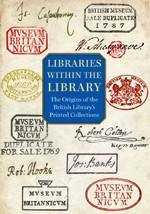 Launch event for the publication of Libraries within the Library: The Origins of the British Library’s Printed Collections, edited by Giles Mandelbrote and Barry Taylor (London: British Library, 2009).
Dispersed along the shelves of the British Library today are many volumes that once stood side by side in private libraries. Libraries within the Library explores some of the most important printed collections which have been brought together within the British Museum Library since its foundation in 1753, casting new light on the individuals whose personal interests and taste they reflect. The launch of this volume will provide an opportunity to hear papers on recent developments in the field.
2.15 Welcome
2.30 David Pearson, “Learning from Collections”
3.00 Alison Walker, “Halfway There? An Update on the Sloane Printed Books Catalogue”
3.20 Phil Harris, “The Old Royal Library and Legal Deposit in the Eighteenth Century”
3.40 Discussion
4.00 Tea
4.30 Stephen Parkin, “Finding and Losing: The Provenance of an Italian Polybius in the British Library”
4.50 John Goldfinch, “A Group of Incunables Collected in the Eighteenth Century”
5.10 David McKitterick, “A View from Cambridge”
5.40 Discussion
6.00 Reception
Attendance is free, but please register your name with Teresa Harrington at the British Library; email: teresa.harrington@bl.uk.
Travel Lecture Series
Art and Travel in the Mediterranean, 1600-1900: A Series of Five Lectures
Paul Mellon Centre, London, November 2009 — February 2010
The grand object of travelling is to see the shores of the Mediterranean –Samuel Johnson, 1776
In the history of British travel since the late sixteenth century, the Mediterranean has always played a prime role and inevitably captured the imagination like no other European region. Travel to the Mediterranean was stimulated by its art and architecture and in return inspired new art, architecture, collecting and art criticism. Images drawn, painted or photographed on these journeys by a diversity of travellers – artists, antiquarians, scientists, ethnographers, diplomats, navy personal, amateurs and tourists, to name just a few – have fulfilled a whole variety of purposes. This lecture series, organised by the National Maritime Museum’s Centre for Art and Travel and generously hosted by the Paul Mellon Centre, attempts a new overview on the subject from the seventeenth to the early twentieth century.
26 November 2009
Edward Chaney (Southampton Solent University), The Origins of the Grand Tour and the Discovery of Art
10 December 2009
Charles Newton (V&A), ‘Present under the rose…’: Stratford Canning, His Greek Artist, and the Last Chance to See Turkey before the Tanzimat
21 January 2010
Briony Llewellyn (Independent Scholar), ‘These inhuman trafficers in flesh & blood’: British Artists and the Slave Trade in Egypt
4 February 2010
David Howarth (University of Edinburgh), Revolving Mirrors: Britain and Spain from the Armada to the Spanish Civil War
18 February 2010
Jenny Gaschke (National Maritime Museum), ‘Hellas… in one Living Picture’: British Artist Travellers in Greece
All lectures will begin at 6pm in the seminar room at the Paul Mellon Centre, 16 Bedford Square, London, WC1B 3JA. They are free of charge and there is no need to book, but if you wish to reserve a place, please contact Janet Norton, Research Administrator at 020 8312 6716 or research@nmm.ac.uk. For details along with abstracts for each lecture, see the website for the series.
The History of Libraries and Censorship
Seminar on the History of Libraries — Dr. Keith Manley
Stewart House, Russell Square, London, Tuesday, 1 December 2009
The next seminar in the History of Libraries series will take place on Tuesday, December 1, in the Institute of English Studies, University of London. Dr. Keith Manley (Institute of Historical Research) will speak on Infidel Books and Subscription Libraries: Government Censorship in Europe during the Napoleonic Period. Many governments tried to prevent libraries from acquiring politically inflammatory and heretical literature. In Germany secret societies of freemasons infiltrated libraries to promote their own views of Enlightenment and world domination, while Hanover feared for the morals of its children if they were allowed access to circulating libraries. Germany and Austria banned subscription libraries, fearing their malignant influence. In France, officials kept libraries under close surveillance. In comparison, British libraries escaped lightly from tight supervision, though in Ulster several were ransacked by yeomanry. The meeting will take place at 5:30pm in Room ST 275 at Stewart House, Russell Square, London WC1E 7HU, UK. Stewart House is adjacent to, and accessible through, Senate House, Malet St. All are welcome.
Media & Theology Conference in Los Angeles
The following two-day conference deals mainly with the sixteenth and seventeenth centuries, though the stakes could also bear on eighteenth-century studies. From the Clark Memorial Library website:
Cultures of Communication, Theologies of Media in Early Modern Europe and Beyond: Theology as Media Theory
Clark Memorial Library, UCLA, Los Angeles, 4-5 December 2009
Organized by Christopher Wild and Ulrike Strasser; registration deadline is 25 November 2009.
The early modern period has long been recognized as a time of revolutionary change in the uses of media and forms of communication. Much attention has been focused on the history of print and the book in particular. Without questioning the importance of this technology- and book-oriented perspective, this series of conferences considers print media alongside a range of other media with which they interacted (“multimediality”) and re-approaches the history of media in early modern Europe from an original and timely perspective. It resists the technological focus and teleological pull of the Gutenberg galaxy and concentrates instead on the powerful religious and theological currents informing communication and media. We suggest that the history of media in early modern Europe is best understood in its longue durée from the sixteenth through the eighteenth century and in reference to the long-term aftershocks of the Reformation and the profound transformation of both media and mediation it set in motion. The sixteenth-century reformers not only revolutionized the use of media, they also formulated their own theories about media and communication, addressing issues that remain of concern to modern media theorists who, however, rarely consider their theological precursors.
Protestants and Catholic reformers, albeit in confessionally distinct ways, responded to the same cultural crisis in mediation between God and humanity, as well as within the community of believers, particularly as the latter began expanding rapidly with the onset of global evangelization. Each camp developed theories and practices of optimizing ‘vertical communication’ with the divine and ‘horizontal communication’ among humanity. Consequently, the recourse to the different theologies of early modern reform can help us examine the complex and competing media cultures of the time and what helped drive technological changes. The transformation of media had a persistent corollary in the critique of mediation. Once unleashed, this critique would not go away, but would be reformulated throughout the early modern period and beyond, and in a host of contexts within and beyond the religious domain.
Against this backdrop, our conference cycle takes as its starting point the conjunction of Reformation theology and the rise of new media in the sixteenth century to then traces the ripple effects of these phenomena in the following centuries. Our sites of investigation include European cultures, “New World” spaces, and the trans-oceanic communication networks linking them.
Registration Fees: $15 per person; UC faculty & staff, students with ID: no charge (photocopy of student ID should accompany registration the completed registration form). Complimentary lunch and other refreshments are provided to all registrants. Please be aware that space at the Clark is limited and that registration closes when capacity is reached. No confirmation will be sent, but we will contact you if we receive your registration after we reach capacity. (more…)
Revisiting the Gaze
The Eighteenth-Century Interdisciplinary Group at CUNY invites you to a talk at the Graduate Center in New York on Friday, 20 November 2009 at 2pm:
Rivka Swenson, Assistant Professor of English (Virginia Commonwealth University),
‘The Eye, in this Respect, is a Female’: Subjects, Objects, and the Eighteenth-Century Gaze
5414, CUNY Graduate Center, 365 Fifth Avenue, New York, NY










leave a comment