Abbey of Cluny after the Revolution
Probably of interest to those of you working on medievalism and the nineteenth century, but the eighteenth century still matters here all the same:
Constructions, reconstructions et commémorations clunisiennes, 1790-2010
Théâtre de Cluny, Ville de Cluny, 13-15 May 2010
A colloquium on the theme of the 1100th anniversary of the foundation of the Abbey of Cluny will take place, consisting of papers by specialists on the abbey’s history. Along with the program provided below, more information can be found at the conference website.
THURSDAY, 13 May 2010
2:00 – 6:30, Restaurations et commémorations, 1790-2010
- Jean-Luc Delpeuch (Mairie de Cluny), Accueil des participants.
- Didier Méhu (Université Laval, Québec), Pourquoi (ne pas) commémorer ?
- Dominique Iogna-Prat (CNRS, Paris / Auxerre), Commémorations clunisiennes, 1910-2010.
- Yann Potin (Université Paris I – Panthéon-Sorbonne), La destruction de l’abbaye de Cluny ou la puissance du vide, 1790-1825.
- Alain Rauwel (Université de Bourgogne, Dijon), Une tentative de restauration monastique à Cluny au XIXe siècle : Dom Mayeul Lamey.
FRIDAY, 14 May 2010
9:30 – 1:00, Cluny et la construction du discours scientifique aux XIXe et XXe siècles
- Isabelle Vernus (Archives départementales de Saône-et-Loire, Mâcon), Les monumenta clunisiens : le sort des archives de Cluny.
- Alain Guerreau (CNRS, Paris), Les recherches sur Cluny au XXe siècle : la balkanisation et ses conséquences.
- Daniel Russo (Université de Bourgogne, Dijon), Cluny dans l’histoire de l’art français d’Émile Mâle à Henri Focillon.
- Kathryn Brush (London, Ontario, University of Western Ontario), Arthur Kingsley Porter et la genèse de sa vision de Cluny.
2:45 – 7:00, Reconstructions émotionnelles et littéraires
- Janet Marquardt (Charleston, Illinois, Eastern Illinois University), Du martyr au monument : les reconstructions romantiques.
- Nicolas Reveyron (Université Lumière – Lyon II, Institut universitaire de France), François Cucherat, l’autre fils de Semur.
- Laurent Baridon (Université Pierre Mendès-France – Grenoble II) et Didier Méhu (Université Laval, Québec), Viollet-le-Duc et Cluny.
- Elizabeth Emery (Montclair, New Jersey, Montclair State University), Cluny dans la littérature française du XIXe siècle.
- François Amy de la Bretèque (Université Paul Valéry – Montpellier III), Chronique d’une absence : Cluny, les moines et le cinéma.
SATURDAY, 15 May 2010
9:30 – 1:00, Reconstructions et présentations contemporaines
- Frédéric Didier (Monuments historiques, Paris), Les enjeux des restaurations et reconstructions monumentales de l’abbaye de Cluny.
- Guillaume Schotté et Jean-François Coulais (ENSAM, Cluny), Les enjeux des reconstitutions virtuelles de l’église abbatiale, de la ville et de l’environnement urbain de Cluny.
- Table ronde conclusive: Commémoration, patrimoine et histoire.
Anthony Gerbino Speaks on Drawing
In conjunction with the exhibition opening in New Haven this week, Compass and Rule: Architecture as Mathematical Practice in England, 1500-1750, the YCBA will host the following lecture on Wednesday, 24 February 2010 at 5:30pm:
Anthony Gerbino (architectural historian, Worcester College, University of Oxford)
The Paper Revolution: Drawing in English Architectural Practice 1500-1750
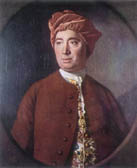
Call for Papers: David Hume Conference in 2011
38th International Hume Society Conference: Hume after 300 Years
The Old College, Edinburgh, 18-23 July 2011
 Proposals due by 31 October 2010
Keynote speakers include Annette Baier, David Fergusson, Don Garrett, John Pocock, and Amartya Sen. Papers are invited on any aspect of Hume studies. Papers should be prepared for blind review and sent to: submissions@humesociety.org.
This year’s conference will be held in Antwerp, 6-10 July 2010. See the Hume Society webpage for more information.
Music and the History of Art
La musique face au système des Beaux-Arts ou les vicissitudes de l’imitation (1690-1803)
Paris, Organisé par le Centre allemand d’histoire de l’art et l’INHA, 17-19 February 2010
Si les littératures artistiques et musicales sont le plus souvent étudiées distinctement et différemment par l’historien de l’art, l’historien des idées et le musicologue, ce colloque propose de les réunir et de les apprécier dans une double perspective, sciemment pluridisciplinaire : rétablir d’une part l’esprit de système qui oriente bien souvent la pensée artistique du XVIIIe siècle, et éclairer d’autre part, à côté de la théorie de l’ut pictura poesis, l’existence d’un autre parti pris de la littérature artistique des Lumières : la possibilité de déduire, du phénomène musical, une théorie des arts au sens large.
For details, including a full program, click here»
You’re Invited . . .
Please join us for the HECAA reception at CAA, Thursday February 12, 5:30-7:00 pm, Ogden West Tower, Silver Level. If you plan on attending, please let me know so I can provide a rough head count for the Hyatt reception service. And don’t forget our HECAA sessions!
New Scholars: Transforming Traditions in Eighteenth-Century Art
Thursday, February ll, 12:30-2:00 pm
Grand CD South, Gold Level, East Tower, Hyatt Regency Chicago
Chair: Laura Auricchio, Parsons The New School for Design
Representing the Psyche in Eighteenth-Century Art
Thursday, February 11, 2:30-5:00 pm
Grand A, Gold Level, East Tower, Hyatt Regency Chicago
Chair: Michael Yonan, University of Missouri, Columbia
See you there!
Dr. Julie-Anne Plax
HECAA President
jplax@email.arizona.edu (R.S.V.P.)
One More Thing for the Chicago Itinerary
Sites to Behold: Travels in Eighteenth-Century Rome
Smart Museum of Art, University of Chicago, 3 November 2009 — 11 April 2010
Curated by Anne Leonard
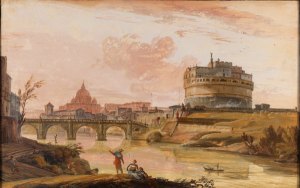
Jean-Baptiste Lallemand, "View of Rome: The Tiber River with the Castel Sant’Angelo and St. Peter’s Basilica in the Distance," n.d., Gouache on paper. Smart Museum of Art, University of Chicago, Gift of Lucia Woods Lindley, 2006.96.
Rome has long been a leading tourist destination. Many of the “must-see” sites were codified centuries ago as part of the Grand Tour, a journey undertaken by young aristocrats to complete their education and give them experience of the world. But by the late eighteenth century, the once-exclusive Grand Tour was giving way to more modern, democratic notions of travel. No longer the preserve of a privileged elite, travel to Italy and other places came within the reach of a wider public, who were eager for tangible souvenirs of what they saw and experienced. This exhibition presents etchings by Giovanni Battista Piranesi, gouache drawings by Frenchman Jean-Baptiste Lallemand, and other works depicting Rome and nearby Tivoli. These eighteenth-century artists, with their different temperaments, techniques, and styles, produced a breathtaking variety of art. A far cry from the monotony of the picture-postcard aesthetic, the works on view appealed to a wide array of tastes and allowed travelers of the period to marvel at the splendor and ruin of an ancient world long after they returned home.
◊ ◊ ◊ ◊ ◊
Right about now, those of you attending CAA in Chicago are probably beginning to cringe at just how tight your schedule already looks. But in the event you can find a few hours to get away from the conference hotel, I would whole-heartedly recommend a morning or afternoon in Hyde Park. In addition to this exhibition at the Smart Museum, the campus of the University of Chicago offers the Oriental Institute Museum, Frank Lloyd Wright’s Robie House, and the Renaissance Society (for ancient, modern, and contemporary aesthetic experiences). The Renaissance Society is currently showing the photographs of Anna Shteynshleyger. No visit is complete without a stop at the Seminary Co-Op Bookstore (one of the best academic bookstores in the world), and La petite folie makes for a lovely quiet lunch or dinner. Hyde Park is easily reached via the Metra commuter train system, available just a few blocks from the Hyatt at Millennium Station. –C.H.
Eighteenth-Century at the Newberry
The Eighteenth-Century Seminar at the Newberry Library is designed to foster research and inquiry across the scholarly disciplines. It aims to provide a methodologically diverse forum for work that engages our ongoing discussions and debates along this historical and critical terrain. The spring program includes the following presentations:
Saturday, 6 March 2010, 2-4 pm
Bernadette Fort (Northwestern University)
“Female Royalty and Women Painters in the Late Ancien Régime”
Focusing on reviews of the exhibitions of the Royal Academy in the late 1780s and in particular on portraits of female royal figures by E. Vigée Le Brun and A. Labille-Guiard, this talk examines the intersection of gender, aesthetics, and politics in the cultural realm on the eve of the French Revolution. It argues that art criticism of the period represents an important discursive site in which the issue of female representation in the political and visual fields was fiercely debated.
Saturday, 17 April 2010, 2-4 pm
Misty Anderson (University of Tennessee, Knoxville)
“Methodistical Sisters and The New Man: Fielding Among the Methodists”
The tabloid-ready tale of “Mrs. Mary, otherwise Mr. George Hamilton,” who married several women while passing as a man, appeared in Boddley’s Bath Journal of November 8, 1746, and in a slew of London and regional newspapers shortly thereafter. This work-in-progress paper examines Henry Fielding’s use of Methodism in The Female Husband to explain the origin of Hamilton’s same sex desire. Instead of standing in the place of religious law, Methodism (to its critics) functioned as a sexuality, a set of practices that excited and transformed the individual into the “new man” through an experience of divine intimacy. Focusing on the Hamilton case, this talk considers the relationship between evangelicalism and gender scripts as they were written into mid-eighteenth century discourses of sex and spirituality.
Attendance at all events is free and open to the public, but participants are asked to register in advance by contacting the Center for Renaissance Studies at: renaissance@newberry.org. A reception will follow each presentation.
Lecture on the Macclesfield Library
Seminar on the History of Libraries
University of London, Senate House, Room G37, Malet St WC1E 7HU, 2 February 2010, 5:30pm
 The next seminar in this series held in London will take place on Tuesday February 2 in the Institute of English Studies, University of London. Paul Quarrie (Maggs Bros. Ltd.) will speak on “An Intellectual Library: The Library Built up between c. 1700 and 1750 by the Earls of Macclesfield at Shirburn Castle.”
Paul Quarrie has been intimately involved in the discovery and documentation of this library since the mid-1990s, and since 2004 in its sad dispersal. He will discuss the nature, growth and composition of this remarkable library, and some of the figures involved in this.
The meeting will take place at 5:30 p.m. in Room G 37, Senate House, Malet St., London WC1E 7HU, UK. All are welcome.
◊ ◊ ◊ ◊ ◊
E. Henry Nicholls provides an introduction to the circumstances surrounding the sale of the Macclesfield library in an article from Endeavour 29 (March 2005), available here.
CAA in Chicago
The 2010 College Art Association conference takes place in Chicago, February 10-13, at the Hyatt Regency. HECAA will be represented by two panels, as listed here. The following sessions may also be of interest for dixhuitièmistes.
HECAA EVENTS, THURSDAY, 11 February 2010
New Scholars: Transforming Traditions in Eighteenth-Century Art
Chair: Laura Auricchio (Parsons The New School for Design)
Thursday, February 11, 12:30-2:00; Grand CD South, Gold Level, East Tower
- Ryan White (independent scholar, Toronto), “Vision, Display, and Information: Chardin as Tapissier”
- Lyrica Taylor (University of Maryland, College Park), “Portrait of the Artist: John Francis Rigaud’s Vision of the Role of the Artist in Eighteenth-Century England”
- Hector Reyes (Northwestern University), “Classicism’s Secret Histories: On Jean-Germain Drouais’s Christ and the Canaanite”
- Amber Ludwig (Boston University), “Emma Hamilton as Grand Tourist”
◊ ◊ ◊ ◊ ◊
Representing the Psyche in Eighteenth-Century Art
Chair: Michael Yonan (University of Missouri, Columbia)
Thursday, February 11, 2:30-5:00; Grand A, Gold Level, East Tower
- Heather McPherson (University of Alabama, Birmingham), “Thinking Heads: Representing Mental Activity in Eighteenth-Century Portraiture”
- Emma Barker (Open University), “Figures of Pathos: Melancholy and Interiority in Late-Eighteenth-Century Art”
- Thomas Beachdel (Graduate Center, City University of New York), “Awestruck: Claude-Joseph Vernet and the French Sublime”
- Yuriko Jackall (Université de Lyon 2), “Divas, Nymphs, and Fallen Maidens: Greuze’s Experiments in Expression”
- Barrett Kalter (University of Wisconisn, Milwauke), “Romantic Stained Glass and the Formation of a Neomedieval Consciousness”
HECAA Reception
Thursday, February 11, 5:30-7:00, Ogden, West Tower at Silver Level
OTHER SESSIONS RELATED TO THE 18TH CENTURY
THURSDAY, 11 February 2010
Early Modern Globalization (1400-1700)
Chairs: Angela Vanhaelen (McGill University) and Bronwen Wilson (University of British Columbia)
Thursday, February 11, 9:30-noon, Grand EF, Gold Level, East Tower
- Susan Wight Swanson (University of Minnesota), “Cannibal Complexities: Metaphors of Incorporation and Early Modern Globalization”
- Sean Roberts (University of Southern California), “Globalism, Economy, and Early Modern Print”
- Emine Fetvaci (Boston University) “From Elogia to Physiognomy: Complicating Early Modern Globalization”
- Stacey Sloboda (Southern Illinois University), “Made in China? Networks of Exchange in Ming Dynasty Porcelain”
- Claudia Swan (Northwestern University), “Exoticism at Work: Dutch Culture in a Global Context (1600-50)”
◊ ◊ ◊ ◊ ◊
British Art: Survey and Field in the Context of Glocalization (Historians of British Art)
Chair: Colette Crossman
Thursday, February 11, 8:00-10:30pm, Grand B, Gold Level, East Tower
- David Bindman, “British Art and the Uncertainties of Britishness”
- Sara N. James (Mary Baldwin College), “Art on the Margins: The Paradoxical Canon of Early British Art”
- Andrea Wolk Rager (Yale Center for British Art), “1870-1910: The Lost Decades of British Artistic Modernity”
- Alice Correia (University of Sussex and Gimpel Fils), “Zarina Bhimji: Broadening Definitions of Britishness?”
- Neil Mulholland (Edinburgh College of Art), “Neomedieval Art after Britain”
- Discussant: Jennifer Way (University of North Texas)
◊ ◊ ◊ ◊ ◊
FRIDAY, 12 February 2010
HBA Business Meeting and Young Scholars’ Session (HBA)
Friday, February 12, 7:30-9:00am: Grand B, Gold Level, East Tower
- Georgina Cole (PhD candidate, University of Sydney), “Doors, Charity, and Genre: A New Reading of Thomas Gainsborough’s Charity Relieving Distress“
- Stassa Edwards (PhD candidate, Florida State University), ‘“Almost Sure to Mislead’: Oscar Rejlander, Charles Darwin and the Photography of Performance”
- Scott Gleeson (MA recipient, Southern Methodist University), “Viewing Belfast: Community Practice in a Divided City”
◊ ◊ ◊ ◊ ◊
Eighteenth-Century European Art
Chair: Nina Dubin (University of Illinois, Chicago)
Friday, February 12, 9:30-noon, Grand A, Gold Level, East Tower
- Amy Freund (Texas Christian University), “Pray, Sir, Whose Dog Are You? Nobility and Animality in Eighteenth-Century French Hunting Pictures”
- Rachel Lindheim (Graduate Center and Brooklyn College, City University of New York), “Sensibilite and Sociability: Antoine-Jean Gros’s Embodied Classicism”
- Mimi Hellman (Skidmore College), “Understanding Overdoors”
- Andrei Pop (Harvard University), ‘“Temples Became Theatres’: Henry Fuseli and the Cultural Politics of Antiquity, 1760-1800″
- Mark Ledbury (Sterling and Francine Clark Art Institute), “Not Being David: Eccentric History Painters of the D’Angiviller Generation”
◊ ◊ ◊ ◊ ◊
War Stories: Violence and Narrative in Early Modern Europe
Chairs: Elizabeth Alice Honig (University of California, Berkeley) and Suzanne Walker (Tulane University)
Friday, February 12, 2:30-5:00, Grand CD, Gold Level, East Tower
- Christiane Andersson (Bucknell University), “Mercenary Warfare: Political and Satirical Narratives by Urs Graf ca. 1515-25”
- Vanessa Lyon (University of California, Berkeley), “Velazquez Breaking Breda: Typology as Ante-Narrative”
- Luke Nicholson (Concordia University), “Nicolas Poussin’s The Plague at Ashdod: Narrating Unconventional Warfare”
- Douglas Fordham (University of Virginia), “Symbol and Allegory in the Many Deaths of General Wolfe”
- Discussant: James Clifton (Museum of Fine Arts, Houston)
◊ ◊ ◊ ◊ ◊
SATURDAY, 13 February
The Materiality of Early Modern Prints, Part II: Plates, States, and Collections
Chairs: Suzanne Karr Schmidt (Art Institute of Chicago) and Lia Markey (Princeton University Art Museum).
Saturday, February 13, 9:30-noon, Water Tower, Bronze Level, West Tower
- Madeleine Viljoen (La Salle University Art Museum), “Prints and Precious Plates”
- Amy Frederick (University of Louisville), “Print, Interrupted: Tracing Rembrandt’s Etched Sketches”
- Audrey Adamczak (University of Paris-Sorbonne), “From Copper to Satin: Engraved Portraits Printed on Silk in Seventeenth-Century France and Their Preservation”
- Alessandra Baroni (University of Siena), “Examining Physical Evidence for the Medici Print Collection”
- Kristel Smentek (Massachusetts Institute of Technology), “Improvising Art History: Three Eighteenth-Century Albums of Prints”
◊ ◊ ◊ ◊ ◊
Art Scandals and Scandalous Art in the Eighteenth Century (ASECS)
Chairs: Mark Ledbury (Sterling and Francine Clark Art Institute) and Angela Rosenthal (Dartmouth College)
Saturday, February 13, 12:30-2:00, Regency C, Gold Level, West Tower
- Melissa Hyde (University of Florida), “‘Quoi! c’est moi la?’ Wertmuller’s Portrait of Marie-Antoinette and Her Children”
- Bernadette Fort (Northwestern University), “Spreading Scandal: The Defamation of Women Artists in Pre-Revolutionary France”
- Laura Auricchio (Parsons the New School for Design), “Sex, Lies, and Caricature: Scandalizing Lafayette in the French Revolution”
◊ ◊ ◊ ◊ ◊
Aesthetic Culture in British India: The Amateur Arts of Brush, Pencil, and Camera in the Colonial Periphery (HBA)
Chair: Renate Dohmen (University of Louisiana, Lafayette)
Saturday, February 13, 12:30-2:00, Gold Coast, Bronze Level, West Tower
- Meredith Gamer (Yale University) “Bringing India to the British: The Making and Marketing of British India, 1770-1800”
- Beth Tobin (Arizona State University), “Sketchbooks and Scrapbooks: Aesthetic Collecting Practices in British India, 1770-1840”
- Gary Sampson (Cleveland Institute of Art), “Samuel Bourne and the Amateur Divide in Photography under the Raj”
◊ ◊ ◊ ◊ ◊
Pictures That Pack a Punch: Violence in American Art, 1780-1917
Chairs: Ross Barrett (University of North Carolina, Chapel Hill) and Kevin R. Muller (Chabot College)
Saturday, February 13, 2:30-5:00, Regency D, Gold Level, West Tower
- Wendy Bellion (University of Delaware), “The Space of Iconoclasm: New York, 1776”
- Kenneth Haltman (University of Oklahoma), “Managing Death in Antebellum Representations of the Hunt”
- Maura Lyons (Drake University), “Wounded Trees: The Traumatic Landscape of Civil War Photography”
- Carol Troyen (Museum of Fine Arts, Boston), “George Bellows and the Great War”
- Hannah Wong (University of Texas, Austin), “Females under Fire: Depictions of Women and Violence in Francis Picabia’s Violà elle and Other New York Work”
Rethinking the Rococo within the Social History of Art
Histoire sociale de l’art, histoire artistique du social / 1680-1730: Amsterdam, Paris
Institute national d’histoire de l’art, Paris, Thursday 29 January 2010
Under the direction of Philippe Bordes, France’s INHA (Institute national d’histoire de l’art) has embarked upon a program to reconsider the relationship between art and society within the context of the social history of art. An anthology of key texts will be published later this spring (along with an extensive bibliography to be made available online), and in December 2010 the INHA will host a final symposium to wrap up the project. This week the fourth workshop in the series tackles the subject through the eighteenth century, 1680-1730: Amsterdam, Paris (the site includes a PDF with useful bibliographies).
Session A
2:00 Philippe Bordes (INHA), Introduction
2:10 Mary Sheriff (University of North Carolina, Chapel Hill), “What is the Interpreter’s Desire? Rococo Art, Society, and the Social History of Art”
2:40 Discussion with Jean-François Bédard (Syracuse University), Magnus Olausson (Nationalmuseum, Stockholm), and questions from the audience
3:10 Charlotte Guichard (laboratoire IRHIS de l’Université de Lille 3), “Coquilles: objets frontières et communautés de goût”
3:25 Anne Perrin-Khelissa (Centre allemand d’histoire de l’art, Paris), “le miroir: objet de luxe, objet de consommation privée, objet soumis à la critique artistique”
3:40 Malcolm Baker (University of California, Riverside), “Histories and Societies in the plural : Francis van Bossuit and the endurance of art”
4:10 Discussion with Jean-François Bédard, Magnus Olausson, and questions from the audience
Session B
5:00 Melissa Hyde (University of Florida), “Rosalba Carriera and Quentin de la Tour, or What is the Matter with Rococo Pastel Portraiture?”
5:20 Jan Blanc (Université de Lausanne), “Réflexions sur les espaces sociaux dans la Hollande du XVIIème siècle: le cas des maisons de poupées”
5:35 Katie Scott (Courtauld Institute), “Histoire rocaille du social?”
5:55 Discussion with Jean-François Bédard, Magnus Olausson, and questions from the audience










leave a comment