Exhibition | Sense of Humor
Opening next month at the NGA in Washington:
Sense of Humor
National Gallery of Art, Washington, D.C., 15 July 2018 — 6 January 2019
Curated by Jonathan Bober, Judith Brodie, and Stacey Sell

James Gillray, Midas, Transmuting All into Paper, 1797, etching with hand-coloring in watercolor on laid paper, Wright and Evans 1851, no. 168, National Gallery of Art, Washington, 2015.49.1.
Humor may be fundamental to human experience, but its expression in painting and sculpture has been limited. Instead, prints, as the most widely distributed medium, and drawings, as the most private, have been the natural vehicles for comic content. Drawn from the National Gallery of Art’s collection, Sense of Humor celebrates this incredibly rich though easily overlooked tradition through works including Renaissance caricatures, biting English satires, and 20th-century comics. The exhibition includes major works by Pieter Brueghel the Elder, Jacques Callot, William Hogarth, James Gillray, Francisco Goya, and Honoré Daumier, as well as later examples by Alexander Calder, Red Grooms, Saul Steinberg, Art Spiegelman, and the Guerrilla Girls.
The exhibition is curated by Jonathan Bober, Andrew W. Mellon senior curator of prints and drawings; Judith Brodie, curator and head of the department of American and modern prints and drawings; and Stacey Sell, associate curator, department of old master drawings, all National Gallery of Art, Washington.
Exhibition | Jean Cotelle (1646–1708): Gardens and Gods
From Versailles:
Jean Cotelle (1646–1708): Gardens and Gods
Grand Trianon, Château de Versailles, 12 June — 16 September 2018
Curated by Béatrice Sarrazin with Clara Terreaux
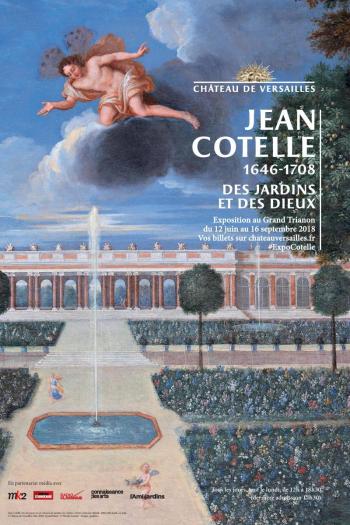 Jean Cotelle (1646–1708): Gardens and Gods, the first exhibition dedicated to the painter, will honour an artist who was very popular in his time, featuring some 120 works: paintings, drawings, engravings, miniatures, and sculptures from public and private collections. Jean Cotelle the Younger belonged to the generation of painters called upon by Louis XIV to decorate the Grand Trianon, a pleasure palace secluded from the hustle and bustle of the court.
For the Trianon Gallery, which overlooks the gardens and connects the Cool Room and the Garden Room, Cotelle was entrusted with the largest portion of the commission: twenty-one paintings. In order to adapt to the setting, he painted in vertical format, rather unusual for landscape painting, to create topographical representations of the Versailles gardens. He adorned the scenes with characters from mythology or fables arranged in two registers (earthly and heavenly), modelled upon the bucolic landscapes of Bolognese painter Albani.
This cycle, completed by three paintings by Jean-Baptiste Martin and Etienne Allegrain, represents a unique ensemble, providing insight into the king’s taste for his gardens which had recently been created by André Le Notre. Hidden by vegetation, the groves served as a backdrop for the portrayal of the loves and pleasures of the gods.
The exhibition will feature the twenty-four restored paintings following a restoration campaign that lasted several years. Along with the large format canvases, the fifteen gouaches created by the artist, masterpieces of miniature painting, will also be displayed. Additionally, a selection of lead sculptures will be included in the exhibition to evoke the decoration of the groves which have since disappeared, in relation to Cotelle’s paintings.
While the Trianon commission represents one of the highlights of Cotelle’s career, retracing the various stages of his work nevertheless reveals different aspects of his talent and his varied career in Saint-Cloud and Versailles as well as in Provence.

Jean Cotelle, Fountain Scene with Alpheus Pursuing Arethusa, 1689–91 (Château de Versailles, Dist. RMN/Jean-Marc Manaï).
Jean Cotelle the Younger was born into a cultured family in Paris in 1646. He grew up in the company of artists, especially painters, including his father Jean Cotelle the Elder, painter to the King, decorator and ornamental painter. He most likely received his early training from the portrait painter Claude Lefèvre. Jean Cotelle the Younger then visited Rome, where he stayed from 1665 until 1670 at his own expense.
His notable works from 1675 and the years which followed include miniatures to illustrate The Campaigns of Louis XIV as well as a large-format May for Notre-Dame in 1681 representing The Marriage at Cana. Cotelle also worked on other decorative commissions, in particular in Saint-Cloud where he created the jewellery cabinet as part of the decoration depicting the story of Venus and Aeneas.
The most important commission he received was a commission in 1688 from Louis XIV to decorate the Trianon gallery also called the Cotelle gallery. Cotelle painted twenty-one topographical representations of the gardens of Versailles, which he adorned with mythological and literary characters. At the same time, he carried out a series of twenty gouaches representing the Trianon Gallery in miniature.
In 1693, he left Paris for Provence, first making a stop in Lyon, where he created the decoration on the ceiling of the great hall for the Château de la Damette. From 1695 to 1700, he lived in Marseille and became the co-director of the opera with Duplessis. He also created ephemeral decorations such as The Entry of the Duke of Burgundy and the Duke of Berry into the City of Avignon. Jean Cotelle the Younger returned to Paris in 1703 where he continued his work for the Academy until his death in 1708.
Beatice Sarazin, ed., Jean Cotelle (1646–1708): Des Jardins et des Dieux (Paris: Liénart, 2018), 240 pages, ISBN: 978-2359062366, 39€ / $68.
◊ ◊ ◊ ◊ ◊
In preparation for the exhibition on Jean Cotelle, the Palace of Versailles launches a research notice for three works attributed to the painter: two gouaches and a drawing. These works disappeared from the public eye in the 1980s for two of them and soon after the year 2000 for the last one. However, reproductions and publications confirm that they exist (see the Château de Versailles website for images).
The works are:
• La Toilette de Vénus, drawing
• Vue du Château de Choisy du côté des parterres et la famille de Louvois, gouache
• Eliezer et Rebecca au Puits, gouache
Once found, their identification would enrich the corpus of the artist and the value of these works, which could be displayed in the exhibition. Internet users are invited to spread this search as far as possible with the hashtag: #ExpoCotelle. People having information about these works can contact the Palace of Versailles through: cotelle@chateauversailles.fr.
Exhibition | The Remaking of Scotland
Press release (12 June 2018) from the National Galleries of Scotland:
The Remaking of Scotland: Nation, Migration, Globalisation 1760–1860
Scottish National Portrait Gallery, Edinburgh, 16 June 2018 — 27 June 2021
A dynamic new exhibition at the Scottish National Portrait Gallery (SNPG) explores how Scotland’s place in the world was dramatically transformed after the mid-eighteenth century, as the country emerged as a leader of European cultural life and a major force in Britain’s industrial and imperial expansion. The Remaking of Scotland: Nation, Migration, Globalisation 1760–1860 traces this remarkable transformation through the many extraordinary personalities who contributed to this turning point in Scottish history, bringing together a range of fascinating paintings, sculptures, and drawings from the National Galleries of Scotland’s outstanding collection.
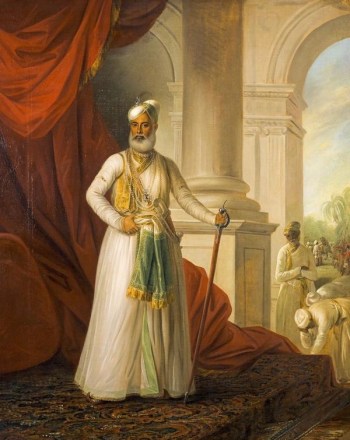
George Willison, Mohamed Ali Khan Walejah, Nawab of the Carnatic, 1777, oil on canvas, 236 × 146 cm (National Galleries of Scotland, Bequeathed by Douglas Willison Clark 1994, PG 2959).
As well as tracing the changes that took place within Scotland in the areas of science, technology, and literature, it will also look beyond Scotland’s borders to highlight the many Scots who ventured further afield—as soldiers, sailors, administrators, artists, missionaries, and adventurers. Their destinations ranged across the world, and the exhibition showcases work featuring Scots with close relationships to India, the Americas and Arctic, as well as the Caribbean.
Among the portraits on display is a captivating new acquisition—a portrait of the lawyer Sir Thomas Strange (1756–1841) by the fashionable London painter John Hoppner. Strange was the son of a Scottish engraver and spent his entire career abroad, first in Nova Scotia, Canada and then in India. While in Nova Scotia he used his position as Chief Justice to protect runaway slaves from their masters. In India, he helped create the fusion between British Common Law and Hindu traditions that would be the foundation of the modern Indian legal system. Hoppner’s characterful portrait gives a vivid sense of Strange’s intelligence and fair-mindedness. Strange’s portrait will be shown with a number of other paintings highlighting the relationships between Scotland and India at this time, including Scottish artist George Willison’s dramatic portrait of his Indian patron, Ali Khan Waledjah, Nawab of Arcot (1717–1795).
Other highlights of the display include Alexander Nasmyth’s portrayal of John Sakeouse (1792–1819), the first arctic Inuit to travel to Scotland. Sakeouse attained instant celebrity from the moment he arrived in Leith in 1816 as a stowaway on a whaling ship and was particularly famous for his remarkable canoeing and harpooning skills, which he demonstrated at the docks. Nasmyth painted the portrait after spotting Sakeouse on the street and went on to give him drawing lessons. Sakeouse became an indispensable member of Admiral John Ross’s arctic expedition of 1817–18, acting as a translator and artist. Fittingly, Sakeouse will be shown alongside a portrait of Ross, one of the great explorers of his time and one of the first Scots of the period to be represented in the collections of the SNPG.

John Singleton Copley, Hugh Montgomerie, 12th Earl of Eglinton, ca. 1780, oil on canvas, 226 × 149 cm (National Galleries of Scotland, PG 1516; photograph by Antonia Reeve).
In addition to documenting the material and cultural benefits that came from this period of unprecedented achievement, the display will also consider some abhorrent contemporary issues. A particularly important theme is Scotland’s extensive involvement in the plantation economy of the Caribbean and its dependence on slave labour. Many Scots went to the Caribbean in the hope of making their fortunes, becoming plantation and slave owners on a large scale. Meanwhile, Scottish merchants in the great ports of Glasgow and Leith maintained a vast West Indies trade, importing slave-produced sugar, rum, and tobacco. Some became hugely wealthy, but they were only the most prosperous of the thousands of Scots who enjoyed secure incomes from plantation investments. Others, however, were inspired by religious and moral convictions to oppose the appalling human cost of the slave trade. In the face of fierce resistance, abolitionists, including the prominent Scottish liberal lawyer and politician, Lord Brougham (1778–1868)—also featured in the display—finally brought slavery to an end in 1838.
Warfare, too, was a constant feature of life in this period, as Britain’s imperial interests involved the many Scottish soldiers and sailors in the British armed forces in bloody land and sea battles. Two spectacular full-length portraits of soldiers in full Highland Dress, John Singleton Copley’s Hugh Montgomerie, 12th Earl of Eglinton (who served in the French and Indian War of 1754–63) and Sir Joshua Reynolds’s John Murray, 4th Earl of Dunmore (made Governor of New York in 1770 and then of Virginia in 1771), show how the cost of war to life and health was made acceptable by the glory of victory.
Taken together, these diverse works give a vivid portrait of the richly complex, and sometimes controversial, legacies of this remarkable period, both at home in Scotland and across the wider world.
Exhibition | Splendours of the Subcontinent

Payag, Jahangir Presents Prince Khurram with a Turban Ornament (12 October 1617), detail, 1656–57 (London: Royal Collection Trust, RCIN 1005025.an), from the Padshahnama (‘Book of Emperors’), an illuminated manuscript recording the reign of the Mughal Emperor Shah-Jahan, which was sent to George III by the ruler of Awadh in 1799. More information on the Christian iconography of the wall paintings is available from the Royal Collection website.
◊ ◊ ◊ ◊ ◊
Press release (7 June 2018) from the Royal Collection Trust:
Splendours of the Subcontinent: Four Centuries of South Asian Paintings and Manuscripts
The Queen’s Gallery, Buckingham Palace, London, 8 June — 14 October 2018
Curated by Emily Hannam
Two exhibitions at The Queen’s Gallery, Buckingham Palace bring together some of the finest examples of craftsmanship and literary and artistic production from the Indian subcontinent. Both are drawn entirely from the Royal Collection, which contains one of the world’s greatest and most wide-ranging collections of material from the region. Exploring the long-standing relationship between the British Monarchy and South Asia, Splendours of the Subcontinent: Four Centuries of South Asian Paintings and Manuscripts presents 150 works from India, Pakistan, and Bangladesh, most of which are on public display for the first time. In the complementary exhibition Splendours of the Subcontinent: A Prince’s Tour of India 1875–6, gifts given to Albert Edward, Prince of Wales go on display in London for the first time in 130 years.
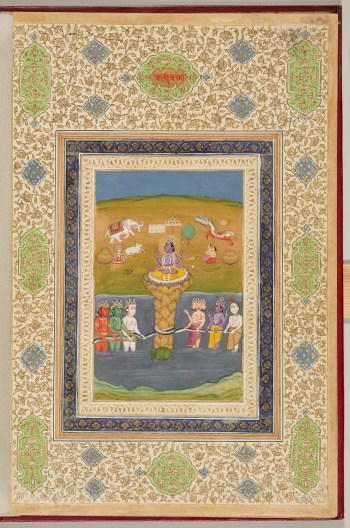
Indian School, Kurma, the Second Incarnation of Vishnu, ca 1790, 41 × 27 cm, page dimensions (Royal Collection Trust, RCIN 1005115.e).
Since the early 17th century, diplomatic gift-giving has played a crucial role in the development of the relationship between the British Monarchy and rulers of South Asia. Among the most important gifts received from the subcontinent is the Padshahnama (‘Book of Emperors’), an illuminated manuscript from 1656–57 recording the reign of the Mughal Emperor Shah-Jahan, sent to George III by the ruler of Awadh in 1799. Ten paintings from the Padshahnama, the only contemporary illustrated imperial volume to survive, are shown in the exhibition.
The Khamsa (‘Quintet’) of Nava’i, 1492, and the Gulistan (‘Rose Garden’) of Sa’di, 1584, also presented to George III, are among the finest examples of manuscripts that combine intricate calligraphy with exquisite illuminations. Sacred religious texts were also presented as gifts, including the 3.5m-long Quran Scroll, thought to have been given to George IV by one of the rulers of the Carnatic. All 114 chapters of the Quran are written on the scroll’s 5cm-wide surface in a miniscule naskh script, known as ghubar (‘dust’).
Queen Victoria acquired many South Asian books and manuscripts, including a volume of her own published journals, The Queen’s Travels in Scotland and Ireland, translated into Hindi by the Maharaja of Benares. Victoria’s interest in South Asian culture continued throughout her life, and her studies of the Hindustani language, undertaken in her seventies with her Indian secretary Abdul Karim, are recorded in her Hindustani diaries, which are shown in the exhibition with her Hindustani phrasebook.
Less well known are the paintings and manuscripts given to, and bought by, King George V and Queen Mary during their two tours of South Asia in the early 20th century. The King and Queen acquired contemporary works, such as Queen Tissarakshita, 1911, by Abanindranath Tagore, founder of the Bengal School of Art, as well as historic paintings reflecting the diverse cultures, history and religions of South Asia. These include a series of 16 paintings from the Pahari region, c.1775–90, depicting the story of the boy Prahlada as told in the seventh book of the Bhagavata Purana, one of the great Hindu sacred texts.
 King George V’s father, King Edward VII, was only the second member of the royal family to visit the subcontinent, undertaking a four-month tour in 1875–76 when Prince of Wales. Travelling almost 10,000 miles and meeting more than 90 local rulers in an effort to establish personal and diplomatic links, the Prince was presented with over 2,000 examples of Indian design and craftsmanship as part of the traditional exchange of gifts. The visit gave the Prince the opportunity to experience first-hand the magnificence of the Indian courts. Many of the gifts he received were ceremonial items connected to courtly customs, such as a pair of enamelled peacock feather fans, which play an important role in the spectacle of a durbar (audience). A ten-piece gold service, given by the Maharaja of Mysore, contains an attardan (perfume holder), rosewater sprinklers and a paandan (betel-nut holder), items associated with welcoming guests to an Indian court.
Traditional arms and armour form the largest group of gifts received by the Prince. These presentation pieces, intended to display their maker’s skill and creativity, include a dagger incorporating loose pearls that travel along a channel in the blade when tilted, and a gold punch dagger embellished with rubies and emeralds, fitted with a single flintlock pistol on both sides of the blade. Enamelled jewellery and decorative items from Jaipur were highly sought after by European visitors. An enamelled gold and diamond perfume holder, presented by Ram Singh II, Maharaja of Jaipur, took five years to produce. It opens like a lotus flower to reveal a hidden cup and cover, and is decorated with scenes of Jaipur’s great palaces.
The Prince recognised the significant cultural and artistic value of the gifts he had received. On his return to Britain he made arrangements for the items to be placed on public display, first at the South Kensington Museum (now the Victoria and Albert Museum) and then at the Bethnal Green Museum, followed by exhibitions in Paris, Copenhagen, and across the UK. Between 1876 and 1880 more than two million people in Britain alone saw the collection, which brought the wonders of Indian art to the British public and played an instrumental role in the intertwined narrative of British and Indian design.
Published by the Royal Collection Trust, catalogues for the two exhibitions are distributed in the USA and Canada by The University of Chicago Press:
Kajal Meghani, Splendours of the Subcontinent: A Prince’s Tour of India, 1875–6 (London: Royal Collection Trust, 2017), 200 pages, ISBN: 9781909741423, $40.
Emily Hannam, Eastern Encounters: Four Centuries of Paintings and Manuscripts from the Indian Subcontinent (London: Royal Collection Trust, 2018), 256 pages, ISBN 978-1909741454, £30 / $60.
 The Royal Library, Windsor Castle, is home to one of the most important collections of South Asian paintings and manuscripts in the world. This publication brings together highlights of these superb works, many of which have never before been publically displayed or published. From dazzling Mughal poetic texts to modern masterpieces, they span a geographical expanse from Kashmir to Kerala and for a period of more than 400 years.
This publication presents new scholarship exploring the history of how these works entered the Royal Collection, tracing the long-standing relationship between the British Crown and South Asia. Beautifully illustrated and meticulously researched, Eastern Encounters: Four Centuries of Paintings and Manuscripts from the Indian Subcontinent provides a fascinating insight into his rich and hither-to underexplored aspect of the Royal Collection.
Emily Hannam is Assistant Curator of Islamic and South Asian Collections, Royal Collection Trust. She curated Splendors of the Subcontinent: Four Centuries of South Asian Paintings and Manuscripts at the Queen’s Gallery, Buckingham Palace, and featured on the BBC series Art, Passion and Power. She holds degrees in art history from the Universities of Edinburgh and Oxford, specialising in the art of the book in South Asia.
Exhibition | Winckelmann and Curiosity
From Christ Church:
Winckelmann and Curiosity in the 18th-Century Gentleman’s Library
Upper Library at Christ Church, Oxford, 29 June — 26 October 2018
Curated by Amy Smith, K. C. Harloe, and Cristina Neagu
 To commemorate the Winckelmann anniversaries 2017/2018, Christ Church Library is preparing an exhibition and series of events in collaboration with the Faculty of Medieval and Modern Languages, University of Oxford and the Ure Museum of Greek Archaeology, University of Reading (a particularly appropriate partnership, since the University of Reading owes its origins to an extension college—University Extension College, Reading—founded by Christ Church in 1892).
Like many antiquarians of his day, the German art historian and archaeologist Johann Joachim Winckelmann (1717–1768) first learned about the ancient world through immersion in literature. As a teacher and then librarian in his native Germany, Winckelmann encountered the classics primarily through literary texts, as well as the souvenirs—coins, gems, and figurines—that grand tourists and other travellers had brought north from their visits to Italy. Once he arrived in Rome, where he rose to prominence at Prefect of Antiquities in the Vatican, Winckelmann studied the remains of Greek, Graeco-Roman, and Roman art on a larger scale. Through personal contacts, letters, and other writings, Winckelmann influenced his and subsequent generations of scholars, aesthetes, collectors, craftsmen and artists both within and beyond Italy.
Winckelmann and Curiosity in the 18th-Century Gentleman’s Library explores the scholar’s varied influence on the arts in Britain, through printed media, architecture, and decorative arts. This exhibition is part of the anniversary celebrations of the work of Winckelmann and particularly his impact on the reception of classical art in Britain. The exhibition will be launched with a symposium on Ideals and Nations: New perspectives on the European Reception of Winckelmann’s Aesthetics.
More information on the series of Winckelmann celebrations is available here»
Exhibition | Eternal Blooms: Chinese Painted Enamels

Round Potpourri, 18th century, Qing dynasty (1644–1911), enamel on copper (Cincinnati: Taft Museum of Art, bequest of Compton Allyn, 2014.001.49).
◊ ◊ ◊ ◊ ◊
From the Taft:
Eternal Blooms: Chinese Painted Enamels on Copper
Taft Museum of Art, Cincinnati, 2 March — 24 June 2018
Celebrate springtime with a lavish array of brightly colored flowers, fruits, and insects, all found decorating small utilitarian objects such as plates, bowls, and boxes. In the 17th century, Jesuit missionaries exported the painted enamel technique, which originated in Limoges, France, to Chinese workshops in Beijing and Guangzhou. During the 18th century, Chinese enamellers illustrated auspicious symbols drawn from the natural world as wishes for happiness, abundance, and long life in a wide range of newly available pastel colors. These rare and beautiful treasures are part of a generous bequest made in 2014 to the Taft Museum of Art from the late Reverend Compton Allyn, a collector and steadfast friend of the Taft. On view for the first time, this selection from his recent gift inaugurates a sequence of exhibitions to be held over the coming years, each of which will feature a different group of enamels.
Exhibition | Afro-Atlantic Histories
From ArtForum:
Histórias Afro-Atlânticas / Afro-Atlantic Histories
Museu de Arte de São Paulo (MASP) and concurrently at Instituto Tomie Ohtake, São Paulo, 28 June — 21 October 2018
Curated by Adriano Pedrosa, Ayrson Heráclito, Hélio Menezes, Lilia Schwarcz, and Tomás Toledo
In the most violent and uncertain times of its recent history, Brazil is revisiting the origins of its racial frictions: the slave trade. Histórias afro-atlânticas (Afro-Atlantic Histories) is a massive, 380-work survey of African, Latin American, and European art from the past five centuries, chronicling the largest diaspora in modern history. Nearly half of all Africans captured by slave traders were brought to Brazil, from the time the Portuguese arrived, in the sixteenth century, all the way through the nineteenth century. The show is a sequel to Histórias mestiças (Mestizo Histories), staged four years ago at the Instituto Tomie Ohtake, the cultural center that is also cohosting the current exhibition. Its scope is far-reaching, with pieces by colonial-era Dutch master Albert Eckhout and modern greats Théodore Géricault and Paul Cézanne, as well as contemporary art-world darlings Glenn Ligon, Kara Walker, and Hank Willis Thomas. A fully illustrated catalogue and companion reader will help sharpen our perspective on it all.
As noted in the May–August 2018 bulletin from the Yale Center for British Art, the YCBA has loaned six works including four paintings by Agostino Brunias (1728–1796).
Note (added 14 October 2018) — Reviewing the exhibition for The New York Times (12 October 2018), Holland Cotter describes it as “a hemispheric treasure chest, a redrafting of known narratives, and piece for piece one of the most enthralling shows I’ve seen in years, with one visual detonation after another.” The full review is available here.
Exhibition | A Taste for the Exotic: European Silks
Press release (April 2018) from the Abegg-Stiftung:
A Taste for the Exotic: European Silks of the Eighteenth Century
Der Hang zur Exotik: Europäische Seiden des 18. Jahrhunderts
Abegg-Stiftung, Riggisberg (near Bern), 29 April — 11 November 2018
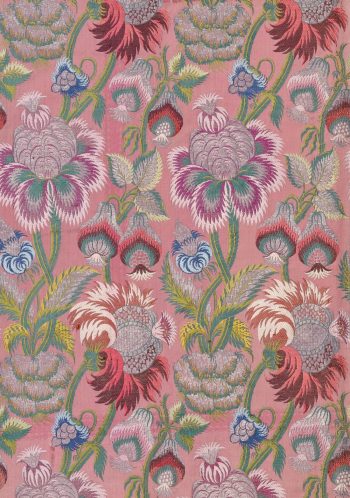
Silk weaving with exotic looking flowers; Lyon, ca. 1725–30 (Riggisberg: Abegg Stiftung, inv. no. 174).
Weird, bold, extravagant—this is how the luxury fashion fabrics of the early eighteenth century appear to us today. The intriguing patterns of these 300-year-old silks reflect a pronounced taste for the exotic. Some of the finest examples of this ‘crazy’ fashion can now be admired in the Abegg-Stiftung’s new exhibition.
Being glamorously fashionable in the eighteenth century entailed first and foremost wearing lavishly patterned silks. While the cuts of both ladies’ gowns and men’s attire scarcely changed throughout the century, new fabric pattern collections came out regularly. Several trends developed, but what all have in common is a preference for strange-looking motifs and extravagant compositions redolent of exotic worlds. Arranged more or less chronologically, the exhibition explores this development and presents a selection of the impressive pattern styles—some of them made up into garments—that were en vogue between 1690 and 1740.
Bizarre Silks
The ‘bizarre silks’ are undoubtedly one of the highlights of the show. These fabrics dating from the period 1690 to 1720 count among the most exotic creations that silk weavers ever produced. Their patterns are so fantastical and bizarre that they almost defy description. Geometrical shapes and purely imaginary figures are here combined with plants that no one has ever seen and strange-looking shadows. While the various motifs stand out clearly from each other and from their damask ground, they are not necessarily identifiable; many are no more than vaguely reminiscent of certain objects or creatures. Here, nature was not the model, it seems. Seen with today’s eyes, some objects look almost futuristic. Their bold colours and the use of gold and silver thread make these fabrics even more spectacular. It is hard to believe that ladies and gentlemen of rank wore clothes made of such brightly coloured, wildly patterned fabrics.
This stylistic phase is thought to have been inspired by Asian art forms, even if no exact models for it have been found as yet. Pattern designers simply borrowed whichever motifs took their fancy and adapted them according to their own ideas, almost certainly taking their cues from the design principles of the Far East. These included a preference for asymmetrical compositions with large, dynamic, often diagonally arranged motifs, which the Europeans then combined as desired, even without any logical or narrative thread; hence their exotic or ‘bizarre’ appearance.
‘Persiennes’ or Lace Pattern
The next fashion trend to follow the surging exuberance of the bizarre silks lasted from ca. 1720 to 1730 and pointed in the opposite direction, as it were. Now the demand was for intricately structured symmetrical patterns, whose white diapered grounds recall fine lace. Yet the models for these decorative, openwork elements are to be found less in European lace than in oriental styles of ornament. Some of the French design drawings for patterns like these are labelled ‘persienne’, which is the name used to describe them in historic sources. Not until much later did art historians, in a nod to their appearance, start referring to them as ‘lace pattern’. Many of the robes and gowns made of such lace-patterned silks were worn at official, ceremonial occasions. That they were also worn in private is evident from the pale blue and white patterned banyan with matching cap on show in the exhibition. This is the kind of outfit a fashion-conscious gentleman might have worn over his knee breeches and chemise in the privacy of his own home. The generous, kimono- or kaftan-like cut had the advantage of being at once comfortable and exotic.
Not so Natural Naturalism
The dominant style from the 1730s was Naturalism. This was identifiable by a marked preference for colourful plant motifs rendered with painterly finesse and a mastery of perspective such as had never before been produced on a loom. The consistent fall of light, abundant highlighting and shading, and fine gradations of colour lend these motifs a true-to-life, three-dimensional appearance. Interlocking, variously coloured weft threads were an important design element here since they enabled the kind of minimal variations in colour that might make even a woven motif look painted. Many of the fabric patterns in the naturalistic style likewise have an exotic quality, especially those that feature tropical fruits and plants that were all but unknown in Europe at the time. One of the silks on display in the exhibition shows pineapples and banana flowers, for example. Far more common, however, are plants, flowers and fruits of the pattern designer’s own invention. Their proportions are often perplexing and some of these flamboyantly colourful blooms seem excessively large. Rendered in a style that is at once realistic and dynamic, these curious plants still look ‘natural’—like specimens from some distant land.
Chinoiseries
A rather more romantic, almost fairy-tale-like style to feature in the eclectic silk pattern catalogues of the early eighteenth century were chinoiseries. Here, the exotic influences are very clearly in evidence as Chinese porcelain, Far Eastern pagodas, Asiatic-looking figures, and ideograms are playfully combined and artfully arranged to produce picturesque scenes and attractive pattern repeats. The aim was not so much to produce naturalistic depictions of Asian plants and animals as to give free rein to European fantasies of life in faraway countries, their inhabitants, and their way of life. The results of such flights of fancy are sometimes very odd indeed, as is borne out by a Dutch silk showing Chinese figures sporting Ottoman turbans. Chinoiseries were en vogue from ca. 1720 to 1740.
Inspiration from Afar
But how did these fabrics come to be patterned with such extraordinary designs? Where did the textile designers of the age draw inspiration? The general fascination with the wares and works of art from the Near and Far East that had been arriving in Europe ever since overseas trade began in earnest in the seventeenth century was undoubtedly a crucial factor here. The ships of the British and Dutch East India Companies brought back not just tea and spices from their voyages to Asia, but also porcelain, wallpaper, lacquer work and textiles. These must have fired the imaginations of Europe’s pattern designers, much as did the many illustrated accounts of journeys to faraway places published at around the same time. One famous example of such a travelogue on show in the exhibition is Johan Nieuhof’s description of his journey to China with a delegation of the Dutch East India Company, published in 1665. Nieuhof accompanied the expedition and wrote a lavishly illustrated account of both the land and its inhabitants. His illustrations in particular proved to be a rich source of inspiration for those European artists who wanted to surprise their noble clientele with ever new motifs from the big wide world.
But the textiles on show in this exhibition are impressive for reasons that go beyond their fantastical patterns alone. Even just the materials out of which they are made—silk, gold, and silver thread—tell us that these were luxury products that very few could afford. Their manufacture, too, was time-consuming and expensive, and the weaving presupposed a very high level of technical accomplishment. To be able to weave fabrics with patterns as wild or intricate as these, the loom first had to be set up or ‘programmed’. Thus a highly specialised line of business emerged, whose primary purpose was to satisfy the exacting demands of aristocrats and the wealthy bourgeoisie. The textiles on show here thus represent a union of exquisite materials, astonishing creativity and craftsmanship. It is a fascinating combination, and one that for several decades held sway over genteel society’s fashion tastes.
Exhibition | Humphry Repton at Woburn Abbey
Now on view at Woburn Abbey:
Humphry Repton: Art & Nature for the Duke of Bedford
Woburn Abbey, 23 March — 28 October 2018
Curated by Matthew Hirst and Victoria Poulton
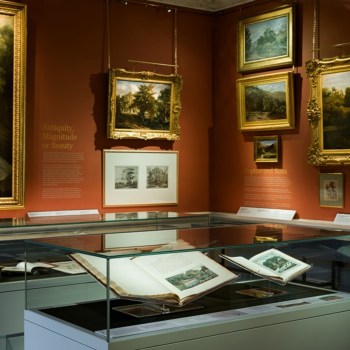 When the 6th Duke of Bedford inherited Woburn in 1802, he commissioned the famous landscape gardener, Humphry Repton (1752–1818), to create designs to enhance the gardens and parkland. 2018 celebrates the bicentenary of Humphry Repton.
Recognised as the first person to invent and use the title ‘landscape gardener’, Humphry Repton regarded himself as the rightful successor to Lancelot ‘Capability’ Brown. Repton produced over 400 designs and schemes for gardens great and small, but of these, he stated, “none were more fully realised than at Woburn Abbey.” He published his theories in two influential books, Observations on the Theory and Practice of Landscape Gardening (1803), and Fragments on the Theory and Practice of Landscape Gardening (1816). In these, he promotes his style and references his important work for the Duke of Bedford.
With the Duke being Repton’s most important client, at a time of declining commissions, the Woburn Red Book is one of his largest works. It contains Repton’s most ambitious and detailed designs covering the approaches to the Abbey, the lakes and plantings in the surrounding parkland, and the formal Pleasure Grounds.

The Rockery and Chinese Pavilion at Woburn Abbey; the pavilion was constructed in 2011.
Open to the public between 23rd March and 28th October 2018, the new exhibition explores the fascinating relationship between Repton and one of his greatest clients. On public display for visitors to see for the first time will be his most elaborate and comprehensive Red Book. In addition, the exhibition will give visitors the opportunity to discover Repton’s other works for the family including at the picturesque Devon estate of Endsleigh, Oakley House, and Russell Square in London. Never before seen unexecuted designs will feature alongside works of art and archival treasures, which bring to life the creative legacy of Repton. There will also be Repton-related family trails, activities, and events throughout the year.
Having explored the Repton’s legacy in the exhibition, visitors need only step outside to discover Repton’s beautiful landscape designs. Since 2004 the present Duke and Duchess of Bedford have been restoring many of Repton’s features in the Woburn Abbey Gardens. These include the folly grotto, the Cone House, the menagerie, and the striking Chinese-style pavilion, which was completed in 2011 and went on to win a Hudson’s Heritage Award. In 2013, Woburn’s project to restore the 19th-century Humphry Repton landscape won the ‘Best Restoration of a Georgian Garden’ at the Georgian Group Architectural Awards. Other Repton features in the Woburn landscape include the Aviary, set to be further restored in 2018, and the Doric Temple.
Exhibition | Lost Treasures of Strawberry Hill
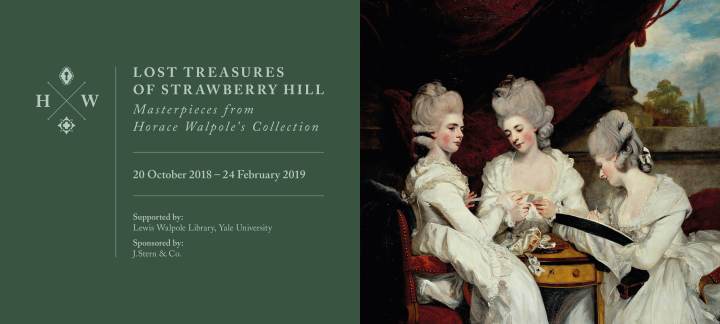
Joshua Reynolds, Portrait of the Ladies Waldegrave, 1780-81, oil on canvas, 143 × 168 cm (Edinburgh: National Galleries of Scotland, purchased with the aid of The Cowan Smith Bequest and the Art Fund 1952).
◊ ◊ ◊ ◊ ◊
This fall at Strawberry Hill:
Lost Treasures of Strawberry Hill
Strawberry Hill House & Garden, Twickenham, 20 October 2018 — 24 February 2019
Curated by Silvia Davoli and Michael Snodin
This exhibition brings back to Strawberry Hill some of the most important masterpieces in Horace Walpole’s famous and unique collection for a once-in-a-lifetime exhibition. Horace Walpole’s collection was one of the most important of the 18th century. It was dispersed in a great sale in 1842. For the first time in over 170 years, Strawberry Hill can be seen as Walpole conceived it, with the collection in the interiors as he designed it, shown in their original positions.
Strawberry Hill was filled with a celebrated collection of paintings, furniture, sculptures, and curiosities: great portraits by Sir Joshua Reynolds, Sir Peter Lely, Allan Ramsay, Rubens, Van Dyck, Hans Holbein, and Clouet; miniature portraits by Isaac and Peter Oliver, Hilliard and Petitot, a carved Roman eagle from the 1st century AD; fine furniture including a Boulle cabinet, fabulous Sèvres pieces as well as some oddities such as a lime-wood cravat, carved by Grinling Gibbons, a lock of Mary Tudor’s hair and a ‘magic mirror’ (an obsidian disc) which Dr Dee, Queen Elizabeth I’s necromancer, had used for conjuring up the spirits.
 In 1842, the collection was dispersed worldwide in a 28-day ‘sale of the century’. From the 1920s to the ‘70s, Walpole scholar and consummate collector Wilmarth S. Lewis, who edited and published with Yale University Press the 48-volume Yale Edition of Horace Walpole’s Correspondence (New Haven, 1937–83), assembled the largest private collection of Walpoliana, including many pieces from Strawberry Hill, which he and his wife bequeathed to Yale University in 1980 as the Lewis Walpole Library, with whose help the Strawberry Hill Trust is delighted to be mounting this exhibition.
Walpole left detailed descriptions of the displays in each of the main rooms of his villa, so that nearly all the works can be shown in their original positions. In The Great Parlour, a display of portraits of Walpole’s family includes the famous Reynolds’s painting of Walpole’s nieces, The Ladies Waldegrave, (now in the National Gallery of Scotland). The Tribune will house the famous rosewood cabinet designed by Walpole, owned by the V&A, together with a display of exquisite portrait miniatures. Walpole’s gilded, crimson Gallery will be once again house the impressive Roman sculpture of an eagle and be hung with life-size portraits, including The Family of Catherine de Medici by Clouet.
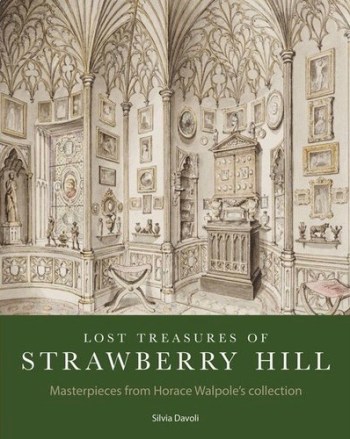
Silvia Davoli, Lost Treasures of Strawberry Hill: Masterpieces from Horace Walpole’s Collection (London: Scala Arts & Heritage Publishers, 2018), ISBN: 9781785511806, £15.










leave a comment