Exhibition | A Stitch in Time at Ham House
Now on view at Ham House near London:
A Stitch in Time
Ham House, Richmond, 10 February — 29 April 2018
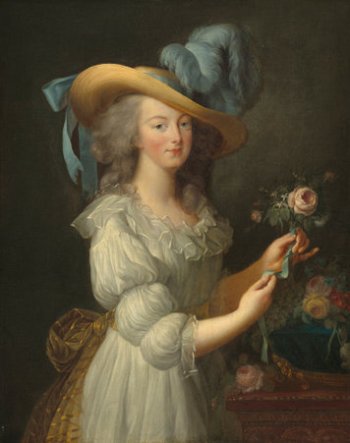
Anonymous artist, after Élisabeth-Louise Vigée Le Brun, Portrait of Marie-Antoinette in a Chemise Dress, after 1783, oil on canvas (Washington, DC: National Gallery of Art).
Earlier this year, BBC Four broadcasted the documentary A Stitch in Time. Presenter Amber Butchart and a team of expert tailors headed by Ninya Mikhaila, took inspiration from works of art and recreated historical clothing using only authentic methods. The six costumes created come to Ham House this spring, allowing visitors to see the intricate work of costumier Ninya Mikhaila and her team up close.
The six costumes include:
• Charles II from a painting at Ham House by Thomas Stewart (from the collection at Ham House)
• The dress from the Arnolfini Portrait by Jan van Eyck at the National Gallery
• The Hedge Cutter leather jacket from a portrait at Broughton Castle
• The dress of Dido Elizabeth Belle from a painting at Scone Palace
• The Jupon of the Black Prince from the effigy at Canterbury Cathedral
• Marie Antoinette’s Chemise à la Reine from a painting by Élisabeth Louise Vigée Le Brun

From left to right: Harriet Waterhouse, Ninya Mikhaila, Amber Butchart, Hannah Marples
A Stitch in Time can be viewed in the UK via the BBC iPlayer. The show is not available in the US, but some episodes have been uploaded to YouTube.
Exhibition | Peacock in the Desert: The Royal Arts of Jodhpur
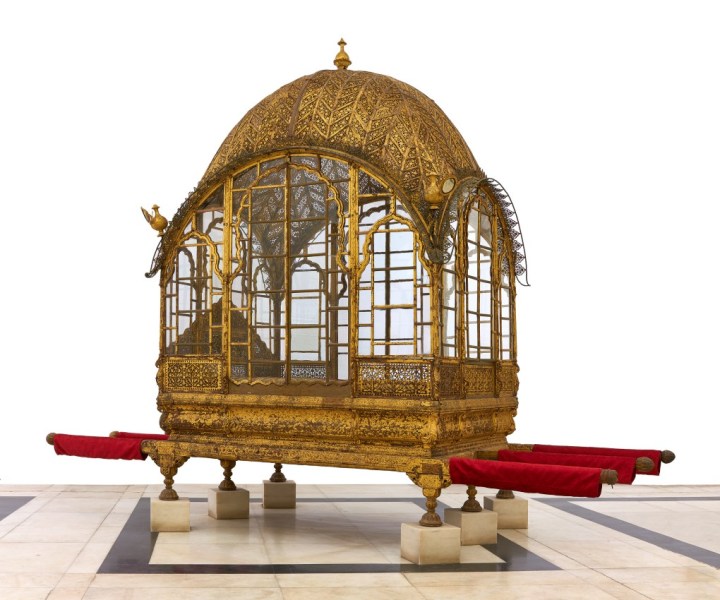
Palanquin (Mahadol), Gujarat, ca. 1700–30, gilded wood, glass, copper and ferrous alloy (Mehrangarh Museum Trust; photograph by Neil Greentree).
◊ ◊ ◊ ◊ ◊
Press release (8 January 2018) from the MFAH:
Peacock in the Desert: The Royal Arts of Jodhpur, India
Museum of Fine Arts, Houston, 4 March — 19 August 2018
Seattle Art Museum, 18 October 2018 — 21 January 2019
Royal Ontario Museum, Toronto, 9 March — 2 September 2019
Curated by Mahrukh Tarapor, Karni Singh Jasol, Martand Singh, and Angma Dey Jhala
A major collaboration brings a groundbreaking exhibition of royal treasures from India to Houston in March. Organized by the Museum of Fine Arts, Houston, in partnership with the Mehrangarh Museum Trust of Jodhpur, Peacock in the Desert: The Royal Arts of Jodhpur, India showcases nearly four centuries of artistic creation from the kingdom of Marwar-Jodhpur, one of the largest princely states in India, in the northwestern state of Rajasthan.
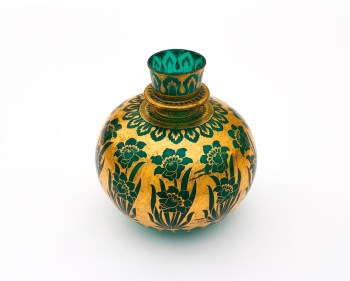
Mughal, Huqqa Vase, early 18th century, glass and gold paint (Umaid Bhawan Palace; photograph by Neil Greentree).
Through lavishly made ceremonial objects, finely crafted arms and armor, sumptuous jewels, intricately carved furnishings, and more, the exhibition outlines the dynamic history of the Marwar-Jodhpur region and the Rathore dynasty that ruled it for over seven centuries. Established in the 15th century, the city of Jodhpur was once the powerful capital of Marwar, a vast desert kingdom ruled by the Rathores, who were descendants of a hereditary social caste of Hindu warriors and kings (known as ‘kshatriyas’). Over the course of several centuries, the prosperity of Jodhpur attracted the attention of two successive empires who ruled India: the Mughals and the British. Both encounters reshaped Jodhpur’s cultural landscape, introducing objects, artists, languages, architectural styles and systems of administration that influenced the royal identity of the Rathore dynasty. Through some 250 objects from Indian courtly life, most never before seen outside of Jodphur, the exhibition illuminates how the Rathores acquired and commissioned objects amidst these cross-cultural exchanges to leverage patronage, diplomacy, matrimonial alliances, trade, and conquest.
Drawn primarily from the collections of the Mehrangarh Museum Trust and the private collections of the royal family of Jodhpur, the exhibition marks the first time that most of these treasures—including paintings, decorative arts and furniture, tents, canopies, carpets, textiles, and weapons—will be seen outside of their palace setting at Mehrangarh Fort and the first time they will travel abroad. The foundations of the Fort, carved out of a rocky hillside 400 feet above Jodhpur, were laid by the Rathores in 1459 as a military stronghold. The Fort, famously described by Rudyard Kipling as “a palace that might have been built by Titans and colored by the morning sun,” has been the seat of the Rathore dynasty since then, serving as a royal residence, a center of cultural patronage, and a place of worship for the royal clan. Today, it houses the collection of the Mehrangarh Museum Trust, which was established in 1972 by the current dynastic head of the Rathore clan, His Highness Maharaja GajSingh II of Marwar-Jodhpur, and remains one of the most important and best-preserved collections of fine and applied arts from the Mughal period of Indian history. A handful of carefully chosen objects from other notable collections, including The al-Sabah Collection, Kuwait, complete the presentation, while large-scale photomurals will evoke the stunning setting of the Mehrangarh Museum, where H. H. Maharaja Gaj Singh II continues to preserve the living heritage of Jodhpur.
“Peacock in the Desert is the result of a landmark partnership, marking the first time the Mehrangarh Museum Trust has shared so many of the treasured objects of their collection,” commented Gary Tinterow, MFAH director. “We are deeply honored and grateful to be the first U.S. organization to present this show, and for the opportunity to provide visitors this unprecedented experience of India’s rich cultural history.”
“The fort of Jodhpur-Mehrangarh has been preserved as a record of the lives and legacy of the Rathores,” added His Highness Maharaja GajSingh II. “I look forward to sharing the artistic and cultural heritage of my country, India, and the city of Jodhpur and its people, with new audiences across North America.”
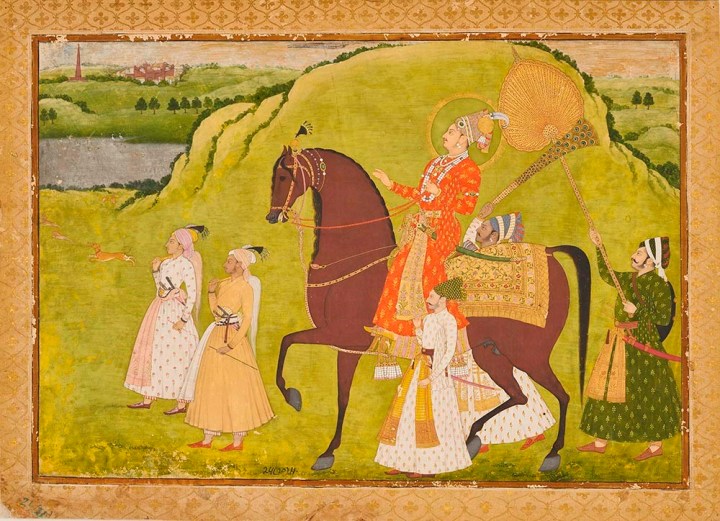
Dalchand, Maharaja Abhai Singh on Horseback, Jodhpur, ca. 1725, opaque watercolor and gold on paper (Mehrangarh Museum Trust; photograph by Neil Greentree).
◊ ◊ ◊ ◊ ◊
Three central, underlying themes woven throughout Peacock in the Desert build upon recent and emerging scholarship to deepen visitors’ understanding of the multifaceted character of a traditional Indian kingdom:
• Interconnections: The relationships between palace and town, urban and rural, central empire and subsidiary kingdom, as well as those that resulted from migratory trade routes, marital alliances, and military partnerships/confrontations, all led to a dynamic crosspollination of new ideas and belief systems, which found brilliant expression in fine and decorative arts, architecture, design, performing arts, and more.
• The role of women and artisans: Contrary to the popular assumption that royal women were quietly hidden away, the exhibition explores the crucial role they played as agents of cultural change and patrons of the arts, showcasing how the gender roles, social etiquette, and aesthetic practices employed by women influenced the identity of Indian courts.
• Royal patronage and the continuity of tradition: An exploration of the royal courts and the ways they were able to preserve India’s cultural traditions, while at the same time absorbing and incorporating external influences.
These themes offer a new perspective on the cosmopolitan culture of the royal courts of the Marwar–Jodhpur region, communicated through the careful juxtaposition of objects, interpretive materials, and immersive installation within the exhibition’s six interlinked sections.
Tradition and Continuity: The Royal Wedding Procession
The exhibition opens with a dramatic recreation of a royal wedding procession with video projections of actual footage from royal weddings performed in the 20th century. Featuring elephant howdahs (seats), horse and elephant mannequins adorned with traditional wedding regalia, and royal insignia, this immersive environment introduces visitors to the role that marital alliances played in the lives of the citizens of Marwar-Jodhpur and in the development of the region’s aesthetic traditions.
The Rathores of Marwar
This section introduces the desert landscape of Marwar-Jodhpur, its diverse peoples, and the exhibition’s central protagonists: the Rathore clan that ruled the region from the 13th to the mid-20th century. Highlights include illuminated manuscript pages that illustrate the scenery of the region and detail the history of the dynasty; an exquisite wood and glass Mahadol (palanquin); textiles, such as turbans worn by various members of the desert community; and a model of the Mehrangarh Fort, in silver.
Conquest and Alliance: The Rathores and the Mughals
The arrival of, and eventual takeover by, the Mughal Empire in 1561 began centuries of political and military alliances brokered between the Mughals and the Rathore clan. This section examines the movement of objects throughout these alliances in the 16th and 17th centuries, presenting ornate sabers, daggers, and rifles alongside 17th- and 18th-century paintings and illustrations of court and war scenes. The section culminates in the extraordinary 17th-century Lal Dera tent, one of the oldest, if not the only, intact Indian court tent of its time.
Zenana: Cross-cultural Encounters
In this section, paintings, carpets, textiles, jewelry, along with intricately-carved sandstone jalis (screens), from behind which women viewed courtly activities, evoke the setting of a royal zenana, the womens’ wing of a Rathore palace. Here, the zenana is explored as a dynamic cosmopolitan space that not only housed women and objects, but also functioned as a preserver of intangible cultural traditions through the propagation of heirlooms, rituals, and dress throughout the centuries. Among the furnishings shown in this section is an exceptional wood baradari (pavilion).
Durbar: The Rathore Court
As Mughal influence began to decline in the late 18th century, the Rathore durbar (royal reception) capitalized on its diminished power by attracting artists and craftsmen from their weakened court. This, in addition to the growing trend of exchanging artworks as gifts, led to a period of intense creativity in artistic and decorative production and a cross-fertilization of Mughal and Rathore styles, as indicated by the woven canopy and textiles, finely crafted arms and armor, and 18th- and 19th-century paintings on view.
The Raj
Extravagant, large-scale objects immediately convey the tone of the last section of the exhibition, which explores the most dramatic period of transformation in Jodhpur’s history, triggered by the arrival of the British in 1818. Garments, paintings, decorative arts, and a 1944 Stinson L-5 Sentinel aircraft illustrate the influence of the British on the region and the unprecedented scale on which Jodhpur royalty began to embrace modernity and western culture as the movement for Indian independence—eventually granted in 1947—gained traction.
Peacock in the Desert is curated by a team of scholars and professionals from India: Dr. Mahrukh Tarapor, senior advisor for international initiatives at the Museum of Fine Arts, Houston; Dr. Karni Singh Jasol, director of the Mehrangarh Museum Trust, Jodhpur; the late Martand Singh, chief consultant from the Mehrangarh Museum Trust; and Dr. Angma Dey Jhala, associate professor at Bentley University, who serves as project advisor and volume editor for the accompanying catalogue.
Distributed by Yale UP:
Karni Jasol, with contributions by Peter Alford Andrews, Robert Elgood, Catherine Glynn, Karni Jasol, Angma Jhala, Shailka Mishra, and Giles Tillotson, and edited by Angma D. Jhala, Peacock in the Desert: The Royal Arts of Jodhpur, India (Houston: Museum of Fine Arts, Houston, 2018), 296 pages, ISBN: 9780300232967, $85.
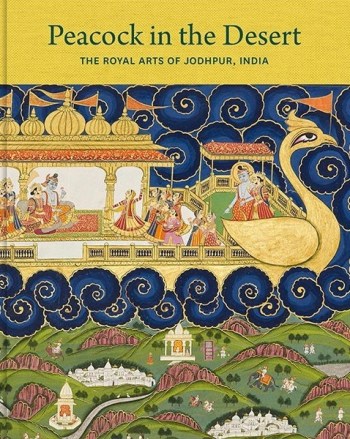 Peacock in the Desert traces the evolution of royal identity in the kingdom of Marwar-Jodhpur in southwestern Rajasthan from the 17th century to the establishment of independence after 1947, presenting the area as a microcosm of India’s extraordinarily vibrant culture. An international team of contributors has contextualized these regional narratives in relation to external—and even global—forces. The book thus offers a new perspective on the acquisition and commissioning of objects through patronage, diplomacy, matrimonial alliances, trade, and conquest. It sheds fresh light on the influential role of women at the royal courts and examines monarchies as lenses onto cross-cultural relationships, the unrecognized roles of groups marginalized in earlier accounts, cultural heterodoxy, and large-scale multicultural exchange. Exploring these webs of connection, Peacock in the Desert makes a transformative contribution to scholarship. Its multidisciplinary approach to artistic and cultural exchange offers pathbreaking insights, adding crucial chapters to the story of India’s royal visual splendor.
Social Media | Redressing Pleasure
Social media and crowd sourcing campaigns can be daunting tasks for museum professionals. The Museum of London’s recent #redressingpleasure campaign offers an exemplary model. With fashion curator Timothy Long’s Twitter and Instagram videos reaching thousands, their efforts have been both engaging and effective.
–Intern JMB
Timothy Long, our fashion curator, has been posting some selfies from inside our Costume Store, as part of our month-long Redressing Pleasure campaign. He’s highlighting some of the most fascinating fashions from our collection of 18th- and 19th-century clothing and picking the best to include in our new, updated Pleasure Gardens gallery display.
Please join us in #redressingpleasure & help us conserve & exhibit rare 18-19th century artefacts. Go to @artfund @ https://t.co/zJQL6Vmnoa pic.twitter.com/dD8Br0fde6
— Timothy Long (@Fashion_Curator) November 3, 2017
We need your help to conserve & exhibit this late 18th century dress, as part of the #redressingpleasure project 👉🏽 https://t.co/lb7K933Qm9 pic.twitter.com/r2g2TTlOmJ
— Timothy Long (@Fashion_Curator) November 4, 2017
This exquisite c. 1790 dress is one of the artefacts we want to conserve and exhibit as part of #redressingpleasure. The conservation will be done by Textile Conservator @melina.plottu. While the bodice is in near mint condition, the skirt needs attention as it is sewn to a thin and fragile silk ribbon waistband, which is not strong enough to support the weight of the skirt. We need your support to help us conserve the waistband and a few other areas. We also need your support to help us reproduce some petticoats, which is a fun, yet time-consuming process—as the shape must be cut to properly exhibit the skirt (and to fit the mannequin).
Will you help us put our ‘Queen of the Night’ back together again? For more info on #RedressingPleasure @artfund: https://t.co/zJQL6Vmnoa pic.twitter.com/4uGZW18LaZ
— Timothy Long (@Fashion_Curator) November 5, 2017
Oh wow! What a treasure. This late 18th-century dress was donated with dozens of ‘scrap’ pieces. As I started to go through these pieces, I was shocked and delighted to find identifiable parts, giving us glimpses of older incarnations of the dress. While the sleeves and the inner layer of the bodice appear to have remained throughout each upgrade, the exterior to the bodice and parts of the skirt, were cut off and kept. We would like to include this dress in our new Pleasure Gardens display, but it requires some creative solutions to put it back together again and then to build a mannequin to exhibit it properly, including petticoats. Will you help us put the ‘Queen of the Night’ back together again?
A Victorian Archeress 💘 We need your support to complete this ensemble. We must make a skirt & undersleeves & we hope to buy an 1850s archery bow! Will you help us? 👉🏽 https://t.co/zJQL6Vmnoa pic.twitter.com/3xxKscFZsc
— Timothy Long (@Fashion_Curator) November 8, 2017
A Victorian Archeress! It doesn’t get much better than this. This stunning ensemble was donated to the Museum of London in 1954. It was worn by Mrs Fanny Giveen (1833–1863). If you know anything about her, please do get in touch. This ensemble will be our ‘performer’ in the 19th-century side of the gallery. Vauxhall Pleasure Gardens had ‘archery fetes’ in the 19th century, represented by this costume. We are so pleased to have an excuse to exhibit this incredible ensemble. However, we must reproduce her skirt and undersleeves and I hope to buy an original 1850s women’s archery bow, to complete the ensemble.
Thank you for your positive responses to our Archeress. Here are more details of the ensemble. Filled pages, water coloured targets & purple feathers on the arrows 💘 For more info & to donate 👉🏽 https://t.co/zJQL6Vmnoa pic.twitter.com/Vm6o1VR9Kv
— Timothy Long (@Fashion_Curator) November 9, 2017
Our Archeress received such a wonderful response on social media that I recorded a second video. Thank you! I thought you might like to see more of the ensemble. Every page of the notebook is filled with scores, lists and drawings…all appear archery related and all written by Fanny Giveen herself! And then the water coloured targets… I’m in love.
If you ❤menswear, we have some rare 18-19th century examples, which need your support! For info & to donate: https://t.co/zJQL6Vmnoa #style pic.twitter.com/Qk24rNvYjq
— Timothy Long (@Fashion_Curator) November 6, 2017
We hope to exhibit this 1830s pelisse next to the men’s 1830s coat. We are calling this ‘couple’, Jeremiah and Electa. I fell in love with this pelisse immediately. For women’s fashion, I think the period around 1830 is fascinating. The odd proportion in design, enormous sleeves, towering hats, and feathers. We may even get to work with ‘sleeve supporters’ (parts of a costume, not donors to #RedressingPleasure). I am really looking forward to seeing this pelisse conserved and mounted, with all the correct undergarments and accessories.
On Loan | Fragonard’s Young Girl Reading
Press release, via Art Daily (21 February 2018). . .
Honoré Fragonard’s Young Girl Reading
Speed Art Museum, Louisville, February — 15 May 2018
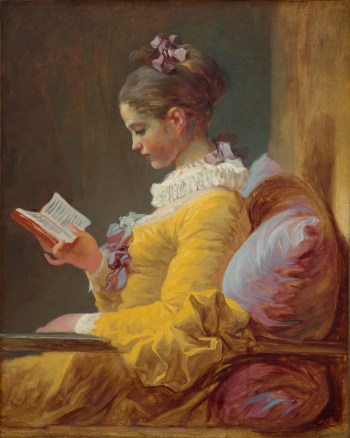
Jean Honoré Fragonard, Young Girl Reading, ca. 1769, oil on canvas, framed: 104.9 × 89.5 cm (National Gallery of Art, Washington, D.C., Gift of Mrs. Mellon Bruce in memory of her father, Andrew W. Mellon).
The Speed Art Museum unveiled a special “Mystery Masterpiece”, Jean Honoré Fragonard’s (1732–1806) Young Girl Reading, ca. 1769. The painting is on loan from the National Gallery of Art in Washington, D.C., through May 15, 2018. The painting was most recently part of the Fragonard: The Fantasy Figures exhibition at the National Gallery of Art.
“The Speed is thrilled to showcase this important and beautiful masterpiece,” said Erika Holmquist-Wall, Chief Curator, Speed Art Museum, and Mary and Barry Bingham, Sr. Curator of European and American Paintings and Sculpture. “We are so fortunate and happy to welcome this painting to Kentucky, even for a short while. It’s really a treasure and has to be seen in person.”
The Speed and the National Gallery of Art have participated in reciprocal loans, sending the Speed’s popular Portrait of Madame Adélaïde by Adélaïde Labille-Guiard, (ca. 1787) to the National Gallery in 2017 (it has since returned to the Speed) where it was on view in the exhibition America Collects Eighteenth-Century French Painting, and now welcoming Fragonard’s Young Girl Reading to the Speed.
“This painting is one of the most beloved works in the National Gallery of Art’s collection,” said Yuriko Jackall, the National Gallery’s specialist of eighteenth-century French paintings and curator of Fragonard: The Fantasy Figures. “It doesn’t leave the National Gallery often, so this is a rare opportunity for the Speed to showcase this painting to the public.”
“Fragonard was consistently among the most innovative and brilliant painters of his time,” said Holmquist-Wall. “He was interested in the world as a setting for imagined pleasures, as were his clients, who were mostly private financiers and aristocrats. He developed a style characterized by delicate color and an affinity for witty, lighthearted subjects. It can be pretty risqué, too—Fragonard’s paintings are filled with abundant gardens populated with amorous young couples. Of course, these were very popular with his patrons, and such paintings helped him earn his keep.”
Fragonard epitomized the artistic style known as Rococo, a highly ornate, decorative style of art which was dominant in France during the reign of Louis XV (1715–74). Rococo art was fanciful and airy, often featuring witty, elegant, or voyeuristic subject matter. It was a style that introduced a greater playfulness and sensitivity to feelings and moods. Unfortunately, the demand for such carefree themes ceased with the French Revolution. Until shortly before his death in 1806, Fragonard worked as a curator at the Parisian museum that would eventually become the Louvre, and he died virtually forgotten.
Around 1769, Fragonard painted a group of works known today as his fantasy figures: vibrant canvases showing individual models in fancy dress engaged in different poses and activities. The paintings have a lot in common with each other: they are of nearly identical dimensions; each is reputed to have taken about an hour to complete; the subjects’ attitudes and faces are all similar; they are all dressed in a distinctive style with ruffs and feathers. For decades, Young Girl Reading was associated with the fantasy figure series. Yet, Young Girl Reading is slightly different. While the other figures gaze directly at the viewer, or off into the distance, she is completely absorbed in her book, her posture relaxed and calm.
“An intriguing note to this painting is that in 2012, researchers discovered a previously unknown drawing by Fragonard that included sketches of 18 paintings related to the fantasy figures, including a sketch corresponding to Young Girl Reading,” said Holmquist-Wall. “In fact, an earlier X-ray of Young Girl Reading revealed that Fragonard had painted the head of the girl over another portrait, but it was impossible to determine the details.”
“The emergence of the drawings was momentous for scholars because it provided vital clues about the meaning of the fantasy figure ensemble. It also provided tangible evidence of a relationship between Young Girl Reading and the group,” added Jackall. “The very first sketch on the first row of the paper represented Young Girl Reading.”
In 2013, Jackall and a team of researchers at the National Gallery used hyperspectral imaging and X-ray fluorescence (XRF), imaging techniques that permitted a clearer view of the underlying portrait. It became obvious that the sitter was a woman wearing a large feathered headdress. Further tests indicated that the painting existed in this state for at least six months before Fragonard painted over it. “This intrigued the research team,” said Holmquist-Wall, “and they recreated a digital simulation of the first portrait, giving us a look at the artist’s original composition, painted over two centuries earlier.”
“Visually, Young Girl Reading is a beautiful painting, highlighting tremendous freedom of brushwork and coloring that it sets Fragonard up as a precursor to the Impressionists,” said Jackall. “Fragonard was a model for those artists who came after him and I hope the loan will introduce new audiences to eighteenth-century French art.”
Fragonard’s Young Girl Reading is on view during the same time as the Speed’s groundbreaking exhibition, Women Artists in the Age of Impressionism, which features over 80 exceptional paintings by 37 women artists from 13 countries. Drawn from prominent collections across the United States and abroad, Women Artists in the Age of Impressionism showcases renowned artists including Mary Cassatt (American) and Rosa Bonheur (French), alongside lesser-known, but equally important peers including Anna Ancher (Danish), Lilla Cabot Perry (American), and Paula Modersohn-Becker (German). Fortuitously, the exhibition also includes the work of Berthe Morisot (French), a great-great niece of Jean Honoré Fragonard. Women Artists in the Age of Impressionism is being featured at the Speed from February 17 through May 13, 2018.
Exhibition | Spanish Still Life

Francisco de Goya y Lucientes, Dead Turkey, 1808–12, oil on canvas
(Madrid: Museo Nacional del Prado)
◊ ◊ ◊ ◊ ◊
Press release (via Art Daily) for the exhibition:
Spanish Still Life: Velázquez, Goya, Picasso, Miró
BOZAR (Centre for Fine Arts), Brussels, 23 February — 27 May 2018
Musei Reali di Torino, Turin, 22 June — 30 September 2018
Curated by Ángel Aterido
Eighty works by Spanish masters are arranged in a chronological overview, from the 1600s to the present-day. The still life paintings of great and universally acknowledged artists, such as Cotán, Velázquez, Goya, Picasso, Miró and Dalí are shown alongside works by their predecessors and contemporaries, providing the most comprehensive picture possible of this genre and its evolutions.
The still life has been known since time immemorial, but only flourished from the seventeenth century onwards, coming into its own as a separate genre. Spanish still life holds a particular position in the European context. While the connection with the Flemish and Italian models is unmistakable, the early Spanish specialists of the still life developed a visual language of their own. The plain and simple style of the seventeenth-century bodegones represents a peak in the genre’s history.
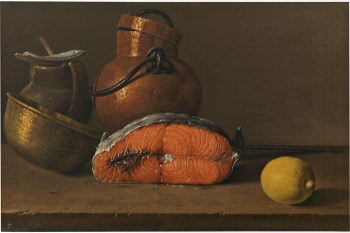
Luis Egidio Meléndez, Still Life with Salmon, Lemon, and Three Vessels, 1772, oil on canvas, 41 x 62.2 cm (Madrid: Museo Nacional del Prado).
Despite its popularity among patrons and at the royal courts, still life painting remained a relatively unappreciated genre. Critics regarded it as an academic exercise in composition, colour and texture, of interest solely for its decorative qualities. And yet it is a fascinating area in the history of art. The huge variety of objects portrayed, such as tables decorated with foods, fruits or game, florals, vanitas paintings, trompe l’oeils, and even cooking scenes—often have symbolic meaning and teem with moralising messages. Still life also experienced a fascinating evolution: from its huge growth and expansion in the lavish Baroque years of the seventeenth and eighteenth centuries to its avant-garde revival in the early twentieth century. Cubist experiments by artists such as Picasso raised this traditional genre to a new level and made it relevant again.
It has been almost 20 years since the last exhibition of Spanish still life (Bilbao Fine Arts Museum, 1999). This retrospective gives the first ever overview of the four-hundred year evolution of Spain’s most beautiful still life paintings and is based on four thematic and chronological clusters per century. The eye-catcher at the exhibition’s start in the seventeenth century is a piece by Sánchez Cotán, who is considered the ‘founding father’ of the genre and influenced several generations to come. From the first seventeenth-century bodegones the exhibition shifts its attention to the personal interpretations of artists such as Velázquez, Zurbarán, and Goya, before going on to the formal experiments of Picasso, Dalí and Miró, and works by contemporary Spanish artists such as Barceló and López. The exhibition focuses on a lesser-known aspect of their work, casting another light on the oeuvres of these prominent Spanish artists by showcasing them in the still life context.
Ángel Aterido, who holds a PhD in art history and is an expert on Spanish still life painting, selected the pieces for the exhibition. A good 70% are from private and public Spanish collections (such as Museo Nacional del Prado, Museo Reina Sofía, Royal Academy of Arts Madrid, Museo Nacional d’Art de Catalunye…). Many are on loan from the Prado, which has one of the largest and best collections of Spanish still life paintings in the world. The remainder are on loan from other great museums around the world including the National Gallery in London, the Fitzwilliam Museum in Cambridge, the Louvre, the Pompidou, the Uffizi, the Museo Nacional de Arte Antiga Lisboa, and the Museum of Modern Art in New York. Spanish Still Life presents a unique opportunity to discover these exceptional artworks at a single location. After its first showing in the Centre for Fine Arts Brussels the exhibition will travel to the Musei Reali di Torino.
Exhibition | Goya and the Enlightenment Court

Antonio Carnicero Mancio, The Ascent of a Montgolfier Balloon at Aranjuez, ca. 1784, oil on canvas, 169 × 280 cm
(Madrid: Prado)
◊ ◊ ◊ ◊ ◊
Now on view at the Bilbao Fine Arts Museum:
Goya and the Enlightenment Court / Goya y la corte ilustrada
CaixaForum, Zaragoza, 28 September 2017 — 21 January 2018
Bilbao Fine Arts Museum, 14 February — 28 May 2018
Curated by Manuela Mena and Gudrún Maurer
Having studied in Italy, Francisco de Goya (Fuendetodos, Zaragoza, 1746 – Bordeaux, 1828) moved to Madrid in 1775 and was first employed at the court of Charles III to work on the production of tapestry cartoons on hunting themes for El Escorial. Goya achieved recognition some years later when he was first appointed painter to the King (1786) then First Court Painter (1799). Despite this success at court, Goya maintained his connections with his native Zaragoza, and his correspondence with his childhood friend Martín Zapater offers proof of this ongoing relationship with his circle of friends and relatives while also providing crucial information on the progress of his career. The Prado’s exceptional loan of 13 original letters offers the documentary counterpoint to Goya as court painter and this is in fact the essential argument of the exhibition, which moves between Goya’s success at the courts of Charles III and Charles IV and the persistent echoes of his origins through his continuing contact with those closest to him.
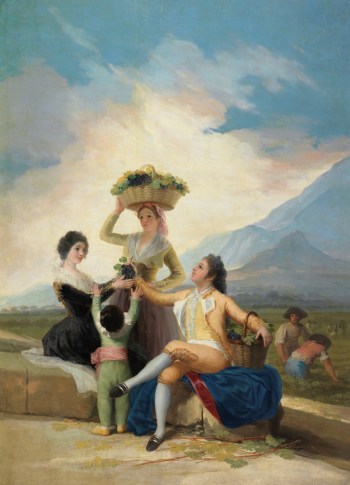
Francisco de Goya y Lucientes, The Grape Harvest, or Autumn, 1786, oil on canvas, 268 × 191 cm (Madrid: Prado).
Co-organised by the Museo Nacional del Prado, Fundación Bancaria “la Caixa” and the Bilbao Fine Arts Museum, Goya and the Enlightenment Court will be on display from 14 February until 28 May 2018, having previously been on view at the CaixaForum, Zaragoza. Curated by Manuela B. Mena and Gudrun Maurer, Chief Curator and Curator in the Department of 18th-century Painting and Goya at the Museo del Prado respectively, the exhibition brings together 96 works, many of which (71, of which 52 are oil paintings and the rest documents and examples of the decorative arts) come from the Museo del Prado. The remaining works on display comprise 9 paintings from the Bilbao Fine Arts Museum’s own collection and further loans from the Museo de Arte de Ponce, Puerto Rico, the Museo de Zaragoza, the Fundación Colección Ibercaja, the Sociedad Ecónomica Aragonesa de Amigos del País and a number of private collections.
In addition to the core group of canvases and cartoons by Goya, the exhibition also features works by other important 18th-century artists such as Luis Paret, Mariano Maella, José del Castillo, Luis Meléndez, Antonio Carnicero and Lorenzo Tiepolo, which together provide a context and also reveal the remarkable originality of Goya’s work. Finally, the exhibition includes examples of the above-mentioned correspondence with Martín Zapater, in addition to miniatures, prints and examples of the decorative arts.
Along with extensive restoration carried out for to this exhibition, the research undertaken has revealed new information, reflected, for example, in the presentation of a new portrait and a miniature of Martín Zapater painted by Goya and by Francisca Ifigenia Meléndez respectively, as well as the attribution to Agustín Esteve of a copy of Goya’s lost portrait of Ramón Pignatelli. Other new discoveries to be seen in Bilbao include the recently restored portrait of Pantaleón Pérez de Nenín and the presentation in context of Luis Paret’s remarkable View of Bermeo, a work recently acquired by the Bilbao Fine Arts Museum.
Major sections of the exhibition address
1 ‘Zaragoza, my heart, Zaragoza, Zaragoza’
2 Goya and Madrid, 1775: Hunting
3 The Enlightenment Court: Meeting Points
4 Friendship and Success
5 Female Refinement in the 18th Century
6 Portraits of Basques and Navarrans
Manuela B. Mena Marqués, Gudrun Maurer, and Virginia Albarrán, Goya y la corte ilustrada (Madrid: Prado, 2018), 216 pages, ISBN: 978 849900 1944, 39€.
Kickstarter | Fashioning the New England Family
From the Massachusetts Historical Society via Kickstarter:
The Massachusetts Historical Society has spent the last two years delving into its collections to uncover stories as told by various examples of clothing, fabric, accoutrements, and associated manuscripts. Through this process, textiles that have largely been divorced from their familial ties have been reunited with family papers. Later this year, we hope to share them with the world through Fashioning the New England Family, a project encompassing a publication, exhibition, and online presentation. But we need your help to bring these stories to life.
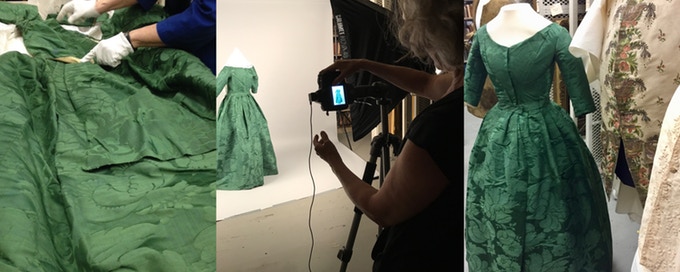
What is Fashioning the New England Family?
This is a project that will make accessible the dynamics of fashion, textiles, and costume across the span of our history. The MHS will produce an exhibition and companion volume to fully explore the ways in which the multiple meanings of fashion and fashionable goods are reflected in patterns of consumption and refashioning, recycling, and retaining favorite family pieces.
This is a unique and significant endeavor. Many of the items that will be featured in the project have been out of sight, having never been exhibited for the public or seen in living memory. The publication and exhibition will give scholars, students, and professionals in fields such as fashion, material culture, and history the chance to see these items for the first time; encourage research; and, provide the possibility for new discoveries. For the public, it is an opportunity to view in detail painstaking craftsmanship, discover how examples of material culture relate to significant moments in our history, and learn how garments were used as political statements, projecting an individual’s religion, loyalties, and social status. It may allow some to recognize and appreciate family keepsakes but it will certainly help us all to better understand the messages we may have previously missed in American art and literature. The MHS is dedicated to producing the exhibition, but we need your help to create the companion volume. Our project page will be updated with fun facts, images, and video clips throughout the month of February.
Why Create a Companion Volume?
Planned as a high-quality, full-color publication, this volume will serve both as a record of the exhibition and as a testament to the importance of the textiles and garments it illustrates and describes. The themes and subject matter pursued in the exhibition also provide the frames of reference for the book, which will include a preface by Catherine Allgor, President of the Massachusetts Historical Society, and a foreword by Anne E. Bentley, MHS Curator of Art and Artifacts. The primary author of the publication and guest curator of the exhibition is Dr. Kimberly S. Alexander.
What’s in the Budget?
While the entire project will cost around $100,000, we have set a Kickstarter campaign goal of $15,000 to produce the companion volume. We want to provide as many people as possible the opportunity to be part of this project. The companion volume is a natural fit for both the Kickstarter community and our mission to make this project as widely accessible as possible. The companion volume will be a lasting resource, serving as both a record of the exhibition and as a testament to the importance of the textiles and garments it illustrates and describes. We are counting on you and other members of the Kickstarter community to make this publication a reality.
What are the Rewards?

First and foremost—our gratitude! The ability to produce a companion volume remains the primary goal of the Society’s Kickstarter campaign. A gift at any level will go towards helping us bring this project to life. All donations also come with an opportunity to be named and publicly thanked as a Kickstarter backer on the Society’s project page. Donations at $15 and more also receive a set of postcards, exclusive to Kickstarter. A successful campaign also means that backers of the project at $50 or more on Kickstarter will be the first to receive the Fashioning the New England Family companion volume.
Backers of the project at higher levels get even more opportunities to engage with and learn about our textile collection. Be sure to check out the special event invitations, tours, and behind-the-scenes opportunities different rewards offer for supporting this project. If our project is completed and the goal is met, you will be asked to fill out a survey so that we can send you your rewards. The MHS is unable to provide your rewards or recognize any gift you made unless the informational survey is completed. Once rewards are shipped, please allow an additional 4–6 weeks for your reward(s) to ship internationally. Note: we are not responsible for international custom fees.
◊ ◊ ◊ ◊ ◊
About the MHS
Founded in 1791, the Massachusetts Historical Society is an invaluable resource for American history, life, and culture. Its extraordinary collections tell the story of America through millions of rare and unique documents, artifacts, and irreplaceable national treasures. As the nation’s first historical society, the MHS strives to enhance the understanding of our nation’s past and its connection to the present, demonstrating that history is not just a series of events that happened to individuals long ago but is integral to the fabric of our daily lives. Its collections are accessible to anyone with an interest in American history. Beyond research, the MHS offers many ways for the public to enjoy its collections including thought-provoking exhibitions, publications, engaging programs, seminars, and teacher workshops.
Wallace Collection Announces £1.2million New Exhibition Space

The Wallace Collection, Manchester Square, London
(Photo: Wikimedia Commons, 2005)
◊ ◊ ◊ ◊ ◊
As announced by The Wallace Collection (13 February 2018) . . .
The Wallace Collection has secured funding to develop expanded exhibition galleries, tripling the capacity of the museum’s existing exhibition space and setting the scene for an ambitious programme of temporary, ticketed [paid] exhibitions. The new space will enable the museum to explore aspects of its existing collection in more depth and collaborate with other institutions, creating partnerships both within the UK and internationally. This transformative project has been made possible by the generosity of The Linbury Trust, the Wolfson Foundation, and an anonymous major donor, creating facilities that reflect the vision and ambition of the Director and Board of Trustees and the growing number of museum visitors.
The new space opens on 19 June 2018 with an inaugural exhibition marking 200 years since the birth of the museum’s founder, Sir Richard Wallace (1818–1890), celebrating him as a great philanthropist and undiscovered cultural luminary. Sir Richard Wallace: The Collector highlights for the first time Sir Richard’s personal contributions to the Collection we know today, focusing on the diverse and idiosyncratic works of art he acquired and his considerable philanthropic legacy. Featuring over twenty works of art collected by Sir Richard, the exhibition explores his eclectic tastes and highlights some of the unexpected treasures of the museum, ranging from a gold trophy head from the Asante Kingdom to imperial ceremonial wine cups from China and a majestic ostrich figure made by the Augsburg silversmith Elias Zorer.
In 2019, Henry Moore: The Helmet Head Series (working title) will be our first paid exhibition, presented in partnership with the Henry Moore Foundation. Moore’s powerful sculptures and drawings will be juxtaposed with Renaissance helmets from the Wallace Collection, which he studied while he was a student at the Royal College in the 1920s. Moore took great inspiration from the Arms and Armour galleries at the Wallace, and this exhibition will demonstrate for the first time a direct connection between Moore’s work and works of art on display within the museum. This inaugural exhibition will be followed by a wide ranging programme of both contemporary and old master exhibitions that will present our extensive collections of paintings, sculpture, armour, and decorative arts in a new light.
Dr Xavier Bray, Director of the Wallace Collection, says: “The Wallace Collection is the greatest gift ever made to the nation, and this new space will enable us to shine a light on the immense quality of our works of art and raise the profile of the museum. The exhibition programme at the Wallace will provide an opportunity to get to know our collection in new ways as well as collaborate with other cultural institutions. Thanks to the generous support of three major donors, who have made it possible to extend our exhibition galleries, we will be able to reach our potential as a truly international institution, sharing the museum with a broader and more diverse audience both at home and abroad.”
Exhibition | Mirroring China’s Past
From the Art Institute of Chicago:
Mirroring China’s Past: Emperors, Scholars, and Their Bronzes
Art Institute of Chicago, 25 February — 13 May 2018
Curated by Tao Wang

Artist Unknown, Court Beauty, Qing Dynasty, Late Kangxi Reign, between 1709 and 1723 (Beijing: The Palace Museum).
Chinese bronzes of the second and first millennia BC are some of the most distinctive achievements in the history of art. Exquisitely ornamented, these vessels were made to carry sacrificial offerings, to use in burial, or to commemorate family in public ceremonies. When they were found by emperors centuries later, these spiritually significant objects were seen as manifestations of a heavenly mandate on a ruler or dynasty and became prized items in imperial collections. This exhibition—the first to explore how these exquisite objects were collected and conceptualized throughout Chinese history—presents a rare opportunity to experience a large number of these works together in the United States.
Unlike Greek and Roman bronze sculptures of human and animal forms, most objects from Bronze Age China (about 2000–221 BC) were vessels for ritual use. Beginning with the Song dynasty (960–1279), emperors unearthed these symbolic works and began collecting them, considering them to be evidence of their own authority and legitimacy as rulers. Several 18th-century portraits of Emperor Quianlong include his bronze collection, demonstrating how ancient bronzes came to play a critical role in imperial ideology and self-fashioning. In addition to impressive collections, the royal fascination with bronzes led to the creation of numerous reproductions and the meticulous cataloguing of palace holdings. These catalogues are works of art themselves, with beautiful illustrations and detailed descriptions.
From the 12th century onward, scholars and artists also engaged in collecting and understanding ancient bronzes, especially their inscriptions. Unlike emperors, who commonly employed art to promote and implement political and cultural policies, scholars regarded bronzes as material evidence of their efforts to recover and reconstruct the past, and they occasionally exchanged them as tokens of friendship. Today ancient bronzes still occupy a prominent position in Chinese culture—as historical or nostalgic objects and as signifiers of an important cultural heritage that inspires new generations, as seen in the works of contemporary artists on view in this presentation.
Mirroring China’s Past brings together approximately 180 works from the Art Institute of Chicago’s strong holdings and from the Palace Museum in Beijing, the Shanghai Museum, and important museums and private collections in the United States. By providing viewers with a new understanding of ancient bronzes and their significance through time, the exhibition illuminates China’s fascinating history and its evolving present.
The catalogue is distributed by Yale UP:
Tao Wang, ed., with essays by Sarah Allan, Jeffrey Moser, Su Rongyu, Edward L. Shaughnessy, Zhixin Jason Sun, Tao Wang, Zhou Ya, Liu Yu, and Lu Zhang, Mirroring China’s Past: Emperors, Scholars, and Their Bronzes (Chicago: Art Institute of Chicago, 2018), 296 pages, ISBN: 9780300228632, $60.
 A lavishly illustrated book that offers an in-depth look at the cultural practices surrounding the tradition of collecting ancient bronzes in China during the 18th and 19th centuries.
In ancient China (2000–221 BC) elaborate bronze vessels were used for rituals involving cooking, drinking, and serving food. This fascinating book not only examines the cultural practices surrounding these objects in their original context, but it also provides the first in-depth study tracing the tradition of collecting these bronzes in China. Essays by international experts delve into the concerns of the specialized culture that developed around the vessels and the significant influence this culture, with its emphasis on the concept of antiquity, had on broader Chinese society. While focusing especially on bronze collections of the 18th and 19th centuries, this wide-ranging catalogue also touches on the ways in which contemporary artists continue to respond to the complex legacy of these objects. Packed with stunning photographs of exquisitely crafted vessels, Mirroring China’s Past is an enlightening investigation into how the role of ancient bronzes has evolved throughout Chinese history.
Tao Wang is Pritzker Chair of Asian Art and curator of Chinese art at the Art Institute of Chicago.
Exhibition | Canova’s George Washington
From The Frick:
Canova’s George Washington
The Frick Collection, New York, 23 May 2018 — 23 September 2018
Gypsotheca e Museo Antonio Canova, Possagno, 10 November 2018 — 22 April 2019
Curated by Xavier Salomon and Peter Jay Sharp in collaboration with Mario Guderzo

Antonia Canova, George Washington, 1818; Gesso (Possagno: Gypsotheca e Museo Antonio Canova).
In 1816, the North Carolina Senate commissioned a full-length statue of George Washington to stand in the State House in Raleigh. Thomas Jefferson, believing that no American sculptor was up to the task, recommended Antonio Canova (1757–1822), then one of Europe’s most celebrated artists. The first and only work Canova created for America, the statue depicted the nation’s first president in ancient Roman garb, per Jefferson’s urging, drafting his farewell address to the states. It was unveiled to great acclaim in 1821, and people traveled from far and wide to see it. Tragically, only a decade later, a fire swept through the State House, reducing the statue to just a few charred fragments.
Canova’s George Washington examines the history of the artist’s lost masterpiece, probably the least well known of his public monuments. It brings together for the first time Canova’s full-sized preparatory plaster model (which has never left Italy), four preparatory sketches for the sculpture, and related engravings and drawings. The exhibition also includes Thomas Lawrence’s 1816 oil portrait of Canova, which, like the model and several sketches, will be on loan from the Gypsotheca e Museo Antonio Canova in Possagno, Italy, the birthplace of the artist. The exhibition is organized by Xavier F. Salomon, Peter Jay Sharp Chief Curator, in collaboration with Mario Guderzo, Director of the Gypsotheca e Museo Antonio Canova, the Venice International Foundation, and Friends of Venice Italy Inc. Following its presentation at the Frick, the exhibition will be shown in Italy at the Gypsotheca e Museo Antonio Canova in Possagno in the fall of 2018.
The accompanying catalogue will include correspondence relating to the commission, as well as essays by Salomon, Guderzo, and Guido Beltramini, Director of the Palladio Museum in Vicenza, Italy.
Catalogue details are available here»










 Enfilade
leave a comment