Exhibition | Jean Jacques Lequeu (1757–1826)
Opening this December at the Petit Palais:
Jean Jacques Lequeu (1757–1826): Builder of Fantasy / Bâtisseur de fantasmes
Petit Palais, Paris, 11 December 2018 — 31 March 2019
Menil Drawing Institute, Houston, 4 October 2019 — 5 January 2020
The Morgan Library & Museum, New York, 2020
Curated by Laurent Baridon, Jean-Philippe Garric, Martial Guédron, Corinne Le Bitouzé, and Christophe Leribault
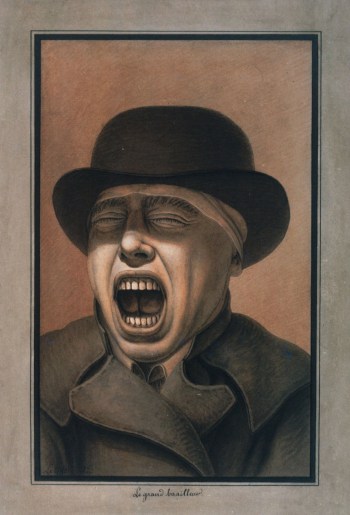 Six months before he died impoverished and forgotten, Jean-Jacques Lequeu donated one of the most singular and fascinating graphic oeuvres of his time to the French National Library. The set of several hundred drawings, presented here in its entirety for the first time, is a testimonial to the solitary and obsessive downward spiral of an exceptional artist that goes well beyond the first steps of an architectural career. Using the precise technical tool represented by the geometric working drawing made in wash, which he filled with handwritten notes, Lequeu scrupulously described the monuments and imaginary factories that filled his imaginary landscapes, rather than carrying out projects. But this initiatory journey, which he made without leaving his studio and enriched with figures and narratives from his library, this pathway that led him from temple to bush, from artificial grotto to palace, from kiosk to subterranean labyrinth, resolved itself as a quest to find himself. To see everything and describe it all—systematically, from the animal to the organic, from fantasy and raw sex to the self portrait—became the mission he assigned to himself.
As a typical representative of the artisanal class, who tried, with the Enlightenment and the French Revolution, to rise socially and break free of the world of trades, Lequeu quickly became disenchanted with the new order and the new hierarchies. Lequeu—the child of his century, the century of licentiousness and Anglo-Chinese gardens—nevertheless pursued an entirely free and singular path. Reduced to employment in a subordinate office, ignored by those in place, now far from his roots, but freed of social or academic pressure, he stalked his dreams with the obstinacy of a builder and without compromise.
Curators
Laurent Baridon, Professor at University of Lyon II; Jean-Philippe Garric, Professor at University of Paris 1 Panthéon-Sorbonne; Martial Guédron, Professor at the University of Strasbourg; Corinne Le Bitouzé, General Curator, Deputy Director of the Department of Prints and Photography at the French National Library; Christophe Leribault, Director of the Petit Palais
Laurent Baridon, et al., Jean-Jacques Lequeu: Batisseur de fantasmes (Paris: Norma, 2018), 176 pages, ISBN: 978-2376660217, $65.
◊ ◊ ◊ ◊ ◊
Note (added 2 January 2018) — The original posting did not include details for the catalogue.
Note (added 23 September 2019) — The posting was updated to include information on the two U.S. venues: the Menil Drawing Institute in Houston and The Morgan Library & Museum in New York.
Exhibition | Georges Michel: The Sublime Landscape
Now on view at the Fondation Custodia:
The Sublime Landscape: Georges Michel
Monastère Royal de Brou, Bourg-en-Bresse, 6 October 2017 — 7 January 2018
Fondation Custodia / Collection Frits Lugt, Paris, 27 January — 29 April 2018
Curated by Ger Luijten and Magali Briat-Philippe
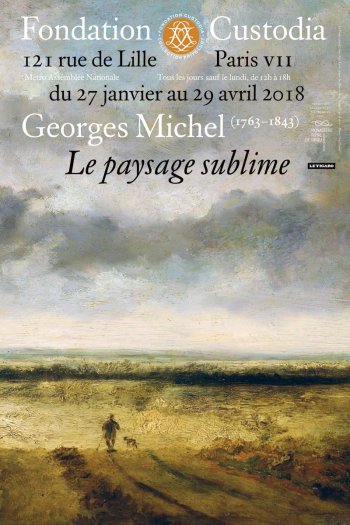 Admired by Vincent van Gogh, Georges Michel (1763–1843) is held to be the precursor of plein air painting. He was influenced by the painters of the Dutch Golden Age, earning the nickname of ‘the Ruisdael of Montmartre’. Yet today he is not widely known. The Fondation Custodia, in collaboration with the Monastère royal de Brou, is proposing to unveil the artist whose merits were first remarked by the dealer Paul Durand-Rueil in the nineteenth century. The first one-man exhibition for fifty years of the work of Georges Michel will be held from 27 January to 29 April 2018 at 121 rue de Lille, Paris. About fifty paintings and forty drawings—on loan mainly from French private and public collections—will be on show, and the exhibition will include some recent acquisitions by the Fondation Custodia.
Georges Michel was born in Paris in 1763 and died there in 1843 after a remarkable career, whether in real terms or in a mythical post-mortem reconstruction of the life of this allegedly misunderstood artist. The main body of what we know about him comes from the biography written by Alfred Sensier in 1873, compiled from information recounted to him by the artist’s widow. Michel kept his distance from official art circles and only took part in the Salon between 1791—the date when the exhibition first opened its doors to artists who were not members of the former Académie royale—and 1814. His name was not mentioned thereafter until the sale of his work and the contents of his studio a year before his death.
The exhibition at the Fondation Custodia opens with youthful work by the artist, still betraying the influence of the eighteenth-century French landscape tradition as embodied in the art of Lazare Bruandet (1755-1804) or Jean-Louis Demaine (1752–1829), with whom Michel explored the Ile-de-France in search of subjects for sketching. He remained loyal to Paris and the surrounding countryside, claiming that ‘anyone unable to spend a lifetime painting within a range of four leagues is just a blundering fool searching for a mandrake—he will find only a void’. Saint-Denis, Montmartre or La Chapelle, the Buttes-Chaumont and the banks of the Seine, the countryside to the north of Paris offered a variety of hills and plains, dotted with quarries, mills and scattered dwellings.
Georges Michel’s style developed gradually away from the picturesque, anecdotic landscape that was in vogue between 1770 and 1830, achieving a notable originality. His paintings capture, with sincerity and a hint of the romanticism to come, the rural spots threatened with extinction as the villages around Paris began to be subsumed into the capital during the 1860s.
At a period when the painting of the Northern schools was enjoying a revival in France, Georges Michel, according to his widow, carried out some restoration work on Dutch paintings for the influential Paris dealer Jean-Baptiste Pierre Le Brun (1748–1813) and for the Muséum central des Arts (now the Musée du Louvre), at the behest of its director, Dominique Vivant Denon (1747–1825). Even though no trace of this activity can be found in the archives, Michel’s work is incontrovertibly influenced by the masters of the Dutch Golden Age. The exhibition at the Fondation Custodia—one of whose aims is to study the reception of Dutch art in France—takes this opportunity to compare Michel with the predecessors he so admired—and whose work he sometimes copied. From Jacob van Ruisdael (1628/1629–1682) he borrows compositions enlivened by vast, windswept skies, with sometimes a shaft of brilliant sunlight breaking through the clouds. The masterly chiaroscuro in his paintings, however, has its source in the work of Rembrandt (1606–1669). Philips Koninck (1619–1688), whose work in the eighteenth century was sometimes confused with that of Rembrandt, also evidently inspired Michel with his vast landscapes and limitless skies.
The Fondation Custodia, a home for art on paper in Paris, has recently acquired a large number of sheets by Georges Michel. The last section of the exhibition is devoted to these drawings. Michel’s prolific graphic work is characterised by its wide variety of techniques and subjects. The artist excelled in capturing vibrant views of Paris—in black chalk or, less frequently, pen and ink. The topographical nature of these drawings makes identification of the chosen locations simple: the Louvre, the Tuileries, the Jardin des Plantes, the Barrières de Ledoux.
Curators: Ger Luijten, director of the Fondation Custodia; and Magali Briat-Philippe, conservateur, responsable du service des patrimoines, Monastère royal de Brou.
More information, including a selection of images, is available here»
Magali Briat-Philippe and Ger Luijten, eds., Georges Michel: Le paysage sublime (Paris: Fondation Custodia, 2017), 208 pages, ISBN 978 9078655 268, 29€.
Exhibition | The Object of My Affection
Now on at the The Fitzwilliam:
The Object of My Affection: Stories of Love from the Fitzwilliam Collection
The Fitzwilliam Museum, Cambridge, 30 January — 28 May 2018
Love is very much in the air in this exhibition, which contains objects alive with the range of emotions that it commands: from admiration and affection, joy and passion, longing and despair, to insults, indifference, grief and remembrance. The exhibition showcases the Fitzwilliam Museum’s collection of valentines, which date from the 18th century to the 20th and include a wide variety of sentimental and decorative types as well as comic examples. Alongside the valentines will be an assortment of other objects relating to the theme of love, including posy rings, love tokens, and works by Dante Gabriel Rossetti (1828–1882) and James Gillray (1756–1815).
Rebecca Virag, Valentines: Highlights from the Collection at The Fitzwilliam Museum (Cambridge: The Fitzwilliam, 2018), 120 pages, £10.
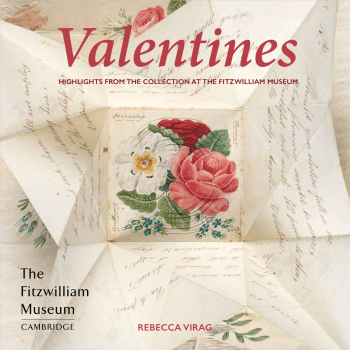 It is probably a little known fact that the Fitzwilliam Museum has a large collection of around 1,600 valentines, which range in date from the early eighteenth century to the 1920s. The vast majority were left to the Museum in 1928 by mathematician and Fellow of Trinity College, J.W.L. Glaisher. Two more Cambridge alumni, the Rev. Herbert Bull (Trinity) and Sir Stephen Gaselee (King’s) also gave their much smaller collections of valentines to the Museum in 1917 and 1942. The Bull valentines are particularly fascinating as they are rare survivals of mid-eighteenth century silhouette cut-paper work and are unlike anything collected by either Glaisher or Gaselee. The Glaisher collection alone is one of the largest amassed by a single collector currently in a UK public collection.
The Glaisher valentines have not been seen in public since 1995, some twenty-three years ago, and since then the entire valentine collection has been catalogued, researched, photographed, and re-housed. This selection of highlights has been published to coincide with a new display of some of these extraordinary objects as part of the exhibition The Object of my Affection: Stories of Love from the Fitzwilliam Collection.
Exhibition | Pockets to Purses
Next month at FIT:
Pockets to Purses: Fashion + Function
The Museum at the Fashion Institute of Technology, New York, 6–31 March 2018
Organized by Graduate Students in FIT’s Fashion and Textile Studies Program
The Fashion Institute of Technology’s School of Graduate Studies and The Museum at FIT present Pockets to Purses: Fashion + Function. Organized by graduate students in the Fashion and Textile Studies program, the exhibition explores pockets and purses as both fashionable and functional objects by tracing both their history and evolution to accommodate the demands of modern life. Displaying objects from the collection of The Museum at FIT, the exhibition analyzes the interplay between pockets and purses in both men’s and women’s wardrobes from the 18th century to the present. In addition to garments and accessories, the exhibition features photographs, advertisements, and film clips that demonstrate how pockets and purses have been utilized throughout history and the ways that lifestyle changes have affected their design and use.
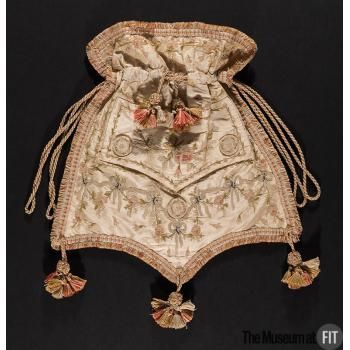
Reticule of a Man’s Waistcoat, embroidered silk, ca. 1800, France (NY: The Museum at FIT, gift of Thomas Oechsler. 93.132.2).
Pockets to Purses: Fashion + Function begins with 18th-century examples of men’s and women’s pockets. Men’s pockets were built into jackets or waistcoats so that men could carry a variety of objects, including books. Problematically, the lines of a man’s tailored ensemble were often disrupted by bulky items. Alternatively, women’s pockets began as separate accessories that were tied to the body and worn underneath a skirt. These pockets were completely hidden, allowing a woman to carry items while maintaining privacy.
Changing fashions and evolving roles in society led to women carrying their possessions in handheld bags. A reticule—a small handbag typically made with a drawstring closure—displayed in the exhibition illustrates the evolution of pockets into handheld purses. The shape, ornamentation, and pocket flap of this example from circa 1800 indicate that it was fabricated from an 18th-century man’s waistcoat, an example of which can be seen in the rendering on a fashion plate dating from 1778 to 1787. A blue bodice from circa 1878 that features a small watch pocket on the left hip reveals a fashionable approach to practical design. The pocket has embroidered decoration, but the easily accessible location and convenient shape of the pocket are function driven.
A needlepoint bag dating from 1920–30 contains three small cases that demonstrate the prevalence for ensemble dressing that arose during the 1920s. The coordinating containers for cigarettes and face powder testify to a growing acceptance of women smoking and wearing makeup in public. The tension between fashion and function continued into the 20th century. The exhibition includes an ad for Elsa Schiaparelli’s ‘Cash and Carry’ suits, which featured large pockets on the hips for carrying supplies, demonstrating the desire for functionality that prevailed at the outbreak of World War II. After the war, designers deemphasized functionality and began to feature pockets primarily as design elements. A Molyneux dress from 1948 has eight strategically placed pockets on the hips that make the waist appear smaller, a silhouette that dominated postwar fashion.
American designers such as Claire McCardell and Bonnie Cashin incorporated pockets that were as playful as they were practical. A bright green raincoat by Cashin circa 1965 features a pocket designed to look like a shoulder bag—making her raincoat a visual fusion of fashion and function. Made from leather, canvas, and the twist-lock closures that were typical of Cashin’s work, the coat’s large, practical pocket allowed the wearer to go hands-free while keeping her possessions close.
Novelty bags demonstrate the whimsy of fashion, though they also convey wealth and status. A 1950s Lederer purse shaped like a clock has a built-in lipstick compartment and utilizes traditional elegant materials in a novel design. Additionally, Judith Leiber’s 1994 Swarovski crystal-encrusted minaudière in the shape of a tomato was designed to be a display of glamour and imagination. Both examples present the handbag as an objet d’art and show how designers sometimes perform more as artists, focusing on form rather than functionality.
Other iterations of the status bag, specifically those of the late 20th century, are also on display. An Hermès “Kelly” bag from 2000 demonstrates the longevity of the bag’s design, which set standards for the luxury market when it was introduced as a saddle bag in 1892. Alternatively, a Louis Vuitton purse from 2003 shows a trendier kind of status bag. Its colorful take on the traditional Vuitton ‘Speedy’ bag played into passing fashion trends during the early 2000s.
Various menswear items are also included, such as a 1990 sport coat by Jean Paul Gaultier. With layers of cargo pockets, velcro flaps, and heavy-duty zippers, this jacket is a take on the functional pockets in conventional men’s sportswear. Similarly, a bowler hat designed by Rod Keenan in 2006 subverts the traditional bowler by including, at the crown, a pocket made to hold a condom.
The final section of the exhibition focuses on pockets that allude to historical embellishments. Included are a Bill Blass knit dress from fall 1986 and a man’s Versace suit from 1992. Shown alongside a reproduction of an 18th-century man’s embroidered coat, these objects are reminders of the pocket’s fashionable use throughout history.
Exhibition | Pink
This fall at FIT:
Pink: The History of a Punk, Pretty, Powerful Color
The Museum at the Fashion Institute of Technology, New York, 7 September 2018 — 5 January 2019
Curated by Valerie Steele
Pink is popularly associated with little girls, ballerinas, Barbie dolls, and all things feminine. Yet the symbolism and significance of pink have varied greatly across time and space. The stereotype of pink-for-girls versus blue-for-boys may be ubiquitous today, but it only gained traction in the mid-twentieth century. In the eighteenth century, when Madame de Pompadour helped make pink fashionable at the French court, it was perfectly appropriate for a man to wear a pink suit, just as a woman might wear a pink dress. In cultures such as India, men never stopped wearing pink.
Yet anyone studying pink comes up against “the color’s inherent ambivalence.” One of “the most divisive of colors,” pink provokes strong feelings of both “attraction and repulsion.” “Please sisters, back away from the pink,” wrote one journalist, responding to the pink pussy hats worn at the Women’s March. Some people think pink is pretty, sweet, and romantic, while others associate it with childish frivolity or flamboyant vulgarity. In recent years, however, pink increasingly has been interpreted as cool, androgynous, and political. “Why would anyone pick blue over pink?” mused the rapper Kanye West. “Pink is obviously a better color.” In the words of i-D magazine, pink is “punk, pretty, and powerful.”
Curated by Dr. Valerie Steele, director of The Museum at FIT, Pink: The History of a Punk, Pretty, Powerful Color will explore the changing significance of the color pink over the past three centuries.
Exhibition | Paris on Display: 18th-Century Boutiques
Opening this spring at the Stewart Museum in Montreal:
Paris on Display: 18th-Century Boutiques / Paris en Vitrine: Les boutiques au 18e siècle
Musée Stewart, Montréal, 25 April 2018 — 24 March 2019

Stores of the Louvre, drawing, France, 18th century (Montreal: Stewart Museum).
Presenting a consumer society in the making, Paris on Display invites visitors to consider the City of Light as it was in the 18th century, exploring the boutiques in three districts known for their commercial bustle: la Cité, la Ville, and l’Université. Browsing through shops with excerpts from 18th-century urban chronicles and travel guides, visitors will meet the merchants of the Quai de l’Horloge and the haberdashers of Saint-Honoré. More than 300 artefacts from the Stewart Museum’s rich collection will evoke the activities of boutiques with such poetic names as “À l’Olivier, À la Sphère” and “Au Chagrin de Turquie.”
Exhibition | Rome!
Opening in April at La Boverie:
Rome!
La Boverie, Liège, Belgium, 24 April — 26 August 2018
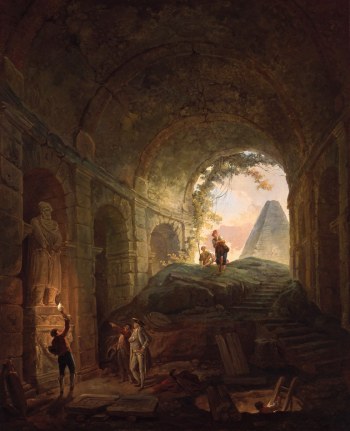
Hubert Robert, Les Découvreurs d’antiques (Musée de Valence).
En partenariat avec le musée du Louvre. Le propos général de l’exposition est d’expliciter les raisons du voyage et de décrire le séjour à Rome des artistes européens et des adeptes, généralement anglais et fortunés, du Grand Tour. L’exposition s’intéresse particulièrement à la vie quotidienne des Romains scrutée dans ses détails par ceux qui les ont peints du 17e au 20e siècle, et évoque bien entendu les emblèmes monumentaux de la cité, raison majeure du voyage des « Touristes » et obsession des artistes. Les liens entre les artistes eux-mêmes, leurs relations de camaraderie ou d’amitié, les lieux où ils se rencontraient (cafés, auberges ou Villas institutionnelles) sont également évoqués. Le ton général de l’exposition se veut explicatif, allant chercher « derrière l’oeuvre » la narration particulière et souvent étonnante, scientifiquement avérée, propre à intéresser tous les publics.
Exhibition | Drawn to Greatness
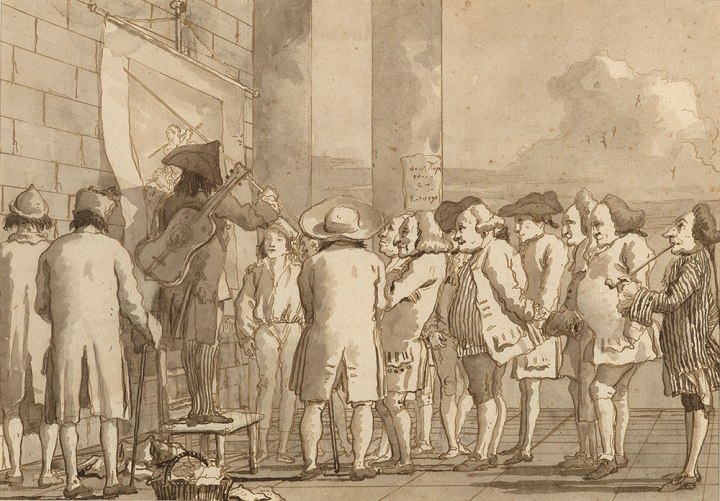
Giovanni Domenico Tiepolo, Scene of Contemporary Life: The Picture Show, 1791; pen and brown and black ink and wash over black chalk on paper, 11 5/16 × 16 5/16 inches (New York: Morgan Library & Museum, 2017.253)
◊ ◊ ◊ ◊ ◊
Press release (15 December 2017) for the exhibition now on view at The Clark:
Drawn to Greatness: Master Drawings from the Thaw Collection
The Morgan Library & Museum, New York, 29 September 2017 — 7 January 2018
The Sterling and Francine Clark Art Institute, Williamstown, MA, 3 February — 22 April 2018
Curated by Jennifer Tonkovich and Jay Clarke
Over the past fifty years, New York art dealer and philanthropist Eugene V. Thaw assembled one of the world’s finest private collections of drawings. The collection, known for its breadth and exceptional quality, charts the high points of drawing from the Renaissance through the twentieth century and features works made by pivotal artists at key moments in the history of the art form. Mr. Thaw donated his collection of more than 400 drawings to the Morgan Library & Museum, New York, which celebrated the gift with the September 2017 opening of Drawn to Greatness: Master Drawings from the Thaw Collection, an exhibition that has drawn critical acclaim for the diversity and quality of the works presented. In recognition of Mr. Thaw’s longstanding interest in the Clark Art Institute, Drawn to Greatness will travel to Williamstown for an exclusive presentation at the Clark from February 3 through April 22, 2018. Featuring 150 drawings that tell the story of a visionary collector, the exhibition examines five centuries of western drawing. Sketchbooks belonging to Jackson Pollock, Francisco de Goya, Edgar Degas, and Paul Cézanne and illustrated letters from Vincent van Gogh are among the works exhibited.
“It is an honor for the Clark to have the opportunity to show this exquisite collection in our galleries,” said Olivier Meslay, the Felda and Dena Hardymon Director of the Clark. “The works in this exhibition provide an incredibly rich and remarkable opportunity to consider the art form as practiced by generations of masters. It is one of the most important and impressive drawing exhibitions that has been assembled in decades.”
The exhibition is organized in a series of chronological sections that illustrate key moments in the history of draftsmanship while also highlighting the work of artists whom the Thaws collected in depth, among them Rembrandt van Rijn, Francisco de Goya, Odilon Redon, and Edgar Degas.
“These exceptional drawings, watercolors, and collages exemplify both the eternal power of the drawn line and the innovative genius of the artists who have explored the medium over five centuries,” said Jay A Clarke, Manton Curator of Prints, Drawings, and Photographs. “It is a truly spectacular collection of works and I am thrilled to be able to work in collaboration with the Morgan’s curatorial team to bring this show to the Clark.”
The exhibition extends the Institute’s relationship to Mr. Thaw who, in 2016, made a generous gift to create the Eugene V. Thaw Gallery for Works on Paper in the Clark’s Manton Research Center. Drawn to Greatness: Master Drawings from the Thaw Collection is organized by the Morgan Library & Museum, New York. The curator of the exhibition at the Morgan is Jennifer Tonkovich, Eugene and Clare Thaw Curator of Drawings and Prints; the curator at the Clark is Jay A. Clarke, Manton Curator of Prints, Drawings, and Photographs. Presentation of Drawn to Greatness at the Clark is made possible by the Eugene V. and Clare E. Thaw Charitable Trust. Major support is provided by the Fernleigh Foundation in memory of Clare Thaw. This exhibition is supported by an indemnity from the Federal Council on the Arts and the Humanities.
An exhibition checklist is available here»
Jennifer Tonkovich, ed., Drawn to Greatness: Master Drawings from the Thaw Collection (New York: The Morgan Library & Museum, 2017), 295 pages, ISBN: 978-0875981826, $40.
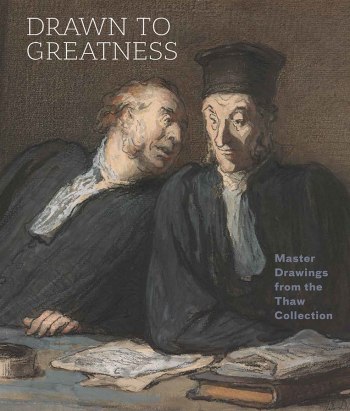 The catalogue features a series of essays by leading scholars devoted to pivotal moments in the history of drawing. Authors include Jane Shoaf Turner, Head of Rijksprentenkabinet, Amsterdam; Andrew Robison, former Head of Drawings, Prints, and Photographs at the National Gallery of Art; Matthew Hargraves, Chief Curator of Art Collections, Yale Center for British Art; Richard R. Brettell, Chair of Art and Aesthetic Studies, University of Texas at Dallas; Jay A. Clarke, Manton Curator of Prints, Drawings, and Photographs, Clark Art Institute; and, of the Morgan Library & Museum, Colin B. Bailey, Director; John Marciari, Curator and Department Head of Drawings and Prints; and Jennifer Tonkovich, Eugene and Clare Thaw Curator.
A selection of programming:
Jennifer Tonkovich | French Artists and Their Models
Sunday, 11 February 2018, 3:00pm
Jennifer Tonkovich, Eugene and Clare Thaw Curator of Drawings at the Morgan Library & Museum, explores how French artists worked with models during the eighteenth and early nineteenth centuries. Where did they find their models? What role did the models play in the creative process? How does an individual artist’s approach to the model reveal their broader outlook? A close look at studies by Watteau, Fragonard, Prud’hon, Gericault, Ingres, and Delacroix illuminates the challenges inherent in working from the model.
Matthew Hargraves | Visionaries: Romantic Drawings from the Thaw Collection
Sunday, 15 April 2018, 3:00pm
Drawn to Greatness includes some of Eugene Thaw’s finest Romantic drawings, among them outstanding works of art by William Blake, Caspar David Friedrich, and J.M.W. Turner. This lecture by Matthew Hargraves, chief curator of art collections and head of college information and access at the Yale Center for British Art, focuses on the visionary qualities of these Romantic artists and explores how they abandoned the simple imitation of the natural world to capture truths beyond the reach of the human eye.
Exhibition | Cathedral of Cloth: Ebley Mill
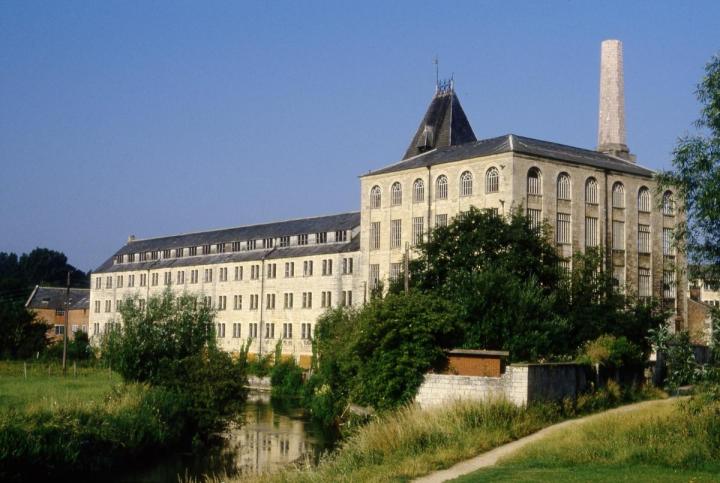
The long range of Ebley Mill was begun in 1818; in 1862, G. F. Bodley added the wing at the end.
◊ ◊ ◊ ◊ ◊
While this is predominantly a nineteenth-century exhibition, Stroud is certainly replete with eighteenth-century significance. From the Museum in the Park:
Cathedral of Cloth: Life and Times at Ebley Mill
Museum in the Park, Stroud, Gloucestershire, 3 February — 4 March 2018
In 2018 Ebley Mill celebrates the building of the Long Block at Ebley 200 years ago. The story of the Mill reaches back to the early 1400s. It was owned by a fashionable man about town before Samuel Marling made it into the powerhouse of the Stroud Valleys. The finest cloth for Victorian gentlemen was made there, but also materials for 1960s dolly birds and racing car drivers. This fascinating exhibition reveals the stories of the famous people and the ordinary workers connected to the Mill and includes many rarely seen items.
Presented by Stroudwater Textile Trust in partnership with the Museum in the Park.
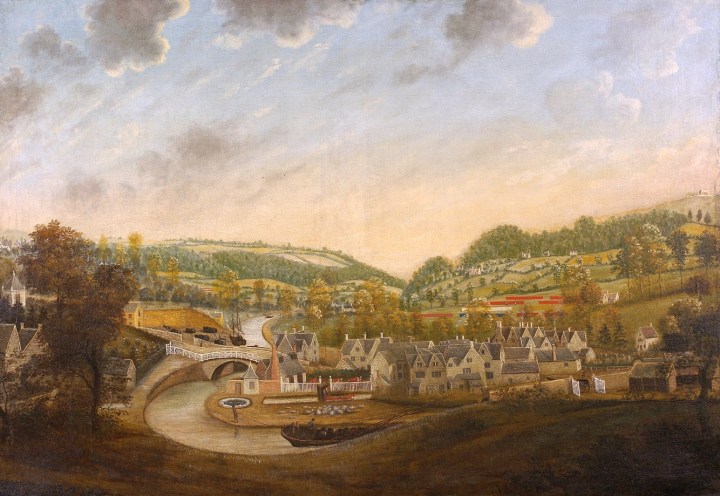
Unidentified artist, View of Wallbridge, Stroud in Gloucestershire, ca. 1790 (Stroud: Museum in the Park). The painting shows “Stroud at a time when spinners and weavers worked at home in their cottages. These were the days before large machinery was housed in huge mills such as Ebley Mill” (from the Museum in the Park’s website).
Exhibition | Power and Beauty in China’s Last Dynasty

Press release (12 October 2017) from Mia:
Power and Beauty in China’s Last Dynasty: Concept and Design by Robert Wilson
Minneapolis Institute of Art, 3 February — 27 May 2018
Curated by Liu Yang
The Minneapolis Institute of Art (Mia) is collaborating with celebrated theater artist Robert Wilson to organize a first-of-its-kind exhibition highlighting the drama, rituals, and opulence of the Qing Empire, the last imperial dynasty of China. The exhibition will present objects from Mia’s renowned collection of Chinese art, including rare court costumes, jades, lacquers, paintings, and sculpture, to be displayed in an immersive, experiential environment conceived of by Wilson. Power and Beauty in China’s Last Dynasty: Concept and Design by Robert Wilson, curated by Liu Yang, Mia’s Curator of Chinese Art, will be on view February 3 through May 27, 2018.

Manchu Emperor’s Ceremonial 12-Symbol jifu Court Robe, 1723–35, Qing Dynasty, silk tapestry (kesi) (Minneapolis Institute of Art, 42.8.11).
“The staging and storytelling involved in this exhibition speak to Mia’s belief in art’s ability to inspire wonder and fuel curiosity,” said Matthew Welch, Mia’s Deputy Director and Chief Curator. “Through the use of the theatrical elements of lighting, sound, and progression, we examine the layers of imperial life—from the external presentation of the court to the internal, private life of the emperor. We want the visitor to feel as though they are part of this otherworldly, intoxicating, and sometimes even dangerous world.”
During the Qing (pronounced ‘ch’ing’) court’s reign (1644–1912), the arts flourished—rivaling that of Europe’s great kingdoms. This backdrop of opulence served to affirm imperial power and prestige, and acted as stagecraft to enhance the emperor’s leading role as the ‘son of heaven’. Court costume, for example, was heavily embroidered or woven with symbolic designs to represent cosmological order. Roiling waves and faceted rocks around the hem evoke the earth’s oceans and mountains. Stylized clouds hover above, indicating the heavens. Dragons, a longstanding symbol of imperial authority and might, cavort in the clouds, suggesting the emperor’s rule of heaven and earth.
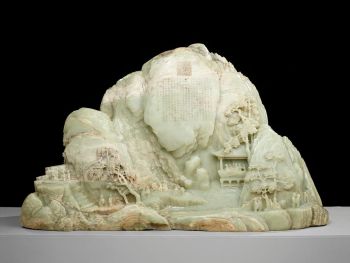
Jade Mountain Illustrating the Gathering of Poets at the Lan T’ing Pavilion, 1790, Qianlong Period (1736–95), Qing Dynasty, light green jade (Minneapolis Institute of Art).
“Mia has one of the world’s great collections of Chinese art outside of China,” said Liu Yang, Mia’s curator of Chinese Art and head of China, South, and Southeast Asian Art. “Our collection of Qing dynasty textiles is one of the most comprehensive in the West, and we have many other important objects associated with the Qing emperors and their courts. It is personally very exciting for me to be able to highlight these objects in an unexpected and fresh manner by working with Robert Wilson.”
“Mia could not be more delighted to work with Robert Wilson on the creation of this exhibition,” said Kaywin Feldman, Mia’s Nivin and Duncan MacMillan Director and President. “His unique approach to exhibition design and his willingness to push the boundaries make him an ideal collaborator. His style often involves dramatic contrasts—brightness and darkness, fullness and emptiness—which bring a new perspective to these historic objects.”
The exhibition progresses through a series of galleries that lead visitors from the performative, external world of the imperial court to the intimate, interior world of the emperor. Each gallery will also feature an original soundscape created by Wilson.
Objects highlights include
• a ceremonial twelve-symbol jifu court robe worn by the emperor
• a formal court robe worn by the empress
• a 640-pound jade mountain commissioned by the Qianlong emperor
• a multi-color lacquered and carved imperial throne
• a meditating Buddha carved from white jade enthroned within a Tibetan-style stupa of green jade
• an imperial portrait of prince Duo Lou
• a carved lacquer box adorned with nine auspicious dragons and bearing the Qianlong emperor’s seal
◊ ◊ ◊ ◊ ◊
Born in Waco, Texas, Robert Wilson is among the world’s foremost theater and visual artists. His works for the stage unconventionally integrate a wide variety of artistic media, including dance, movement, lighting, sculpture, music, and text. His images are aesthetically striking and emotionally charged, and his productions have earned the acclaim of audiences and critics worldwide. After being educated at the University of Texas and Brooklyn’s Pratt Institute, Wilson founded the New York–based performance collective “The Byrd Hoffman School of Byrds” in the mid‐1960s, and developed his first signature works, including Deafman Glance (1970) and A Letter for Queen Victoria (1974–75). With Philip Glass he wrote the seminal opera Einstein on the Beach (1976). Wilson’s artistic collaborators include many writers and musicians, such as Heiner Müller, Tom Waits, Susan Sontag, Laurie Anderson, William Burroughs, Lou Reed, and Jessye Norman. He has also left his imprint on masterworks such as Beckett’s Krapp’s Last Tape, Brecht/Weill’s Threepenny Opera, Debussy’s Pelléas et Melisande, Goethe’s Faust, Homer’s Odyssey, Jean de la Fontaine’s Fables, Puccini’s Madama Butterfly, and Verdi’s La Traviata. Wilson’s drawings, paintings, and sculptures have been presented around the world in hundreds of solo and group showings, and his works are held in private collections and museums throughout the world. Wilson has been honored with numerous awards for excellence, including a Pulitzer Prize nomination, two Premio Ubu awards, the Golden Lion of the Venice Biennale, and an Olivier Award. He was elected to the American Academy of Arts and Letters, as well as the German Academy of the Arts, and holds eight Honorary Doctorate degrees. France pronounced him Commander of the Order of Arts and Letters (2003) and Officer of the Legion of Honor (2014); and Germany awarded him the Officer’s Cross of the Order of Merit (2014). Wilson is the founder and Artistic Director of The Watermill Center, a laboratory for the arts in Water Mill, New York.
After completing his PhD at the School of Oriental and African Studies at the University of London in 1997, Liu Yang served as the curator of Chinese art at the Art Gallery of New South Wales. There he mounted an impressive number of major exhibitions, including shows on Chinese painting, Buddhist sculpture, jades, bronzes, calligraphy, modern prints, and Daoist art. Since joining Mia in 2011, Liu has curated exhibitions on the contemporary ink painter Liu Dan as well as on ancient ritual bronzes and treasures associated with China’s first emperor, Qin Shi Huang.











 Enfilade
leave a comment