Exhibition | Ragnar Kjartansson: The Sky in a Room
From the National Museum Cardiff:
Ragnar Kjartansson: The Sky in a Room
National Museum Cardiff, 3 February — 11 March 2018
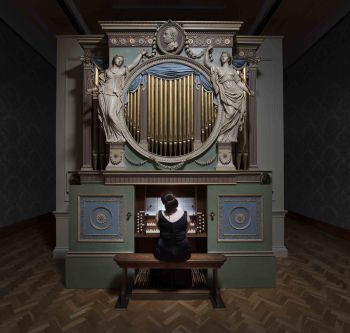
Chamber Organ, 1774, commissioned by Sir Watkins Williams Wynn for his London town house in St James’s Square. The case was designed by Robert Adam (National Museum Cardiff).
Icelandic artist Ragnar Kjartansson will return to Wales to present a brand-new site-specific performance piece, The Sky in a Room, co-commissioned by Artes Mundi and Amgueddfa Cymru – National Museum Wales. The performance will see a series of organists performing the 1959 hit song “Il Cielo In Una Stanza” (“The Sky in a Room”) on the 1774 Sir Watkins Williams Wynn organ, and it will run from 3 February to 11 March at National Museum Cardiff.
Developed after Kjartansson’s participation in Artes Mundi 6 in 2015, the exhibition is made possible by the Derek Williams Trust Purchase Prize, which enables Amgueddfa Cymru to purchase work by Artes Mundi shortlisted artists. It is also the first performance piece acquired by the Museum.
As part of the work, all of the paintings, objects and decorative furniture from the Museum’s Art in Britain 1700–1800 gallery have been removed. In the centre of the empty gallery is a solo performer, seated at a chamber organ originally commissioned by the Welsh patron of the arts Sir Watkins Williams Wynn in 1774. Throughout the day, across the five-week duration of the performance, the organist sings and plays “Il Cielo In Una Stanza,” a famous Italian love song written by Gino Paoli in 1959. The lyrics of this song recall the power of love to disappear walls into forests and ceilings into sky. Kjartansson’s work similarly transforms the Museum, dissolving space and time through the hypnotic repetition of the song.
Ragnar Kjartansson was born in Iceland in 1976. Live performance and music are central to his practice which also incorporates film, installation and painting. His film installation The Visitors featured in Artes Mundi 6.
Artes Mundi brings exceptional and challenging international artists to Wales, generating unique opportunities to engage creatively with the urgent issues of our time. Artes Mundi 8 takes place at National Museum Cardiff, 26 October 2018 – 24 February 2019.
The winner of the prestigious £40,000 Artes Mundi prize will be announced in January 2019 following a four-month exhibition of works by the shortlisted artists. The shortlist was selected from over 450 nominations spanning 86 countries and comprises five of the world’s most celebrated contemporary artists, whose works explore what it means to be human. They are: Anna Boghiguian, Bouchra Khalili, Otobong Nkanga, Trevor Paglen and Apichatpong Weerasethakul.
Exhibition | Classic Beauties
Looking ahead to the summer, from the Hermitage Amsterdam:
Classic Beauties: Artists, Italy, and the Aesthetic Ideals of the 18th Century
Hermitage Amsterdam, 16 June 2018 — 13 January 2019

Antonio Canova, The Three Graces, 1813–16.
The human body has fascinated artist throughout centuries. In the mid-eighteenth century this topic in art was been given a new lease on life due to spectacular archaeological discoveries in Italy. Artists like Canova, Thorvaldsen, Mengs, Kauffmann, and Batoni pursue ultimate perfection: even more perfect then the (aesthetic) ideal of the Greeks and the Romans. Many artists and elite youths set off for Italy, to see the sources of inspiration themselves. In the exhibition the visitor makes a grand tour along the finest examples of neoclassical art from the Hermitage. The exhibition Classic Beauties will offer a delightful journey through European Neoclassicism, including the unrivalled Canova collection with The Three Graces.
More information is available here»
The catalogue is published by W Books:
Thera Coppens and Arnon Grunberg, eds., Classic Beauties: Artists, Italy, and the Aesthetic Ideals of the 18th Century (Zwolle: W Books, 2018), 224 pages, ISBN: 978-9078653745, 30€.
Around the middle of the eighteenth century, Europe was enthralled by the archaeological excavations then taking place in Italy. Artists and young aristocrats from across the continent travelled there to see the country’s classical Roman and trendsetting contemporary art for themselves. The Grand Tour often lasted many months. Among those who made it were Goethe and the ‘Count and Countess of the North’ (the later Russian Tsar Paul I and his wife). In Rome, they met renowned artists like Pompeo Batoni, Anton Raphael Mengs, Hubert Robert, Angelica Kauffmann, and—most famous of all—Antonio Canova. In short, all the great names of eighteenth-century Neoclassicism. Classic Beauties allows readers to share the adventures of the Grand Tourists and meet the leading Neoclassical artists of the day. Their accounts and the book’s many illustrations—both of works of art and of contemporary tourist attractions—paint a vivid picture of a period in which the quest for classical beauty and the ideal nude was at the forefront of people’s minds.
Note (added 18 June 2018) — The posting was updated to include catalogue information.
Exhibition | First Academies: Benjamin West

Benjamin West, Death on the Pale Horse, 1817, oil on canvas, 447 × 765 cm
(Philadelphia: PAFA, 1836.1)
◊ ◊ ◊ ◊ ◊
Opening next month at PAFA:
First Academies: Benjamin West and the Founding of the RA of Arts and PAFA
Pennsylvania Academy of the Fine Arts, Philadelphia, 2 March — 3 June 2018
Curated by David Brigham
Investigating the role of Benjamin West in the founding of arts academies in England and the United States.
On the occasion of the 250th anniversary of the founding of the Royal Academy of Arts (RA) in London, the Pennsylvania Academy of the Fine Arts (PAFA) is pleased to recognize the role that Benjamin West (1738–1820) played in founding each of these first sustained academies in England and the United States. Born outside of Philadelphia, West traveled to Europe at age twenty-one to study painting and, rather than return home, he was lured by immediate patronage and recognition to remain in England where he would become one of the founders in 1768 of the RA, its second president, and court painter to George III. While West never returned to America, he educated three generations of American artists in his London studio, including Charles Willson Peale, Gilbert Stuart, Thomas Sully, and Rembrandt Peale.
In 1805, when PAFA was founded, West was selected as the first Honorary Academician. By lending his name to the first sustained art academy in North America, then RA President West contributed to PAFA’s nascent reputation and importance. West accepted the honor and wrote, “It is my wish that your Academy should be so indowed [sic] in all points which are necessary to instruct, not only the mind of the student in what is excellent in art—but that it should equally instruct the eye and the judgement [sic] of the public to know, and properly appreciate Excellence when it is produced….”
This exhibition explores West’s important role in the establishment of the RA and PAFA through more than sixty paintings, drawings, prints, sculptures, manuscripts, and books. In addition to the founding stories of the RA and PAFA, this exhibition recognizes the other artist-founders of PAFA, West’s role as the teacher of eighteenth- and early-nineteenth-century American artists, and the development of monumental history paintings such as Christ Rejected and Death on the Pale Horse.
Exhibition | Marie-Antoinette’s Japanese Lacquer

On view this year at the Getty Center:
A Queen’s Treasure from Versailles: Marie-Antoinette’s Japanese Lacquer
J. Paul Getty Museum, Los Angeles, 23 January 2018 — 6 January 2019
Curated by Jeffrey Weaver

Hen-shaped Tiered Box, Edo Period, late 17th–mid-18th century, artist unknown, lacquer (Musée National des Châteaux de Versailles et de Trianon; photo by Thierry Ollivier).
This exhibition showcases Japanese lacquer from the private collection of the French queen Marie-Antoinette. Her collection of small lacquer boxes was one of the finest in Europe, and she considered it to be among her most cherished possessions. The elaborate works reveal the queen’s personal taste and demonstrate the high level of achievement attained by Japanese lacquer artists during the 17th and 18th centuries.
The loan of the boxes is part of an artistic exchange between the J. Paul Getty Museum and Versailles, where an important desk made for Louis XVI from the Museum’s collection is currently on long-term loan.
Exhibition | Finding Form
Press release for the exhibition now on view at the Getty Center:
Finding Form
J. Paul Getty Museum, Los Angeles, 12 December 2017 — 11 February 2018
Curated by Annie Correll and Julian Brooks
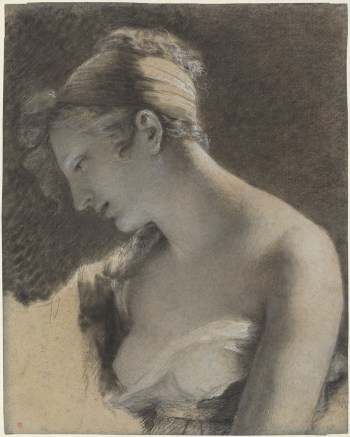
Pierre-Paul Prud’hon, Head of a Woman: Study for The Happy Mother (L’Heureuse mère), 1810, black and white chalk, stumped, on blue paper (Los Angeles: The J. Paul Getty Museum).
From two-dimensional sheets of paper, artists conjure three-dimensional worlds. Even the simplest sketch can yield an arresting impression of presence in the hands of a master, and close examination of a drawing often reveals hidden layers of creativity and complexity. Featuring celebrated works from the 1500s to the 1800s, all from the Getty Museum’s drawings collection, Finding Form, on view now through 11 February 2018, demonstrates how artists skillfully select from a vast array of media and techniques to best generate form, likeness, and depth in creating a drawing.
“The immediacy of drawing brings us into direct contact with the creative process as we seem to peer over the artist’s shoulder,” says Getty Museum Director Timothy Potts. “This display of a wide range of master drawings from our collection focuses on the seeming magic of creating an image of three-dimensional reality on a two-dimensional surface, and the various techniques artists use to convey the effects of light and shadow on our ‘reading’ of form.”
Works in the exhibition reveal how artists utilized media such as chalk, ink, and different pens to yield form. In Study of a Rearing Horse (about 1616), where the artist Jacques Callot was faced with the difficult task of showing a dramatically foreshortened horse from behind, he made initial quick sketches with a quill pen (made from a bird’s feather), then added more forceful strokes with a reed pen (made from a reed), which produces lines that more easily swell and taper with the pressure of the artist’s hand.
Watercolor can produce transparent, luminous effects that are well suited to conveying the impression of weather. As the mist dissolves and sunshine breaks through scattering rain clouds in Mount Snowdon through Clearing Clouds (1857) by Alfred Hunt, the mountains dematerialize and reappear within the shifting effects of light and shadow. Hunt used the medium of watercolor and the techniques of blotting, rubbing, and scraping to capture brilliantly these atmospheric conditions.
“I find it fascinating to see how—over the centuries—artists have used all the techniques at their disposal to create different realities on each sheet,” says Julian Brooks, senior curator of drawings. “We always provide magnifying glasses in our displays, and—just by looking closely—anyone can gain entry into a rich variety of other worlds.”
In The Archangel Raphael Refusing Tobias’s Gift, Giovanni Biliverti explored the full potential of red chalk, a classic Florentine medium used widely since the Renaissance. While some forms were created with traditional strokes, to render smoke and ruffled drapery the chalk was ground to a powder and mixed with water to produce translucent effects. A new acquisition, the drawing is one of the finest by the artist.
Finding Form, is curated by Annie Correll, former graduate intern in the department of Drawings, and Julian Brooks, senior curator of drawings at the J. Paul Getty Museum.
Display | New Discoveries in Philadelphia Slipware
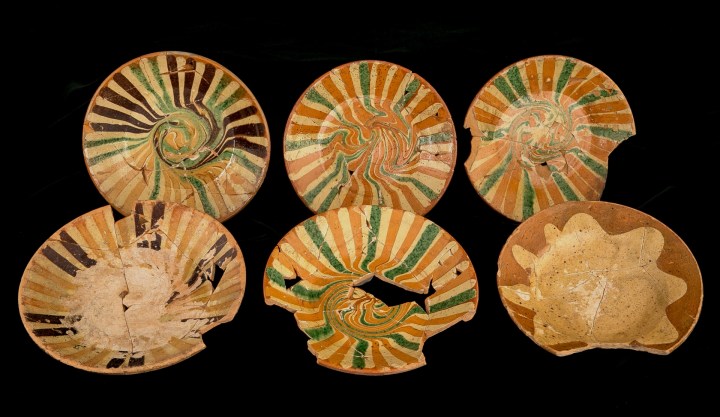
18th-century Slipware Ceramics, excavated from the site of the new Museum of the American Revolution in Philadelphia.
◊ ◊ ◊ ◊ ◊
Press release, via Art Daily:
Buried Treasure: New Discoveries in Philadelphia Slipware from the Collection of the Museum of the American Revolution
New York Ceramics and Glass Fair, 18–21 January 2018
A remarkable assemblage of 18th-century slipware ceramics uncovered during an archaeological excavation in Philadelphia has been revealed to the public for the first time. Nearly a dozen pieces of slipware, a form of decorative lead-glazed pottery, are on view at the 2018 New York Ceramics and Glass Fair from Thursday, January 18 until Sunday, January 21, at Bohemian National Hall in Manhattan. Buried Treasure: New Discoveries in Philadelphia Slipware from the Collection of the Museum of the American Revolution is sponsored by Ceramics in America, which is published by the Chipstone Foundation of Milwaukee, Wisconsin, and the Museum of the American Revolution. After the exhibit, the items will be returned to the Museum for future display.
The slipware was uncovered during excavations on the site of the new Museum of the American Revolution in Philadelphia, during which archaeologists from Commonwealth Heritage Group recovered nearly 85,000 artifacts. Among these was a group of slipware ceramics, including large dishes and other items, distinguished by vivid abstract patterns created using a specialized skill known as ‘slip trailing’, which involves pouring liquid clay onto an object.
The pieces were discovered in a brick-lined privy shaft associated with one or more taverns. Current research suggests that these previously undocumented slipwares were made in Philadelphia by one or more French or German potters operating within the confines of the historic Old City district. Researchers believe that, although the pieces primarily had display value, they may have been used for serving as well.
“We’ve seen hints of this type of slipware before but nothing that has this degree of intactness and comprehensiveness as far as the patterns exhibited here,” said Robert Hunter, editor of the annual journal Ceramics in America, an author, and archaeologist. “Nothing else has been this complete. By virtue of that intactness, we have been able to make great bounds in what we can learn from them about who made them and how they were used.”
“The site of the Museum of the American Revolution is the gift that keeps on giving,” said Hunter. “There is no question that it has been an extremely rich deposit of 18th-century material culture. And we’ve only scratched the surface—I believe it will be many years before we fully realize the research potential from the materials from the site.”
 In addition to the slipware, a newly analyzed decorated porcelain teapot is on display. The teapot was discovered to be only the second-known example of American-made hard-paste porcelain. The first example was the ‘Holy Grail’ bowl exhibited last year. Historical research by Hunter and Miller has now suggested that this porcelain was being made in the period around 1765–68, earlier than the previously known Bonnin and Morris porcelain Factory which opened in 1770. This new discovery changes the complexion of the history of porcelain making both in Philadelphia and the larger American context. The findings will be discussed in depth in an upcoming article in Ceramics in America.
“What is so exciting about this discovery is that it is a reminder of the importance of archaeology in colonial urban sites like Philadelphia,” said Dr. R. Scott Stephenson, Vice President of Collections, Exhibitions, and Programming at the Museum of the American Revolution. “The materials recovered on these sites require years of research to fully appreciate, and so these treasures from the Museum site will continue to provide new insight into Revolutionary America.”
Archaeologists from Commonwealth Heritage Group, Inc. conducted fieldwork at the site of the new Museum of the American Revolution from July through October 2014 and briefly in April 2015 and May 2016, uncovering a record of occupation from the earliest settlement of Philadelphia through the mid-20th century. Most of the artifacts were found in brick-lined privy and well shafts. The features contained an enormous quantity of of ceramics, including locally made Philadelphia objects and imported English, German, and Chinese wares, among other artifacts.
Exhibition | Winckelmann and the Capitoline Museum
From the Capitoline Museum:
The Treasure of Antiquity: Winckelmann and the Capitoline Museum in Eighteenth-Century Rome
Musei Capitolini, Rome, 7 December 2017 — 22 April 2018
Curated by Eloisa Dodero and Claudio Parisi Presicce
 Una mostra per celebrare gli anniversari della nascita e della morte del fondatore dell’archeologia moderna, Johann Joachim Winckelmann (1717–1768)
La mostra Il Tesoro di Antichità. Winckelmann e il Museo Capitolino nella Roma del Settecento intende celebrare gli importanti anniversari winckelmanniani del 2017 (300 anni dalla nascita) e del 2018 (250 anni dalla morte) e si inserisce nel contesto delle manifestazioni europee coordinate dalla Winckelmann Gesellschaft di Stendal, dall’Istituto Archeologico Germanico di Roma e dai Musei Vaticani. L’esposizione ha una duplice finalità: la prima, offrire ai visitatori il racconto degli anni cruciali che hanno portato, nel dicembre del 1733, all’istituzione del Museo Capitolino, il primo museo pubblico d’Europa, destinato non solo alla conservazione ma anche alla promozione della “magnificenza e splendor di Roma”; la seconda, presentare le sculture capitoline sotto una luce diversa, ovvero attraverso le intuizioni, spesso geniali, del grande Winckelmann.
Arricchita da una selezione di 124 opere e da apparati multimediali realizzati appositamente, il Tesoro di Antichità si sviluppa in tre sedi diverse nell’ottica di una “mostra diffusa”: le Sale Espositive di Palazzo Caffarelli, le Stanze Terrene di Sinistra del Palazzo Nuovo e le Sale museali del Palazzo Nuovo.
Negli anni in cui Winckelmann rivoluziona il modo di studiare le testimonianze del mondo antico dando inizio alla moderna archeologia, il modello di museo pubblico rappresentato dal Museo Capitolino si diffonde rapidamente in tutta Europa, segnando la nascita di modalità del tutto nuove di fruizione dei beni artistici: un Tesoro di Antichità non più concepito come proprietà esclusiva di pochi, ma come luogo destinato all’avanzamento culturale della società.
Eloisa Dodero and Claudio Parisi Presicce, Il Tesoro di Antichità: Winckelmann e il Museo Capitolino nella Roma del Settecento (Rome: Gangemi Editore, 2017), 384 pages, ISBN: 978 884923 5371, 35€.
«Vivo come un artista e come tale sono accolto nei luoghi dove ai nella Roma del Settecento giovani è permesso di studiare, come nel Campidoglio. Qui è il Tesoro delle Antichità di Roma e qui ci si può trattenere in tutta libertà dalla mattina alla sera». È il 7 dicembre del 1755 ed è con queste parole che Johann Joachim Winckelmann (1717–1768) descrive a un amico la sua prima visita al Museo Capitolino. Negli anni in cui Winckelmann rivoluziona il modo di studiare le testimonianze del mondo antico, il modello di museo pubblico rappresentato dal Museo Capitolino si diffonde in tutta Europa, segnando la nascita di nuove modalità di fruizione dei beni culturali: un «Tesoro di Antichità» non più concepito come proprietà esclusiva di pochi, ma come luogo destinato all’avanzamento culturale della società.
Exhibition | Thomas Gainsborough: Modern Landscape

Thomas Gainsborough, Mr. and Mrs. Andrews, ca. 1750
(London: National Gallery)
◊ ◊ ◊ ◊ ◊
On view this spring at the Hamburger Kunsthalle:
Thomas Gainsborough: The Modern Landscape / Die moderne Landschaft
Hamburger Kunsthalle, 2 March — 27 May 2018
Curated by Katharina Hoins and Christoph Martin Vogtherr
Thomas Gainsborough (1727–1788) was a pioneering artist in the development towards ›modern‹ landscape painting of around 1800. He was mainly perceived as a painter of brilliant society portraits by his contemporaries, although he personally far preferred his landscapes. They reflect the dramatic technological and artistic developments of his time and the growing contradictions in British society. Landscape painting served Gainsborough as a laboratory to transform impressions into innovation. He experimented with colours and techniques, painted on glass and combined natural materials into landscape models. Establishing England as a centre of European landscape painting, he created images of timeless power. Iconic works like Mr and Mrs Andrews will feature in the exhibition. Gainsborough: Modern Landscape is the first exhibition by a German museum devoted to Gainsborough. For a German and an international public it promises the (re-)discovery of an exceptional painter.
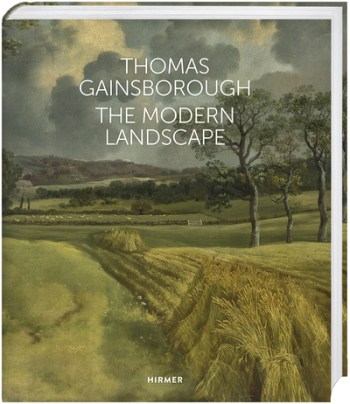 M. Bills, B. Gockel, M. Hallett, K. Hoins, R. Jones, J. Karg, S. Pisot, and C. Vogtherr, Thomas Gainsborough: The Modern Landscape (Munich: Hirmer, 2018), 224 pages, ISBN: 978 37774 29977, $65.
Gainsborough himself favoured landscape painting, a field to which he made important contributions, over his well-known portraits. His works are fascinating for their painterly subtlety and technical variation. This volume brings together German and British traditions of viewing, interpreting, and studying Gainsborough. It looks at the connections to the Dutch landscapes, explains Gainsborough’s unusual and experimental techniques from an art technological point of view, and situates his landscapes in the context of the social tensions of early industrialisation.
Exhibition | Luigi Valadier: Splendor in Eighteenth-Century Rome
Looking ahead to the fall, from the press release:
Luigi Valadier: Splendor in Eighteenth-Century Rome
The Frick Collection, New York, 31 October 2018 — 20 January 2019
Galleria Borghese, Rome, 30 October 2019 — 2 February 2020
Curated by by Alvar González-Palacios and Xavier Salomon

Luigi Valadier, Herma with Bacchus for the Palazzo Borghese, alabaster and glazed bronze with traces of gilding, 1773, 69 inches (Rome: Galleria Borghese; photo by Mauro Magliani).
Of the many artists who flourished in Rome during the eighteenth century, the silversmith Luigi Valadier (1726–1785) was among those particularly admired by popes, royalty, and aristocrats. Luigi was born in Rome in 1726, about six years after his parents emigrated from France. His father, Andrea, established a silversmith workshop that quickly captured the attention of the wealthiest Roman aristocrats. Heir to his father’s business, Luigi had an unsurpassed technical expertise, which, combined with his avant-garde aesthetic, resulted in extraordinary works in silver and bronze. Well aware of the evolution of artistic taste throughout Europe, he had an impressive ability to reframe examples of ancient Roman art and architecture within the context of contemporary Rome. Sculptures in private collections, cameos, architectural details, and ruins of ancient monuments served as his inspiration for candelabra, tableware, altars, and centerpieces in both silver and bronze. Luigi’s fame and influence spread beyond the borders of Italy, and he received commissions from patrons in France, England, and Spain. He was, however, burdened by debts for commissions undertaken but never paid for, and, in 1785, he committed suicide, drowning himself in the Tiber. Following this tragic event, his workshop passed to his son Giuseppe.
Illustrating the uncommon versatility of Luigi Valadier, who produced everything from large altar pieces to intricate works of jewelry, the Frick’s fall 2018/winter 2019 exhibition will include more than sixty works carefully selected from the vast production of the Valadier workshop. Preparatory drawings of both sacred and profane subjects will be displayed alongside finished works. . One of the highlights of the exhibition will be a full centerpiece, or deser (from the Italianization of the French word dessert), created around 1778 for the Bali de Breteuil, Ambassador of the Order of Malta to Rome. Atop a gilt-bronze base inlaid with precious stones, Valadier has re-created temples, triumphal arches, columns, and other miniature representations of ancient Roman monuments. The multiple elements of the Breteuil deser are today separated between two museums in Madrid (the Museo Arqueológico Nacional and the Palacio Real), but will be reunited for this special exhibition at the Frick. It will therefore be possible to admire this masterwork in its entirety, as nobles and cardinals did in 1778, when it was displayed for a few days in Valadier’s workshop in a candle-lit room specially decorated for the occasion.
The exhibition will also feature finely worked silver plates, tureens, salt cellars, and other pieces of tableware. The juxtaposition of these individual works with the complete centerpiece will illustrate the evolution of the Valadier workshop. While the earliest pieces presented are distinctly in the Baroque style, Valadier’s work becomes more refined in the Rococo style, before becoming neoclassical by the late-eighteenth century. The monochrome silver objects will be contrasted with polychrome works in gilt-bronze, marble, and precious stones, such as the Egyptian clock, a table from Villa Borghese, and extraordinary mounts for two antique cameos once in the Vatican collections and now at the Musée du Louvre.
One section of the exhibition will be devoted to reproductions in bronze of famous antique sculptures in Roman collections, such as the Apollo Belvedere and the Ares Ludovisi.
Luigi Valadier: Splendor in Eighteenth-Century Rome is co-curated by Professor Alvar González-Palacios, considered the world’s authority on Valadier, and Xavier F. Salomon, Peter Jay Sharp Chief Curator of The Frick Collection. It is part of a series of monographic exhibitions that focus on remarkable decorative arts artists and follows the ground-breaking and critically acclaimed Pierre Gouthière: Virtuoso Gilder at the French Court, organized by the Frick, where it was on view in fall 2016 before traveling to the Musée des arts décoratifs, Paris, in spring 2017.
Accompanying the exhibition will be the first complete monograph on Luigi Valadier. Written by González-Palacios, the book will shed new light on the provenance and dating of some works. It also identifies the exact roles performed inside the workshop by Andrea, Luigi, and Giuseppe Valadier, tracing the genesis of inventions and the authorship of models. The monograph also details the Valadier family’s collaborations with other workshops and artists. Typically, works in various materials such as bronze, marble, and precious stones were realized not by one person but by many artisans working together. The decoration of both sacred and private buildings likewise involved outside artisans and architects. This will be the only comprehensive publication on Valadier in English and, lavishly illustrated, it will feature much-needed new photography.
Together, the monograph and exhibition at the Frick will reconstruct the artistic endeavors of one of the most important silversmith families, shedding new light on the cultural life of Rome and, more broadly, Europe, during the eighteenth century. Following the presentation of this show in New York, a related exhibition will be on view later in 2019 at the Galleria Borghese, Rome.
◊ ◊ ◊ ◊ ◊
Note (added 20 December 2019) — The posting was updated to include specific dates for the Galleria Borghese.
Exhibition | Pastels in Pieces

Maurice-Quentin de La Tour, Portrait of Gabriel Bernard de Rieux, 1739–41; pastel and gouache on paper mounted on canvas, 201 × 150 cm (Los Angeles: The J. Paul Getty Museum).
On view through the summer at The Getty Center:
Pastels in Pieces
Getty, Los Angeles, 16 January — 29 July 2018
Curated by Emily Beeny
European paper was not manufactured in giant sheets until the nineteenth century. Competing with painters who worked on monumental canvases, eighteenth-century pastellists joined together multiple sheets of paper in order to create large, continuous surfaces. The piecing together of pastels, however, also served other purposes, allowing artists to paper over their mistakes or paste the heads of important sitters onto bodies posed by models. Matching each exhibited pastel with a map of its component sheets, this installation encourages visitors to consider how these objects were made.










 Enfilade
leave a comment