Exhibition | Luigi Valadier: Splendor in Eighteenth-Century Rome
Looking ahead to the fall, from the press release:
Luigi Valadier: Splendor in Eighteenth-Century Rome
The Frick Collection, New York, 31 October 2018 — 20 January 2019
Galleria Borghese, Rome, 30 October 2019 — 2 February 2020
Curated by by Alvar González-Palacios and Xavier Salomon

Luigi Valadier, Herma with Bacchus for the Palazzo Borghese, alabaster and glazed bronze with traces of gilding, 1773, 69 inches (Rome: Galleria Borghese; photo by Mauro Magliani).
Of the many artists who flourished in Rome during the eighteenth century, the silversmith Luigi Valadier (1726–1785) was among those particularly admired by popes, royalty, and aristocrats. Luigi was born in Rome in 1726, about six years after his parents emigrated from France. His father, Andrea, established a silversmith workshop that quickly captured the attention of the wealthiest Roman aristocrats. Heir to his father’s business, Luigi had an unsurpassed technical expertise, which, combined with his avant-garde aesthetic, resulted in extraordinary works in silver and bronze. Well aware of the evolution of artistic taste throughout Europe, he had an impressive ability to reframe examples of ancient Roman art and architecture within the context of contemporary Rome. Sculptures in private collections, cameos, architectural details, and ruins of ancient monuments served as his inspiration for candelabra, tableware, altars, and centerpieces in both silver and bronze. Luigi’s fame and influence spread beyond the borders of Italy, and he received commissions from patrons in France, England, and Spain. He was, however, burdened by debts for commissions undertaken but never paid for, and, in 1785, he committed suicide, drowning himself in the Tiber. Following this tragic event, his workshop passed to his son Giuseppe.
Illustrating the uncommon versatility of Luigi Valadier, who produced everything from large altar pieces to intricate works of jewelry, the Frick’s fall 2018/winter 2019 exhibition will include more than sixty works carefully selected from the vast production of the Valadier workshop. Preparatory drawings of both sacred and profane subjects will be displayed alongside finished works. . One of the highlights of the exhibition will be a full centerpiece, or deser (from the Italianization of the French word dessert), created around 1778 for the Bali de Breteuil, Ambassador of the Order of Malta to Rome. Atop a gilt-bronze base inlaid with precious stones, Valadier has re-created temples, triumphal arches, columns, and other miniature representations of ancient Roman monuments. The multiple elements of the Breteuil deser are today separated between two museums in Madrid (the Museo Arqueológico Nacional and the Palacio Real), but will be reunited for this special exhibition at the Frick. It will therefore be possible to admire this masterwork in its entirety, as nobles and cardinals did in 1778, when it was displayed for a few days in Valadier’s workshop in a candle-lit room specially decorated for the occasion.
The exhibition will also feature finely worked silver plates, tureens, salt cellars, and other pieces of tableware. The juxtaposition of these individual works with the complete centerpiece will illustrate the evolution of the Valadier workshop. While the earliest pieces presented are distinctly in the Baroque style, Valadier’s work becomes more refined in the Rococo style, before becoming neoclassical by the late-eighteenth century. The monochrome silver objects will be contrasted with polychrome works in gilt-bronze, marble, and precious stones, such as the Egyptian clock, a table from Villa Borghese, and extraordinary mounts for two antique cameos once in the Vatican collections and now at the Musée du Louvre.
One section of the exhibition will be devoted to reproductions in bronze of famous antique sculptures in Roman collections, such as the Apollo Belvedere and the Ares Ludovisi.
Luigi Valadier: Splendor in Eighteenth-Century Rome is co-curated by Professor Alvar González-Palacios, considered the world’s authority on Valadier, and Xavier F. Salomon, Peter Jay Sharp Chief Curator of The Frick Collection. It is part of a series of monographic exhibitions that focus on remarkable decorative arts artists and follows the ground-breaking and critically acclaimed Pierre Gouthière: Virtuoso Gilder at the French Court, organized by the Frick, where it was on view in fall 2016 before traveling to the Musée des arts décoratifs, Paris, in spring 2017.
Accompanying the exhibition will be the first complete monograph on Luigi Valadier. Written by González-Palacios, the book will shed new light on the provenance and dating of some works. It also identifies the exact roles performed inside the workshop by Andrea, Luigi, and Giuseppe Valadier, tracing the genesis of inventions and the authorship of models. The monograph also details the Valadier family’s collaborations with other workshops and artists. Typically, works in various materials such as bronze, marble, and precious stones were realized not by one person but by many artisans working together. The decoration of both sacred and private buildings likewise involved outside artisans and architects. This will be the only comprehensive publication on Valadier in English and, lavishly illustrated, it will feature much-needed new photography.
Together, the monograph and exhibition at the Frick will reconstruct the artistic endeavors of one of the most important silversmith families, shedding new light on the cultural life of Rome and, more broadly, Europe, during the eighteenth century. Following the presentation of this show in New York, a related exhibition will be on view later in 2019 at the Galleria Borghese, Rome.
◊ ◊ ◊ ◊ ◊
Note (added 20 December 2019) — The posting was updated to include specific dates for the Galleria Borghese.
Exhibition | Pastels in Pieces

Maurice-Quentin de La Tour, Portrait of Gabriel Bernard de Rieux, 1739–41; pastel and gouache on paper mounted on canvas, 201 × 150 cm (Los Angeles: The J. Paul Getty Museum).
On view through the summer at The Getty Center:
Pastels in Pieces
Getty, Los Angeles, 16 January — 29 July 2018
Curated by Emily Beeny
European paper was not manufactured in giant sheets until the nineteenth century. Competing with painters who worked on monumental canvases, eighteenth-century pastellists joined together multiple sheets of paper in order to create large, continuous surfaces. The piecing together of pastels, however, also served other purposes, allowing artists to paper over their mistakes or paste the heads of important sitters onto bodies posed by models. Matching each exhibited pastel with a map of its component sheets, this installation encourages visitors to consider how these objects were made.
Exhibition | Oser l’Encyclopédie: Un combat des Lumières
Now on view at the Mazarin Library (with the full press release available as a PDF file here)
Oser l’Encyclopédie: Un combat des Lumières
Bibliothèque Mazarine, Paris, 20 October 2017 — 19 January 2018
 L’Encyclopédie, ou Dictionnaire raisonné des sciences, des arts et des métiers (1751–1772), codirigée par Diderot, D’Alembert et Jaucourt, constitue la plus vaste entreprise éditoriale du 18e siècle, par le nombre des forces humaines mobilisées, l’étendue des savoirs convoqués, et son retentissement en Europe. La publication de cet « ouvrage immense et immortel » (Voltaire), dont la première édition rassemble 28 volumes, quelque 74 000 articles et près de 2 600 planches, s’étend sur plus de 25 ans. Autorisée par un privilège de librairie (1746), elle est censurée alors que deux tomes sont déjà imprimés (1752), puis tolérée (1753), à nouveau interdite et condamnée à la destruction (1759), et enfin poursuivie grâce à une permission tacite (1759–1772). Et, parce qu’elle constitue une entreprise commerciale à succès, elle connaît immédiatement réimpressions et contrefaçons.
Pour la première fois, une édition critique de l’Encyclopédie voit le jour. Réalisée au format numérique et menée de façon collaborative par plus de 120 chercheurs de tous horizons, elle vise l’annotation progressive des articles et des planches, en mobilisant l’ensemble des connaissances sur l’ouvrage. Soutenue par l’Académie des sciences, l’Édition Numérique Collaborative et CRitique de l’Encyclopédie (ENCCRE)1 s’appuie sur un exemplaire exceptionnel du premier tirage de la première édition, conservé par la Bibliothèque Mazarine qui en a fait l’acquisition au 18e siècle, volume après volume.
L’exposition met en relation cet exemplaire original et l’édition numérique. Elle montre ce que fut le travail de l’Encyclopédie au 18e siècle, et ce que représente son édition critique au 21e. De l’architecture complexe de l’ouvrage à son histoire éditoriale, on y découvre matériellement et numériquement l’intérieur de l’œuvre, ses enjeux et ce qui fut une de ses ambitions fondamentales : « changer la façon commune de penser ». (Diderot).
Organisation et commissariat
Alain Cernuschi (Université de Lausanne)
Alexandre Guilbaud (Institut de mathématiques de Jussieu) Marie Leca Tsiomis (Université Paris Ouest, Société Diderot) Irène Passeron (Institut de mathématiques de Jussieu)
Yann Sordet (Bibliothèque Mazarine)
Anne Weber (Bibliothèque Mazarine)
Alain Cernuschi, Alexandre Guilbaud, Marie Leca-Tsiomis, Irène Passeron, with Yann Sordet, preface by Cathérine Bréchignac, Oser l’Encyclopédie: Un combat des Lumières (Paris: EDP Sciences, 2017), 120 pages, ISBN: 978 27598 21389, 15€.
Display | Lighting Up the Stage: Stars of the Georgian Theatre
From The Holburne Museum:
Lighting Up the Stage: Stars of the Georgian Theatre
The Holburne Museum, Bath, 2 February — 3 June 2018

Samuel de Wilde, John Palmer as Don John in ‘The Chances’, 1791 (Bath: The Holburne Museum).
William Somerset Maugham (1874–1965), a playwright and novelist, began collecting paintings of actors in the 1910s. He built a sizeable and important collection of theatrical portraits, which he displayed in his villa in the south of France. The collection remained together throughout the Second World War, despite Maugham himself having to leave France and his villa being taken over by the occupying forces. He gifted his collection to the National Theatre in 1951, from which the paintings were transferred to Bath in 2010. The collection contains key works by Zoffany, including portraits of David Garrick in some of his most celebrated tragic and comic roles, and the 18th-century small-scale portraitist Samuel de Wilde. The theatrical portraits immortalise stars of the 18th- and 19th-century stage in character and often in moments of high drama. The collection forms an important historical record as well as being the unique creation of one man’s personal taste.
This temporary display will provide a rare view of some of the less frequently seen portraits in the Maugham collection. These include sitters whose names may be less familiar to audiences today but who were nevertheless considered among the great actors of their day. They include the comic actor Richard Wilson (1744–1796) and John Palmer (1745–1798), who regularly performed at Drury Lane and who Sheridan nicknamed ‘plausible Jack’.
Later in the year, The Holburne Museum will present the exhibition Gainsborough and the Theatre , on view from 5 October 2018 until 20 January 2019.
Exhibition | Faces of China
From the Staatliche Museen zu Berlin:
Faces of China: Portrait Paintings from the Ming and Qing (1368–1912)
Gesichter Chinas: Porträtmalerei der Ming- und Qing-Dynastie (1368–1912)
Royal Ontario Museum, Toronto, 18 May 2013 — 23 February 2014
Kulturforum, Berlin, 12 October 2017 — 7 January 2018
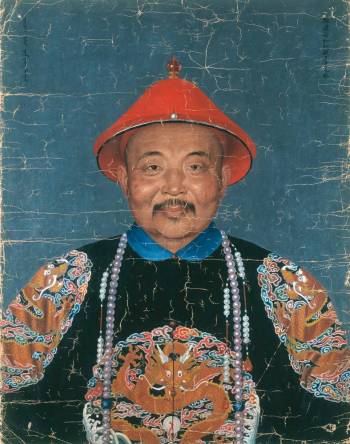
Unidentified Painter, Portrait of Dawaci, 佚名 達瓦斉像, Qing dynasty, Qianlong period (1736–1795), ca. 1756, oil on Korean paper (Ethnologisches Museum – Staatliche Museen zu Berlin, I D 22242, Waltraut Schneider-Schütz).
Faces of China is the first exhibition explicitly dedicated to Chinese portrait painting. A selection of more than 100 paintings from the collections of the Palace Museum Beijing and the Royal Ontario Museum Toronto, most of which have never been shown in Europe, spans a period of more than 500 years. The main focus is on the unique portraits of the Qing Dynasty (1644–1912), including images of members of the imperial court, ancestors, military figures, and informal portraits of artists and famous women. These portraits evidence a blossoming of the genre that had never been seen before.
Portrait painting has a 2000-year-old tradition in China. Beginning in the middle of 16th century, the late Ming Dynasty brought with it an economic boom and great intellectual openness that spurred a significant moment of florescence. It was in this period that Italian Jesuit painters visited the country, such as Matteo Ricci, who brought new techniques of European portrait painting with him in 1583. After the Manchu people conquered China in 1644 and established the Qing Dynasty, the imperial court in Beijing was host to a lively cultural exchange between China and Europe. This is particularly well reflected in the portrait paintings. The Jesuit painter Giuseppe Castiglione (Chinese name: Lang Shining; Milan 1688–Beijing 1766) is a key figure of this period.
Chinese portrait painting is characterized by two traditions of representation: images of ancestors and images of living figures. Ancestor portraits were created to honor deceased family members, who were venerated as part of religious observance within the family. Most were painted by professional but anonymous artists and are unsigned. On the other hand, there are portraits signed by often famous artists depicting well-known figures, such as officials, artists, poets, or those in the military, along with ordinary citizens shown in both single and group family portraits.
In exhibitions on Chinese portrait painting to date, only one of these traditions of representation has always been the central theme. However, Faces of China is deliberately dedicated to both of these two traditions, as developments in one always informed developments in the other. While the upper exhibition hall is dedicated to portraits of princely figures, officials, and artists, the focus in the galleries on the lower exhibition hall is on private individuals, families, and ancestral portraits.
The works are placed in carefully chosen relationships in light of their original social and religious contexts, as well as their circumstances of production. Thus, large-scale imperial portraits are surrounded by imperial silk garments once worn in the Palace—both groups of objects are on loan from the Palace Museum Beijing. The ancestor portraits—loans from the Royal Ontario Museum Toronto—are placed alongside an altar table with a censer, candlesticks, and flower vases, intended for honoring deceased relatives. Further objects on display come from the extensive Chinese collections of the Staatliche Museen’s own Ethnologisches Museum and Museum für Asiatische Kunst.
A collection of 365 preparatory studies for ancestral portraits that have never gone on display before, along with a series of presentation pieces in album form that artists showed potential clients as a way of sampling their wares, offers insight into workshop practices of the time. Also included in this collection are handbooks for portrait painters with woodcut illustrations, such as Ding Gao’s Secret Workshop Traditions of Portrait Painting, which not only gives details on technique, but also explores scientific approaches to the art of portraiture, such as physiognomy.
In addition, the exhibition deliberately highlights transcultural relationships to European portraiture by placing the Chinese portraits alongside a handful of European masterworks from the same time. So Anthony van Dyck’s Portrait of a Genovese Lady (ca. 1623) from the collection of the Gemäldegalerie appears next to a Chinese portrait of similarly large dimensions and from the same time, depicting a male ancestor.
The exhibition is organized by the Museum für Asiatische Kunst – Staatliche Museen zu Berlin and the Palace Museum Beijing, in cooperation with the Royal Ontario Museum Toronto (at the ROM, the exhibition was entitled Faces to Remember: Chinese Portraits of the Ming and Qing Dynasties). An extensive catalogue, published by Imhof Verlag, will accompany the exhibition.
Klaas Ruitenbeek, Gesichter Chinas: Porträtmalerei der Ming- und Qing-Dynastie, 1368–1912 (Petersberg: Michael Imhof Verlag, 2017), 368 pages, ISBN: 978 37319 05875, 50€.
Exhibition | Gainsborough’s Family Album
Looking ahead to the fall with a reminder that paper proposals for the coordinated conference on Portraiture and Biography, to take place at the end of November, are due by 1 February 2018; from the NPG press release (6 December 2017). . .
Gainsborough’s Family Album
National Portrait Gallery, London, 22 November 2018 — 3 February 2019
Princeton University Art Museum, 23 February — 5 June 2019.
Curated by David Solkin with Lucy Peltz

Thomas Gainsborough, The Artist’s Daughters, Mary, and Margaret, Chasing a Butterfly, ca. 1756, 113.5 × 105 cm (London: National Gallery).
The National Portrait Gallery London is to bring together for the first time all twelve surviving portraits of Thomas Gainsborough’s daughters in a major new exhibition, Gainsborough’s Family Album, opening on 22 November 2018. The portraits, which trace the development of the Gainsborough girls from playful young children to fashionable adults, include such famous images as The Artist’s Daughters Chasing a Butterfly (ca. 1756) and The Artist’s Daughters with a Cat, (ca. 1760–61). These will be shown alongside rarely seen paintings, such as the grand double full-length portrait of Mary and Margaret Gainsborough as sumptuously-dressed young women (ca. 1774).
Featuring over fifty works from public and private collections across the world, Gainsborough’s Family Album will provide a unique insight into the private life and motivations of one of Britain’s greatest artists. The exhibition will include a number of works that have never been on public display in the UK, including an early portrait of the artist’s father John Gainsborough (ca. 1746–48) and a drawing of Thomas and his wife Margaret’s pet dogs, Tristram and Fox.
Thomas Gainsborough (1727–1888) was one of Britain’s most successful eighteenth-century portraitists, but in his private correspondence he lamented that the need to earn his living from an endless parade of “damnd Faces” prevented him for pursuing his devotion to landscape, the branch of art he most loved. Nonetheless, he still managed to find the time, the energy and the desire to paint more portraits of his family members than any other artist of his or any earlier period is known to have produced. These include pictures of himself, his father, his wife, his daughters, two sisters and two brothers, a brother-in-law, two nephews, one niece, and a few more distant connections, not to mention his dogs. The vast majority of these works stayed with the family throughout the painter’s lifetime, by the end of which he had single-handedly created an unusually comprehensive visual record of an eighteenth-century British kinship network, with several of its key players shown more than once, at different stages of their lives.
Gainsborough’s Family Album will chart Gainsborough’s career from youth to maturity, telling the story of a provincial artist’s rise to metropolitan fame and fortune. However, alongside this runs a more private narrative about the role of portraiture in the promotion of family values, at a time when these were in the process of assuming a recognizably modern form. The exhibition will both offer a new perspective on Gainsborough the portraitist and challenge our thinking about his era and its relationship to our own.
Dr Nicholas Cullinan, Director, National Portrait Gallery, London, says: “We are delighted to be able to bring together so many of Gainsborough’s family portraits for the first time. The exhibition, which is unique in focusing on his paintings made for love, rather than for money, provides an unprecedented opportunity to see the intimate and personal aspect of Gainsborough’s portraits through this remarkable body of works depicting ‘ordinary people’ from a time when portraiture was almost exclusively confined to the rich, the famous and the upper classes.”
Professor David Solkin, Exhibition Curator and Emeritus Professor of the Courtauld Institute of Art says: “My hope is that Gainsborough’s Family Album will prompt new ways of thinking about Gainsborough and about the family albums that so many of us create.”
Gainsborough’s Family Album is curated by Professor David Solkin, with support from Dr Lucy Peltz, Senior Curator, 18th-Century Collections and Head of Collections Displays (Tudor to Regency), at the National Portrait Gallery. Professor Solkin is one of the world’s leading authorities on the history of British art. He joined The Courtauld Institute of Art in 1986 and completed his career there as Walter H. Annenberg Professor of the History of Art and Dean and Deputy Director. Solkin has published extensively on eighteenth-century art and culture and is the author of four major books, the latest of which are Painting out of the Ordinary: Modernity and the Art of Everyday Life in Early Nineteenth-Century Britain (2008) and Art in Britain 1660–1815 (2015). He has also curated several important exhibitions including, most recently, Turner and the Masters (2009).
Dr Peltz joined the National Portrait Gallery in 2001 as Curator of 18th-Century Collections and has curated several permanent galleries, temporary exhibitions and displays including The Regency in the Weldon Galleries (2003–); Brilliant Women: 18th-Century Bluestockings (2008); Thomas Lawrence: Regency Power and Brilliance (2010–11) and Simon Schama’s Face of Britain (2014–15), a project which resulted in a television series, a Viking-Penguin book, and an exhibition at the National Portrait Gallery.
David Solkin, Ann Bermingham, and Susan Sloman, Gainsborough’s Family Album (London: National Portrait Gallery Publications, 2018), 192 pages, ISBN: 978-1855147904, £30.
The exhibition will be accompanied by a fully illustrated book featuring fifty beautifully reproduced portraits from public and private collections around the world. The book includes essays by exhibition curator David Solkin, Ann Bermingham, Professor Emerita of Art History at the University of California, Santa Barbara and Susan Sloman, independent art historian and author of Gainsborough in Bath.
Exhibition | Fans of the Eighteenth Century

T. Ballister (English publisher), Traveling Fan, 1788; paper, wood, bone or ivory, and metal; engraved with stippling; opaque watercolor (hand-coloring) and sticks and guards; rivet; 24.4 cm length, 41.9 cm width open (Fine Arts Museums of San Francisco, Gift of Mrs. S. Conning, 9206).
◊ ◊ ◊ ◊ ◊
The exhibition is presented as a complement to Casanova: The Seduction of Europe, on view at the Legion of Honor from February 10 until May 28.
Fans of the Eighteenth Century
de Young Museum, San Francisco, from 31 March 2018
Fans have served as accessories of fashion and utility since antiquity but reached their peak production and use in eighteenth-century Europe. Made from and embellished by precious materials such as ivory, mother-of-pearl, and silver and gold leaf, eighteenth-century fans also featured designs that reflected the spirit of their times. Fans addressed current events as well as themes of broad interest, including biblical and mythological tales and romanticized domestic and pastoral vignettes. Fans of the Eighteenth Century explores this quintessential period of fan production through a selection of examples from the permanent collection.
Exhibition | Pots with Attitude: Political and Satirical Prints on Ceramics
From the press release for the exhibition:
Pots with Attitude: British Satire on Ceramics, 1760–1830
The British Museum, London, 12 January — 11 March 2018
Curated by Patricia Ferguson
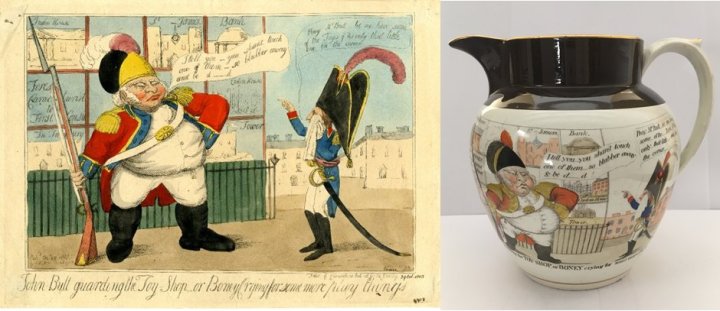
Ceramics are rarely confrontational, but the pugnacious mugs, jugs, and plates in Pots with Attitude: British Satire on Ceramics, 1760–1830, in Room 90a, a display at the British Museum, supported by the Monument Trust, are exceptions. Here, utilitarian creamwares and pearlwares are transformed with images appropriated from contemporary engravings into militant wares, fragile platforms criticising the latest political propaganda or blunder. Humour dissipates the uncomfortable truths in these satirical prints published in London between 1770 and 1830. Transferring printed images direct from copper plates onto ceramic bodies was an innovation embraced by the English potteries in the 1750s. They quickly exploited its possibilities to international acclaim and commercial gain. This interdisciplinary display uniting political prints and transfer-printed ceramics, two great British traditions, is part of a one-year Monument Trust funded curatorial project to champion interactions between 18th-century prints and ceramics.

Creamware jug, probably Liverpool, transfer-printed in red, ‘The Governor of Europe Stopped in his Career’, ca. 1803, 13 cm (London: The British Museum, 1922,1220.2.CR).
The British Museum has one of the largest collections of satirical prints in the world. The earliest were acquired by Sarah Sophia Banks (1744–1818), the sister of the naturalist Sir Joseph Banks (1743–1820), who collected 800 caricatures, as they were then known. Despite their popular appeal, these costly, hand-coloured etchings were aimed at the affluent and sold at Mayfair ‘Caricature Warehouses’ from the 1780s. The aristocracy pasted them into albums or lined print rooms with them as at Calke Abbey, Derbyshire. Samuel Fores (1761–1838), an enterprising London publisher, at No. 50, Piccadilly, offered ‘Folios of Caricatures lent out for the Evening’. Others charged an entrance fee, but many enjoyed them in the windows of print-shops for free.
Mass-produced pots with political prints were marketed at a broader social level and appeared on inexpensive earthenware, more at home in an alehouse than a drawing room. Most were printed over the glaze. New copper plates were engraved, scaled to the size of the pots. The small but choice collection in the British Museum is primarily from the 1887 gift of Sir Augustus Wollaston Franks (1826–1897), the first Keeper of the newly formed Department of British and Mediaeval Antiquities and Ethnography, who believed that the Museum’s collection should reflect historical events. Many of the pots in the display are on loan from a generous private collector.

Creamware jug, probably Liverpool, transfer-printed in red, ‘Success To the Volunteers’, ca. 1803, 13 cm (London: The British Museum, 1922,1220.2.CR).
The imagery became increasingly cruel, especially during Napoleon Bonaparte’s threatened invasion in 1803, when prints as government funded propaganda stirred up the populace with nasty images of the Corsican tyrant. Just weeks before the collapse of the Peace of Amiens in May 1803, a caricaturist captured a colossal ‘Boney’ with a foot firmly planted in Germany about to straddle the English Channel. A feisty, pint-sized John Bull with a blood stained sword has sliced off his toes, while exclaiming ‘Paws off, Pompey’, associating Bonaparte with the hero of a popular novel, a lap-dog, known as ‘Pompey the Little’.
This particular image was used by a number of potteries in Liverpool, Staffordshire, and Sunderland. The reverse of a creamware ale or wine jug, transfer-printed in iron-red, is inscribed ‘Success to the Volunteers’ within a Bacchic grapevine border. The Volunteers were a civilian militia formed following the Defence of the Realm Act 1803, when the heightened threat of invasion easily mobilized a 380,000 strong force by the year’s end. What role, if any, these humble printed pots played in encouraging their decision to volunteer is debatable, but they clearly supported their agenda.
Lecture by Patricia Ferguson
Tuesday, 23 January 2018, 13.15–14.00, Room 90a; free, just drop in.
Study Day | Pots, Prints, and Politics: Ceramics with an Agenda
Friday, 16 February 2018. More information is available here.
Note (added 28 January 2018) — The original version of this posting listed the title as Pots with Attitude: Political and Satirical Prints on Ceramics.
Display | Sir Hans Sloane’s Practices of Collecting and Cataloguing
Now on view at The British Museum:
A Physician’s Cabinet: Sir Hans Sloane’s Practices of Collecting and Cataloguing
The British Museum, London, 24 November 2017 — 11 January 2018

Dorothea Graff, Scarlet Ibis, watercolour on vellum, ca. 1700–07 (London: The British Museum).
This small display brings together an array of prints, drawings, and objects—all related to medicine—that were collected by the founder of the British Museum, Sir Hans Sloane (1660–1753). Sloane was a well-regarded physician and this display focuses on how medicine influenced his collecting. During the course of his life, Sloane brought together hundreds of thousands of objects to create one of the most significant collections in the world. On his death, he bequeathed these objects to the nation and they became the foundation of the British Museum’s collection.
Sloane was first and foremost a physician, and was doctor to Queen Anne and Kings George I and II. Medicine, in its broadest sense, influenced how Sloane collected and catalogued objects, especially from the natural world. He received specimens of plants, insects, shells and corals from around the globe. He also acquired exquisite albums of watercolours and drawings like the works on display by Jan Van Huysum (1682–1749) and Maria Sibylla Merian (1647–1717) and her daughters.
The medicinal use of objects was also important to Sloane. He carefully recorded this information as he organised his collection at his house in Bloomsbury Square and later in Chelsea. Two objects sent to him from China and Japan are on show for the first time: a fine ear cleaning implement and an ornate acupuncture needle case. Rare engravings—including a broadside on conjoined twins by John Day (1522–1584) and prints after Rubens (1577–1640) showing human musculature—demonstrate Sloane’s interest in artistic processes, anatomy, and the curiosities of nature.
Exhibition | Chippendale 300

During 2018, the Chippendale 300 partnership is celebrating Thomas Chippendale (b. 5 June 1718) and his legacy as widely as possible, both by encouraging greater public awareness of his genius and the glories of 18th-century craftsmanship and by demonstrating how the same spirit animates today’s designers and makers. The following institutions and historic houses have joined together to create a programme of exhibitions and events to celebrate Thomas Chippendale’s tercentenary: Burton Constable Hall, The Chippendale Society, Dumfries House, Firle Place, The Furniture History Society, Harewood House, Leeds Museum & Galleries, Master Carvers’ Association, The National Trust, Newby Hall, Paxton House, Visit Otley, and Weston Park. Visit Chippendale 300 for more information. Opening in February at Leeds:
Thomas Chippendale: A Celebration of Craftsmanship and Design, 1718–2018
Leeds City Museum, 9 February — 10 June 2018
Curated by Adam Bowett and James Lomax
 This exhibition celebrates the life and work of Thomas Chippendale (1718–1779), Britain’s most famous furniture maker. It will be the most comprehensive exhibition of Thomas Chippendale’s work ever presented and will include furniture, accessories, drawings, documents and other material from collections throughout the United Kingdom. Alongside well-known masterpieces from public collections there will be rarely-seen furniture from private houses and some new discoveries, never before exhibited. The exhibition explores Thomas Chippendale’s life and work in five major themes: his family origins, training, career and the publication of the ground-breaking Director; his furniture in the Rococo, Gothic, Chinese, and neo-Classical styles; the management of his commissions, including relations with clients; his workshops, including manufacturing and decorative techniques; and his legacy from the 18th century to the present day.
◊ ◊ ◊ ◊ ◊
From ACC Publishing Group:
Adam Bowett and James Lomax, Thomas Chippendale (1718–1779): A Celebration of British Craftsmanship and Design (Bradford: The Chippendale Society, 2018), 208 pages, ISBN: 9781999922917, $90.
Celebrating the tercentenary of Thomas Chippendale’s birth, this catalogue of the 2018 Leeds exhibition covers all 95 exhibits including furniture, drawings, engravings, textiles and wallpaper, together with other contemporary and later material. Each entry is illustrated in colour, with supporting images in both colour and black and white. Also included are introductory essays to each section of the exhibition, covering Chippendale’s life and career, his furniture styles, his relationships with customers, and his legacy from the 18th century to the present day.
Adam Bowett is the Chairman of the Chippendale Society and co-curator of the tercentenary exhibition. He is a well-known historian of English furniture and has published widely on the subject in both popular and scholarly journals. He is also the author of three books on English furniture. James Lomax is the Curator of the Chippendale Society and co-curator of the tercentenary exhibition. He was formerly curator at Temple Newsam House, Leeds and is an acknowledged expert on 18th-century applied arts, particularly silver, and has a special interest in the work of Thomas Chippendale.
Note (added 4 March 2018) — The original posting did not include information about the catalogue.










 Enfilade
leave a comment