Exhibition | Opera: Passion, Power, and Politics
Press release for the exhibition opening this weekend at the V&A:
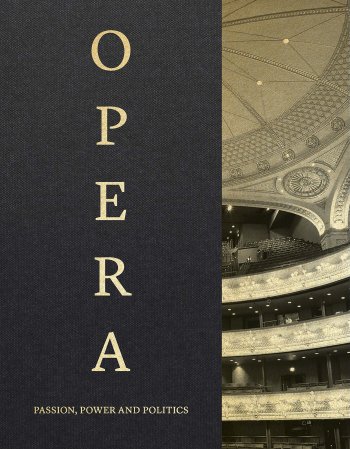
Opera: Passion, Power and Politics
Victoria and Albert Museum, London, 30 September 2017 — 25 February 2018
Curated by Kate Bailey
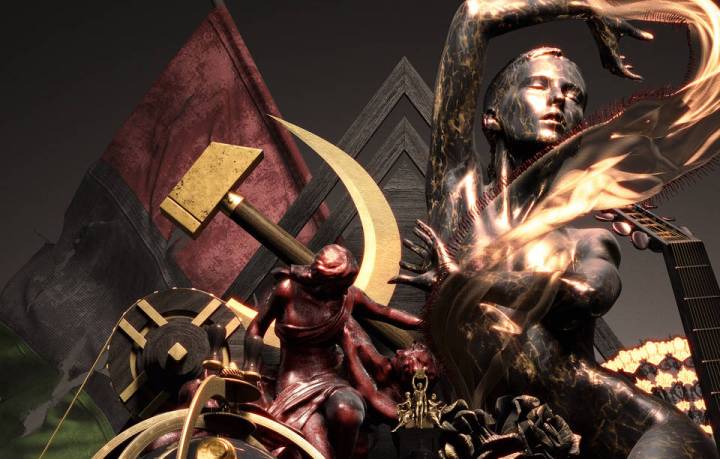
This autumn the Victoria and Albert Museum, in collaboration with the Royal Opera House, will create a vivid and immersive journey through nearly 400 years of opera, exploring its passion, power and politics. The only exhibition ever to explore opera on a grand scale, it will immerse visitors in some key moments of the history of European opera from its roots in Renaissance Italy to its present-day form, by focusing on seven operatic premieres in seven cities. It will reveal how opera brings together multiple art forms to create a multi-sensory work of art, and show how social, political, artistic and economic factors interact with great moments in the history of opera to tell a story of Europe over hundreds of years.
 More than 300 extraordinary objects, including important international loans, will be shown alongside digital footage of compelling opera performances. Objects on display include Salvador Dali’s costume design for Peter Brook’s 1949 production of Salome; Music in the Tuileries Gardens by Edouard Manet, a masterpiece of modernist painting contextualising Wagner’s modern approach to music in 1860s Paris; the original score of Verdi’s Nabucco from the Archivio Storico Ricordi in Milan; and one of two surviving scores from the first public opera (L’incoronazione di Poppea) will be on display. Original material from the 1934 St Petersburg premiere of Shostakovich’s avant-garde Lady Macbeth of Mtsensk will be reunited and displayed outside Russia for the first time: these include the composer’s original autograph score, along with stage directions, libretto, set models and costume designs.
World-leading opera performances will be played via headphones, dynamically changing as you explore the cities and objects, to create an evocative and fully immersive sound experience. The exhibition will include a powerful new recording of the Royal Opera Chorus singing ‘Va pensiero’ (the Chorus of the Hebrew Slaves) from Giuseppe Verdi’s Nabucco, experienced in a 360-degree sound installation.
Opera: Passion, Power and Politics will be the first exhibition staged in the V&A’s purpose-built Sainsbury Gallery, one of the largest exhibition spaces in Europe, opening beneath the new Sackler Courtyard as part of the Exhibition Road Building Project. It will be accompanied by live events and other digital initiatives from BBC Arts in collaboration with the V&A, Royal Opera House and high-profile opera companies from across the UK to convey opera to a wider audience. To coincide, BBC Music will be working with the V&A interpreting themes from the exhibition across television and radio, including a landmark BBC Two documentary series exploring many of the same operas and cities, presented by Lucy Worsley and featuring The Royal Opera’s Music Director and Music Director of the V&A exhibition, Sir Antonio Pappano. Other activity will include live outside broadcasts, recordings of live performances of all seven featured operas on BBC Radio 3, and episodes of its flagship In Tune and Music Matters programmes—broadcast live from the museum. A partnership with King’s College London, the Royal Opera House and the V&A will create a free MOOC (Massive Open Online Course) introducing the core tenets of opera.
Kate Bailey, V&A curator of the exhibition, said: “Opera: Passion, Power and Politics will be an ambitious exhibition from the V&A, the world-leader in innovative performance exhibitions. We are delighted to be working so closely with the Royal Opera House, drawing together their expertise with the V&A’s broad collections to bring the total art form of opera to life in a stunning new space.”
Kasper Holten, The Royal Opera’s outgoing Director of Opera, said: “One of the first things I did when I arrived in London in 2011 was to reach out to leaders of other important cultural organisations. But I could not have imagined then that my first meeting with Martin Roth (then director of the V&A) would have resulted in an incredible collaborative journey that now results in this marvellous and immersive exhibition being born. The exhibition will show us opera as the soundtrack to the history of Europe. We hope to show audiences—both those in love with opera already and those who are still missing out—that the art form is alive and kicking and has as much to say to the society around it today as it did 400 years ago.”
The seven cities and premieres are:
Venice — Monteverdi’s L’incoronazione di Poppea, 1642. The narrative of the exhibition will begin in Venice, a Renaissance centre of entertainment, gambling and disguise, with a sumptuous painting of composer Barbara Strozzi depicted as a courtesan. The original surviving manuscript score of Monteverdi’s L’incoronazione di Poppea—an opera exploring scandal and ambition, which premiered in Venice’s Carnival season 1642-43—represents opera’s transition from private court entertainment to the public realm.

Louis François Roubiliac, George Frideric Handel, before 1738, terracota (The Fitzwilliam Museum, University of Cambridge, M.3-1922).
London — Handel’s Rinaldo, 1711. In 1711 Handel’s Rinaldo was premiered—one of the first Italian language operas performed in London, as the city emerged as a global trade centre. A dramatic, kinetic set will re-create the premiere’s elaborate staging, which caused a sensation at the time. The fashion for castrat0 singers will be shown through paintings and rare surviving costumes. Tensions at the time between the incoming European-inspired opera and traditional theatre are highlighted in a Hogarth engraving depicting crowds attending the opera as Shakespeare’s plays are wheeled away.
Vienna — Mozart’s Le nozze di Figaro, 1786. Mozart’s comic opera Le nozze di Figaro premiered in 1786 in Vienna, a centre of the Enlightenment. Its characters were drawn from everyday life and the singers wore contemporary costume on stage. Fashionable dress as worn by Mozart’s Count and Countess Almaviva will be on display. The role of the composer will be examined through the figure of Mozart, and a piano he played on a visit to Prague will travel for the first time for the exhibition.
Milan — Verdi’s Nabucco, 1842. The growing importance of the chorus is explored through Giuseppe Verdi’s Nabucco which premiered in Milan in 1842. The opera’s ‘Chorus of the Hebrew Slaves’ (‘Va pensiero’) became an unofficial national anthem for Italy after the events of the Risorgimento led to the country’s unification.
Paris — Wagner’s Tannhäuser, 1861. In the 1860s opera enjoyed a high status in Paris, a city undergoing huge transformations. The 1861 Paris premiere of Richard Wagner’s Tannhäuser, which he had revised specially for performances in the city, polarised audiences, but Wagner’s vision for the art form proved inspirational for artists and writers.
Dresden — Strauss’s Salome, 1905. Richard Strauss’s explosive modernist opera Salome premiered in 1905 in Dresden, a progressive city in the grip of artistic expressionism, as depicted in Erich Heckel’s painting of the suburbs. The opera’s reception and the shifting perceptions of women that the story reflected will be examined. The exhibition also includes many depictions of Salome, from Aubrey Beardsley’s illustrations to a Versace costume design.
St Petersburg — Shostakovich’s Lady Macbeth of Mtsensk, 1934. The final opera explored in detail is Shostakovich’s Lady Macbeth of Mtsensk. Initially embraced by audiences at its St Petersburg premiere in 1934 as an expression of new Soviet opera, it was banned under political censorship in 1936. Shostakovich did not write another opera. Both avant-garde and propaganda material will be on display alongside a painting inspired by Shostakovich’s First Symphony by Pavel Filonov, rarely seen outside Russia.
Footage from 20th- and 21st-century premieres will create a finale showing how opera has moved from Europe across the world and continues to take on new forms. The operas include Benjamin Britten’s Peter Grimes, Philip Glass’s Einstein on the Beach, Stockhausen’s Mittwoch aus Licht, and George Benjamin’s Written on Skin.
Kate Bailey, ed., Opera: Passion, Power, Politics (London: Bloomsbury, 2017), 304 pages, ISBN: 9781851779284, $75.
Exhibition | The Princes of Rambouillet: Family Portraits
From Versailles:
The Princes of Rambouillet: Family Portraits
Château de Versailles, 15 September 2017 — 22 January 2018
 On the occasion of the reopening of the Château de Rambouillet, the Centre des Monuments Nationaux and the Palace of Versailles present the The Princes of Rambouillet: Family Portraits, on view from 15 September 2017 to 22 January 2018. Ten or so portraits from the collections of the Palace of Versailles will cast a spotlight on the Bourbon-Toulouse-Penthièvre family, who owned Rambouillet for almost all of the 18th century. The château was embellished and the estate largely extended over two generations, first by the Count of Toulouse, the legitimated son of Louis XIV and Madame de Montespan who bought the marquisate of Rambouillet from Fleuriau d’Armenonville in 1706, and then by his son, the Duke of Penthièvre, who was obliged to part with the estate in 1783 upon command by Louis XVI.
The exhibition will feature famous works such as the Portrait of the Count of Toulouse as a Sleeping Putto by Mignard and the famous Cup of Hot Chocolate by Charpentier, alongside lesser-known but just as evocative portraits like that of the Princess of Lamballe by Ducreux or the Duke of Valois in the Cradle by Lépicié, the latter being displayed for the first time since its recent purchase by the Palace of Versailles.
Raphaël Masson, Les Princes de Rambouillet: Portraits de Famille (Paris: Éditions du Patrimoine, 2017), 36 pages, ISBN : 9782757705742, 6€.
Exhibition | Making History Visible
From Princeton University Art Museum:
Making History Visible: Of American Myths and National Heroes
Princeton University Art Museum, Princeton, 26 September 2017 – 17 January 2018

Titus Kaphar, Billy Lee: Portrait in Tar, 2016, tar and oil on canvas, 152.4 x 121 cm (Kansas City, Collection of Billy and Christy Gautreaux; © Titus Kaphar / image courtesy Jack Shainman Gallery, New York)
Making History Visible will bring together historical and contemporary works to consider the role of visual art in creating an image of American identity and a multifaceted representation of history in the United States. Portraiture and history paintings were instrumental to the early formation of the republic, generating a vision of the new nation that served to unify the disparate colonies behind a cast of influential figures and pivotal events. This fall, as Princeton University examines its historic links to the institution of slavery, this installation juxtaposes works from the eighteenth century with those of contemporary artists to call into question who is represented, who is invisible, and what cultural values are embedded in the visual traditions of American history.
The artists whose work is featured include Titus Kaphar, Thomas Hart Benton, Elizabeth Catlett, Glenn Ligon, Sally Mann, William Ranney, Faith Ringgold, William Rush, Kara Walker, Carrie Mae Weems, Charles White, John Wilson, and Hale Woodruff.
Making History Visible is one component of a rich campus-wide conversation catalyzed by the Princeton and Slavery Project, which examines the University’s historical links to the institution of slavery.
Exhibition | The Birth of Pastel
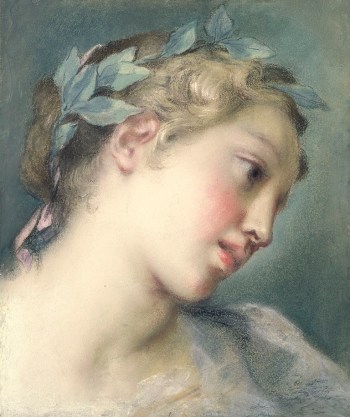
Rosalba Carriera, A Muse, mid-1720s, pastel on blue paper (The J. Paul Getty Museum, 2003.17).
On view through the fall at The Getty Center:
The Birth of Pastel
The Getty, Los Angeles, 6 June — 17 December 2017
This installation explores the evolution of pastel paintings out of colored chalk drawings from the Renaissance to the Rococo. Featuring works by Jacopo Bassano, Federico Barocci, Simon Vouet, Robert Nanteuil, Joseph Vivien, Rosalba Carriera, and Maurice-Quentin de La Tour, the display focuses most closely on the late seventeenth and early eighteenth century, when pastels began to rival oils—in their variety of color, their high degree of finish, and even their scale—as the preferred medium for stately portraits.
Exhibition | Making Beauty: The Ginori Porcelain Manufactory
Now on view at the Bargello:
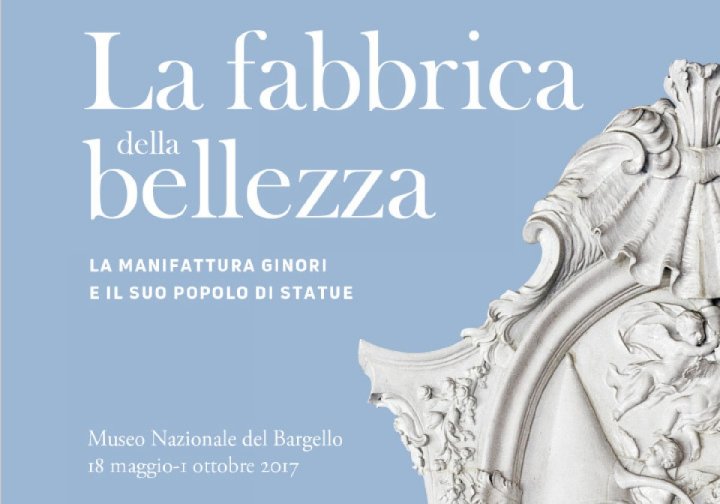
Making Beauty: The Ginori Porcelain Manufactory and Its Progeny of Statues
La Fabbrica della Bellezza: La manifattura Ginori e il suo popolo di statue
Museo Nazionale del Bargello, Florence, 8 May — 1 October 2017
The exhibition is divided into six thematic sections illustrating the transformation of sculptural invention into works of porcelain. The first section opens with an 18th-century life-size bronze Venus, a copy of the celebrated Medici Venus in the Uffizi Tribune. Sculpted by Massimo Soldani Benzi in 1702, the bronze was commissioned by Prince Johann Adam Andreas I of Liechtenstein and still forms part of the present prince’s collection, this exhibition marking its first return to Italy in over 350 years. It stands side by side with a large porcelain Venus made by Gasparo Bruschi in 1747–48, probably using the plaster moulds which Carlo Ginori purchased from Soldani Benzi’s workshop. The two Venuses are, in turn, displayed alongside a monumental porcelain Mercury based on another Classical statue in the Uffizi Tribune. The Mercury, now in the Ginori Lisci Collection, is on display for the very first time in this exhibition, not only with the Venus but also with the monumental Fireplace alongside which it stood in the old Museo di Doccia until 1962, because the Museo Ginori has kindly granted the loan of the two most important works in its entire collection: the Medici Venus reproducing the celebrated statue in the Uffizi Tribune, and the monumental Fireplace specially restored for the exhibition.

Tempietto Ginori, modeled by Gaspero Bruschi, 1750–51; glazed and painted porcelain, heigh 167 cm including ebony base (Museo dell’Academia Etrusca e della Città di Cortona).
The second section is devoted to the superlative Ginori Tempietto Ginori, a masterpiece by Gasparo Bruschi which Carlo Ginori himself donated to the Accademia Etrusca in Cortona. The Tempietto, of exceptional sophistication in terms of its technique and design and unique in terms of its size, summarises in concentrated form not only the artistic aims but also the political aspirations of the manufactory’s founder. Specially restored for the exhibition, it is returning to Florence for the first time since 1757. Alongside it we have Giambologna’s small bronze and wax models of Mercury, from the Bargello Collection and the Museo Ginori respectively, which inspired the Mercury atop Gaspare Bruschi’s Tempietto.
The next room hosts two large, complex bronze and porcelain versions of the Pietà. In 1708, Soldani made the model for the large Lamentation over the Dead Christ, of which numerous versions are known. Carlo Ginori purchased the plaster moulds—some of which are on display in the exhibition—which were used for the porcelain version that the Marchese Ginori gave to the influential Cardinal Neri Corsini around 1745. The group was made in fifty-nine different porcelain parts, individually fired and then assembled by the manufactory’s craftsmen in Sesto Fiorentino.
Somewhat smaller but equally sophisticated in terms of their execution are the groups of Judith with the Head of Holofernes that comprise the exhibition’s fourth thematic section. Gaspare Bruschi’s porcelain version, on loan from the Los Angeles County Museum, is displayed in an unprecedented dialogue with Agostino Cornacchini’s terracotta model, the first sculptural study for this popular group.

Lamentation over the Dead Christ, after Massimo Soldani Benzi, 1745–50, glazed porcelain, height 71.5 cm not including ebony base (Rome: Palazzo Corsini).
This is followed by Soldani’s precious bronze ‘pictorial’ relief depicting the Passing of St. Joseph and the wax model based on the bronze, from the Bargello Collection, which are on display alongside the preparatory study in unfired clay, it too in Italy for the very first time, testifying to the Ginori Manufactory’s plan to produce porcelain versions of it—none of which have, however, survived.
The exhibition’s ‘grand finale’ is the monumental porcelain Fireplace, an absolutely unique work, which may be attributed to Doccia’s chief modeller Gasparo Bruschi and to Domenico Stagi, a stage set designer and painter of quadrature. The piece is a veritable triumph of technical mastery and ornamental sophistication. Its upper part hosts porcelain versions of works by illustrious sculptors, the oval bas-relief with ‘putti distilling flowers’ after a bronze by Massimiliano Soldani Benzi and copies of Dawn and Dusk which Michelangelo carved for the tomb of Lorenzo de’ Medici in the Medici Chapels.
The exhibition is accompanied by a catalogue rich in new research, published by Mandragora in both Italian and English. The catalogue entries explore the manufactory’s artistic and political history, using essays focusing on the works on display to set Ginori’s porcelain sculpture, whether monumental or on a smaller scale, in the broader artistic and political context of the time, and presenting a number of important new attributions. The catalogue also contains fascinating input from experts in the manufacture of porcelain, not only reviewing the manufactory’s history but also illustrating previously unpublished material and highlighting the unique technical nature of Ginori’s inventions.
 La Fabbrica della bellezza has also served as a formative experience for two university students who have taken part in all of the various phases in the development of the exhibition project and drafted the catalogue entries on the basis of an apprenticeship agreement with Florence University’s SAGAS Department. The exhibition and catalogue have been designed and produced with a grant from the Fondazione Cassa di Risparmio di Firenze, with the sponsorship of Richard Ginori and with the collaboration of Firenze Musei; Opera Laboratori Fiorentini and Arteria have also contributed in their capacity as partners for the layout and transport respectively.
In addition to acquainting the general public with an exceptional chapter in the history of Florentine sculpture, the exhibition also sets out to draw the attention of Florentine and international public opinion to the fate of the Museo di Doccia. The generosity of international loans for the exhibition points to the intense interest in the the museum and the manufactory shown by numerous institutions both in Italy and abroad. In that connection, we would like to express our special gratitude to HRH Prince Hans-Adam II von und zu Liechtenstein for granting the exhibition his lofty patronage.
Tomaso Montanari and Dimitrios Zikos, eds., Making Beauty: The Ginori Porcelain Manufactory and Its Progeny of Statues (New York: ACC Publishing, 2017), 160 pages, ISBN: 978 88746 13496, $30. Also available in Italian.
◊ ◊ ◊ ◊ ◊
Note (added 17 September 2017) — Aileen Dawson provides a review of the exhibition in the current issue of The Burlington Magazine (September 2017), pp. 748–49.
Exhibition | Luigi Crespi
Now on view at the Museo Davia Bargellini in Bologna:
Luigi Crespi: Portraitist in the Age of Pope Lambertini
Museo Davia Bargellini, Bologna, 15 September — 3 December 2017
Curated by Mark Gregory d’Apuzzo and Irene Graziani
 The Musei Civici d’Arte Antica dell’Istituzione Bologna Musei, in collaboration with the Department of Arts at the University of Bologna, present Luigi Crespi: Portraitist in the Age of Pope Lambertini, the first exhibition dedicated to the painter and art dealer Luigi Crespi (1708–1779), the son of the famous painter Giuseppe Maria Crespi (1665–1747).
The exhibition is a tribute to this multifaceted figure—among the most interesting of the artistic and literary panorama of eighteenth-century Bologna—in relation to the climate of cultural renewal favored by the enlightened pastoral work of Cardinal Prospero Lambertini, who in 1740 became Pope Benedict XIV. The exhibition presents the most significant core of Crespi’s paintings here, together with other works from the Municipal Art Collections and loans from other important museums and private collectors. The exhibition is organized around seven thematic sections that chart the most important phases of the artist’s career.
◊ ◊ ◊ ◊ ◊
La mostra, a cura di Mark Gregory D’Apuzzo e Irene Graziani, è la prima dedicata al pittore, molte opere del quale sono esposte presso il Museo Davia Bargellini e le Collezioni Comunali d’Arte. Figura poliedrica fra le più interessanti del panorama artistico e letterario di Bologna durante l’episcopato del cardinale Prospero Lambertini (1731–54), e dunque nel periodo di apertura della città alle istanze di rinnovamento culturale sostenute dal vescovo e poi papa Benedetto XIV (1740–58), Luigi Crespi è protagonista della mostra realizzata grazie alla collaborazione di importanti Istituzioni museali cittadine e collezionisti privati.
Luigi, pur essendo soprattutto celebre come letterato e autore del terzo tomo della Felsina Pittrice, edita nel 1769, ha percorso con successo anche la carriera artistica, intrapresa sotto la guida del padre fra la fine degli anni venti e gli inizi degli anni trenta del Settecento. Un’attività che egli stesso, molti anni più tardi, nella biografia del padre (1769), sosterrà di aver svolto «per divertimento», per significare il privilegio accordato al prestigioso ruolo, assunto a partire dagli anni cinquanta, di scrittore e critico d’arte, che gli frutterà infatti l’aggregazione alle Accademie di Firenze (1770), di Parma (1774) e di Venezia (1776).
La sua produzione figurativa tuttavia, in particolar modo quella rappresentata dal più congeniale genere del ritratto, lo rivela sensibile al dialogo con la scienza moderna e con la libera circolazione delle idee dell’Europa cosmopolita. Nonostante l’impegno applicato anche all’ambito dell’arte sacra, cui Luigi si dedica almeno fino agli inizi degli anni sessanta, è soprattutto nella ritrattistica che raggiunge esiti di grande efficacia, molto apprezzati dalla committenza. «Ebbe un particolare dono di ritrarre le fisionomie degli Uomini, e ne fece una serie di Ritratti di Cavaglieri e Damme», scrive infatti Marcello Oretti (1760–80), celebrandone l’abilità nell’adattare la formula del codice ritrattistico alle esigenze della clientela.
Come dimostrano il Ritratto di giovane dama con il cagnolino, o i tre ritratti dei Principi Argonauti in origine nel collegio gesuitico di San Francesco Saverio, la pittura di Crespi junior, già addestrato dal genitore Giuseppe Maria ad un fare schietto, attento al naturale e al «vero», evolve verso un nitore della visione che risalta i dettagli, in un’analitica investigazione della realtà, memore di certi esempi (Balthasar Denner e Martin van Meytens) osservati durante un viaggio di sette mesi fra Austria e Germania, dove visita le Gallerie delle corti di Dresda e Vienna (1752). Così li commenterà infatti Gian Pietro Zanotti in una nota manoscritta: «Bisogna dire il vero che ora fa ritratti bellissimi, e di ottimo gusto, in un certo stile oltramontano».
Dal confronto con il «grande mondo»—per utilizzare un’espressione di Prospero Lambertini, che fu in stretti rapporti con Giuseppe Maria Crespi e fu in gran parte il responsabile della carriera ecclesiastica del figlio, conferendogli la carica di «segretario generale della visita della città e della diocesi», il canonicato di Santa Maria Maggiore (1748) ed ancora nominandolo suo cappellano segreto—Luigi deriva dunque la conferma della validità del codice del ritratto ufficiale, che gli consente di rappresentare i personaggi, qualificandone i gusti sofisticati, le abitudini raffinate, i comportamenti eleganti e disinvolti da assumere nella vita di società, dove si praticano i rituali di quella “civiltà della conversazione” che nella moderna Europa riunisce aristocratici e intellettuali in un dialogo paritario, dettato dalla condivisione di regole e valori comuni. Ma la prossimità con la cultura lambertiniana lo conduce anche a sperimentare, dapprima ancora con il sostegno del padre, poi autonomamente (Ritratto di fanciulla), nuove tipologie di ritratto, in cui lo sguardo incrocia i volti di individui del ceto borghese: talvolta sono gli oggetti a raccontare con la loro perspicuità di definizione la dignità del lavoro (Ritratto di Antonio Cartolari), altre volte sono invece i gesti caratteristici, l’inquadratura priva di infingimenti (Ritratto di fanciulla), la resa confidenziale del modello, quasi al limite della caricatura (Ritratto di Padre Corsini), a fare emergere il valore umano di quella parte della società, cui papa Lambertini riconosceva un ruolo fondamentale nel rinnovamento.
Irene Graziani and Mark Gregory d’Apuzzo, Luigi Crespi: Ritrattista nell’età di Papa Lambertini (Milan: Silvana, 2017), 144 pages, ISBN: 978 88366 37928, $35.
Exhibition | Whimsy and Reason

Now on view at Museo del Tessuto:
Whimsy and Reason: Elegance in Eighteenth-Century Europe
Museo del Tessuto, Prato, 14 May 2017 — 29 April 2018
Staged in the museum’s historical textiles room, the exhibition is a journey into the style and trends of eighteenth-century artistic culture through fashion, textiles, and the decorative arts. Over 100 exhibits—including textiles, men’s and women’s garments, porcelain, fashion accessories, paintings, and etchings—narrate the stylistic changes which unfolded during this historical period, from exoticism and compositional ‘whimsies’ in the first half of the century to the austere classical forms of neoclassical decoration. Textiles are juxtaposed with the most diverse types of artefacts and artistic techniques, offering an overview of styles throughout the century, with examples of eighteenth-century textile production such as bizarre, chinoiserie, dentelles, and revel, just to name a few, thus creating an ongoing dialogue between garments and fashion accessories, as well as with other furnishing elements.
The exhibition has been made possible thanks to the prestigious collaboration of the Uffizi Gallery’s Costume Gallery, the Stibbert Museum in Florence, and the Antonio Ratti Foundation’s Textile Studio Museum in Como, as well as other public and private institutions which have allowed for the organisation of a unique and innovative exhibition exploring the eighteenth century, a rich and complex period.
In addition to the textiles in our collections, the extraordinary garments from the Uffizi Gallery’s Costume Gallery and rare silk specimens from the Antonio Ratti Foundation’s Textile Studio Museum in Como converse with the precious waistcoats and fine porcelain from the treasure trove that is the Stibbert Museum in Florence. Volumes from the Biblioteca Nazionale Centrale in Florence enrich the exhibition, as well as period footwear from Museo Salvatore Ferragamo, paintings from the Palazzo Pretorio Museum in Prato and from the antique Florentine galleries, Eredi Antonio Esposito – Antique Gallery, the Giovanni Pratesi Collection, and Tornabuoni Arte.
Exhibition | African Servants at Court in The Hague

From the press release for the upcoming exhibition:
African Servants at Court in The Hague / Afrikaanse Bedienden aan het Haagse hof
Haags Historisch Museum, Den Haag, 21 September 2017 — 28 January 2018
Curated by Esther Schreuder
With the exhibition African Servants at Court in The Hague, the Haags Historisch Museum will showcase the lives of two black men, Cupido and Sideron. Originally from Curaçao and Guinea, the two were, as enslaved boys, presented to Stadholder William V as gifts in the 1760s. They went on to spend much of their lives as well-paid servants at the court in The Hague. Whereas exhibitions about court life generally omit references to servants with a non-European background, this exhibition specifically focuses on servants of African descent to highlight an aspect of Dutch history that remains relatively unknown.

Hendrik Pothoven, William V Visiting the Fair at the Buitenhof in The Hague, 1781 (The Hague: Historisch Museum Den Haag).
The Museum places the story of Cupido and Sideron within the long tradition of African servants in European Royal courts and includes the story of Jean Rabo (ca. 1715–1769), valet to Stadholder William IV. Paintings, drawing, prints, and textual documents are used to relate the story of Cupido and Sideron. What do we know about these two African men? What role did they play as servants? Were there any other black servants? The exhibition features major loans from the British Royal Collection, Amsterdam’s Rijksmuseum, and the Cultural Heritage Agency (Rijksdienst Cultureel Erfgoed). Writer and art historian Esther Schreuder is the guest curator, a role she previously held for the exhibition Black is Beautiful: Rubens to Dumas in the Nieuwe Kerk, Amsterdam (2008).
In the words of Director Marco van Baalen, “The Netherlands’ history of slavery has featured increasingly in the news in recent years, but there has so far been little attention paid to black people in the Netherlands in the 17th and 18th centuries. Our aim with this exhibition is to highlight that shared history from a new perspective.”
In the exhibition and additional programming, the Museum explicitly intends to broach contemporary discussions about the history of slavery and racism. Especially for the exhibition, artist Tirzo Martha (b. 1965) from Curaçao will create an installation in which he gives his personal interpretation of the story of Cupido and Sideron. Also in connection with the exhibition, Balans Publishing House will issue the publication Cupido en Sideron: Twee Moren aan het hof van Oranje (Two Moors at the Court of Orange) by Esther Schreuder.

Hendrik Pothoven, William V Visiting the Fair at the Buitenhof in The Hague (detail showing Cupido and Sideron), 1781
(The Hague: Haags Historisch Museum)
Exhibition | The Challenge of White: Goya and Esteve
Press release for the exhibition now on view at the Prado:
The Challenge of White: Goya and Esteve, Portraitists to the Osuna Family
El desafío del blanco: Goya y Esteve, retratistas de la Casa de Osuna
Museo Nacional del Prado, Madrid, 20 June — 1 October 2017
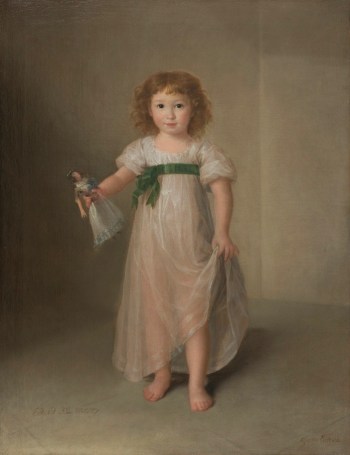
Augustín Esteve y Marqués, Portrait of Manuela Isidra Téllez-Girón, future Duchess of Abrantes, 1797 (Madrid: Prado).
The recent addition to the Prado’s collection of Portrait of Manuela Isidra Téllez-Girón, future Duchess of Abrantes by Augustín Esteve y Marqués, acquired with funds from the Óscar Alzaga Villaamil donation, will allow for greater knowledge of this interesting painter who was in his day considered the finest court portraitist after Francisco de Goya. This work completes the Alzaga donation, which was accepted last March and comprises six important paintings plus funding for the acquisition of a seventh.
For the first time, the current exhibition brings together Esteve’s portraits of the Duke and Duchess of Osuna’s children, including outstanding works loaned by the Fundación Casa Ducal de Medinaceli, the Duque del Infantado collection, and the Masaveu and Martínez Lanzas-de las Heras collections, with the aim of providing a context for the portrait of Manuela Isidra. Furthermore, with this exhibition the Prado is the first museum to focus on Esteve with the aim of rescuing him from the secondary role unjustifiably assigned to him by art history.
In addition, Esteve’s works are accompanied by various portraits of the Duke and Duchess and their children by other artists, including the miniaturist Guillermo Ducker (doc. between 1795 and 1830) and Francisco de Goya, whose outstanding portraits of the family dating from the same period demonstrate the influence of his work on Esteve’s. The treatment of light and the skillful depiction of the transparent materials of the sitters’ clothes are the focus of attention of this exhibition, revealing Esteve and Goya’s ability to meet the difficult artistic challenge of representing the colour white.
The number of portraits housed in the Museo del Prado of the Duke and Duchess of Osuna and their children, from their infancy to adulthood, means that the Museum offers the best representation of this prominent family.
The portrait of Manuela Isidra Téllez-Girón (1794–1838), future Duchess of Abrantes, has been acquired for the Museo del Prado’s collection with funds from the Óscar Alzaga Villaamil donation. Painted in 1797 by Agustín Esteve y Marqués (1753–after 1820), it is undoubtedly the best known work by the artist due to its skillful technique, refined elegance, and evident charm. Its presence in the Museum will firstly allow for greater knowledge of this interesting painter, considered in his day the finest court portraitist after Francisco de Goya (1746–1828) and on occasions confused with him. Secondly, Esteve’s portrait clearly relates to 17th-century Spanish painting, particularly works by Velázquez and Murillo, and adds a new dimension to the Prado’s 18th-century collections. Esteve had previously worked for the 9th Duke of Osuna and his wife, but with this portrait, he became a type of official painter to the family, sharing this role for almost four decades with Goya, whose influence would be fundamental for his approach to painting.
The marriage of Pedro de Alcántara Téllez-Girón (1755–1807), future 9th Duke of Osuna, to his cousin María Josefa de la Soledad Alonso Pimentel (1752–1834), Duchess of Benavente, produced a union between two of the oldest, largest and wealthiest noble houses in Spain and gave rise to a family unparalleled at the time in terms of social prestige and intellectual and artistic interests. The Duchess, known for her wit, decided character and distinction, was considered by contemporaries to be the true head and heart of the Osunas given the Duke’s frequent lengthy absences on military campaigns. A mother at a late age, proud of her five children and accustomed to luxury and ostentation, the Duchess commissioned successive portraits of them in order to record their growth, progress and abilities, largely deriving from the privileged and innovative education they received and a reflection of the Enlightenment ideal of producing individuals of use to their country. The result was a true iconographic gallery of the family, in which Goya and Esteve played a fundamental role.
The acquisition of Portrait of Manuela Isidra Téllez-Girón, future Duchess of Abrantes, completes the Alzaga donation and joins the six paintings that entered the Museum’s collection last March through that donation. They encompass a broad chronological span from the late 16th to the mid-19th century, painted by artists from Italy (Jacopo Ligozzi), Spain (Sánchez Cotán, Herrera the Elder, Antonio del Castillo, Agustin Esteve and Eugenio Lucas Velázquez), and Bohemia (Anton Raphael Mengs).
Exhibition | The Temple of Flora
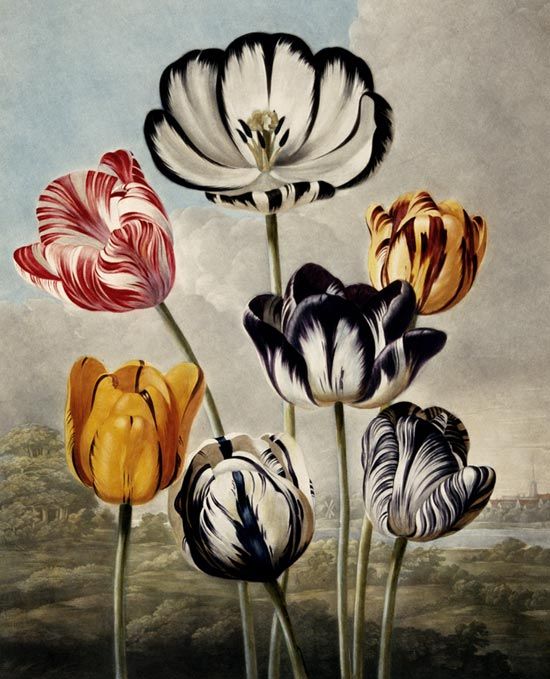
Richard Earlom, after Philip Reinagle, Tulips, 1798; color mezzotint with hand coloring (Milwaukee Art Museum, M1973.99)
Now on view at the Milwaukee Art Museum:
The Temple of Flora
Milwaukee Art Museum, 4 August — 10 December 2017
Fifteen large-scale color prints from the illustrated book The Temple of Flora (1812) reflect the true passion of English doctor John Robert Thornton: botany. The plants pictured are dramatically rendered and set against romantic landscapes—as opposed to the plain backgrounds that were typical of botanical images at the time. In honor of the Swedish botanist Carl Linnaeus (1707–1778), Thornton had hired eminent artists to produce the engravings, which later inspired American artist Jim Dine (b. 1935). Dine’s illustrated book from 1984 is featured alongside the prints.










 Enfilade
leave a comment