Exhibition | Becoming a Woman in the Age of Enlightenment
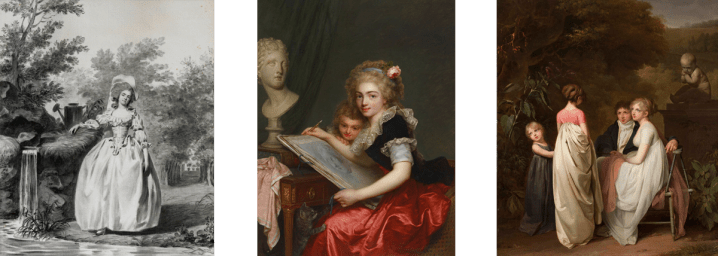
Jacques-Antoine-Marie Lemoine, Woman Standing in a Garden, 1783, black chalk and brush with gray wash on off-white laid paper; Antoine Vestier, Allegory of the Arts, 1788, oil on canvas; and Louis-Léopold Boilly, Conversation in a Park, oil on canvas. All on loan from The Horvitz Collection.
◊ ◊ ◊ ◊ ◊
From the Harn Museum of Art:
Becoming a Woman in the Age of Enlightenment: French Art from The Horvitz Collection
Harn Museum of Art, University of Florida, Gainesville, 6 October — 31 December 2017
Ackland Art Museum, The University of North Carolina at Chapel Hill, 26 January — 8 April 2018
Crocker Art Museum, Sacramento, 13 May — 19 August 2018
Smith College Museum of Art, Northampton, MA, dates TBA
Curated by Melissa Hyde and Mary D. Sheriff
Organized by Alvin Clark
Becoming a Woman in the Age of Enlightenment: French Art from the Horvitz Collection is primarily an exhibition of drawings but will include pastels, paintings, and sculptures selected from one of the world’s best private collections of French drawings. The exhibition will feature nearly 120 works by many of the most prominent artists of the eighteenth century, including Antoine Watteau, Nicolas Lancret, François Boucher, Jean-Honoré Fragonard, as well as lesser-known artists both male and female, such as Anne Vallayer-Coster, Gabrielle Capet, François-André Vincent, Philibert-Louis Debucourt. Ranging from spirited, improvisational sketches and figural studies, to highly finished drawings of exquisite beauty, the works included in the exhibition vary in terms of style, genre, and period.
Becoming a Woman will be organized into thematic sections that address some of the most important and defining questions of women’s lives in the eighteenth century. These include: how the stages of a woman’s life were measured; what cultural attitudes and conditions in France shaped how women were defined; what significant relations women formed with men; what social and familial rituals gave order to their lives; what pleasures they pursued; and what work they accomplished. The aim is to bring new insights to the questions of what it meant to be a woman in this period, by offering the first exhibition to focus specifically on representations of women of a broad range of ages and conditions.
The exhibition will offer fresh perspectives on a subject that still has direct relevance to our times but that has not been the focus of a significant exhibition for decades. Through its conceptual framework, thematic organization, and its emphasis on historical context, the exhibition will provide viewers opportunities to consider what issues pertaining to women’s lives seem to have changed or persisted through time and across space. Although the circumstances and the specifics have changed, many issues remain with us today and can still provoke contentious debates. Pay equity, reproductive rights, gender-discrimination, violence against women, work-family balance, the ‘plight’ of the alpha-female, and the devaluation of the stay-at-home mom, are but a few of the women’s issues that are still hotly contested in the media, in cultural production of all kinds, in politics, and in public and private life.
Becoming a Woman is curated by Melissa Hyde, Professor of Art History, University of Florida Research Foundation Professor, University of Florida, and the late Mary D. Sheriff, W.R. Kenan J. Distinguished Professor of Art History, University of North Carolina, Chapel Hill; the exhibition is organized by Alvin L. Clark, Jr, Curator, The Horvitz Collection and The J.E. Horvitz Research Curator, Harvard Art Museums/Fogg.
The catalogue is available from ArtBooks.com:
Melissa Hyde, Mary D. Sheriff, and Alvin Clark, Becoming a Woman in the Age of Enlightenment: French Art from The Horvitz Collection (Boston: The Horvitz Collection, 2017), 208 pages, ISBN: 978 099126 2526, $39.

François Boucher, Young Travelers, black chalk on cream antique laid paper, framing line in black ink, laid down on a decorated mount, 295 × 188 mm; Jacques-Louis David, Andromache Mourning the Death of Hector, pen with black ink and brush with gray wash over traces of black chalk on cream antique laid paper, 293 × 248 mm; Jean-Baptiste Greuze, The Chestnut Vendor, brush with gray and brown wash on cream antique laid paper, 385 × 460 mm. All works on loan from The Horvitz Collection.
◊ ◊ ◊ ◊ ◊
From the Lecture and Symposium Schedule:
Thinking Women: Art and Representation in the Eighteenth Century
A Symposium in Honor of Mary D. Sheriff
Harn Museum of Art, University of Florida, Gainesville, 20–22 October 2017
• Keynote Address: “The Woman Artist and the Uncovering of the Social World,” Lynn Hunt, Distinguished Research Professor, University of California, Los Angeles
Art, women, and society came together in surprising ways at the end of the eighteenth century. ‘Society’ only began to be conceptualized as an object for study at the end of the 1700s, in particular in reaction to the French Revolution. Art, especially engraving and painting, helped make society visible to itself. Women could join the art world but rarely as fully fledged members, and as a consequence they occupied a kind of in-between position that made them especially attuned to social relations. The life and work of Marie-Gabrielle Capet will be highlighted to show how the social world could be uncovered.
 • “Fashion in Time: Visualizing Costume in the Eighteenth Century,” Susan Siegfried, Denise Riley Collegiate Professor of the History of Art and Women’s Studies, Department of Art History, University of Michigan
• “Beauty Is a Letter of Credit,” Nina Dubin, Associate Professor, Department of Art and Art History University of Illinois, Chicago
• “Chardin: Gender and Interiority,” Ewa Lajer-Burcharth, William Dorr Boardman Professor of Fine Arts, Department of History of Art and Architecture, Harvard University
• “The Global Allure of the Porcelain Room,” Meredith Martin, Department of Art History, New York University
• “Pictured Together? Questions of Gender, Race, and Social Rank in the Portrait of Dido Elizabeth Belle and Lady Elizabeth Murray,” Jennifer Germann, Associate Professor, Department of Art History, Ithaca College
• “Becoming an Animal in the Age of Enlightenment,” Amy Freund, Associate Professor & Kleinheinz Family Endowed Chair in Art History, Southern Methodist University
• “Marguerite Lecomte’s Smile: Portrait of a Woman Engraver,” Mechthild Fend, Reader in the History of Art, Department of History of Art, University College London
• “Exceptional, but not Exceptions: Women Artists in the Age of Revolution,” Paris Spies Gans, Doctoral Candidate, Department of History, Princeton University
The final program, with times, is available here»
At the Ackland Art Museum at UNC, Chapel Hill, there will be a sister symposium in Mary’s honor entitled “Taking Exception: Women, Gender, Representation in the Eighteenth Century,” 1–3 February 2018.
◊ ◊ ◊ ◊ ◊
Note (added 14 October 2017) — The posting has been updated with additional information, including details on the catalogue, venues, and the conferences.
Exhibition | Jean-Baptiste Perronneau
Now on view in Orléans:
Jean-Baptiste Perronneau: Portraitiste de génie dans l’Europe des Lumières
Musée des Beaux-Arts d’Orléans, 17 June — 22 October 2017
Curated by Dominique d’Arnoult with Valérie Luquet and Olivia Voisin
 Du 17 juin et au 17 septembre 2017, le musée des Beaux-Arts d’Orléans présente la première rétrospective consacrée à Jean-Baptiste Perronneau (v. 1715–1783), véritable portraitiste de génie à la personnalité artistique singulière et exigeante.
Cette exposition invite à visiter l’Europe des Lumières—moment du plus extraordinaire engouement pour le portrait jamais connu—à travers 120 oeuvres provenant de prestigieuses collections publiques (musée du Louvre, National Gallery…) et privées, souvent inédites, mais aussi du musée des Beaux-Arts d’Orléans qui conserve le fonds le plus riche d’oeuvres de l’artiste.
Dans un parcours chronologique, l’exposition retrace l’incroyable carrière de Perronneau (depuis sa formation et ses débuts fulgurants à Paris, marqués par sa réception à l’Académie royale en 1753, jusqu’aux voyages qui lui feront aborder les villes de France (Lyon, Toulouse, Bordeaux, Orléans) et d’Europe (Bruxelles, Rome, Londres) avant de faire d’Amsterdam un port d’attache et de départ vers les villes hanséatiques comme Hambourg ou vers Saint-Pétersbourg et Varsovie.
Illustrant le goût du XVIIIe siècle pour le brillant et l’éclat, les pastels de Perronneau côtoient ici ses portraits peints à l’huile et comme chez leurs commanditaires de l’époque, des peintures des maîtres anciens, des oeuvres de peintres et de sculpteurs contemporains de l’artiste, ainsi que des objets d’arts décoratifs. Tous réunis, ils offrent un regard neuf sur ce portraitiste trop rapidement classé comme le rival malheureux de Maurice Quentin Delatour (1704–1788) et qui s’avère être, au contraire, un artiste virtuose dont le parcours se distingue nettement de ses contemporains.
Ses réseaux de sociabilité embrassent en effet le siècle de manière plus complète que pour d’autres peintres, avec cette nouvelle composante de sa clientèle que représentent les acteurs du négoce et du grand commerce, qu’ennoblit la sociabilité artistique.
L’exposition reconstitue les liens que noue Perronneau lors de ces nombreux voyages avec les amateurs d’art et notamment sa longue amitié avec Aignan Thomas Desfriches—riche entrepreneur orléanais et futur fondateur du musée des Beaux-Arts d’Orléans—de laquelle naîtra une série de pastels parmi les plus importants de sa carrière.
Depuis 1860, le musée des Beaux-Arts d’Orléans, n’a cessé d’acquérir des oeuvres de Perronneau, jusqu’à l’achat en juin 2016 d’un chef-d’oeuvre—le portrait d’Aignan Thomas Desfriches—à la suite duquel le musée a souhaité restituer l’oeuvre de Perronneau dans son siècle avec cette première rétrospective.
Olivia Voisin and Dominique d’Arnoult, eds., Jean-Baptiste Perronneau: Portraitiste de génie dans l’Europe des Lumières (Paris: Réunion des Musées Nationaux, 2017), 192 pages, ISBN: 978 23590 62021, 29€.
Neil Jeffares provides a glowing review (in English) here»
Exhibition | Model Citizens
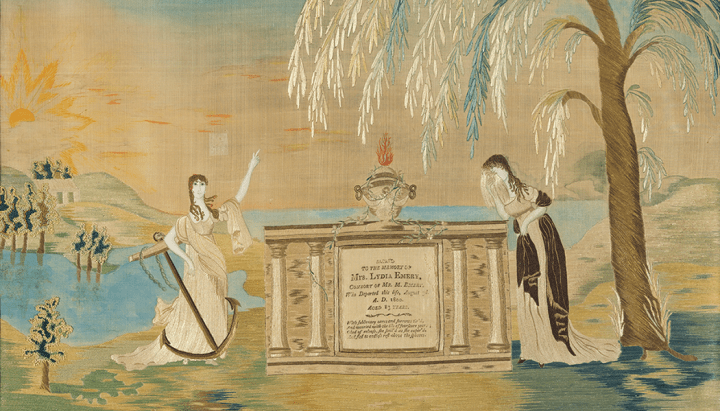 Susan Merrill, Memorial to Mrs. Lydia Emery (1717–1800), 1811; watercolor on silk
(Portland Museum of Art, 1968.4)
◊ ◊ ◊ ◊ ◊
From the Portland Museum of Art:
Model Citizens: Art and Identity in the United States, 1770–1830
Portland Museum of Art, 10 September 2017 — 28 January 2018
Model Citizens: Art and Identity in the United States, 1770–1830 presents works from the PMA’s permanent collection by the most celebrated artists of the early United States alongside portrait miniatures, samples, and silhouettes. This wide range of visual culture provides a glimpse into how late 18th- and early 19th-century Americans elected to represent themselves in private and public spheres as husbands, wives, children, and citizens.
Arranged in three sections, the exhibition uses the life cycle as an organizing principle to introduce viewers to the many modes of self-representation popular in the era, from finely painted portraits by Gilbert Stuart and Thomas Badger to modestly-scaled cut silhouettes and mourning embroideries. The first section showcases paintings of children alongside embroidered samplers produced by the young women of the Stone family at Portland’s Miss Martins’ School. This portion provides a glimpse of how families understood lineage as well as how painters helped visualize changing ideas about the nature of childhood. The samplers show how young, upper-class women expressed their creativity and accomplishment. The second section features works that portray grown men and women, often commemorating major life events such as marriage. In addition to paired portraits and individual works by renown painters such as Stuart and John Singleton Copley, this section will also feature silhouettes and minatures—small-scale, modestly priced works that allowed sitters to circulate likenesses among family and friends. The final section presents examples of men and women at the end of life such as the PMA’s newly acquired portrait of Judge Stephen Jones, who was in his eighties when he sat for Gilbert Stuart. This section will also include mourning emroideries to underscore how early Americans used painting and needle work to commemorate loved ones after death.
Generously supported by Shannon C. Gordon with additional support from Friends of the Collection.
Exhibition | Louis-Nicolas van Blarenberghe and the Battle of Yorktown

Louis-Nicolas Van Blarenberge, The Siege of Yorktown, 1786; gouache on panel, 24 × 37 inches
(Private Collection of Nicholas Taubman)
◊ ◊ ◊ ◊ ◊
Press release (24 August 2017) from the Museum of the American Revolution:
Louis-Nicolas van Blarenberghe and the Battle of Yorktown
Museum of the American Revolution, Philadelphia, until 24 September 2017
Only one month remains to see two 18th-century paintings depicting the last major land battle of the Revolutionary War on display at the Museum of the American Revolution. The paintings, The Siege of Yorktown and The Surrender of Yorktown, are incredibly detailed and populated with hundreds of tiny figures, like 18th-century ‘Where’s Waldo?’ scenes. The original versions of the paintings were created for King Louis XVI by French artist Louis-Nicolas van Blarenberghe, the court Painter of Battles to the King. Those paintings are on display at the Palace of Versailles. The paintings on view at the Museum of the American Revolution are secondary versions created by Van Blarenberghe in 1786 for French General the Comte de Rochambeau, the commander of the French forces at Yorktown. The paintings remained in the Rochambeau family until about 15 years ago and are in pristine condition.
“We are thrilled to be able to offer our visitors the extraordinary opportunity to view these incredible, richly detailed paintings,” said Museum President Michael Quinn. “The discovery of previously undetected differences between the two sets of paintings is a fascinating detective story, making the paintings all the more intriguing.”
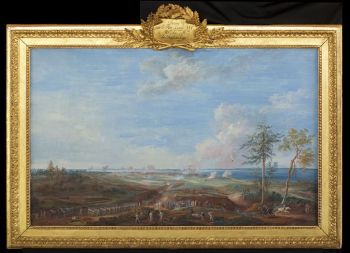
Louis-Nicolas Van Blarenberge, The Siege of Yorktown, 1786; gouache on panel, 24 × 37 inches.
Having researched the paintings, Christopher Bryant, a Massachusetts-based independent scholar and dealer of historical portraits and artifacts, believes that Rochambeau gave direction to Van Blarenberghe in the execution of the paintings on display at the Museum. Bryant argues that, given the interest taken by Rochambeau in the paintings as visual records of the crowning achievement of his career and the fact that he was an eyewitness to the events depicted, the differences between the paintings are likely corrections made from the originals, rendering Rochambeau’s copies even more historically accurate than those painted for King Louis XVI.
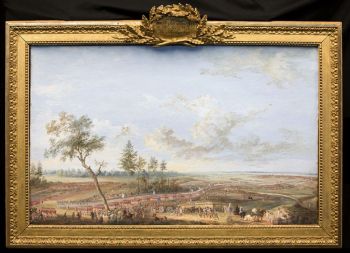
Louis-Nicolas Van Blarenberge, The Surrender of Yorktown, 1786; gouache on panel, 24 × 37 inches.
The most prominent alteration to the 1786 version of the Siege is the addition of a group of American officers near the figure of Rochambeau. While the original painting includes only one American officer holding a map, the replica depicts a group of ten officers gathered around that original figure, now identifiable as General George Washington. The map he holds can be identified as a plan drawn by Lafayette’s cartographer of the British fortifications at Yorktown. Interestingly, this same scene is reprised in Louis-Charles-Auguste Couder’s Siege of Yorktown (1836), a 19th-century copy of which is displayed on the Museum’s second floor.
“These paintings are remarkable in being superb works of art while also being extraordinarily accurate and detailed. It is very rare that you have that combination as those two circumstances are usually mutually exclusive,” said Bryant. “However, these paintings are both: they are wonderful paintings on an artistic basis, but there is also so much historical information within them that can be independently corroborated, that they can now be seen as important historical documents in their own right. The Surrender provides one of the most accurate accounts of this historic event known.”
Other changes to the paintings include alterations to the uniforms worn by Rochambeau and Washington, several topographical revisions, and the addition of a tree to obscure portions of a scene in Surrender. Van Blarenberghe also altered the location of the Metz Artillery, the senior French artillery present at the battle, within the Surrender painting. This change reveals the important role the Metz Artillery played in the surrender ceremony.
The paintings, on short-term loan from Ambassador and Mrs. Nicholas F. Taubman, are located in one of the Museum’s final galleries that explores the battles and skirmishes in 1781 that culminated with the Siege of—and ultimately, the Surrender of General Cornwallis’s 6,000-man British army at—Yorktown, Virginia. They will be replaced with two 18th-century prints from the Museum’s collection, one of British General Charles Cornwallis and one of British Lieutenant Colonel Banastre Tarleton.
Exhibition | Streams and Mountains

Ten Thousand Miles along the Yellow River, detail, 1690–1722; Chinese, Qing Dynasty (1644–1911); two handscrolls; ink, color, and gold on silk; image is 78 × 1285 cm (New York: The Metropolitan Museum of Art, 2006.272a, b). More information is available here»
◊ ◊ ◊ ◊ ◊
Press release (10 August) from The Met:
Streams and Mountains without End: Landscape Traditions of China
The Metropolitan Museum of Art, New York, 26 August 2017 — 6 January 2019 (with three rotations)
Curated by Joseph Scheier-Dolberg
From the standpoint of splendid scenery, painting cannot equal [real] landscape. But when it comes to the wonders of brush and ink, [real] landscape is no match for painting! —Dong Qichang (1555–1636)
About a thousand years ago, the legendary Chinese landscape painter Guo Xi posed the question, “In what does a gentleman’s love of landscape consist?” This question is at the heart of The Metropolitan Museum of Art’s Streams and Mountains without End: Landscape Traditions of China.
Showcasing more than 120 Chinese landscape paintings in three rotations, Streams and Mountains without End explores the many uses of landscape in the Chinese visual arts. The focus is on paintings, but textiles, ceramics, bamboo carvings, and objects in other materials are also included. Arranged in thematic groupings, the works in the exhibition have been selected to provide gateways into the tradition, drawing out distinctions between types of landscape that may not be obvious at first glance. What appears to be a simple mountain dwelling is revealed to be the villa of the painter’s friend, which encodes a wish for his happy retirement; what seems to be a simple study in dry brushwork turns out to be an homage to an old master, a sign of reverence for what had come before. The exhibition brings the tradition to life by showing the layers of meaning that lie behind these ubiquitous images of tree, stream, and mountain. A quotation from classical Chinese painting theory introduces each grouping, giving the tradition itself a voice in the exhibition. The works in the exhibition are drawn primarily from The Met collection, supplemented by a dozen works from private lenders. The exhibition is made possible by the Joseph Hotung Fund.
Among the show’s highlights are a Song dynasty (960–1279) handscroll, Two Landscapes Inspired by the Poetry of Du Fu, a rare example of early literati painting, attributed to Sima Huai (Chinese, active ca. 1131–62); a 15th-century handscroll, The Four Seasons, which takes the viewer through an extended journey; the 1571 handscroll Fantastic Scenery in the Human Realm, a dynamic landscape of bizarre and contorted forms, by Wen Boren; and two majestic landscapes from the Qing dynasty court: Ten Thousand Miles along the Yellow River, dated to 1690–1722, and the The Qianlong Emperor’s Southern Inspection Tour, scroll four, dated 1770, by Xu Yang (active ca. 1750–after 1776).
In conjunction with the exhibition, The Met’s Education Department is offering tours led by the exhibition organizer Joseph Scheier-Dolberg, Assistant Curator in the Museum’s Department of Asian Art, on September 27 and November 8; the one-hour tours start at 10:30am.
Exhibition | Leonardo to Matisse: Master Drawings
From The Met:
Leonardo to Matisse: Master Drawings from the Robert Lehman Collection
The Metropolitan Museum of Art, New York, 4 October 2017 — 7 January 2018
Curated by by Dita Amory and Alison Nogueira
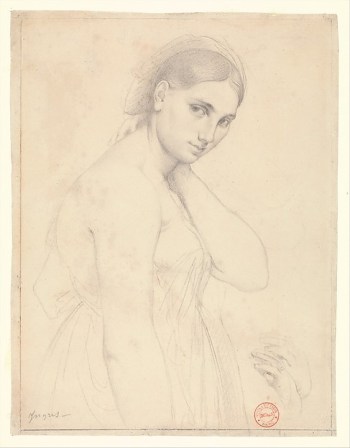
Jean Auguste Dominique Ingres, Study for ‘Raphael and the Fornarina'(?), ca. 1814; graphite on white wove paper, 25.4 × 19.7 cm (New York: The Metropolitan Museum of Art, Robert Lehman Collection, 1975.1.646).
This exhibition will trace the development of European drawing from the Renaissance to the early 20th century through works by celebrated masters such as Leonardo da Vinci, Dürer, Rembrandt, Tiepolo, Ingres, Seurat, and Matisse. Fifty-five drawings from the Museum’s acclaimed Robert Lehman Collection will present a dynamic array of styles, techniques, and genres—from panoramic landscapes and compositional studies for mythological and biblical narratives to arresting studies of the human form.
The selection will illustrate different facets of the artists’ creative processes—from Leonardo’s keen anatomical observation in his Study of a Bear, to Dürer’s awakening self-consciousness as an artist in his Self-Portrait study, to Rembrandt’s reinterpretation of Leonardo’s painted masterpiece, The Last Supper. The exhibition will also be the first to explore Robert Lehman’s significant activity as a 20th-century collector by highlighting the full range of his vast and distinguished drawings collection, which numbers more than 700 sheets.
The exhibition is organized by Dita Amory, Curator in Charge, and Alison Nogueira, Associate Curator, both of the Robert Lehman Collection at The Met.
New Book | Enchanted World of German Romantic Prints
The related exhibition was on display at the Philadelphia Museum of Art in the autumn of 2013. From Yale UP:
John Ittmann, ed., with essays by Warren Breckman, Mitchell B. Frank, Cordula Grewe, John Ittmann, Catriona MacLeod, and F. Carlo Schmid, Enchanted World of German Romantic Prints, 1770–1850 (New Haven: Yale University Press, 2017), 424 pages, ISBN: 978 03001 97624, $65.
 From the 1770s through the 1840s, German, Austrian, and Swiss artists used the medium of printmaking to create works that synthesized poetry, literature, music, and the visual arts in new and captivating ways. Finding an eager audience in the growing number of educated middle-class collectors, printmakers experimented with modern technologies, such as lithography, and drew on the contemporary interest in regional folklore and traditional fairy tales to produce innovative compositions that both contributed to and reflected the dramatic cultural and political upheavals of the Romantic era. Featuring the work of more than 120 artists, including Casper David Friedrich, Ludwig Emil Grimm, Joseph Anton Koch, Philipp Otto Runge, and Johann Gottfried Schadow, this authoritative book contains many unique and never-before-published examples of prints from the Philadelphia Museum of Art’s unrivaled collection.
John Ittmann is the Kathy and Ted Fernberger Curator of Prints at the Philadelphia Museum of Art.
Print Quarterly, September 2017
The eighteenth century in the current issue of Print Quarterly:
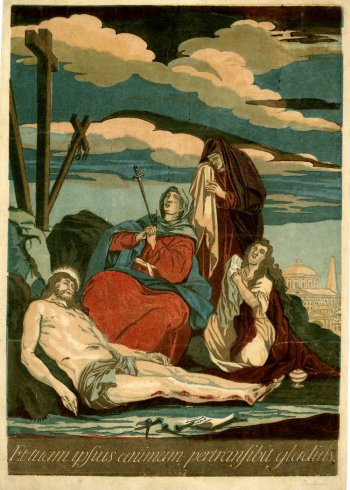
John Baptist Jackson, Lamentation over the Body of Christ, ca. 1740–44, woodcut with embossing (London: The British Museum).
Print Quarterly 34.3 (September 2017)
A R T I C L E S
• Evelyn Wöldicke, “John Baptist Jackson’s Woodcuts and the Question of Embossing,” pp. 298–310.
• Freyda Spira, “Micrographic Allegories by Johann Michael Püchler and Matthias Buchinger,” pp. 310–16.
R E V I E W S
• Adriano Aymonino, Review of the exhibition catalogue, Maria Rosaria Nappi, ed., Immagini per il Grand Tour: L’attività della Stamperia Reale Borbonica (Edizioni Scientifiche Italiane, 2015), pp. 328–31.
• Rolf Reichardt, Review of Philippe de Carbonnières, La Grande Aarmée de papier: Caricatures napoléoniennes (Presses Universitaires de Rouen et du Havre, 2015), pp. 331–33.
• Perrin Stein, Review of Kristel Smentek, Mariette and the Science of the Connoisseur in Eighteenth-Century Europe (Ashgate, 2014), pp. 340–44.
Exhibition | Witches: Metamorphosis of Goya
Press release (via Art Daily) for the exhibition:
Denise de la Rue, Witches: Metamorphosis of Goya / Brujas: Metamorfosis de Goya
Lázaro Galdiano Museum, Madrid, 21 June — 31 October 2017
Curated by Carmen Espinosa and Flavia Hohenlohe
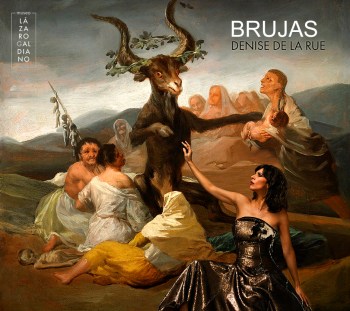
Denise de la Rue, ‘Maribel Verdú y Goya’, a partir de ‘El Aquelarre’ de Francisco de Goya (1798), 2017.
Witches, an exhibition by Mexican artist Denise de la Rue, curated by Carmen Espinosa and Flavia Hohenlohe at the Lázaro Galdiano Museum in Madrid, is the second component of her series Angels and Witches: Goya, Metamorphose, a study of Francisco de Goya’s paintings through a reinterpretation of the old master’s work. De la Rue has created a series of photographs juxtaposing iconic Spanish actresses with the painter’s work, analysing the dichotomies and similarities between these characters whilst engaging with historical and relevant sites such as the Museum. Taking elements of the actor profession that coincide with the characteristics of angels and witches such as mysticism, magic, life, death and the power of creation, transformation and destruction, De la Rue has created a dialogue between the actresses and Goya’s paintings. The essence of this series is the interest of the artist in researching the capability of women to transform and empower themselves, which historically has been seen as threatening to the conservative preconception of patriarchal societies.

Denise de la Rue, a partir de ‘Vuelo de Brujas’ de Francisco de Goya (Prado, 1798), 2017.
As a starting point to create Witches, a new body or work, De la Rue has taken Goya’s Vuelo de Brujas (Witches’ Flight), Prado Museum; El Aquelarre (Witches’ Sabbath) and Las Brujas (The Witches), both at the Lázaro Galdiano Museum; Hechizado a la Fuerza (The Forcibly Bewitched), National Gallery London; La Cocina de las Brujas (The Witches’ Kitchen), untraced; and Don Juan y el Comendador (Don Juan and the Commander), untraced. The series was commissioned by the Dukes of Osuna between 1797 and 1798 for the Alameda Palace in Madrid, best known as El Capricho.
Two of these pieces, Las Brujas and El Aquelarre, are part of the Museum’s permanent collection and will be displayed alongside De la Rue’s work, creating a conversation between the old master and the contemporary artist. The extravagance of these two pieces also draws special attention. Here the unreal becomes visible, riding between the terrifying and the ironic. Both paintings appear to be inspired by eighteenth-century texts as well as popular tradition, a key focus in De la Rue’s research. The exhibition of Witches is a unique opportunity not only to see two of Goya’s original paintings of witches together but to appreciate the full series through De la Rue’s work.
Two of the original paintings have been lost, and De la Rue has recaptured them by retrieving historic files that include details of the works. Using photography technology, the artist has reconstructed the works and reunited them in the same space for the first time since the pieces left the Dukes of Osuna’s hands.
In addition to the photographs, the Museum will present De la Rue’s video dedicated to the painting Las Brujas in which the actress Bárbara Lennie dances to the poem “Pequeño vals Vienés” (“Little Venice Waltz”) by Federico Garcia Lorca interpreted by flamenco singer Enrique Morente.
The first component of the exhibition Angels and Witches Goya, Metamorphose was the chapter of Angels at the Royal Chapel of San Antonio de la Florida in Madrid where Goya remains rest, as well as where some of his most recognised frescos are. The exhibition opened in February and was a highlight of the Madrid cultural calendar. Having the two exhibitions of Angels and Witches in dialogue with Goya’s work in these unique venues is a rare opportunity to see and understand Goya’s interest in witchcraft and the holy, revised by photography and a contemporary perspective.
Video from the previous installation Ángelas:
Symposium | Art of Power: The 3rd Earl of Bute, Politics, and Collecting
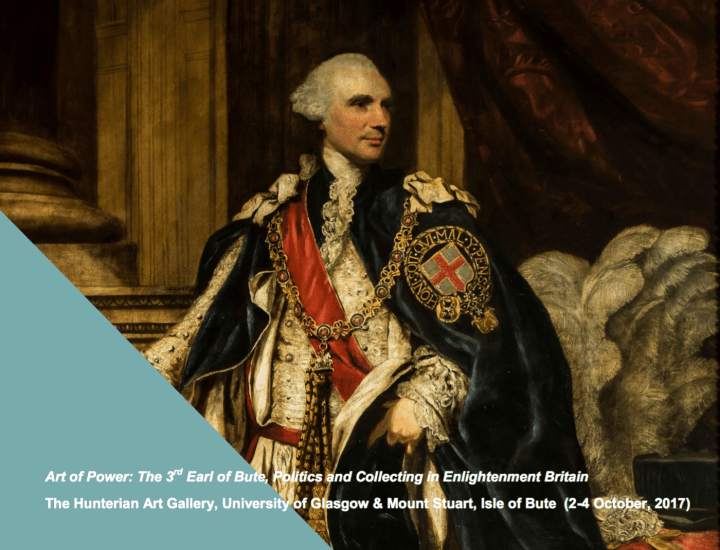
From the symposium flyer:
Art of Power: The 3rd Earl of Bute, Politics, and Collecting in Enlightenment Britain
The Hunterian Art Gallery, University of Glasgow and Mount Stuart, Isle of Bute, 2–4 October 2017
In 2017, the Mount Stuart Trust and The Hunterian Art Gallery, University of Glasgow, are hosting a major exhibition merging art, biography, politics, and cultural history. Art of Power: Masterpieces from the Bute Collection uncovers the fascinating Enlightenment figure, John Stuart, 3rd Earl of Bute (1713–1792), and his collection of rarely-seen masterpieces. A three-day interdisciplinary symposium inspired by themes of the exhibition will explore the dynamic interplay between art, politics, and collecting so evident in the life of the 3rd Earl of Bute. In sessions open to the public, papers will be delivered on day one in Glasgow. Days two and three will take place at Mount Stuart (with only a very limited number of spaces) and will include tours of the house, archives, and collection highlights.
Confirmed Speakers
Desmond Shawe-Taylor (Royal Collection), Rosie Razzall (Royal Collection), Anne T. Woollett (J. Paul Getty Museum), Anthony Lewis (Glasgow Museums), Wayne E. Franits (Syracuse University), Graham Rowe (University of Derby), Heiner Krellig (independent), Janet Stiles Tyson (Birkbeck), Oliver Cox (Oxford), Peter Black (Hunterian), Mungo Campbell (Hunterian), and Caitlin Blackwell (Mount Stuart)










 Enfilade
leave a comment