Exhibition | Global Encounters and the Archives: Britain’s Empire
Opening this month at the Lewis Walpole Library:
Global Encounters and the Archives: Britain’s Empire in the Age of Horace Walpole
The Lewis Walpole Library, Farmington, CT, 20 October 2017 — 2 March 2018
Curated by Justin Brooks, Heather Vermeulen, Steve Pincus, and Cynthia Roman
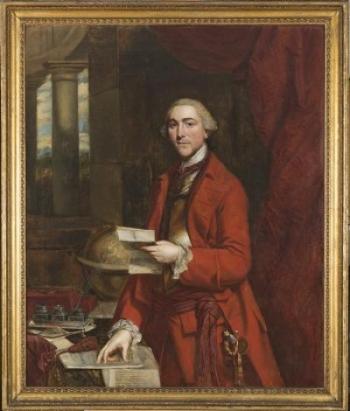
Barrett Ranelagh, Portrait of General Henry Seymour Conway (The Lewis Walpole Library, Yale University).
As part of the year-long celebrations of the 300th anniversary of Horace Walpole’s birth, Global Encounters and the Archives: Britain’s Empire in the Age of Horace Walpole draws on the Lewis Walpole Library’s rich collections to bring Walpole’s global interests to light. As befitting the son of a prime minister (Sir Robert Walpole), the nephew of the auditor-general of the Revenue of America (Horatio Walpole), and the close friend of a secretary of state (Henry Seymour Conway) who oversaw important imperial affairs, Horace Walpole well understood the partisan conflicts that helped shape the British Empires. A lively collaboration between the Lewis Walpole Library and Yale faculty and graduate students, this exhibition takes full advantage of the diverse range of archival resources and special collections held by the Library, including manuscripts, printed texts, and graphic images in presenting conflicting visions of empire through the domains of political economy, diplomacy, slavery, and indigenous peoples.
In association with this exhibition, the library will sponsor a two-day conference in New Haven on 9-10 February 2018. The conference papers will present new archival-based research on Britain’s global empire in the long eighteenth century.
Curated by Justin Brooks (Doctoral Candidate in History, Yale University), Heather V. Vermeulen, (Ph.D., Lecturer in African American Studies, Yale University), Steve Pincus (Bradford Durfee Professor of History, Yale University), and Cynthia Roman (Curator of Prints, Drawings, and Paintings, The Lewis Walpole Library).
◊ ◊ ◊ ◊ ◊
George Haggerty, The Many Lives of Horace Walpole
Yale Center for British Art, New Haven, 26 October 2017
In his charming biography of Horace Walpole, R.W. Ketton-Cremer makes the point that “one of the difficulties which confront a biographer of Walpole is his remarkable versatility. He was active in many fields—in politics, social life, literature, architecture, antiquarianism, printing, virtú; and it is not easy to include them all in the compass of a single volume.” George Haggerty, who is currently writing a new biography of Horace Walpole, will take up this challenge in his lecture with and through Walpole’s letters. Haggerty asserts that Walpole writes himself into his experience by means of his epistolary imagination. George E. Haggerty is the Distinguished Professor and Chair of the Department of English at the University of California, Riverside. Yale Center for British Art Lecture Hall, Thursday, 26 October 26 2017, 5:30pm.
Queer Biography and the Archives: A Roundtable with George Haggerty
Beinecke Rare Book and Manuscript Library, New Haven, 27 October 2017
Discussants include Abby Coykendall, Jason Farr, Caroline Gonda, Paul Kelleher, Ellen Malenas Ledoux, Susan Lanser, and Timothy Young. Friday, 27 October 2017, 2:30–4:45pm. Registration is required. For questions and further information, please contact Cynthia Roman cynthia.roman@yale.edu.
◊ ◊ ◊ ◊ ◊
Justin Brooks, Global Encounters in the Archives: Britain’s Empire in the Age of Horace Walpole
The Lewis Walpole Library, Farmington, CT, 1 November 2017
Justin Brooks, Doctoral Candidate in History, Yale University, will speak on the the Lewis Walpole Library’s exhibition Global Encounters in the Archives: Britain’s Empire in the Age of Horace Walpole. The exhibition, which looks at aspects of the global British Empire in the long eighteenth century, takes full advantage of the diverse range of archival resources held by the Library and which Mr. Brooks co-curated, including manuscripts, printed texts, graphic images, and objects. Interrelated themes include political economy, diplomacy, indigeneity, and slavery. The talk, exhibition, and other related programs celebrate the broad pre-disciplinary collecting activities of Horace Walpole (1717–1797) and W.S. Lewis (1895–1979) and will explore how current multi-disciplinary methodologies invite creative research in the Library’s archival collections. Mr. Brooks’s talk is offered as part of a year’s worth of events celebrating the 300th anniversary of Horace Walpole’s birth. This Lewis Walpole Library lecture is held in partnership with the Farmington Libraries. Wednesday, 1 November 2017, 7:00pm. Space is limited, and registration is required.
Exhibition | Monochrome: Painting in Black and White
Press release (August 2017) from The National Gallery:
Monochrome: Painting in Black and White
The National Gallery, London, 30 October 2017 – 18 February 2018
Museum Kunstpalast, Düsseldorf, 21 March — 15 July 2018
Curated by Lelia Packer and Jennifer Sliwka
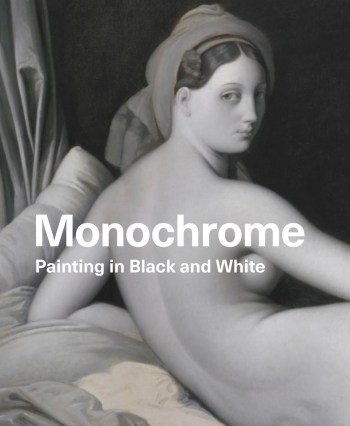 At the National Gallery this autumn, journey through a world of shadow and light. With more than fifty painted objects created over 700 years, Monochrome: Painting in Black and White is a radical new look at what happens when artists cast aside the colour spectrum and focus on the visual power of black, white, and everything in between.
Paintings by Old Masters such as Jan van Eyck, Albrecht Dürer, Rembrandt van Rijn, and Jean-Auguste-Dominique Ingres appear alongside works by some of the most exciting contemporary artists working today including Gerhard Richter, Chuck Close, and Bridget Riley. Olafur Eliasson‘s immersive light installation Room for One Colour (1997) brings a suitably mind-altering coda to the exhibition. With major loans from around the world and works from the National Gallery’s Collection, Monochrome reveals fresh insights into the use of colour as a choice rather than a necessity.
As Lelia Packer and Jennifer Sliwka, curators of Monochrome: Painting in Black and White, explain: “Painters reduce their colour palette for many reasons but mainly as a way of focusing the viewer’s attention on a particular subject, concept, or technique. It can be very freeing—without the complexities of working in colour, you can experiment with form, texture, mark making, and symbolic meaning.”
Monochrome: Painting in Black and White guides visitors through seven rooms, each addressing a different aspect of painting in black, white and grey, also known as grisaille.
Sacred Subjects
The earliest surviving works of Western art made in grisaille were created in the Middle Ages for devotional purposes, to eliminate distractions and focus the mind. As colour pervades daily life, black and white can signal a shift to an otherworldly or spiritual context. For some, colour was the forbidden fruit and prohibited by religious orders practising a form of aesthetic asceticism. Grisaille stained glass, for example, was created by Cistercian monks in the 12th century as an alternative to vibrant church windows, with its translucent greyish panels sometimes painted with images in black and yellow. Light and elegant in appearance, grisaille glass such as this window panel made for the Royal Abbey of Saint-Denis, Paris (1320–24, Victoria and Albert Museum, London) gained popularity outside the order and eventually became de rigueur in many French churches.
Studies in Light and Shadow
From the 15th century onward artists made painted studies in black and white to work through challenges posed by their subjects and compositions. Eliminating colour allows artists to concentrate on the way light and shadow fall across the surface of a figure, object or scene before committing to a full-colour canvas. The beautiful Drapery Study (possibly study for Saint Matthew and an Angel), (about 1477, Kupferstichkabinett, Staatliche Museen zu Berlin) attributed to Domenico Ghirlandaio is a template work which an artist could reuse in multiple finished colour paintings. This particular motif for example reappeared in a frescoed vault in San Gimignano, Italy.
Independent Paintings in Grisaille
Increasingly, paintings in grisaille were made as independent works of art, complete unto themselves. This section explores the inspiration and desire for such paintings, prized for their demonstration of artistic skill, for the insights they provide into the artist’s craft, and for their profound consideration of a particular subject.
Jan van Eyck’s Saint Barbara (1437, Royal Museum of Fine Arts Antwerp) is the earliest known example of a monochrome work on panel, drawn in metalpoint, India ink, and oil on a prepared ground. Although there has been ongoing debate as to whether a master colourist such as van Eyck intended Saint Barbara as a sketch in preparation for a painting in colour or a as a finished drawing, the panel was admired and collected as early as the 16th century suggesting that a taste for independent monochrome pictures existed from an early date.
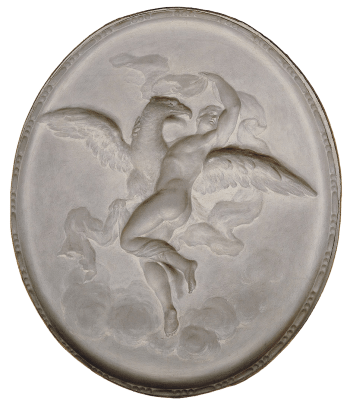
Jacob de Wit, Jupiter and Ganymede, 1739 (Hull: Ferens Art Gallery).
Monochrome Painting and Sculpture
For centuries artists have challenged themselves to mimic the appearance of stone sculpture in painting. In Northern Europe, a taste for illusionistic decorative elements—such as decorative wall painting and sculpted stucco—may have helped give rise to stunning works of trompe l’oeil painted on panel or canvas. Jacob de Wit excelled at this practice and his Jupiter and Ganymede (1739, Ferens Art Gallery, Hull) could easily be mistaken for a three-dimensional wall relief.
Monochrome Painting and Printmaking
Beginning in the 16th century, painters developed ingenious ways to compete with new developments in printmaking. An exceptionally rare grisaille work by Hendrik Goltzius, Without Ceres and Bacchus, Venus Would Freeze (1606, the State Hermitage Museum, St Petersburg) for example, dazzled viewers who could not fathom how it was made, as it very much looks like a print but was drawn by hand on prepared canvas.
Black-and-White Painting in the Age of Photography and Film
Similarly, the invention of photography in 1839, and that of film much later, prompted painters to imitate the effects of these media, in order to respond to, or compete with their particular qualities. Gerhard Richter employed a press photograph of a prostitute who had been brutally murdered as the foundation of his painting Helga Matura with Her Fiancé (1966, Museum Kunstpalast, Düsseldorf). The grey palette—for Richter, “the ideal colour for indifference”—removes any sentimentality about Helga’s murder. By deliberately blurring the photograph, the artist makes the viewer aware that this is an altered image, contrasting with the crispness and apparent objectivity of the original.
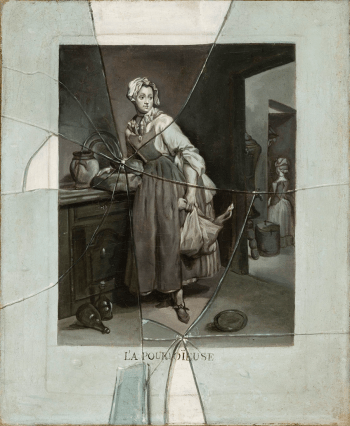
Étienne Moulinneuf, after Jean-Siméon Chardin, Back from the Market (La Pourvoyeuse), ca. 1770, oil on canvas, 46 × 38 cm (Los Angeles: LACMA).
Abstraction
Abstract and installation artists have often been drawn to black and white. When artists have ready access to every possible hue, the absence of colour can be all the more shocking or thought-provoking. In 1915, Kiev-born artist Kazimir Malevich painted the first version of his revolutionary work, Black Square (in the exhibition is the 1929 version from the State Tretyakov Gallery, Moscow)—an eponymous black square floating within a white painted frame—and declared it to be the beginning of a new kind of non-representational art. Works by Josef Albers, Ellsworth Kelly, Frank Stella, and Cy Twombly all exemplify the use of minimal colour for maximum impact.
Artists intrigued by colour theory and the psychological effects of colour (or its absence) manipulate light, space, and hue to trigger a particular response from the viewer. In this way, Olafur Eliasson brings the exhibition to a close with his large-scale, immersive light installation, Room for One Colour (1997). In a room illuminated with sodium yellow monofrequency lamps, all other light frequencies are suppressed and visitors are transported to a monochrome world.
National Gallery Director, Dr Gabriele Finaldi, says: “Artists choose to use black and white for aesthetic, emotional, and sometimes even for moral reasons. The historical continuity and diversity of monochrome from the Middle Ages to today demonstrate how crucial a theme it is in Western art.”
Exhibition organised by The National Gallery in collaboration with Museum Kunstpalast, Dusseldorf.
Lelia Packer and Jennifer Sliwka, Monochrome: Painting in Black and White (London: The National Gallery, 2017), 240 pages, ISBN: 978 18570 96132 (hardback), £35 / ISBN: 978 18570 96132 (paperback), £20.
Lelia Packer is Acting Curator of Paintings, Watercolours, Miniatures, and Manuscripts (excluding France) at the Wallace Collection, London. She was formerly McCrindle Curatorial Assistant at The National Gallery.
Jennifer Sliwka is Deputy Director of the Visual Commentary on Scripture Project and Senior Research Fellow, King’s College London. She was formerly Ahmanson Curator of Art and Religion at The National Gallery.
Exhibition | Maria Sibylla Merian
Opening this week at the Städel Museum:
Maria Sibylla Merian and the Tradition of Flower Depiction
Kupferstichkabinett, Staatliche Museen zu Berlin, 7 April — 2 July 2017
Städel Museum, Frankfurt am Main, 11 October 2017 — 14 January 2018

Maria Sibylla Merian, Shrub Rose with Gracillariidae, Larva and Pupa, 1679 (Frankfurt: Städel Museum)
Maria Sibylla Merian (1647–1717), a native of Frankfurt, was not only a highly prominent naturalist but also one of the most renowned artists of her time. The year 2017 marks the 300th anniversary of her death. On this occasion, the Städel Museum is presenting the special exhibition Maria Sibylla Merian and the Tradition of Flower Depiction from 11 October 2017 to 14 January 2018. The show will acquaint visitors with the fascinating and filigree world of flower and plant depiction in drawings and prints of the fifteenth to the eighteenth centuries.
Developed in collaboration with the Kupferstichkabinett of the Staatliche Museen zu Berlin and the Technische Universität Berlin, the exhibition will feature major works by Maria Sibylla Merian in the context of flower depictions by her forerunners, contemporaries and successors, among them the famous Hortus Eystettensis by the pharmacist Basilius Besler (1561–1629) of Nuremberg, ornament engravings by Martin Schongauer (ca. 1445–1491), pharmacopeia of the fifteenth and sixteenth centuries, plant studies from the circle of Albrecht Dürer, and studies of nature by Georg Flegel (1566–1638) and Joris (Georg) Hoefnagel (1542–1600/01) of the period around 1600. Flower drawings by Bartholomäus Braun will also be on view, as will floral compositions by Barbara Regina Dietzsch (1706–1783) and her circle of the eighteenth century. Maria Sibylla Merian and the Tradition of Flower Depiction will present more than 150 works in all: sheets from the collections of the Städel and the Kupferstichkabinett, but also valuable loans from the Bibliothèque Nationale in Paris, the Sächsische Landes- und Universitätsbibliothek in Dresden, the Staatsbibliothek zu Berlin, and the Universitätsbibliothek Johann Christian Senckenberg in Frankfurt.
Exhibition | Exchanging Gazes: Between China and Europe

Chinese Ladies Playing a Board Game, Qing Dynasty, Qianlong Period (1736–1795), 2nd half of the 18th century, watercolour and opaque watercolour on silk (Museum für Völkerkunde Hamburg)
◊ ◊ ◊ ◊ ◊
Press release from the Berlin State Museums:
Exchanging Gazes: Between China and Europe, 1669–1907
Kunstbibliothek, Staatliche Museen zu Berlin, 29 September 2017 — 7 January 2018
China and Europe are linked by a long tradition of reciprocal cultural exchange. These transactions were particularly intensive during the Qing Dynasty (1644–1911), which is regarded as one of the key phases of Chinese cultural and political history. Exquisite gifts were exchanged. European envoys attempted to establish official trade relations with China. But their efforts were in vain, as the Chinese established trade barriers, with the exception of the port of Canton—although they were very much interested in European science, art, and culture.
The exhibition illustrates the richly varied nature of this mutual fascination in objects ranging in date between 1669 and 1907. Many of the almost one hundred pieces could be classified as Chinoiserie or so-called Europerie: they provide us with information about early modern European images of China and also allow us to trace the predominant images of Europe in China. Highlights of the exhibition include impressive paintings, exquisite porcelain objects, a door from a wood-paneled room, as well as large-format photographs and copper engravings. The photographs and engravings show the ‘European palaces’ which Emperor Qianlong, who reigned from 1736 to 1795, had built in one of his parks. Today, only their ruins exist: British and French troops burned down the palaces and destroyed the extensive gardens during their 1860 Chinese campaign. Surprisingly, however, in this way they created a visual subject that was much-loved by European photographers after 1870.
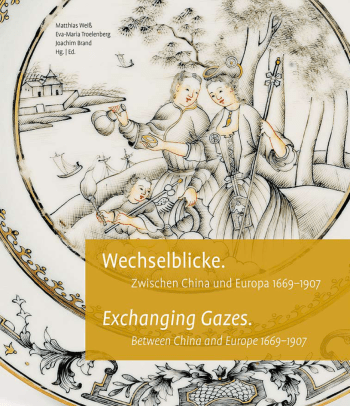 Until now, the reciprocity—and sheer variety—of cultural exchange between China and Europe has hardly been appreciated or shown in an exhibition setting. The chosen objects offer impressive testimony to a long- lived and mutual interest between the two cultures. In addition, they can help us understand how Europe’s conception of China and China’s conception of Europe changed over the course of 250 years.
Particularly in the 18th century, it was not only Europe looking to China’s art production but also China looking to that of Europe. The fact that these exchanging gazes are to be taken quite literally and that they were cast back and forth now and again is demonstrated by the Chinese production of porcelain: around 1700, European missionaries living at the imperial court contributed to the development of the so-called foreign colours (yangcai). The chinaware that was subsequently decorated with the new shades of red and pink (famille rose) became so popular that it developed into an export hit and hence also had a lasting impact on European dining culture.
An exported plate, which was produced in China and shows two pilgrims on their way to Cythera, the island of love, allows the term ‘exchange of gazes’ to be connected more closely to the 18th century. In the European love discourse of that time, this term is connected with the concept of the love of souls. This type of love enables an encounter between lovers at eye level; yet it also involves the danger of unilateral self-reflection. Certainly this metaphor of love cannot be transferred unmitigatedly to the cooperation of cultures. Nevertheless, it points at two contradictory foundations of cultural exchange: such an exchange is only possible if, apart from differences, common features are recognized, for instance in the characteristics of systems of rule or in courtly cultures. At the same time, ‘exchange of gazes’ can allude to the fact that it is first and foremost one’s own self-interest that is respected in these constellations.
Due to political and economic changes, China and Europe had to repeatedly reconsider themselves, which means they had to come to a kind of self-understanding as well as set themselves in relation to each other. This becomes particularly evident when looking at objects called Chinoiseries, as they reflect the European image of China prevalent throughout the 18th century. Chinoiseries can be juxtaposed with the so-called Europeries, which were produced in China and give insight into the Chinese image of Europe. In order to present the foreign as alien, it had to be at least partially adapted to the familiar, which is why the objects exhibited here can be aesthetically classed in-between China and Europe. Many objects can additionally be found ‘between’ China and Europe because they circulated as export goods, diplomatic gifts or as possessions acquired abroad, all in order to develop an altered effect in their respective new repositories. It is furthermore evident that motifs and techniques migrated not only between these cultures but also between genres and materials. Prints, for example, became built architecture and vice versa. The exhibition, moreover, offers the rare occasion to simultaneously view Chinoseries and Europeries, which are usually stored in different collections. This therefore allows the gaze to wander back and forth and, in so doing, to comprehend that China and Europe share a common history.
Even though there are hardly definite dates that mark the history of exchange between China and Europe, the years in the exhibition’s title indicate two important stages in the European production of images of China. In 1669, Johan Nieuhof’s travelogue was published. Nieuhof had joined the first Dutch delegation of the United East India Company travelling to China in order to intensify the trade relationship with the empire that increasingly isolated itself—a venture which failed. From a historic point of view, the journey’s true success was Nieuhof’s richly illustrated travelogue that was published in large numbers and became one of the most important sources for European knowledge about China.
1907, on the other hand, marks the creation of four architectural photographs by Ernst Boerschmann, who travelled China as an architectural historian and re-established Western knowledge on Chinese architecture. This had become possible only because the major European powers had gradually forced the opening of China beginning in the second half of the 19th century. The objects exhibited here render not only the changing relationship between China and Europe from the late 17th to the early 20th century comprehensible—how and why it shifted in the direction of colonial policy—but also the traditional tendencies which persisted through these changes. Boerschmann, for instance, perpetuated the myth that porcelain was used as construction material, even though this was not his personal view.
A special exhibition of the Kunstbibliothek – Staatliche Museen zu Berlin, in cooperation with the Max Planck Research Group ‘Objects in the Contact Zone: The Cross-Cultural Lives of Things’ at the Kunsthistorisches Institut in Florence – Max Planck Institute.
Curatorial concept: Professor Dr. Matthias Weiß
From Michael Imhof Verlag:
Matthias Weiß, Eva-Maria Troelenberg, and Joachim Brand, eds., Wechselblicke: Zwischen China und Europa 1669–1907 / Exchanging Gazes: Between China and Europe 1669–1907 (Petersberg: Michael Imhof Verlag, 2017), 352 pages, ISBN: 9783731905738, $70.
Exhibition | European Old Masters: 16th–19th Centuries
Press release for the exhibition:
European Old Masters: 16th–19th Centuries
Hazelhurst Regional Gallery and Arts Centre, Gymea (Sydney), 28 September — 3 December 2017

Jean-Marc Nattier, Portrait of Madame de La Porte, 1754; oil on canvas, 82 × 65.5 cm (Art Gallery of New South Wales, gift of William Bowmore, OBE 1992).
New South Wales’s most important European old masters including magnificent works by some of the leading Italian, French, and British artists of the High Renaissance, Baroque, Rococo, and Romantic periods are on loan from the Art Gallery of New South Wales to Hazelhurst Regional Gallery for the exhibition European Old Masters: 16th–19th Century.
Michael Brand, director of the Art Gallery of New South Wales said the exhibition is the first occasion so many of these important European paintings have been shown together outside the Art Gallery of New South Wales. “We are delighted to collaborate with Hazelhurst Regional Gallery to share some of the finest European works in our collection with their audiences in the Sutherland Shire and further afield,” Brand said. “The Gallery’s early ambitions to display paintings by the masters can be seen in the roll-call of European greats inscribed on the building’s façade, and I applaud Hazelhurst Regional Gallery for showing works from this glorious tradition that is still relevant today,” Brand added.
Belinda Hanrahan, director, Hazelhurst Regional Gallery said leading artists in the exhibition include Thomas Gainsborough, William Hogarth, Sir Joshua Reynolds, Bernardo Strozzi, and Frans Snyders. “Hazelhurst Gallery is thrilled that Michael Brand as director of the Art Gallery of New South Wales has given us this opportunity for people to encounter the state’s finest European old masters. Paintings such as these remind us of what is constant in human experience and emotion while offering an insight into ages and cultures so different to our own,” Belinda said.
Sutherland Shire Mayor and Hazelhurst Gallery Board member, Carmelo Pesce said this exhibition is another example of our commitment to a culturally rich community. The Sutherland Shire community is the first to see the collection outside its home and showcases Council’s commitment to strengthen its community connections through shared cultural experiences.
Despite its early ambitions to collect works by the European masters, The Art Gallery of New South Wales did not in fact start collecting old masters until the 1950s. AGNSW curator European prints, drawings and watercolours, Peter Raissis said prior to that time the great masters of the past could be experienced only through copies intended for educational purposes due to the Gallery’s earlier focus on acquiring works by living artists. “Between 1951 and 1976, the Gallery acquired an outstanding group of English 18th-century portraits, including works by three of the leading painters of the age: William Hogarth, Thomas Gainsborough, and Joshua Reynolds. During these years the Gallery also purchased landscapes and subject pictures representative of British Neo-Classicism and Romanticism by artists such as Richard Wilson, John Glover, Richard Westall, William Hamilton, and Francis Danby. “Although accessions of non-British painting were rare, three powerful and imposing figural compositions by the Baroque painters Bernardo Strozzi, Jan van Bijlert, and Matthias Stomer expanded the scope and ambition of the collection,” Raissis said.
The extraordinary donation by James Fairfax AC during the 1990s significantly enriched the Gallery’s holdings of European old masters, particularly in the area of 18th-century French and Italian art such as the works by Nicolas de Largillierre and Canaletto. The collection has continued to develop with the acquisition of major Italian Renaissance and Baroque works such as the work of Giulio Cesare Procaccini, also exhibited in European Old Masters: 16th–19th Century.
Exhibition | Canova, Hayez, and Cicognara: The Last Glory of Venice
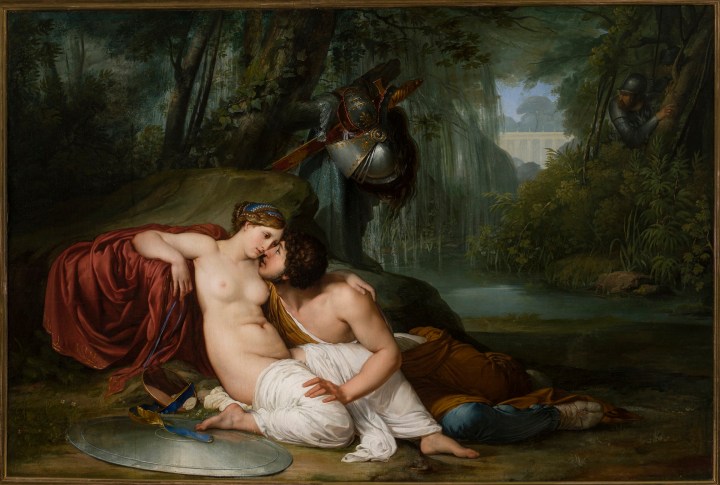
Francesco Hayez, Rinaldo and Armida, 1812–13, oil on canvas
(Venice: Museo Nazionale Gallerie dell’Accademia)
◊ ◊ ◊ ◊ ◊
From Et Electa:
Canova, Hayez, and Cicognara: The Last Glory of Venice
Gallerie dell’Accademia, Venice, 29 September 2017 — 2 April 2018
Curated by Paola Marini, Fernando Mazzocca, and Roberto De Feo
In the year of the bicentennial celebrations of the opening of the Gallerie dell’Accademia—an international institution first founded to compensate for the loss of so many masterpieces removed during the suppression of schools and religious institutions—the exhibition Canova, Hayez, Cicognara: L’ultima gloria di Venezia pays homage to a unique moment in the artistic history of the Serenissima, its cultural revival initiated in 1815 when the Four Horses of Saint Mark, the iconic symbol of the city, were returned from Paris.
The acknowledged leader of this revival was the intellectual Count Leopoldo Cicognara, President of the Accademia di Belle Arti, who together with his friend Antonio Canova, the guiding spirit of the project, and Francesco Hayez, worked to create a museum on an international scale, a worthy setting for Venice’s unrivaled art heritage, yet one also suitable for promoting contemporary art.
The exhibition includes 100 major works, arranged in nine thematic sections, including a series of artefacts known as ‘The Homage of the Venetian Provinces’ sent to the imperial court of Vienna in 1818 to mark the fourth marriage of Emperor Francis I, reunited and returning to their native city for the first time in 200 years.
Highlights of the exhibition also include the opening section dedicated to the return of the Four Horses of St Mark and the cameo depicting Jupiter the Shield Bearer, a masterpiece whose beauty was hymned by Canova, and further on the commemoration of the acquisition of a series of drawings by Leonardo da Vinci and Raphael from Canova and Cicognara’s mutual friend Giuseppe Bossi, a purchase which significantly enriched the Academy’s collection.
Fernando Mazzocca et al., Canova, Hayez, Cicognara: L’ultima Gloria di Venezia (Venice: Marsilio, 2017), 352 pages, ISBN: 9788831728225, $65.
Exhibition | Chaekgeori: Korean Painted Screens
In terms of objects, it is a nineteenth-century exhibition, but this fascinating genre dates to the late eighteenth century. From SUNY Press:
Chaekgeori: Pleasure of Possessions in Korean Painted Screens
Charles B. Wang Center, Stony Brook University, 29 September — 23 December 2016
Spencer Museum of Art, The University of Kansas, 15 April — 11 June 2017
The Cleveland Museum of Art, 5 August — 5 November 2017
 Chaekgeori explores the genre of Korean still-life painting known as chaekgeori (loosely translated as ‘books and things’). Encouraged and popularized by King Jeongjo (1752–1800, r. 1776–1800) as a political tool to promote societal conservatism against an influx of ideas from abroad, chaekgeori was one of the most enduring and prolific art forms of Korea’s Joseon dynasty (1392–1910). It depicts books and other material commodities as symbolic embodiments of knowledge, power, and social reform.
Chaekgeori has maintained its popularity in Korea for more than two centuries, and remains a force in Korean art to this day. No other genre or medium in the entirety of Korean art, including both court and folk paintings, has so engaged and documented the image of books and collectable commodities and their place in an ever-evolving Korean society. When it transitioned into folk-style painting, unexpected and creative visual elements emerged. Folk versions of chaekgeori from the eighteenth and nineteenth centuries often show an exquisite fusion of Korean and Western composition that feels modern to our contemporary eyes. Not only books but many other commodities are depicted to represent the commoner’s desire for higher social status, wealth, and knowledge.
The first large-scale traveling exhibition of its kind to be published, The Power and Pleasure of Possessions in Korean Painted Screens is made possible by generous grants from the Korea Foundation and the Gallery Hyundai.
Byungmo Chung and Sunglim Kim, eds., Chaekgeori: The Power and Pleasure of Possessions in Korean Painted Screens (Albany: State University of New York Press, 2017), 250 pages, ISBN: 978 14384 68112, $60.
Byungmo Chung is Professor in the Department of Cultural Assets at Gyeongju University, Korea. He was a visiting scholar in the Department of Asian Cultures and Languages at Rutgers University and President of the Korean Folk Painting Society. His scholarship focuses on the genre paintings and Minhwa—the folk painting of Korea. He has organized several Minhwa exhibitions in Korea and written numerous articles and books about Korean folk and genre paintings, including Chaesaekhwa: Polychrome Paintings of Korea.
Sunglim Kim is Assistant Professor of Korean Art History in the Department of Art History and the Asian and Middle Eastern Studies Program, Dartmouth College. Her scholarship focuses on premodern and early twentieth-century Korean art and culture, including the rise of consumer culture and the role of professional nouveau riche in late Joseon Korea, Japanese colonial photographs of Korea, and Korean women artists. She has curated several exhibitions in the United States and written numerous publications on Korean art.
Exhibition | Théâtre du Pouvoir
Press release (via Art Daily) for the exhibition now on view at the Petite Galerie of the Louvre:
Power Plays / Théâtre du Pouvoir
Musée du Louvre, Paris, 27 September 2017 — 2 July 2018
Curated by Paul Mironneau and Jean-Luc Martinez with Florence Dinet
 The Petite Galerie exhibition for 2017–18 focuses on the connection between art and political power. Governing entails self-presentation as a way of affirming authority, legitimacy, and prestige. Thus, art in the hands of patrons becomes a propaganda tool; but it can also be a vehicle for protest and subverting the established order. Spanning the period from antiquity up to our own time, forty works from the Musée du Louvre, the Musée National du Château de Pau, the Château de Versailles, and the Musée des Beaux-arts de la Ville de Paris illustrate the evolution of the codes behind the representation of political power.
The exhibition is divided into four sections. ‘Princely Roles’: The first room presents the king’s functions—priest, builder, warrior/protector—as portrayed through different artistic media. Notable examples are Philippe de Champaigne’s Portrait of Louis XIII, Léonard Limosin’s enamel Crucifixion Altarpiece, and the Triad of Osorkon II from ancient Egypt.
‘Legitimacy through Persuasion’: The focus in the second room is on the emblematic figure of Henri IV, initially a king in search of legitimacy, then a model for the Bourbon heirs from Louis XVI to the Restoration. Features include sculptures by Barthélémy Prieur and François-Joseph Bosio and paintings by Frans Pourbus the Younger, Ingres, and others.

Antoine-François Callet, Portrait of Louis XVI, 1778, oil on canvas (Château du Versailles).
‘The Antique Model’: The theme of the third room is the equestrian statue. The Louvre is home to several remarkable examples, among them the Barberini Ivory leaf, a bronze of Charles the Bald, and François Girardon’s Louis XIV.
‘The Insignia of Power’: In the fourth room majestic portraits of monarchs, including Antoine-François Callet’s Portrait of Louis XVI, François Gérard’s Portrait of Napoleon I, and Franz-Xaver Winterhalter’s Portrait of Louis Philippe, are accompanied by the regalia used during the coronation of the kings of France. This final section also highlights the dramatic historical and representational changes that came with the French Revolution.
“By providing keys to the observation and explanation of different artworks, the Petite Galerie sets out to make the visit to the museum an enjoyable and enlightening experience” says Jean-Luc Martinez, president-director of the Musée du Louvre. Informative labels and digital touchscreen displays encourage attention to detail and help to establish context. In addition, five themed tours of the Louvre’s permanent collection are proposed: 1) Royal Roles and Representational Codes in the Ancient East, 2) The Pharaoh, 3) The Powers of the Roman emperor, 4) The Islamic Sovereign, and 5) The King as Artist and Patron.
◊ ◊ ◊ ◊ ◊
The Louvre’s Petite Galerie opened in 2015:
A new exhibition space at the heart of the museum, the Petite Galerie is designed to be open to all with particular focus on young visitors and their accompanying adults. An unprecedented project, the Petite Galerie draws on the museum’s experience gained in the field of art and cultural education. Each year, this ambitious project develops an overarching theme to give visitors a unique encounter with a variety of artworks and enrich the way they look at them. From October to June, an exhibition of around forty original and multidisciplinary works from the collections of the Louvre and other French national museums will be presented on a chosen theme.
In addition to the temporary exhibition, the project will also be rolled out in two other areas:
• online via a Web site and an innovative digital environment (applications, e-learning, collaborative platforms, etc.),
• and beyond the museum walls through traveling outreach initiatives for all audiences (cultural institutions, companies, schools, etc.).
A budget of 5 million euros has been allocated for the gallery program and its first five years of operation. Resources and publications will be available to all visitors, while activities and events will also be organized to engage audiences of different ages. Readings, storytelling, films, concerts, conferences, and talks held in the Louvre Auditorium will also reflect the year’s chosen theme. In keeping with French Ministry of Culture and Ministry of Education guidelines, the Petite Galerie will also provide an opportunity for the Louvre to strengthen cooperation with major partners (institutions, museums, media), as well as associations and local authorities, to forge ties that extend the project’s reach outside of the museum.
Exhibition | Opera: Passion, Power, and Politics
Press release for the exhibition opening this weekend at the V&A:
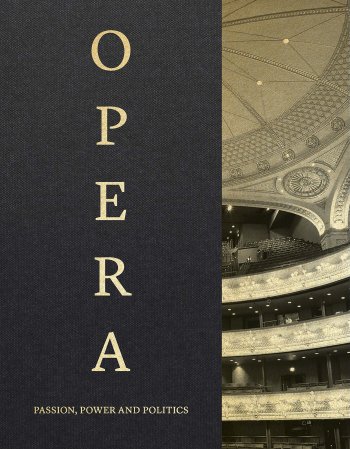
Opera: Passion, Power and Politics
Victoria and Albert Museum, London, 30 September 2017 — 25 February 2018
Curated by Kate Bailey
This autumn the Victoria and Albert Museum, in collaboration with the Royal Opera House, will create a vivid and immersive journey through nearly 400 years of opera, exploring its passion, power and politics. The only exhibition ever to explore opera on a grand scale, it will immerse visitors in some key moments of the history of European opera from its roots in Renaissance Italy to its present-day form, by focusing on seven operatic premieres in seven cities. It will reveal how opera brings together multiple art forms to create a multi-sensory work of art, and show how social, political, artistic and economic factors interact with great moments in the history of opera to tell a story of Europe over hundreds of years.
 More than 300 extraordinary objects, including important international loans, will be shown alongside digital footage of compelling opera performances. Objects on display include Salvador Dali’s costume design for Peter Brook’s 1949 production of Salome; Music in the Tuileries Gardens by Edouard Manet, a masterpiece of modernist painting contextualising Wagner’s modern approach to music in 1860s Paris; the original score of Verdi’s Nabucco from the Archivio Storico Ricordi in Milan; and one of two surviving scores from the first public opera (L’incoronazione di Poppea) will be on display. Original material from the 1934 St Petersburg premiere of Shostakovich’s avant-garde Lady Macbeth of Mtsensk will be reunited and displayed outside Russia for the first time: these include the composer’s original autograph score, along with stage directions, libretto, set models and costume designs.
World-leading opera performances will be played via headphones, dynamically changing as you explore the cities and objects, to create an evocative and fully immersive sound experience. The exhibition will include a powerful new recording of the Royal Opera Chorus singing ‘Va pensiero’ (the Chorus of the Hebrew Slaves) from Giuseppe Verdi’s Nabucco, experienced in a 360-degree sound installation.
Opera: Passion, Power and Politics will be the first exhibition staged in the V&A’s purpose-built Sainsbury Gallery, one of the largest exhibition spaces in Europe, opening beneath the new Sackler Courtyard as part of the Exhibition Road Building Project. It will be accompanied by live events and other digital initiatives from BBC Arts in collaboration with the V&A, Royal Opera House and high-profile opera companies from across the UK to convey opera to a wider audience. To coincide, BBC Music will be working with the V&A interpreting themes from the exhibition across television and radio, including a landmark BBC Two documentary series exploring many of the same operas and cities, presented by Lucy Worsley and featuring The Royal Opera’s Music Director and Music Director of the V&A exhibition, Sir Antonio Pappano. Other activity will include live outside broadcasts, recordings of live performances of all seven featured operas on BBC Radio 3, and episodes of its flagship In Tune and Music Matters programmes—broadcast live from the museum. A partnership with King’s College London, the Royal Opera House and the V&A will create a free MOOC (Massive Open Online Course) introducing the core tenets of opera.
Kate Bailey, V&A curator of the exhibition, said: “Opera: Passion, Power and Politics will be an ambitious exhibition from the V&A, the world-leader in innovative performance exhibitions. We are delighted to be working so closely with the Royal Opera House, drawing together their expertise with the V&A’s broad collections to bring the total art form of opera to life in a stunning new space.”
Kasper Holten, The Royal Opera’s outgoing Director of Opera, said: “One of the first things I did when I arrived in London in 2011 was to reach out to leaders of other important cultural organisations. But I could not have imagined then that my first meeting with Martin Roth (then director of the V&A) would have resulted in an incredible collaborative journey that now results in this marvellous and immersive exhibition being born. The exhibition will show us opera as the soundtrack to the history of Europe. We hope to show audiences—both those in love with opera already and those who are still missing out—that the art form is alive and kicking and has as much to say to the society around it today as it did 400 years ago.”
The seven cities and premieres are:
Venice — Monteverdi’s L’incoronazione di Poppea, 1642. The narrative of the exhibition will begin in Venice, a Renaissance centre of entertainment, gambling and disguise, with a sumptuous painting of composer Barbara Strozzi depicted as a courtesan. The original surviving manuscript score of Monteverdi’s L’incoronazione di Poppea—an opera exploring scandal and ambition, which premiered in Venice’s Carnival season 1642-43—represents opera’s transition from private court entertainment to the public realm.

Louis François Roubiliac, George Frideric Handel, before 1738, terracota (The Fitzwilliam Museum, University of Cambridge, M.3-1922).
London — Handel’s Rinaldo, 1711. In 1711 Handel’s Rinaldo was premiered—one of the first Italian language operas performed in London, as the city emerged as a global trade centre. A dramatic, kinetic set will re-create the premiere’s elaborate staging, which caused a sensation at the time. The fashion for castrat0 singers will be shown through paintings and rare surviving costumes. Tensions at the time between the incoming European-inspired opera and traditional theatre are highlighted in a Hogarth engraving depicting crowds attending the opera as Shakespeare’s plays are wheeled away.
Vienna — Mozart’s Le nozze di Figaro, 1786. Mozart’s comic opera Le nozze di Figaro premiered in 1786 in Vienna, a centre of the Enlightenment. Its characters were drawn from everyday life and the singers wore contemporary costume on stage. Fashionable dress as worn by Mozart’s Count and Countess Almaviva will be on display. The role of the composer will be examined through the figure of Mozart, and a piano he played on a visit to Prague will travel for the first time for the exhibition.
Milan — Verdi’s Nabucco, 1842. The growing importance of the chorus is explored through Giuseppe Verdi’s Nabucco which premiered in Milan in 1842. The opera’s ‘Chorus of the Hebrew Slaves’ (‘Va pensiero’) became an unofficial national anthem for Italy after the events of the Risorgimento led to the country’s unification.
Paris — Wagner’s Tannhäuser, 1861. In the 1860s opera enjoyed a high status in Paris, a city undergoing huge transformations. The 1861 Paris premiere of Richard Wagner’s Tannhäuser, which he had revised specially for performances in the city, polarised audiences, but Wagner’s vision for the art form proved inspirational for artists and writers.
Dresden — Strauss’s Salome, 1905. Richard Strauss’s explosive modernist opera Salome premiered in 1905 in Dresden, a progressive city in the grip of artistic expressionism, as depicted in Erich Heckel’s painting of the suburbs. The opera’s reception and the shifting perceptions of women that the story reflected will be examined. The exhibition also includes many depictions of Salome, from Aubrey Beardsley’s illustrations to a Versace costume design.
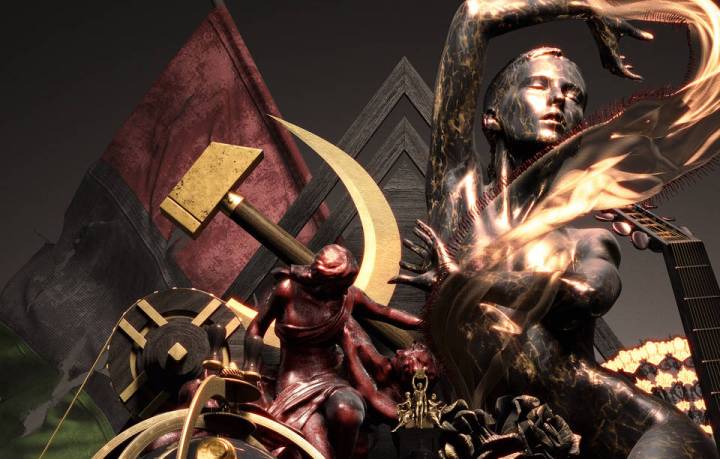
St Petersburg — Shostakovich’s Lady Macbeth of Mtsensk, 1934. The final opera explored in detail is Shostakovich’s Lady Macbeth of Mtsensk. Initially embraced by audiences at its St Petersburg premiere in 1934 as an expression of new Soviet opera, it was banned under political censorship in 1936. Shostakovich did not write another opera. Both avant-garde and propaganda material will be on display alongside a painting inspired by Shostakovich’s First Symphony by Pavel Filonov, rarely seen outside Russia.
Footage from 20th- and 21st-century premieres will create a finale showing how opera has moved from Europe across the world and continues to take on new forms. The operas include Benjamin Britten’s Peter Grimes, Philip Glass’s Einstein on the Beach, Stockhausen’s Mittwoch aus Licht, and George Benjamin’s Written on Skin.
Kate Bailey, ed., Opera: Passion, Power, Politics (London: Bloomsbury, 2017), 304 pages, ISBN: 9781851779284, $75.
Exhibition | The Princes of Rambouillet: Family Portraits
From Versailles:
The Princes of Rambouillet: Family Portraits
Château de Versailles, 15 September 2017 — 22 January 2018
 On the occasion of the reopening of the Château de Rambouillet, the Centre des Monuments Nationaux and the Palace of Versailles present the The Princes of Rambouillet: Family Portraits, on view from 15 September 2017 to 22 January 2018. Ten or so portraits from the collections of the Palace of Versailles will cast a spotlight on the Bourbon-Toulouse-Penthièvre family, who owned Rambouillet for almost all of the 18th century. The château was embellished and the estate largely extended over two generations, first by the Count of Toulouse, the legitimated son of Louis XIV and Madame de Montespan who bought the marquisate of Rambouillet from Fleuriau d’Armenonville in 1706, and then by his son, the Duke of Penthièvre, who was obliged to part with the estate in 1783 upon command by Louis XVI.
The exhibition will feature famous works such as the Portrait of the Count of Toulouse as a Sleeping Putto by Mignard and the famous Cup of Hot Chocolate by Charpentier, alongside lesser-known but just as evocative portraits like that of the Princess of Lamballe by Ducreux or the Duke of Valois in the Cradle by Lépicié, the latter being displayed for the first time since its recent purchase by the Palace of Versailles.
Raphaël Masson, Les Princes de Rambouillet: Portraits de Famille (Paris: Éditions du Patrimoine, 2017), 36 pages, ISBN : 9782757705742, 6€.










leave a comment