Exhibition | The Artist
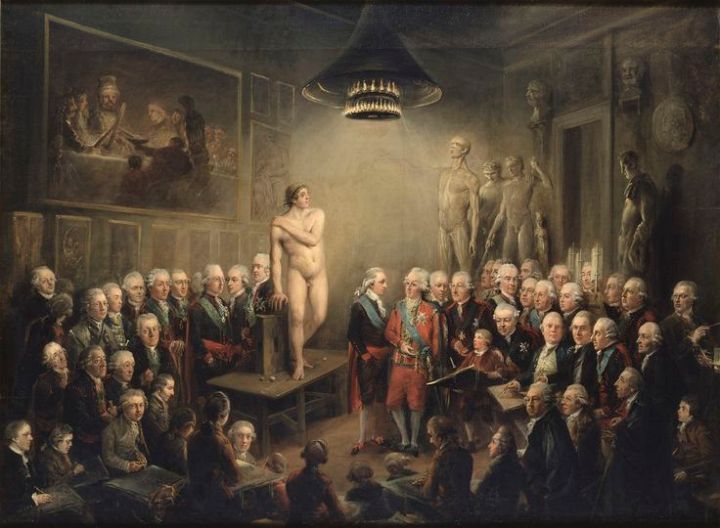
Elias Martin, King Gustav III Visits the Academy of Fine Arts in 1780, 1782, oil on canvas, 99 × 135 cm
(Stockholm: Nationalmuseum)
◊ ◊ ◊ ◊ ◊
Now on view at the Moderna Museet in Malmo:
The Artist / Konstnären
Konstakademien (Royal Academy of Fine Arts), Stockholm, 11 February — 11 September 2016
Moderna Museet, Malmö, 24 September 2016 — 19 February 2017
Throughout history, artists have played a wide variety of different roles. It’s a huge leap from the courtly painter who works on commission to the bohemian who refuses to rely on the approval of high society. This exhibition explores a number of different roles for artists, and also uncovers some of the myths that surround them.
How independent was the bohemian really? What kinds of new standards and rules have emerged within the avant-garde of modern art? And where did the idea of the free, creative, male genius come from? Women artists have often been portrayed as ‘exceptional anomalies’ in the history of art, but this exhibition shows just how numerous and how influential they have been, and how in the 1870s and 80s they shook up the preconception of the artist as a role for men.

Alexander Roslin, The Artist and His Wife Marie Suzanne Giroust Painting the Portrait of Wilhelm Peill, 1767, oil on canvas 131 × 98.5 cm (Stockholm: Nationalmuseum).
In more recent times, many artists have played the role of entrepreneur. Jeff Koons and Ernst Billgren work as modern businessmen in a commercial market economy. But the entrepreneurial artist has historical roots. Rosa Bonheur and Anders Zorn were both skilled painters as well as extremely competent when it came to building up their own personal brands, which helped them achieve great success in the international art market at the end of the nineteenth century. Entrepreneurial artists played an important role in seventeenth-century Holland as well.
During the eighteenth and nineteenth centuries, it was the values of the art academies of Europe that set the standard in the art world. Artists in these academies were trained in reproducing the classical ideals. Today the research conducted in university art schools is an example of a new form of academic work for artists.
This exhibition illuminates how artists relate to travel and to encounters with other cultures. In some cases an artist’s view of foreign cultures may be full of clichés and stereotypes. But there are also plenty of examples of artists who have worked to expose underlying power structures and standards in their encounters with other cultures.
Many artists throughout history have seen themselves as visionaries or prophets. Feminist artists such as Siri Derkert and Gittan Jönsson have worked both with criticism of contemporary society and with politically charged visions of the future. Other artists have been preoccupied with visions of a more spiritual nature, including Hilma af Klint and Vassilij Kandinskij.
This exhibition is a collaboration between Moderna Museet, the Royal Academy of Fine Arts, and the National Museum of Fine Arts. We want to show how powerful it is when we allow our collections from different eras to meet, and then complement that mix with a number of key works on loan.
Anne Dahlström, Margareta Gynning, Per Hedström, Carl-Johan Olsson, Andreas Nilsson, John Peter Nilsson, and Eva-Lena Bengtsson, Konstnären / The Artist (Stockholm: Nationalmuseum, 2016), 130 pages, ISBN: 978–9171008626, SEK149.
Exhibition | Portrait of the Artist

Press release (6 September 2016) from the Royal Collection Trust:
Portrait of the Artist
The Queen’s Gallery, Buckingham Palace, London, 4 November 2016 — 17 April 2017
The Queen’s Gallery, Palace of Holyroodhouse, Edinburgh, TBA
The first-ever exhibition of portraits of artists in the Royal Collection examines the changing image of the creative genius through more than 150 paintings, drawings, prints, photographs and decorative arts. Portrait of the Artist explores themes such as the cult of the artistic personality, the artist at work, and artists’ self-portraits.
From the 16th century, artists rose from the ranks of skilled artisans to a more elevated social status, a change in part influenced by royal patronage. The medieval tradesmen’s guilds were replaced first by workshops run by a master and subsequently by the first art academies. The lives of the most successful artists were recorded for posterity in the new literary genre of artists’ biographies. One of the most important collections of biographies from this period was Giorgio Vasari’s Delle vite de’ piu eccellenti pittori, scultori et architettori (1568), which described the lives of over 150 artists including that of the author. As artists became more prominent in society, a market developed for images of those deemed to be exceptional by virtue of their artistic talent. At the same time, artists increasingly saw self-portraiture as a way of demonstrating their skills to potential collectors and asserting their new standing in the world.
Images of artists became a valuable commodity, keenly acquired by monarchs and other influential patrons. The inventory compiled by Charles I’s Surveyor of Pictures in the late 1630s shows that three of the most important artists’ portraits owned by the monarch, including self-portraits by Daniel Mytens (c.1630) and Sir Peter Paul Rubens (1623), hung outside the King’s Withdrawing Room at Whitehall Palace. The 1666 inventory of Charles II’s collection lists 24 portraits of artists in “the Pafsage betweene ye Greene Roome and ye Clofet.” In this most intimate part of the royal apartments, accessible only to the King’s closest acquaintances and family, were Artemisia Gentileschi’s Self-portrait as the Allegory of Painting (La Pittura) (c.1638–39), Rubens’s self-portrait (1623) and portrait of his former assistant Anthony van Dyck (c.1627–28).
During the 17th century, general advancements in optics and practical developments in the production of mirrors enabled artists to be increasingly experimental and ambitious in their self-portraits. Artemisia Gentileschi used two mirrors to capture herself from an unusual angle for her powerful self-portrait as the personification of Painting, a remarkably unorthodox representation of a woman at this early date.
Artists frequently incorporated their own image into their works, as major players in historical and mythological narratives or through more subtle means. In Judith with the Head of Holofernes (1613), the painter Cristofano Allori appears as the decapitated Holofernes, his former lover Maria di Giovanni Mazzafiri is the murderous Judith, and her mother is Judith’s maidservant. Jan de Bray’s The Banquet of Cleopatra (1652) is a thinly disguised family portrait in which the artist casts his father Salomon de Bray, also a successful painter, in the role of Mark Antony.

Jean-Étienne Liotard, Self-Portrait, ca. 1753, enamel (London: Royal Collection Trust, RCIN 421436).
Through the choice of costume, gesture, props and setting, a self-portrait enabled an artist to take on a variety of roles. After visiting the Levant in 1738–43, the painter Jean-Étienne Liotard adopted a style of clothing for which he was to become known as ‘Le Peintre Turc’. His unconventional appearance—the Moldavian fur headdress and long beard seen in his self-portrait miniature of 1753—was thought by some to have contributed to his commercial success.
For young artists without the funds to pay a professional model, self-portraiture was a convenient way to practice their drawing skills. Annibale and Agostino Carracci’s self-portraits of c.1575–80 were probably produced by the teenage artists to hone their talents in this way. Some self-portraits appear to have been produced solely for the purpose of self-scrutiny. In a chalk drawing, possibly executed at the age of 80 in the final year of his life, Gianlorenzo Bernini records his hooded eyes and sunken cheeks with unflinching honesty.
The relationship between contemporaries in the art world is explored in the exhibition through representations of artists by their friends, admirers and pupils. Francesco Melzi’s chalk drawing of the aged Leonardo da Vinci (c.1515) is thought to be the most reliable surviving likeness of his teacher. Rubens’s portrait of his former assistant and lifelong friend Van Dyck shows the artist in three-quarter profile, his gaze averted to make him appear reflective, in contrast to the confident figure presented in Van Dyck’s self-portraits. The friendship between the engraver Francesco Bartolozzi and the painter Giovanni Battista Cipriani, Italian artists working in London, is recorded in charming pencil sketches that the pair made of each other in 1770—one painting, the other dozing in a chair.
In the 19th century, romanticised episodes from the lives of famous artists from the past were popular subject-matter. Johann Michael Wittmer’s Raphael’s First Sketch of the ‘Madonna della Sedia’ (c.1853) depicts the fable of how the Renaissance master came to create one of his best-known works on the base of a wine barrel. Frederick Leighton’s monumental work Cimabue’s Madonna Carried in Procession (1855) encapsulates the Victorian artist’s belief that, during the Renaissance, great art was appreciated at all levels of society and artists were held in high esteem, their genius widely acknowledged.
◊ ◊ ◊ ◊ ◊
In the US and Canada, the catalogue is distributed by The University of Chicago Press:
Anna Reynolds, Lucy Peter, and Martin Clayton, Portrait of the Artist (London: Royal Collection Trust, 2016), 240 pages, ISBN: 978-1909741324, $48.
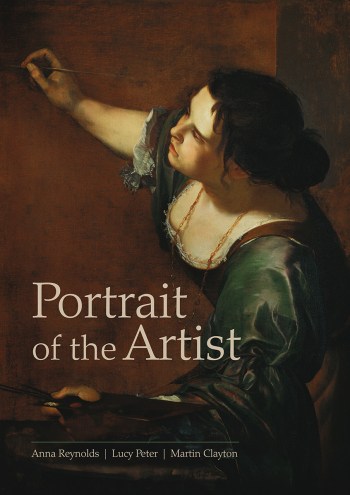 Dürer’s Self-Portrait at Age Twenty-Eight. Hockney’s Self-Portrait with Cigarette. Melzi’s drawing of Leonardo da Vinci, widely regarded as the most reliable surviving likeness of this most famous Old Master. Throughout history, many of the world’s most renowned artists have made portraits to represent themselves and others.
The first book to focus on images of artists from within the Royal Collection, Portrait of the Artist brings together paintings, drawings, prints, and photographs by artists from across the centuries, including works by Rembrandt van Rijn, Peter Paul Rubens, David Hockney, and Lucian Freud. While some of the portraits included in this book were created to showcase the artist’s talent, others were motivated by more personal reasons, to preserve the images of cherished friends. Anna Reynolds, Lucy Peter, and Martin Clayton explore the miscellany of themes running throughout the discipline of portraiture, from the rich symbolism found in images of the artist’s studio to the transformation of styles with which artists depicted themselves, changing their portrayals to align with their changing status. They also explore the relationships between artists and patrons, including the important role of the monarchy in commissioning and collecting portraits of artists.
Exhibition | The Culture of Wine: Masters of Printmaking

Jan Popels, after Peter Paul Rubens, The Triumph of Bacchus, etching.
◊ ◊ ◊ ◊ ◊
Now on view at the Bilbao Fine Arts Museum:
Ardoaren Kultura / La Cultura del vino
The Culture of Wine: Masters of Printmaking from the Vivanco Collection
Bilboko Arte Ederren Museoa / Museo de Bellas Artes de Bilbao, 8 November 2016 — 6 February 2017
The Bilbao Fine Arts Museum is joining forces with the 5th edition of the International Festival of Printmaking and Art on Paper (FIG Bilbao), presenting a selection of prints from the collection of the Fundación Vivanco [cultural arm of the Vivanco family winery] based on the theme of the world of wine. The Culture of Wine: Masters of Printmaking from the Vivanco Collection brings together 76 works from the 15th century to the present day by artists of the stature of Andrea Mantegna, Albrecht Dürer, Hendrick Goltzius, Giulio Bonasone, José de Ribera, Lucas van Leyden, Pablo Picasso, Joán Miró, Marc Chagall, Roy Lichtenstein, Antoni Tàpies, Andy Warhol, Paula Rego, Antonio Saura, Eduardo Chillida, Manolo Valdés, Eduardo Arroyo and Miquel Barceló, among others: all classic masters whose works are part of the holdings not normally on display at the Museo Vivanco de la Cultura del Vino. The exhibition is organised as a comprehensive survey of the evolution of the print from the perspective of the culture of wine as perceived by each of the selected artists. As such, it constitutes a reflection on the importance of wine within the history of humanity and on a recurring iconographic motif in works of art of all periods.
The International Festival of Printmaking and Art on Paper (FIG Bilbao) has been working with the Bilbao Fine Arts Museum since 2012, programming an exhibition in its galleries to coincide with the fair. Over the past four years the public has been able to see Giovanni Battista Piranesi: Visionary Memory (2012), Deciphering Sardinia: The Engraved Symbol (2013), Mimmo Paladino: Prints (2014), and The Long Shadow of the Burin: Lucas van Leyden in the Mariano Moret Collection (2015). This year The Culture of Wine: Masters of Printmaking from the Vivanco Collection is part of the 5th edition. The FIG’s art fair will be taking place from 17 to 20 November in the Palacio Euskalduna.
The exhibition is structured into two clearly differentiated sections. The first focuses on historical prints and is sub-divided into three parts: mythology, scenes of everyday life and customs, and Christianity. The second, which centres on the modern print, is a more varied section determined by the artistic personality of each of the artists represented.
Mythology
The presence of wine in classical mythology is exemplified in the figure of Bacchus, Roman god of excess, madness, theatre and wine, whose Greek counterpart was Dionysus. With his colourful story, Bacchus was a notably ambiguous figure who could arouse passions but was simultaneously ingenuous. This dual nature brought his emotions close to those of human beings, for which reason he has attracted numerous artists over the course of the centuries. Subject since birth to the wrath of the goddess Hera, he was a homeless god who travelled around Egypt, Syria and India, from where he returned triumphant, giving rise to the splendid iconography known as ‘The Triumph of Bacchus’, which inspired various prints in this collection. These works depict the elements characteristic of the god’s retinue: fauns, maenads, panthers, Bacchus’s companion Silenus (almost always shown drunk), myrtle, vine tendrils, and the recurring presence of music and dance.
As a result, a number of printmakers, including Andrea Mantegna (1430/1431–1506), Giulio di Antonio Bonasone (1510–1576), Johannes Sadeler (1550–1600), Annibale Carracci (1560–1609), Jan Saenredam (1565–1607), Jacob Matham (1571–1631), Theodor Galle (1571–1633), José de Ribera (1591–1652), Johannes Popels (ca. 1600–1663), Pierre Lombart (1612/1613–1681), Gerard de Lairesse (1641–1711), Bernard Picart (1673–1733), Francesco Bartolozzi (1727–1815), Nicolas de Launay (1739–1792), Francesco Piranesi (ca. 1785–1810), and Johann Adam Klein (1794–1875), depicted episodes from the life of the god of wine.
Bacchus thus appears in the series of twelve prints by Jacob Matham, notable for their technical virtuosity despite the small scale of the compositions, or the splendid print by José de Ribera based on one of his own paintings of 1626 in which Silenus yields to excess and inebriation in a setting in which the narrative details set this story in a human context. The same worldly air is evident in the engraving by Annibale Carracci, which reproduces his design for the background of a silver goblet made for Cardinal Odoardo Farnese. Among works relating to classical antiquity is the print by Andrea Mantegna inspired by Bacchic sarcophagi and by the celebrated Apollo Belvedere. The same classical source is also evident in three engravings by Jan Saenredam after drawings by Hendrick Goltzius—an erudite allegory on the pleasures of the table and love, which would re-emerge with force during the Renaissance and Baroque periods as a metaphor of fertility and prosperity.
Scenes of Everyday Life and Customs
This group includes scenes of taverns, banquets, and figures drinking, in addition to images of labours associated with the cultivation of vines and with winemaking and its related trades, such as barrel-making, as seen in the print by Johannes van Vliet (ca.1610—?). Also notable is the engraving by William Hogarth (1697—1764), a moralistic work in a satirical mode typical of this artist.
Christianity
In the classical world wine was one of the most appreciated products in the Mediterranean region, seen as a civilising element and above all associated with a spiritual dimension through the myths and rituals of numerous societies. The symbolic value of wine and the vine and wine’s intoxicating effect encouraged encounters between man and the sacred realm of a universal type. The colour of wine, easily identifiable with that of blood, was a symbol shared by different beliefs which related it to the mortal and divine realms, from ancient libations to Christian Transubstantiation in which it was transformed into the blood of Christ.
Artists thus depicted numerous biblical episodes using grapes and wine as the principal symbolic element in the narrative. This is the case with Lot and his Daughters, brilliantly depicted in prints by Lucas van Ledyen, Jan Saenredam, and Johann Gotthard von Müller; The Supper at Emmaus by Albrecht Dürer; and Noah’s Vineyards by Francesco Bartolozzi.
Modern Prints
The modern section of works from the Vivanco Collection presents the world of wine through the multiplicity of styles of the principal artistic movements of the 20th century and their offshoots. This section opens with works from the 1920s, notably the unique narrative style of Marc Chagall (1887—1985) and a Cubist still-life by Juan Gris (1887—1927). In the 1930s Pablo Picasso (1881—1973) focused with particular interest on mythology, evident in images such as the Minotauromachie and in the print series entitled The Metamorphoses of Ovid and the Suite Vollard. In works from the Vivanco Collection from the 1950s and 1960s the Bacchic universe is also a recurring theme as an expression of human passions. Represented here by an etching from the 1960s and another from the 1970s, Joan Miró (1893—1983) expressed his work in a graphic style that reveals the influence of Japanese art at this period.
The mid-20th-century Spanish avant-garde, represented by the El Paso and Dau al Set groups, is present in the exhibition with unique works by Antoni Tàpies (1923—2012) and Antonio Saura (1930—1998). The Basque sculptor Eduardo Chillida (1924—2002) is present with a print that reflects his style of compact forms and ‘imprecise geometry’. Its title Zapatu (‘to press’) subtly relates it to the overall theme of this exhibition.
Roy Lichtenstein (1923—1997) and Andy Warhol (1928—1987), both represented in the exhibition, were two of the leading exponents of American Pop Art of the late 1950s and early 1960s. Their influence and a reinterpretation of their artistic principles is to be found in the work of Spanish artists such as Eduardo Arroyo (b. 1937), with his subtly ironic figuration, and Manolo Valdés (b. 1942), who offers his particular vision of the Cubist still-life.
Finally, this section includes some strikingly unique works such as the mezzotints by Yozo Hamaguchi (1909—2000) and the lithographs by Paula Rego (b. 1935) and Miquel Barceló (b. 1957).
Exhibition | Reuniting the Masters: European Drawings

François Boucher, The Birth of Venus, n.d., black and white chalks and charcoal on beige laid paper, 32.6 × 44.9 cm
(Sacramento: Crocker Art Museum).
◊ ◊ ◊ ◊ ◊
Press release for the exhibition now on view at the Crocker:
Reuniting the Masters: European Drawings from West Coast Collections
Crocker Art Museum, Sacramento, 13 November 2016 — 5 February 2017
Reuniting the Masters: European Drawings from West Coast Collections brings together related European drawings, separated over centuries and continents, that are now in the possession of the West Coast’s great art collections. By coincidence or by design, drawings by the same artist, for the same project, and even from the same sketchbook, have made their way separately into galleries and museums on the West Coast. Bringing these long-estranged drawings together again illuminates the work and process of specific artists in the rich history of European draftsmanship and brings forward the history of drawings collectors and scholars in the West.
“Through the generosity of our fellow West Coast institutions, we are delighted to unite these drawings, some separated for centuries, in our galleries,” said Crocker curator William Breazeale. “They illuminate not only artists’ working process but also a chapter in American patronage and scholarship that should be better known. West Coasters from E.B. Crocker to Vincent Price and Cary Grant have fallen under the spell of master drawings, and distinguished curators here have furthered their study.”
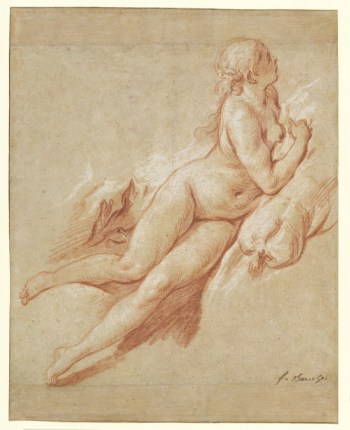
François Boucher, Study of a Reclining Nude. 1732–35, red and white chalk on beige laid paper, 32.5 × 24.6 cm (Los Angeles: The J. Paul Getty Museum, 84.GB.21).
Some works, such as François Boucher’s Study of a Reclining Nude at the J. Paul Getty Museum in Los Angeles and his Birth of Venus at the Crocker Art Museum, relate to the same project, though one made its way to California a century later than the other. Pieter Quast’s A Man in Oriental Dress at the Iris and B. Gerald Cantor Arts Center for Visual Arts at Stanford University and A Skater at the Achenbach Foundation for Graphic Arts in San Francisco, come from the same sketchbook, where they originally appeared just pages apart. Others, such as Adolph Menzel’s Artist’s Model in Eighteenth-Century Costume at the Cantor Center and Study for a Tree at the Fine Arts Museums of San Francisco illustrate contrasting aspects of the same artist’s work.
Reuniting the Masters is presented in four sections representing the major European schools, showcasing the development of draftsmanship across the continent in a series of comparative pairs. Many of the most appealing artists from the 16th through 19th centuries are highlighted, including Italy’s Fra Bartolommeo and Guercino, the Low Countries’ Adriaen Frans Boudewijns and Anthonie van Waterloo, Germany’s Friedrich Heinrich Füger and Adrian Zingg, and France’s Jean-Baptiste Oudry and Charles-Nicolas Cochin the Younger. Among the objects are newly acquired and newly attributed drawings, representing the continuing work of patrons and scholars in the West.
Consisting of 52 drawings, Reuniting the Masters is accompanied by an 150-page, full-color catalogue authored by Breazeale; Cara Denison, curator emerita at the Morgan Library and Museum in New York City; and Victoria Sancho Lobis, Prince Trust curator of prints and drawings at the Art Institute of Chicago.
British Miniatures on View at Compton Verney
As noted at Art Daily (15 November 2016). . .
The Dumas Collection of British Portrait Miniatures
Compton Verney Art Gallery and Park, Warwickshire
Over forty miniature paintings, not previously seen in public, have now gone on show at Compton Verney Art Gallery and Park in Warwickshire. The works are part one of the most important collections of this art form held anywhere in the world. The collection consists of 842 works in total and has been generously loaned on a permanent basis by Simon Dumas following the death of his father in 2013.
Simon Dumas said: “We wanted Dad’s exceptionally broad and, in the context of miniatures, important collection to be in the Midlands and not in London, Cambridge, or Oxford—since the Victoria and Albert Museum and National Portrait Gallery, the Fitzwilliam and the Ashmolean already have such wonderfully rich resources to display. We approached Compton Verney because they already have a fine collection of English portraits, which we thought Dad’s mainly English collection would complement well.”
Upon his retirement from a successful career in the City, Dumas’s firm, ED&F Man Capital Markets, gave him and his wife a round-the-world trip as a leaving present. It was on a wet day in Canada that the couple visited an art gallery that happened to be staging an exhibition of miniatures.
“They captivated Dad, who at the time was vaguely looking around for an indoor hobby for his retirement. He asked a curator where these little paintings were from, only to learn that they were from his own country, England. He started collecting almost immediately on their return from their trip in 1975, with the objective—impossible to achieve, but still a reference point—of acquiring an example, signed if possible, by every artist who ever worked in the British Isles,” Simon explained.
With his enthusiasm fired, Dumas developed and added to his collection over the next thirty years.
The advent of photography and its ability to capture people’s likenesses relatively cheaply and led to the rapid decline of the portrait miniature from about 1850 onwards. Miniatures were often carried around or worn as a necklace or brooch but, because of the skill required to create them, were expensive to commission. Deeply personal and available only to the wealthier echelons of society, miniatures were rarely seen by the greater public; consequently, miniature painting is not a well-known aspect of art—albeit that it flourished for some three centuries.
Steven Parissien, Director of Compton Verney, believes the Dumas loan makes a significant contribution to our understanding of the British tradition of miniature portraits: “We are delighted that this world-class collection of outstanding British portrait miniatures has finally come back to England from Scotland, allowing us to share in the hidden delights of this most intimate and touching form of portraiture—as well as to learn much about their Stuart and Georgian sitters.”
Highlights include Lucas Horenbout’s Unknown Lady, painted ca. 1543. Sir Roy Strong has suggested that the sitter was King Henry VIII’s sixth and last wife, Queen Catherine (Parr). Horenbout worked for Henry VIII from 1525 and is said to have taught Holbein how to paint miniatures—thus introducing this skill into Britain. Catherine herself died aged 36, five years after this portrait was painted, giving birth to a child by her fourth husband.
The celebrated Elizabethan and Jacobean painter Nicholas Hilliard is also represented, with Unknown Gentleman (1589). Hilliard made portrait miniatures popular in Britain, largely due to the patronage of Queen Elizabeth I herself. Having helped create fashionable images of the Virgin Queen and her court—one of whose members may be depicted here—Hilliard became the royal miniaturist (‘court limner’) to her successor, James I.
Also of note are the works of six female artists, including the exceptional Sarah Biffin (1784–1850). Born without hands, arms, or feet, Sarah taught herself to paint and write by using her mouth. Apprenticed by her family to a man who exhibited her round the country as a sideshow freak, she simultaneously taught herself how to paint miniatures. She was rescued by the Earl of Morton, who sponsored formal painting lessons for her at the Royal Academy, and she built up a large practice painting miniatures as a result of Queen Victoria’s patronage.
Having just visited the national gallery in Warwickshire to see the first selection from the collection on display, Simon Dumas says he is very pleased that his father’s collection has found the ideal place for members of the public to enjoy them: “I hope the miniatures stay for many years in the beautiful surroundings of Compton Verney, where they are displayed so very well in the newly-made cabinet alongside the British paintings of the permanent collection. The display is far better than those in some of the London galleries in my opinion!”
The Dumas Loan can be seen in the British Portraits gallery at Compton Verney, along with remarkable collections such as the nationally-designated Chinese Bronzes and Britain’s best collection of British Folk Art.
Exhibition | Meta-painting: A Journey to the Idea of Art
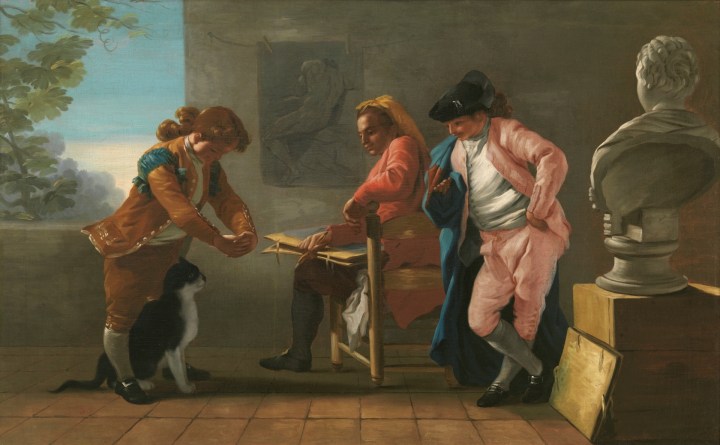
José del Castillo, The Study of Drawing, 1780, oil on canvas, 105 × 160 cm
(Madrid: Prado).
◊ ◊ ◊ ◊ ◊
Now on view at the Prado:
Meta-painting: A Journey to the Idea of Art / Metapintura: Un viaje a la idea del arte
Museo Nacional del Prado, Madrid, 15 November 2016 — 19 February 2017
Curated by Javier Portús
With Meta-painting, the Museo del Prado is offering a new approach to its collection in the latest in a series of exhibitions that began in 2010 with Rubens and continued with Captive Beauty (2013) and Goya in Madrid (2014). This series has aimed to offer visitors the chance to reflect on the Museum’s own collections and to look at its works in a new context which encourages different interpretations. Meta-painting proposes a journey that begins with mythological and religious narratives on the origins of artistic activity at the dawn of the modern age and concludes in 1819, the year of the Prado’s foundation. The exhibition thus also celebrates the 197th anniversary of the Museum’s founding as a temple of the arts, signifying their full acceptance as disciplines of social utility.
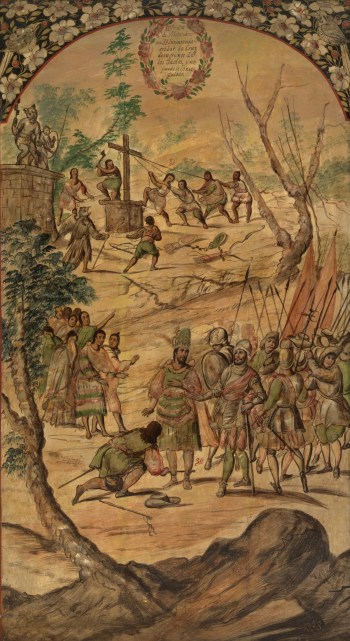
Juan González / Miguel González, Conquista de México por Hernán Cortés (30 y 31), 1698. Enconchado, Óleo sobre lienzo sobre tabla, 97 × 53 cm.
Two aspects central to the Prado—the Spanish royal collections and Spanish art—provide the context for the exhibition’s structure. Furthermore, these are two inseparable terms, given that the evolution of Spanish art was determined by the existence of the royal collections. The survey offered by the exhibition is a wide-ranging and varied one, including paintings, drawings, prints, books, medals, examples of the decorative arts and sculptures. Twenty-two of these works have been loaned by eighteen museums and collections, including the Fundación Casa de Alba, the National Gallery in London, the Museo de Bellas Artes in Seville, the Banco de España, and the Museo de la Real Academia de Bellas Arts de San Fernando in Madrid.
All the 137 works in the exhibition refer to art or to images, either as self-portraits of creators such as Titian, Murillo, Bernini and Goya; or because they include other paintings and sculptures, such as Saint Benedict destroying Idols by Ricci and Arachne by Rubens; or because they analyse issues relating to the definition of art and its history, such as José García Hidalgo’s book Principles for studying the very noble and royal art of painting […] and Goya’s Portrait of Jovellanos.
The exhibition’s ‘journey’ is divided into different phases. Fifteen sections focus on the relationship between art, the artist and society, each one of which looks at a specific issue, among them: the powers attributed to religious images; the role played by the ‘painting within the painting’; artists’ attempts to break through the pictorial space and continue it towards the viewer; the origins and practice of the idea of artistic tradition; portraits and self-portraits of artists; places for the creation and collecting of art; the origin of the modern concept of art history; the subjectivity that emerged in self-portraits from the Enlightenment onwards; and the importance of the concepts of love, death and fame in the modern artistic discourse.
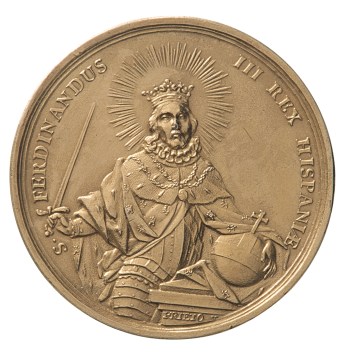
Francisco Tomás Prieto, Segundo premio de primera clase de la Academia de San Fernando, 1753, Silver-gilt, 44,5 mm diameter (Madrid: Prado)
The exhibition also represents a tribute by the Museo del Prado to Cervantes on the 400th anniversary of his death as it includes a section on Don Quixote as one of the great examples of self-referential literature, juxtaposed with Las Meninas. Thus, just as Cervantes’ text is a ‘novel within a novel’ so Velázquez’s painting is a ‘painting on painting’ in which the artist not only depicts himself painting but which involves various important issues regarding the potential of the art of painting and the role of the painter.
Las Meninas will remain in Room 12 of the Villanueva Building where it is habitually displayed but it is present in the exhibition through a modern facsimile of part of Laurent’s graphoscope which is displayed alongside editions of the two parts of Don Quixote, reminding visitors that these two masterpieces of the Spanish Golden Age are both reference points in the history of meta-fiction.
Javier Portús, Metapintura: Un viaje a la idea del arte (Madrid: Museo Nacional del Prado, 2016), 304 pages, ISBN: 978-8484803270.
Exhibition | Bitter Sweet: Coffee, Tea, and Chocolate
Overlapping, at least partially, with The Edible Monument, this DIA exhibition explores luxury drinks:
Bitter|Sweet: Coffee, Tea, and Chocolate
Detroit Institute of Arts, 20 November 2016 — 5 March 2017
Curated by Yao-Fen You
The Detroit Institute of Arts presents Bitter|Sweet: Coffee, Tea & Chocolate, on view from November 20, 2016 to March 5, 2017. The introduction of coffee, tea, and chocolate to Europe, beginning in the late 16th century, profoundly changed drinking habits, tastes, and social customs, and spurred an insatiable demand for specialized vessels such as tea canisters, coffee cups, sugar bowls, and chocolate pots. The exhibition is organized by the Detroit Institute of Arts with support from the National Endowment for the Arts.

Pineapple Coffeepot, ca. 1750, creamware with colored glazes, Staffordshire, England (Detroit Institute of Arts).
The 68 works of art in Bitter|Sweet are mostly from the museum’s comprehensive holdings in pre-1850 European silver and ceramics. Highlights include three exquisitely decorated beverage services: a rare 24-piece set made by Germany’s Fürstenberg Porcelain Manufactory; a set once owned by Prince Louis, Duke of Nemours that illustrates the refinement of early 19th-century French Sèvres porcelain; and a Vienna Porcelain ensemble for two associated with Archduke Joseph of Austria. DIA paintings, prints, and sculpture related to the arrival and impact of the beverages in Europe help create new contexts and connections for objects from the permanent collection.
Other key works include Madame de Pompadour’s coffee grinder from the Musée du Louvre; a 1684 handwritten Spanish manuscript satirizing the vogue for chocolate from the Hispanic Society, New York; and an 18th-century German breakfast set containing chocolate beakers from the Clark Art Institute, Williamstown, Massachusetts. Diego Velázquez’s painting Infanta Maria Theresa from the Museum of Fine Arts Boston helps tell the story of the cocoa bean’s migration from the New World to the French royal court of Louis XIV via Spain.
Bitter|Sweet will be the first DIA exhibition to engage all five senses. In addition to the artworks, there will be videos about the preparation of coffee, tea, and chocolate as well as opportunities to touch, to hear, to smell, and even to taste. Such interactive components demonstrate the DIA’s commitment to engaging visitors in meaningful experiences with art.
“The exhibition is a very exciting venture for the DIA, with regards to the rich, complex story we’re telling and the innovative visitor-centered ways in which we are presenting it,” said Salvador Salort-Pons, DIA director. “While European art will be at center stage, the exhibition examines global interconnections from centuries ago that we hope will resonate with all visitors today. Just about everyone—regardless of culture or background—has a personal relationship with one or more of these beverages. I’m also excited about the ways the exhibition engages the permanent collection. Of course, I love that several of the loans in Bittersweet comment on Spain’s relationship to chocolate.”
Bitter|Sweet also touches on the human cost of procuring the raw materials to produce coffee, tea, and chocolate as well as the sugar used to alter the beverages’ bitter taste. Coffee was imported from Africa through the Middle East, tea from Asia, chocolate from the Americas, and sugar harvested by slaves on colonial plantations. To meet demand and keep prices down for the European market, merchants—such as the Dutch East India Company and the British East India Company—eventually found ways to cultivate tea and coffee bushes on foreign lands colonized under their rule.
◊ ◊ ◊ ◊ ◊
From Yale UP:
Yao-Fen You, with essays by Mimi Hellman and Hope Saska, Coffee, Tea, and Chocolate: Consuming the World (New Haven: Yale University Press, 2016), 142 pages, ISBN: 978-0300222500, $25.
 Coffee, tea, and chocolate were all the rage in Enlightenment Europe. These fashionable beverages profoundly shaped modes of sociability and patterns of consumption, yet none of the plants required for their preparation was native to the continent: coffee was imported from the Levant, tea from Asia, and chocolate from Mesoamerica. Their introduction to 17th-century Europe revolutionized drinking habits and social customs. It also spurred an insatiable demand for specialized vessels such as hot beverage services and tea canisters, coffee cups, and chocolate pots.
This beautiful book demonstrates how the paraphernalia associated with coffee, tea, and chocolate can eloquently evoke the culture of these new beverages and the material pleasures that surrounded them. Contributors address such topics as the politics of coffee consumption in 18th-century Germany; 18th-century visual satires on the European consumption of tea, coffee, and chocolate; and the design history of coffee pots in the United States between the colonial period and the present.
Yao-Fen You is associate curator of European sculpture and decorative arts at the Detroit Institute of Arts.
Exhibition | John Trumbull: Visualizing American Independence

Press release (1 November 2016) from the Wadsworth Atheneum:
John Trumbull: Visualizing American Independence
Wadsworth Atheneum Museum of Art, Hartford, 5 November 2016 — July 2017
Three historic scenes by America’s first history painter, John Trumbull, are central to a new installation at the Wadsworth Atheneum Museum of Art that explores the visual interpretation of the Revolutionary War (1775–83). John Trumbull: Visualizing American Independence features more than 30 objects taken from the museum’s permanent collection, including additional work by Trumbull, as well as works by modern artists who revisited the legacy of the war in the twentieth century in observance of major anniversaries such as the bicentennial of George Washington’s birth in 1932 and the nation’s bicentennial in 1976. The installation opens November 5, 2016 and is on view through July 2017.
John Trumbull (1756–1843) served in the Continental Army during the Revolutionary War and later created a series of eight paintings devoted to the subject, explaining once to Thomas Jefferson that he hoped the paintings would “diffuse the knowledge and preserve the memory of the noblest series of actions which have ever dignified the history of man.” After completing a second edition to adorn the rotunda of the United States Capitol in Washington, D.C., Trumbull began a third and final series in 1831. Due to his failing health, Trumbull was able to complete only five of the paintings, all of which were purchased by the trustees of the Wadsworth Atheneum. Trumbull’s Revolutionary War scenes were some of the museum’s inaugural objects and were displayed when the first gallery opened in 1844. Three of those paintings—The Death of General Montgomery in the Attack on Quebec, December 31, 1775; The Declaration of Independence, July 4, 1776; and The Capture of the Hessians at Trenton, December 26, 1776—are included in the installation. The Death of General Warren at the Battle of Bunker’s Hill, June 17, 1775 is on view in the museum’s Morgan Great Hall, and The Death of General Mercer at the Battle of Princeton, January 3, 1777 is scheduled for loan to a peer institution.
Trumbull’s role as artist-historian encouraged later generations of artists to address the American Revolution, securing the legacy of its heroes. “Trumbull set the stage for later generations of artists to reinterpret the Revolutionary War and enhance the iconography of American independence,” says Erin Monroe, the Robert H. Schutz, Jr., Associate Curator of American Paintings and Sculpture.
One of the most frequently portrayed subjects from this period is George Washington, whose image—especially after his death—became so symbolic that memorial portraits elevated him to a divine figure. Many portraits were made into engravings and mass-produced, providing artists with easy accessibility to Washington’s likeness for transfer onto textiles, decorative arts, jewelry, postage stamps, currency, and other objects. John Trumbull: Visualizing American Independence features a range of such renditions, including several nineteenth-century ceramic jugs decorated with Washington’s image and a 1975 color lithograph by Alex Katz, titled Young Washington, from the Kent Bicentennial Portfolio, Spirit of Independence.
Exhibition | Fashionable Likeness: Pastel Portraits in Britain
Press release (21 October 2016) from The Getty:
Fashionable Likeness: Pastel Portraits in 18th-Century Britain
Getty Center, Los Angeles, 1 November 2016 — 7 May 2017
Curated by Julian Brooks and Ketty Gottardo with assistance from Alessandra Nardi
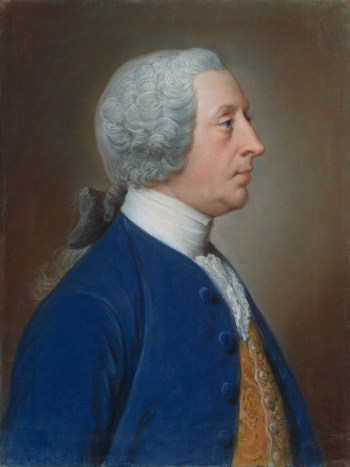
William Hoare, Portrait of Henry Hoare, ‘The Magnificent’, of Stourhead, ca. 1750–60, pastel on paper. Unframed: 61 × 45.7 cm (Los Angeles: The J. Paul Getty Museum, 2013.47.1).
In eighteenth-century Britain, portraits were commissioned by an increasingly wide cross-section of society, including the newly rich, as a visible symbol of their wealth and cultural aspirations. Fashionable Likeness: Pastel Portraits in 18th–Century Britain explores the topic of portrait drawing through a number of works in the Getty Museum’s permanent collection and select loans.
“Eager to affirm their elevated social status, sitters in 18th-century Europe were frequently portrayed in the latest fashion, wearing opulent outfits topped with powdered wigs and elaborate hairstyles,” explains Timothy Potts, director of the J. Paul Getty Museum. “With its unique texture and luminosity, pastel was the perfect medium to capture the sitters’ evanescent expressions and the symbols of their stature—the richness of their silk dresses and velvet coats. As well as its rich artistry, this exhibition also provides an insight into the carefully calibrated social structure of the day.”
“For artists and sitters, pastel painting offered practical advantages over oil, as it required fewer sittings and did not need to dry between sessions,” says Julian Brooks, co-curator of the installation. “In addition, ready-made pastel sticks were easily portable and cost less than oils.”
The first artist to become internationally renowned for pastel portraits was the Venetian artist Rosalba Carriera, whose work was much sought after by collectors across Europe. Praised for her talent at capturing a vivid likeness, Carriera employed a subtle technique of smoothing and blending hues that influenced a generation of British pastelists. Among those was John Russell, who trained with Francis Cotes and later authored Elements of Painting with Crayons (1772), one of the earliest English treatises on the pastel technique.
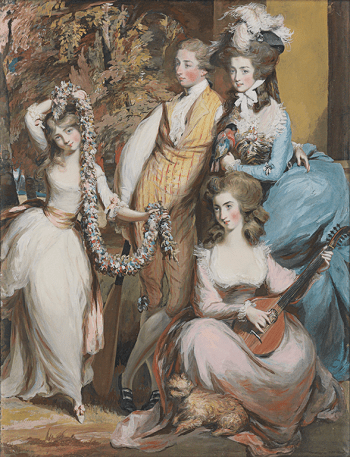
Daniel Gardner, Portrait of Mary Sturt of Crichel and Her Three Eldest Children, ca. 1777, pencil, pastel, and opaque watercolor on paper (Private collection).
In a sumptuous and vibrant family portrait by Daniel Gardner, Portrait of Mary Sturt of Crichel and Her Three Eldest Children (about 1777), Gardner perfectly illustrates English high society’s taste for fashionable costumes. Mary Sturt’s son, Humphry, wears a ruffled necktie and double-breasted striped waistcoat with large pointed lapels. His matching pair of breeches fastened at the knee feature a stylish rosette instead of the usual buckle, details only made possible with the use of pastels. “This portrait is a magnificent example of Gardner’s very original technique,” says Ketty Gottardo, co-curator of the installation. “Unusual for a pastelist, he mixed pastel powder with alcohol and applied it with a brush to paint faster, only rendering the faces in dry pastel.”
Fashionable Likeness: Pastel Portraits in 18th–Century Britain is curated by Julian Brooks, senior curator of drawings at the J. Paul Getty Museum, and Ketty Gottardo, former associate curator of drawings at the J. Paul Getty Museum now at The Courtauld Gallery in London. They were assisted by former graduate intern Alessandra Nardi.
Exhibition | On Time
Now on view at The Grolier Club:
On Time: The Quest for Precision
Linda Hall Library of Science, Engineering, and Technology, Kansas City, 2012
The Grolier Club, New York, 14 September — 19 November 2016
Curated by Bruce Bradley
From sundials to atomic clocks, the exhibition On Time: The Quest for Precision explores the history of precise timekeeping through rare books that taught readers techniques of timekeeping, announced new inventions, and provided instructions on the construction and use of timekeeping instruments. On view at The Grolier Club from September 14 through November 19, 2016, the works are drawn from the comprehensive collections of the Linda Hall Library of Science, Engineering, and Technology, Kansas City, Missouri.
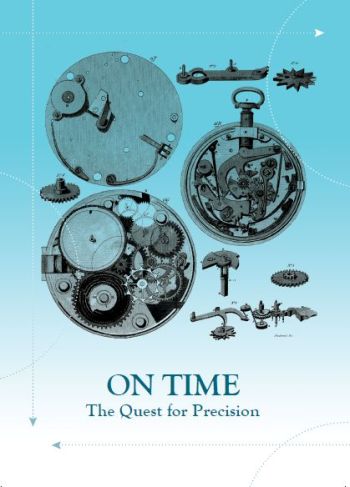 Curator Bruce Bradley tells a timely story with 86 illustrated books dating from the fifteenth century to the present that graphically and artistically depict the sweep of timekeeping. “These books are fascinating and ornate, as well as informative about the innovations that have led to increasingly precise timekeeping devices,” notes Mr. Bradley. As a complement to the printed books, the exhibition includes a small selection of historical clocks and timepieces from the collection of Grolier Club member Fortunat Mueller-Maerki.
The early books describe techniques for timekeeping with fantastic illustrations of sundials and water clocks. The sunflower clock described and illustrated by Athanasius Kircher in his book, Magnes siue De arte magnetica opus tripartitum (Rome, 1641) shows a detailed, full-page engraving of the sunflower clock floating on a piece of cork with its roots in the water. Vegetable magnetism supposedly caused the flower to follow the sun, so that a pointer fixed in the center would indicate the hour on a clock dial. A book that featured more traditional types of sundials is Sebastian Münster’s Horologiographia (Basel, 1533). This comprehensive treatise was first issued as Compositio horologiorum in 1531, but it was popular enough to warrant this second enlarged edition just two years later. Both editions illustrate all manner and variety of sundials with beautiful woodcuts, some of which are attributed to Hans Holbein the Younger.
Early mechanical clocks offered several advantages over sundials, such as portability and the ability to show the time during cloudy weather and at night. They lacked precision, however, and had to be readjusted periodically to synchronize them with local solar time. Even after the appearance of mechanical clocks, books about sundials and how to make them remained popular. Demand for them continued throughout the sixteenth century and into the seventeenth.
A book that described and illustrated some of the best astronomical instruments of the sixteenth century is Tycho Brahe’s Astronomiae instauratae mechanica (Nuremberg, 1602). Of the four clocks in his observatory, two of the smaller clocks are shown in the plate of the famous mural quadrant that Brahe used for making observations of star positions. Brahe explained that he used two clocks to reduce errors in recording the exact moment of observation.
The sixteenth century also saw the first printed depictions of mechanical clocks, published in books by the Italian natural philosopher Girolamo Cardano. The innovation that made mechanical clocks possible, the escapement mechanism, was first illustrated in a seventeenth-century book by Robert Fludd. An English clergyman, William Derham, produced the first practical manual on clock making, The Artificial Clock-Maker (London, 1696), which was popular enough to go through several editions in the early eighteenth century. Much of Derham’s knowledge of clocks came from his friend, the natural philosopher Robert Hooke, who was involved in priority disputes over horological innovations such as the anchor escapement and the balance spring regulator for watches.
Pendulum clocks represented a revolution in timekeeping devices. They had greater accuracy than any other clocks and became standard pieces of scientific equipment, particularly for astronomical observatories. Christiaan Huygens designed the first successful pendulum clock and described it in his classic book on display in the exhibition, Horologium oscillatorium (Paris, 1673). It includes a famous woodcut of the clock’s mechanism.
Another milestone was the marine chronometer built by John Harrison in the eighteenth century. The Principles of Mr. Harrison’s Time-Keeper (London, 1767), includes a preface by Nevil Maskelyne, Astronomer Royal, who insisted on detailed accuracy in the engravings of the chronometer’s mechanism, so others could make duplicates of the watch.
In the twentieth century, Nature, a scientific journal known for publishing important new advances and original research, published the description of the first atomic clock, designed and built by Louis Essen with Jack Parry at the National Physical Laboratory in Teddington, England. Atomic clocks are more precise than the Earth’s rotation and led to a new definition of the second at the 1967 meeting of the International Bureau of Weights and Measures in Paris.
Accompanying the illustrated books and journals are a variety of intricately designed horological objects. Included are a selection of sundials, a clepsydra or water clock, a variety of clock maker’s tools, weight driven clocks, marine chronometers, examples of American railroad-grade pocket watches, and an uncommon Accutron desk clock.
A 60-page illustrated catalogue is available which includes short essays and descriptions by Mr. Bradley for each book in the exhibition. The exhibition and its associated catalogue are supported by a generous grant from the Ascher Family Foundation and by the Linda Hall Library Foundation.
Linda Hall Library is among the world’s foremost independent research libraries devoted to science, engineering, technology, and their histories. Founded in 1946 through an endowment created by Linda and Herbert Hall, the library is a not-for-profit, privately funded institution, and is open to the public free of charge. Scholars, technologists, engineers, researchers, academic institutions and businesses, nationally and internationally, use Linda Hall Library’s collections to investigate, invent, and increase knowledge. The library’s holdings range from rare books to private papers, including extensive collections in diverse areas such as aeronautics, astronomy, engineering standards, a resource center for patents and trademarks and more. In addition to the library’s resources, hundreds of people attend the library’s public programs throughout the year to expand their awareness and understanding of science and technology.
The Grolier Club of New York is America’s oldest and largest society for bibliophiles and enthusiasts in the graphic arts. Founded in 1884, the club is named for Jean Grolier, the Renaissance collector renowned for sharing his library with friends. The club’s objective is to foster the literary study and promotion of arts pertaining to the production of books.
Bruce Bradley, On Time: The Quest for Precision (Kansas City: Linda Hall Library, 2016), 64 pages, ISBN: 978-0976359067.










leave a comment