Exhibition | Appropriate Dress Required

Le Magasin des modes, 1787. Dessin : Claude-Louis Desrais ; gravure : A.-B. Duhamel. 23e cahier, pl. II. Maciet MOD/2/35 Paris: Bibliothèque des Arts Décoratifs.
◊ ◊ ◊ ◊ ◊
Opening at the Musée des Arts Décoratifs:
Appropriate Dress Required: When Clothing Causes a Scandal
Tenue Correcte Exigée: Quand le Vêtement Fait Scandale
Musée des Arts Décoratifs, Paris, 1 December 2016 — 23 April 2017
Curated by Denis Bruna
The history of fashion is studded with a host of iconic inventions: rhinegraves, the robe volante, the robe chemise, the chemise à la grecque, women’s trousers, skirts for men, the female tuxedo, the miniskirt, the ‘baggy’ look, and jeans, to list only a few.
Although emblematic of the ephemerality of fashion, these garments all challenged the dress does of their era and were violently criticised and even banned when they first appeared. Because they were too short or too long, too tightfitting or too ample, too shameless or too covering, too feminine for a man, too masculine for a woman, these garments transgressed the established order. They were condemned for their form, which should neither deform the body nor accentuate its anatomy, the sexual identity of the garment and its wearer, and circumstances that dictated certain dress and forbade another.
With a selection of characteristic garments and fashion accessories, portraits, caricatures, advertisements, and a host of other objects, the exhibition explores this history of vestimentary liberties, and offences—highlighting dress codes and moral values from the 14th century to today, from the royal courts to the street and magazines.
Exhibition | Port Cities: Multicultural Emporiums of Asia

Press release for the exhibition:
Port Cities: Multicultural Emporiums of Asia, 1500–1900
The Asian Civilisations Museum, Singapore, 4 November 2016 — 19 February 2017
Curated by Peter Lee
The Asian Civilisations Museum presents Port Cities: Multicultural Emporiums of Asia, 1500–1900, an exhibition that explores the unique heritage of Asian port cities and tells the story of how the global flow of people, goods, and ideas contributed to the evolution of multi-cultural societies in Singapore and other port cities in Asia today. The first in the world to explore the topic, Port Cities charts a lesser known era of globalisation, identifying linkages between cities across the Asian continent, from Goa and Bombay in India, to Batavia (Jakarta) and Manila in Southeast Asia, to Canton (Guangzhou) and Nagasaki in East Asia. It tell the stories of how specific people and objects adapted as they traveled across the seas from one port city to another and how communities in many of these port cities were thoroughly modern, blending the latest global trends with their own local traditions of craft and design to create entirely new forms of fashion, decorative arts, and ways of living.
Speaking on the exhibition, Director of the ACM and NHB Group Director, Museums, Kennie Ting said, “Port cities that have come before Singapore illustrate that globalisation and cosmopolitanism are not a modern phenomenon. There have been global trade networks since ancient times and certainly during the period from 1500 to 1900. These networks facilitated the development and evolution of multicultural societies in historic port cities leading up to Singapore. As the latest in a long line of cosmopolitan port cities in Asia, Singapore is in a good position to explore this topic because our history is precisely that of trade and connections across cultures.”
He added, “This special exhibition furthers the museum’s mission of exploring and presenting cross-cultural and hybrid forms of art, people, and cultures that have emerged at crossroads of civilisations in Asia. Focusing on ‘East-meets-West’ and ‘East-meets-East’ is crucial in that it allows us to better understand who we are as Singapore and as Singaporeans today. I hope that through this exhibition, Singaporeans and visitors get a deeper understanding of what makes Singapore tick and what it means to have lived and continue to live in a multicultural society grounded in trade.”
Port Cities: Multicultural Emporiums of Asia, 1500–1900 has been made possible through the strong relationships between ACM and many international partners. Over 180 objects from eight countries—Singapore, Portugal, Netherlands, Switzerland, Japan, Indonesia, Belgium, the Philippines—and 22 acclaimed institutions and private collections around the world are on display to tell this lesser known history behind our pan-Asian networks. Many of these objects are being showcased for the first time in Singapore, including a collection of rare Chinese objects from 17th-century Batavia on loan from Stiftsbibliothek St Gallen in Switzerland, with whom ACM is partnering for the first time.
The exhibition presents three aspects related to the movement of people, goods and ideas in Asia— Divergence (Moving, Selling, Copying), Convergence (Owning, Collecting, Commissioning), and Integration (Contriving, Combining, Creating)—along with how these aspects shaped the development of port cities.
Peter Lee, guest curator at ACM and of the exhibition, shared, “We hope visitors will gain a new perspective of port cities through this fresh curatorial approach as we trace the stories of intensely globalised individuals and communities through lesser known networks. The Chettiar community, for example, were as globalised and multicultural then as they are today. They have been trading beyond their homeland for centuries, even building temples in Saigon more than two hundred years ago, when Pondicherry and Saigon became part of the French colonial empire.”
◊ ◊ ◊ ◊ ◊
Port Cities curator Peter Lee shares on the life of Cornelia van Nijenroode and how her story provides an insight to the dynamics of Asian port cities between the sixteenth and twentieth centuries. Painted in Batavia (Jakarta) by Jacob Jansz. Coeman, Portrait of Peter Cnoll and Cornelia van Nijenrode with Their Daughters and Malay Slaves dates to 1665 and is now part of the collection of the Rijksmuseum. It was also included in the exhibition Asia in Amsterdam (shown at the Rijksmuseum and the Peabody Essex Museum).
Exhibition | 350 Years of Creativity
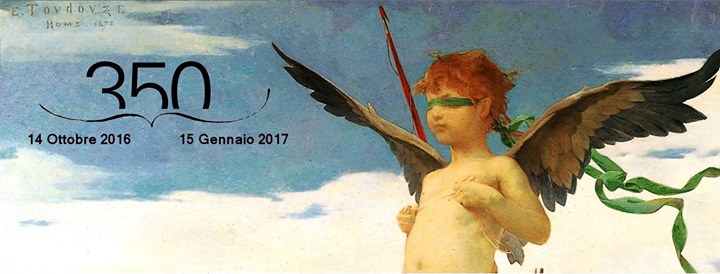
Now on view at the French Academy in Rome:
350 Years of Creativity: The Artists of the French Academy in Rome from Louis XIV to the Present
350 ans de création: Les artistes de l’Académie de France à Rome de Louis XIV à nos jours
Académie de France à Rome – Villa Medici, 14 October 2016 — 15 January 2017
Curated by Jérôme Delaplanche
Founded by Louis XIV in 1666, the Academy is celebrating its 350th anniversary this year with a special series of events retracing its history. This exhibition is one of the program’s high points and is accompanied by two others in Rome, organized by the Accademia Nazionale di San Luca and the Accademia di Belle Arti di Roma and focusing on their relationships with the French Academy. 350 Years of Creativity is a chance for the visitor to discover the creative output of artists at the Academy—both residents and directors—during their stays in Rome. It includes over a hundred works dating from 1666 to the present day, by artists including Fragonard, David, Ingres, Berlioz, Garnier, Carpeaux, Debussy, and Balthus. In the course of a fascinating journey through three and half centuries of French art, visitors are offered a closer look at the Academy and its successive generations of creators.
350 Years of Creativity illustrates the high points of the Academy’s long life with works by its leading artists presented under the following headings: the ancient and modern quest for the ideal; the discovery of picturesque reality; the relationship with the body and the nude; the significance of the move to the Villa Médicis; eclecticism and the value of originality; new life for tradition; and the Academy as a center for creative experiment. The exhibition itinerary brings together paintings, drawings, statues, prints, musical scores, and archival material as testimony to the sheer artistic variety the institution has produced. Some of these works come from the Academy’s own collection, notably portraits by residents and the plaster statues. The exhibition closes with a video of works created by residents over the last few decades. For the visitor all this adds up to an opportunity to survey the history of French art from 1666 to 2016.
 350 Years of Creativity will also be accompanied by other events—screenings, encounters, concerts—presented at the Villa Médicis as part of the series ‘Thursdays at the Villa: Art Matters’. It will conclude with a symposium on 11–13 January 2017 with the Accademia Nazionale di San Luca and the Accademia di Belle Arti di Roma, titled Art Academies: Heritage and Contemporary Art Issues.
Jerome Delaplanche, ed., 350 anni di creatività: Gli artisti dell’Accademia di Francia a Roma da Luigi XIV ai nostri giorni (Milan: Officina Libraria, 2016), 224 pages, ISBN: 978 8899765101 (Italian), ISBN: 978 8899765088 (French), 35€.
The Burlington Magazine, November 2016
The eighteenth century in The Burlington:
 The Burlington Magazine 158 (November 2016)
A R T I C L E S
• Lucia Simonato, “A New Work by Domenico Guidi: The Bust of Cardinal Gianfrancesco Albani,” pp. 885–90.
• Bent Sørensen, “The Parisian Career of Jacques François Saly, 1749–53,” pp. 891–99.
L E T T E R
• Kim Legate, “More on Chippendale at Hestercombe House,” p. 904.
R E V I E W S
• Anthony Geraghty, Review of Owen Hopkins, From the Shadows: The Architecture and Afterlife of Nicholas Hawksmoor (Rekation Books, 2015), p. 907–08.
• Tessa Murdoch, Review of Malcolm Baker, The Marble Index: Roubiliac and Sculptural Portraiture in Eighteenth-Century Britain (Paul Mellon Centre for Studies in British Art, 2015), p. 908.
• Martin Postle, Review of James Ayres, Art, Artisans, and Apprentices: Apprentice Painters and Sculptors in the Early Modern British Tradition (Oxbow Books, 2014), p. 909.
• Loyd Grossman, Review of Susan Rather, The American School: Artists and Status in the Late-Colonial and Early National Era (Yale University Press, 2016), pp. 909–10.
• François Quiviger, Review of Andrea Daninos, Una Rivoluzione di Cera: Francesco Orso e e i «cabinets de figures» in Francia (Officina Libraria, 2016), pp. 911–12.
• Philip Ward-Jackson, Review of Vanessa Brett, Bertrand’s Toyshop in Bath: Luxury Retailing, 1685–1765 (Oblong Creative, 2014), p. 912.
• Jamie Mulherron, Review of the exhibition Marseille au XVIIIe siècle: Les années de l’Académie, 1753–1793 (Le Musée des Beaux-Arts, Marseille, 2016), pp. 921–23.
• Jeremy Warren, Review of the exhibition Splendida Minima (Tesoro dei Granduchi, Palazzo Pitti, Florence, 2016), pp. 923–24. [Includes the eighteenth-century reception of these small-scale sculptures.]
New Book | The Neapolitan Crèche at the Art Institute of Chicago
Distributed by Yale University Press:
Sylvain Bellenger, Carmine Romano, and Jesse Rosenberg, with a preface by Riccardo Muti, The Neapolitan Crèche at the Art Institute of Chicago (Chicago: Art Institute of Chicago, 2016), 176 pages, ISBN: 978 0300222357, $40.
 The 18th-century Neapolitan crèche at the Art Institute of Chicago, which contains over 200 figures arranged in a panorama of street life, represents the pinnacle of a rich artistic heritage. This luxurious catalogue is the first to study the crèche in the context of art and music history. Essays explore the Neapolitan crèche tradition and examine the design of Chicago’s example with reference to other important crèches in Europe and the United States. Entries on individual figures identify the characters and types they represent, as well as their social and historical meaning and religious significance. Other entries address groups of figures, animals, and cultural themes present in the creche. Together the essays and entries highlight the astonishing realism and potent symbolism of these figures, which range from heavenly angels and the Holy Family around the manger to street vendors and revelers feasting, drinking, and dancing in a tavern. Nativity scene.
Sylvain Bellenger is director of the Museo de Capodimonte, Naples; Carmine Romano is a PhD student at Paris-Sorbonne University; and Jesse Rosenberg is clinical associate professor, musicology, at the Northwestern University Bienen School of Music.
Exhibition | Salzillo’s Nativity Scene
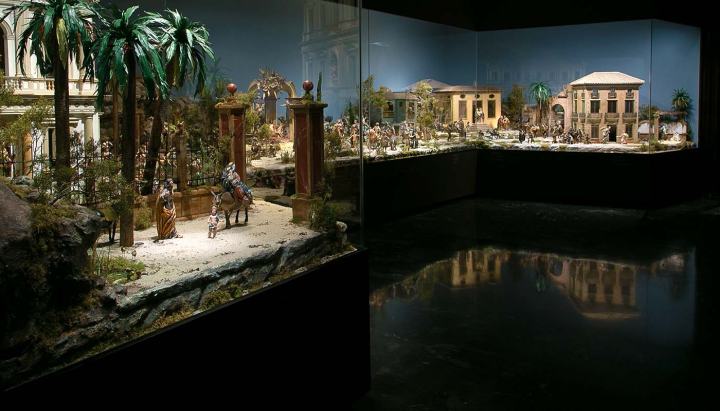
Francisco Salzillo, with Roque López, Nativity Scene of around 300 Polychromed Figures, 1776–83; clay, carved wood, and fabric
(Murcia: Museo Salzillo)
◊ ◊ ◊ ◊ ◊
Now on view at the Bilbao Fine Arts Museum:
Salzillo’s Nativity Scene / Salzilloren Jaiotza / El Belén de Salzillo
Bilboko Arte Ederren Museoa / Museo de Bellas Artes de Bilbao, 28 October 2016 — 6 February 2017
For its latest edition and thanks to the sponsorship of Fundación Banco Santander, the ‘Invited Work’ programme presents a significant part of the famous Nativity Scene by the sculptor and religious image maker Francisco Salzillo (Murcia, 1707–1783). It has been loaned by the Museo Salzillo (Murcia), to which the Bilbao Fine Arts Museum will be lending in exchange seventeen works on the Christmas theme, to be exhibited with the title Nativitas Domini until 12 February next year.
 Comprising around 300 polychromed figures (of the 556, including figures and six architectural structures, that make up the entire work), the Nativity was made by Salzillo between 1776 and 1783 for his fellow Murcian, the aristocrat Jesualdo Riquelme y Fontes, and was completed by his pupil Roque López and his studio. It was finished around 1800 and only one of the six architectural elements is a modern creation. Throughout the entire 19th century, it was in the Palacio Riquelme, entering the collection of the Museo Salzillo as one of the key works within Salzillo’s oeuvre.
The narrative structure of the Nativity follows various canonical and apocryphal texts in order to establish a chronological sequence that runs from the Annunciation to the Flight into Egypt and in which the figures occupy a predetermined position while the other elements can vary. The scenes include magnificent architectural structures, some copies of buildings of the period when the work was made—such as Herod’s palace, which imitates a local Murcian aristocratic residence; Mary’s house, which reflects urban dwellings of the time; and Saint Elizabeth’s house, which echoes the sophisticated typology of the small rural house. Others, however, employ classical or Renaissance references, such as the ruined portico in which the Birth of Christ takes place, or the Temple of Solomon, based on the Roman church of San Pietro in Montorio. Mary’s house retains its Rococo furnishings, which must have been added in the 19th century.
The biblical episodes are acted out by a wide range of picturesque figure types that are also to be found in painting and literature of the day. In this respect, the Enlightenment writer Ceán Bermúdez observed that Salzillo gave lodgings to beggars in his house in exchange for them posing for him. These popular types co-exist with the solemn figures that act out the religious mysteries, as well as sumptuously dressed angels and nobles. Some of them are portraits of real people of the day, including Riquelme y Fontes himself, the Marquis of Beniel and the Count of Flordablanca.
 Despite his Italian origins (his father was an Italian sculptor based in Murcia who ran an important family workshop principally producing religious images), Salzillo’s Nativity Scene is notable for its inspiration in popular life and customs, its profound religious sentiment, and the narrative character of the scenes.
The figures, which are about 30 centimetres high, are modelled in clay or carved in wood. They have complex polychromy, in some cases applied directly onto the wood using a finely detailed technique that reflects the Rococo tradition. The clothes are made from glue-sized fabric over which the paint, applied with brushes of different thicknesses, creates a range of textures from the softness of silk to the rough clothing of the shepherds. Other techniques, such as the incising of the estofado, add richness to the mantles and tunics of the holy figures. Blue, red, and green are the predominant colours, combined with gilding. The angels, such as those present in the Dream of Saint Joseph, are the most sophisticated figures. The work as a whole includes a wide range of clothing, from the plain local jerkin and embroidered skirts to be seen in the Massacre of the Innocents to the gleaming armour worn by the Roman soldiers.
Through these gospel scenes Salzillo offers a fascinating image of the habits and customs of the Spanish peasantry, showing the finest aspects of their dress and their amusements and pastimes such as music and dancing. In this folk universe the rustic shepherds happily co-exist with the sophisticated local nobility. The grace of the pages in their coloured livery, silk stockings and elegant hats contrasts with the roughness of the shepherds and the rags of the blind man’s guide. Alongside them we also see supernatural beings such as the angels in their richly patterned and gilded tunics who add delicacy to the overall composition.
The scene as a whole includes a wide range of figure types, poses and notably realistic portraits despite the small size of these figures, some of whom represent trades and activities, such as the groups of butchers, musicians, and hunters. Alongside them we also see a remarkable variety of animals, including the migrating birds that nested in the region of Murcia called the Mar Menor and different types of bulls, goats, and sheep.
Salzillo’s Nativity Scene thus combines the inspiration of the Gospel texts with a wide range of figure types, clothes, trades and activities of the day, all taken directly from life. The narration, with its colourful incidental details, the setting, and the figures together create an intimate, domestic atmosphere that is notably different to the more worldly one of the Neapolitan presepe, the other preeminent type of Nativity scene at this date. While the latter are characterised by an urban context inspired by the Commedia dell’Arte, Salzillo made use of Spanish rural life and its traditions to transmit a devotional mood of a more intimate, accessible nature.
Concepción de la Peña, Maria Teresa Marín, and Carlos Moisés García, El Belén de Salzillo / Salzillo’s Nativity Scene (Murcia: Museo Salzillo, 2013), 143 pages, ISBN: 978-8415369509 (Spanish and English), 25€.
Exhibition | Nativitas Domini: Art and Devotion
On view at the Museo Salzillo:
Nativitas Domini: Art and Devotion / Arte y Devoción
Museo Salzillo, Murcia, 14 October 2016 — 12 February 2017
 La Natividad es una festividad litúrgica que se celebra popularmente desde el siglo XVI, la cual, con el paso del tiempo, se ha convertido en una de las representaciones más recurrentes dentro de la iconografía cristiana. Las diferentes escuelas artísticas europeas han sabido adaptar este episodio con sus misterios a los diferentes estilos y gustos de cada época.
Durante el Renacimiento la representación pictórica de este acontecimiento alcanzó gran auge, y en su representación los artistas mostraron el concepto de ‘belleza ideal’, tan característico tanto de las escuelas del norte como las italianas.
Se muestra así una selección de pinturas y esculturas del Museo de Bellas Artes de Bilbao con representaciones que van desde el citado Renacimiento hasta el siglo XVIII, pasando por trabajos del manierismo y del Barroco, que se inician con Los desposorios de la Virgen, la Adoración de los pastores, los Magos de Oriente concluyendo con la representación de la Virgen.
Exhibition | Robert Adam’s London
Press release (26 October 2016) for the exhibition:
Robert Adam’s London
Sir John Soane’s Museum, 30 November 2016 — 11 March 2017
Curated by Frances Sands
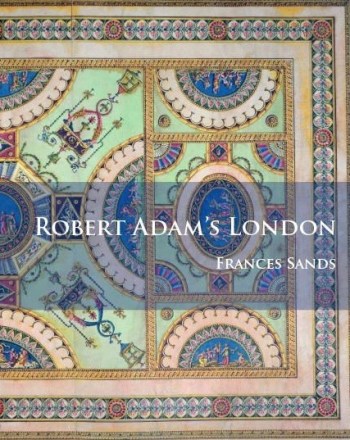 The work of one of the greatest British architects of all time is examined in a new exhibition at Sir John Soane’s Museum. Robert Adam’s London takes an in-depth look at some of the Scottish architect’s work which helped change the landscape of the capital. Some of the famous buildings looked at in the exhibition include Buckingham Palace, the Admiralty Screen on Whitehall and Portland Place. Robert Adam’s London is the first time the architect’s work across the city as a whole has been examined in a London museum. It will showcase his ground-breaking neo-classical style and his desire to unify architecture and interior design. It will also feature both completed buildings alongside those, which were never realised, offering a glimpse into the architect’s ambitious vision for London.
On display will be some of Sir John Soane’s Museum’s most beautiful, influential, and rarely seen designs of Adam’s projects in London, taken from their 9,000-strong Adam drawing collection. The Museum holds 80% of the world’s surviving Adam drawings which are of huge international-significance for our understanding of Georgian architecture and interior design. Projects on show include the famous Admiralty Screen on Whitehall, Portland Place, and six monuments for Westminster Abbey, as well as projects subsequently demolished or never realised, such as the interiors of Buckingham House (before it became Buckingham Palace), 15 Downing Street, Lansdowne House, and Adelphi. A large-scale facsimile of an eighteenth-century map of London will form the centrepiece of the show, plotting Adam’s various projects across the city, creating an ‘in-exhibition’ trail for visitors. Alongside this will be a portrait of Robert Adam by George Williamson, on loan from the National Portrait Gallery, and a pedestal designed by Adam from Kenwood House.
Robert Adam had a long and enduring connection to London, establishing his London practice in 1758 and remaining in the city until his death in 1792. There is a greater density of his work for this city than anywhere else, as he focused on designing complete schemes for the decoration of domestic, public, commercial, speculative and commemorative buildings. His work in London demonstrates how his style evolved past the fashionable Palladian design of the time, into a new, more flexible style, incorporating influences from Roman, Etruscan, and Baroque styles. Adam’s radical style was often attributed to a desire to design everything down to the smallest detail.
Adam regularly favoured large-scale and grandiose designs, many of which remained purely speculative as their ambitions—and cost—were often prohibitive. One such project examined in the exhibition in detail is for Portland Place, where he hoped to construct detached aristocratic palaces which might rival noblemen’s urban homes in Europe. Palaces for the Earls of Kerry and Findlater were designed, but never came to fruition. If they had, central London would have looked significantly different to how it is today.
Bruce Boucher, Director of Sir John Soane’s Museum says: “The Adam Drawings at the Soane Museum is one of our most important collections. Not only is it an invaluable record of the work of one of this country’s most innovative architects, but also a fascinating glimpse into what London could have been had all his projects survived or come to fruition. People have always cared passionately about the architecture of London, as today’s fierce debates testify, so it is wonderful to be able to examine this fascinating chapter in the architectural history of this great city, right in the heart of the city itself.”
Dr Frances Sands, Curator of Drawings and Books at Sir John Soane’s Museum comments: “The Adam office provided designs in deliberate contrast to the more severe neo-Palladian style that had dominated Britain in earlier decades. Adam instigated a fashion for his own recognisable and characteristic style, one not based on dogmatic archaeological accuracy, but rather a creative fusion of all that he had seen abroad. With his distinctive, delicate interior decorative style and bold, rippling architecture, Adam became enormously successful; his practice catered to clients across Britain—and occasionally beyond—but nowhere more heavily than in London. Often remembered as an architect of great country houses, this exhibition celebrates the skill and dexterity of his numerous works here in town.”
◊ ◊ ◊ ◊ ◊
Frances Sands, Robert Adam’s London (Oxford: Archaeopress, 2017), 142 pages, ISBN: 978-1784914622, £18.
The iconic eighteenth-century architect Robert Adam was based in London for more than half of his life and made more designs for this one city than anywhere else in the world. This book reviews a wide variety of his designs for London, highlighting lesser known buildings as well as familiar ones. Each of Adam’s projects explored in this book is plotted on Horwood’s map of London (1792–99), enabling readers to recognise Adam’s work as they move around the city, as well as to envisage London as if more of his ingenious designs had been executed or survived demolition.
Frances Sands is Curator of Drawings and Books at Sir John Soane’s Museum.
Exhibition | From Alcove to Barricades, From Fragonard to David
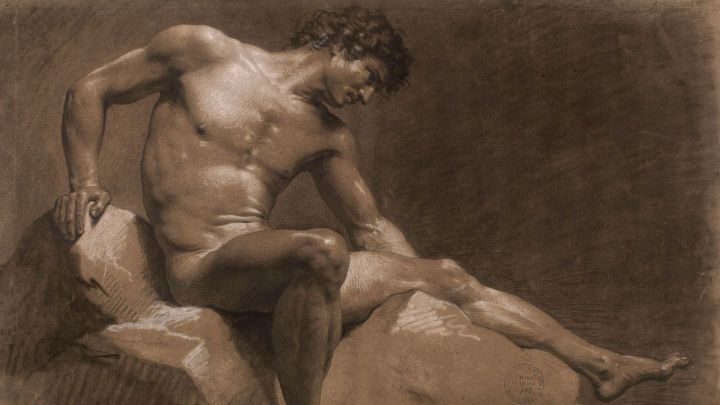
Jean-Baptiste Isabey, Academy Figure of a Nude Man Seated, Resting on his Left Arm, 1789, black chalk with stumping and white chalk heightenings on brown paper, 46.8 × 60.7 cm (Collection des Beaux-Arts de Paris / photo Thierry Ollivier)
◊ ◊ ◊ ◊ ◊
Now on view at the Fondation Custodia:
From Alcove to Barricades, From Fragonard to David: Drawings from the École des Beaux-Arts
De l’alcôve aux barricades, De Fragonard à David: Dessins de l’École des Beaux-Arts
Fondation Custodia, Paris, 15 October 2016 — 8 January 2017
Curated by Emmanuelle Brugerolles
Renowned for its precious drawings collection, the École des Beaux-Arts de Paris collaborates with the Fondation Custodia in the context of its Bicentennial celebration, presenting this autumn at 121 rue de Lille one of the most glorious components of its collections. With 145 drawings, the exhibition From Alcove to Barricades presents an ambitious historical survey of art in the second half of the 18th century.

Jacques-Louis David, Head of a Plague Victim, 1780, pen and black ink over a sketch in black chalk, 21.3 × 15.2 cm (Collection des Beaux-Arts de Paris)
The selected works cast light on a period of historical as well as artistic turmoil. From the last decades of the reign of Louis XV (1715–1774) to the close of the revolutionary period (1789–1799), we observe the transition from a monarchy to the Republic: a world that shifts from the space of the court occupied by the nobility to that of the city where the notion of citizenship prevails. Following suit, the arts pass through multiple transformations. This process was long considered a clear break between two opposing styles: rocaille (or rococo)—defined at the time as a feminine style owing to its arabesques, whims and at times extravagance—and neoclassicism, a masculine style whose noble simplicity is inspired by the Antique.
Arranged according to seven thematic chapters—academic training, Roman sojourn, genre scenes, history painting, landscape in France, architectural drawing, and decorative arts—the exhibition reveals a more complex situation.
The great number of masterpieces assembled here for the first time evoke this diversity of styles and approaches. They also enable us to follow the careers of the artists who played a role in these developments. We discover them during their training at the Académie Royale de Peinture et de Sculpture in their large-format nude studies after live models and drawings done for the competition for a Tête d’expression (a face depicting an emotion). A number of awards established in the second half of the 18th century, aimed at inspiring emulation among the Academy’s pupils in order to regenerate the arts, offered young artists opportunities to gain recognition.
We then follow these draughtsmen to Palazzo Mancini, the seat of the Académie de France in Rome, where they were pensionnaires. Whether copies of ancient and modern masters or views of classical ruins, gardens and recently discovered sites, the Beaux-Arts sheets reveal the motifs that impressed French artists during their stay in Italy.

Anne-Louis Girodet, Étude pour la Scène de déluge, figure de la mère, pierre noire et rehauts de craie blanche, 53.7 × 43.9 cm (Collection des Beaux-Arts de Paris)
On their return to France we see these artists obtain official recognition through important State commissions and trying to satisfy the changing taste of connoisseurs. Employing the strategies of history painting—expressive intensity, narrative clarity and theatrical layout—Jean-Baptiste Greuze (1725–1805) renews the genre scene, evoking everyday dramas in moralising tones. His art, admired by the public of the Salon and Denis Diderot, is illustrated in the exhibition by a number of drawings.
Ranging from the scenes à la grecque by Joseph-Marie Vien (1716–1809) to the large neoclassical compositions by Jacques-Louis David (1748–1825) that inspired an entire generation of painters, the drawings shown in the next section allow us to follow the evolution of history painting as it gradually leaves behind amorous and sensual mythological subjects to explore heroic scenes drawn from ancient history. Indeed, since the mid-18th century rocaille art was highly criticised by scholars, such as the German art historian Winckelmann, and members of the artistic community. The Academy sought to resume ties with the Grand Genre by proposing Antiquity as the model to follow, as it had been in Poussin’s day.
Whether impressive designs—sometimes several metres long—sketched for the competitions organised by the Académie royale d’architecture, or inventions of imaginary buildings in the manner of Piranesi’s capricci, most of the works that introduce the sixth chapter of the exhibition are sheer graphic elaborations. They attest to the autonomy of architectural drawing in the second half of the 18th century and the beginning of a new form of urban planning around public buildings that offered citizens a richer social and cultural life.
In the exhibition’s final section, devoted to the decorative arts, many drawings are preparatory for engravings forming collections of models, a flourishing genre at the time, while others were used directly to make furniture or ornaments. Through these works we can measure the influence of classical art in the evolution of the repertory of decorative motifs. Although characterised by a return to the straight line and a certain restraint, neoclassicism remained open to the lasting taste for the pleasing and the exotic, the legacy of the rocaille style.
From academic exercises to large-format preparatory studies for paintings, sculpture, furniture and architecture, these drawings thus encompass all the arts. They place us at the heart of the artistic practices and creative processes prevalent in a society undergoing profound transformations.
Emmanuelle Brugerolles, ed., De l’alcôve aux barricades, De Fragonard à David: Dessins de l’École des Beaux-Arts (Paris: Beaux-Arts de Paris éditions, 2016), 400 pages, ISBN: 978 2840564904, 39€.
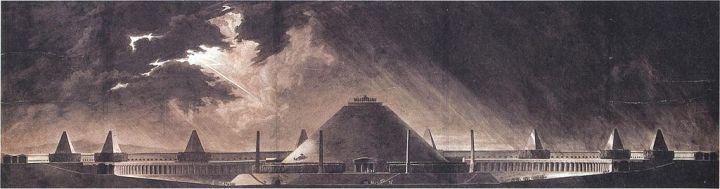
Pierre-François-Léonard Fontaine, Sepulcral monument: Section of the overall monument and elevation of the central pyramid, 1785, pen and black ink, grey wash, 76.5 x 275 cm (Collection des Beaux-Arts de Paris)
Exhibition | Antonio Balestra: Nel Segno della Grazia
Now on view in Verona:
Antonio Balestra: Nel Segno della Grazia / In the Sign of Grace
Museo di Castelvecchio, Verona, 19 November 2016 — 19 February 2017
 Il Comune di Verona, Direzione Musei d’Arte e Monumenti honors the painter Antonio Balestra (1666–1740) on the occasion of the 350th anniversary of the artist’s birth with the exhibition Antonio Balestra: In the Sign of Grace, staged in the Castelvecchio Museum. The exhibition presents over sixty works: paintings, drawings, etchings, and volumes of prints, coming from public and private lenders.
Andrea Tomezzoli, Antonio Balestra: Nel Segno della Grazia (Verona: Scripta Edizioni, 2016), 208 pages, ISBN: 978-8898877690, $38.










leave a comment