Exhibition | Making Nature: How We See Animals
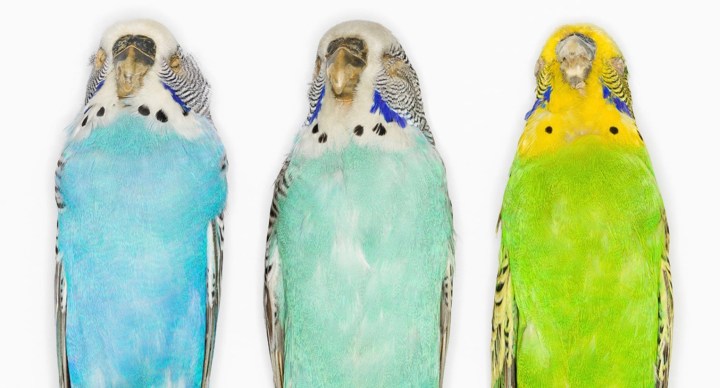
Press release (23 September 2016) from the Wellcome Collection:
Making Nature: How We See Animals
Wellcome Collection, London, 1 December 2016 — 21 May 2017
Curated by Honor Beddard
The question of how humans relate to other animals has captivated philosophers, anthropologists, scientists, ethicists and artists for centuries. Making Nature brings together over 100 objects from literature, film, taxidermy, and photography to examine what we think, feel, and value about other species and the consequences this has for the world around us. It will include works by contemporary artists including Allora and Calzadilla and Phillip Warnell and asks how and why we look at animals and what we see when we do.
From the formalisation of natural history as a science, through the establishment of museums and zoos, to lavish contemporary wildlife documentaries, Making Nature reveals the hierarchies in our view of the natural world and considers how these influence our actions, or inactions, towards the planet. The exhibition—organised around four themes: ordering, displaying, observing, and making—opens with Marcus Coates’s Degreecoordinates, Shared Traits of the Hominini (Humans, Bonobos and Chimpanzees), 2015. This recent work questions the definitions of difference between species and establishes this as an idea that runs throughout the exhibition.
Attempts to categorise the natural world in the 18th century will be introduced through the work of Carl Linnaeus and the publication of Systema Naturae in 1735. His efforts to record, describe, and classify the animal kingdom solved the practical problem of identifying species but introduced a manmade ranking system. Similarly, Charles Bonnet’s Scale of Natural Beings 1783 provided a ladder of the animal kingdom with humans placed at the top. Such views are challenged by the depictions of animals—and human-like animals—in Jonathan Swift’s satire of man, Gulliver’s Travels.
Making Nature questions the approach of ‘learning through looking’, including artists such as herman de vries, a trained botanist interested in the challenge of objectivity, and Edwina Ashton who explores the politics of representation. The importance of listening is also examined by artists Allora and Calzadilla in The Great Silence (2014). This film installation is a depiction of endangered parrots paired against footage of the Arecibo Observatory, the world’s largest telescope, in Puerto Rica.
The exhibition also charts changing fashions of museum displays alongside society’s changing attitudes to nature, from overstuffed cabinets in Victorian institutions to elaborately staged dioramas from natural history museums in the 20th century. Contemporary photographers Richard Ross and Hiroshi Sugimoto expose the complexities of successive attempts to give visitors an authentic representation of the animal in a museum setting, revealing works of art as yet another form of mediation. Roger Fenton’s 1855 image of an unnaturally upright gorilla skeleton next to a human one, taken during his time as the British Museum’s documentary photographer, interrogates the idea that natural history displays may not necessarily represent an objective truth.
The search for an authentic encounter with nature will be further examined through our ever more ambitious attempts to get closer to animals—in zoos, national parks, and on screen—while simultaneously hoping to preserve their wildness. The New Architecture and The London Zoo (1936), a film by László Moholy-Nagy, and Casson Condor’s architectural photographs from the 1970s provide examples of how the designs of zoo enclosures are used to frame animals. The phenomena of the ‘zoo-pet’, or mascot, is explored through cases like Jumbo the elephant, adored by Victorian audiences and subject of a public outcry when he was sold to P. T. Barnum’s Circus in 1882. Souvenirs and toys will show how zoo animals have frequently been anthropomorphised in popular culture.
Depictions of animals on film include, Woodpeckers 1954, the first documentary to use new camera technologies to film a family of woodpeckers from within their nest. When broadcast on the BBC, it was second in popularity only to the Queen’s coronation that year and set the precedent for natural history documentaries that remain popular today. The exhibition also features an extract from Seal Island (1948), part of Walt Disney’s True-Life Adventures series of nature films promoted as entertainment.
Phillip Warnell’s film installation Ming of Harlem: Twenty One Storeys in the Air (2016) explores the true story of Antoine Yates, who lived in a high-rise New York apartment with a tiger called Ming and a large alligator. Combining documentary with recreated scenes, Warnell offers new insights on the human/animal relationship and the question of representation.
The final section of the exhibition is curated in collaboration with the Center for PostNatural History, Pittsburgh, USA, the only organisation to solely collect organisms that have been intentionally altered by humans. Specimens, paintings, literature, and scientific models—many on loan from the Center’s museum—will chart a relationship to animals that is bound up with the history, and future, of human civilisation. This includes the breeding of domesticated pigeons by Charles Darwin that helped to inform his theories of natural selection and the genetic modification of mosquitos in the fight against disease spread. Further case studies comprise dog breeding, the origins of laboratory mice and rats, and a history of songbirds as told by musicologist Ian Nagoski. Unlike traditional natural history collections, the significance of postnatural organisms lies in the role they play in human culture.
Making Nature is the first part of a year-long exploration of our relationship with the natural world in the past, present, and future. The exhibition is curated by Honor Beddard, and the exhibition design is by AOC.
◊ ◊ ◊ ◊ ◊
Tim Dee and Anna Faherty, Animal, Vegetable, Mineral: Organising Nature: A Picture Album (London: Wellcome Collection, 2016), 112 pages, ISBN: 978 095 7028593, £13.
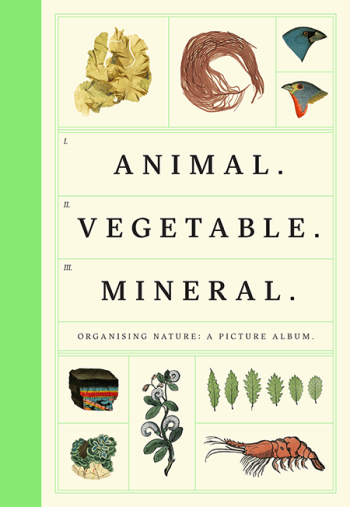 Animal, Vegetable, Mineral celebrates the beauty and strangeness of the very early ‘infographics’, charts, and ordering systems devised in an age that transformed how we see and understand nature. These are the tools created by pioneering European naturalists, artists, scientists, housewives, and explorers in the 18th and 19th centuries in an attempt to better understand (and control) a teeming and shifting natural world: the original big data challenge. In a collision of science, art, and imagination, these images and objects range from intricate specimen illustrations, taxonomy charts, and animal distribution maps, to lavish colour dictionaries, and more. Together, they attest to the deeply human desire to order and identify the world around us—and a restless quest to find our own place in it.
Exhibition | The Frick Collects: From Rubens to Monet

Arthur Devis, Sir Joshua Vanneck and His Family, 1752, oil on canvas, 146 × 142 cm
(Pittsburgh: Frick Art & Historical Center, 1984.24)
◊ ◊ ◊ ◊ ◊
Now on view at The Frick Pittsburgh:
The Frick Collects: From Rubens to Monet
Frick Art & Historical Center, Pittsburgh, 29 October 2016 — 14 May 2017
Take a look at the Frick in a new way in this exhibition, which, for the first time tells the story of the Frick through its collection. From Henry Clay Frick’s early purchases, to his daughter Helen’s collecting interests, through to the acquisitions that have been made by the museum in recent years, visitors will see and learn about the enduring legacy of the Frick family as art collectors. Objects will be brought together to tell a unified story—a story that doesn’t stop with Henry Clay Frick’s early purchases for Clayton, but continues, looking at both Henry and Helen as the collectors who have shaped the Frick Art & Historical Center’s holdings.
The earliest acquisitions in the collection date to Henry Clay Frick’s bachelor days. Before his marriage (and for the first months after his marriage) he lived in downtown Pittsburgh at the fashionable Monongahela House. He bought his first paintings and decorative objects for his rooms there: an elaborate rococo revival clock and candelabra set purchased through Tiffany’s, an ebonized cabinet, and his first documented painting purchase, a landscape by local artist George Hetzel.
When they moved into Clayton, Henry Clay Frick and his wife furnished it as many young couples do—most of the purchases were new, fashionable and of the period. Frick had met his wife, Adelaide Howard Childs (1859–1931) in February 1881. Adelaide was the sixth daughter of the wealthy Pittsburgh Childs family, who were manufacturers and importers of shoes and boots. For young couples during America’s Gilded Age like the Fricks, art collecting was not simply a way to exercise taste and create a suitable environment—although these were important considerations. More subtly the right objects gave their owner a sense of history and pedigree. Collecting was a personal pleasure and an indicator of status, discernment and good taste.
The rise in American collecting of this period also coincided with the establishment of the first museums in the country, including the Wadsworth Athenaeum of Hartford, Connecticut in 1842, the Museum of Fine Arts, Boston in 1870, New York’s Metropolitan Museum of Art in 1872, and in 1896, Pittsburgh’s Carnegie Institute. As the century progressed, forming collections and bequeathing them to the public became one way to put wealth and the accumulation of a collection to public service.
It was Helen Clay Frick’s vision that led to the restoration of Clayton as a house museum. The Frick Art Museum, which was opened to the public in 1970 just a block south of Clayton, was built primarily for the collection she developed, rather than the one she inherited. Helen even had the family cars and carriages carefully preserved and brought back to Pittsburgh from the family’s Massachusetts summer estate.
The Frick Art Museum opened in 1970 with its main galleries devoted to Helen’s greatest interests: early Italian Renaissance paintings and eighteenth-century French fine and decorative art. Since Helen’s death in 1984, the collection has continued to develop—through generous donations and acquisitions that reflect the same quality as that evinced by the founding collection. Through the foresight of Helen Clay Frick who valued Pittsburgh, and who understood that her youth at Clayton was one of unique privilege—not simply financially, but aesthetically—these collections are the heart of the experience at the Frick Pittsburgh.
The Frick Collects is accompanied by a new, fully-illustrated guide to the collection published by Scala, specialists in working with museums to produce beautiful publications. The publication is generously underwritten by The Richard C. von Hess Foundation.
Robin Nicholson, Sarah Hall, and Dawn Reid Brean, The Frick Pittsburgh: A Guide to the Collection (New York: Scala, 2016), 120 pages, ISBN: 9781785510717, $15.
 The collections at The Frick Pittsburgh are the combined legacy of famed art collector and industrialist Henry Clay Frick and his daughter Helen. Two essays tell the story of Frick’s early collecting and his daughter’s interest in continuing his mission to purchase great art and make it publicly accessible. The book also provides a photographic tour of Clayton, the Frick family’s historic Pittsburgh home, which is now a house museum.
Collection highlights presented include fabulous examples of early Renaissance Italian painting, eighteenth-century French painting, furniture, and decorative arts, spectacular Chinese porcelains, and masterpieces by artists like Rubens, Guardi, Boucher, Gainsborough, Fragonard, Millet, and Monet. The entirety of the Frick’s collections—spanning the thirteenth century to the present—are displayed at The Frick Art Museum, Clayton, and the Car and Carriage Museum—all located on the Frick’s five-plus acres of landscaped grounds.
Robin Nicholson has been Director of The Frick Pittsburgh since 2014. Sarah J. Hall began working at The Frick Pittsburgh in 1994 and has been Director of Curatorial Affairs since 2007. Dawn Reid Brean joined the Frick as Associate Curator of Decorative Arts in 2015.
Exhibition | Winckelmann, Florence, and the Etruscans
Winckelmann turns 300 next December 9th. In anticipation of the event, the National Archaeological Museum presents this exhibition:
Winckelmann, Florence, and the Etruscans: The Father of Archeology in Tuscany
Winckelmann, Firenze e gli Etruschi: Il padre dell’archeologia in Toscana
Museo Archeologico Nazionale, Florence, 26 May 2016 — 30 January 2017

Anton von Maron, Portrait of Johann Joachim Winckelmann, 1767, oil on canvas, 136 × 99 cm (Weimar: Stadtschloss).
Johann Joachim Winckelmann (1717–1768), the Prussian art scholar who was superintendent of antiquities of Rome, had a purpose behind his stay in Florence: to broaden knowledge of the Etruscan civilization. From 1758 to 1759, Winckelmann lived in Florence, where he hoped to complete his work. Ahead of the three hundredth anniversary of his birth—and while waiting to celebrate more widely with a conference in 2017—the Archaeological Museum of Florence presents the exhibition Winckelmann, Firenze e gli Etruschi (Winckelmann, Florence and the Etruscans), from May 26 to January 30, 2017.
Winckelmann’s studies of classical works, particularly his Geschichte der Kunst des Alterthums (The History of Art in Antiquity) of 1764, promoted the aesthetics of neoclassicism and created a sensibility and a taste that influenced all of late eighteenth-century Europe; furthermore, the Winckelmann methodological approach provides the basis of modern art history. The exhibition, installed on the ground floor of Florence’s Archaeological Museum, consists of three sections. The first addresses the study of antiquities and private collecting in mid-eighteenth-century Florence. The second section is more specific to Winckelmann’s Florentine studies, including his cataloguing of Baron von Stosch’s collection of gems, of which casts are on exhibit. Finally, the third section shows the cultural legacy that Winckelmann left to the Grand Ducal city and the whole of Europe, with the neoclassical style born from this man’s notes and publications.
 Visitors are welcomed to the exhibition by the large, late-Etruscan bronze sculpture of The Orator (Aulus Metellus). It must be remembered, however, that in Winckelmann’s opinion, Etruscan art was not at the level of Greek art because of the Etruscans’ inability to detach themselves from their passions. After visiting this exhibit, visitors can continue on to the Museum to admire other masterpieces of Etruscan art, including the Chimera and the Idolino.
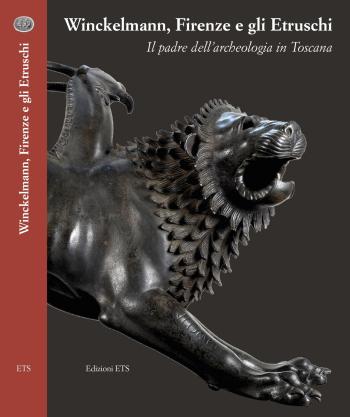
Barbara Arbeid, Stefano Bruni, Mario Iozzo, eds., Winckelmann, Firenze e gli Etruschi: Il padre dell’archeologia in Toscana / Winckelmann, Florenz und die Etrusker: Der Vater der Archäologie in der Toskana (Pisa: Edizioni ETS, 2016), 347 pages, ISBN: 978 8846745187 (Italian) / ISBN: 978 8846745194 (German), 28€.
Exhibition | Charles III and the Dissemination of Antiquity
The exhibition is one of several held to mark the 300th anniversary of the birth of King Charles III of Spain:
Charles III and the Dissemination of Antiquity / Carlos III y la difusión de la antigüedad
Real Academia de Bellas Artes de San Fernando, Madrid, 15 December 2016 — 18 March 2017
Museo Archeologico Nazionale di Napoli, Naples, 15 December 2016 — 18 March 2017
Academia de San Carlos, Mexico City, 15 December 2016 — 18 March 2017
Curated by José María Luzón Nogué, Valeria Sampaolo, Elizabeth
Fuentes Rojas, and María del Carmen Alonso Rodríguez
The exhibition uses virtual reality and 3D technology to enable it to be viewed simultaneously from three different venues in Naples, Mexico City, and Madrid. With the aid of the most advanced digital technology, it shows the highly significant role played by Charles III (1716–1788) in disseminating the heritage of Herculaneum, Pompeii, and Stabiae, as it was he who, as king of Naples, gave orders for the excavations at one of the most important historic sites ever discovered.
The dissemination of the archaeological finds at Herculaneum, Pompeii, and Stabiae is explained in three rooms in three different museums in three different countries: Italy, Spain, and Mexico. All three rooms are equipped with a similar installation and share the same purpose: to underline the role played by Charles III in making known antiquities in the eighteenth century. These rooms are interconnected in real time by means of live streaming and use virtual reality, augmented reality and 360-degree photos, which make it possible for people visiting one of the museums to fully appreciate the extent of the work carried out three hundred years ago using other means.
Owing to its unique characteristics, the exhibition relies on the technical support of several companies specialised in virtual recreation and 3D images. It employs cutting-edge technology and aims to be the first step towards designing a model for virtual exhibitions that establish interconnections between museums and their collections in different countries.
The main group of antiquities, which had been discovered by the time Charles III departed for Spain in 1759, came from the Villa of the Papyri at Herculaneum, though other antiquities had been found at Pompeii and the villas of the former Stabiae. They were initially used to adorn Portici Palace and to establish the Herculaneum Museum there.
Naples
The bronzes and paintings of Herculaneum were disseminated under the auspices of the king through Le antichità di Ercolano Esposte, a publication on which excellent eighteenth-century illustrators and engravers worked. The king made gifts of this work to scholars of the period, artists, members of the nobility and European universities that requested it. The copper-plates and their prints make up an interesting chapter in the history of archaeological documentation and its role in disseminating new discoveries.
Madrid
Back in Spain, Charles III asked Bernardo Tanucci, Secretary of State of the kingdom of the Two Sicilies, to send him plaster copies of the antiquities he liked so much. These plaster copies were installed in the Buen Retiro Palace until 1776, when, at the request of the instructors at the Royal Academy of the Three Noble Arts, the king agreed to donate them so that they could be used to train architects, sculptors and painters. The collection of casts sent from Naples remains in the academy to this day and is of great historical and documentary interest.
Mexico City
Later, when King Charles III founded the Academy of San Carlos in Mexico, a selection of casts from the Academy of San Fernando in Madrid was sent there in 1780, including copies of the casts from Naples. The busts from the Villa of the Papyri at Herculaneum and a few others from Pompeii and Stabiae thus crossed the Atlantic to be used as models by the students of the Academy of San Carlos.
Exhibition | Carlos III: Majestad y Ornato
The exhibition is one of several held to mark the 300th anniversary of the birth of King Charles III of Spain:
Carlos III: Majestad y Ornato en los Escenarios del Rey Ilustrado
Palacio Real de Madrid, 6 December 2016 — 31 March 2017
Curated by María Pilar Benito García, Javier Jordán de Urríes, and José Luis Sancho Gaspar
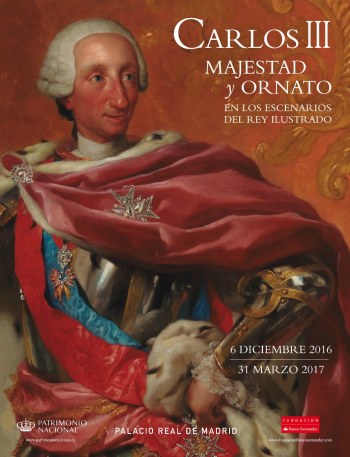 El próximo 6 de diciembre, en el Palacio Real de Madrid, se abre al público la exposición Carlos III. Majestad y Ornato en los Escenarios del Rey Ilustrado, con la que se conmemora del tercer centenario de este monarca y que permanecerá abierta hasta el 31 de marzo de 2017.
Soberano ilustrado y, como tal, mecenas de las artes, el monarca constituye el referente más indiscutible en la fértil relación que han mantenido la Corona y la Cultura en España durante la Edad Moderna. Su gobierno, además de las grandes obras públicas que promovió, supuso la intervención estatal en aspectos estéticos a una escala amplia y variada. Pero sin duda donde con más claridad se perciben tales innovaciones es en el propio entorno del monarca, en el arte cortesano creado bajo su directo mecenazgo, y que pone en valor esta exposición.
Estas obras artísticas, que servían para la vida cotidiana del rey y su familia, estaban pensadas tanto para fines funcionales, como ornamentales y representativos: su calidad, su magnificencia y suntuosidad, su tono cosmopolita constituían toda una declaración de poder. Expresaban no sólo la majestad del rey, sino la de la vasta monarquía simbolizaba en su persona. En sus palacios –tanto el de Madrid como el de los cuatro sitios reales donde la corte pasaba cada estación del año- se expresaba esta alianza entre el poder y la ilustración mediante todas las bellas artes: la pintura con figuras como Giambattista Tiepolo, el ya mencionado Mengs y todos sus discípulos españoles, entre ellos el incipiente genio de Francisco de Goya; las artes decorativas merced a las Reales Fábricas de tapices, de porcelana y piedras duras, de cristales y de relojes, y a los talleres dirigidos por diseñadores como Mattia Gasparini.
Reconocibles aún en los palacios, pero en gran medida dispersas debido a la misma evolución de la vida cortesana y a los avatares históricos, las obras ornamentales creadas para expresar la magnificencia de Carlos III constituyen uno de los tesoros culturales de España. Patrimonio Nacional plantea aquí una nueva lectura de esta página esencial en el acervo estético español, presentando obras emblemáticas y programas decorativos que no podían verse de forma conjunta desde el siglo XVIII, así como otras obras no mostradas al público en los últimos años o procedentes de colecciones extranjeras de difícil acceso. Asimismo, será la primera vez que se muestre el Retrato de Carlos III, pintado por Mengs y regalado por el monarca al rey Federico V de Dinamarca, que nunca se ha expuesto en España.
Los comisarios de esta exposición son Dña. María Pilar Benito García, D. Javier Jordán de Urríes y D. José Luis Sancho Gaspar.
◊ ◊ ◊ ◊ ◊
The catalogue is available from ArtBooks.com:
Pilar Benito Garcia, et al., Carlos III: Majestad y Ornato en los Escenarios del Rey Ilustrado (Madrid: El Viso, 2016), 392 pages, ISBN: 9788471205216, $62.
To commemorate the 300th anniversary of the birth of King Charles III (1716–1788), Patrimonio Nacional (National Heritage) has organised a show especially focused on studying the courtly art created under his direct patronage at Madrid’s Palacio Real. The catalogue assembles the complete renovation of all of the Royal Sites promoted by Charles III. The works that adorned the Royal Chamber, the mural paintings that decorated the archs of the royal palaces, as well as the most delicate works elaborated by the royal ateliers of workwood, bronze, and embroidery can be admired.
Exhibition | Senses of Time: Video and Film-based Works of Africa

Yinka Shonibare MBE, still from Un Ballo in Maschera (A Masked Ball), 2004, high-definition digital video, 32 minutes
(Courtesy the artist and James Cohan Gallery, New York)
◊ ◊ ◊ ◊ ◊
Now on view at LACMA and the National Museum of African Art:
Senses of Time: Video and Film-based Works of Africa
Los Angeles County Museum of Art, 20 December 2015 — 2 January 2017
Smithsonian National Museum of African Art, Washington, D.C., 18 May 2016 — 2 January 2017
Our hearts beat to the rhythms of biological time and continents drift in geological time, while we set our watches to the precision of naval time. Time may seem easy to measure, but it can be challenging to understand. The six African artists featured in Senses of Time explore how time is experienced—and produced—by the body. Bodies stand, climb, dance, and dissolve in seven works of video and film—or ‘time-based’—art. Characters and the actions they depict repeat, resist, and reverse the expectation that time must move relentlessly forward. Senses of Time invites viewers to consider tensions between personal and political time, ritual and technological time, bodily and mechanical time. Through pacing, sequencing, looping, layering, and mirroring, diverse perceptions of time are embodied and expressed.
History repeats itself as Yinka Shonibare MBE’s European ballroom dancers in sumptuous African-print fabric gowns dramatize the absurdities of political violence, while Sammy Baloji choreographs a haunting exploration of memory and forgetting in the ruins of postcolonial deindustrialization. Sue Williamson sensitively highlights the generational gaps wrought by time, while Berni Searle addresses genealogical time in one work as ancestral family portraits are tossed by the winds and focuses on the slippages and fragility of time and personal identity in another. Moataz Nasr’s work treads upon identities distorted by the march of time as Theo Eshetu draws us into a captivating kaleidoscopic space where past, present, and future converge.
Senses of Time was co-organized by the Los Angeles County Museum of Art and the Smithsonian’s National Museum of African Art.
◊ ◊ ◊ ◊ ◊
Yinka Shonibare MBE, excerpt from Un Ballo in Maschera (A Masked Ball), 2004, high-definition digital video, 32 minutes (Courtesy the artist and James Cohan Gallery, New York). As noted by the NMAfA: “In Un Ballo in Maschera, Yinka Shonibare MBE interweaves and subverts the geographies and temporal assumptions that shape narratives of tradition and modernity. The artist draws on Giuseppe Verdi’s 1859 opera of the same name about the 18th-century Swedish king Gustav III, who was assassinated at a masked ball while his countrymen fought a war far from home. In Shonibare’s rendition, the event is an allegory for political hubris—with the artist specifically thinking of the Iraq war—and a playful attempt to reveal that the Western world has its traditions, too. . .”
Exhibition | The Art of Law: Three Centuries of Justice Depicted
Now on view in Brugge:
The Art of Law: Three Centuries of Justice Depicted
De kunst van het recht: Drie eeuwen gerechtigheid in beeld
Groeningemuseum, Brugge, 28 October 2016 — 5 February 2017
Curated by Vanessa Paumen
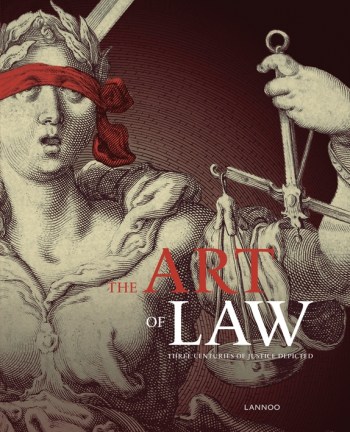 In the fifteenth century, it was customary to decorate courtrooms with works of art that were intended to ‘encourage’ the aldermen and judges to perform their duties in an honest and conscientious manner. These works often depicted the supreme moment of divine justice: the Last Judgement. But other scenes from the Bible were also used, as were images from more profane sources. Together, these are known as the exempla iustitiae (‘examples of fair justice’). In 1498, Gerard David was commissioned by the city council of Bruges to paint just such a work: The Judgement of Cambyses. This remarkably gruesome painting once hung in the courtroom of Bruges town hall and is now one of the finest masterpieces in the Groeningemuseum.
Subjects relating to justice were also depicted outside the courtroom in paintings, prints, drawings, sculpture and stained glass windows. The Art of Law exhibition has brought together some twenty works of art from the collections of Musea Brugge, supplemented by about hundred other pieces on loan from galleries and museums both at home and abroad. They paint a fascinating picture of the way in which justice and the law were represented in art during the Ancien Régime.
Vanessa Paumen works at the Groeningemuseum in Bruges as the coordinator of the Flemish Research Center for the Arts in the Burgundian Netherlands. She earned a BA degree, cum laude and an MA degree in Art History, with a focus on European Art at the University of Texas in Austin. In her master’s thesis, “Judged, Beheaded, Burned: Dieric Bouts, The Justice of Emperor Otto III within the Context of Fifteenth-Century Punitive Practices,” she looked at how justice paintings functioned in fifteenth-century Flemish society.
Vanessa Paumen, et al., The Art of Law: Three Centuries of Justice Depicted (Tielt: Lannoo Publishers, 2016), 208 pages, ISBN: 978 9401440417, £30.
Exhibition | Creating History: Stories of Ireland in Art
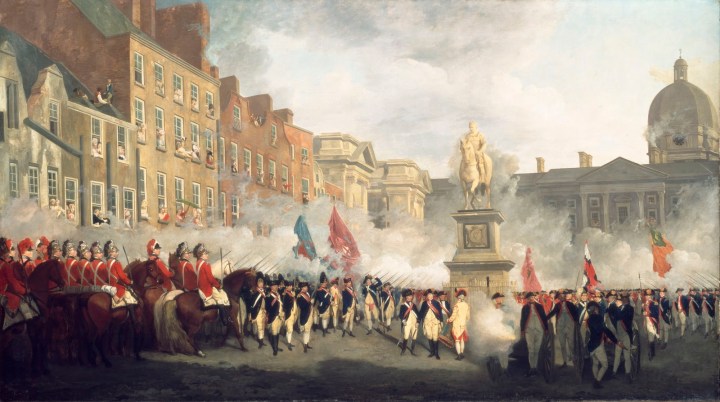
Francis Wheatley, The Dublin Volunteers on College Green, 4th November 1779, 1779–80, oil on canvas, 175 × 323 cm
(Dublin: National Gallery of Ireland)
◊ ◊ ◊ ◊ ◊
Now on view at the National Gallery of Ireland:
Creating History: Stories of Ireland in Art
National Gallery of Ireland, Dublin, 8 October 2016 – 15 January 2017
Curated by Brendan Rooney
This exhibition represents the Gallery’s principal contribution to the Decade of Centenaries. It brings together over 50 paintings spanning the seventeenth century to the 1930s, depicting or inspired by episodes in Irish history from the early fifth century arrival of St. Patrick to the establishment of the Free State. A significant number of paintings in the exhibition are drawn from the Gallery’s collection, many of which have undergone extensive conservation in preparation for this show, such as Jan Wyck’s The Battle of the Boyne, Francis Wheatley’s The Dublin Volunteers on College Green, 4th November 1779, and Joseph Patrick Haverty’s The Monster Meeting at Clifden. Other artists represented in the exhibition include James Barry, Charles Russell, John Lavery, Richard Thomas Moynan, Seán Keating, and Jack B. Yeats, complemented by loans from public and private collections in Ireland and overseas.
Brendan Rooney, ed., Creating History: Stories of Ireland in Art (Dublin: Irish Academic Press, 2016), 312 pages, ISBN: 978-1911024286, €25.
Brendan Rooney is Curator of Irish Art at the National Gallery of Ireland, and author/editor of numerous works on Irish art, including Thomas Roberts: Landscape and Patronage in Eighteenth-Century Ireland (2009) and A Time and a Place: Two Centuries of Irish Social Life (2006).
Exhibition | Festivities and Entertainment at Court

Slodtz Brothers, Stage backdrop, Temple of Minerva, Olympia version, Fontainebleau, 1754.
◊ ◊ ◊ ◊ ◊
Press release for the exhibition:
Festivities and Entertainment at Court / Fêtes et divertissements à la Cour
Château de Versailles, 29 November 2016 — 26 March 2017
Curated by Béatrix Saule, Élisabeth Caude, and Jérôme de La Gorce
As a political monarch, King Louis XIV took ‘grand entertainment’ to the height of magnificence, making Versailles a venue for monumental, extraordinary, and fantastical parties and shows. The king had a shrewd understanding of the human mind and understood that “this society of pleasure, which gives members of the Court an honest familiarity with [the sovereign], and touches and charms them more than can be said,” was necessary for the political framework he had built (Louis XIV, Memoirs for the Instruction of the Dauphin, 1661). Everyday life in Court required multiple forms of entertainment, and extraordinary royal events needed to surprise and enthrall the court, the kingdom—all of Europe. Each of his successors maintained the tradition of splendid, creative shows in their own way, according to their own tastes and the fashions of the time.
 This exhibition presents the infinite variety and ingenuity of entertainment in the court, whether put on by the king or enjoyed by the court. These included all forms of public shows, comedies, operas, concerts, fireworks, and light displays, as well as private performances in which Seigneurs and Ladies of the court went on stage themselves. The was a large amount of gambling, leading to fortune or ruin, as well as physical activities in which members of the court had to shine, including hunting, dancing in balls and masked balls, pallmall, and real tennis.
Spanning three reigns, from Louis XIV to the Revolution, the exhibition does not aim to be exhaustive but focuses on the courtier’s point of view. A large selection of clothing, paintings, objects, and graphics from French and foreign public and private collections convey the wide range of entertainment and the refinement associated with them. The objects are accompanied by large visuals, 3D images, and immersive scenes that invite visitors to rediscover the atmosphere in the venues—some of which no longer exist—and imagine what it would be like to be in the king’s court.
Section 1: Hunting
Versailles was initially built as a hunting lodge, and the sport always remained the most popular form of royal entertainment. All three kings partook in the activity several times a week, but Louis XV was the most enthusiastic adherent. He enjoyed hunting with weapons but was especially fond of hunting with dogs. To accompany the king on a hunting trip, courtiers had to fully master the customs of hunting with hounds or to share the sovereign’s passion and thus gain his favour. Hunting was also a means of relaxation; the speed and open air were a way to escape from the constraints of court life.
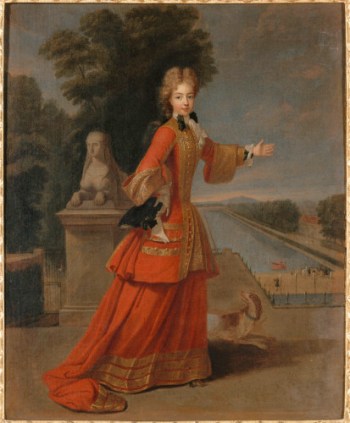
Pierre Gobert, Portrait of Marie Adélaïde of Savoy, Duchess of Burgundy in Her Hunting Attire, 1704 (RMN-GP / Château de Versailles).
Themes
• The hunting ritual: moments, participants, personnel, clothing, and equipment
• The game, horses, and especially the importance of hounds
• Courteousness: the role of the ladies and the pleasure of picnics
Section 2: The Last Carousels
Carousels were another equestrian pleasure, replacing the tournaments that were banned after the death of Henry II. The last carousels were held at Versailles in 1664 during the Delights of the Enchanted Island party and in 1685 and 1686 in the Great Stables at the initiative of the Grand Dauphin.
This equestrian ballet was doomed to fade out, since in the 18th century the Seigneurs of the court could no longer afford its exorbitant cost, notably to the luxurious clothing required.
Section 3: Temporary Stages and Venues
The whole of Versailles, and even Marly and Trianon, served as a theatre. Until the Royal Opera House was finally built in Versailles in 1770 for the Dauphin’s wedding, stages were set up in the park and its perspectives, in various apartments using removable installations, and even in rooms which were temporarily or permanently modified for the purpose. This proliferation of stages demonstrates the incredible theatre culture in Versailles.
Themes
• The Temple of Minerva, the fully preserved unique stage backdrop from the Ancien Régime, which has been restored and reassembled for the exhibition.
• Five videos guide visitors through sites of ordinary and extraordinary spectacles, using 3D modelling to present both still-existing and bygone performance venues.
Section 4: Stage Performances
All performances, from comedies to tragedies, operas to ballets, fell into one of three categories: extraordinary (open to a large audience), ordinary (reserved for the court), and society theatre (highly exclusive). In particular, there were constant repeat performances, mixing of genres within a single evening and a predilection for the comical and even burlesque.
Ordinary Theatre
Ordinary performances, or ‘court performances’, were given in the winter three or four evenings a week, from 6:00 to 10:00, by three dedicated troops. They alternated between French comedy, Italian comedy, and tragedy. Italian comedy notably included comedies in three acts, entertainment and pieces de circonstance of all kinds. Marivaux was an official playwright of Italian comedies. French comedy was characterised by grand five-act dramas, comedies and tragedies. Lyric tragedies and tragic operas were put on by the Royal Academy of Music. Since Versailles did not have a suitable theatre space (unlike Saint-Germain and Fontainebleau), tragedies were performed without scenery, mechanisms or costumes. Under Louis XV, who did not much care for music, lyric works were rarely performed for ordinary audiences.
Society Theatre
• For the education of the Duchess of Burgundy in the Grand Chamber of Mme de Maintenon. She was taught by Baron. Edifying plays by Racine were put on (Esther at Saint-Cyr but attended by the entire court, and Athalie in 1702), as were plays that were specially written by Duché, the king’s Valet de Chambre.
• The Marquise de Pompadour in the theatre in the private apartments on the Ambassadors’ Staircase. During four seasons, from 1747 to 1750, from 6:00 until 10:00 or 11:00pm, plays were performed in two parts, with an interval for scenery and costume changes. Additional pieces were recited or sung alongside works from the great repertoire by Molière, Lully, and others.
• The Seigneurs’ Troop at the Petit Trianon. Much less professional than Mme de Pompadour’s troop, the Seigneurs’ Troop was composed of ten or so artists performing simple plays, comic operas and comedies. There were three major seasons: August and September of 1780, the summers of 1782 and 1783, and the one-time, crowning performance of The Barber of Seville (Beaumarchais) on August 19, 1785 (with the queen as Rosine, Artois as Figaro, and Vaudreuil as Count Almaviva) in front a very small audience and with the playwright present as a guest.
Section 5: Concerts

Jean-Marc Nattier, Portrait of Madame Henriette of France Playing the Viola da Gamba (RMN-GP / Château de Versailles).
Music was everywhere. Under the aegis of the all-powerful Superintendent of His Majesty’s Music, the Musique de la Chamber was in charge of the Court’s daily entertainment. Balls, comic ballets, lyric tragedies and dances at evening gatherings were all part of the Musique de la Chambre’s remit.
Chamber Concerts and, under Marie Leszczyńska, the Queen’s Concerts
Chamber concerts were performed without costumes, backdrops, or ballets and lasted an hour. The princes would sometimes play instead of musicians who were not up to standard. Grand chamber concerts were also held two or three times a week.
Concerts in the King’s Chamber
The flautist Michel de la Barre quickly became a frequent performer in the rooms of Versailles, alongside François Couperin, Antoine Forqueray and the Hotteterre brothers, at the famous concerts in the King’s Chamber, which Louis XIV enjoyed toward the very end of his reign.
Private Practice
Louis XIV was very skilled at the lute and guitar, which had until then been considered commoners’ instruments but which he made respectable. The Mesdames played the violin and viola da gamba, and Marie Antoinette played the harp.
Section 6: Promenades and Outdoor Games
Like hunting, with which they alternated, promenades and strolls in the gardens provided a breath of fresh air. Under Louis XIV, promenades were a courtly affair, with the king travelling on foot, in a wheeled chair or in a carriage. Conversely, Louis XV and Louis XVI preferred to take their strolls in a less ceremonial manner, so their presence did not detract from the pleasure.
Groves were constant sources of surprise and marvel thanks to their variety, landscape design and water features, providing a cool, summertime refuge full of birdsong.
Trianon was popular for its botanical collections, and the Menagerie for its curious animals. The canal was perfect for boating in the summer and ice skating and sled races in the winter.
Between Versailles, Trianon, and Marly, skilled players of pall-mall and real tennis had a number of courts at their disposal. Boldness and athleticism were a must in a competitive world where education and personality traits required players to give it their all in appearance and in reality.
Section 7: Games
In the court, games took three forms:
• ‘The king’s game’ and ‘the queen’s game’, played at evening gatherings in the apartments at Versailles during the reign of Louis XIV. Marie Leszczynska’s game was played in the Peace Room starting in 1739. It continued in the Royal Room at Marly during all three reigns and included lotteries.
• ‘The royal game’ was played at evening gatherings in the State Apartments during grand royal festivals as a spectacle open to a wider audience than just the court.
• Private games, open only to certain members and more with a more relaxed etiquette. The games were played after the king’s supper in his private rooms or in the accommodation of one of the courtiers.
High-stakes games attracted bold and expert players, both male and female. Losses meant financial dependence on the king. To be permitted to play at the king’s table was a mark of favour that made and lost fortunes.
Games required luxurious furniture and accessories. Agreements were put in place to codify the Court’s house rules.
• Card games: lansquenet, ombre, quadrille, reversis, brelan, whist, pharaoh
• Games of chance: dice, lotto, cavagnole
• Strategy games: chess, checkers, and especially tric trac
• Games of skill: billiards, gym sets
Section 8: Balls and Masquerades
Court Balls
In the time of Louis XIV, balls were held every Saturday in the Mars Room or in the gallery next to the War Room. Under Louis XV, dances at Versailles were more spread out, taking place mainly in the Hercules Room but also sometimes spreading to four locations: the Hercules, Mars, Mercury, and Apollo Rooms. Later on, the theatre in the Princes’ Courtyard, which could be transformed into a ballroom when enlarged, was also used. Beginning in 1775, Marie Antoinette restored the pomp to court balls, which she held on Wednesdays […] from the start of the year until Lent, often in wooden houses constructed temporarily for the purpose.
Dances
Ballroom dancing required great technical skill acquired from childhood. Dancing was practiced under the supervision of dance masters (Beauchamp, Pécour and Ballon, and later Lany, Laval, Gardel, and Vestris). Balls began with group dances (the branle under Louis XIV, then later the gavotte), followed by couples’ dances (frequently minuets, which were replaced by contra dances in the 1750s).
Formal Balls and Masked Balls
Held for special occasions, formal balls involved a higher degree of ceremony and pomp than court balls and were held in the largest rooms (the Royal Stables, the Hall of Mirrors, the Royal Opera House). During Carnival and other major celebrations, ordinary balls were replaced by masked balls, which were an opportunity to show off extravagant costumes, although in terms of choreography the two were nearly indistinguishable.
Section 9: Behind the Scenes
Of Monsters and Machines
Special effects, monsters, splendour, and sound effects transported courtiers to fantastical worlds that were as much a testament to the inventiveness of the engineers and designers of the King’s Chambers as to the kings’ passion for Baroque effects.
Fireworks and Illuminations
No extraordinary event could be held without a firework show, with temporary constructions set aflame, illuminations along the grand canal, and fireworks in the Marble Courtyard. Every spectacle required creativity, technical knowledge, and ingeniousness; only the best pyrotechnicians were hired.
Credits
Curators
• Beatrix Saule — Head curator of the exhibition, Director – general curator of the Musée National des Chateaux de Versailles et de Trianon
• Elisabeth Caude — General curator, Head of the Department of Furniture and Works of art of the Musée National des Chateaux de Versailles et de Trianon
• Jerome de La Gorce — Emeritus director of research at the CNRS, Scientific advisor at the Centre de recherche du chateau de Versailles
Artistic Director
Patrick Hourcade
New Book | A Civic Utopia
When we noted the exhibition A Civic Utopia this past summer, we didn’t include information on the catalogue, which is now available from Drawing Matter:
Nicholas Olsberg and Basile Baudez, A Civic Utopia: Architecture and the City in France, 1765–1837 (London: Drawing Matter, 2016), 52 pages, ISBN: 978-0995630901, £20.
 This large format, finely illustrated edition is published to coincide with the exhibition A Civic Utopia at The Courtauld Gallery of Art. In addition to the ‘Introduction’, it contains an essay entitled ‘Law, Order and the Beautiful’ by Nicholas Olsberg and ‘Case Studies’ by Basile Baudez. The essay explores the Enlightenment themes: A New Rome, Porta, Ratio, Lex, Sanitas, Spectaculum, Lexicon, and Exemplum. The case studies examine the work of Louis Combes, Pierre-François-Léonard Fontaine, André Sainte-Marie Châtillon, Paul Piot, François-Joseph Bélanger, François-Joseph Bélanger, and Louis-Pierre Baltard. The book expands on a selection of architectural drawings from the exhibition that show public building and public space in Enlightenment-era France. The drawings served as models for the expression of an ordered and open civic life as the foundation of an ideal polity. They responded to the urgings of writers, critics, and philosophes to make a systematic effort toward civic improvement, or what Voltaire entitled the “embellissement de la ville.”
The book traces how, over the next century, a new model of the modern French city emerged, one that deployed a consistent architecture capable of expressing the liberal qualities of the civic life within it: ordered, open, and dignified. These ideal forms, the methods of visualising and realising them through drawing, and the techniques of design and construction developed to build them, were circulated through engravings and compendia throughout the world. With their new emphases on turning their principal face out towards the street and square, on the horizontal line, and on the evident entrance, these models established an international aesthetic for the architecture of public life, and a universal system of architectural training.
Basile Baudez is maître de conférences at Université Paris-Sorbonne, Paris IV and visiting professor at the Ecole nationale des Chartes. His main areas of research are the history of architectural schools and the Beaux-Arts system and the history of architectural representation in the Western world. Recent publications include, Les Hôtels de la Guerre et des Affaires étrangères à Versailles (co-editor), and Chalgrin, architectes et architecture entre l’Ancien Régime et l’Empire as well as numerous journal articles. His current book project addresses the history of colour in architectural representation.
Nicholas Olsberg is an historian, archivist, curator and writer. As Editor of the Colonial and State Records of South Carolina from 1967–74, he published numerous studies on political and civic life in the eighteenth and early nineteenth centuries, and as Archivist of the Commonwealth from 1975 to 1979 produced a major exhibition on the 1790 constitution of Massachusetts. His recent published works in architecture include major monographs on Cliff May, John Lautner, Arthur Erickson, and Ernest and Esther Born; a series of essays on Frank Lloyd Wright; and regular contributions to journals of architecture.










leave a comment