Exhibition | Wooden Sculptures, Busts, Reliquaries, and Shrines
Now on view at Pinacoteca Giovanni Züst:
Sculptures, Busts, Reliquaries, and Shrines from the Middle Ages to the Eighteenth Century
Legni Preziosi: Sculture, Busti, Reliquiari e Tabernacoli dal Medioevo al Settecento
Pinacoteca Giovanni Züst, Rancate, Switzerland, 16 October 2016 — 22 January 2017
Curated by Edoardo Villata
 La mostra presenta una carrellata di sculture in legno dal XII al XVIII secolo— Madonne, Crocifissi, Compianti, busti, polittici scolpiti e persino un Presepe—provenienti da musei, chiese e monasteri del territorio ticinese, dove questi autentici capolavori sono stati oggetto di devozione e ammirazione per secoli. L’allestimento è stato curato da Mario Botta, che ha studiato, a titolo completamente gratuito, ogni dettaglio, affinché il visitatore sia immerso in un’atmosfera suggestiva e solenne, in cui la sacralità delle immagini esposte risulta pienamente valorizzata.
Edoardo Villata, Legni Preziosi: Sculture, busti, reliquiari e tabernacoli dal Medioevo al Settecento nel Cantone Ticino (Milan: Silvana, 2016), 208 pages, ISBN: 978 8836 634767, $55.
The Burlington Magazine, December 2016
The eighteenth century in The Burlington (the issue is dedicated to ‘Art in Britain’):
 The Burlington Magazine 158 (December 2016)
A R T I C L E S
• Lydia Hamlett, “Pandora at Petworth House: New Light on the Work and Patronage of Louis Laguerre,” pp. 950–55.
• Jennifer Melville, “Lady Forbes of Monymusk: A Rediscovered Portrait by Joshua Reynolds,” pp. 956–60.
• Brendan Cassidy, “A Portrait by Gavin Hamilton: Sir John Henderson of Fordell,” pp. 961–63.
• Alex Kidson, “David Solkin’s Art in Britain, 1660–1815 (Paul Mellon Centre for Studies in British Art, 2015),” pp. 964–67.
L E T T E R S
• Peter Lindfield, “A Further Allusion to Strawberry Hill at Lee Priory, Kent,” p. 979.
• Nicholas Penny, “Hugh Honour,” p. 979.
R E V I E W S
• Susanna Avery-Quash, Review of Lucilla Burn, The Fitzwilliam Museum: A History (Philip Wilson Publishers, 2016), p. 980.
• Greg Smith, Review of the exhibition catalogue, Tim Barringer and Oliver Fairclough, Pastures Green & Dark Satanic Mills: The British Passion for Landscape (Giles, 2014), pp. 981–82.
• Barry Bergdoll, Review of Stefan Koppelkamm, The Imaginary Orient: Exotic Buildings of the 18th and 19th Centuries in Europe (Axel Munges, 2015), p. 982.
• Giles Waterfield, Review of the exhibition catalogue, Victoria Avery, Melissa Calaresu, and Mary Laven, eds., Treasured Possessions from the Renaissance to the Enlightenment (Philip Wilson Publishers, 2015), p. 988.
• Malcolm Bull, Review of the exhibition In the Light of Naples: The Art of Francesco de Mura (Cornell Fine Arts Museum, Rollins College, Winter Park, 2016; Chazen Museum, University of Wisconsin-Madison, 2017; The Frances Lehman Loeb Art Center, Vassar College, Poughkeepsie, 2017), pp. 1006–07.
S U P P L E M E N T
• Tim Knox, “Recent Acquisitions (2012–16) at the Fitzwilliam Museum, Cambridge,” pp. 1017–28.
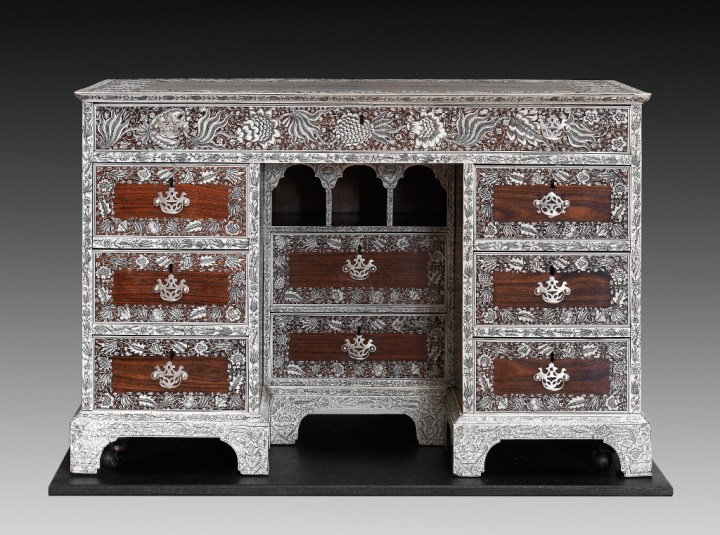
The Rumbold Desk, by an unknown craftsman from Vizagapatam, Southern India, ca. 1750–60, rosewood inlaid with ivory, silver handles, 76 × 113 × 62 cm. Accepted in Lieu of Inheritance Tax by HM Government and allocated to the Fitzwilliam Museum, 2016 (M.3–2016). This Anglo-Indian desk has been on loan to the Fitzwilliam Museum in Cambridge since 2012 and is one of the finest of a very small group of similar desks made for British patrons in India at Vizagapatam (near Madras), a centre for the manufacture of such luxurious ivory-inlaid furniture. It belonged to Sir Thomas Rumbold, 1st baronet (1736–91), a British administrator in India, who amassed a great fortune in the service of the East India Company and served as Governor of Madras from 1777 to 1780.
Exhibition | The Variable Line: Master Drawings
Press release (via Art Daily). . .
The Variable Line: Master Drawings from Renaissance to Contemporary
Redwood Library & Athenæum, Newport, 1 December 2016 — 5 March 2017
Curated by Benedict Leca
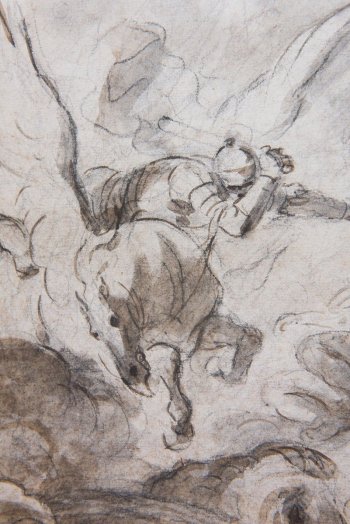
Jean-Honoré Fragonard, Ruggiero Attacks the Orc (illustration for Ariosto, Orlando Furioso), pencil and wash on paper.
Departing from the appreciation that drawing not only remains foundational to art theory and pedagogy, but that it is also undergoing a discernible resurgence in current artistic practice, the Redwood Library and Athenaeum presents The Variable Line: Master Drawings, Renaissance to Contemporary. Organized by the Redwood Library, the sole U.S. venue, and featuring forty-five works, the exhibition is arranged as a survey featuring many types of drawings, rendered in a rich variety of styles and techniques, and treating a broad range of themes.
“Artists have always relied on drawing to put down ideas quickly—it serves this purpose perhaps even more now as the medium on-the-go appropriate to today’s global art world. In that sense drawing has always attached to the conceptual. Certainly drawing is integral to the larger turn towards conceptual thinking in contemporary art, from Sol Lewitt to Julie Mehretu,” explains Benedict Leca, Redwood Executive Director and exhibition curator. “That said, it is interesting to note how the works by contemporary women artists on view are at once visibly painstaking in their technique and contrary to traditional notions of skill.”
The presentation is arranged into seven sections—Académies and the Centrality of the Figure, Line and the ‘Grand Manner,’ Fragonard and Ariosto, The Light of Italy and the Lure of the Antique, Drawing the Pastoral, Landscape and the Bucolic, and Master/Mistress: the Gendered Line—enabling visitors to identify both continuities and ruptures in theme and technique across 500 years of drawing practice in Western Europe and America. Upending the now conventional dominance accorded to digital media or even painting, the selection of drawings on display crossing five centuries—from Renaissance to contemporary—speaks to drawing’s eternal relevance as consonant to art making in any medium, be it painting, sculpture, or video. It is for this reason that drawing’s ubiquity has stretched unbroken to this day, routinely entering our own lives as doodle or sketch. From the most pervasive to the most individual, drawing, like handwriting, thus offers historical perspectives through the continuities inherent to the medium, as well as insights into the stylistic idiosyncrasies of its adaptation by individual artists. The immutable simplicity of a line drawn across paper, parchment, or mylar makes the drawings exhibited here among those rare objects that enable visitors to ride along on the creative journey of both Renaissance and contemporary artists.
Exhibition | Lafayette and the Antislavery Movement
Now on view at The Grolier Club:
‘A True Friend of the Cause’: Lafayette and the Antislavery Movement
The Grolier Club, New York, 7 December 2016 — 4 February 2017
Curated by Olga Anna Duhl and Diane Windham Shaw
 Although the Marquis de Lafayette is popularly known as ‘America’s Favorite Fighting Frenchman’ in the current Broadway musical Hamilton, his role as an ardent abolitionist has not received the same kind of attention as his contributions to the American Revolution. The groundbreaking exhibition A True Friend of the Cause: Lafayette and the Antislavery Movement, on view at the Grolier Club from December 7, 2016 to February 4, 2017, is designed to offer a more comprehensive look at the man who was a ‘hero of two worlds’. While Lafayette’s contributions in the areas of politics, diplomacy, and the military have received renewed scholarly and public recognition, his abolitionist activities are not widely known, nor have they been adequately explored in any major exhibition or publication in the last twenty-five years. This exhibition brings into focus Lafayette’s sustained efforts in France, the United States, and South America on behalf of the abolition of slavery.
Co-curators Olga Anna Duhl, Oliver Edwin Williams Professor of Languages, and Diane Windham Shaw, Director of Special Collections and College Archivist, Skillman Library, Lafayette College, offer a comprehensive view of Lafayette’s activities. Drawn from Lafayette College’s rich collections of 18th- and 19th-century rare books, manuscripts, paintings, prints, and objects—some of which are on public view for the first time—the approximately 130 works in the exhibition also include loans from Cornell University and the New-York Historical Society.
The Marquis de Lafayette (1757–1834) fought in the American War of Independence; was a friend to the Native Americans; defended the rights of French Protestants and Jews during the French Revolution; supported the national emancipation movements of the people of Poland, Ireland, Italy, Greece, and South America; and promoted the ideas and causes of women. Most significantly, he remained throughout his life a fervent advocate of the abolition of slavery and the African slave trade, earning the recognition of prominent British abolitionist, Thomas Clarkson, as “a true friend of the cause.” Early on, Lafayette learned that the ideals of liberty and equality during the revolutionary era hardly benefited all members of society. In fact, one of the most daunting paradoxes of that era, which became a source of reflection and action for him, was the incompatibility between the national independence of the newly formed United States and the practice of slavery and slave trade.
The exhibition traces Lafayette’s first encounters with slaves on the South Carolina coast upon his arrival in America in 1777. Highlights of his role in service with the Continental Army are revealed in his letters to his mentor, George Washington, written from Valley Forge, Newport, and Virginia during the Yorktown Campaign, where Lafayette writes of the intelligence gathered by one of his spies, James, an enslaved African American. On view is a highly significant letter written by Lafayette to Washington requesting his partnership in a venture to free slaves. Stunning French prints of the American Revolution are included, as is an influential portrait, Lafayette at Yorktown, by Jean-Baptiste Le Paon.
The impact of abolitionist ideas on Lafayette is represented by the Marquis de Condorcet’s seminal work of 1781, Réflexions sur l’esclavage des nègres, and writings of British abolitionists Thomas Clarkson and Granville Sharp. Lafayette’s decision to move forward on his own by purchasing property in French Guiana to carry out his experiment in gradual emancipation is documented by an extraordinary group of documents on loan from the Cornell University Library. Included among them is a list of the enslaved who were selected to work on the property. Maps, prints, and early travel volumes recreate the image of this South American colony.
Lafayette’s complicated story during the French Revolution includes his membership in the French Society of the Friends of Blacks. Publications of the Society are on view, as are printed versions of landmark French documents— the Declaration of the Rights of Man (1789), the French Constitution (1791), and the decree abolishing slavery in the French colonies (1794). Lafayette’s hasty departure from France in 1792 to avoid the guillotine is documented by the beautiful sword that was taken from him when he was arrested and imprisoned by the Austrians, which stands as a symbol of his personal experience with captivity. Lafayette’s return to a quiet life in France in 1800 found him still passionately committed to the antislavery movement, rejoicing when England outlawed the slave trade in 1807. Commemorative volumes and prints celebrate that milestone.
Lafayette’s last visit to America in 1824–25 was an extravagant moment in the nation’s history. The exhibition includes some of the spectacular souvenirs that were made to commemorate his visit—china, textiles, and even a clothes brush with the bristles dyed to spell “Lafayette 1825.” Lafayette’s emphasis on greeting all Americans is highlighted, including his visit to the African Free School in New York City, where he received a welcome address by an eleven-year-old student. Calligraphed and delivered by the student himself, James McCune Smith, who went on to become one of America’s first black physicians and a noted abolitionist, this text is a loan from the New-York Historical Society Library. The Farewell Tour section also documents Lafayette’s friendship with fellow antislavery advocate, Frances Wright, and his support of her gradual emancipation project “Nashoba” near Memphis, Tennessee.
Also included are letters from James Madison, Thomas Jefferson, and John Marshall, and letters from Lafayette to Albert Gallatin, William H. Crawford, Joel Poincett, and others. Even after his death in 1834, his influence continued, particularly in America, where abolitionists, both black and white, continued to cite his example. Finally, the exhibit includes special items chosen to remind us of the human face of slavery—manumission papers of a woman and a man freed by their Quaker owners; the pension records of an African American Revolutionary soldier from Connecticut; and the first American printing of the Brooks engraving of slaves tightly packed on board a slave ship. Despite the changing fortunes and conflicting reviews of his career, Lafayette has remained a compelling figure in world history, and the interest in his contributions shows no sign of diminishing.
Lunchtime Guided Tours with the Curators
December 7 and 14, January 11 and 18, and February 1, 1–2pm
Roundtable Discussion: Lafayette and the Antislavery Movement
24 January 2017, 2–3:30pm
With co-curators and moderators Olga Anna Duhl and Diane Windham Shaw and featuring panelists Laura Auricchio (The New School), François Furstenberg (Johns Hopkins University), and John Stauffer (Harvard University). Reception to follow.
◊ ◊ ◊ ◊ ◊
The catalogue is available from Oak Knoll Press:
Olga Ann Duhl and Diane Windham Shaw, ‘A True Friend of the Cause’: Lafayette and the Antislavery Movement (New York: The Grolier Club and Lafayette College, 2016), 76 pages, ISBN: 978 160583 0650, $40.
Exhibition | Curious Revolutionaries: The Peales of Philadelphia
From APS:
Curious Revolutionaries: The Peales of Philadelphia
American Philosophical Society, Philadelphia, 7 April — 30 December 2017

Charles Willson Peale, Self Portrait as a Revolutionary War Captain in the Philadelphia Brigade, 1777–78 (Philadelphia: American Philosophical Society).
The Peales were an extraordinary early American family, curious in every sense of the word. They were patriots, soldiers, politicians, inventors, explorers, naturalists, entrepreneurs, and world-class, ever busy tinkerers. Above all, the Peales embraced the Enlightenment ideal to expand man’s universal knowledge while improving life on earth.
Charles Willson Peale (1741–1827) and his brother James Peale (1749–1831) began as portrait-painters and miniaturists on the eve of the Revolution. In 1786, Charles Willson converted his portrait studio into the nation’s first successful public museum, housed in the American Philosophical Society from 1794 to 1810. By educating the American public and increasing man’s understanding of the natural world, he believed his museum would cultivate a more enlightened citizenry and advance America’s prestige around the world. The second and third generations of aptly named Peales—most notably Rembrandt, Rubens, Benjamin Franklin, and Titian Ramsay—continued the family business as significant artists, naturalists, and inventors.
Curious Revolutionaries is divided into three major thematic sections: Nationhood, The Philadelphia Museum, and The Peale Family Legacy. The exhibition draws on the APS Library and Museum holdings relating to the Peale family. These include the Library’s Peale-Sellers Family Collection of 19 linear feet, comprising some 38 boxes and 147 volumes of archival materials relating to the family. The exhibition showcases letters and diaries, as well as sketchbooks, painting palettes, hollow-cut silhouettes, and watercolors. The exhibition also features pieces from the APS Museum collections, including oil portraits of early American scientists such as David Rittenhouse; painted miniatures of Peale family members; and patent models, including miniature fireplace designs by Peale and his sons.
On view from April to December 2017, Curious Revolutionaries reveals the Peale family’s role in shaping early American public culture through innovations in art, science, and technology. Through their quest for personal prestige, as well as their commitment to advancing the new American republic, the Peales became influential members of Philadelphia’s artistic, intellectual, and political communities.
Exhibition | Gathering Voices: Thomas Jefferson and Native America
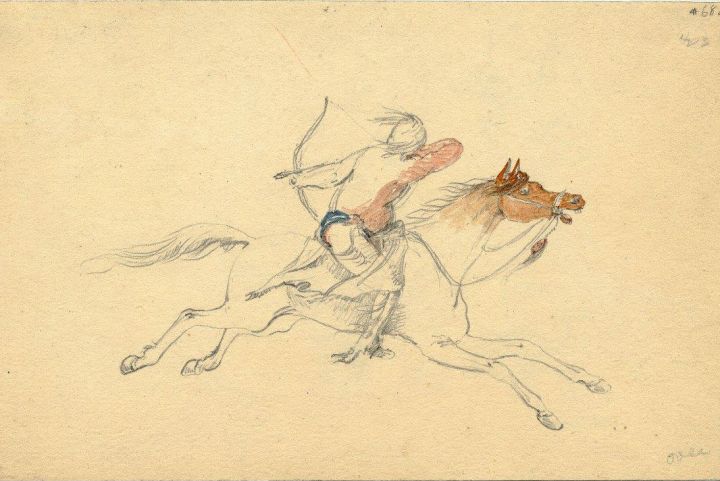
Titian Ramsay Peale, Indian on Horseback, 1820, pencil and watercolor on paper
(Philadelphia: American Philosophical Society).
◊ ◊ ◊ ◊ ◊
Closing this month at APS:
Gathering Voices: Thomas Jefferson and Native America
American Philosophical Society, Philadelphia, 15 April — 30 December 2016
Thomas Jefferson was president of the American Philosophical Society from 1797 to 1814—before, during, and after he was President of the United States—and the Society was one of Jefferson’s primary ties to Philadelphia even after he left for Washington. As the site of Charles Willson Peale’s famed natural history museum, for which Jefferson served as chairman of the first Board of Visitors, the American Philosophical Society Museum provides an ideal venue for a series of exhibitions about Jefferson. This tripartite exhibition series—exploring Jefferson as a statesman, as a promoter of science and exploration, and as a student of Native America and indigenous languages—adds not only to our historical understanding of Jefferson’s accomplishments but also demonstrates how his multifaceted legacy continues to be relevant today.
 The last of three exhibitions, Gathering Voices, tells the story of Jefferson’s effort to collect Native American languages and its legacy at the Society. Jefferson had an abiding interest in Native American culture and language, while, at the same time, supporting national policies that ultimately threatened the survival of Indigenous peoples. As president of the APS from 1797 to 1814, Jefferson charged the Society with collecting vocabularies and artifacts from Native American nations. Over the next two hundred years, the APS would become a major repository for linguistic, ethnographic, and anthropological research on Native American cultures.
Gathering Voices traces the Native American language collection at the APS from Jefferson’s vocabularies to the current language revitalization projects at the Society’s Center for Native American and Indigenous Research (CNAIR). Audio stations will allow visitors to hear Native American voices from the past speaking their own languages, and interactive touchscreens will reveal the dramatic extent of Native American language loss as well as the active tribal revitalization efforts underway in collaboration with CNAIR.
“I … would with all possible pleasure have communicated to you any part or the whole of the Indian
vocabularies which I had collected, but an irreparable misfortune has deprived me of them.”
—Letter from Thomas Jefferson to Benjamin Smith Barton, 21 September 1809
When Thomas Jefferson left Washington after two terms as President of the United States, he packed 50 Native American vocabulary lists in a trunk and sent them on a river barge back to Monticello along with the rest of his possessions. Somewhere along the journey, a thief stole the heavy trunk, thinking it was full of treasure. Upon discovering it was only filled with papers, he tossed the seemingly worthless contents into the James River.
The loss of the vocabularies represented the destruction of 30 years of collecting on Jefferson’s part. Only a few precious fragments were rescued from the muddy banks along the shore. Those fragments, along with Jefferson’s original letter to Barton describing the theft, are on view in the exhibition Gathering Voices: Thomas Jefferson and Native America.
Exhibition Advisors
Dr. Margaret M. Bruchac (Abenaki) is an Assistant Professor of Anthropology, Associate Professor in the Penn Cultural Heritage Center, and Coordinator of the Native American & Indigenous Studies Initiative at the University of Pennsylvania. She directs two restorative research projects—“On the Wampum Trail” and “The Speck Connection”—that endeavor to reconnect objects and data in museums and archives with Indigenous communities and traditions. Her publications include Dreaming Again: Algonkian Poetry (Bowman Books 2012), Indigenous Archaeologies: A Reader in Decolonization (Left Coast Press 2010), and the forthcoming Consorting With Savages: Indigenous Informants and American Anthropologists (University of Arizona Press).
Richard W. Hill, Sr. (Tuscarora) is an artist, writer, and curator who lives at the Six Nations Community of the Grand River Territory in Ontario, Canada. Over the years, Rick has served as the Manager of the Indian Art Centre, Ottawa, Ontario; Director of the Indian Museum at the Institute of American Arts in Santa Fe, NM; and the Assistant Director for Public Programs at the National Museum of the American Indian, Smithsonian Institution; and taught at the State University of New York at Buffalo. Currently he is the Senior Project Coordinator, Deyohahá:ge – Indigenous Knowledge Center at Six Nations Polytechnic.

Excerpt from the vocabulary of the Unquachog (Unkechaug) Indians, collected by Thomas Jefferson, Long Island, 1791
(Philadelphia: American Philosophical Society).
Exhibition | Opulent Fashion in the Church
From
Opulent Fashion in the Church
The Cleveland Museum of Art, 24 September 2016 — 24 September 2017

Chasuble, early eighteenth century, Genoa, silk, gilt-metal thread: velvet, cut and uncut, 106 × 68 cm (The Cleveland Museum of Art, gift of Mr. and Mrs. J. H. Wade, 1916.1443.1).
Throughout history, precious works of art have been used in worship. Radiant textiles—cherished symbols of the majesty of God as well as the wealth and power of the Catholic Church—embellished the high altar and clothed the clergy. Quality was expensive. Lustrous silk thread dyed vibrant colors was transformed into luxury textiles by skilled designers, weavers, and embroiderers. One of the most beautiful and important vestments is the chasuble, the outer garment worn for the Catholic Mass. By the 1700s, its original full shape, influenced by fashion, acquired a fiddle-shaped front to facilitate arm movement and a straight-sided back. It was worn over a long white garment called an alb, enriched with the most costly material: lace.
As part of the museum’s centennial celebration, this exhibition honors Mr. and Mrs. Jeptha H. Wade II, the museum’s visionary co-founder and president, who in 1916 donated most of these European vestments of the 1600s and 1700s with regalia from a matching set. The Cleveland Museum of Art is generously funded by Cuyahoga County residents through Cuyahoga Arts and Culture. The Ohio Arts Council helped fund this exhibition with state tax dollars to encourage economic growth, educational excellence, and cultural enrichment for all Ohioans.
Exhibition | Master Drawings Unveiled: 25 Years of Major Acquisitions
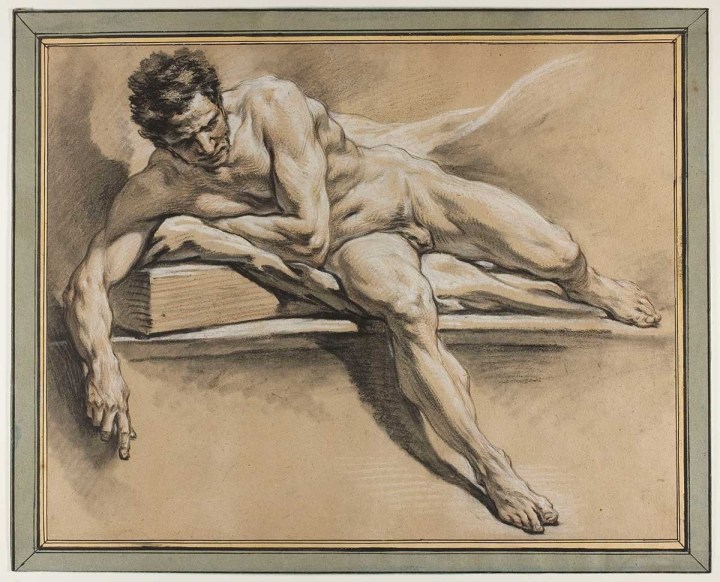
François Boucher, Academic Study of a Reclining Male Nude, ca. 1750
(Art Institute of Chicago, Regenstein Endowment Fund).
◊ ◊ ◊ ◊ ◊
Press release (8 June 2016) from AIC
Master Drawings Unveiled: 25 Years of Major Acquisitions
Art Institute of Chicago, 27 August 2016 — 29 January 2017
The Art Institute of Chicago presents 84 hitherto unexhibited masterful drawings carefully and thoughtfully acquired over the last quarter century in an exhibition titled Master Drawings Unveiled: 25 Years of Major Acquisitions. Building upon an established and world-renowned collection, these masterpieces range from the French and Italian schools of the 17th century to Swiss, German, and Austrian Romanticism, midcentury Realism, Belgian Symbolism and into the mid-20th century. The recent acquisitions will be on display from August 27, 2016 to January 29, 2017 and provide visitors a full range of artistic achievement, featuring key works by François Boucher, Henri Fantin-Latour, Edgar Degas, Odilon Redon, Francis Picabia, Grant Wood, and other iconic figures.
The exhibition is a culmination of the legacy and focus of curator Suzanne Folds McCullagh, who along with Mark Pascale, Martha Tedeschi, and Douglas Druick strategically acquired the works to reinforce the strengths of the collection and add new dimensions and greater depth. The selected works offer a “leap through the ages,” says McCullagh. “This is only the tip of the iceberg, not including gifts or bequests, or works that have been or will be shown in other exhibitions here. We have acquired over 9,000 prints and drawings since 1991; this installation reveals some of the areas we have sought to develop through purchases. The range of the materials means the show offers something for everyone.”
Among the works never-before-seen in Chicago are three studies for beloved works in the permanent collection. A full-scale study of A Young Peasant Woman Drinking her Café au Lait, 1881, is almost the same size as the painting (Gallery 246). There is a final compositional study for Puvis de Chavanne’s Sacred Grove, Beloved of the Arts and the Muses, 1883/84 (Gallery 245). And, most surprising of all is the large abstract planning drawing for Gustave Caillebotte’s Paris Street; Rainy Day, 1877 (Gallery 201).
Exhibition | Doctrine and Devotion: The Spanish Andes
Now on view at AIC:
Doctrine and Devotion: Art of the Religious Orders in the Spanish Andes
Art Institute of Chicago, 19 March — 25 June 2017
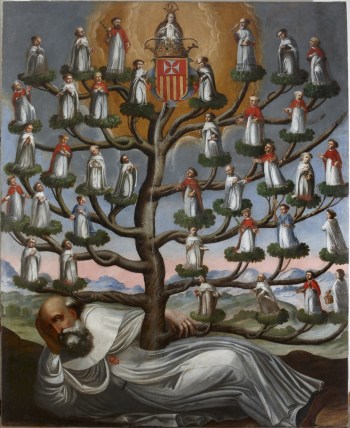
Unidentified artist, active in Potosí, Bolivia, Genealogical Tree of the Mercedarian Order, mid-18th century (Thoma Collection).
Presenting 13 paintings by South American artists from the 17th through 19th century, this focused exhibition introduces visitors to images promoted by several Catholic orders at work in the Spanish Andes—the Dominicans, Franciscans, Mercedarians, and Jesuits—examining the politics of the distinct iconographies each group developed as they vied for devotees and dominion.
Francisco Pizarro arrived in Peru with a mandate from Charles V to impose Spanish law and order, as well as the Roman Catholic religion, upon the indigenous Inca society that he encountered. The enormous task of converting the indigenous peoples of Spain’s overseas territories to Christianity fell largely to missionaries from several religious orders rather than parish clergy. For a native population that had no written language tradition, the missionaries relied heavily on works of art to illustrate their sermons and lessons and help them gain converts.
In the wake of the Protestant Reformation, the Catholic church embraced the use of images both as pedagogical tools and instruments of devotion, and the religious orders in South America relied on them in similar ways—as didactic materials employed in the teaching of new converts, and in later years as a means of spreading devotions specific to their own interests. While their ultimate goals were the same, each religious order promoted images specific to their own histories, identities, and goals. This exhibition explores examples of the iconographies that were particular to each group.
Doctrine and Devotion: Art of the Religious Orders in the Spanish Andes is generously supported by the Carl and Marilynn Thoma Art Foundation.
Exhibition | Shakers and Movers
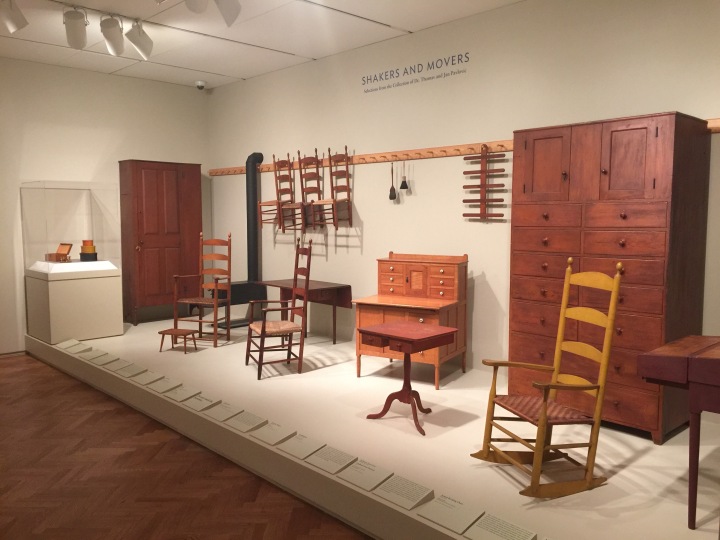
Now on view at AIC:
Shakers and Movers: Selections from the Collection of Dr. Thomas and Jan Pavlovic
Art Institute of Chicago, December 2015 — Fall 2017
For Shakers, work was a form of worship, and objects were expressions of their attempt to create heaven on earth. They employed unique techniques to build furniture that was like their faith: honest, simple, and humble. Featuring over 20 such objects generously loaned by collectors Thomas and Jan Pavlovic, this exhibition—the first of its kind at the Art Institute—shows the range of items made by the Shakers in the late 18th and 19th centuries. Presented within the chronology of the permanent collection galleries, the exhibition considers Shakers in the larger context of American furniture production, demonstrating the artistic exchange and innovation that defined the country’s early history.
Shakers were well known for their austere and rigid lifestyle. Believers lived in separate men’s and women’s dormitories and practiced celibacy and communal ownership. Their worship, however, could be quite lively; the name Shaker derives from the frenzied, whirling dancing that took place at services. Following the arrival of the first Shakers from England in 1774, the group peaked in the mid-19th century, boasting more than 6,000 members from Maine to Kentucky. Though only one Shaker community survives today, the impact of Shakers on American culture has endured, particularly in art and design. The Pavlovics’ collection—passionately assembled over the last 40 years—exemplifies the virtuosic craftsmanship synonymous with this influential utopian religious community.










leave a comment