Exhibition | 300 Years of the Cemetery for Foreigners in Rome

Rudolph Müller, The Protestant Cemetery in Rome with the Tomb of Julius August Walther von Goethe (1789–1830), ca. 1840s
(Klassik Stiftung Weimar)
◊ ◊ ◊ ◊ ◊
From Rome’s Non-Catholic Cemetery for Foreigners:
At the Foot of the Pyramid: 300 Years of the Cemetery for Foreigners in Rome
Ai piedi della Piramide, Il cimitero per gli stranieri a Roma – 300 anni
Am Fuße der Pyramide: 300 Jahre Friedhof für Ausländer in Rom
Casa di Goethe, Rome, 23 September — 13 November 2016
Curated by Nicholas Stanley-Price
“The most beautiful and solemn cemetery I have ever beheld” declared the poet Percy Bysshe Shelley. Since the height of the Grand Tour, non-Catholic foreigners dying in Rome have been buried in front of the pyramid-tomb of Caius Cestius. In 2016 the Protestant Cemetery (now officially the Non-Catholic Cemetery for Foreigners) in Rome will celebrate its 300th anniversary. For this occasion the Cemetery, in partnership with the Casa di Goethe, has planned an exhibition of paintings, drawings and prints from the 18th to early 20th centuries to illustrate the history of this place dedicated to citizens of Protestant faith who died in papal Rome.
The curator of the exhibition is Dr Nicholas Stanley-Price. It is sponsored by the 15 embassies that administer the Cemetery (Australia, Canada, Denmark, Finland, Germany, Greece, Ireland, Netherlands, Norway, Russia, South Africa, Sweden, Switzerland, the United Kingdom and the United States of America), under the Presidency of H.E. Peter McGovern, Ambassador of Canada in Italy.
The area of today’s cemetery was made available in 1716 by Pope Clement XI, initially to serve as a burial-ground for members of the Stuart court in exile from Britain. After a few decades, permission was given to erect funerary monuments to those buried there. The first such monument, which survives today, is to Georg Anton Friedrich von Werpup from Hanover, who died in 1765. His grave and that of the chamberlain to the Marquis of Ansbach, Wolf Carl Friedrich von Reitzenstein († 1775), are depicted in a drawing by Jacob Philipp Hackert (Vienna, Albertina).
They were followed by many others. It is the last resting-place not only of August von Goethe, son of the poet, but also numerous painters, sculptors, architects, as well as poets and scholars who lived in Rome or nearby. Among others, we mention Christopher Hewetson († 1799), the sons of Wilhelm von Humboldt († 1803 e 1807), John Keats († 1821) and Percy Bysshe Shelley († 1822), John Gibson († 1866), Gottfried Semper († 1879), Antonio Gramsci († 1937) and Gregory Corso († 2001).
Famous artists such as Giovanni Battista Piranesi, Bertel Thorvaldsen, William Wetmore Story and John Gibson designed funerary monuments for the Cemetery. Their fascination with the place has in turn inspired other artists to produce paintings, poems or monuments: from Goethe to Schinkel, from Oscar Wilde to d’Annunzio, and from Turner to Munch. The exhibition will, for the first time, provide a panorama of how European and American artists of different periods have depicted the Cemetery in paintings, drawings and prints, documenting at the same time the gradual changes in the appearance of the Cemetery. Some of the exhibits will be overall views of the area adjacent to the Pyramid and others of individual tombs. Various depictions of night-time funerals illustrate the difficult conditions in which the Protestants had to be buried. In addition to works by the artists already mentioned, there will be works by Jacques Sablet, Bartolomeo Pinelli, Salomon Corrodi, Walter Crane and others. The loans, already confirmed, come from different European museums and from private collections in Germany, Italy, Scandinavia, and the United States of America. The exhibition catalogue will be published in three different editions (English, German and Italian).
Exhibition | Everyday English: The Hooker Ceramics Collection

Bristol, Double-Ogee Cup and Saucer, ca. 1775; Hard-paste porcelain (Collection of the Dixon Gallery and Gardens, Gift of Mrs. Charlotte Stout Hooker, 2008.DA.2.31.2a, b)
◊ ◊ ◊ ◊ ◊
From Dixon Gallery and Gardens:
Everyday English: The Charlotte Stout Hooker Gift of English and Continental Ceramics
Dixon Gallery and Gardens, Memphis, 31 July — 9 October 2016
Everyday English considers the marketing and consumption of eighteenth- and nineteenth-century English porcelain through the Dixon’s Charlotte Stout Hooker Gift of English and Continental Ceramics. Everyday English also highlights Mrs. Hooker’s accomplishments as a collector, exhibiting both her popular useful wares and rare ornamental finds.
From Laura Gray McCann’s posting for Dixon’s blog (8 January 2016) . . .
In 2008, the Dixon received 384 pieces of eighteenth- and nineteenth-century English porcelain and pottery, and Asian and Continental ceramics from the collection of Mrs. Charlotte Stout Hooker. Mrs. Hooker’s collection was a natural fit for the Dixon—the nascence of her English porcelain came from her mother, Warda Stevens Stout, whose collection of eighteenth-century German porcelain came to the Dixon in 1985. Mrs. Hooker continued to collect, adding a more popular dimension to her collection. In 2003, Art & Antiques Magazine named her one of the top 100 collectors in the country.
Now, it is time to put the spotlight on the Hooker Collection! As we did with the Stout Collection, we are publishing a catalogue of the Hooker collection, The Charlotte Stout Hooker Gift of English and Continental Ceramics. The catalogue celebrates Mrs. Hooker’s achievements as a collector and provides the public with a record of the works in collection. The release of the catalogue will coincide with an exhibition of the Hooker Collection, Everyday English: The Charlotte Stout Hooker Gift of English and Continental Ceramics this summer. . .
Exhibition | Art and Industry in Early America: Rhode Island Furniture
Opening in August at the Yale University Art Gallery:
Art and Industry in Early America: Rhode Island Furniture, 1650–1830
Yale University Art Gallery, New Haven, 19 August, 2016 — 8 January 2017
Curated by Patricia Kane
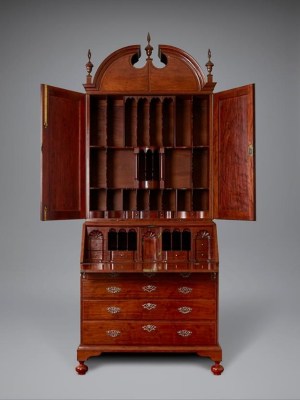
Christopher Townsend and Samuel Casey, Desk and Bookcase, Newport, R.I., 1745-50. Mahogany and sabicu (?) with silver hardware. Private collection.
This groundbreaking exhibition presents a comprehensive survey of Rhode Island furniture from the colonial and early Federal periods, including elaborately carved chairs, high chests, bureau tables, and clocks. Drawing together more than 130 exceptional objects from museums, historical societies, and private collections, the show highlights major aesthetic innovations developed in the region. In addition to iconic, stylish pieces from important centers of production like Providence and Newport, the exhibition showcases simpler examples made in smaller towns and for export. The exhibition also addresses the surprisingly broad reach of Rhode Island’s furniture production, from the boom of the export trade at the turn of the 17th century and its steady growth throughout the 18th century to the gradual decline of the handcraft tradition in the 19th century. Reflecting on one of New England’s most important artistic traditions, Art and Industry in Early America encourages a newfound appreciation for this dynamic school of American furniture making.
◊ ◊ ◊ ◊ ◊
And due out in October from Yale UP:
Patricia Kane with Dennis Carr, Nancy Goyne Evans, Jennifer Johnson, and Gary Sullivan, Art and Industry in Early America: Rhode Island Furniture, 1650–1830 (New Haven: Yale University Press, 2016), 504 pages, ISBN: 978-0300217841, $85.
 The most comprehensive publication available to date on the topic, Art and Industry in Early America examines furniture made throughout Rhode Island from the earliest days of the settlement to the late Federal period. This stunning volume features more than 200 illustrations of beautifully constructed and carved objects—including chairs, high chests, bureau tables, and clocks—that demonstrate the superb workmanship and artistic skill of the state’s furniture makers. Written by distinguished scholars, the book presents new information on the export trade, patronage, artistic collaboration, and the small-scale shop traditions that defined early Rhode Island craftsmanship. In addition to iconic, stylish pieces from important centers of production like Newport and Providence and by well-known makers such as John Goddard and Samuel and Joseph Rawson, Jr., the catalogue showcases simpler examples made in smaller towns. More than 100 catalogue entries detail marks and inscriptions, bibliography, and provenance and feature many new photographs, encouraging a deeper understanding of this dynamic school of American furniture making.
Patricia E. Kane is the Friends of American Arts Curator of American Decorative Arts at the Yale University Art Gallery.
Exhibition | Made in China: Cultural Encounters through Export Art
Press release for the exhibition now on view at the ROM:
Made in China: Cultural Encounters through Export Art
Royal Ontario Museum, Toronto, 5 September 2015 — 2 August 2016
Curated by Jian-fei He and Wen-chien Cheng

Soup plate (ROM European Collection)
Primarily originating from four renowned ROM collections, Made in China: Cultural Encounters through Export Art features nearly 100 objects including paintings, porcelain, lacquer, silver, and photography. Displayed over several rotations, these pieces were created in the 18th and 19th centuries for enthusiastic European and North American consumers. Placing the ‘Made in China’ trademark in historical context, the exhibition explores the cultural encounters between China and the West, revealing a dynamic history of export trade centered in the port city of Canton (Guangzhou). Dr. Jianfei He, the ROM’s James M. Menzies Chinese Research Fellow, is the exhibition guest curator. Dr. Wen-chien Cheng, the ROM’s Louise Hawley Stone Chair of Far Eastern Art, is curatorial supervisor.

Wallpaper detail (ROM, Gift of Noah Torno)
Chinese export art is associated with both Chinese art traditions and Western ideas. Like many products manufactured in China today, the works created centuries ago served as decorative art and souvenirs for foreigners. Examples of pith paper paintings, a materially demanding and technically complex art form, are among the highlights of this intimate exhibition. Derived from the ginseng family, pith paper is strong and, when damp, may be stretched and folded into nearly any shape. Watercolours and tempera are absorbed easily, creating a relief texture with a velvety visual depth. Rarely publicly displayed, these paintings are among the hidden treasures of the ROM’s Far Eastern holdings. Beyond this distinction, these works embody the exhibition’s theme: a lens through which extraordinary cultural encounters are witnessed. Scenes painted on the pith paper romanticized Chinese customs, daily life, landscapes, and exotic plants and insects—all serving to evoke fantasized images of China for Westerners.
Establishing that this tradition continues to this day is the inclusion of a set of contemporary hand-painted wallpaper commissioned especially for the ROM’s exhibition and created by a modern workshop in Shenzhen, China. A diverse group of specimens and objects from a number of different collections—from insects of the ROM’s entromology department corresponding to those seen in nearby pith paper paintings to a silver goblet from the Museum’s European Decocorative Arts Department depicting a dramatic scene—round out the display.
Jianfei He’s research fields and interests include ancient Chinese bronze mirrors as well as the embroidery, textile, and cultural heritage management of Southwest China and Southeast Asia. Wen-chien Cheng’s major area of research is premodern Chinese painting, and her research approach is a contextualized study of visual culture.
Exhibition | Of Beauty and Grandeur: Roman Portraits in the Baroque
From the Staatliche Kunstsammlungen Dresden:
Of Beauty and Grandeur: Roman Portraits and their Baroque Appropriation
Von Schönheit und Größe: Römische Porträts und ihre barocke Aneignung
Skulpturensammlung at the Albertinum, Dresden, 22 July — 6 November 2016
 The Dresden Antiquities Collection is one of the oldest collections amassed in Dresden by the kings and prince electors, and one of the oldest large collections of antiquities presented in a museum outside Italy. The items, on view behind glass in storage depots at the Albertinum, are currently waiting to be presented again in the eastern gallery of the Semperbau at the Zwinger. The sculptures from classical antiquity and the Baroque period have not been presented to the public in a fitting manner since 2002, the year of a major flood on the Elbe, followed by the reconstruction of the Albertinum and its reopening as a museum for modern art.
The collection displays a selection of some 50 classical and Baroque portraits and portrait statues. These portraits—sculptures combining authenticity and idealisation—played a crucial role in defining and communicating political, social and communal identities, sending out various messages to their audience in ancient times. One of the most important art genres of classical antiquity, portraits of children, women, politicians, military commanders and the ruling elite were a ubiquitous element of everyday Roman life. They were erected on public squares, influencing broad swathes of the public as a kind of mass media. In the 16th and 17th centuries, the works, which had often survived only as fragments, were elaborately and splendidly completed with busts made of coloured stone or reworked in the classical style. At the start of the 18th century, they came to Dresden from the Brandenburg Collection built up by Friedrich Wilhelm I (1688–1740) and the Roman Collection assembled by the House of Chigi.
This presentation shines the spotlight on the sculptures which make up the heart of the collection and which stand out in terms of their quality and quantity. Among the items there are some unusual works, such as the statue of the Roman Emperor Antoninus Pius (150–160 AD), the portrait of his wife Faustina (around 140 AD) on a magnificent Baroque bust of coloured marble, or the porphyry bust of the emperor known as Caligula (17th century), whose acquisition was of particular value to Augustus the Strong because of its precious material. Loans from the Grünes Gewölbe (Green Vault) include a showpiece by Johann Melchior Dinglinger and Balthasar Permoser: a cameo of a Roman emperor from classical antiquity set in a precious frame. In the 18th century this portrait was seen as that of the first Roman emperor, Augustus. Augustus the Strong saw himself as linked to his namesake by his own fame as a ruler and a patron of the arts.
Exhibition | Versailles: Treasures from the Palace

Hall of Mirrors (Galerie des Glaces), 1678–84
(Château de Versailles)
◊ ◊ ◊ ◊ ◊
Press release (18 July 2016) from the NGA:
Versailles: Treasures from the Palace
National Gallery of Australia, Canberra, 9 December 2016 — 17 April 2017
The NGA has revealed details of the sumptuous treasures from the Palace of Versailles, which will be on show in Canberra this December. Versailles: Treasures from the Palace is a once-in-a-lifetime chance to see and experience a mesmerising period in French history in Australia. For the first time ever, the treasures will travel from France to entice visitors into a world of power, passion and luxury through this epic exhibition. More than 130 paintings, intricate tapestries, gilded furniture, monumental statues and other objects from the Royal gardens, and personal items from Louis XIV to Marie-Antoinette, will bring to life the reigns of three kings, their queens and mistresses in a fascinating and tumultuous period of French history. The exhibition will celebrate the lives, loves, and passions of the people of Versailles through a full program of activities including music performances, children’s programs, and public events.

François Hubert Drouais, The Sourches Family (‘Le Concert Champêtre’), 1756, oil on canvas (Château de Versailles, Dist. RMN-Grand Palais / Christophe Fouin)
“We are delighted to bring the grandeur of the culture of Versailles exclusively to Canberra and make it possible for all Australians to access and appreciate the social, political and cultural aspects of this unique phenomenon. If ever absolute power can be expressed through unbridled opulence, this is it,” said Gerard Vaughan, NGA Director.
“Along with astonishing treasures, like the marble bust of Louis XIV, or the glamorous formal portrait of Marie- Antoinette, we are bringing to Australia the entire 1.5 tonne statue of Latona and Her Children from one of the main fountains of the Palace of Versailles,” said Dr Vaughan. “The authenticity of this cultural experience will leave a lasting imprint on all our visitors.”
The exhibition contrasts small personal items, such as the precious golden reliquary which belonged to Louis XIV’s mother, or Marie-Antoinette’s hand-crafted chair and harp, with huge works including six-metre tapestries from the most important Gobelins series ever produced for Louis XIV, and a monumental conversation piece of the Sourches family which requires individual freight.
“Versailles is at the heart of French cultural expression as much as the NGA is the heart of Australian visual expression and we are very excited to bring this historic exhibition to Australia,” said Catherine Pégard, President of the Public Establishment of the Palace, Museum and National Estate of Versailles.
“The opportunity to send such important French treasures has been made possible because of the major restoration program at Versailles, and we are thrilled to see that the outcome of the work will be the enjoyment of thousands of Australians,” said Christophe Lecourtier, Ambassador of France to Australia.
“The NGA is bringing to Canberra yet another spectacular show, which will attract people from all over the country and the world this summer,” said Andrew Barr, ACT Chief Minister. “These shows are important to the local tourism sector and I’m confident that this show will be another success for the Gallery.”
Exhibition | The Artistry of Outlander: Costumes and Set Designs
From The Paley Center:
The Artistry of Outlander: Costumes and Set Designs
The Paley Center for Media, Los Angeles, 8 June — 14 August 2016
 The Artistry of Outlander takes visitors into the world of the critically acclaimed STARZ and Sony Pictures Television series Outlander, showcasing many iconic costumes designed by Emmy-winning costume designer Terry Dresbach. Fans can step into 18th-century Parisian society, where they will be able to view actual set pieces from Outlander production designer Jon Gary Steele, life-size episodic photography, and behind-the-scenes video segments.
An extended description, with photographs, is provided by Amy Ratcliffe, writing for Nerdist (8 June 2016).
During a panel after the exhibit preview, Dresbach and Steele revealed they’ve been wanting to tackle 18th-century Paris for practically their entire careers. In fact, they longed to specifically work on Outlander. “Gary and I have been planning to do this show for about 25 years,” Dresbach said. She joked that she had to marry somebody (Outlander executive producer Ronald D. Moore) to make it happen, “It was all to get to Outlander.” Dresbach introduced Steele to Gabaldon’s book in the early ’90s, and they’ve been dreaming about it since. . . .
The sets in 18th-century France were so opulent and vivid, you’d think they were shot on location. That wasn’t the case. Most sets were built in a stage—including Claire and Jamie’s apartment, Master Raymond’s apothecary, and King Louis’ star chamber. They shot some exteriors in Prague, but for the most part, Steele got to dream the world into creation. “As designers, we want to build. It’s all from the ground-up. You create the whole thing. You control the color, the floor, the walls, the ceiling. That is so much more fun. It’s on stage, so it’s better in many ways for all of production,” Steele said. . .
Ratcliffe’s full piece is available here»
Exhibition | In the Light of Naples: The Art of Francesco de Mura

Francesco de Mura, The Visitation, ca. 1750, oil on canvas, 37 × 46 1/2 inches
(Winter Park: Cornell Fine Arts Museum, Rollins College)
◊ ◊ ◊ ◊ ◊
Opening in September at the Cornell Fine Arts Museum:
In the Light of Naples: The Art of Francesco de Mura
Cornell Fine Arts Museum, Rollins College, Winter Park, Florida, 17 September — 18 December 2016
Chazen Museum, University of Wisconsin-Madison, 20 January — 2 April 2017
The Frances Lehman Loeb Art Center, Vassar College, Poughkeepsie, New York, 21 April — 2 July 2017
Curated by Arthur Blumenthal
In the Light of Naples: The Art of Francesco de Mura will be the first-ever exhibition of the art of Francesco de Mura (1696–1782), arguably the greatest painter of the Golden Age of Naples. The Cornell Museum owns a major painting by De Mura, The Visitation, which is the impetus for this show.
Francesco de Mura, the indisputable leader in his day of the Neapolitan School and the favorite of the reigning Bourbon King Charles VII, was the chief painter of decorative cycles to emerge from the studio of Francesco Solimena (1657–1747), the celebrated Baroque artist. De Mura’s refined and elegant compositions, with their exquisite, light, and airy colors, heralded the rococo in Naples, and his later classicistic style led to Neo-Classicism. De Mura’s ceiling frescoes rivaled those of his celebrated Venetian contemporary, Giambattista Tiepolo (1696–1770). Yet, today, he lacks his proper place in the history of art. This show seeks to answer why this is so: If he was so celebrated and admired in his lifetime, why is De Mura so little known today?
The exhibition—which, in 2017, will travel to the Chazen Museum at the University of Wisconsin-Madison and the Loeb Art Center at Vassar College—will feature more than 40 works by De Mura from such collections as Boston’s Museum of Fine Arts, the Metropolitan Museum in New York, the Art Institute of Chicago, the Minneapolis Art Institute, the National Gallery of Art in Washington, and other public and private collections. In addition, there will be loans from Naples, Paris, and London.
Included will be the Cornell Museum’s recently acquired Solimena painting, as well as the Cornell’s newly identified oil by a follower of Solimena. Dr. Arthur Blumenthal, Director Emeritus of the Cornell, is the Guest Curator of the show, which will have a scholarly catalogue with essays by such art historians as Nicola Spinosa, former Superintendent of the National Museums in Naples and foremost expert on De Mura. Through De Mura’s original creations in the exhibition, the Cornell will finally be giving this richly deserving Neapolitan artist—the last Baroque artist—his due.
◊ ◊ ◊ ◊ ◊
Catalogue available in September from Artbooks.com:
Arthur Blumenthal, ed., In the Light of Naples: The Art of Francesco de Mura, (London: Giles, 2016), 208 pages, ISBN: 978-1907804854, $50.
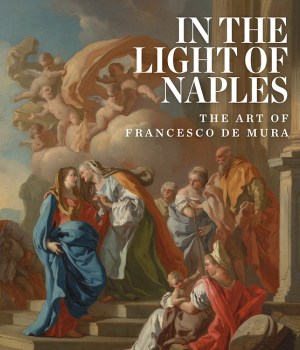 Francesco de Mura (1696–1782), one of the greatest painters of the Golden Age of Naples, at last gains the attention he deserves in this first-ever scholarly publication. De Mura’s refined and elegant compositions, with their exquisite light and color, heralded the Rococo in Naples, while his later classicistic style led to the simplicity and sculptural quality of Neoclassicism. In the Light of Naples: The Art of Francesco de Mura reveals the power of his work through more than 200 colour illustrations, including details from his great frescoes, as well as images of many of his key paintings—published here for the first time. The indisputable leader in his day of the Neapolitan School and the favorite of the reigning Bourbon King Charles VII (1735–59), Francesco de Mura was the chief painter of decorative cycles to emerge from the studio of Francesco Solimena (1657–1747), the great Baroque artist. Outstanding works in Naples include the enormous oil painting of The Adoration of the Magi (ca.1728) for the church of Santa Maria Donnaromita, and the stunning frescoes of The Adoration of the Magi (1732) in the apsidal dome of the church of the Nunziatella and, on the ceiling of the nave of the same church, The Assumption of the Virgin (1751). Nearly a third of De Mura’s works were destroyed in the American and British bombing of Naples during World War II, including, most tragically, his series of frescoes at the abbey of Monte Cassino.
Arthur Blumenthal is Director Emeritus of Cornell Fine Arts Museum at Rollins College.
◊ ◊ ◊ ◊ ◊
Note (added 21 December 2016) — Malcolm Bull reviews the exhibition for The Burlington Magazine 158 (December 2016), pp. 1006–07:
In the mid-eighteenth century, Francesco de Mura (1696–1782) was universally acknowledged to be the leading artist in Naples . . . But his fortune since then has been less favourable . . . Most of De Mura’s work remains in situ, making it hard to mount a representative exhibition. In these circumstances it is not surprising that this, the first-ever exhibition of the artist’s work, In the Light of Naples: The Art of Francesco de Mura at Cornell Fine Arts Museum, Rollins College, Winter Park, FL (to 18th December), where this reviewer saw the show, required a decade of planning by its curator, Arthur Blumenthal. The result is, however, a triumph. . . Although this is a small exhibition, there is enough to convince even the most skeptical viewer that De Mura is an artist of the first rank (1006).
Display | Masterpieces & Curiosities: The Fictional Portrait
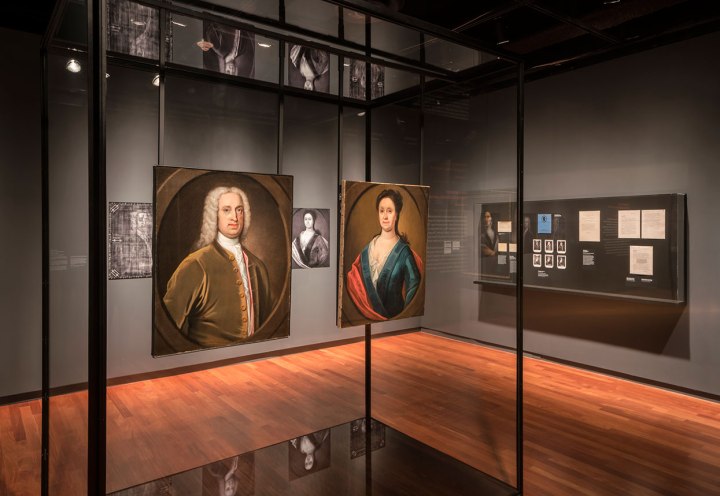
Unknown Artist, Portraits of a Man and a Woman, n.d., oil on canvas. 30⅜ × 25¼ inches (New York: Jewish Museum, Gift of Dr. Harry G. Friedman, F 4922a). Installation view at the Jewish Museum, 2016.
◊ ◊ ◊ ◊ ◊
Now on view at the Jewish Museum:
Masterpieces & Curiosities: The Fictional Portrait
Jewish Museum, New York, 18 March — 14 August 2016
Curated by Stephen Brown
The latest iteration of the essay-style exhibition series studies two companion portraits in the Jewish Museum’s collection, revealing a tale far different from what has been assumed for almost a century.
If every picture tells a story then, at a glance, a portrait tells a simple one—the faithful biography of a sitter as conveyed by a named artist. This often misleading assumption lies at the heart of Masterpieces & Curiosities: The Fictional Portrait, which illuminates the complex relationship between portraiture and truth.
Stephen Brown, Associate Curator, examines two paintings in the Museum’s permanent collection: Acquired in 1957, the ‘Mears’ portraits were credited to an 18th-century American artist and thought to represent a prominent Jewish merchant of colonial New York and his wife. After a decade of research, the identities of the artist and sitters have been reconsidered through archival investigation, genealogical studies, and X-ray analysis.
“The idea of portraiture is based on the belief in some direct relation between the image and the sitter,” asserts Brown. “But every image is a representation, and all representation is fiction.”
By separating fact from fiction and unveiling the truth behind these enigmatic portraits, Masterpieces & Curiosities: The Fictional Portrait lays to rest a mystery centuries-old while challenging our notions concerning the genre of portraiture.
Exhibition | Italian Landscape of the Romantic Era

Ferdinand Oehme, Villa d’Este in Tivoli, detail, 1833
(Dresden: Albertinum, Galerie Neue Meister)
◊ ◊ ◊ ◊ ◊
From the Staatliche Kunstsammlungen Dresden:
Italian Landscape of the Romantic Era: Painting and Literature
Italienische Landschaft der Romantik: Malerei und Literatur
Neues Schloss, Bad Muskau, 11 May — 21 August 2016
The whole sky was covered with a whitish haze of cloud, through which the sun, without its form being distinguishable, gleamed over the sea, which displayed the most beautiful sky blue hue that one ever could see. –Johann Wolfgang von Goethe, 1787
Tivoli and the Roman Campagna, Capri and the Bay of Naples, majestic silhouettes of lofty mountains, glittering expanses of sea, dignified ancient architecture and Mediterranean flora: il bel paese (‘the beautiful country’) as seen by writers and artists, is at the focus of this special exhibition.
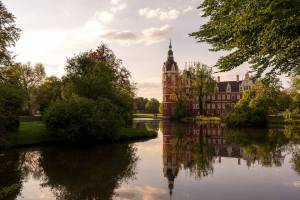
Neues Schloss in Bad Muskau (Photo by David Pinzer)
In the late 18th and early 19th centuries travelers to Italy increasingly focused on the perception of nature. Their encounters with southern climes promised a substantial impetus for artistic development and regeneration. Hence, the Italian landscape became a new ideal for landscape gardens which spread more or less simultaneously from England over the whole continent of Europe. One of the most important protagonists of this movement in Germany was Prince Hermann von Pückler-Muskau (1785–1871), whose park and castle in Bad Muskau are an ideal venue for the exhibition. His landscape park, which was begun in 1815, is now one of the most beautiful in Europe and has been a UNESCO World Heritage site since 2004. Indeed, the park itself was originally conceived as a kind of museum: “A park must be like an art gallery: every few steps you should see a new picture” (Pückler-Muskau).
The special exhibition in the New Castle (Neues Schloss) features more than 20 masterpieces—landscapes full of light by painters such as Jakob Philipp Hackert, Ludwig Richter, Ernst Ferdinand Oehme, Carl Rottmann, and Carl Blechen. All these paintings reflect the poetry of nature, the rich colours, and forms found in the south. Most of them are usually housed in the Dresden Albertinum and are among the highlights of the Galerie Neue Meister; thanks to the restoration of several paintings from the store room, their original radiance has been revitalized.
Selected writings by contemporary authors who also traveled around Italy—Johann Wolfgang von Goethe, Johann Gottfried Seume, Madame de Staël, and Wilhelm Waiblinger—enable the Italian landscape to be experienced in a combination of genres. The most important starting point for such painted and written projections of this land of longing, Goethe’s Italian Journey was first published in installments in 1816, and so the year 2016 marks the 200th anniversary of its publication. It initiated a period of German fascination for the “land where the lemon trees bloom” (Goethe), a fascination which—with few exceptions and several interruptions—extended into broad social circles and whose effect is still felt today.










 Enfilade
leave a comment