Exhibition | Vanishing Ice: Alpine and Polar Landscapes in Art

William Hodges, The Resolution and Adventure, 4 January 1773, Taking Ice for Water, Latitude 61 Degrees South, ink and wash on paper; 14 x 22″ (Mitchell Library, State Library of New South Wales).
Click here for more information.
◊ ◊ ◊ ◊ ◊
From the McMichael press release (9 December 2014) for the Vanishing Ice exhibition:
Vanishing Ice: Alpine and Polar Landscapes in Art, 1775–2012
Whatcom Museum, Bellingham, Washington, 3 November 2013 — 16 March 2014
El Paso Museum of Art, 1 June — 24 August 2014
Glenbow Museum, Calgary, Alberta, 27 September 2014 — January 4, 2015
McMichael Canadian Art Collection, Kleinburg, Ontario, 31 January — 26 April 2015
On January 31, 2015, the powerful and provocative exhibition Vanishing Ice: Alpine and Polar Landscapes in Art, 1775–2012 opens at the McMichael Canadian Art Collection. Since debuting in 2013 at the Whatcom Museum in Bellingham, Washington, the exhibition has garnered attention for its unique interweaving of art, history, and science. Showcasing the beauty and fragility of Earth’s frozen frontiers through the eyes of artists, writers, and naturalists over a period of more than 200 years, the exhibition offers a unique take on the timely subject of climate change.
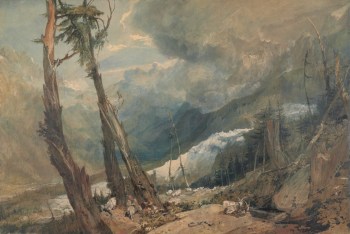
Joseph Mallord William Turner, Mer de Glace, in the Valley of Chamouni, Switzerland, 1803, watercolor, graphite, gum, 28 x 41″ (New Haven: Yale Center for British Art, Paul Mellon Collection)
Vanishing Ice features over seventy works including drawings, prints, paintings, photographs, videos, and installations by fifty artists from twelve countries. Among these historical and contemporary artists are: Ansel Adams, Lita Albuquerque, James Balog, Thomas Hart Benton, David Buckland, Gustave Doré, Lawren Harris, Isaac Julien, Kahn & Selesnick, Rockwell Kent, Paul D. Miller (aka DJ Spooky), Alexis Rockman, Camille Seaman, and Spencer Tunick. The exhibition unfolds thematically, geographically, and chronologically, moving from alpine to Arctic and Antarctic landscapes.
The idea for Vanishing Ice grew out of curator Barbara Matilsky’s doctoral dissertation, written thirty years ago about the sublime landscapes of French artist-naturalist-explorers who were among the first to depict the poles and mountain glaciers. As Matilsky became aware of the increasing number of contemporary artists who were venturing to the Arctic and Antarctic, she saw an opportunity to compare historical and contemporary depictions of these rapidly changing landscapes, as epitomized by the juxtaposition of Arthur Oliver Wheeler’s 1917 image of the Athabasca Glacier in Jasper National Park and Gary Braasch’s 2005 photograph of the same location.
“I am hoping that Vanishing Ice will stimulate a new appreciation for alpine and polar landscapes by revealing their significance for both nature and culture,” said exhibition curator Barbara Matilsky from the Whatcom Museum. “In the past, artists and naturalists expanded the public’s awareness of Earth’s icy frontiers. Today, artists continue to collaborate with scientists, motivated by the belief that art will help people to visualize the accelerating effects of climate change. They awaken the world to both the beauty and increasing vulnerability of ice, which is critical for biological and cultural diversity. Their work will hopefully inspire activism on the regional and national levels to make the requisite policy changes that will bring Earth back into balance.”
The McMichael is the exhibition’s final stop on a tour that included the Whatcom Museum; the El Paso Museum in Texas; and most recently the Glenbow Museum in Calgary.
“The McMichael nurtures a special interest in exploring the intersection of art and nature, and encouraging meaningful dialogue about the environment,” said Dr. Victoria Dickenson, Executive Director and CEO of the McMichael. “Vanishing Ice is both a beautiful glimpse of some of the most remote and fragile ecosystems, and a call to action on what many people hold to be the defining issue of this generation.”
Vanishing Ice, which will span the McMichael’s upper level of gallery spaces, will be complemented by an exhibition based on the McMichael’s permanent collection of works related to the Arctic, opening on February 14, 2015. The installation will include paintings and drawings by members of the Group of Seven, including Lawren Harris—famed for his depiction of icebergs and glaciers—and works by Inuit artists, including Tim Pitsiulak.
Vanishing Ice: Alpine and Polar Landscapes in Art, 1775–2012 is organized by the Whatcom Museum. Major funding for the exhibition has been provided by the Paul G. Allen Family Foundation and the National Endowment for the Arts with additional support from the Norcliffe Foundation, the Washington State Arts Commission, and the City of Bellingham.
From the University of Washington Press:
◊ ◊ ◊ ◊ ◊
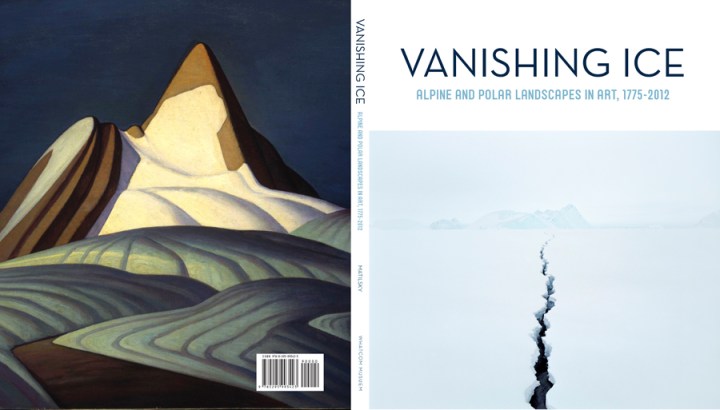
Barbara C. Matilsky, Vanishing Ice: Alpine and Polar Landscapes in Art, 1775–2012 (Seattle: University of Washington Press, 2013), 144 pages, ISBN: 978-0295993423, $40.
Vanishing Ice introduces the rich artistic legacy of the planet’s frozen frontiers now threatened by a changing climate. Tracing the impact of glaciers, icebergs, and fields of ice on artists’ imaginations, this interdisciplinary survey explores the connections between generations of artists who adopt different styles, media, and approaches to interpret alpine and polar landscapes.
Beginning in the eighteenth century, collaborations between the arts and sciences contributed to a deeper understanding of snowcapped mountains, the Arctic, and Antarctica. A resurgence of interest in these environments as dramatic indicators of climate change galvanizes contemporary expeditions to the glaciers and the poles. Today, artists, writers, and scientists awaken the world to both the beauty and increasing vulnerability of ice.
Barbara C. Matilsky is curator of art at the Whatcom Museum, Bellingham, Washington. She is the author of numerous books, including Fragile Ecologies: Contemporary Artists’ Interpretations and Solutions.
C O N T E N T S
Director’s Foreword
Prologue
From the Sublime to the Science of a Changing Climate
Voyage to Glacial Peaks
Magnetic Attraction: The Allure of the Poles
Elegy: The Open Polar Sea
Timeline
Checklist of the exhibition
Exhibition | Jean-Jacques de Boissieu
◊ ◊ ◊ ◊ ◊
From the Städel Museum:
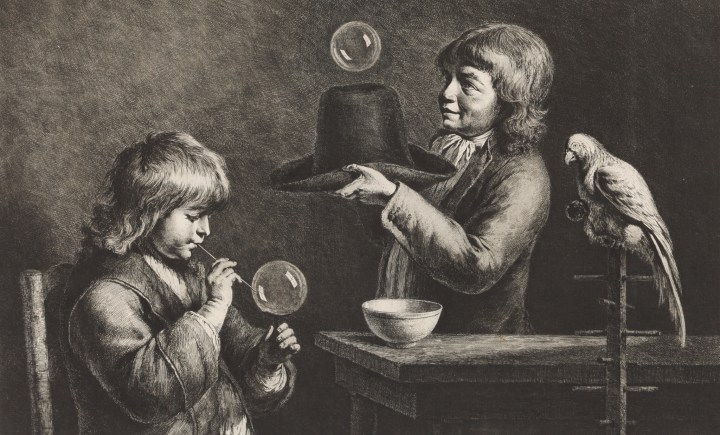
Jean-Jacques de Boissieu: A Contemporary of Städel’s / Ein Zeitgenosse Städels
Städel Museum, Frankfurt, 11 February — 10 May 2015
Curated by Jutta Schütt
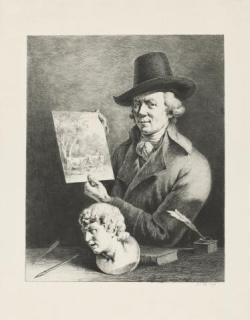
Self-Portrait of Jean-Jacques de Boissieu, 1796, etching.
Jean-Jacques de Boissieu (1736–1810) was already a highly acclaimed artist beyond France in his lifetime. Not only princes but also private collectors like Johann Friedrich Städel were fascinated with the landscapes, genre scenes, and portraits depicted in the artist’s drawings and prints. The founder of the Städelsches Kunstinstitut acquired over twenty drawings and far more than two hundred etchings by de Boissieu, which still rank among the central holdings of the Städel’s Department of Prints and Drawings. Created in a period of historically revolutionary events, de Boissieu’s oeuvre mirrors the landscape and life of the province around the artist’s native city of Lyon with an almost irritatingly unexcited and serious steadiness. His etched landscapes and portraits as well as his subtly nuanced brush and chalk drawings reveal a progressive realism that hints at a bourgeois understanding of art independent of any academic norms.
Exhibition | Close-up and Personal: Eighteenth-Century Gold Boxes
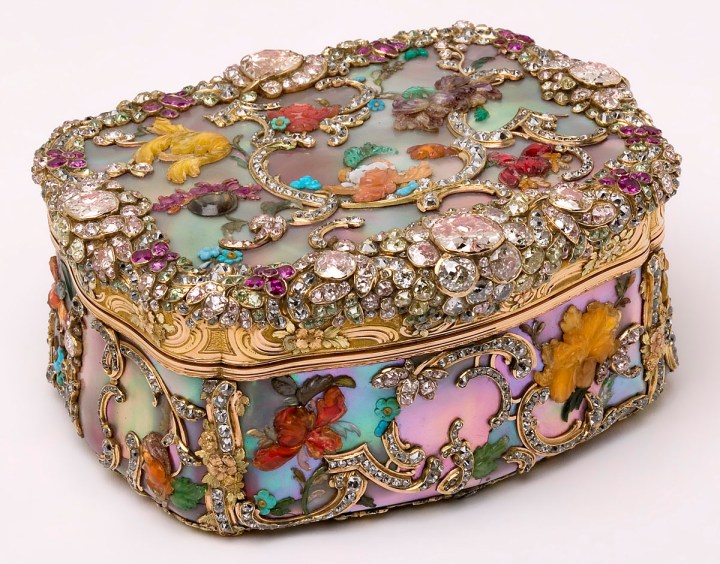
Snuffbox with Flowers, Berlin, Germany, ca. 1765, from the Rosalinde and Arthur Gilbert collection on loan to the Victoria and Albert Museum, London (formerly in the collection of Frederick II of Prussia, 1712–1786), photo Victoria and Albert Museum, London.
◊ ◊ ◊ ◊ ◊
A loan exhibition from the V&A, Close-Up and Personal includes 28 boxes in LA and nearly 60 in Cambridge. As reported by Paula Weideger for The Financial Times in 2009, the history of the fate of the collection is complicated, thanks partially to Arthur Gilbert’s conflicted relationship with LACMA, where he served as a member of the board of trustees. From LACMA:
Close-up and Personal: Eighteenth-Century Gold Boxes
from the Rosalinde and Arthur Gilbert Collection
Los Angeles County Museum of Art, 6 September 2014 — 1 March 2015
The Fitzwilliam Museum, Cambridge, 24 March — 6 September 2015
“So small a thing imposes on people,” remarked the notorious Giacomo Girolamo Casanova (1725–1798), who also carefully selected the type of tobacco to send inside such boxes when he presented them as gifts. Taking snuff and carrying it with you in an elaborate container was a universal practice in 18th-century Europe. A year before the death of the Elector of Cologne, one of the most powerful men in Europe at the time, Casanova had been given a snuffbox decorated with the Elector’s portrait. Going incognito to the Ridotto (the famous gambling halls of Venice), it was important that Casanova use an accessory he had not been seen with before. However, the very distinctive gold box with the Elector’s portrait eventually betrayed him when a former lover remembered it.
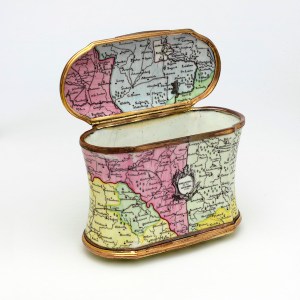
Double Snuffbox with Maps, ca. 1757, possibly Berlin, Germany, from the Rosalinde and Arthur Gilbert collection on loan to the Victoria and Albert Museum, London.
You yourself may recognize some of the gold boxes on view at LACMA through March 1, 2015. Carefully collected by Rosalinde and Arthur Gilbert in Los Angeles, they are here on loan from the Victoria and Albert Museum in London. Designed to carry just a small amount of powdered tobacco, the fine decorations of these pocket-sized containers have to be examined close up. The proximity of the viewing experience makes it very personal, intensifies the response, and can be a powerful experience when shared. Even today, a common reaction when examining them is wonderment, but these complex objects also have the potential to spark a wide range of emotions. Infinitely customizable, gold boxes became the most versatile form of gift in the 18th century.
Unlike the cups of precious metal that continue to lend themselves to specific types of acknowledgment such as loyalty of service or achievements in sport, these portable presents made it possible to communicate a spectrum of sentiments in a variety of social situations. While the double snuffbox covered with maps detailing maneuverings in the Seven Years’ War was probably made in Berlin or among the Prussian allies, other examples are less readily attributable to one side of the conflict. The same imagery would have been understood as a political statement and demonstration of allegiance by participants on either side.
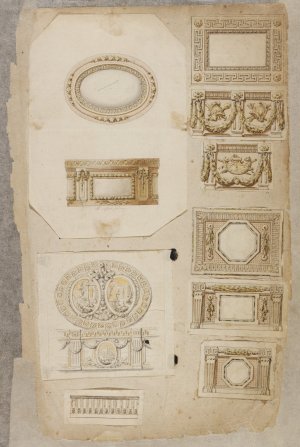
Pierre-Philippe Choffard, Design for an Oval Gold Box, 1759, Victoria and Albert Museum, London.
Elite production of the flashiest boxes was controlled by Frederick II, King of Prussia from 1740 to 1786, who banned imports from France (the unrivalled center of production at the time) “for the best [interest] of the gold workers in Berlin.” He presented some of his lavish commissions to courtiers and other sovereigns, and the local industry flourished under his patronage. Frederick’s personal enjoyment of these intensely bejeweled trinkets, and appreciation for their artistry, inspired him to engage with the manual process of designing them himself. Often the precious metal of the boxes is marked, revealing the places, names, and sometimes dates attached to their making and circulation. However, the designers, royal or otherwise, upon whose creativity all gold snuffboxes depend, cannot be as readily identified. A design on paper signed ‘Choffard fecit 1759’ for a box bearing the mark of maker Jean Ducrollay, is the great exception. However, we have very little information about Pierre-Philippe Choffard as a man or an artist.
Tantalizing details are a major characteristic of gold boxes, and eccentric examples have captivated many onlookers through their puzzling appearance. Like other curious objet d’art, such as the elephant supported musical vanity box (called a nécessaire), some snuffboxes were more than just containers. In the form of gadgets or figurines, they beg to be picked up and turned over in the hand. For example, a delicate box imitating a wicker basket reveals (when the lid is lifted) a cornucopia of fruit painted to fool the eye.
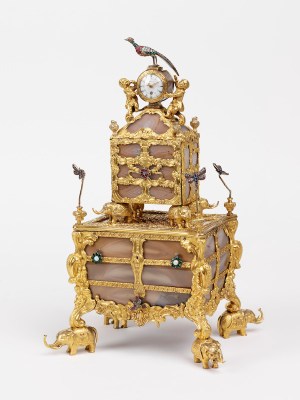
James Cox, Nécessaire, ca. 1770, from the Rosalinde and Arthur Gilbert collection on loan to the Victoria and Albert Museum, London.
You would have to travel to Strawberry Hill near London, the residence of Horace Walpole (1717–1797), to see a truly bizarre example of a snuffbox commissioned exclusively as a curiosity rather than a functional object. Exploiting the genre’s reputation for erudite encoding and connoisseurial delectation, it titillates through its command of wit. An elaborate ruse, it was conceived by the French patron of the arts Marie Anne de Vichy-Chamrond, marquise du Deffand (1697–1780) as a fake declaration of love from a social rival of hers to Walpole, the fourth Earl of Orford and a famous English collector. Her good friend was completely taken in by the exquisite portrait-clad box containing a flattering letter, and he wrote to the marquise about the excitement it gave him. Although the prank was at his expense, he seems to have been rather tickled by the incident. In the introduction to the catalog of his private collections, he recounts the practical joke as an enticement to his readers.
There can be no joking about the significance of the display of gold snuffboxes in the Koenig Gallery. Nothing prepares you for the power of these petite and precious masterpieces of extraordinary design and making. To really understand their attraction, you must encounter the real thing. And once you do, you will have an insider’s view of the preoccupations and passions of 18th-century aristocrats as well as an admiration for the genius of the best makers and designers of the period. With their curious shapes, elaborate surfaces, and the intriguing thoughts they express, gold boxes are some of the most delightful objects ever made.
Exhibition | Enlightenment: Carte Blanche of Christian Lacroix
◊ ◊ ◊ ◊ ◊
Press release from the Musée Cognacq-Jay:
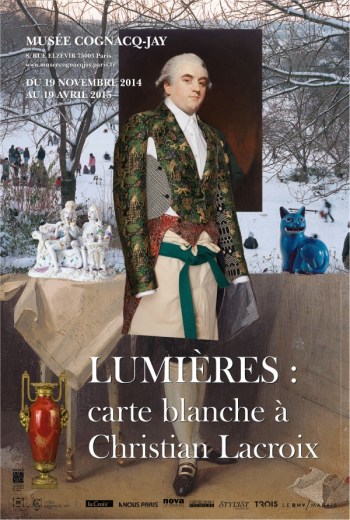
Lumières: Carte Blanche à Christian Lacroix
Musée Cognacq-Jay, Paris, 19 November 2014 — 19 April 2015
Curated by Christian Lacroix and Rose-Marie Mousseaux
In celebration of its grand reopening, the Musée Cognac-Jay has offered Christian Lacroix a creative carte blanche.
Established in 1928 by the founder of the La Samaritaine department store, Ernest Cognacq, in 1990 the museum was transferred to the Hôtel Donon, a recently-renovated sixteenth-century townhouse in the Marais district. The Musée Cognacq-Jay is home to a collection of emblematic eighteenth-century artworks, selected by its founder to be displayed in wood-panelled rooms representative of “the artistic décor of French life.”
Renowned for his creative collaborations with museums, Christian Lacroix has accepted the dual challenge of reimagining the ‘guiding narrative’ of the exhibition spaces while exploring a concept which has shaped his own approach to his art—the fascination exerted by the eighteenth century. He has curated contributions from over 40 contemporary artists, invited to reflect upon ten key themes identified in Ernest Cognacq’s collections with a view to enhancing our understanding of the Age of Enlightenment and its continued relevance in our own era.
◊ ◊ ◊ ◊ ◊
Christian Lacroix
Visions of the Enlightenment
 My perspective on the Age of Enlightenment is simply that of someone who is passionate about that era. It is an indirect perspective of the late 19th and early 20th century, when the Cognacqs built up their collection in consultation with ‘enlightened’ art historians. However, I admit that its influence on my work is less clear, as I see myself as more Dionysian than Apollinian. I can only gratefully advocate everything that the Enlightenment brought about in terms of social progress, political thinking, the fight against obscurantism, tolerance and a thirst for knowledge, as demonstrated by the encyclopaedists. All the more so given that, paradoxically, this seemingly unshakeable knowledge, these foundations that were thought to be the definitive basis of modern societies were suddenly undermined, disputed and denied in the early 21st century. If only for these reasons, it is interesting to make these connections between the 18th century and our own times. However, in my opinion we should also consider 19th-century taste—the ‘century of the pastiche’—when almost nothing new was created. Post-Napoleon III, decorative arts did nothing but ‘sample’ previous centuries, just as the Romantic period revived the medieval troubadour. There was no sign of pure, ex nihilo ‘contemporary creativity’, unlike what was emerging in England and the northern countries. From 1880 to 1910, people were expected to live in accordance with good taste—that is, past tastes—as the middle class post-Napoleon III adopted the style of the pre-Revolution enlightened aristocracy. I must confess that, beyond my appreciation and respect for the Age of Enlightenment, I am not impervious to all the rococo froth it created and inspired in the second half of the 19th century and beyond, with the somewhat risqué ‘marquise’, ‘shepherdess’ style, which was basically bourgeois and borderline kitsch. Contemporary artists often look back upon the 18th century from this angle.
◊ ◊ ◊ ◊ ◊
Rose-Marie Mousseaux, Director of the Musée Cognacq-Jay
A Return to the Museum’s Founding Vision
The Musée Cognacq-Jay is more than just a general collection of 18th-century art. It is an evocation of the taste in the 1900s for the Age of Enlightenment. The artistic collaboration with Christian Lacroix happened at exactly the same time as we were rethinking our vision of the Musée Cognacq-Jay, its place among Paris’s museums today, and what it has to offer in terms of revealing the appeal of the 18th century. To develop our 21st-century perspective, we had to go back to the founding vision of Ernest Cognacq, philanthropist and founder of the La Samaritaine department store who bequeathed the works to the City of Paris.
The exhibition design had not been reviewed since the museum moved premises in 1990, although the thematic display of the works had changed over time. This resulted in the creation of a temporary exhibition space but also led to an imbalance between the number of exhibits and the space in the rooms to display them. The empty galleries detracted from the ‘charm’ of the tour through the wood-panelled rooms. Finally, when the exhibits in the collection underwent the statutory inspection of their condition and physical integrity, we were able to look at each item in greater detail and consider its importance and meaning in the context of the collection as whole.
Today, the challenge is to make the museum’s layout clearer by structuring it around better defined themes. By giving Christian Lacroix carte blanche, we were able to identify ten recurring themes within the collection and structure them around two key aspects of 18th-century society—the importance of social occasions and the emergence of the individual. The layout has therefore been designed to go beyond the chronological limits of the temporary exhibition and incorporate several of the themes explored in the museum’s future permanent exhibition spaces. We adopted the same approach when deciding how to present each theme.
Christian Lacroix played a key role in presenting the collections in a way that was both physical and conceptual. The carte blanche that we gave him marks a highlight in the history of the Musée Cognacq-Jay. The temporary exhibition that he has curated combines contemporary works with historical exhibits and is an opportunity to reconsider our perspective of the Age of Enlightenment, its promises, and disappointments by inviting visitors to explore and reflect upon its legacy.
◊ ◊ ◊ ◊ ◊
The New Museum Layout
Thanks to Christian Lacroix’s input, we have been able to rethink how the museum’s collections are displayed and show the exhibits in a new light by presenting them in a more structured way that reflects the personalities of Ernest Cognacq and Marie-Louise Jay. The themes explored as part of this new layout reflect the different motifs found in the collection, which were influenced by the choices made by Ernest Cognacq and Marie-Louise Jay as collectors and by the major artistic movements of the 18th century.
The tour begins in the introductory room, which explains the history of the collection and its founders. After that, the exhibition is structured around ten different themes:
• Sensory experience and knowledge in the 18th century (room 2)
• Shows, balls, and sociability (rooms 3 and 4)
• Paris, capital of the Enlightenment (room 5)
• Europe’s artistic economy (rooms 6 and 7)
• 18th-century exoticism (room 8)
• The classical model (room 9)
• Childhood and education (rooms 10 and 11)
• Portraits and the emergence of the individual (rooms 12, 13 and 15)
• The age of Boucher (room 14)
• Fables, stories, and novels (room 17)
Throughout the exhibition, Christian Lacroix draws links between the museum’s collections and photographs, textiles, design pieces, and installations by contemporary artists. In doing so, he encourages visitors to reflect on how the Age of Enlightenment has influenced today’s society and gain a better understanding of its cultural legacy.
Details are available from the press kit, available as a PDF file here»
◊ ◊ ◊ ◊ ◊
It seems to me that the historiographical layers involved with the new presentation of the museum are also playing out in curious ways with the fate of La Samaritaine, the department store founded by Ernest Cognacq; Adan Gopnik provides commentary in “The View from a Bridge: Shopping, Tourism, and the Changing Face of Luxury,” The New Yorker (8 December 2014), pp. 42–47. –CH
Display | Prud’hon: Napoleon’s Draughtsman
Looking ahead to the summer at Dulwich:
Prud’hon: Napoleon’s Draughtsman
Dulwich Picture Gallery, London, 23 June — 15 November 2015
In coordination with London’s celebrations surrounding the 200th anniversary of the Battle of Waterloo, Dulwich Picture Gallery presents Prud’hon: Napoleon’s Draughtsman, the first UK exhibition devoted to Pierre-Paul Prud’hon (1758–1823), a painter and draughtsman who, through his distinctive and unconventional vision, emerged as one of the most exceptional talents working in post-Revolutionary Paris.

Pierre-Paul Prud’hon, Seated Nude with Arm Extended, black and white chalk on blue-tinted (Gray: Le Musée Baron Martin)
A selection of 13 works on paper will celebrate Prud’hon as court artist to Napoleon and Joséphine Bonaparte and as one of France’s greatest draughtsmen. The display will focus on the artist’s extraordinary life studies in white and black chalk, remarkable for their ethereal forms, subtlety of light and shade, and mastery of expression. Whether sketched quickly or finished to perfection, the drawings reveal Prud’hon’s working processes, exploring the constant experimentation that led to the unique blend of Romantic expression and Neoclassical forms that marked him out amongst his contemporaries.
Prud’hon, unlike many of his contemporaries, drew from the live model throughout his career giving him the freedom to focus on certain forms or details without the confines of specific commissions. His drawings, which range from preparatory studies for interior decoration to allegorical compositions (conveying meaning through symbolic figures, actions, imagery, and events) not only demonstrate his incredible skill but also provide a sense of contact with the heart and mind of the artist. On his preferred medium of thick blue paper you can catch a glimpse of his ideas unfolding beneath his chalk, an expression of his thoughts at the moment of creation.
◊ ◊ ◊ ◊ ◊
Known for its outstanding collection of drawings, pastels, and prints by Pierre-Paul Prud’hon, the Musée Baron Martin in Gray is housed in an eighteenth-century château (refurbished between 1777 and 1783), built on the site of a medieval fortress (the fourteenth-century tower remains). More information is available here.
Exhibition | The U.S. Constitution and the End of American Slavery
Press release (24 November 2014) from The Huntington:
The U.S. Constitution and the End of American Slavery
The Huntington, San Marino, California, 24 January — 20 April 2015
Curated by Olga Tsapina
In commemoration of the 150th anniversary of the passage of the 13th Amendment to the U.S. Constitution, The Huntington Library, Art Collections, and Botanical Gardens will illuminate the complexities of ending slavery with an exhibition drawn from its renowned collections of American historical manuscripts and prints. “The U.S. Constitution and the End of American Slavery” will be on view in the West Hall of the Library from January 24 until April 20, 2015.

Thomas Jefferson, notes on the 12th Amendment, ca. 1803 (The Huntington Library, Art Collections, and Botanical Gardens)
“The exhibition follows a long, tortuous, and bloody road that led to that fateful vote,” said Olga Tsapina, the Norris Foundation Curator of American Historical Manuscripts and curator of the exhibition. On January 31, 1865, Schuyler Colfax, the speaker of the U.S. House of Representatives, called for a vote on a joint resolution that would amend the Constitution to abolish slavery throughout the United States and empower Congress to “enforce this article by appropriate legislation.” After the clerk read the tally—119 ayes to 56 nays, with eight abstaining—the House erupted in wild jubilation. American slavery was dead. “The 119 congressmen who voted ‘aye’ on January 31, 1865, accomplished two things that seemed nearly impossible—abolishing slavery and amending the U.S. Constitution,” Tsapina added.
Many hurdles stood in the way of ending slavery: racism, fear, political partisanship, economic interests, and the lack of political will, to name a few. The Constitution presented the most formidable obstacle. The very same national charter that had created a republic dedicated to liberty also guaranteed the rights of Americans who owned human property, said Tsapina. For example, the Constitution mandated that each state respect the other states’ laws, even while Southern states permitted ownership of slaves. “But this is just one area of the Constitution that was problematic,” she added. “There were many others, and they all factored into what was a tremendously complicated—and daunting—matter.”
The conflict between the foundational principles of liberty and the reality of American slavery proved to be irreconcilable. After decades of increasingly bitter discord, it finally broke the Union apart, plunging the nation into civil war in 1861. Even the war failed to end human bondage. That was achieved only by changing the Constitution in a way its framers could not have imagined.
Featuring some 100 manuscripts, rare books, prints, and photographs, most exhibited for the first time, the exhibition will offer Huntington visitors a rare opportunity to experience the history of what Colfax called “that great measure, which hereafter will illuminate the highest place in our History” through the extraordinary breadth and depth of The Huntington’s collections.
The exhibition includes the writings of abolitionists and slave masters; runaway slaves and slave speculators; African American emigrants to Liberia and members of the Underground Railroad; and legal scholars and leaders of political parties. Visitors will see manumissions (formal documents freeing slaves from servitude) and slave traders’ business correspondence, letters from Civil War battlefields, and congressional speeches and resolutions, as well as political cartoons representing viewpoints from both sides of the partisan divide.
The display includes a 1796 letter by President George Washington discussing the fate of his runaway slave, Ona Marie ‘Oney’ Judge; Thomas Jefferson’s notes on amending the Constitution; a notebook from the famous abolitionist John Brown; and the writings of Francis Lieber, the celebrated author of the U.S. Army military code that was praised as “better than the Emancipation Proclamation.” The exhibition will feature letters and manuscripts from The Huntington’s famous collection of Abraham Lincoln material, including Lincoln’s record of his debates with Stephen A. Douglas and a copy of the 13th Amendment signed by the president.
“‘The U.S. Constitution and the End of American Slavery’ tells a complex and fascinating story in which the fate of American slavery was decided not only on Civil War battlefields, but also in courtrooms, the debating floors of state legislatures and the chambers of the U.S. Congress, as well as in proverbial smoke-filled rooms,” said Tsapina.
Display | Working Women: Images of Female Labor
From The Huntington:
Working Women: Images of Female Labor in the Art of Thomas Rowlandson
The Huntington, San Marino, California, 20 December 2014 — 13 April 2015
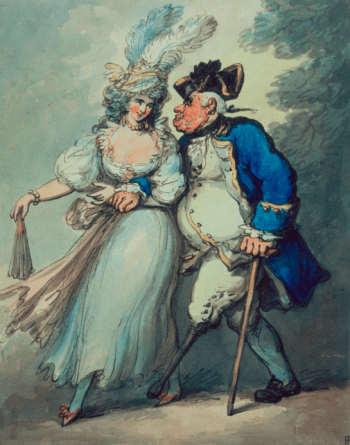
Thomas Rowlandson, A French Frigate Towing an English Man o’ War into Port, no date, pen and watercolor (The Huntington Library, Art Collections, and Botanical Gardens; Gilbert Davis Collection)
As one of Britain’s premier draftsmen, Thomas Rowlandson (1756–1827) lent his vast talent to the comic depiction of a wide range of topics, from politics to pornography. His satirical views of Georgian society are among his strongest work, and The Huntington’s collection focuses primarily on this aspect of his oeuvre. Rowlandson’s observations of the follies of the world around him provide us with a view of late 18th- and early 19th-century England that goes beyond what we see in aristocratic portraits or in the prose of Jane Austen, which portray a world of grand ladies and gentlemen and genteel manners.
This display of 11 rarely-exhibited watercolors from the collection focuses on Rowlandson’s depiction of women. His subjects are primarily those who were most visible within the public sphere—street vendors, servants, actresses, and prostitutes as they plied their various trades—with an occasional glance at the foibles of the upper class. Eschewing complex political or philosophical messages, Rowlandson’s images, though humorous, provide a fascinating glimpse into the reality of women’s lives at this time.
Exhibition | Shoes: Pleasure and Pain

Pale-blue shoes, silk satin with silver lace and braid, diamond and sapphire buckles, England, 1750s (London: V&A: T.70+A—1947; M.48+A—1962). Photographed on the mantelpiece in The Norfolk House Music Room, the British Galleries at the V&A.
◊ ◊ ◊ ◊ ◊
Press release from the V&A:
Shoes: Pleasure and Pain
Victoria & Albert Museum, London, 13 June 2015 — 31 January 2016
The Bowes Museum, Barnard Castle, County Durham, 11 June — 9 October 2016
Peabody Essex Museum, Salem, Massachusetts, 9 November 2016 — 12 March 2017
Savannah College of Art and Design, Savannah, Georgia, March — June 2017
Curated by Helen Persson
The transformative power of extreme footwear will be explored in the V&A’s summer 2015 fashion exhibition, Shoes: Pleasure and Pain. More than 200 pairs of historic and contemporary shoes from around the world will be on display, many for the first time. The exhibition will explore the agonizing aspect of wearing shoes as well as the euphoria and obsession they can inspire.
The V&A’s shoe collection is unrivalled, spanning the globe and over 2000 years. For Shoes: Pleasure and Pain, curator Helen Persson has delved into this, other international collections and the wardrobes of private individuals to select an exceptional range of shoes from a sandal decorated in pure gold leaf originating from ancient Egypt to futuristic looking shoes created using 3D printing.
 Shoes worn by or associated with high profile figures including Marilyn Monroe, Queen Victoria, Sarah Jessica Parker, and the Hon Daphne Guinness will be shown as well as famous shoes, such as the ballet slippers designed for Moira Shearer in the 1948 film The Red Shoes. Footwear for men and women by 70 named designers including Manolo Blahnik, Christian Louboutin, Jimmy Choo, and Prada will be on display. Historic lotus shoes made for bound feet and 16th-century chopines, silk mules with vertiginous platforms designed to lift skirts above the muddy streets, will also feature.
Exhibition curator, Helen Persson, said: “Shoes are one of the most telling aspects of dress. Beautiful, sculptural objects, they are also powerful indicators of gender, status, identity, taste and even sexual preference. Our choice in shoes can help project an image of who we want to be.”
The exhibition will be shown over two floors. The luxurious, boudoir design of the ground floor gallery will examine three themes: transformation, status, and seduction.
‘Transformation’ will present shoes that are the things of myth and legend, opening with different cultural interpretations of the Cinderella story from across the globe. It will explore the concept of shoes being empowering as passed down through folklore, illustrated by the Seven League Boots from the ‘Hop o’ My Thumb’ tale, and how this feeds into contemporary marketing for such things as football boots and the concept of modern-day, fairy-tale shoemakers, whose designs will magically transform the life of the wearer.
‘Status’ will reveal how impractical shoes have been worn to represent privileged and leisurely lifestyles—their design, shape and material can often make them unsuitable for walking—and how shoes also dictate the way in which the wearer moves, how they are seen and even heard. Shoes on display will include Indian men’s shoes with extremely long toes, noisy slap-sole shoes worn in Europe during the 17th century and the now infamous Vivienne Westwood blue platforms worn by Naomi Campbell in 1993. ‘Status’ will also demonstrate how historically shoe fashions originated from the European royal courts, while today the focus has shifted to famous shoe designers. Desirable shoes such as the ‘Pompadour’, worn by trend-setting women in the 18th-century French court will sit together with designs by the some of the most well-known names in fashion today, including Alexander McQueen and Sophia Webster.
Within ‘Seduction’, the shoes represent an expression of sexual empowerment or a passive source of pleasure. Like feet, shoes can be objects of fetishism. High Japanese geta, extreme heels, and tight-laced leather boots will be on display as well as examples of erotic styles channeled by mainstream fashion in recent years.
In contrast, the laboratory style setting of the first floor gallery is dedicated to dissecting the processes involved in designing and creating footwear, laying out the story from concept to final shoe. This will be enhanced by films and animations that peel back the layers of a shoe and reveal how they are made. The displays will show how makers combine traditional craftsmanship with technological innovation and how they unite function with art.
Designer sketches, materials, embellishments and shoe lasts, such as the lasts created by H. & M. Rayne for Princess Diana, will be on show, alongside ‘pullovers’ from Roger Vivier for Christian Dior. The section will highlight the makers’ ingenuity in creating innovative styles and dealing with the structural challenges of creating ever higher heels and more dramatic shapes and will feature filmed interviews with five designers and makers.
The exhibition will go on to examine shifts in consumption and production—with examples from an 18th-century ‘cheap shoe warehouse’, one-off handmade men’s brogues and trainers made in China. It will also look at the future of shoe design, with experiments of material and shapes, moulding and plastics. On display will be footwear that pushes the boundaries of possibility, including the form-pressed ‘Nova’ shoes designed by Zaha Hadid with an unsupported 16cm heel and Andreia Chaves’ ‘Invisible Naked’ shoes that fuse a study of optical illusion with 3D printing and high quality leather making techniques. The last section of the exhibition will look at shoes as commodities and collectibles. Six different people’s collections will be presented from trainers to luxury footwear.
Sponsored by Clarks, supported by Agent Provocateur, with additional thanks to the Worshipful Company of Cordwainers
Note (added 14 June 2016) — Venues updated to reflect the latest schedule.
◊ ◊ ◊ ◊ ◊
A preview of the accompanying publication is available via Issuu:
Helen Perrson, ed., Shoes: Pleasure and Pain (London: V&A Publishing, 2015), 176 pages ISBN: 978-1851778324, £25 / $40.
 Beautiful, sculptural objects, shoes are powerful indicators of gender, status, identity, taste, and even sexual preference. Our choice in shoes can be aspirational, even fantastical—and projects an image not just of who we are, but who we want to be. Feet are made for walking, but shoes may not be. Featuring extensive new photography, this is a beautiful and authoritative guide to the history and culture of footwear. Iconic creations by celebrated designers sit alongside masterpieces by unknown craftsmen in this book.
Embracing both men’s and women’s footwear, from the Chinese lotus shoe to laser-printed contemporary shoes-as-sculpture, Shoes: Pleasure and Pain engages with the cultural significance of shoes—the source of their allure, how they are made, and the people who buy and wear them. Contributors from a wide range of disciplines consider subjects as diverse as ballet slippers and fetishism, shoes and ceramics, traditional shoemaking, and the obsessive shoe collector. The book also includes a comprehensive discussion of the history of shoe design, and case studies including Marie-Antoinette’s shoe collection and the footwear of the Maharajas.
Helen Persson is curator of Chinese textiles and dress in the V&A’s Asian Department.
◊ ◊ ◊ ◊ ◊
C O N T E N T S
Helen Persson, Introduction
Part 1: The Lure of Shoes
Hilary Davidson, Shoes and Magical Objects
Elizabeth Semmelhack, The Allure of Height
Rowan Bain, Status and Power in the Hamam
Divia Patel, Bling: Footwear of the Maharajas
Cassie Davies-Strodder, Shoes and Sex
Valerie Steele, Ballet Shoes and Fetishism
Rowan Bain, The Shoe and the Body
Part 2: Art and Innovation
Naomi Braithwaite, Shoe Design: Creativity and Process
Helen Persson, The Beauty of Shoemaking
Jana Scholze, Extreme Future
Sonia Solicari, The Shoemaker and the Ceramicist
Joanne Hackett, Plastic Galore
Christopher Breward, Men in Heels
Part 3: Shoe Obsession
Cally Blackman, The Rise of the Celebrity Shoe Designer
Giorgio Riello, Production for Consumption
Kirstin Kennedy, Cracowes and Duckbills
Helen Persson, Lotus Shoes for the Masses
Kimberly Chrisman-Campbell, Marie Antoinette’s Love of Shoes
Karin M. Ekström, The Show Cabinet: Collectors Case Study
Notes
Bibliography
Parts of a Shoe
Glossary
Index
Acknowledgements
Picture Credits
Master Drawings New York, 2015

Aert Schouman (Dordrecht 1710–1792 The Hague), A Cockerel Crowing, pencil, pen and ink and watercolour and gum arabic, heightened with white, signed ‘A. Schouman. ad.f’ in pen and brown ink, 171 x 191 mm, Provenance: Lord Fairhaven. Offered by Crispian Riley-Smith Fine Arts Ltd. and on view during Master Drawings New York 2015 at Shepherd / W & K Galleries.
◊ ◊ ◊ ◊ ◊
Press release (26 November 2014) as edited to highlight the eighteenth-century offerings:
Master Drawings New York, 2015
New York, 24–31 January 2015
The 2015 edition of Master Drawings in New York promises to be the best ever. More than thirty of the world’s leading dealers are coming to New York City to offer for sale master art works in pencil, pen and ink, chalk and charcoal, as well as oil on paper sketches and watercolours, created by iconic artists working in the 16th to 21st centuries. Each exhibition is hosted by an expert specialist and many works on offer are newly discovered or have not been seen on the market in decades, if at all.
In addition, Margot Gordon and Crispian Riley-Smith, co-founders of Master Drawings in New York, are delighted to announce that John Marciari, the new head of the Department of Drawings and Prints at the Morgan Library & Museum in New York, will provide the introduction for the 2015 brochure.
Highlights at the 2015 edition include ….
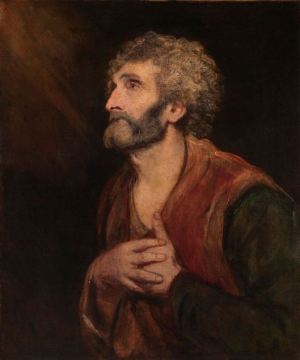
Joshua Reynolds, Dionysius Aeropagites. oil on canvas, 30 x 25 inches, ca. 1772
• A major rediscovered masterpiece by Sir Joshua Reynolds, listed as missing since 1905, and a star attraction at the exhibition of London gallery LOWELL LIBSON LTD. “Dionysius Aeropagites has only been known from an 18th-century engraving,” according to Libson. It depicts Reynolds’s favorite model, a street mender from York, George White. The painting perfectly communicates Reynolds’s ambitions as a history painter shortly after the founding of the Royal Academy.” Painted in emulation of an Italian old master, the powerful head was published shortly after its completion and given the title identifying the sitter as a follower of St. Paul. Libson is also featuring works by William Blake, John Singleton Copley, Thomas Jones, Samuel Palmer, Simeon Solomon and a fascinating group of British portrait drawings of the 1830s and 1840s depicting Queen Victoria, Talleyrand, Chopin and Paganini—plus Sir Thomas Lawrence’s portrait of the Duke of Wellington’s nieces and J.M.W. Turner’s Alpine tour watercolor, The Val d’Aosta.
• A small group of noteworthy David Cox watercolours MARTYN GREGORY is bringing to New York includes a very large one that is completely fresh to the market. Gregory says it is interesting as it is made on several sheets of the ‘Scotch’ paper Cox used later in his career, which he had carefully pieced together to make a much larger sheet. It is a fascinating watercolour which shows Cox working on grand scale, mastering one of his favourite subjects: Betwys-y-Coed in North Wales. Gregory is also showing 18th- and 19th-century British watercolours including Richard Parkes Bonington’s The Ruins of Chateau d’Harcourt near Lillebonne, a pencil and watercolour dating to 1821-22 when Bonington made his first tour of Normandy; a 1793 watercolour by British artist William Alexander showing Chinese Barges of the first British embassy preparing to pass under a bridge, led in 1792-4 by Lord Macartney; and a highly detailed wash drawing, John Hood’s The East Indiaman Essex in Three Positions.
• London specialist STEPHEN ONGPIN FINE ART always manages to acquire new-to-the-market works by the most iconic names in fine art including Edgar Degas, Thomas Gainsborough, Adolph Gottlieb, Paul Klee, Henri Matisse, Edvard Munch, Paul Signac, Alfred Sisley, Wayne Thiebaud, and Odilon Redon. This year’s exhibition won’t disappoint as Ongpin is showing Gainsborough’s Travellers Passing Through A Village, Klee’s Night impression of a Southern Town, Degas’s A Seated Young Woman Plaiting her Hair, Matisse’s Standing Female Nude, Munch’s Rocks on the Edge of a Sea, Paul Signac’s Still Life with a Bowl of Fruit, Wayne Thiebaud’s Ice Cream Cone, and Redon’s A Face in the Window.
• New exhibitor PRPH RARE BOOKS is offering an album of 70 uncensored 16th-century drawings after Michelangelo’s Last Judgment in the Sistine Chapel. The original figures depict genitalia and other ‘lewd’ elements which were later censored and painted over at the Church’s direction. These were generally unknown until the restoration of the work in 1980–84. They are bound in 18th-century calf and were in the collection of Count Leopold Cicognara (1767–1834), the leading Italian art historian of his time. PRPH is also showing a highly important complete set of 50 engraved fortune telling cards (Northern Italy 1465) by the Master of the ‘Mantegna’ Tarocchi—E-series, rebound in 18th-century cartonnato.
• London dealer GUY PEPPIATT brings over wonderful British works including artworks by one of the most important British topographical artists of the late 18th century, Edward Dayes, whose Carlsbrooke Castle Isle of Wight, dating to 1788, is featured at MDNY. Also featured is a William Callow R.W.S. watercolour A Spring Day at Florence from San Miniato, dating to 1882, and Thomas Rowlandson’s pen, ink and watercolour,The Mid-day Rest.
• PIA GALLO is offering a Salvator Rosa (1615–1673) Study for the Figure of Scylla in pen ink and wash that is a study for the painting Glaucus and Scylla at the Brussels Musee des Beaux Arts. The drawing was once owned by Queen Christina of Sweden. Also showing splendid, hand-painted, fan-shaped gouaches with views of the Gulf of Naples that were meant to be folding fans. Fans and hand screens—predominantly as a fashion accessory—became popular in Europe from the seventeenth century onwards. These two individual fans are made from natural vellum, hand-painted by an anonymous artist. The fans here are not folded nor are they mounted and date from probably around 1800. They show Romantic views of the most frequently visited sights in the Bay of Naples by travelers on the Grand Tour. Villa di Pompejo (Villa of Diomedes). Gouache on natural vellum. Veduta del Sepolcro della Sacerdotessa Mammia a Pompejano.
• CRISPIAN RILEY-SMITH of London has titled his exhibition, Flights of Fancy: Birds and Animals by Aert Schouman and his Contemporaries in 18th-century Holland. On view are six Aert Schouman watercolours, including five from the collection of the late Lord Fairhaven, and four watercolours by Abraham Meertens—plus master drawings by Bandini, Benso Hackert, Zuccarelli and Van Goyen.
• MARGOT GORDON FINE ARTS is staging a show titled Five Centuries of Faces and Figures.
• MIA WEINER is showing a selection of important works such as Gaetano Gandolfi’s Studies of Two Angels, preparatory for the flanking angels in the 1780 altarpiece Immaculate Conception in S.M. Lambarun Coeli, Bologna. She also offers a charming red chalk drawing by a student of the Carracci closest in technique to Annibale, drawing a fellow student or perhaps himself as he works from model sheets of facial features made by Agostino. Plus Filippo Lauri’s Allegorical Figures Frolicking in the Flowers in gouache, Jan Van Kessel’s watercolour of Butterfly, Moth, Rose and Spring of Gooseberries, Salvator Rosa’s Study of a River God for The Dream of Aeneas, a study for the same figure in a painting at the Metropolitan Museum. A number of 19th-century landscape oil sketches and watercolours by Northern European and Italian artists such as Carl Friedrich Heinrich Werner’s A Beautiful Water Carrier, which Weiner says is a stunning example of the artist’s work, and Daniel Israel’s large scale Portrait of a Bearded Man, as strong as any German sheet of the period.
• MIREILLE MOSLER is showing artworks spanning five centuries including works by Zacharias Blijhooft, Pieter Holsteyn II, Francois Bonvin, John Constable, Jules Bastien-Lepage, Willem van den Berg, Leo Gestel, Jan Sluyters, Jan Toorop and Jacobus van Looy. The earliest 17th-century drawings exhibited are a group of 15 small animals and insects that once belonged to a larger album in the possession of the Earl of Arundel (1585–1648) known as ‘The Collector Earl’. John Constable’s 1810 ‘En plein air’ East Bergholt depicts the surroundings where he grew up. A Francois Bonvin Study for Le Couvreur tombe dating to 1877 is a recently rediscovered study of a now lost important Salon painting of the same year.
Founded in 2006 as a way to draw upon and buttress the presence of collectors and museum officials during the important January art-buying events, including the Old Master auctions and The Winter Antiques Show, Master Drawings in New York has become an important part of the winter art scene in its own right, attracting the most influential dealers not only in New York but in England, France, Italy, Germany, and Spain who each stage a themed exhibition in more than two dozen Upper East Side galleries between East 63rd and 93rd Streets. Master Drawings in New York has received critical acclaim for orchestrating a showcase for fine art works that cut across the full range of styles, centuries, mediums and genres, and for providing greater accessibility to fine art at price points that range from several thousand dollars to several million.
◊ ◊ ◊ ◊ ◊
Note (added 4 February 2015) — A press release recapping the 2015 event is available here»
Exhibition | Liverpool’s Most Radical Son: Edward Rushton
◊ ◊ ◊ ◊ ◊
The Museum of Liverpool, the International Slavery Museum, and the Victoria Gallery and Museum celebrate the activism and legacy of Edward Rushton (1756–1814) with a trio of exhibitions:
Unsung – Liverpool’s Most Radical Son: Edward Rushton
The Museum of Liverpool, 7 November 2014 — 10 May 2015
International Slavery Museum, Liverpool, 7 November 2014 — 10 May 2015
Victoria Gallery and Museum, University of Liverpool, 7 November 2014 — 10 May 2015
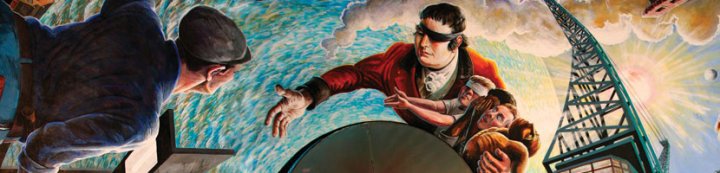
What made a Liverpool bookseller, and former seaman, publican, and newspaper editor who was blind, take on George Washington, the President of the United States of America, over his personal and public failure to liberate enslaved Africans?

Moses Haughton (1773–1849), Portrait of Edward Rushton (Liverpool: Royal School for the Blind)
Edward Rushton’s knowledge of slavery was first hand—as a West Indies sea boy from the age of ten he had experience of both the slave trade and plantation slavery. In Caribbean waters his life was saved by an African sailor, Quamina, whom he had befriended, and who lost his own life in consequence. Two years later, at eighteen, Rushton was the only crewmember who tended the enslaved Africans infected with the epidemic eye disease, trachoma. Rushton caught the infection and became blind.
Surviving a period of poverty, he opened a bookshop on Paradise Street, which became a hub for Liverpool’s ‘Friends of Freedom’. Rushton was then able to establish the Liverpool School for the Indigent Blind—still in existence today—second only in the world to the Paris school.
Edward Rushton used his pen to support the revolutionary struggles in America, France, Haiti, Ireland, and Poland and was a friend to all who were oppressed whether by human exploitation or human frailty. At the heart was his plea to respect human rights. He saw the press gang as a “a National Stain” and slavery as the “ the Foulest Stain.” Rushton’s poetry broke the mould and gave a voice to the powerless and dispossessed across the world. His work reached a wide audience—it was published on both sides of the Atlantic in newspapers, collected volumes, in broadsides and put to music.
◊ ◊ ◊ ◊ ◊
Supported by the Heritage Lottery Fund and led by DaDaFest as part of DaDaFest International 2014, Unsung began last year in Liverpool as a city-wide project celebrating the social activism and legacy of Edward Rushton on the bicentenary of his death. Kathleen Hawkins wrote about the project for the BBC back in November.










 Enfilade
leave a comment