Exhibition | Fashioning the Body: An Intimate History of the Silhouette
Press release for the upcoming exhibition at the BGC:
Fashioning the Body: An Intimate History of the Silhouette
Musée des Arts Décoratifs, Paris, 5 July — 24 November 2013
Bard Graduate Center, New York, 3 April — 26 July 2015
Curated by Denis Bruna
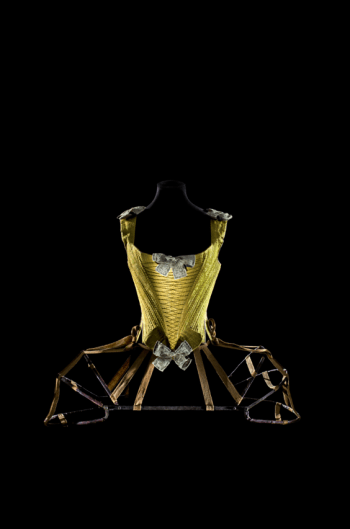
Whalebone corset. France, ca. 1740–60. Silk satin damask, braided silk, linen bows covered in silk and decorated with metallic thread, whalebone, linen lining. Les Arts Décoratifs, PR 995.16.1. Articulated pannier. France, ca. 1770. Iron covered with leather, fabric tape. Les Arts Décoratifs, depot du musée national du Moyen Âge-Thermes et hotel de Cluny 2005, Cluny 7875. Photographer: Patricia Canino.
Having garnered high acclaim at the Musée des Arts décoratifs in Paris in 2013, the exhibition Fashioning the Body: An Intimate History of the Silhouette will be on display at the Bard Graduate Center from April 3 through July 26, 2015. The exhibition will present the many devices and materials that women and men have used to shape their silhouettes from the seventeenth century to today, including panniers, corsets, crinolines, bustles, stomach belts, girdles, and push-up brassieres. The exhibition will also look at how lacing, hinges, straps, springs, and stretch fabrics have been used to alter natural body forms.
Curated by Denis Bruna, curator of pre-19th-century fashion and textile collections at the Musée des Arts décoratifs and professor at the École du Louvre, the exhibition will explore the history of what has long been ‘behind the scenes’ in clothing and fashion—far beyond the corset, the best-known device for shaping the figure. This show, which draws heavily on the Paris museum’s unrivaled costume collection, is the first of its kind, and the Bard Graduate Center will be its only venue in North America.
Although a broad array of silhouette-shaping garments has evolved over the course of fashion history, and techniques have been refined, the purpose of such garments has remained consistent: to flatten the stomach, compress the waist to the point of hollowing it out, support the bust, lift the breasts (and sometimes flatten them), and add curves to the hips. In short, comfort was superseded by appearance until about 1900, when couturiers such as Paul Poiret launched, however fleetingly, a vogue for ‘natural’ lines.
The tricks for fashioning women’s bodies have always confounded belief, from the earliest boned bodices through today’s push-ups. Spread across three floors of the Bard Graduate Center Gallery’s townhouse, Fashioning the Body opens with the seventeenth-century silhouette, exemplified by a rare women’s Spanish doublet, which was internally reinforced to be more rigid. Structured with armatures and other mechanisms, the garments of the eighteenth century enforced the erect posture prized first by the aristocracy and later by an influential bourgeoisie in order to convey a sense of superiority through the display of an idealized physical form. The epitome of the transformed female silhouette is the late eighteenth-century formal or court dress, examples of which will be on display alongside the undergarments that molded their distinctive silhouettes. In men’s fashion, the exhibition explores how padded jackets provoked arched torsos; how calf enhancers, stomach belts, and codpieces were worn; and how variations on these enhancements continued into the nineteenth century and beyond. The exhibition will also include garments for children, who wore corsets beginning in the seventeenth century.
Fashioning the Body continues into the nineteenth century, in which the corset held tyrannical sway, embodying the voguish insistence on a ‘wasp waist’, accentuated by the excessive ballooning of crinoline. After 1870 this kind of boned hoopskirt disappeared and was replaced by the bustle—also known as the faux-cul (fake buttocks), ‘shrimp tail’, or strapontin (jump seat)—which gave women an odd and sinuous profile reminiscent of a goose. Undergarments were never as abundant or as concealed as they were in the nineteenth century. The exhibition will continue with the brassiere and girdle, including examples used by men, and eventually the bust-enhancing and push-up bras of today. These devices were designed to create a plunging look for even the slimmest figures, reflecting the dictates of the canons of beauty at a time when bodies are modeled more by diets, body building, and surgery than by clothing.
In addition to complete outfits shaped by these hidden structural contraptions, the exhibition will also feature moving mannequins wearing mechanized reconstructions of panniers, crinolines, and bustles in order to show how the undergarments worked. The exhibition space will also include an area where visitors can try on specially made replicas of corsets, eighteenth-century panniers, and crinolines in order to understand the workings of these structures, which have played such an important role in the history of fashion.
Denis Bruna has a doctorate in history from the University of Paris I Panthéon-Sorbonne. He joined Les Arts Décoratifs in 2011 as curator of textile and fashion collections before the nineteenth century. He is also a professor and director of research in the history of fashion, costume, and textiles at the École du Louvre. His research focuses on the history and iconography of the costume, dress, and customs of the body. He has published several books and was the curator of the 2012 exhibition Fashioning Fashion: Two Centuries of European Fashion 1700–1915.
The Bard Graduate Center is a graduate research institute in New York City. The Center’s Gallery exhibitions and publications, MA and PhD programs, and research initiatives explore new ways of thinking about decorative arts, design history, and material culture. Founded in 1993, the BGC is an academic unit of Bard College. Fashioning the Body is the third in a series of collaborations between the Musée des Arts décoratifs and the Bard Graduate Center, which included Chinese Cloisonné (2011) and Discovering the Secrets of Soft-Paste Porcelain at the Saint-Cloud Manufactory, ca. 1690–1766 (1999).
The Musée des Arts décoratifs, housed in the Louvre building, is a unique, private institution composed of a specialized library, teaching facilities, and an ensemble of prestigious museums, including the Musée Nissim de Camondo and the Musée des Arts décoratifs. The Musée des Arts décoratifs fulfills a unique role in the French cultural landscape. Its six thousand objects on view in 10,000 square meters of exhibition space highlight the skills of craftsmen through the centuries, the evolution of styles, technological innovation, and the creativity of artists in enriching our day-to-day environ- ment. It is the only museum able to pay tribute to all the great names that have forged the history of French taste, from Boulle, Sèvres, Aubusson, Christofle, Lalique, and Guimard to Mallet Stevens, Le Corbusier, Perriand, and Starck. The museum’s chronological itinerary guides visitors through all the major styles and movements, from Gothic to Louis XVI, Art Nouveau, Art Deco, and modern design. Les Arts Décoratifs also boasts exceptional fashion and textile collections, among the finest in the world, and a vast collection of advertising posters, films, and objects. The wealth of these collections enables Les Arts Décoratifs to run a program of ten to fifteen thematic and monographic exhibitions covering every historic and contemporary aspect of the decorative arts.
◊ ◊ ◊ ◊ ◊
The Bard Graduate Center, in collaboration with Yale University Press, will publish an English-language version of the book that accompanied the exhibition in Paris, which is now out of print:
Denis Bruna, ed., with photographs by Patricia Canino, Fashioning the Body: An Intimate History of the Silhouette (New Haven: Yale University Press, 2015), 272 pages, ISBN: 978-0300204278, $50.
 This unique survey offers fascinating insights into the convoluted transformations employed by both men and women to accommodate the fickle dictates of fashion. With high design, wit, and style, Fashioning the Body tracks the evolution of these sartorial devices—from panniers, crinolines, and push-up bras to chains, zippers, and clasps—concealed beneath outer layers in order to project idealized figures. Women’s corsets constricted waists; exaggerated buttocks and hips counterbalanced jutting bust lines; and chic, aerodynamic silhouettes compressed breasts and flattened bellies. Yet masculine fashion has been no stranger to these tortuous practices. Men flaunted their virility by artificially broadening their shoulders, applying padding to their chests, and slipping codpieces over their groins. With more than 200 beautiful illustrations—including reproductions of superb historic advertisements—Denis Bruna reveals the industry and art of these contrivances meant to entice and beguile as well as assert status and power. Contemporary haute-couture designers Thierry Mugler, Jean Paul Gaultier, Rei Kawakubo for Comme des Garçons, Christian Lacroix, and Vivienne Westwood are featured in this indiscreet tour of intimate fashion history.
Exhibition | Fantastical Worlds: Adam Friedrich von Löwenfinck
From the Staatliche Kunstsammlungen Dresden:
Fantastical Worlds: Painting on Meissen Porcelain
and German Faience by Adam Friedrich von Löwenfinck (1714–1754)
Zwinger, Dresden, 1 October 2014 — 22 February 2015

Adam Friedrich von Löwenfinck, Meissen, 1734
To mark the 300th anniversary of the birth of Adam Friedrich von Löwenfinck, the Porzellansammlung of the Staatliche Kunstsammlungen Dresden presents a comprehensive exhibition of this artist’s oeuvre, bringing together around 100 selected porcelain and faience exhibits from the Dresden Porzellansammlung, private collections and renowned museums, including the Metropolitan Museum of Art, New York, the Rijksmuseum, Amsterdam, the Reiss-Engelhorn Museum, Mannheim, and the Museum für Kunst und Gewerbe, Hamburg.
Adam Friedrich von Löwenfinck (1714–1754) was one of the most important ceramic painters of the eighteenth century. He began his career at the Meissen Porcelain Manufactory in 1728, but by 1736 had fled to escape restrictions on his artistic development and difficult working conditions in the painters’ workshops. His life then took an adventurous path to a succession of faience manufactories, starting with Bayreuth and moving on by way of Fulda to Strasbourg-Haguenau. Due to his exceptional artistic abilities, but also to his guile and lack of scruples, Löwenfinck eventually rose from lowly journeyman painter to manufactory director.
Inspired by the painted decoration on Chinese and Japanese porcelain in the collection of August the Strong, he created a fantastic world inhabited by vibrantly colourful, fabulous creatures. He later took these exotic motifs, as well as his knowledge of both East Asian and European flower painting, with him as he travelled, transferring them from one workplace to the next. As Löwenfinck did not sign his works, for a long time it was impossible to attribute them with any certainty: as a result, his oeuvre long remained completely unrecognised, even among specialists.
The life and works of this exceptional artist were the focus of several years of research conducted by the Porzellansammlung of the Staatliche Kunstsammlungen Dresden. The results of this project are now presented in a comprehensive anniversary exhibition. Systematic evaluation of archive sources, including manufactory reports and case files, shed light on previously little known aspects of social conditions in the porcelain and faience manufactories of the time, and enabled a fundamental and thorough reassessment of his work.
◊ ◊ ◊ ◊ ◊
◊ ◊ ◊ ◊ ◊
From Arnoldsche Art Publishers:
Ulrich Pietsch, Phantastische Welten: Malerei auf Meissener Porzellan und deutschen Fayencen von Adam Friedrich von Löwenfinck, 1714–1754 (Stuttgart: Arnoldsche Art Publishers, 2014), 384 pages, ISBN: 978-3897904200, 78€.
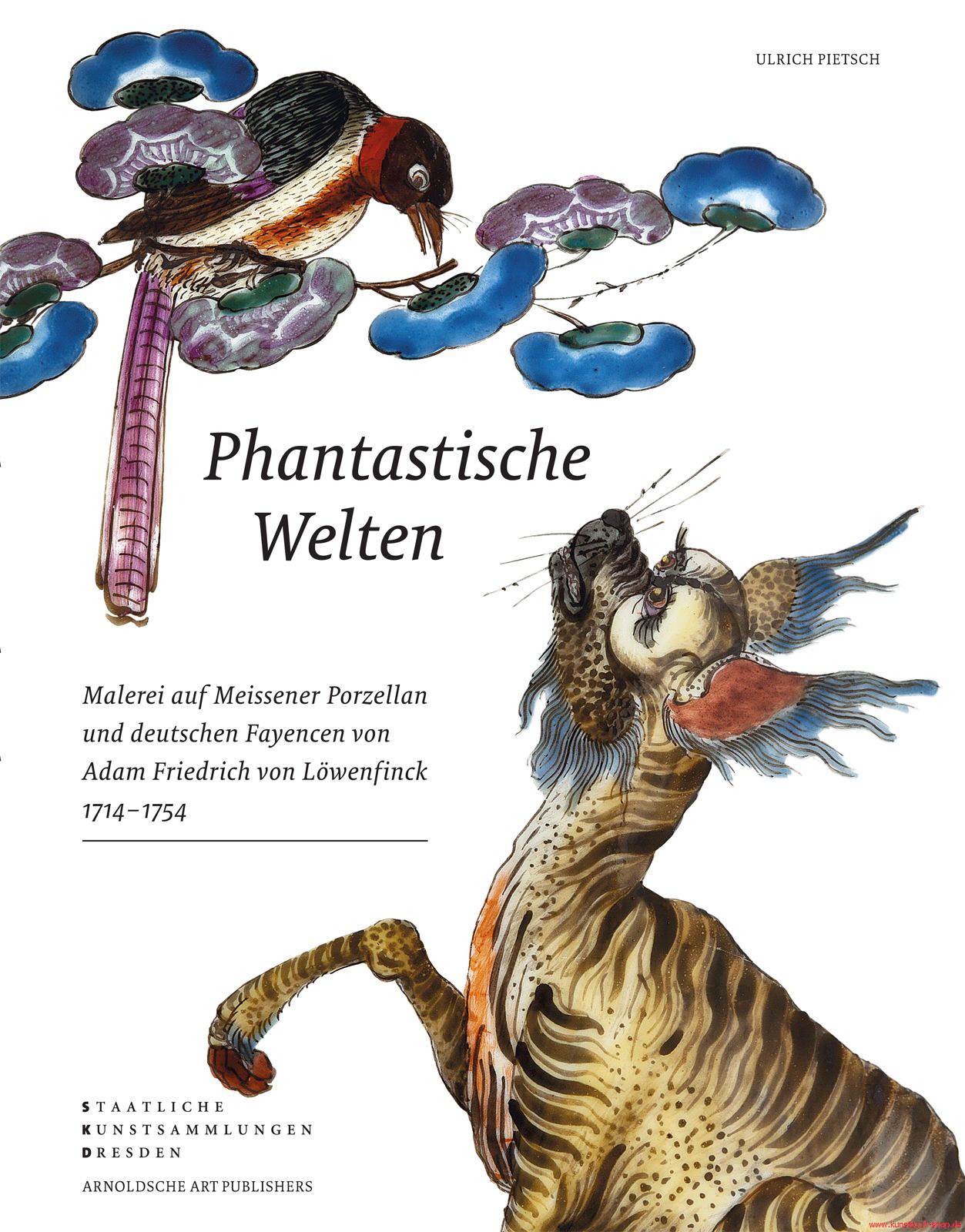 Adam Friedrich von Löwenfinck (1714–1754) war einer der bedeutendsten Keramikmaler des 18. Jahrhunderts. Er begann seine Karriere 1728 in der Porzellan-Manufaktur Meissen, die er wenige Jahre später wieder verließ, um der Einschränkung seiner künstlerischen Entfaltung und den schwierigen Arbeitsbedingungen in den Malerstuben zu entfliehen. Sein abenteuerlicher Lebensweg führte ihn in verschiedene Fayence-Manufakturen, darunter Bayreuth, Ansbach, Fulda, Höchst und Straßburg-Haguenau. Aufgrund seiner außergewöhnlichen künstlerischen Fähigkeiten, aber auch durch Geschick und Skrupellosigkeit stieg Löwenfinck schließlich vom einfachen Malergesellen in die Position eines Manufakturdirektors auf. Löwenfinck ist bekannt für seine fantastische Welt bunt schillernder und märchenhafter Fabeltiere. Er beeinflusste und prägte nachhaltig die Keramikmalerei seiner Zeit und wirkte stilprägend auf viele andere Manufakturen des 18. Jahrhunderts in Europa. Aufgrund fehlender Künstlersignaturen ist sein Werk umstritten und wurde bislang kontrovers diskutiert.
Die vorliegende Publikation ist das Ergebnis eines mehrjährigen Forschungsprojektes der Porzellansammlung Dresden, mit der nun erstmals eine grundlegende Untersuchung der Biografie und des OEuvres Adam Friedrich von Löwenfincks vorgelegt wird.
Exhibition | Jean-Etienne Liotard
On this summer at the Scottish National Gallery (more information to come in the spring). . .
Jean-Etienne Liotard
Scottish National Gallery, Edinburgh, 4 July — 13 September 2015
Royal Academy, London, 24 October 2015 — 31 January 2016
Curated by MaryAnne Stevens, William Hauptman, and Christopher Baker

Jean Étienne Liotard, Laura Tarsi, ‘A Grecian Lady’, watercolour and bodycolour on ivory, ca 1745–49 (Cambridge: Fitzwilliam Museum)
A stunning exhibition celebrating one of the greatest artists of the eighteenth century. The work of Jean- Étienne Liotard (1702–89) has been rarely exhibited, and this is the first time it will be comprehensively celebrated in Britain.
Liotard enjoyed a long career, and his finest portraits display an astonishing hyper-realism achieved through a combination of incredible, intense observation and remarkable technical skills. He excelled at the delicate art of pastel, but also drew, painted in oil, created enamels, and was a refined miniaturist and printmaker. His activity was prodigious: Liotard wrote a treatise on painting, was a collector, a dealer, a traveller and an artistic innovator. In the age of Mozart and Casanova, he was a key international figure whose achievement deserves to be better known. Highlights of this important show include famous portraits, startling self-portraits, and brilliant experiments with genre and still-life subjects from the end of his career.
◊ ◊ ◊ ◊ ◊
Update (added 5 July 2015) — From the press release:
The National Galleries of Scotland is delighted to announce a major exhibition in the summer of 2015 celebrating one of the greatest yet little- known artists of the eighteenth century. The work of Jean-Étienne Liotard (1702–1789) has rarely been exhibited and this is the first time it will be comprehensively celebrated in Britain. Liotard enjoyed a long career and his finest portraits display an astonishing hyper-realism achieved through a combination of incredible, intense observation and remarkable technical skills.
Liotard was one of the most sophisticated artists of eighteenth-century Europe; a brilliant, witty portraitist, he excelled at the delicate art of pastel, but also drew, painted in oil, created enamels and was a refined miniaturist and printmaker. According to his contemporary Horace Walpole “Truth prevailed in all his works.” In some respects he also displayed striking modernity as a highly accomplished self-publicist, formulating a powerful ‘eastern’ image of himself following his period in Constantinople, by wearing exotic clothes and growing a long beard, which became as much a focus of curiosity as his portraits. His activity was prodigious: Liotard wrote a treatise on painting, was a collector, a dealer, a traveller and an artistic innovator. In the age of Mozart and Casanova, he was a key international figure, whose achievement deserves to be better known.
Born in Geneva, he travelled extensively, working in Amsterdam, The Hague, Venice, Rome and Naples. He spent four years in Constantinople depicting foreign residents in the city and developed a fascination with near- eastern fashions and customs. His career also took him to the courts of Vienna, Paris and London, where he portrayed the families of Empress Maria Theresa, King Louis XV and Augusta, Princess of Wales, creating images of great candour and charm.
Christopher Baker, Director of the Scottish National Portrait Gallery, and one of the exhibition’s curators commented: “This exhibition will be a revelation to many visitors who are unfamiliar with Liotard’s dazzling achievement. He was undoubtedly one of the most remarkable and idiosyncratic artists of the eighteenth century, and his work and career are fascinating, as they touch on themes such a travel, orientalism, court art, fashion and technical experimentation.”
Liotard depicted a number of important British patrons, in addition to members of the Royal family, such as the actor David Garrick, and some of his key works remain in U.K. public and private collections. Highlights of the exhibition will also include a selection of his startling self-portraits and brilliant experiments with genre and still life subjects that date from late in his career.
◊ ◊ ◊ ◊ ◊
Christopher Baker, Duncan Bull, Marc Fehlmann, William Hauptman, Neil Jeffares, Aileen Ribeiro, MaryAnne Stevens, Jean-Etienne Liotard (London: Royal Academy Publications, 2015), 224 pages, ISBN: 978-1907533990, £35.
 Renowned during the eighteenth century for his exquisite portraits and works in pastel, not to mention his outlandish Orientalist outfits, Jean-Etienne Liotard (1702–1789) painted some of the most significant rulers and aristocrats in Europe, including the entire British Royal Family. A peripatetic artist who worked in the Near East as well as in major European capitals, Liotard was born in Geneva and studied in Paris, before travelling to Italy and then on to Constantinople, in the company of Lord Duncannon. While there he painted the local residents as well as the British community, and adopted the eccentric style of dress that, when he later visited London, saw him become known as ‘The Turk’. This volume, accompanying the first exhibition of his works to be shown in the United Kingdom, illuminates the career of this unique artist, showcasing a variety of his extraordinary works, including portraits, drawings
and enamels.
Christopher Baker is Director of the Scottish National Portrait Gallery.
Duncan Bull is Curator of Foreign Paintings at Rijksmuseum, Amsterdam.
Marc Fehlmann is Associate Professor of Archaeology and Art History at Eastern Mediterranean University, Northern Cyprus.
William Hauptman is an independent scholar.
Neil Jeffares is an art historian with a particular interest in eighteenth-century pastels.
Aileen Ribeiro is Emeritus Professor at the Courtauld Institute of Art.
Mary-Anne Stevens, an independent curator, worked as Director of Academic Affairs at the Royal Academy for 29 years.
◊ ◊ ◊ ◊ ◊
Note (added 17 January 2016) — Neil Jeffares has compiled an extensive errata for the catalogue, available at his website.
Installation | A Voyage to South America

Unidentified artist, active in Cuzco, Peru, Our Lady of the Rosary of Chiquinquirá with Female Donor, late 17th/early 18th century (Carl and Marilynn Thoma Collection)
◊ ◊ ◊ ◊ ◊
From the AIC:
A Voyage to South America: Andean Art in the Spanish Empire
Art Institute of Chicago, 11 November 2014 — 21 February 2016
While the Art Institute has a long tradition of collecting and displaying works from the pre-Hispanic cultures of South America, this long-term installation offers the museum’s first presentation of work from the viceregal period. Fourteen paintings and related works on paper—including pieces from the collection of Chicagoans Marilynn and Carl Thoma never before displayed in a museum, as well as important loans from the Newberry Library and Denver Art Museum—introduce visitors to explorers, artists, and patrons who lived in the Spanish-governed Andes during the 17th, 18th, and 19th centuries.
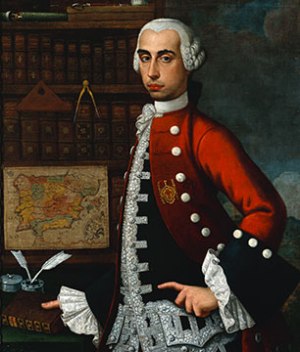
Unidentified artist, active in Spain, Portrait of Antonio de Ulloa y de la Torre-Guiral, 1768–70
(Carl and Marilynn Thoma Collection)
The metaphorical guide of this journey is Antonio de Ulloa (1716–95), a Spanish naval officer and cartographer who traveled to South America with a French scientific mission in the 1730s and 1740s. His portrait introduces the group of works assembled—paintings of identified sitters, signal works by important South American artists, and devotional paintings that include historical figures. Each work has its own direct link to individual biography and lived experience in the New World, offering a more personal look at the themes of exploration and discovery and bringing to life the culture and artistic production in South America as European conventions combined with indigenous traditions.
The installation is accompanied by a bilingual brochure as well as bilingual treatment of all object labels, wall texts, and audio guide stops. Select works have also been added to the museum’s ‘Closer’ app, featuring slide shows, videos, archival materials, and more for further insight into this unique period of cultural convergence.
At noon on 17 February 2015, Victoria Sancho Lobis, associate curator in the Department of Prints and Drawings, will discuss the exhibition.
◊ ◊ ◊ ◊ ◊
Chicago’s Newberry Library will host a symposium on Latin America in the Early Colonial Period on Saturday, 11 April 2015, exploring related material in the sixteenth and seventeenth centuries.
Exhibition | The Critique of Reason: Romantic Art, 1760–1860

George Stubbs, A Lion Attacking a Horse, 96 x 131 inches (243.8 x 332.7 cm), 1762 (New Haven: Yale Center for British Art, Paul Mellon Collection B1977.14.71)
◊ ◊ ◊ ◊ ◊
From the YCBA:
The Critique of Reason: Romantic Art, 1760–1860
Yale University Art Gallery, New Haven, 6 March — 26 July 2015
Curated by Cassandra Albinson, Nina Amstutz, Elisabeth (Lisa) Hodermarsky, Paola D’Agostino, and Izabel Gass
The first major collaborative exhibition between the Yale University Art Gallery and the Yale Center for British Art, The Critique of Reason offers an unprecedented opportunity to bring together treasures of the Romantic art movement from the collections of both museums. The exhibition comprises more than three hundred paintings, sculptures, medals, watercolors, drawings, prints, and photographs by such iconic artists as William Blake, Théodore Géricault, Francisco de Goya, and J. M. W. Turner. This broad range of objects challenges the traditional notion of the Romantic artist as a brooding genius given to introversion and fantasy. Instead, the exhibition’s eight thematic sections juxtapose arresting works of art that reveal the Romantics as attentive explorers of their natural and cultural worlds as well as deeply invested in exploring the mysterious, the cataclysmic, and the spiritual. The richness and range of Yale’s Romantic holdings will be on display, presented afresh for a new generation of museumgoers.
The Critique of Reason: Romantic Art, 1760–1860 has been co-organized by the Yale Center for British Art and the Yale University Art Gallery. The curators are, at the Center, A. Cassandra Albinson, Curator of Paintings and Sculpture, and Nina Amstutz, Postdoctoral Research Associate, and, at the Gallery, Elisabeth (Lisa) Hodermarsky, Sutphin Family Senior Associate Curator of Prints and Drawings, and Paola D’Agostino, Nina and Lee Griggs Assistant Curator of European Art; and Izabel Gass, Graduate Research Assistant, is at the Center and Gallery. The exhibition has been made possible by the Art Gallery Exhibition and Publication Fund and the Robert Lehman, B.A. 1913, Endowment Fund, as well as by funds from the Yale Center for British Art Program Endowment.
◊ ◊ ◊ ◊ ◊
Note (added 30 March 2015) — In connection with the exhibition, Yale is hosting a two-day symposium, The Romantic Eye, 1760–1860 and Beyond, 17–18 April 2015. More information is available here»
Exhibition | China: Through the Looking Glass
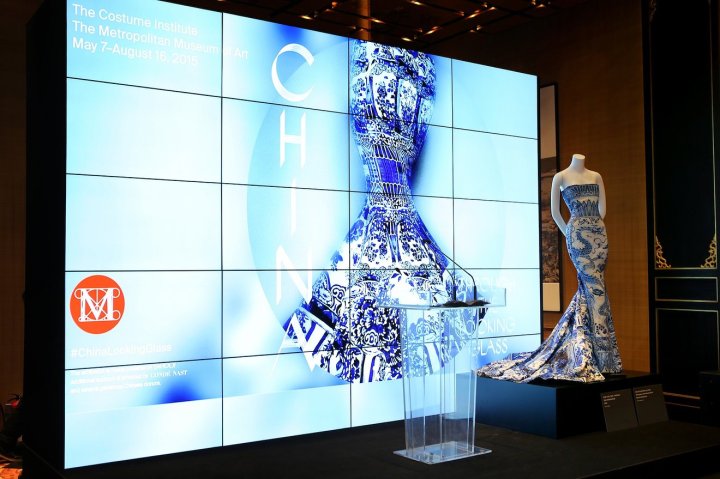
Evening dress by Roberto Cavalli, 2005
Photo: The Metropolitan Museum of Art
◊ ◊ ◊ ◊ ◊
Press release (23 December 2014) from The Met:
China: Through the Looking Glass
The Metropolitan Museum of Art, New York City, 7 May — 16 August 2015
Curated by Andrew Bolton with Harold Koda, Maxwell Hearn, Denise Patry Leidy, and Zhixin Jason Sun
The Costume Institute’s spring 2015 exhibition, China: Through the Looking Glass, will be on view at The Metropolitan Museum of Art from May 7 through August 16, 2015 (preceded on May 4 by The Costume Institute Benefit). Presented in the Museum’s Chinese Galleries and Anna Wintour Costume Center, the exhibition will explore how China has fueled the fashionable imagination for centuries, resulting in highly creative distortions of cultural realities and mythologies. In this collaboration between The Costume Institute and the Department of Asian Art, high fashion will be juxtaposed with Chinese costumes, paintings, porcelains, and other art, as well as films, to reveal enchanting reflections of Chinese imagery.
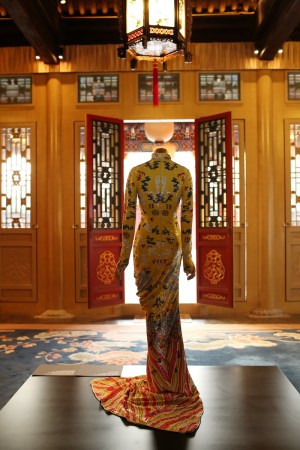
Yves Saint Laurent by Tom Ford, 2004
Photo: Courtesy of The Metropolitan Museum of A
“I am excited about this partnership between these two forward-thinking departments which will undoubtedly reveal provocative new insights into the West’s fascination with China,” said Thomas P. Campbell, Director and CEO of the Met. “The artistic direction of acclaimed filmmaker Wong Kar Wai will take visitors on a cinematic journey through our galleries, where high fashion will be shown alongside masterworks of Chinese art.”
In celebration of the exhibition opening, the Museum’s Costume Institute Benefit will take place on Monday, May 4, 2015. Silas Chou will serve as Honorary Chair. The evening’s co-chairs will be Jennifer Lawrence, Gong Li, Marissa Mayer, Wendi Murdoch, and Anna Wintour. This event is The Costume Institute’s main source of annual funding for exhibitions, publications, acquisitions, and capital improvements.
“From the earliest period of European contact with China in the 16th century, the West has been enchanted with enigmatic objects and imagery from the East, providing inspiration for fashion designers from Paul Poiret to Yves Saint Laurent, whose fashions are infused at every turn with romance, nostalgia, and make-believe,” said Andrew Bolton, Curator in The Costume Institute. “Through the looking glass of fashion, designers conjoin disparate stylistic references into a fantastic pastiche of Chinese aesthetic and cultural traditions.”
Exhibition Overview

Chanel by Karl Lagerfeld, 1984
Photo: The Metropolitan Museum of Art
This is The Costume Institute’s first collaboration with another curatorial department since AngloMania: Tradition and Transgression in British Fashion in 2006, a partnership with the Department of European Sculpture and Decorative Arts. China: Through the Looking Glass will feature more than 130 examples of haute couture and avant-garde ready-to-wear alongside masterpieces of Chinese art. Filmic representations of China will be incorporated to reveal how our visions of China are shaped by narratives that draw upon popular culture, and to recognize the importance of cinema as a medium through which we understand Chinese history.
The Anna Wintour Costume Center’s Lizzie and Jonathan Tisch Gallery will present a series of ‘mirrored reflections’ through time and space, focusing on Imperial China; the Republic of China, especially Shanghai in the 1920s, 1930s and 1940s; and the People’s Republic of China. These reflections, as well as others in the exhibition, will be illustrated with scenes from films by such groundbreaking Chinese directors as Zhang Yimou, Chen Kaige, Ang Lee, and Wong Kar Wai. Distinct vignettes will be devoted to ‘women of style’, including Oei Huilan (the former Madame Wellington Koo), Soong May-Ling (Madame Chiang Kai-shek), and Empress Dowager Cixi.
Directly above the Anna Wintour Costume Center, the Chinese Galleries on the second floor will showcase fashion from the 1700s to the present, juxtaposed with decorative arts from Imperial China, including jade, lacquer, cloisonné, and blue-and-white porcelain, mostly drawn from the Met’s collection. The Astor Court will feature a thematic vignette dedicated to Chinese opera, focusing on the celebrated performer Mei Lanfang, who inspired John Galliano’s spring 2003 Christian Dior Haute Couture Collection, ensembles from which will be showcased alongside Mr. Mei’s original opera costumes.
Designers in the exhibition will include Giorgio Armani, Vitaldi Babani, Cristobal Balenciaga, Sarah Burton for Alexander McQueen, Callot Soeurs, Roberto Cavalli, Coco Chanel, Christian Dior, Domenico Dolce and Stefano Gabbana, Peter Dundas for Emilio Pucci, Tom Ford for Yves Saint Laurent, John Galliano for Christian Dior, Jean Paul Gaultier, Valentino Garavani, Nicolas Ghesquière for Balenciaga, Maria Grazia Chiuri and Pierpaolo Picciolo for Valentino, Craig Green, Madame Grès, Ground-Zero, Guo Pei, Adrian Hailwood, Marc Jacobs for Louis Vuitton, Charles James, Charles Jourdan, Mary Katrantzou, Karl Lagerfeld for Chanel, Jeanne Lanvin, Ralph Lauren, Judith Leiber, Ma Ke, Mainbocher, Martin Margiela, Alexander McQueen, Alexander McQueen for Givenchy, Missoni, Edward Molyneux, Kate and Laura Mulleavy, Dries van Noten, Jean Patou, Paul Poiret, Oscar de la Renta for Balmain, Ralph Rucci, Yves Saint Laurent, Paul Smith, Anna Sui, Vivienne Tam, Isabel Toledo, Giambattista Valli, Vivienne Westwood, Jason Wu, Laurence Xu, and others.
The exhibition, a collaboration between The Costume Institute and the Department of Asian Art, coincides with the Museum’s year-long centennial celebration of the Asian Art Department, which was created as a separate curatorial department in 1915. China: Through the Looking Glass is organized by Andrew Bolton, Curator, with the support of Harold Koda, Curator in Charge, both of The Costume Institute. Additional support is provided by Maxwell Hearn, Douglas Dillon Chairman; Denise Patry Leidy, Curator; and Zhixin Jason Sun, Curator, all of the Department of Asian Art.
Internationally renowned filmmaker Wong Kar Wai will be the exhibition’s artistic director working with his longtime collaborator William Chang, who will supervise styling. Nathan Crowley will serve as production designer for the exhibition-he has worked on three previous Costume Institute exhibitions including Superheroes: Fashion and Fantasy (2008), American Woman: Fashioning a National Identity (2010), and Schiaparelli and Prada: Impossible Conversations (2012). The design for the 2015 Costume Institute Gala Benefit will be created by Wong Kar Wai and William Chang with 59 Productions, and Raul Avila, who has produced the Benefit décor since 2007.
“William Chang and I are pleased to be working in collaboration with The Costume Institute and the Asian Art Department of The Metropolitan Museum of Art on this exciting cross-cultural show,” said Wong. “Historically, there have been many cases of being ‘lost in translation’–with good and revealing results. As Chinese filmmakers we hope to create a show that is an Empire of Signs–filled with meaning for both East and West to discover and decipher.”
The exhibition is made possible by Yahoo. Additional support is provided by Condé Nast and several generous Chinese donors.
◊ ◊ ◊ ◊ ◊
The accompanying publication will be distributed by Yale UP:
Andrew Bolton, with Adam Geczy, Maxwell K. Hearn, Homay King, Harold Koda, Mei Mei Rado, Wong Kar Wai, and John Galliano, with photography by Platon, China: Through the Looking Glass (New York: The Metropolitan Museum of Art, 2015), 256 pages, ISBN: 978-0300211122, $45.
For centuries, China’s export arts—jade, silks, porcelains, and, more recently, cinema—have fueled Western fantasies of an exotic East and served as enduring sources of inspiration for fashion. This stunning publication explores the influence of Chinese aesthetics on designers, including Giorgio Armani, Christian Dior, Jean Paul Gaultier, Karl Lagerfeld, Ralph Lauren, Alexander McQueen, and Yves Saint Laurent. Drawing upon Chinese decorative arts, cinema, and costume—notably imperial court robes, the close-fitting cheongsam, and the unisex Mao suit—their designs are fantastical pastiches of anachronistic motifs. As in the game of “telephone,” the process of cultural translation transforms the source material into ingeniously original fashions that are products solely of the designers’ imaginations.
In a similar way, contemporary Chinese film directors render fanciful, highly stylized evocations of various epochs in China’s history—demonstrating that China’s imagery is equally seductive to artists in the East and further inspiring today’s designers. Juxtaposing modern fashions and film stills with their forebears in fine and decorative arts and historical dress, this book reveals the rich and ongoing creative dialogue between East and West, past and present.
Andrew Bolton is curator in the Costume Institute, The Metropolitan Museum of Art.
Exhibition | Goya: The Portraits
Looking ahead to the fall at The National Gallery in London:
Goya: The Portraits
The National Gallery, London, 7 October 2015 — 10 January 2016
Curated by Xavier Bray

Francisco de Goya, Self Portrait in His Studio, 1793–95 (Madrid: Museo de la Real Academia de Bellas Artes de San Fernando)
Francisco de Goya (1746–1828) is one of Spain’s most celebrated artists. He was considered a supremely gifted portrait painter and an excellent social commentator who took the genre of portraiture to new heights through his ability to reveal the psychology of his sitter. This landmark exhibition—the first ever focusing solely on his portraits—will re-appraise Goya’s genius as a portraitist and provide a penetrating insight into both public and private aspects of his life. It will explore Goya’s ambitions and development as a painter, and his innovative and unconventional approach to portraiture which often broke traditional boundaries.
The exhibition will trace Goya’s career from his early beginnings at the court of Charles III in Madrid to his appointment as First Court Painter to Charles IV, through the difficult period under Joseph Bonaparte and then Ferdinand VII, which nevertheless saw some of his finest work, and then his final years in France. By bringing together more than 50 of his most outstanding portraits from around the world, including drawings and miniatures, and organising them in a chronological and thematic sequence, the show will enable viewers to engage for the first time with the full range of Goya’s technical, stylistic and psychological development as a portraitist.
◊ ◊ ◊ ◊ ◊
Note (added 4 August 2015) — The full press release is available here.
The catalogue is distributed by Yale UP:
Xavier Bray, with Manuela Mena Marqués and Thomas Gayford, Goya: The Portraits (London: The National Gallery, 2015), 272 pages, ISBN: 978-1857095739, $60.
 Francisco de Goya y Lucientes (1746–1828) was one of the greatest portraitists of his time. The first large-scale book devoted to the topic, this handsome volume features portraits that shed light on Goya and his subjects, as well as on the politically turbulent and culturally dynamic era in which they lived. Whether portraying royalty, philosophers, military men, or friends, these works are memorable both for the insight they provide into the relationship between artist and sitter, and for their penetrating psychological depth.
Xavier Bray traces Goya’s career from his beginnings at the Madrid court of Charles III to his final years in Bordeaux, played out against the backdrop of war with France and the social, political, and cultural shift of the Enlightenment. More than 60 remarkable portraits, including drawings and miniatures, reveal the full range of Goya’s technical and stylistic achievements, while also depicting sitters with a previously unparalleled humanity. His break with traditional, late-18th-century conventions allowed him to achieve a new modernity in portraiture that paved the way for artists such as Matisse and Picasso.
Xavier Bray is chief curator at Dulwich Picture Gallery. Manuela Mena Marqués is chief curator of 18th-century paintings at the Museo del Prado, Madrid. Thomas Gayford is a former research assistant at Dulwich Picture Gallery.
Exhibition | Hungarian Treasure: Silver from the Salgo Collection
Press release (24 November 2014) from The Met:
Hungarian Treasure: Silver from the Nicolas M. Salgo Collection
The Metropolitan Museum of Art, New York, 6 April — 4 October 2015
Curated by by Wolfram Koeppe
 Nicolas M. Salgo (1915–2005), a Hungarian native and former United States ambassador to Budapest, was fascinated by the art of the goldsmith in Hungarian culture and formed his own “treasury” by collecting pieces that are individual and unique. Hungarian Treasure: Silver from the Nicolas M. Salgo Collection will celebrate the gift to The Metropolitan Museum of Art of the major part of the silver collection assembled by this focused collector over three decades.
This large collection of silver—about 120 pieces, most dating from the 15th to the late 18th century—comprises a variety of types with especially refined appearance and high levels of craftsmanship, representing Hungarian silver at its best. The earliest works in the Salgo collection are medieval: seven objects, including two rare chalices with mastered filigree enameling. The intriguing shapes, inventive decoration, and historical importance of the objects, products of once-prosperous local aristocratic dynasties, make this ensemble exceptional. As a result of this generous gift, the Metropolitan Museum is now the only museum outside Hungary to possess such an array of sumptuous goldsmiths’ work from the region.
The rich natural resources and a flourishing mining system in what it is today Hungary and Romania (including the major parts of Transylvania and the so-called Siebenbürgen area) attracted artisans from all over Europe who created decorative objects with what was to become a characteristic opulence. Because the Balkans and the neighboring dominions were a major battlefield between the West and the Ottomans for centuries, few of these objects have survived. Those that have endured—many of which are included in this exhibition—offer a fascinating look into the techniques and abilities of this distinct interpretation of Renaissance and Baroque ornamentation.
The abundant deposits of silver ore in the region sparked the development of an active goldsmith community, the forerunners of which were mainly masters of German origin who were working under the strong influence of the German-speaking cultural area. Many of these craftsmen and workers emigrated from Saxony, which at that time was one of Europe’s main mining centers. In addition to German styles, the shape and ornamentation of the objects typically show an Ottoman influence, since this region was regularly occupied by the Ottoman Empire. The ornate embellishment on many of the pieces is derived from contemporary prints, textiles (such as lace), and other luxury goods that were sought-after all over Europe.
Comparative material culled from other areas of the Metropolitan Museum’s collection—including the Arms and Armor Department, the Costume Institute, and the Robert Lehman Collection— will also be on view in the exhibition to illustrate the multi-regional, wide-ranging influence on Hungarian silver during this period.
Hungarian Treasure: Silver from the Nicolas M. Salgo Collection is organized by Wolfram Koeppe, the Marina Kellen French Curator in the Metropolitan Museum’s Department of European Sculpture and Decorative Arts. The exhibition will be accompanied by an extensive web feature on the Museum’s website, including a scholarly essay on the subject of Hungarian goldsmiths’ work, a history of the collection and its collector, and catalogue entries. This online feature is made possible by the Salgo Trust for Education, New York.
Exhibition | A Passion for Jade: Heber Bishop and His Collection
Press release (22 November 2014) from The Met:
A Passion for Jade: Heber Bishop and His Collection
The Metropolitan Museum of Art, New York, 14 March 2015 — 8 May 2016
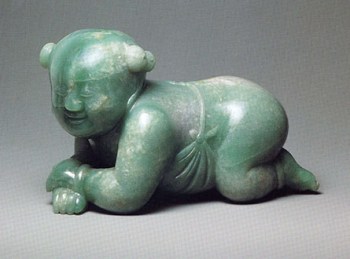 An installation of some 100 precious carvings in Chinese and Mogul jade and other hardstones, collected by Heber R. Bishop, will go on view at The Metropolitan Museum of Art beginning March 14. Featuring various types of objects—from containers for everyday use and pendants to ornaments intended for an emperor’s desk—A Passion for Jade: Heber Bishop and His Collection will illustrate the wide range of the lapidary’s repertoire.
An industrialist and entrepreneur, Mr. Bishop was an active patron of the arts and a Trustee of the Metropolitan Museum during its formative years. In the late 19th century, he assembled a collection of more than a thousand pieces of jade and other hardstones from China and elsewhere, and in 1902, he bequeathed the collection to the Museum.
Dating from Han dynasty (221–207 B.C.) to the 20th century, the objects on view in the installation will be selected entirely from the Museum’s collection. They will include outstanding Qing-dynasty (1644–1911) examples that are representative of the sophisticated art of Chinese lapidaries, as well as highly accomplished works by Mogul Indian jade carvers that provided an exotic inspiration to their Chinese counterparts. Also on display will be a set of Chinese lapidary tools and illustrations of jade workshops in China.
Exhibition | Wellington: Triumphs, Politics and Passions
Press release (29 October 2014) from the NPG:
Wellington: Triumphs, Politics and Passions
National Portrait Gallery, London, 12 March — 7 June 2015
Curated by Paul Cox with Lucy Peltz

Sir Thomas Lawrence, Portrait of Arthur Wellesley, 1st Duke of Wellington, 1815–16. (London: Wellington Collection, Apsley House, English Heritage).
The first gallery exhibition devoted to the Duke of Wellington will open at the National Portrait Gallery, to mark the 200th anniversary year of the Battle of Waterloo in 2015. Wellington: Triumphs, Politics and Passions will explore not only the political and military career of the victor of this great battle—but also his personal life through portraits of his family and friends.
Highlights include Goya’s portrait of Wellington started in 1812 after his entry into Madrid and later modified twice to recognise further battle honours and awards; and from Wellington’s London home, Apsley House, Thomas Lawrence’s famous 1815 portrait painted in the same year as the Battle of Waterloo. This iconic military image of Wellington was used as the basis of the design of the British five pound note from 1971 to 1991.
Drawn from museums and private collections including that of the present Duke of Wellington, the exhibition of 59 portraits and other art works has the support of the Marquess of Douro, and includes rarely-seen loans from the family including a portrait by John Hoppner of the Duke as a youthful soldier and a daguerreotype portrait by Antoine Claudet, in the new medium of photography, taken on Wellington’s 75th birthday in 1844. The family has also loaned Thomas Lawrence’s beautiful drawing of Wellington’s wife, Kitty (née Pakenham).
The real experience of soldiers fighting in Wellington’s armies will be explored through eyewitness accounts, including prints based on sketches by serving soldiers and the illustrated diary of a young officer, Edmund Wheatley written, in a lively style, with the intention of it being read by his sweetheart.

Francisco de Goya, Portrait of Arthur Wellesley, 1st Duke of Wellington, 1812–14 (London: The National Gallery).
Wellington: Triumphs, Politics and Passions considers the attempts of the art world to celebrate the Duke of Wellington’s military successes. Commemorative objects on display will range from royal commissions by Europe’s foremost artists and manufacturers to more modest souvenirs aimed at the domestic market. Wellington’s eventful and often difficult political career will be illustrated by examples of the many satirical prints published in the 1820s and 1830s and the exhibition will also examine the reappraisal of Wellington’s life that took place at his death and on the occasion of his lavish state funeral.
The Duke of Wellington’s long life (1769–1852) spanned the eighteenth and nineteenth centuries. Most famous for his victory over Napoleon at the battle of Waterloo, he later entered politics, serving twice as Prime Minister. Wellington: Triumphs, Politics and Passions will explore the role of visual culture in creating the hero, the legacy of heroism and the role of the portrait in Wellington’s own public and personal self-representation.
Curated by Paul Cox, Associate Curator, National Portrait Gallery, with close support from Dr Lucy Peltz, Curator of Eighteenth-Century Portraits, National Portrait Gallery, this biographical exhibition will use portraits and objects to explore Wellington’s military career and his sometimes controversial political and personal life.
Paul Cox, Associate Curator, National Portrait Gallery, London, says: “The Duke of Wellington’s victory over Napoleon at Waterloo is well known. This exhibition provides the opportunity to examine less familiar aspects of his life, including the long political career during which he saw through important forward-looking legislation, but suffered a dramatic loss of popularity. I hope that visitors to the exhibition will gain a fuller picture of Wellington as a man, rather than simply as a hero.”
The exhibition is part of the Battle of Waterloo 200th Anniversary Commemorations, the national partnership of commemorative events.
◊ ◊ ◊ ◊ ◊
Paul Cox, with a foreword by William Hague, Wellington: Triumphs, Politics and Passions (London: National Portrait Gallery, 2015), 128 pages, ISBN: 978-1855144996, £15.
This new book about the 1st Duke of Wellington provides a novel take on the traditional biography in that it explores the life of this complex man through portraits of Wellington himself, his friends, family and associates, as well as his political and military allies and opponents. There are examples of painted portraits by Goya and Thomas Lawrence, several caricatures that illustrate Wellingtons political career, and a watercolour by George Chinnery that shows the future duke as a young Major-General at the Chepauk Palace, Madras being received by Azim al-Daula, Nawab of the Carnatic, in February 1805. Also reproduced is a rare photograph, a Daguerreotype, made by Antoine Claudet on the occasion of Wellingtons seventy-fifth birthday in 1844, and sections of a sixty-six-foot roll from the Collection of the National Portrait Gallery depicting his entire funeral procession. Paul Cox explores Wellingtons military career and the battle of Waterloo, which remain central to his story, but also examines his personal relationships, his legacy and his enduring place in the popular imagination. Finally, a narrative chronology presents a useful overview of Wellingtons life and times.










 Enfilade
leave a comment