Exhibition | 1740, Un Abrégé du Monde
On at the INHA in Paris this summer, as noted by Hélène Bremer:
1740, Un Abrégé du Monde: Savoirs et Collections autour de Dezallier d’Argenville
Institut National d’Histoire de l’Art, Paris, 4 May — 27 July 2012
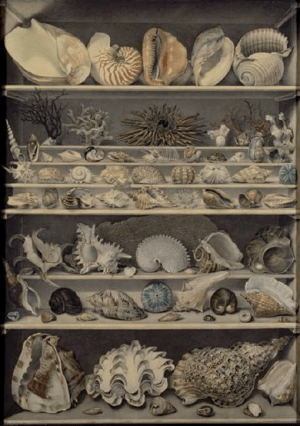
Alexandre Isidore Leroyde Barde (1777-1828), Choix de coquillages, encre noire et gouache, 125cm × 90cm (Paris: Musée du Louvre)
Naturaliste et historien de l’art, Antoine-Joseph Dezallier d’Argenville (1680-1765) fut membre de nombreuses académies scientifiques, auteur d’une théorie du jardinage, de traités sur les pierres et les coquillages (1742), et de l’Abrégé de la vie des plus fameux peintres de toutes les écoles… (1745-1752). Il fut aussi un grand collectionneur qui possédait plus de cinq cents dessins et de rares spécimens naturels. Pour interroger cette figure symptomatique de la dynamique entre arts et savoirs au XVIIIe siècle, l’Institut national d’histoire de l’art a voulu retrouver la fonction première de l’un des espaces-clefs de la Galerie Colbert, une ancienne boutique, car les savants-collectionneurs du siècle des Lumières étaient étroitement liés aux marchés de l’art et des curiosités naturelles.
L’exposition s’organise donc autour d’un comptoir qui évoque non seulement le long meuble à surface plane sur lequel les marchands échangeaient coquillages, estampes, tableaux et dessins, mais aussi les implantations commerciales sur les côtes des colonies d’où provenaient ces étranges objets naturels, lesquels manifestaient à la fois la soif de découverte du monde et l’ambition encyclopédique de ces amateurs.
Les curieux français du XVIIIe siècle furent avant tout des collectionneurs d’objets, que leur goût portait indistinctement sur les produits de l’Art ou de la Nature. Ils prêtaient également une attention remarquable à l’arrangement, la disposition dans l’espace des choses naturelles et artificielles constituant leurs cabinets. À cet égard, il faut noter que Dezallier fut l’un des premiers auteurs français à théoriser, dans un article de 1727, l’arrangement idéal d’un cabinet de curiosités, tout comme il fut le premier à employer en français le terme muséographie, en 1742.
Les années 1740 sont celles de la métamorphose des lieux de savoirs, puisque l’on passe alors des salles dédiées, dans les demeures privées, à la présentation d’objets de collection, à la création de musées, autrement dit de salles publiques d’exposition, où les visiteurs sont invités à s’instruire. C’est aussi l’époque de la mutation des savoirs livresques, dont les formes et les structures sont alors repensées dans le but de dresser des inventaires totalisants, comme l’Encyclopédie ou les catalogues raisonnés illustrés.
The exhibition press release is available (as a PDF) here»
◊ ◊ ◊ ◊ ◊
From Fage éditions:
Anne Lafont, ed., 1740, Un Abrégé du Monde: Savoirs et Collections autour de Dezallier d’Argenville (Paris: Fage éditions) 304 pages, ISBN: 9782849752609, 35€.
Contributeurs: Nebahat Avcioglu, Lise Bicart-Sée, Sarah Boyer, Sabine Cartuyvels, Pascal Dubourg Glatigny, Jennifer Ferng, Isabelle Flour, Catherine Girard, Martial Guédron, Charlotte Guichard, Pierre-Yves Lacour, Anne Lafont, Gaëtane Maës, Marie-Pauline Martin, Dominique Morelon, Aline Pelletier, Jessica Priebe, Chiara Savettieri, Anke Te Heesen, Isabelle Tillerot
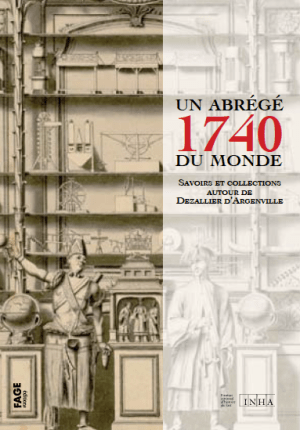 1740 un abrégé du monde traite des modalités de présentation des objets naturels et artificiels au sein des cabinets de curiosités, des relations entre les marchands et les collectionneurs de coquillages, estampes, tableaux, dessins, et des systèmes de classification en vigueur au temps de l’Encyclopédie et de Linné…
Rédigé par vingt spécialistes sous la direction d’Anne Lafont, conseillère scientifique à l’INHA, l’ouvrage gravite autour de la figure du naturaliste, historien de l’art et collectionneur français Dezallier d’Argenville (1685-1765), pivot de la dynamique nature/culture au XVIIIe siècle.
Il est organisé sous la forme d’un abécédaire de vingt-sept articles illustrés abordant des concepts qui sont au cœur de cette enquête sur les arts et les savoirs naturalistes : Abrégé, Amateur, Basseporte, Cabinet, Dessein, École, Fossiles, Grotesque, Histoire naturelle, Illustration, Jardin, Kiosque, Laboratoire, Manière, Numérotation, Ornement, Parterre, Plume, Quartz, Rocaille, Système, Table, Unique, Vernis, Vie, Watteau, Zoomorphose.
Exhibition | Splendeur de la Peinture sur Porcelaine
On at Versailles this summer, as noted by Hélène Bremer:
Splendeur de la peinture sur porcelaine: Charles Nicolas Dodin
et la manufacture de Vincennes-Sèvres au XVIIIe siècle
Château de Versailles, 15 May — 9 September 2012
 Du 15 mai au 9 septembre 2012, le château de Versailles présente l’exposition Splendeur de la peinture sur porcelaine. Charles Nicolas Dodin et la manufacture de Vincennes-Sèvres au XVIIIe siècle dans les appartements de Madame de Maintenon et dans la salle des Gardes du Roi.
Cette exposition est consacrée à un des peintres les plus doués de la Manufacture royale de porcelaine au XVIIIe siècle, Charles Nicolas Dodin, dont les œuvres ont été, de son vivant comme au siècle suivant, recherchées par les plus grands amateurs de porcelaine. L’exposition vise à mettre en évidence à la fois l’évolution artistique et la diversité des sources d’inspiration de Charles Nicolas Dodin.
Au long de ses quarante-neuf années à la Manufacture, Dodin a contribué aux plus grandes commandes passées par les rois et leur entourage, en particulier les maîtresses de Louis XV, et par des souverains étrangers, comme Catherine II de Russie. A travers ces œuvres de prestige, l’exposition retrace l’évolution artistique très lisible et éclairante de l’œuvre de Dodin, à l’instar de celle d’un peintre de chevalet contemporain.
Elle met également en lumière la diversité des sources d’inspiration de Dodin, par la présentation des gravures ou des tableaux qui lui ont servi de sources d’inspiration. Ces œuvres permettent de montrer les correspondances très profondes qui, dans la seconde moitié du XVIIIe siècle, existaient entre les arts (peintures, dessins, estampes, sculptures, médailles, arts du feu) et l’extraordinaire émulation artistique qui devait en résulter.
Dodin a essentiellement été, comme on le disait au XVIIIe siècle, un peintre “en miniature”, ou un peintre de figures, c’est-à-dire qu’il a exercé ses talents dans le genre le plus élevé dans la hiérarchie en vigueur à la Manufacture. Dès leur exécution, ses œuvres ont figuré dans les plus grandes collections d’œuvres d’art, notamment au château de Versailles, et y sont demeurées au siècle suivant.
Exhibition | Trompe-l’œil: Imitations, Pastiches, et Autres Illusions
From the Musée de la Mode et du Textile:
Trompe-l’œil: Imitations, Pastiches et Autres Illusions
Musée de la Mode et du Textile, Paris, 2 February 2012 — November 2013
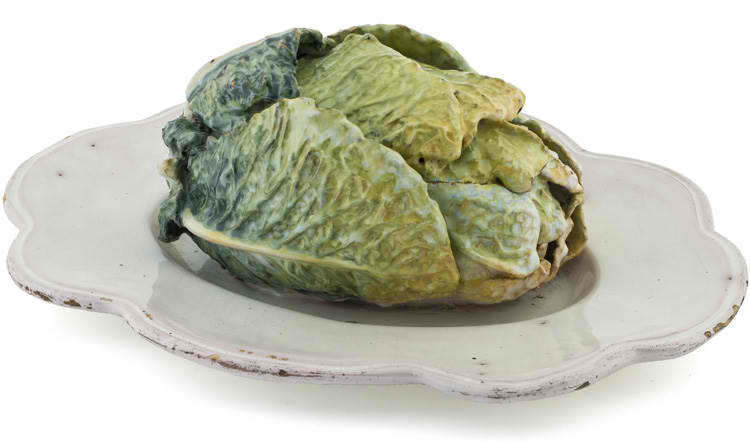
Récipient en forme de chou. Göggingen, Manufacture de Josef I de Hesse-Darmstad, 1748-52, faïence émailée (Paris: Les Arts Décoratifs) Photo: Jean Tholance
In the Musée des Arts Décoratifs’ Study Gallery the public can discover the wealth of its collections via selections of rarely or never previously shown works from its storerooms, shown for an 18-month period. Trompe-l’oeil, as its name indicates, is meant to trick the eye, and originated in painting, in which the illusion created by a painted object relies heavily on perspective and chiaroscuro.
In decorative art, this ‘trickery of the eye’ took very diverse forms. Wallpapers, for instance, proved ideal for this form of expression. From the most modest to the most sumptuous, they all imitate materials: wood, lacquer, tiles, straw, velvet, and even framed pictures. Many imitations were of course done for economic reasons, and in this game of substitutes, one sees that for centuries many materials have been imitated by others: marbled ceramics imitating jasper, glazed ceramics imitating porphyry or gold, paste imitating the diamond, linoleum floorboards, and so on. This game of illusions evolved in the 19th century, when, historicism oblige, it was not only materials that were imitated but motifs too. Owen Jones’ famous The Grammar of Ornament, like its French equivalent, Albert Racinet’s l’Ornement polychrome, provided numerous medieval and Moorish motifs for 19th-century creators.
Fashion was no exception and became the theatre of the most outrageous illusions. In the 18th and 19th centuries, wigs, tournures and faux-cul were worn to give false impressions. In the 20th century, illusion focussed less on form than on the fabric itself, with the appearance of false wears and tears, false pockets, false buttons, etc. Like a treasure hunt traversing centuries and materials, this exhibition invites us into the great game of illusion or the ‘vertigo of imitation’.
More information (in French) is available here»
Exhibition | William Kent, 1686-1748: Designing Georgian Britain
We’ll hear more in the coming months about this exhibition, but I note it here just to whet your appetite. Based on recent exhibitions at The Bard, I’m especially looking forward to the programming and publication. -CH.
◊ ◊ ◊ ◊ ◊
William Kent 1686-1748: Designing Georgian Britain
The Bard Graduate Center for Studies in the Decorative Arts, New York, Fall 2013
V&A, London, Spring 2014
Organized in collaboration with the Victoria & Albert Museum (V&A).
Curated by Susan Weber Director and Founder, BGC and Julius Bryant, Keeper of Word and Image Department, V&A
Exhibition | Gold, Jasper, and Carnelian: Johann Christian Neuber
From The Frick:
Gold, Jasper, and Carnelian: Johann Christian Neuber at the Saxon Court
Grünes Gewölbe, Dresden, 3 March — 2 May 2012
The Frick Collection, New York, 30 May — 19 August 2012
Galerie J. Kugel, Paris, 12 September — 10 November 2012
Coordinated by Dirk Syndram, Jutta Kappel, Ian Wardropper, and Charlotte Vignon

Johann Christian Neuber, Breteuil Table, Dresden, 1779–80, wood, gilded bronze, semiprecious stones, faux-pearls, and Meissen porcelain plaques, H: 32 inches, collection of the Marquis de Breteuil, Chäteau de Breteuil (Choisel/Chevreuse); photo: © Georges Fessy
Johann Christian Neuber was one of Dresden’s most famous goldsmiths. Sometime before 1775 he was named court jeweler to Friedrich Augustus III, elector of Saxony, and in 1785 he was appointed Curator of the Grünes Gewölbe (Green Vault), the magnificent royal collection of Augustus the Strong, the founder of the Meissen Porcelain Manufactory. For more than thirty years, Neuber created small gold boxes, chatelaines, and watchcases decorated with local semiprecious stones such as agate, jasper, and carnelian. He fashioned enchanting landscapes, complex floral designs, and geometric patterns with tiny cut stones, often incorporating Meissen porcelain plaques, cameos, and miniatures. These one-of-a-kind objects, which reflect the Saxon court’s interest in both luxury items and the natural sciences, remain prized treasures today, but have never before been shown together in a monographic exhibition.
In 2012, the public will have their first comprehensive introduction to this master craftsman’s oeuvre through a traveling exhibition that is accompanied by a lavishly illustrated publication (Paul Holberton publishing, London, and Editions d’Art Monelle Hayot, under the direction of Alexis Kugel). The exhibition began in Dresden at the Grünes Gewölbe on March 3, remaining there through May 2, 2012, when it travels to the United Sates for an exclusive engagement at The Frick Collection (May 30 through August 19, 2012). It concludes at Galerie J. Kugel in Paris in the fall (September 12 through November 10, 2012).
Gold, Jasper, and Carnelian: Johann Christian Neuber at the Saxon Court includes some thirty-five boxes and other decorative objects from the Grünes Gewölbe and the Porcelain Collection of the Staatliche Kunstsammlungen Dresden, The Metropolitan Museum of Art, and private collections in Europe and the United States. The exhibition also features Neuber’s masterpiece, the Breteuil Table. This small table is regarded as one of the most extraordinary pieces of eighteenth-century furniture ever made, distinguished not only by the materials used in its construction and for the remarkable skill of its creator, but also for its prestigious history. It was presented in 1781 by Friedrich Augustus III to Baron de Breteuil, a French diplomat, as recognition for the role Breteuil played in the negotiation of the Treaty of Teschen, which officially ended the war of Bavarian Succession fought between the Habsburg monarchy and a Saxon-Prussian alliance to prevent the Habsburg acquisition of the Duchy of Bavaria. The table features a mosaic top of 128 semiprecious stones and Meissen porcelain plaques. Still owned by the family who received it nearly 250 years ago, this stunning object has almost never been exhibited outside the Château de Breteuil (some twenty-five miles west of Paris) and has never before crossed the Atlantic. The Frick exhibition also reunites for the first time two bases designed and crafted by Neuber for the display of Meissen porcelain groups. One is now in the collection of the Walters Art Museum, Baltimore, while the other is from a private collection in Paris. These bases were part of a much larger diplomatic gift from Friedrich Augustus III to Nicolai Wasilijewitsch Repnin, the Russian emissary who helped to negotiate the Treaty of Teschen. The gift originally included a Meissen porcelain service and an enormous centerpiece composed of seven stands of varying heights, each supporting an allegorical group made of Meissen porcelain. Of this extravagant gift, only these two bases have been definitively identified.
The exhibition is co-organized by the Grünes Gewölbe, Staatliche Kunstsammlungen Dresden, The Frick Collection, and Galerie J. Kugel, Paris. The exhibition in Dresden will be shown in a slightly different form as Johann Christian “Neuber à Dresde”: Schatzkunst des Klassizismus für den Adel Europas. It is coordinated by Dirk Syndram, Director of the Grünes Gewölbe and the Armoury, and Jutta Kappel, Senior Curator of the Grünes Gewölbe. The presentation of the exhibition at The Frick Collection is coordinated by Director Ian Wardropper and Charlotte Vignon, Associate Curator of Decorative Arts.
◊ ◊ ◊ ◊ ◊
From Paul Holberton Publishing:
Alexis Kugel, ed., Gold, Jasper and Carnelian: Johann Christian Neuber at the Saxon Court (London: Paul Holberton, 2012), 400 pages, ISBN: 9781907372360, £100.
 Johann Christian Neuber (1736–1808) was a goldsmith and mineralogist at the Saxon Court. In 1769 he became director of the Grünes Gewölbe, the magnificent State Treasury, and was appointed court jeweler in 1775. He specialized in creating small gold boxes, chatelaines and watchcases decorated with semiprecious stones, such as agate, jasper and carnelian. Neuber fashioned enchanting landscapes, complex floral designs and geometric patterns out of tiny cut stones, often incorporating Meissen porcelain plaques, cameos and miniatures. These one-of-a-kind objects are treasured in public and private collections all over the world today, but have never been brought together.
This book is the first comprehensive introduction to this master craftsman’s oeuvre, presenting boxes and other decorative objects from the Grünes Gewölbe, the Metropolitan Museum of Art as well as public and private collections in Germany, France and New York. One of its highlights is the ‘Breteuil Table’, still owned by the family for which it was made as a diplomatic gift nearly 250 years ago.
Beautiful photographs of all Neuber’s creations adorn this extraordinary book – well over 500 in number. The context and history of the growing interest in mineralogy and its celebration in these works of art are fully investigated. Its distinguished authors include Dr Jutta Kappel, Head of Conservation at Grünes Gewölbe, Dresden; art historians and specialists Sophie Mouquin and Philippe Poindront; marquis de Breteuil, Henri-François Le Tonnelier; and the editor of the book, Alexis Kugel, of the famous Parisian gallery.
There is also a French edition of this book: Le luxe, le goût, la science: Neuber, orfèvre minéarologiste à la cour de Saxe (ISBN 9782903824808).
Exhibition | Women of Achievement in the Early American Republic
From the exhibition website:
A Will of Their Own: Judith Sargent Murray and Women of Achievement in the Early Republic
Smithsonian National Portrait Gallery, Washington, D.C., 20 April — 13 September 2012
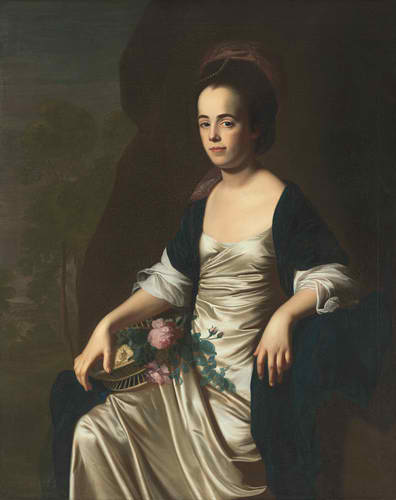
John Singleton Copley, "Judith Sargent Murray,"
1770–72 (Terra Foundation for American Art)
At the time of the American Revolution with Great Britain, women did not share the same status or rights as men. They could not vote or hold political office, enjoyed few property rights, were not equal in marriage, and had limited access to educational opportunities. As the debate about liberty and the rights of men took center stage during the Revolution, some women began to question their position in American society. Whereas many believed that women’s primary responsibility was to raise their children to be productive, moral citizens, some women began to argue for certain legal and economic rights and to pursue various professional careers. The Revolution created new opportunities for women to do work outside the home and to voice their opinions and concerns in public. Given the racial and class divisions that existed during the period, however, not all women were permitted to step forward in this manner. The eight women who are highlighted here did not produce a collective movement for women’s rights, but they were important in sowing the seeds for future progress. While the nature of their achievements differed, each demonstrated through their work that women possessed a will
of their own.
Autumn Exhibition in Venice | Francesco Guardi
From the Correr:
Francesco Guardi, 1712-1793
Museo Correr, Venice, 28 September 2012 — 6 January 2013
Curated by Alberto Craievich and Filippo Pedrocco

Francesco Gurdi, The Parlour of the Nuns at San Zaccaria
ca. 1750 (Venice: Ca’ Rezzonico), Photo: Wikimedia Commons
◊ ◊ ◊ ◊ ◊
In the third centenary of the birth of Francesco Guardi, the last great landscape artist of the 18th century, the monographic exhibition promoted by the Fondazione dei Musei Civici di Venezia aims to highlight his complex artistic production, from the lesser-known figure paintings of his youth to the ‘interior scenes’, concluding with the splendid views of Venice and his fabulous capriccios, painted in his maturity and old age. The exhibition at the Museo Correr will illustrate the various phases in Guardi’s development thanks to a series of major loans of works never before made to Venice.
It is known that Francesco Guardi’s training took place within a modest family workshop in which everyone was a painter, from his father, Domenico, to his brothers, Nicolò and Antonio. None of them in life was able to attain a certain degree of prosperity, let alone success. After his death in 1793, Francesco Guardi was forgotten. His rediscovery is the merit of 20th-century criticism, and attained a high point in the fine exhibition curated by Pietro Zampetti, held in Palazzo Grassi in 1965.
The first part of the exhibition will focus on the production of works of a prevalently everyday life subject inspired by genre painting of costume painting, one dominated by Pietro Longhi. The exhibition will present two masterpieces from this period: The Ridotto and The Parlour of the Nuns at San Zaccaria, now in Ca’ Rezzonico. A little later, Francesco Guardi began his production of the views, capriccios and fantastic landscapes that underpin his fame today. It is not certain when exactly he began working as a landscape painter; perhaps it was around 1755, when the painter was over 40 years old and had a less than exhilarating career as a figure painter behind him. His first works echoed the compositions of Canaletto and Marieschi, with fluid, controlled brushstrokes, still a long way from the bubbling, shorthand manner that would make him famous. But his unique style does already emerge in some of these works from the first period, including in the St. Mark’s Square belonging to the National Gallery in London, in which the figures, painted by frothy little impastos of colour, reveal a lively chromatic touch. His period of greatest success was between the 1760s and 1770s and it was in this period that he painted the 12 canvases of the Ducal celebrations adapted from Canaletto’s own models and engraved by Giambattista Brustolon. Guardi based his paintings, today in the Louvre, on these prints; the result is truly astonishing and reveals the artist’s transfiguring, fantastic skill.
The picture showing the Bucentaur at San Nicolò on the Lido is exemplary: although faithful to its model, it creates an image of unmatched appeal. The gondolas and Bucentaur used for special occasions seem to shimmer on the water; a myriad of reflections sparkle on the slightly choppy sea, while tiny figures resembling Oriental ideograms bustle in the vessels. In 1782, Guardi was commissioned to paint four pictures to commemorate the visit of Pope Pius VI to Venice. For the 70-year-old artist, here at last was an official commission, and it was followed by the celebratory paintings of the incognito visit to Venice of the Russian archdukes, who travelled under the name of the Counts of the Nort
Over time, his highly personal style became increasingly free and allusive; the proportions between the various elements were freely modified, the perspective framework became elastic and was deformed, losing all association with reality. And finally, the figures became simply splashes of colour, a rapid white scribble or black dot traced out with a trembling movement.
Apart from a number of airy capriccios, he also painted some splendid pictures of villas half-hidden in the green Veneto countryside, and alongside traditional views of Venice he added others of the lagoon, broadening the horizons of 18th-century Venetian landscape and dissolving it in wide stretches of water and sky.
The exhibition will present a total of over 100 paintings and drawings from leading Italian and foreign institutions, including the Musée du Louvre in Paris, the Metropolitan Museum of Art of New York, the National Gallery of Washington, the National Gallery in London, the Gemäldegalerie in Berlin, the Alte Pinakothek of Munich, the Gulbenkian Foundation of Lisbon, the Hermitage of Saint Petersburg, the Fine Art Museum of Boston, the Accademia Carrara in Bergamo and the Poldi Pezzoli of Milan. The exhibition can boast an academic committee formed of the leading international scholars of 18th-century Venetian painting, and will be accompanied by a comprehensive, well-illustrated catalogue edited by Alberto Craievich and Filippo Pedrocco, and published by Skira, containing the latest studies concerning the artist.
Curators: Alberto Craievich and Filippo Pedrocco
Academic Committee: Giuseppe Pavanello, Charles Beddington, Catherine Whistler, Keith Cristiansen, Stephane Loire, Andrew Robison, Irina Artemieva, Lino Moretti
Scientific Director: Gabriella Belli
◊ ◊ ◊ ◊ ◊
Catalogue: Alberto Craievich and Filippo Pedrocco, eds., Francesco Guardi, 1712-1793 (Milan: Skira, 2012), ISBN: 9788857214818, $90. Available October 2012
Exhibition | Hubert Robert: Les Jardins du Temps
From The National Museum of Western Art:
Hubert Robert: Les Jardins du Temps
The National Museum of Western Art, Tokyo, 6 March — 20 May 2012
Fukuoka Museum of Art, Fukuoka, 19 June — 29 July 2012
Shizuoka Municipal Museum of Art, Shizuoka, 9 August — 30 September 2012
Curated by Hélène Moulin-Stanislas and Megumi Jingaoka
 In 18th-century Europe, enthralled by the discoveries at the sites of Pompeii and Herculaneum, Hubert Robert (1733-1808) was a French landscape painter became known later by the nickname Robert des ruines (Robert of the Ruins), for his many works on these ancient sites. During his studies in Italy, Robert depicted fascinating landscapes that incorporated ancient motifs enhanced by his own fanciful imagination. His images brought to life the architecture and sculpture of ancient times, contrasting with the scenes of trees, flowing streams and the lively everyday world of ordinary people. These images developed in an age newly fascinated with antiquity. Robert’s arts with their uniquely lyrical expression attracted a great number of people, inspiring dreams of the flow of time, nature and the power of the arts.
The painter of these fantastic scenes was also the creator of numerous famous landscape-style garden designs, under his title of Designer of the Royal Gardens. Robert’s placement of ancient architectural forms and man-made waterfalls and grottoes amidst actual scenery adds all the more fascination to his works. This exhibition focuses on about 80 drawings in red chalk, selected from the world-renowned Robert Collection of the Musée de Valence, as it introduces Japanese audiences to Robert’s oeuvre, dating from his earliest production to his final years. Works by Robert’s teachers and colleagues, including Piranesi and Fragonard, from other collections round out the display of approximately 130 oil paintings, drawings, prints and furnishings. The natural and the man-made, fiction and fact, and the jumbled memories of happiness and imaginary futures, all present the secrets of Arcadia, as created in the midst of this artist’s paintings and gardens.
◊ ◊ ◊ ◊ ◊
Addition information is available at the Art Media Agency; the complete exhibition checklist (as a PDF file) is available here (in both English and Japanese).
Exhibition | The Prisons by Giovanni Battista Piranesi
From The National Museum of Western Art:
The Prisons by Giovanni Battista Piranesi
The National Museum of Western Art, Tokyo, 6 March — 20 May 2012

Giovanni Battista Piranesi, "The Prisons (Le Carceri," Round Tower 2nd edition, 1st Publication: 1761 G.1987-425 (Tokyo)
Giovanni Battista Piranesi was a major 18th-century Italian print artist. The Prisons [Carceri d’invenzione], a series of prints, are amongst his most famous works. Amidst the rise of Romanticism at the beginning of the 19th century, this series stimulated the imaginations of a number of writers. In the intervening decades and centuries, this series has continued to exert an influence in architecture, literature and film, as well as fine art. As indicated by its title, this series presents various views of prisons. But these images are not depictions of actual prisons; rather they are images of a fantastic, imaginary world. Giant pillars, beams, chains and torture implements, along with prisoners, are depicted amongst bold compositions made up of powerful lines. The NMWA collection includes a set of the first state of the Prisons, along with the second state, which involved considerable reworking of the first, plus two additional prints. The second state was made by Piranesi in 1761, the year in which he established his own printing studio, and is characterized by its stronger light-dark contrast and its more dramatic impression. Piranesi sought the full expressive range of the print in this series, at times going so far as to use his own finger and
the palm of his hand to achieve desired results.
This exhibition presents approximately 30 works from both the first and second states, allowing visitors a chance to compare the two states and the changes in Piranesi’s conception of the prints. We hope that you will enjoy these many prints with their powerful impact.
◊ ◊ ◊ ◊ ◊
The exhibition checklist (as a PDF) is available here (in Japanese and English).
Exhibition | Gainsborough’s Landscapes
From the Holburne Museum in Bath . . .
Gainsborough’s Landscapes: Themes and Variations
Holburne Museum, Bath, 24 September 2011 — 22 January 2012
Compton Verney, Warwickshire, 11 February — 10 June 2012

Thomas Gainsborough, Landscape with a View of a Distant
Village, ca. 1750 (Edinburgh: National Gallery of Scotland)
◊ ◊ ◊ ◊ ◊
Gainsborough’s Landscapes: Themes and Variations is the first exhibition in fifty years devoted solely to his landscape paintings and drawings, bringing together remarkable works from public and private collections, many of them little known and some not previously exhibited. For Gainsborough, if portraiture was his business, landscape painting was his pleasure, and his landscape paintings and drawings reveal his mind at work, the extraordinary breadth of his invention and the dazzling quality of his technique.
Thomas Gainsborough (1727-1788) sold relatively few of his landscape paintings, and none of his drawings, but he regarded them as his most important work. His paintings do not represent real views, but are creations ‘of his own Brain’, as he put it. A limited number of rural subjects exercised his imagination from one decade to the next, changing as he developed an increasingly energetic ‘hand’, or manner of painting, and becoming ever grander in conception.
The exhibition includes some of his most famous and popular works including The Watering Place from the National Gallery (the most famous of all his landscape compositions in his life-time) and less well-known works such as the little-seen but ravishing Haymaking from Woburn. The paintings have been selected to represent six landscape themes; the remarkable drawings and prints show Gainsborough returning to these themes and demonstrate the longevity of each theme and the degree of experimentation that was involved in the search for the perfect composition.
The evolution of Gainsborough’s style is traced from early naturalistic landscapes in the Dutch manner, enlivened with small figures (pictured above), to grand scenery that is dramatically lit and obviously imaginary, such as the Romantic Landscape from the Royal Academy of Arts. In the Girl with Pigs, from the Castle Howard Collection, a rustic figure takes centre stage: fancy figures of this kind are, in Gainsborough’s art, closely integrated with his landscape practice.
◊ ◊ ◊ ◊ ◊
Accompanying publication: Susan Sloman, Gainsborough’s Landscapes: Themes and Variations (London: Philip Wilson Publishers, 2011), ISBN: 9780856676970, £14.99










leave a comment