Exhibition: Samplers at Boston’s MFA
From the MFA website:
Embroideries of Colonial Boston: Samplers
Museum of Fine Arts, Boston, 20 November 2010 — 13 March 2011
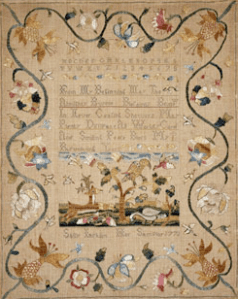 The embroideries of colonial Boston girls and women have long been treasured family possessions and are now much sought after by collectors. The charm and craftsmanship of the Adam and Eve samplers, pastoral pictures with leaping stags and galloping hunters, as well as crewelwork bed hangings and delicately embroidered baby caps bring to mind a warm domesticity; however, as a group they also reveal much about the lives of Boston women and their role within colonial society.
The first of three exhibitions in the Edward and Nancy Roberts Family Gallery in the new wing for Art of the Americas, “Embroideries of Colonial Boston: Samplers” demonstrates the role these schoolgirl exercises played in educating Boston’s genteel young women. The use of samplers was common in Europe, and when the first colonists to New England arrived they brought their samplers with them to help educate their children.
The exhibition will feature a pair of 17th-century samplers brought to Boston as well as two 17th-century American examples clearly illustrating the connection between Great Britain and the colonies. During the 18th century, samplers evolved from their original format as collections of embroidery stitches and designs into more pictorial works that could be proudly hung in the family home. Distinctive sampler styles developed throughout Boston that can be associated with specific neighborhoods. The exhibition will feature many of these styles, including Boston’s most famous samplers—those including the depiction of Adam and Eve at the bottom that were woven by girls from the North End of the city.
Exhibition: Drawings at the Art Institute
The current exhibition of drawings at the Art Institute includes works by Charles de la Fosse, Charles-Antoine Coypel, Panini, Canaletto, Tiepolo, Guardi, Gaetano Gandolfi, Fragonard, Jean-Baptiste Isabey, David, and Ingres. From the museum’s website:
Gray Collection: Seven Centuries of Art
The Art Institute of Chicago, 25 September 2010 — 2 January 2011
Curated by Suzanne Folds McCullagh
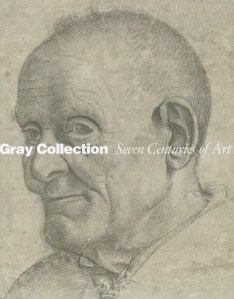 One of America’s foremost art dealers, Richard Gray, and his wife, art historian and author Mary Lackritz Gray, have gathered an unparalleled collection of paintings, drawings, and sculpture spanning the 15th century to the present. This exhibition features more than 120 of the couple’s most dynamic and important works on paper, including Renaissance- and Baroque-era treasures by Guercino, Tiepolo, and Rubens; 19th-century works by masters such as Delacroix, Degas, and Seurat; and stellar examples by acclaimed 20th-century artists Picasso, Matisse, and Miró.
Lifelong Chicagoans deeply involved in the cultural life of city, the Grays have devoted more than half a century—both privately and professionally—to pursuits associated with the visual arts. Their first work on paper was a Paul Klee lithograph received as a wedding present in 1953; ten years later, Richard founded the Richard Gray Gallery, exposing the couple to a much more encyclopedic view of art as he helped major museums and private individuals form collections of real substance and quality. At the same time, the Grays acquired works for their own collection without any specific program, discovering the various pleasures of looking at and living with drawings. This highly personal collection has been shaped by Richard’s informed eye as a dealer—his intuitive sense, willingness to take risks and respond to opportunities—and Mary’s historical and contextual approach enriched by her graduate degree in art history. As the reach of their collecting interests in more recent years extended back in time from the modern and contemporary masters they knew so well, the art of drawing has offered a quality of instantaneity, a means to maintain contact with artistic genius across the centuries. The varied, individually important works collectively combine to create a rich and resonant survey of some of the most accomplished draftsmen of the ages. (more…)
Exhibition: Science at Versailles
From the Palace of Versailles:
Sciences and Curiosities at the the Court of Versailles
Château de Versailles, 26 October 2010 — 27 February 2011
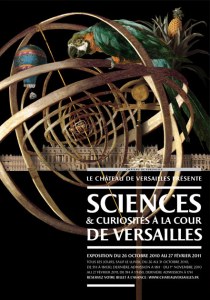 This exhibition reveals a new, unexpected face of Versailles as a place of scientific inquiry in its most various forms: the Hall of Mirrors electricity experiment, Marley Machine on the banks of the Seine, burning mirror solar power demonstration, etc. It brings together works and instruments from the old royal collections, spectacular achievements of beauty and intelligence, for the first time.
Versailles is the place where control over science was exercised. At the urging of Jean-Baptiste Colbert, Louis XIV’s “prime minister,” the royal authority became aware of the benefits of scientific research. In 1666 Colbert founded the Academy of Science, establishing a new contract between the government and scientists. Many “natural philosophers,” as they were known at the time, including some of the most famous, assiduously frequented the Court as physicians, army engineers, tutors, etc. The physicists Benjamin Franklin and Abbot Nollet compared their theories in front of the king and the encyclopaedists Diderot and D’Alembert met in the office of Dr. Quesnay, physician to Madame de Pompadour, Louis XV’s favourite. Some courtiers were real experts.
The Château de Versailles offered many research resources. Anatomists and zoologists could study the menagerie’s ostriches, pelicans, rhinoceroses and other rare animals, botanists and agronomists the plants on the grounds of the Trianon and “hippiatrists,” the forerunners to veterinarians, the horses in the Grand Stables. Educators developed new teaching methods using cutting-edge tools for the royal children and the kings’ personal practice. While Louis XIV considered himself a protector of the arts and sciences without practicing them, his successors, Louis XV and Louis XVI, became true connoisseurs. A presentation to the king or demonstration before the Court was the highest honour, equivalent to winning a Nobel Prize. Many people know about the first hot-air balloon flight, but numerous other events have fallen into oblivion, such as the burning mirror demonstration in front of Louis XIV or the electricity experiment in the Hall of Mirrors under his successor’s reign. The mosaic of places, people and events that Science and Curiosities at the Court of Versailles presents must be perceived not as a conclusion but as a stepping-stone to further research.
Engraved Portraits on Display in Moscow
From the State Historical Museum website:
Russian Portrait Engravings of the 18th Century
State Historical Museum, Moscow, 6 October — 21 November 2010
For the first time the richest and little-known Museum’s collection of engraved portraits is exhibited. Two hundred works executed by the best Russian and foreign masters permit visitors to see the whole variety of Russian portraits — equestrian, child’s, full-length, and half-length. At the exhibition there are engraved portraits of the epochs of Peter the Great, Empress Anna, Empress Elizabeth, Catherine the Great, and Paul I. Among the exhibits there are unique prints and copper plates. Engraved portrait is a bright phenomenon of Russia’s artistic culture; at the same time it is an invaluable historical source of images of famous Russians of the 18th century: imperial, statesmen, military leaders, court nobility, men of letters, and scientists.
Exhibition: Kolbe’s Fantastic Flora
From the Kunsthaus Zürich website:
Giant Herbs and Monster Trees: Drawings and Prints by Carl Wilhelm Kolbe
Anhaltische Gemäldegalerie, Dessau, 28 November 2009 — 31 January 2010
Städtische Galerie in der Reithalle Schloß Neuhaus, Paderborn, 24 April — 13 June 2010
Kunsthaus Zürich, 10 September — 28 November 2010
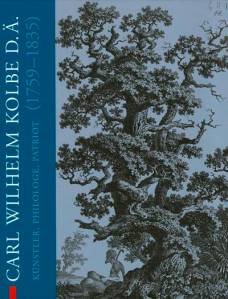
ISBN: 978-3865685179, $89.50
C.W. Kolbe (1759–1835) is one of the most intriguing figures in German art at the turn of the 19th century. With his fantastical, almost surreal landscapes featuring woods and marshes, Kolbe exerted a considerable (albeit long underestimated) influence on the graphic arts between Sturm und Drang and Romanticism. Kolbe, who did research in linguistics in addition to his artistic career, was born in Berlin and spent much of his life in Dessau. From 1805 to 1808 he lived in Zurich, where he produced engravings based on aquarelle gouaches by the late Salomon Gessner, celebrated at the time as a painter and poet.
As a souvenir of his time by the banks of the Limmat, where he had learned of the collapse of the ‘Holy Roman Empire of the German Nation’, he presented the Künstlergesellschaft with the drawing of the trunk of a dead willow tree. Kolbe’s renderings of trees are a wholesale product of his
imagination, and the fear of radical change lurks in his Arcadian fantasies.
Exhibition: ‘Italy Observed’ at the Met
Press release from the Met:
Italy Observed: Views and Souvenirs, 1706-1899
Metropolitan Museum of Art, New York, 12 October 2010 — 2 January 2011
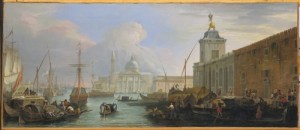
Luca Carlevaris, "The Bacino, Venice, with the Dogana and a Distant View of the Isola di San Giorgio," ca. 1709 (New York: Metropolitan Museum of Art, Robert Lehman Collection)
In the 18th century, privileged Europeans embarked on the Grand Tour, traveling principally to sites in Italy, where they visited cherished ruins of the ancient world and the splendid architecture of the Renaissance and Baroque eras. The influx of these travelers to destinations north and south – Venice, Rome, and Naples in particular – led to a flowering of topographical paintings, drawings, and prints by native Italians serving a foreign market eager to return home with pictures and souvenirs.

Italian Fan with view of the Roman Colosseum flanked by grotesques and landscapes, late 18th-century. Paint on parchment (New York: Metropolitan Museum of Art)
Italy Observed: Views and Souvenirs, 1706-1899, currently on view at the Metropolitan Museum through January 2, 2011, showcases a selection of the rich holdings of Italian vedute (views) collected by Robert Lehman. From paintings of Venetian life by Luca Carlevaris to a Neapolitan album of gouache drawings documenting the eruption of Vesuvius in 1794 to sketches and watercolors of Italian antiquities, the installation captures the artist’s romantic attraction to Italy and its irresistible Roman heritage. It also includes various marketed souvenirs—exquisite fans, spoons, teapots, and pocket watches—on loan from the Museum’s Department of European Sculpture and Decorative Arts.
The exhibition is divided into three sections: Venice, Rome, and Naples. The British elite constituted the largest percentage of Grand Tourists, and their fascination with Venice and its surrounding landscapes fueled the vedute market. Artists like Luca Carlevaris, Canaletto, Bernardo Bellotto, and Francesco Guardi produced vedute of the Venetian Grand Canal. In Rome, wealthy aristocrats commissioned artists such as Pompeo Batoni to paint their portraits surrounded by imagery of the Coliseum, Palatine Hill, Saint Peter’s Basilica and other emblematic souvenirs of the Grand Tourist culture. And in Naples, the picturesque Bay of Sorrento, Mount Vesuvius, and Pompeian frescoes inspired a prosperous trade in affordable mementos to foreign visitors in port. The spectacular eruptions of Mount Vesuvius were particularly popular, and found expression on porcelain, fans, and even pocket watches. The installation combines the rich artistic tradition of Canaletto and his contemporaries with marketed souvenirs adapting the same iconic monuments as keepsakes. (more…)
Current Issue of ‘Eighteenth-Century Studies’
Selections from Eighteenth-Century Studies 44 (Fall 2010):
- Lisa L. Moore, “Exhibition Review: Mary Delany and Her Circle, in the Museum and on the Page,” pp. 99-104.
- Yuriko Jackall, “Exhibition Review: Jean Raoux, 1677-1734,” pp. 104-111.
- Katherine Arpen, “Review of Thomas Kavanagh’s Enlightened Pleasures: Eighteenth-Century France and the New Epicureanism (Yale UP, 2010),” pp. 136-38.
Exhibition: ‘Cultural Exchange’ at Boston’s MFA
From the MFA website:
Luxuries from Japan: Cultural Exchange in the 17th and 18th Centuries
Museum of Fine Arts, Boston, 30 September 2009 — 17 January 2011

"Dutchman on a Barrel," Japanese, Edo period, ca. 1675-1699, 14 inches high
More than 400 years ago, Japan forged strong trading partnerships with China and the West, and Japan’s lacquer and porcelains were among the most sought-after luxuries in the world. Although Japan largely closed itself to the West around 1640 to preserve domestic stability, Chinese and Dutch merchants were allowed to trade goods through a network that extended down the Asian coast to Islamic ports, around Africa, and then to Europe.
The Japanese frequently created items specifically tailored to aristocratic European tastes for ornamentation in royal palaces and stately homes—exquisite blue-and-white and enameled porcelains, as well as sumptuous mother-of-pearl inlaid lacquers. However, Japan also imported luxuries. Practitioners of chanoyu (popularly known as the tea ceremony), for example, treasured ceramics and textiles from China, Korea, Vietnam, and Southeast Asia. Presenting works from several private collections and from the Museum’s own holdings, Luxuries from Japan explores these dynamic intercultural exchanges that shaped the creation of Japanese works of art
during the seventeenth and eighteenth century.
Exhibition: British Soldiers in India
Press release from the National Army Museum:
Indian Armies, Indian Art: Soldiers, Collectors, and Artists 1780-1880
National Army Museum, London, 19 May — 1 November 2010

"Bengal Army Troops," watercolor on European paper by a Company artist, ca. 1785 (London: National Army Museum).
An ivory chess set, watercolours of Indian soldiers, and miniature paintings presented by Maharaja Ranjit Singh will form part of the National Army Museum’s exhibition Indian Armies, Indian Art: Soldiers, Collectors, and Artists which explores the story of the soldiers serving the British in India. The exhibition looks at the period of East India Company rule in India and the early years of British colonial rule. British and Indian cultures merged and co-existed for many years, which can be seen in the multi- ethnic and multi-faith armies of the East India Company. The watercolours, intricate sculptures and miniature paintings that will be exhibited were created by local artists, usually for a European audience, and reveal the fascination many British officers had for aspects of Indian life.
A highlight of the exhibition will be a series of eight paintings commissioned by Colonel James Skinner, an officer of the Bengal Army whose father was Scottish and his mother Rajput. The paintings were commissioned by him to record his life and exploits, from images of a regimental durbar hosted by Skinner to St. James’s church in Delhi, which he built – in addition to a mosque and Hindu temple. Many of the paintings have never been exhibited before, and it will be the first time that the Museum’s collection of Skinner paintings will be displayed together. Other objects in the exhibition with powerful stories to tell include:
- three watercolours from 1885 of the last king of the Konbaung kingdom of Burma, King Thibaw
- two early carved wooden figures of a sepoy of the Madras Army created in 1785 by an Indian craftsman.
- a white metal tiger taken from the palace of Tipu Sultan at Seringapatam at the fall of that city during the fourth Mysore War, 1799
Exhibition curator Pip Dodd said, “The National Army Museum has one of the largest collections relating to the armies of the East India Company and the Indian Army, and this exhibition will be a great opportunity for Museum visitors to learn more about this fascinating and beautiful collection.”
The British East India Company traded in India from 1617 and established Company rule by the eighteenth century. The Company created the Bengal, Madras and Bombay presidencies each with its own army of Indian soldiers and British officers. This rule lasted until 1858, after the Mutiny in the Bengal Army when power was transferred to the British Crown, and the armies of the presidencies were merged to form the British Indian Army. After the Indian Independence act of 1947 and the subsequent partition of India, the British Indian Army was divided between India and Pakistan and British Army units returned to the United Kingdom.
Exhibition: Artists’ Travels to Italy, 1770-1880
Press release from the museum’s website (the catalogue is available through artbooks.com) . . .
Viaggio in Italia: Künstler auf Reisen 1770–1880
Staatliche Kunsthalle Karlsruhe, 11 September — 28 November 2010
 Künstlerreisen nach Italien sind in der Sammlung der Staatlichen Kunsthalle Karlsruhe durch eine immense Fülle von Werken belegt, von denen nun erstmals eine Auswahl vorgestellt wird. „Viaggio in Italia. Künstler auf Reisen 1770 – 1880“ zeigt mehr als 150 Skizzen und Zeichnungen, Aquarelle und Ölstudien, aber auch großformatige Kartons, Gemälde und Druckgraphik. Vor allem Rom als internationales Kunstzentrum zog Künstler aus ganz Europa an und bildete ein Forum für einen regen Austausch unter Malern, Architekten und Bild-hauern. So vereint die Ausstellung unter anderem Werke von Jean-Honoré Fragonard, Joseph Anton Koch, Bertel Thorvaldsen, Julius Schnorr von Carolsfeld, Carl Blechen, Camille Corot, Johann Wilhelm Schirmer, Arnold Böcklin und Anselm Feuerbach.
Den Schwerpunkt der Ausstellung bilden Landschaftsmotive. Sie beginnt mit einigen Arbeiten französischer Künstler wie Claude Lorrain, Hubert Robert und Jean-Honoré Fragonard. Die jungen Stipendiaten der französischen Akademie in Rom durchstreiften die Campagna in der Nachfolge Lorrains, um zu zeichnen. Künstler wie Fragonard suchten nicht die unberührte, sondern die kultivierte Natur in Form von Parklandschaften, die sich als Kulisse für amouröse und gesellige Szenen eignete. Den französischen Werken werden Arbeiten von deutschen Künstlern wie Jakob Philipp Hackert, Wilhelm Friedrich Gmelin und Joseph Anton Koch gegenübergestellt, für die Italien vor allem aufgrund seiner historischen Dimension und seiner geschichtsträchtigen Stätten zum einzigartigen Anziehungspunkt wurde. Ihnen fehlte das Sammelbecken einer Akademie, doch knüpften sie vereinzelt Kontakte zu ihren Kollegen aus Frankreich und gründeten eigene Zirkel, in denen sie Ideen austauschten. (more…)










leave a comment