Flaxman at UCL
From the UCL website:
Life, Action, and Sentiment: John Flaxman on the Art of Modern Sculpture
University College London, Strang Print Room, 21 June — 17 December 2010
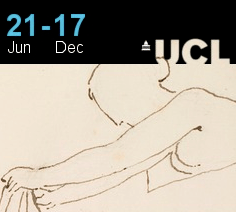 This exhibition celebrates the 200th anniversary of John Flaxman’s appointment as the first Professor of Sculpture at the Royal Academy. On display are the many preparatory sketches Flaxman drew to work through his ideas on how to convey life, action and sentiment in three-dimensional form. Kept for reference at his studio, then given to UCL by his family, these informal, linear drawings are shown together for the first time. They reveal Flaxman’s almost obsessive dedication to his cause, the creation of a modern school of sculpture.
Flaxman at the Royal Academy of Arts in London
From the Royal Academy of Arts:
The Language of Line: John Flaxman’s Illustrations to the Works of Homer and Aeschylus
Royal Academy of Arts Library, London, 27 July — 29 October 2010
Curator’s Talk, Tuesday, 5 October, 3:30 in the Library Print Room

John Flaxman, "Lampetia Complaining to Apollo," 1792-93, pen and ink with pencil on paper. © Royal Academy of Arts, London; photographer J. Hammond
This year marks the 200th anniversary of John Flaxman’s appointment as the first Professor of Sculpture at the Royal Academy. Although recognised as one of the leading sculptors of his day, it was Flaxman’s talent as a draughtsman that won him international acclaim. His dynamic yet understated outline illustrations to the works of Homer, Hesiod, Aeschylus and Dante were an immediate success when published as engravings and proved highly influential for generations of artists. The display features a selection of Flaxman’s drawings for the Iliad, the Odyssey and the Tragedies of Aeschylus. The works reveal delicate modifications to the designs that offer insight into the artist’s creative process prior to the production of the engraved plates. Flaxman’s experimentations with pose and composition are resolved into an archetypal style of linear clarity in the engravings, highlighting the practice underpinning his ability to convey dramatic, emotive and even comic effect with a single line.
Canaletto Exhibition To Open Soon in London
Press release from the National Gallery in London:
Venice: Canaletto and His Rivals
National Gallery, London, 13 October 2010 — 16 January 2011
National Gallery, Washington D.C., 20 February — 30 May 2011
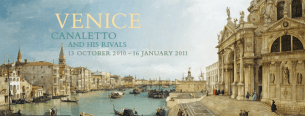 This exhibition presents the finest assembly of Venetian views, by Canaletto and all the major practitioners of the genre, to be held since the much-celebrated display in Venice in 1967. Remarkably, considering the dominant role of British patronage in this art form, Venice: Canaletto and His Rivals is also the first exhibition of its kind to be organised in the UK.
Additional information can be found here»
New Installations Open at the Getty
From the Getty:
New Galleries for Neoclassical, Romantic, and Symbolist Sculpture and Decorative Art
Getty Center, Los Angeles, opened 31 August 2010
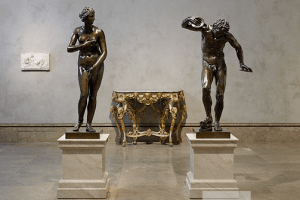 A suite of newly designed sculpture and decorative arts galleries in the West Pavilion at the Getty Center takes visitors through a survey of European sculpture, decorative arts, and paintings, 1700–1900. Recent acquisitions are prominently featured, including Pietro Cipriani’s Medici Venus and Dancing Faun and Jean-Désiré Ringel d’Illzach’s nine-foot-high Vase covered with life casts of spiders, juniper branches, and scraps of lace. Other engaging highlights include Johannes Andreas Beo’s secrétaire and a bust of French socialite Juliette Récamier by Joseph Chinard.
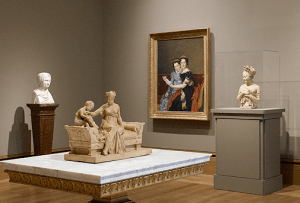 Following in the footsteps of the recently reinstalled North Pavilion galleries, the new chrono-thematic configuration juxtaposes sculptures, paintings, decorative arts, and prints from similar periods in contextualized displays. The galleries progress chronologically from around 1700 to around 1900, reflecting the development of styles associated with that span.
The Invention of a New Classical Style, 1700–1830. The excavations of ancient archaeological sites in Greece and in Italy and the wish to break with the no-longer-fashionable styles of Baroque and Rococo sculpture led in the 1700s to a fervent desire to create modern sculpture imbued with the characteristics of ancient sculpture. An ideal canon of beauty that included pure forms and silhouettes, this new classical style in Europe is defined by the predominant use of white marble and the adaptation of mythological subject matter.
 Late Neoclassicism in European Art and Design, 1780–1830. In the wake of the French Revolution in 1789, Napoleon Bonaparte’s adoption of Neoclassicism as an official imperial style, coined the Empire style, contributed to the popularity of Neoclassical ideals in France and its imitation by European rulers. The curvilinear silhouettes that had dominated the decorative arts were replaced by rectilinear lines, incorporating ancient motifs.
Romanticism to Symbolism, 1830–1900. The Romantic movement, which emphasized the irrational in man and the sublime in nature, had its roots in the literary, visual, and musical arts. Toward the end of the 19th century, a group of French and Belgian artists developed a style known as Symbolism, which reflected the spiritual and mystical philosophies of the day.

The Royal Society Turns 350 in November!
On now at the National Portrait Gallery:
Science, Religion and Politics: The Royal Society
National Portrait Gallery, London, 11 September — 5 December 2010
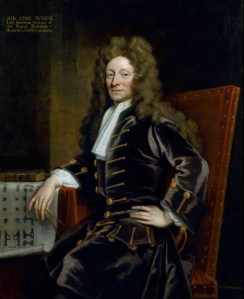
Sir Godfrey Kneller, "Portrait of Sir Christopher Wren," 1711 © National Portrait Gallery, London.
Marking the 350th anniversary of the foundation of the Royal Society, this display celebrates a key moment in the development of modern science. The Society was founded on 28 November 1660 when a dozen men gathered to hear the young Christopher Wren give a lecture on astronomy. In the discussion that followed they decided to form ‘a Colledge for the Promoting of Physico-Mathematicall Experimentall Learning’. They rejected the classical ideal that knowledge could be acquired through contemplation alone. Instead, they drew on the ‘new philosophy’ devised by Sir Francis Bacon to pursue knowledge through first hand observation, data collection and experimentation. This revolutionary approach to investigating the world laid the foundations for three and a half centuries of scientific discovery and innovation. The display features key figures in the early history of the Royal Society including Sir Christopher Wren, Robert Boyle, Samuel Pepys and Sir Isaac Newton. The Royal Society has generously loaned two important early portraits from its collection.
Exhibition: The Lake District
From the Wordsworth Museum:
Savage Grandeur and Noblest Thoughts, Discovering the Lake District, 1750 — 1820
The Wordsworth Museum & Art Gallery, Grasmere, England, 1 June 2010 — 12 July 2011
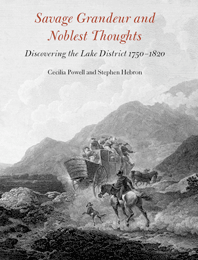
Catalogue by Cecilia Powell and Stephen Hebron, ISBN: 9781905256426, £19.95
From the mid 1700s until the early 1800s, British people who would normally have travelled abroad for recreation were confined to these shores. The French Revolution and the Napoleonic Wars made it dangerous for the British to travel in Europe and the conflicts created an upsurge in patriotic feeling. Artists and writers began to explore areas of natural beauty in Britain and their discoveries inspired a wide range of drawings, watercolours, oil paintings and engravings as well as prose and poetry of the highest quality. This work resulted in prints of the pictures and eventually what we might now call coffee table books, containing descriptions and pictures. These inspired more enthusiasm for the British landscape and an increasing number of people made their way to The Lake District.
Horrors like these at first alarm,
But soon with savage grandeur charm,
And raise to noblest thoughts the mind.
-from Dr John Dalton’s Descriptive Poem, first published in the 1750s
It became fashionable to travel through areas of wild and rugged scenery and visitors delighted in the thrilling experiences that the Lake District offered and its beauty and interest were ever more enthusiastically proclaimed. The Wordsworth Trust’s new exhibition explores the ways in which artists and writers discovered, portrayed and celebrated the Lake District in the years 1750-1820, a period of radical developments in both art and literature. The exhibition includes over 100 pictures and books from the period and shows how the British were inspired to invent the ‘staycation’. Savage Grandeur is the first exhibition which draws its content entirely from the Wordsworth Trust’s own collection. The exhibition will be complemented by a computer-generated guide to the scenery depicted in selected exhibits.
Exhibition: Paper Museums at the Louvre
From the Louvre:
Musées de papier: L’Antiquité en livres, 1600-1800
Musée du Louvre, Paris, 25 September 2010 — 3 January 2011
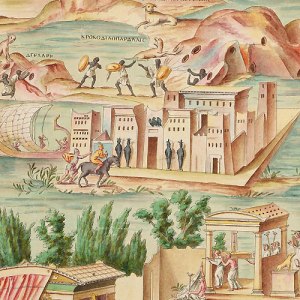
Pietro Santi Bartoli Receuil de peintures antiques trouvées à Rome © Bibliothèque nationale de France, Paris
Les antiquaires des XVIIe et XVIIIe siècles ont souvent rassemblé leur savoir dans d’imposants recueils figurés d’antiquités, sortes de « musées de papier » donnant à voir, sous forme de gravures ou de dessins, un nombre considérable d’œuvres antiques. Les images de l’art antique contenues dans ces musées de papier ont directement alimenté une série de phénomènes majeurs dans l’histoire de l’art du XVIIIe siècle : essor du goût pour l’antique et mode néoclassique, naissance de l’historiographie de l’art, élargissement de la notion d’Antiquité à des aires géographiques et culturelles nouvelles.
L’exposition révèle l’extrême fécondité de ces recueils de dessins et gravures. Elle mène le visiteur du Museo cartaceo de Cassiano dal Pozzo (1588-1657) – érudit qui rassembla une célèbre collection de reproductions d’œuvres antiques – jusqu’aux années 1760-1800, marquées par les ouvrages illustrés de Caylus, de Winckelmann et de Séroux d’Agincourt. Elle donne un aperçu des systèmes de classement de ces recueils et montre comment, à la suite notamment des fouilles d’Herculanum, la littérature antiquaire s’enrichit de publications somptueuses. Enfin, elle présente les multiples objets et instruments qui ont accompagné le travail antiquaire et ainsi préparé la naissance de deux disciplines modernes : l’histoire de l’art et l’archéologie.
Cette exposition a été réalisée avec le concours exceptionnel de la Bibliothèque nationale de France.
Vasi Exhibition Opens at the University of Oregon
The following is an edited version of the UO press release:
Giuseppe Vasi’s Rome: Lasting Impressions from the Age of the Grand Tour
Jordan Schnitzer Museum of Art, University of Oregon, Eugene, 25 September 2010 — 3 January 2011
Princeton University Art Museum, 2011
Curated by James Tice and James Harper
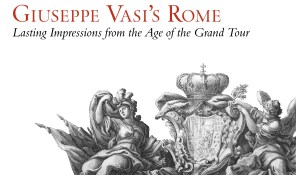 Giuseppe Vasi’s Rome: Lasting Impressions from the Age of the Grand Tour opens this fall at the Jordan Schnitzer Museum of Art at the University of Oregon. Vasi was an eighteenth-century Italian engraver and architect who is best known for his cityscapes of Rome. The exhibition is curated by UO faculty members James Tice and James Harper. Tice is an architecture professor and a research fellow at Studium Urbis, an international study center in Rome devoted to study of the city’s urban history. Harper is associate professor of art history. He worked at the Philadelphia Museum of Art, the National Gallery of Art and the Fogg Art Museum at Harvard University before joining the UO faculty in 2000.
Giuseppe Vasi’s Rome is the first major exhibition to be devoted solely to Vasi’s work. Coinciding with the 300th anniversary of his birth, the exhibition combines graphic imaging technology with new research on how he observed and documented his city. Vasi lived and worked in Rome, where he was a contemporary of such other notable vedutisti as Giovanni Paolo Panini, his student Giovanni Battista Piranesi, and cartographer Giovanni Battista Nolli.
The exhibition traces the emergence of Vasi’s graphic chronicles within their cartographic and artistic traditions, and explores their impact on ways of seeing and interpreting the city as a work of art. Also featured in the exhibition is a new media component that builds on two websites designed by Tice and Erik Steiner, who was assistant director of the InfoGraphics Lab in the UO Department of Geography at the time he worked on the sites. The exhibition invites viewers to use touch screens and iPads to view Vasi’s work, compare them to those of other artists of the period and explore Rome, then and now, through georeferencing.
A 200-page catalogue features essays from Mario Bevilacqua, Vincent Buonanno, Allan Ceen, Adrianne Hamilton, Read McFaddin, John Moore, John Pinto, and the curators. In conjunction with a series of educational programs, the museum will host a symposium on November 12; “Una Roma Visuale: New Research on Giuseppe Vasi and the Art, Architecture and Urbanism of Rome” will bring together scholars to address the topics of prints, painting, sculpture, architecture, urbanism and cartography. John Pinto will deliver the keynote address.
Following its presentation at the Schnitzer Museum, the exhibition will be on view at the Princeton University Art Museum.
The Fabric of Their Lives
I’m delighted to welcome Courtney Barnes of Style Court as a guest contributor to Enfilade. With a B.A. in art history and an M.A. in education, Courtney has worked as a docent at the High Museum of Art in Atlanta and has contributed to Southern Accents, among other publications. Established in 2006, Style Court has won praise from Time, Elle Decor, Domino, Atlanta Homes & Lifestyles, 1stdibs, Country Living, and Apartment Therapy L.A. Courtney’s site does a particularly good job of bringing together a wide variety of people interested in design and the arts. While Enfilade has previously included postings that were sparked by coverage at Style Court, it’s a treat to hear from Courtney directly – and on textiles, a topic that’s of special interest to her. As a HECAA member, Courtney (I hope) will have more postings to share from time to time in the future. -CH
◊ ◊ ◊ ◊ ◊
Threads of Feeling
The Foundling Museum, London, 14 October 2010 — 6 March 2011
B y C O U R T N E Y B A R N E S
In 2003 I ventured down into the densely packed textile and costume archives of the Atlanta History Center to meet with curator Susan Neill. At the time, she was preparing for the opening of Gone With the Girdle: Freedom, Restraint and Power in Women’s Dress, an exhibition that used the familiarity and allure of fashion to engage a general audience in the social, economic, and political history of women living in the southeastern United States from the nineteenth century up to the present.
In addition to the always crowd-pleasing couture, Neill brought into the galleries more common garments including a restrictive maternity corset, a domestic worker’s evening uniform, the first pantsuit designed for Delta Airlines flight attendants, a mini skirt half slip, and jeans — all to tell a story of radical change. Not surprisingly, such everyday articles of clothing worn on the job by waitresses and domestic workers were harder for Neill to obtain since they were typically discarded due to wear and tear or lack of interest. And examples of clothing worn by slaves during the antebellum era eluded Neill completely.

"Sleeves red and white speckl’d linen turn’d up red spotted with white." A baby’s sleeve made from linen © Coram
This simple but profoundly ironic rule of material culture — that the most common and mundane traces of the past, especially when associated with the working classes and the poor — are the least likely to survive makes an upcoming exhibition at The Foundling Museum in London all the more remarkable. Threads of Feeling showcases women’s and children’s textile tokens from the middle of the eighteenth century. The exhibition curator, John Styles, a specialist in the material culture of eighteenth-century Britain, has assembled a selection of fabric tokens that have survived some 250 years in the archives of The Foundling Hospital. Beginning in the 1740s, the institution served as a last resort for many of London’s impoverished, unmarried women who found themselves unable to care for their infants. A single identifying record, usually a clipping of fabric, was typically left at the
Foundling when the child was accepted.

"A bunch of 4 ribbons narrow – Yellow, Blue, Green, & Pink." Silk ribbons tied in a bunch with a knot © Coram
As noted at the Museum’s website:
In the cases of more than 4,000 babies left between 1741 and 1760, a small object or token, usually a piece of fabric, was kept as an identifying record. The fabric was either provided by the mother or cut from the child’s clothing by the hospital’s nurses. Attached to registration forms and bound up into ledgers, these pieces of fabric form the largest collection of everyday textiles surviving in Britain from the 18th Century.
Because the babies were essentially adopted by an institution (rather than a particular family) and were rarely reclaimed, Threads of Feeling provides both a material and emotional window into the past. Styles comments on his own website:

"Flowered lawn." Lawn printed with flowers © Coram
The textiles are tangible evidence of babies abandoned, many destined to die within a few days or weeks. To see them is a poignant, emotional experience. But the textiles are also beautiful objects in their own right. Most are colourful, patterned fabrics that served as tokens precisely because they were visually arresting. At the same time, they witness a rich social history. They show how ordinary people conducted their romances, clothed their babies, and engaged with fashion, providing a market for the cotton fabrics that were fundamental to the Industrial Revolution of the later 18th century.
For anyone who would like to learn more about the antique textile tokens, the September-October 2010 issue of the British-based textile magazine, Selvedge, features a terrific, in-depth cover story on the exhibition written by Shelly
Goldsmith. Selvedge is available at select bookshops in the
U.S. and by subscription, in digital or traditional paper formats.
At The Frick Next Summer: The French Court à la Turc
Press release (PDF) from The Frick:
Turkish Taste at the Court of Marie-Antoinette
The Frick Collection, New York, 8 June — 11 September 2011
Curated by Charlotte Vignon

Small Console Table with Supporting Figures of Nubians (one of a pair), c.1780, gilded and painted wood and marble slab (NY: The Frick Collection), photo by Michael Bodycomb
By the late eighteenth century, France had long been fascinated by the Ottoman empire. Trade with Turkish territories had gone on for centuries, bringing precious velvets, brocades, carpets, arabesque-decorated leathers, and metalwork to the Continent. In the fall of 1776, a performance of Mustapha and Zeangir, a tragedy in five acts by Sebastien-Roch Chamford that played in Paris, seems to have launched a taste for interiors “à la Turc,” or “in the Turkish style.” Soon after, boudoirs turcs were created in several royal residences, especially in the circle of Marie-Antoinette and the comte d’Artois, Louis XVI’s younger brother. This taste seems to have been confined largely to the royal court and the French aristocracy, and few objects from such rooms survive today. In the summer of 2011, the Frick will present a dossier exhibition on the subject, bringing together several examples that have rarely—or, in some cases never—been on view in New York City.
This exhibition was inspired by a pair of French console-tables at the Frick, whose exceptional quality suggests a royal origin. The tabletops are supported by two Nubian slaves who wear pearl-bedecked turbans; each figure holds a floral garland surrounding a medallion depicting a Sultan. The Turkish iconography is complemented by a frieze of crossed crescents, a symbol of the Ottoman empire. Such objects were not literal copies of Turkish models. Rather, they were created by interior decorators, architects, designers, and craftsmen inspired by an imaginary Ottoman empire, such as that depicted in A Thousand and One Nights and in the aforementioned tragedy Mustapha and Zeangir. Although the objects often featured turbaned figures, camels, palm trees, cornucopias, arabesques, crossed crescents, pearls and jewel-like ornaments, elaborate draperies, and heavy garlands of fruits and flowers, their form and function remained essentially French. Having been made for the royal family or wealthy aristocrats, the objects were usually of the highest quality, and can be attributed to the best artists and craftsmen of the time. Turkish Taste at the Court of Marie-Antoinette is being organized by Charlotte Vignon, the Frick’s Associate Curator of Decorative Arts.
◊ ◊ ◊ ◊ ◊
The exhibition might bring to mind the forthcoming book by Nebahat Avcioglu, Turquerie and the Politics of Representation, 1728-1876 (Aldershot: Ashgate, 2011), a description of which is available here»










leave a comment