German Drawings in Washington
Press release from the National Gallery:
German Master Drawings from the Wolfgang Ratjen Collection, 1580-1900
National Gallery of Art, Washington D.C., 16 May — 28 November 2010
Curated by Andrew Robison, Senior Curator of Prints and Drawings, National Gallery of Art
 The National Gallery of Art, Washington, will present for the first time worldwide 120 stunning German watercolors and drawings from the Wolfgang Ratjen Collection—one of the finest private European holdings of old master drawings. On view in the Gallery’s West Building from May 16 to November 28, 2010, German Master Drawings from the Wolfgang Ratjen Collection, 1580–1900 will include rare and influential examples of German works on paper encompassing 16th-century mannerism, the 17th-century baroque, the 18th-century rococo, early 19th-century romanticism, and late 19th-century realism.
In 2007, the National Gallery of Art acquired 185 German and Italian works from the Ratjen Collection with the help of a dozen generous private donors as well as the Paul Mellon Fund and the Patrons’ Permanent Fund. Works included in the exhibition are by artists from Germany and German-speaking areas of Europe, German-born artists practicing abroad, and artists born in other areas who spent time working in Germany and adapting to German culture.
Organized chronologically throughout five rooms, the exhibition begins with outstanding early works by three of the most notable German mannerists: Friedrich Sustris (c. 1540–1599), living primarily in Munich; Hans von Aachen (1552–1615), working at the court of the Holy Roman Emperor Rudolf II in Prague; and Hans Rottenhammer (1564/1565–1625), living in Venice and Augsburg. Sustris’ sophisticated drawing An Elaborate Altar with the Resurrection of Christ and the Martyrdom of Saint Andrew (1570/1580) is one of the earliest Bavarian responses to Italian mannerist altars. Von Aachen’s The Madonna Enthroned with Saint John the Baptist and Saint John the Evangelist (1589), a sacra conversazione (devotional scene) produced soon after his return from Venice, was a favored Venetian motif at the time. Rottenhammer’s colorful watercolor Minerva and the Muses (c. 1610) is directly inspired by Tintoretto, whose work he studied in Venice.
From the baroque period, Adam Elsheimer (1578–1610), a favorite artist of both Rubens and Rembrandt, is represented by an extremely rare atmospheric gouache—Ceres Changes Stellio into a Lizard (1605/1608)—perhaps his finest work in the United States.
Ratjen especially pursued watercolors from the 18th century by the great painters—including Cosmas Damian Asam (1686–1739), Matthäus Günther (1705–1788), and Johann Baptist Enderle (1725–1798)—who filled Bavarian churches and palaces with elaborate rococo altarpieces and stunning ceiling frescoes. A remarkable series of Augsburg rococo drawings includes Johann Elias Ridinger’s (1698–1767) charming portrait of the first rhinoceros to come to northern Europe, endearingly nicknamed “Miss Clara” (1748).
Around the turn of the 18th century, German artists developed a particular fondness for nature, as represented here by an extensive series of luminous drawings and watercolors. Highlights include five evocative landscape watercolors by Johann Georg von Dillis (1759–1841) as well as Caspar David Friedrich’s (1774–1840) romantic masterpiece New Moon above the Riesengebirge Mountains (1810 or 1828/1835). (more…)
Anatomy and Art Theory in Washington
The Body Inside and Out: Anatomical Literature and Art Theory
Selections from the National Gallery of Art Library
National Gallery of Art, Washington D.C., July 24, 2010 — January 23, 2011
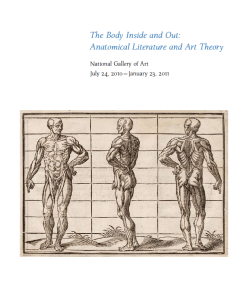
A PDF file of the exhibition brochure is available for download (click on the link at the left)
The humanist movement of the Renaissance introduced new realms of possibility in the arts and the sciences, including the study of anatomy. Many artists witnessed or participated in dissections to gain a better understanding of the proportions and systems of the body. Artists and physicians also worked together and formed partnerships—Leonardo and Marcantonio della Torre, Michelangelo and Realdo Columbo, and perhaps most famously, Titian and Andreas Vesalius—where the artist’s renderings of the anatomist’s findings were reproduced and dispersed to a scattered audience through the relatively recent innovation of print.
This exhibition, featuring outstanding examples of anatomy-related material from the collection of rare books in the National Gallery of Art Library, offers a glimpse into the ways anatomical studies were made available to and used by artists from the 16th to the early 19th century. On view are detailed treatises on human proportion and beauty by artists and scholars including Albrecht Dürer and Juan de Arfe y Villafane; drawing and painting manuals by Leonardo, Jean Cousin, and others, which include chapters on proportion and anatomy; and adaptations of anatomical treatises tailored to the needs of working artists by Roger de Piles and Johann Daniel Preissler, among others.
The exhibition brochure is available here»
Print Collecting in the Eighteenth Century: Richard Fitzwilliam
The founder of the Fitzwilliam Museum in Cambridge, Richard Fitzwilliam, 7th Viscount Fitzwilliam of Merrion (1745-1816) is the subject, or at least part of the subject, of this small exhibition of prints after Elsheimer:
Prized Possession: Lord Fitzwilliam’s Album of Prints after Adam Elsheimer
Fitzwilliam Museum, Cambridge, England, 25 May — 26 September 2010
 The second in the Hidden Depths exhibition series, this display will focus on one of Lord Fitzwilliam’s print albums, devoted entirely to prints made after paintings by Adam Elsheimer (1578-1610). The album, one of 198 bequeathed by Lord Fitzwilliam to Cambridge University in 1816, reveals the varied response by printmakers captivated by Elsheimer’s deployment of light and atmospheric rendering of nature. This exhibition will reconstruct the arrangement of the album, which was taken apart some time during the last century, and explore the allure of Elsheimer not only for printmakers, but for print collectors, in particular Lord Fitzwilliam himself.
German Enlightenment Portraiture: Art and Culture
Information on the following exhibition comes from the Gleimhaus Museum. For a scholarly point of entry into Wilhelm Ludwig Gleim’s “Temple of Friendship,” see Leah Hochman, “The Ugly Made Beautiful: Mendelssohn as Icon,” Journal of Modern Jewish Studies 5 (July 2006): 137–161. The museum itself is described here in a brochure describing the use of “EU Structural Funds for the City of Halberstadt”:
With the Enlightenment in the 18th century, Halberstadt experienced years of great intellectual activity. In 1747 the poet Johann Wilhelm Ludwig Gleim was appointed as cathedral secretary in Halberstadt, after years in the service of the Prussian King. Gleim knew all the important German-speaking authors of his time, and his house, his “temple of friendship” near the cathedral, was a meeting place for literary greats such as Johann Wolfgang von Goethe, Gotthold Ephraim Lessing, Johann Gottfried Herder, Johann Heinrich Voß, Friedrich Gottlieb Klopstock and Jean Paul. Today, Gleim’s house is Germany’s second-oldest museum of literature, and the poet’s extensive estate comprising letters, books and portraits makes it a cultural site of remembrance of national significance. . . .
◊ ◊ ◊ ◊ ◊
Von Mensch zu Mensch: Porträtkunst und Porträtkultur der Aufklärung
Gleimhaus Museum, Halberstadt, Germany, 29 August — 20 November 2010
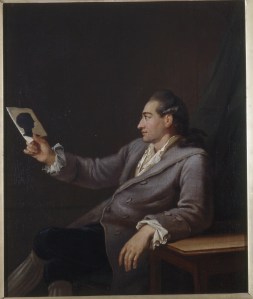 Jahrhunderte lang war das Porträt innerhalb der Kunst gering geschätzt worden, denn es strebte nicht nach Schönheit, sondern nur nach Ähnlichkeit. Diese Geringschätzung wandelte sich im Zeitalter der Aufklärung in ihr Gegenteil. Das Bildnis erlebte nun eine hohe Blüte, die gekennzeichnet war nicht etwa durch Prachtentfaltung, sondern durch die Konzentration auf das Gesicht. Der Mensch wurde als der nobelste Bildgegenstand bestimmt, das Gesicht konsequenter als je zuvor als Membran aufgefasst. Damit galt das Porträt nunmehr als Darstellung der Seele. Der Mensch zeigte sich nicht mehr nach seiner sozialen Geltung, sondern als Verstandes- und Gefühlsmensch. Das Bildnis war nicht mehr auf Autorität, sondern auf Sympathie angelegt. Bezeichnend hierfür ist, dass den meisten Porträts ein Lächeln ins Gesicht geschrieben steht.
Die Ausstellung Von Mensch zu Mensch. Porträtkunst und Porträtkultur der Aufklärung verzichtet auf das repräsentative und effektvolle Bildnis und beschränkt sich stattdessen weitgehend auf das Brustbild – wie bereits der Dichter und Sammler Johann Wilhelm Ludwig Gleim, der erklärte, nur Ritter lassen sich mit Sporen malen, bei Denkern genüge der Kopf. Gleim hat in seinem so genannten ‘Freundschaftstempel’ Bildnisse seiner Freunde und verdienter Zeitgenossen versammelt. Diese Sammlung – die größte Porträtsammlung der deutschen Geisteswelt des 18. Jahrhunderts – bietet ein Panorama der Porträtkunst der zweiten Hälfte des 18. Jahrhunderts. Zugleich steht mit der Person ein Exponat des innigen Umgangs des 18. Jahrhunderts mit dem Bildnis vor Augen – der Zwiesprache mit dem Porträt, des Küssens, Bekränzens und Sammelns des Bildnisses. Beides will die Ausstellung zeigen: Porträtkunst und Poträtkultur im Zeitalter der Aufklärung.
Der ‘Freundschaftstempel’ Gleims, dessen Wände mit Bildnissen dicht behängt sind, stellt selbst das zentrale Exponat der Ausstellung dar, die daher an keinem anderen Ort möglich wäre. Dieser Bestand wird ergänzt durch Meisterwerke der Porträtkunst aus bedeutenden Museen und Privatsammlungen.
Die Ausstellung lässt das Bildnis als allgegenwärtiges Medium der empfindsamen Kommunikation erkennbar werden, an das sich das ausgeprägte “sittlich-gesellige Interesse” dieser Epoche am Menschen (Goethe) knüpfte. Die Porträtkunst der Aufklärung weist mit ihren Qualitäten von Menschlichkeit und Zwischenmenschlichkeit allgemeingültige Werte auf, mit denen ihr heute noch – und gerade heute – besondere Geltung zukommt.
Zur Ausstellung erscheint ein Katalog mit Beiträgen von Helmut Börsch-Supan, Reimar F. Lacher und Doris Schumacher im Wallstein-Verlag, Göttingen. Die Ausstellung ist einer der zentralen Beiträge zu dem Themenjahr Menschenbilder des Museumsnetzwerkes Sachsen-Anhalt und das 18. Jahrhundert. Sie wird unterstützt vom Land Sachsen-Anhalt, von Lotto-Toto Sachsen-Anhalt und den ÖSA Versicherungen. Die Schau ist bis zum 20. November zu sehen.
At the Louvre this Winter: ‘Antiquity Rediscovered’
From the Louvre:
L’Antiquité rêvée – Innovations et résistances au XVIIIe siècle /
Antiquity Rediscovered: European Art between the Antique and Reinvention, 1720-1790
Musée du Louvre, Paris, 3 December 2010 — 14 February 2011
Museum of Fine Arts Houston, 20 March — 30 May 2011
Curated by Marc Fumaroli (Paris) and Edgar Peters Bowron (Houston)

Pierre Julien, "Dying Gladiator," 1779 © 2007 Musée du Louvre / Pierre Philibert
The “neoclassical” trend emerged in the 18th century not only as a result of the processes of innovation and emulation, but also in response to Europe’s rediscovery of its ancient heritage. The exhibition will shed light on the origins of the movement and illustrate the diverse manifestations of the new aesthetic. Sculptures, paintings, decorative objects and graphic arts bear witness to the work of artists during this period. All neoclassicism’s protagonists will thus be represented, the exhibition showing both their individual styles and their reactions against their contemporaries’experiments. Two hundred works in all will be on view, curated by Marc Fumaroli of the French Academy.
◊ ◊ ◊ ◊ ◊
For anyone struck by the difference between the French and English titles of the exhibition, the contrast between the full descriptions is even more striking (the French summary is certainly more informative and generally characteristic of the scholarship of Fumaroli, whose contributions are here praised as “exceptionnelle”) . . .
Le courant « néoclassique » est né au XVIIIe siècle dans les processus d’innovation, d’émulation, mais aussi de résistance liés à la redécouverte du patrimoine antique. L’exposition fait découvrir les origines du mouvement et illustre les diverses manifestations d’une nouvelle esthétique. Sculptures, peintures, objets d’art et arts graphiques témoignent du travail des artistes de cette période. Tous les grands créateurs de l’époque sont ainsi représentés à la fois dans leur propre démarche et en réaction aux expérimentations de leurs contemporains : de Bouchardon à Houdon, de Piranèse à Boullée, de Batoni à Mengs, de Sergel à Flaxman, de Füssli à Blake et de David à Canova… (et aussi Pajou, Nollekens, Banks, Greuze, Goya, Cades, Adams, Soufflot, Ledoux, Wright of Derby, les vases de Wegdwood …). L’exposition est constituée d’une sélection de deux cents oeuvres, et bénéficie de la contribution exceptionnelle de Marc Fumaroli de l’Académie française.
Piermarini Exhibition
Most famous for his Teatro alla Scala in Milan, Giuseppe Piermarini (1734-1808) is the subject of this exhibition that comes on the heels of the the bicentenary of his death. Also, see the website of the Piermarini Foundation (all pages are available only in Italian). The following description comes from the site of the European Architectural History Network (EAHN) . . .
Giuseppe Piermarini tra Barocco e Neoclassicismo — Rome, Naples, Caserta, Foligno
Palazzo Trinci di Foligno, 5 June — 2 October 2010
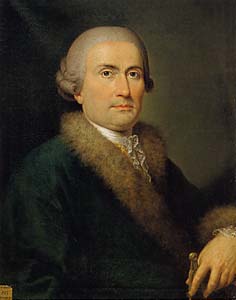 Curated by Marcello Fagiolo and Marisa Tabarrini
Giuseppe Piermarini, one of the most famous neoclassical figures in Italy, is best known as the architect of the Theatre alla Scala in Milan and refounder of good taste in Lombardy during the second half of eighteenth century. The exhibition is divided into chronological and thematic sections, beginning with a panorama of eighteenth-century Rome, the place of Piermarini’s apprenticeship, between the end of the pontificate of Benedict XIV (1740-1758) and the reign of Clement XIII (1758-1769). It then follows the architect to Naples in the studio of Vanvitelli, his time in Milan from 1769 and, finally, his return to his native Foligno in the early nineteenth century.
Note (added 5 August 2010) — The exhibition catalogue, Giuseppe Piermarini tra barocco e neoclassico. Roma, Napoli, Caserta, Foligno, edited by Marcello Fagiolo and Marisa Tabarrini (Perugia, 2010), ISBN: 9788896591277, is available through artbooks.com.
Prince Eugene of Savoy
From The Art Newspaper:
Agnes Husslein-Arco, ed., Prince Eugene: General-Philosopher and Art Lover (Munich: Hirmer Verlag), ISBN 9783777425511, $75.
Reviewed by Theodore K. Rabb, Professor Emeritus, Princeton University; posted 29 June 2010
. . . Ruling a multitude of languages and peoples, the Habsburgs were unique among Europe’s monarchs in their enthusiasm for foreign aristocrats at their court and as commanders of their armies. None repaid that welcome as handsomely as Eugene. In a few decades, he not only launched a once shrinking dynasty into an expansive era of conquest, but he helped make Vienna into one of the most dazzling capitals and cultural centres in Europe.
This catalogue records an exhibition (until 6 June) that pays tribute to the prince’s many achievements. It is held in the lower half of the Belvedere in Vienna, a two-part palace that is a contender for the title of the most imposing townhouse ever built, and which Eugene spent over a decade completing during the 1710s and 1720s. Although more than 300 objects are on display, ranging from sculptures to manuscripts, weapons to portraits, they barely scratched the surface of his possessions. His library alone, now owned by the national library, contained some 15,000 volumes. He had two Van Dycks, seven Guido Renis, and hundreds of Dutch and Italian paintings. At the heart of the Albertina’s collection of prints, the largest in the world, are the 255 volumes of engravings by masters such as Dürer that ultimately came from Eugene. . . .
For the full review, click here»
◊ ◊ ◊ ◊ ◊
The exhibition as described at EuroMuse (sorry that this one slipped by me until just recently). . .
Prinz Eugen: Feldherr, Philosoph, und Kunstfreund / General, Philosopher, and Art Lover
Lower Belvedere, Vienna, 11 February — 6 June 2010
Of Italian descent and a native French, Prince Eugene of Savoy (1663-1736), following his meteoric rise and splendid career as a military leader, became one of the most influential Austrians who had a long-lasting impact on the country’s fate and its art and cultural history. As a diplomat and counsel to the emperors Leopold I, Joseph I, and Charles VI, he travelled across Europe from one theatre of war to the next, playing a decisive role in determining the future of the House of Habsburg.
In 2010, the Vienna Belvedere, with its two palaces and Baroque gardens built by Johann Lucas von Hildebrandt in the early eighteenth century as a summer residence for Prince Eugene of Savoy, will be the venue of an exhibition presenting the prince as a general, statesman, and patron of the arts and sciences. Throughout his lifetime, he devoted himself to the compilation of a comprehensive collection of paintings, copper engravings, incunabula, illuminated manuscripts, and books, which he displayed in his Viennese palaces. From ever changing war sites, Prince Eugene corresponded with artists and artisans, landscape designers and architects, as well as the most influential thinkers of his time.
His acquisitions went down in the annals of European art and cultural history and facilitated the transfer of works of art from the court of the French king Louis XIV to Vienna. His interest in the natural sciences – in matters of which he relied on the expertise of the philosopher and scientist Gottfried Wilhelm Leibniz – is reflected in a large collection of exotic animals and plants.
The exhibition will showcase exhibits from Prince Eugene’s art collections – predominantly paintings from the Galleria Sabauda in Turin and cimelia from the Bibliotheca Eugeniana – in an ambience simulating period interiors, thus conveying to the visitors the complex decoration of those buildings where Prince Eugene, as president of the Imperial War Council and member of the Privy Council, received such illustrious guests as the ambassador of the Ottoman Empire.
◊ ◊ ◊ ◊ ◊
Additional information on the exhibition is available at The Luxury Traveler.
Sport and Panelling at the Bowes
From the Bowes Museum’s website:
British Sporting Art
Bowes Museum, County Durham, England, 11 May — 10 October 2010
 British Sporting Art, will explore the genre of Sporting Art in Britain, from horseracing and hunting to boxing, football and cricket. Central to the theme of the exhibition, which will include works by George Stubbs, Sir Alfred Munnings and George Morland, is John Bowes, the founder of the Museum and the first man to lift the renowned Triple Crown. Inspired by Bowes’ love for horseracing and its importance to the story behind The Bowes Museum, this exhibition will explore his prolific racing career and the wider genre of Sporting Art.
The branch of painting which has come to be known as British Sporting Art was at its height during the 18th Century, when horseracing fervour swept the nation. It was a golden age for sporting artists, the most famous of which was Stubbs, with an urge to immortalise winners on canvas. Despite it being rejected by connoisseurs as a low form of art, and by Sir Joshua Reynolds as
genre painting, Stubbs was a significant presence at the Royal Academy annual exhibitions, to huge critical acclaim.
Featured in the display will be the Museum’s painting, Cotherstone, by J F Herring Jnr, and John Ferneley’s Beeswing. The former was bought at auction from Christie’s in New York in 2006, Cotherstone being one of Bowes’ most successful racehorses, while the latter is on long term loan to the Museum. Beeswing won 51 from 64 races, becoming quite a celebrity, with several public houses named after her.
Artists such as Gillray, whose work also features in the exhibition, were quite different from those depicting field sports. They produced detailed portraits of boxers and comical sporting scenes, which were reproduced in popular print form. The exhibition will consider whether this in itself is a statement about the class system in the 18th Century, particularly as the print industry became prominent. It will also consider the next generation of painters – Herring Snr & Jnr and Henry Alken, who faced less prejudice than their predecessors, and will conclude with more recent sporting paintings by Munnings, whose hunting scenes are instantly recognisable. Lifelike bronzes of racehorses, deer and gundogs, by sculptor Sally Arnup, will enhance the sporting art.
◊ ◊ ◊ ◊ ◊
As noted at Art Daily (27 July), the Bowes Museum’s ‘Object of the Month’ for August is the panelling from the London townhouse of Philip Dormer Stanhope, 4th Earl of Chesterfield.
 Chesterfield, best known for his letters to his [illegitimate] son, giving advice on how to behave and get on in society, was also an international diplomat who desired a house fully up-to-date in style. His house was the first in England to show the ornate rococo style imported from France in the mid-18th Century. . . . Chesterfield House was demolished in 1937 and parts of the ante-room were brought up to Sunderland. The panelling was presented by Sir Nicholas Williamson of Whitburn Hall in 1968. It forms the centrepiece of the Museum’s new galleries devoted to English Interiors 1500-1900.
Collection of Early Drawing Instruments
The following 2007 press release from Columbia University regarding the Alpern Collection of drawing instruments notes that “an exhibition and catalogue are in preparation.” Well, here they are (nearly so anyway). . .
◊ ◊ ◊ ◊ ◊
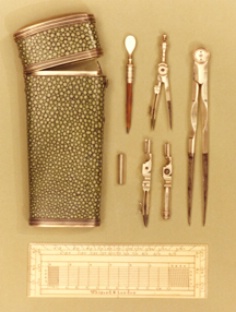
A pocket set of silver instruments with an ivory scale/protractor, housed in a silver-mounted case covered in shagreen – the skin of a sting ray. English, 2nd half of the 18th c.
February 28, 2007 An outstanding collection of early architectural drawing instruments has been donated to the Avery Architectural and Fine Arts Library at Columbia University by noted New York architectural historian Andrew Alpern.
The collection comprises 170 English, Continental and American sets and individual pieces spanning over 250 years of exquisite craftsmanship in silver, ivory, steel and brass. Sets range from small portable sharkskin or tortoise-shell cases containing the architect’s essential tools – pen, scales, dividers, compass and protractor – to large mahogany cases containing every aid imaginable for the aspiring draftsman. Assembled over a 40-year span, the collection is fully functional. According to Alpern, “Preparing construction drawings (as I have) employing 18th-century solid silver instruments of superb quality is vastly more satisfying than using ordinary modern ones.”
“We are tremendously grateful to Andrew Alpern for his gift of these rare and precious instruments” said Avery Library’s Director, Gerald Beasley, who added that “Computer-aided design has entirely supplanted their manufacture and use, but this only increases their research value to historians of architectural design.”
The collection, which also includes numerous trade catalogues and other rare books about the instruments, is available to researchers by appointment at Avery Library’s Department of Drawings and Archives. An exhibition and catalogue are in preparation.
◊ ◊ ◊ ◊ ◊
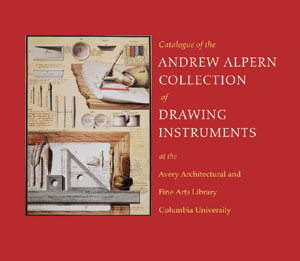 This elegant volume documents three hundred years of exquisite drawing tools, richly photographed and described, for architects, draftsmen, and engineers. Crafted in silver, ivory, steel, and brass, the instrument sets catalogued here range from small silver-mounted tortoiseshell pocket étuis to multitiered mahogany cases housing every professional aid imaginable. Computers have supplanted their manufacture and use, yet these exquisite traditional instruments are still fully functional. ISBN 9780978903732, $60 (September 2010).
Exhibition Marks the 300th Birthday of Johann Evangelist Holzer
The following comes from the website of the Domschatz- und Diözesanmuseum; there’s also a fine site dedicated to the exhibition (I’m sorry that all are only in German). . .
Johann Evangelist Holzer (1709-40), Painter of Light
Augsburg, 28 March — 20 June 2010
Eichstätt, 14 July — 31 October 2010
Innsbruck, 3 December — 13 March 2011
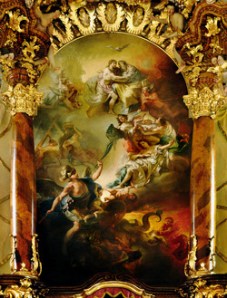
- Johann Evangelist Holzer, altarpiece in Eichstätt Schutzengelkirche
Johann Evangelist Holzer (1709-1740) gehört zu den großen Meistern des 18. Jahrhunderts. Kirchen und Klöster in Süddeutschland stattete er mit prächtigen Fresken und Altarblättern aus. Nach nur wenigen Schaffensjahren hatte der in Burgeis in Südtirol geborene Künstler, der lange in Augsburg wirkte und mit nur 31 Jahren in Clemenswerth an der niederländischen Grenze starb, ein bedeutendes Werk hinterlassen.
Seine Zeitgenossen setzten Holzer gar dem italienischen Maler Raffael gleich, heute ist sein Werk eine wahre Entdeckung. Vier Museen in Deutschland und Österreich haben sich das gemeinsame Ziel gesetzt, mit unterschiedlichen Schwerpunkten Leben und Werk dieses Malers und Grafikers des Spätbarock in einer Werkschau mit etwa 160 Exponaten erstmals umfassend vorzustellen.
In der barocken Residenzstadt Eichstätt wird die Kunst Holzers in ihrer ursprünglichen städtebaulichen und künstlerischen Atmosphäre besonders gut erlebbar. In der ehemaligen Jesuitenkirche präsentieren sich dem Besucher frisch restauriert, drei Altarblätter Holzers, darunter der Hochaltar als sein größtes Leinwandgemälde. Weitere Altarbilder sowie eine Computersimulation der Kuppel von Münsterschwarzach sind im Kuppelraum der ehemaligen Klosterkirche Notre Dame zu besichtigen. Im Festsaal der ehemaligen fürstbischöflichen Sommerresidenz bildet das zauberhafte Deckengemälde Holzers einen weiteren Höhepunkt.
 Das Domschatz- und Diözesan als zentrale Anlaufstelle in Eichstätt präsentiert eine reiche Schau zu Holzers Früh- und graphischem Werk. Ein vielfältiges Veranstaltungsprogramm rundet die Werkschau ab, zu der ein umfangreicher Katalog erscheint.










leave a comment