Exhibition | Drawing in Britain, 1700–1900, New Acquisitions
Opening in April at the National Gallery of Art in DC:
Drawing in Britain, 1700–1900: New Additions to the Collection
National Gallery of Art, Washington DC, 2 April — 6 August 2023
Curated by Stacey Sell

John Hoppner, A Young Boy Seated beneath a Tree, ca. 1790s/1810, red and black chalk with brush and grey and black ink (Washington, DC: National Gallery of Art, 2022.78.1).
Selected entirely from the National Gallery’s permanent collection, this exhibition of approximately 80 recently acquired drawings and watercolors provides an overview of two centuries of British art.
Works on view reveal European influences on British art starting in the 1700s. They trace the development of watercolor as a national specialty and introduce the varied approaches that emerged during the Victorian era. Drawing in Britain not only includes significant examples of the landscapes that are traditionally associated with British art, but it also highlights portraits, history scenes, and nude studies. Works by British women provide glimpses into the lives and work of several fascinating yet little-known artists.
The exhibition is curated by Stacey Sell, associate curator of old master drawings, National Gallery of Art, Washington.
Exhibition | Muse or Maestra? Women in Italian Art, 1400–1800

Rosalba Carriera, Self-Portrait of the Artist, detail, 1707–08
(Staatliche Museen zu Berlin, Kupferstichkabinett / Jörg P. Anders)
◊ ◊ ◊ ◊ ◊
From the Staatliche Museen zu Berlin:
Muse or Maestra? Women in the Italian Art World, 1400–1800
Muse oder Macherin? Frauen in der italienischen Kunstwelt 1400 – 1800
Kupferstichkabinett, Berlin, 8 March — 4 June 2023
Curated by Dagmar Korbacher
Featuring some 90 works, this special exhibition organised by Berlin’s Kupferstichkabinett elucidates the lives and impact of women such as Rosalba Carriera, Artemisia Gentileschi, Elisabetta Sirani, Diana Scultori, Isabella d’Este, Christina, Queen of Sweden, and others. Their works, fates and enormous influence on the art world of their times have in part been forgotten today.
During the Renaissance and Baroque periods, the art of these women outshone that of their fathers, brothers, and husbands. They created and collected oeuvres that were sought after throughout Europe. They knew how to market themselves and how to network. The protagonists in the exhibition comprise not only women artists who created works in demand, but also wives who supported their husbands and posed for them as models and female patrons who gave commissions for artworks and supported women artists, as well as preservationists and collectors who kept and passed on the works.
Not only does the exhibition show the art of these women, it also provides details about the circumstances of their lives to the extent that this information is known. A number of issues are addressed. These include determining what influence being a woman had on these women’s roles in the art world, whether or not they married and became mothers, and which strategies they pursued to assert themselves in a man’s world, thus making it possible for us to still find traces of their respective impacts.
Women’s diverse, active roles in Italian art are presented with drawings and prints until 1800 from the Kupferstichkabinett’s vast collection, as well as some outstanding loans. In various interventions in the exhibition and catalogue, the youth advisory panel of the Staatliche Museen zu Berlin, Achtet AlisMB, contributes the younger generation’s perspective on this topic.
Muse or Maestra?: Women in the Italian Art World, 1400–1800 is curated by Dagmar Korbacher, director of the Kupferstichkabinett. A catalogue accompanies the exhibition.
New Book | Afterlives: Recovering the Lost Stories of Looted Art
The exhibition was at the Jewish Museum in New York from August 2021 until January 2022. From Yale UP:
Darsie Alexander and Sam Sackeroff, with contributions by Julia Voss and Mark Wasiuta, Afterlives: Recovering the Lost Stories of Looted Art (New Haven: Yale University Press, 2022), 280 pages, ISBN: 978-0300250701, $50.
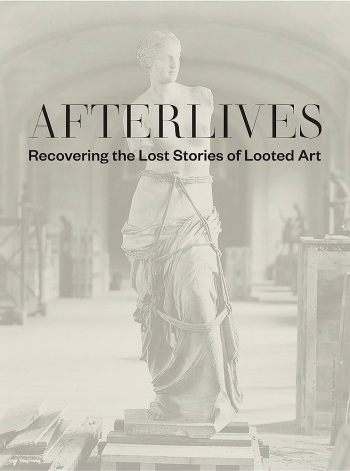 A strikingly original exploration of the profound impact of World War II on how we understand the art that survived it
By the end of World War II an estimated one million artworks and 2.5 million books had been seized from their owners by Nazi forces; many were destroyed. The artworks and cultural artifacts that survived have traumatic, layered histories. This book traces the biographies of these objects—including paintings, sculpture, and Judaica—their rescue in the aftermath of the war, and their afterlives in museums and private collections and in our cultural understanding. In examining how this history affects the way we view these works, scholars discuss the moral and aesthetic implications of maintaining the association between the works and their place within the brutality of the Holocaust—or, conversely, the implications of ignoring this history. Afterlives offers a thought-provoking investigation of the unique ability of art and artifacts to bear witness to historical events. With rarely seen archival photographs and with contributions by the contemporary artists Maria Eichhorn, Hadar Gad, Dor Guez, and Lisa Oppenheim, this catalogue illuminates the study of a difficult and still-urgent subject, with many parallels to today’s crises of art in war.
Darsie Alexander is the Susan and Elihu Rose Chief Curator, and Sam Sackeroff is the Lerman-Neubauer Assistant Curator at the Jewish Museum, New York.
Exhibition | The Gregory Gift
From the press release (30 November) for the exhibition:
The Gregory Gift
The Frick Madison, New York, 16 February — 9 July 2023
Organized by Marie-Laure Buku Pongo
 A remarkable gift of twenty-eight fine and decorative works of art recently bequeathed to the Frick by Alexis Gregory (1936–2020) will be shown as a group for the first time at Frick Madison in 2023. The gift includes two eighteenth-century pastels, fifteen Limoges enamels, two eighteenth-century clocks, a large gilt-bronze figure of Louis XIV, and objects made of metal, enamel, and hardstone dating from the sixteenth through eighteenth centuries.
The celebrated holdings of decorative arts objects amassed by Henry Clay Frick have been significantly enriched in recent decades by gifts from other collectors. In 1999, Winthrop Kellogg Edey’s bequest added to the museum’s holdings an important group of European clocks and watches, and in the last decade or so, gifts from Dianne Dwyer Modestini (2008), Melinda and Paul Sullivan (2016), Henry Arnhold (2019), and Sidney R. Knafel (2021) have reshaped The Frick’s holdings of European ceramics with significant groups of Du Paquier and Meissen porcelain, French faience, and Italian maiolica.
The remarkable bequest in 2020 from the collection of Alexis Gregory builds on this tradition by enhancing the museum’s existing holdings and introducing to the museum new types of objects. The exhibition The Gregory Gift features the twenty-eight acquisitions in a variety of media and forms, curious luxury objects that, shown together, suggest a fine collector’s cabinet or Kunstkammer. Among them are fifteen Limoges enamels, two clocks, two ewers, a gilt-bronze sculpture, a serpentine tankard, an ivory hilt, a rhinoceros horn cup, a pomander, and two stunning pastels by Rosalba Carriera. The exhibition is organized by Marie-Laure Buku Pongo, Assistant Curator of Decorative Arts, and will be accompanied by a catalogue and complementary education programs.
Comments Ian Wardropper, Anna-Maria and Stephen Kellen Director of The Frick, “Alexis Gregory had one of the finest collections of Renaissance and Rococo decorative arts in this country. His deep affection for The Frick led to his bequest of a selection of a superb group of objects, and we are gratified to mount this exhibition in his memory.” Buku Pongo adds, “This generous and important gift to The Frick Collection opens new areas of research and lays the groundwork for exciting projects. From research into the context of their creation to technical analyses expanding our knowledge of how these objects were produced, the exhibition at Frick Madison will celebrate Alexis Gregory’s generous gift and The Frick Collection’s commitment to the display of European decorative arts.”

Rosalba Carriera, Portrait of an Unidentified Woman, ca. 1730, pastel on paper, laid down on canvas, 59 × 48 cm (New York: The Frick, Gift of Alexis Gregory, 2020.3.02).
Gregory built his career in book publishing, establishing the celebrated Vendome Press, a publisher of significant volumes on French culture and art. His contributions to and engagement in the arts included serving on art committees at several cultural institutions in the United States, including the visiting committees of European Paintings and European Sculpture and Decorative Arts at The Metropolitan Museum of Art. His history with The Frick began with frequent visits to the museum as a youth. On one occasion, Gregory left the boarding school he was attending with a classmate to visit the museum and managed to convince his friend that he lived in its mansion, as everyone they encountered on staff seemed to know him extremely well. At Harvard, he studied with leading art historians. Those close to him often described him as a Renaissance man as he spoke several languages, wrote books, traveled the globe, and collected art. These pursuits went hand in hand, as collecting art allowed him to research objects and travel around Europe to find new acquisitions. The purchase of his first Renaissance bronze at the age of eighteen marked the starting point of his collection.
Gregory collected widely, from paintings and works on paper to bronzes and sculptures. In the 1980s, his deep interest in European decorative arts prompted him to exchange one of the Impressionist paintings he had inherited from his parents for an assortment of bronzes, sculptures, and Limoges enamels, as well as a watercolor. He later expanded his collection with additional sculptures, Italian bronzes, and Limoges enamels, continuing throughout his life to acquire objects from the United States and Europe. Gregory’s collection echoes, in many ways, the Kunstkammers created by princes during the Renaissance, where they would not only display enamels, faience, carved ivories, automatons and clocks, and precious and mounted metalwork, but also show exotic natural specimens.
A Saint-Porchaire ceramic ewer joins two such objects already in The Frick Collection. This addition is particularly significant as only about seventy Saint-Porchaire works exist today. The ewer is part of a limited experimental production that still poses many questions and is represented in a few museums, among them, The Metropolitan Museum of Art, the Victoria and Albert Museum, and the Musée du Louvre.
Other highlights from the gift include a fine group of Limoges enamels, including a significant number of grisaille examples, which strengthens The Frick’s holdings of mostly polychrome enamels. Grisaille refers to a technique developed in the sixteenth century that was often used by enamelers including the famed Pierre Reymond (1513–after 1584). The Gregory gift includes multiple enamels by Reymond and his workshop, as well as objects by Jean de Court (active 1541–83) and broadens the representation of these artists at The Frick. A large dish enameled on copper with at his center a Saxon silver coin engraved by Hans Biener (ca. 1556–1604), is the first of its kind to enter the collection. It belongs to a rare production in sixteenth-century Venetian workshops, and only about three hundred pieces exist today. (Of these, only about fifty have painted coats of arms or coins, making this example quite rare.)
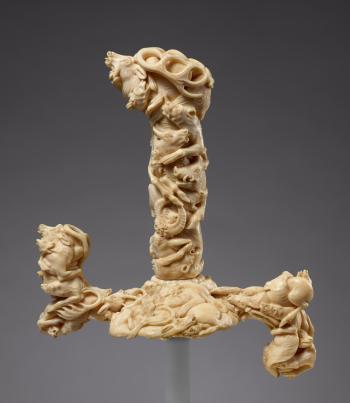
Sword Hilt, possibly by Johann Michael Maucher, ca. 1700, ivory, 16 × 16 × 6 cm (New York: The Frick, Gift of Alexis Gregory, 2021.18.01).
Carved ivory and rhinoceros horn objects also enter the collection for the first time. A fine hilt in ivory, possibly made by Johann Michael Maucher (1645–1701)—one of the most important ivory carvers and sculptors at that time—will shed more light on ivory carving and production in southern Germany during the seventeenth century.
A gilt bronze that represents Louis XIV is attributed to Domenico Cucci (ca. 1635–1704) and his workshop. Cucci was one of the most talented cabinetmakers of the eighteenth century, and this bronze is likely one of the few remaining remnants of a elaborate cabinet made for the king, around 1662–64. In 1883, the Musée du Louvre tried unsuccessfully to acquire the bronze, which mostly remained in private hands before being acquired by Gregory in 2007. Gilt bronzes and other objects designed by Cucci and produced in the Gobelins Manufactory (which made sumptuous furnishings and objects for French royal residences and as lavish diplomatic gifts) are mostly held in private hands. Besides The Frick, only a few collections, including the Château de Versailles, hold remnants of cabinets made by Cucci and his workshop.
Two clocks, one made by the British jeweler and goldsmith James Cox (ca. 1723–1800) and the second by Johann Heinrich Köhler (1669–1736), jeweler at the court of Dresden, diversify The Frick’s holdings of important clocks and watches and are key examples of their respective types. Both jewelers worked for powerful patrons: Köhler for Augustus II (‘the Strong’), Elector of Saxonyand King of Poland, and Cox for the Chinese Qianlong Emperor. Cox crafted automatons with musical movements, also called ‘sing-songs’, which were exported to China, India, Persia, and Russia. Examples of their work are still on view in the Grünes Gewölbe (Green Vault) in Dresden and the Forbidden City in Beijing.
Gregory’s bequest also brings to The Frick several works by women. An enameled medallion by Suzanne de Court (active ca. 1600), the only known female artist to lead a Limoges workshop during the sixteenth century, joins a notable pair of saltcellars signed by de Court already in The Frick’s collection. Two portraits by the celebrated Venetian pastel artist Rosalba Carriera (1673–1757), significantly enhance the museum’s holdings in this medium.
The exhibition Is generously funded by the Alexis Gregory Foundation.
Marie-Laure Buku Pongo, The Gregory Gift (London: Paul Holberton Publishing, 2023), 96 pages, ISBN: 978-1913645434, £25 / $30.
Catalogue cover image: James Cox, Musical Automaton Rhinoceros Clock, ca. 1765–72, gilt bronze, silver, enamel, paste jewels, white marble, and agate, 40 × 21 × 9 cm (The Frick Collection, Gift of Alexis Gregory, 2021.6.02; photo by Joseph Coscia Jr).
Exhibition | Nicolas Party and Rosalba Carriera
Opening in June at The Frick:
Nicolas Party and Rosalba Carriera
The Frick Madison, New York, 1 June 2023 — February 2024
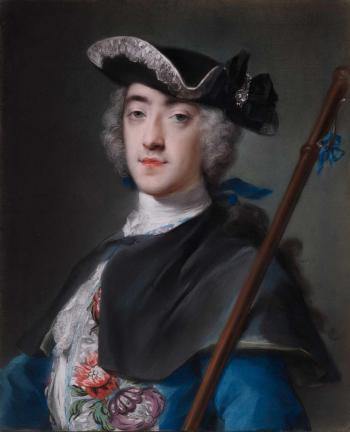
Rosalba Carriera, Portrait of a Man in Pilgrim’s Costume, ca. 1730. pastel on paper, glued to canvas, 59 × 48 cm (New York: The Frick Collection, Gift of Alexis Gregory, 2020.3.01).
This summer, The Frick Collection will debut a site-specific pastel mural by Swiss-born artist Nicolas Party (b. 1980), executed in the Italian Galleries at the museum’s temporary home, Frick Madison. The work will be created in response to Rosalba Carriera’s Portrait of a Man in Pilgrim’s Costume, a spectacular eighteenth-century pastel bequeathed to the Frick in 2020 by Alexis Gregory, the founder of Vendome Press. This is the second Frick installation to be inspired by a volume from The Frick’s popular Diptych series, each volume of which focuses on a single work from the collection, pairing an illuminating essay by a curator with a contribution from a contemporary cultural figure. Party’s mural will be the centerpiece of an upcoming Diptych, Rosalba Carriera’s Man in Pilgrim’s Costume, to be co-authored by Party and Xavier F. Salomon, the Frick’s Deputy Director and Peter Jay Sharp Chief Curator.
Funding for the installation is generously provided by The Christian Humann Foundation and the David L. Klein, Jr. Foundation.
Exhibition | Love Stories from the NPG
Now on view at The Baker Museum in Florida:
Love Stories from the National Portrait Gallery, London
Worcester Art Museum, 13 November 2021 — 13 March 2022
Amsterdam Museum in the Hermitage, 17 September 2022 — 8 January 2023
The Baker Museum, Naples, 4 February – 7 May 2023
Curated by Lucy Peltz
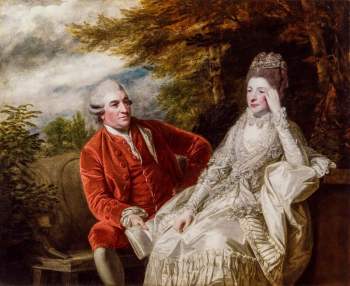
Joshua Reynolds, Portrait of David Garrick and Eva Maria Garrick, 1772–73, oil on canvas, 55 × 67 inches (London: National Portrait Gallery, purchased, 1981).
This groundbreaking exhibition presents masterpieces from the collection of the National Portrait Gallery, London, arguing that ideas of love and desire have been critical to the development of portraiture from the 16th century to the present day. Portraits provide visual records of relationships, are used to memorialize dead or absent lovers and have often been given as love tokens. Featured artists include Sir Joshua Reynolds, Angelica Kauffman, Man Ray, Lee Miller, David Hockney, and others. At the heart of this exhibition are a series of real-life love stories, from the English Renaissance to today, grouped thematically. Each of the love stories sheds light on a different aspect of romantic love and the role of portraits within it, from images that capture an artist’s obsession with their muse to those that record tragic love affairs or celebrate the triumph of love against the odds.
Love Stories from the National Portrait Gallery, London is organized by the National Portrait Gallery, London, and is curated by Dr. Lucy Peltz. The presentation of this exhibition at Artis—Naples, The Baker Museum is curated by Courtney McNeil, museum director and chief curator.
Lucy Peltz, ed., with contributions by Peter Funnell, Simon Callow, Marina Warner, Louise Stewart, and Kate Williams, Love Stories: Art, Passion & Tragedy (London: National Portrait Gallery, 2020), 231 pages, ISBN: 978-1855147034, $40.
Exhibition | The Garden: Six Centuries of Art and Nature

Johan Johnsen, Still Life with a Bouquet of Flowers, detail, oil on canvas, 65 × 50 cm (Stockholm: National Museum, 487, bequest 1863 Marshal of the Court Martin von Wahrendorff).
◊ ◊ ◊ ◊ ◊
Opening this month at Sweden’s Nationalmuseum:
The Garden: Six Centuries of Art and Nature
Trädgården: Konst och natur under sex sekler
Nationalmuseum, Stockholm, 23 February 2023 — 7 January 2024
On display throughout 2023 at the Nationalmuseum, The Garden: Six Centuries of Art and Nature explores how gardens have been portrayed in art. Visitors will experience nearly 300 paintings, drawings, applied art, and sculpture by artists such as Watteau, Boucher, Oudry, Le Nôtre, Monet, and Carl Larsson and, from contemporary times, Peter Frie and Emma Helle.
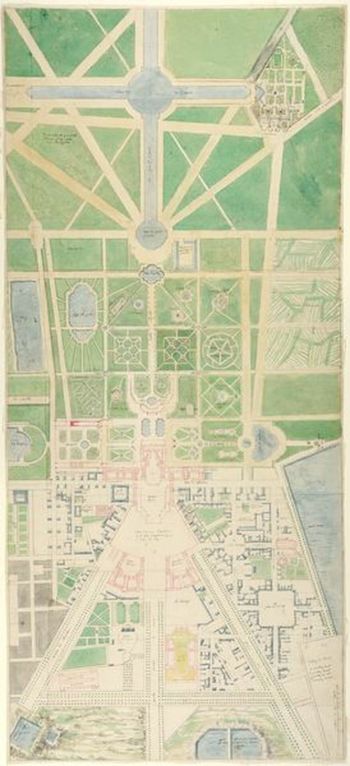
Jean II Le Blond, Versailles, Large Plan of the Château, Town, Gardens, and Surroundings, ca 1687, pen and black ink, grey wash, and watercolour, on paper, 128 × 57 cm (Stockholm: Nationalmuseum, NMH THC 1, transferred in 1866 from Kongl. Museum).
The exhibition takes the form of a grand tour showing how gardens have been portrayed in art, often walking the line between culture and nature. Garden art has always involved living materials: nature itself and the changing seasons. This makes it a dynamic artform—transforming, dying, and renewing in line with the natural cycle.
A garden, whether artful or utilitarian, is not the same thing as nature. It has always been consciously designed in accordance with particular ideas and plans. Ultimately, the garden can be seen as a desire to recreate Paradise. The square, geometric quarters of a Renaissance garden with a fountain in the middle were one expression of this desire. Likewise, baroque pleasure gardens could be seen as a way of restoring what was lost in the fall of man. On the drawing board, God’s creation would be resurrected with the aid of compasses and rulers. Geometry and optics would then translate the architect’s vision into practice.
A complete reappraisal occurred in the 18th century, when humanity suddenly realised that it could be a danger to nature. The dark forests and rugged mountains were no longer considered threatening. Virgin nature, yet to be exploited by mankind, was the new ideal influencing landscape architecture. Eventually, though, the toytown scale and artificial character were perceived as so comical that art and nature went their separate ways after 1800—a distinction that has endured. However, many of the questions raised throughout history about mankind’s relationship with art and nature have persisted and recurred. This is clearly apparent in contemporary art, where both Paradise and the threat to nature are ever present themes.
The relationship between art and nature is central to the exhibition. The introductory section, devoted to the myth of Paradise, occupies a large gallery of its own, lined with cabinets containing the various natural elements as reflected in the artworks. Similarly, the artificial garden forms the focus of the second large gallery, covering the period from the Renaissance to the present day. This gallery is surrounded by smaller exhibition rooms featuring individual design forms ranging from caves to ruins. At the centre of all this is a section covering the human presence in the garden.

Olof Fridsberg, A Huge Pumpkin, 1757, oil on canvas, 89 × 104 cm (Stockholm: National Museum, 7007, Acquisition Gåva 2001 av Nationalmusei Vänner).
As an example of contemporary interpretations, we have invited the artist Peter Frie to take part in the exhibition. Known as a painter of dreamlike landscapes, Frie has created a series of bronze sculptures of trees, having progressed from painting to a three-dimensional format. Trees of various sizes are presented as an installation in dialogue with the historical material on landscape and gardens. Emma Helle, another contemporary artist invited to take part, works in ceramics and draws inspiration from sources such as classical mythology. Her decorative and colourful, almost baroque works take us on a fanciful journey through the history of myth and literature. Helle has also created two new works especially for Nationalmuseum’s exhibition as a commentary on the theme of Paradise.
The majority of the almost 300 exhibits come from Nationalmuseum’s own collections, but the exhibition also includes important pieces on loan, in order to give a complete picture of the garden as a phenomenon. A catalogue with a series of in-depth articles will be published to coincide with the exhibition.
Exhibition | The Mysterious Peter Adolf Hall
Opening this spring at Sweden’s Nationalmuseum :
The Mysterious Peter Adolf Hall: A Swedish Miniature Painter in 18th-Century Paris
Mysteriet Peter Adolf Hall: En svensk miniatyrmålare i 1700-talets Paris
Nationalmuseum, Stockholm, 23 March — 25 June 2023
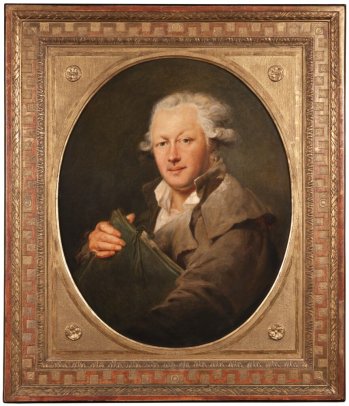
Peter Adolf Hall, Self-portrait, 1780, oil on canvas, 71 × 58 cm (Stockholm: National Museum 7091, gift of Gunvor Svartz-Malmberg).
During the spring and early summer 2023, Nationalmuseum presents an exhibition on Peter Adolf Hall, a Swedish artist, who revolutionised the art of miniature portraits in Paris in the latter half of the 18th century. The exhibition includes some 70 portrait miniatures from the museum’s collection, both by Hall himself and some of his followers.
Based on the museum’s miniatures collection, Nationalmuseum is to present an exhibition on the Swedish artist Peter Adolf Hall, who revolutionised the art of miniature portraits in the French capital in the latter half of the 18th century. Born in Borås, Hall studied in Stockholm under the pastel painter Gustaf Lundberg. This offers a clue as to how Hall came by his innovative miniature painting technique, but how he learned or developed this art form, remains a mystery.
When Hall arrived in Paris in 1766, he was already a fully fledged miniature portraitist, with a particular talent for reproducing the finish of garment fabrics. This was to become something of a trademark. He used relatively thick layers of watercolour in relief, a technique known as impasto, to create the illusion of reflected light on various materials, especially textiles. Folds were emphasised with wide brushstrokes and lines. Another revolutionary feature of Hall’s free style was the way he depicted a glowing skin by taking advantage of the ivory on which miniatures were painted and allowing it to shine through a thin, transparent layer of watercolour paint.
In 1767, a mere year after his arrival, Hall received a royal commission. Two years later he became an associate member of the French academy of fine arts, but he never applied for full membership as expected of him. He was so secure in his success that he clearly felt no need to devote time to producing a reception piece in order to become a full member. Besides his artistic talent and skill, there was another reason for Hall’s rapid progress in Paris: he was an adept social climber.
The exhibition traces how Hall’s painting style changed over the years. The colour palette became warmer, and the subjects were portrayed more freely. In the 1780s he enjoyed great success, was incredibly productive and made a lot of money. Perhaps out of a desire to please his subjects, Hall eventually developed a somewhat affected style which meant that, in particular, all the women in his portraits looked alike. The French Revolution put an abrupt end to all this. Hall’s patrons left the country, and he went too. He departed for Brussels in May 1791 and died two years later in Liège.
Although Hall’s style of portraiture did not survive the French Revolution, his innovative miniature paintings influenced several of his younger French contemporaries. The exhibition includes some 70 portrait miniatures from the museum’s collection, both by Hall himself and some of these followers who were heavily influenced by his mastery of free style.
The exhibition will be on show for a few months in the spring and summer of 2023, adjacent to the Treasury on the middle floor of Nationalmuseum. It will form a thematic extension to the permanent exhibition of pieces from the museum’s miniatures collection, which is the world’s largest. This collection comprises 5,700 miniatures, mainly portraits, by Swedish and European artists from the 16th to the mid 20th century. The Treasury houses 1,170 small works of significance, the majority of which are miniature portraits.
Exhibition | Prussian Palaces, Colonial Histories
Opening this summer at Charlottenburg Palace:
Prussian Palaces, Colonial Histories: Biographies and Collections
Schlösser. Preußen. Kolonial. Biografien und Sammlungen
Schloss Charlottenburg, Berlin, 4 July — 31 October 2023

Antoine Pesne, Portrait of Prince Frederick Ludwig or Prince Frederick William of Prussia in a Garden Cart with Friedrich Ludwig (?) (Berlin: Stiftung Preußische Schlösser und Gärten; photo by Jörg P. Anders).
The former palaces and gardens of the Hohenzollern dynasty make Germany’s colonial past visible and tangible today. Attesting to this history is an 18th-century portrait of a young Black boy, possibly Fredrick Ludwig (1708 – date of death unknown), whose father was brought to the Berlin royal court through the slave trade. Another example is provided by the glass beads produced on Peacock Island that were used to purchase slaves and colonial trading goods. With a special exhibition at Charlottenburg Palace, the Prussian Palaces and Gardens Foundation Berlin-Brandenburg (SPSG) is facing the colonial histories of its collections.
Colonial practises and structures can be traced throughout earlier centuries, before German colonialism of the 19th and early 20th centuries, as well as afterwards. In this light, the special exhibition is looking to explore the connection between Germany’s longer colonial history and how they persist today. Based on the scant information that has been preserved over time, the special exhibition attempts to reconstruct the biographies of people after they were forcibly brought to Berlin and Potsdam. These biographies highlight both the ways they were able to socially assimilate and how they resisted the conditions of their lives at court. In addition, the exhibition examines non-European works in the collections that have long been interpreted within strictly European frameworks. As a result, these works were culturally re-appropriated and alienated from their original uses.
The exhibition themes were developed together with various experts in a joint process over the course of five workshops. This special exhibition is part of the annual theme for 2023: “Elector—Emperor—Colonies.” Thus, the SPSG is taking an important step in its ongoing work on this theme that will continue beyond the coming year. This exhibition is supported by the Federal Government Commissioner for Culture and the Media under a resolution passed by the German Parliament.
Carolin Alff, Susanne Evers, and Hatem Hegab, et al., Prussian Palaces, Colonial Histories: Places, Biographies, and Collections (Dresden: Sandstein Verlag, 2023), 168 pages, ISBN: 978-3954987375 (German edition) / ISBN: 978-3954987382 (English edition), €18.
◊ ◊ ◊ ◊ ◊
Note (added 7 September 2023) — The posting was updated to include information on the catalogue.
Exhibition | Enslavement: Voices from the Archives
From Lambeth Palace:
Enslavement: Voices from the Archives
Lambeth Palace Library, London, 12 January — 31 March 2023
This exhibition accompanies the Church Commissioners’ public report on historic links between Queen Anne’s Bounty (one of the predecessors of the Church Commissioners’ endowment) and transatlantic chattel slavery. [See the press release below.]
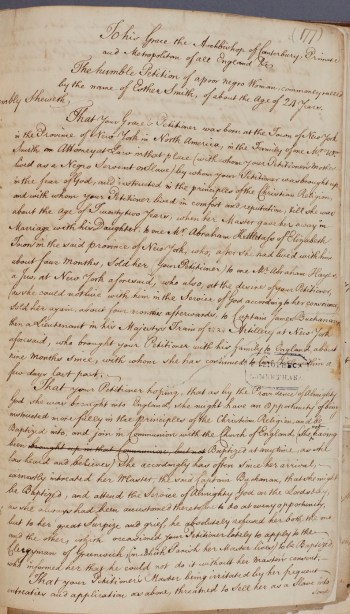
Petition from Esther Smith, an enslaved woman, to Archbishop Secker, 19 July 1760 (Lambeth Palace, MS 1123/2 item 177).
Letters, books, and documents from our collections are displayed to show some of the links between the Church of England and transatlantic slavery. Amongst these are rare documents from enslaved people, contrasting views on the rights of enslaved people from within the Church, and from missionaries working in the Caribbean and the Americas. These documents also present the arguments put forward using the Church’s teaching at the time both for and against the abolition of slavery.
The role of the Church of England in the transatlantic slavery economy was complex and varied. Missionaries sent to work in the Caribbean and the Americas documented the harsh conditions of daily life on the plantations. Enslaved people were not allowed basic Christian rights such as baptism and marriage in case these rights damaged the property and legal rights of the owners. Some voices were raised against enslavement including Revd Morgan Godwyn, an Anglican missionary to Virginia and Barbados. He wrote in 1680 appealing to the Archbishop of Canterbury to allow Anglican priests to baptise enslaved people.
As a result of the transatlantic slavery economy, enslavement, and disease, Indigenous populations were virtually wiped out. It is believed that of the 12 million Africans enslaved and transported to the Caribbean and Americas between 1500 and 1900, only around 10 million reached their destination. The effects and legacy of slavery are visible to this day.
◊ ◊ ◊ ◊ ◊
MS 1123/2 item 177 — Petition from Esther Smith, an enslaved woman, to Archbishop Secker, 19 July 1760, pictured above.
This petition was written on behalf of Esther Smith. She was born in New York and brought to England by one of her enslavers. The letter documents the number of times she had been bought and sold in her life. In this petition, she is asking to be baptised so that she could,
“[…] attend the Service of Almighty God on the Lordsday, as she always had been accustomed theretofore to do at every opportunity.”
Esther’s enslaver opposed her baptism. Further correspondence contained within the archives provides a raw account of Esther’s desperation and fears. She tried to obtain baptism at St Alphage’s church in Greenwich, London, and fought to avoid being sent to the West Indies, as confirmed by letters from the church’s vicar Revd Samuel Squire and a Methodist prison visitor Silas Told. Archbishop Secker eventually sought advice from Philip Yorke, 1st Earl of Hardwicke, who confirmed that “a slave brought to England is still a slave” and baptism would not change this status. Whether Esther succeeded in her efforts remains unknown.
◊ ◊ ◊ ◊ ◊
From the press release (16 June 2022) . . .
Church Commissioners’ research identifies historic links to transatlantic chattel slavery
The Church Commissioners for England has learned from research it commissioned that Queen Anne’s Bounty, a predecessor fund of the Church Commissioners’ £10.1 billion endowment, had links with transatlantic chattel slavery. The Church Commissioners is deeply sorry for its predecessor fund’s links with transatlantic chattel slavery.
In the 18th century, Queen Anne’s Bounty invested significant amounts of its funds in the South Sea Company, a company that traded in enslaved people. It also received numerous benefactions, many of which are likely to have come from individuals linked to, or who profited from, transatlantic chattel slavery or the plantation economy.
The Church Commissioners in 2019 decided to conduct research into the source of its endowment fund to gain an improved understanding of its history. It worked with forensic accountants to review early ledgers and other original source documents from Queen Anne’s Bounty. That research is now complete, and a final report of the findings will be published later this year. The Church Commissioners is forming a group to consider the research and how to respond to these findings. Further information will be shared in due course. . . .










leave a comment