Exhibition | Three Rare Treasures of Imperial China
From the press release for the exhibition:
In Focus: Three Rare Treasures of Imperial China
Im Fokus: Drei seltene Schätze des Kaiserlichen China
Sponsel Room, Residenzschloss, Dresden, 1 April — 29 June 2026
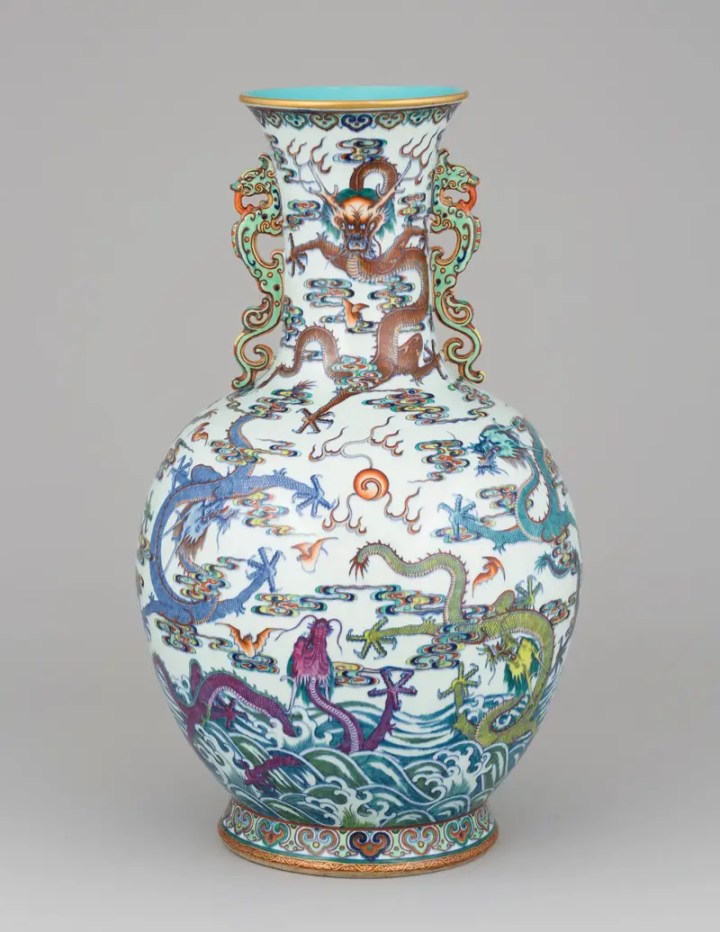
Dragon Vase with Imperial Seal Mark, China, 1735–96 (Dresden: SKD).
The exhibition In Focus: Three Rare Treasures of Imperial China presents objects from different imperial dynasties from among the holdings of the Grünes Gewölbe (Green Vault) and the Porzellansammlung (Porcelain Collection) of the Staatliche Kunstsammlungen Dresden. The Ru Bowl, the so-called Dragon Vase, and a tiny snuff bottle (barely five centimetres tall) exemplify the aesthetics and exceptional craftsmanship of their respective eras. The items from the Porzellansammlung have attracted a lot of media attention in recent weeks. The public will now be given the opportunity to discover what makes them so special.
The Porzellansammlung of the SKD holds the largest collection of early modern porcelain from China and Japan outside of Asia. It preserves a cross-section of that which was collected in Europe in the late 17th and early 18th centuries. From the mid-19th century onwards, the Electoral and Royal collection amassed by August the Strong and August III—the historical core of the museum—was expanded, by means of exchanges and purchases, to include ceramics from all over the world, including the Ru Bowl and the Dragon Vase.
Originally created exclusively for the Chinese imperial court, these are outstanding examples of Chinese ceramic art, the likes of which were unknown in Dresden during the Augustan period. It was only in the early 20th century that such imperial pieces became available to European collectors. The Ru bowl, in particular, is regarded as one of the most beautiful and extremely rare ceramic products of the Song Dynasty (960–1279) and the crowning glory of any collection of Chinese art. In exhibiting these two objects along with the snuff bottle from the Grünes Gewölbe, the SKD are presenting three exceptionally rare and precious Chinese imperial artefacts from different dynasties. The small snuff bottle is an original from the imperial workshops of the Chinese Qing Dynasty, where European influence led to the development of new enamelling techniques and such vessels became highly sought-after luxury objects. These outstanding pieces are exemplary of the aesthetics and exceptional craftsmanship of their time.
In a recent agreement signed with the Hong Kong Palace Museum, the SKD have committed to conducting more in-depth research into their holdings of East Asian art in collaboration with experts from the Palace Museums in Hong Kong and Beijing. The exhibition In Focus: Three Rare Treasures of Imperial China highlights how mutual respect, as well as the pursuit of precision both in art and in scholarly research, form a strong bond between China and Germany.
The Ru Bowl
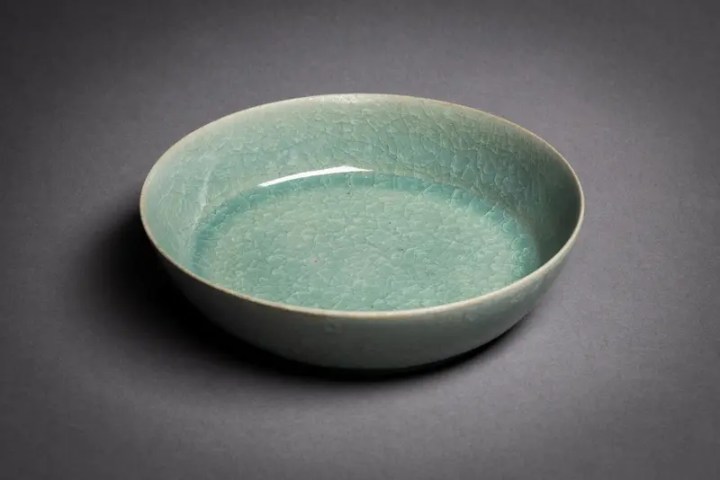
Ru Bowl, Brush Washer, China, 1100–25 (Dresden: SKD).
This small, glazed stoneware bowl from the Northern Song Dynasty (960–1127), which at first glance appears unremarkable, is one of the rarest and most precious objects of Chinese ceramic art. The vessel, which is around 900 years old, was used as a brush-washing bowl and is one of only 89 known Ru wares in the world; it is also the only specimen of its kind in Germany. It was part of a private collection acquired by the Porzellansammlung in the 1920s. These first ceramics made exclusively for the Chinese imperial court are named after their place of origin, the Ru Prefecture in the northern province of Henan. The production of imperial Ru wares went on for only a little more than 20 years, ending when the Northern Song Dynasty was driven south in 1126. The few pieces that were produced and salvaged soon became mythologised as reminders of the empire’s former grandeur and are now considered the pinnacle of any collection of Chinese ceramics. This perfectly preserved Dresden bowl is striking in its exceptionally simple elegance. With its gently shimmering, delicately crackled glaze in a particularly beautiful bluish-green hue, it is reminiscent of winter colours and brittle ice.
The Dragon Vase
The so-called Dragon Vase was commissioned for the court of Emperor Qianlong (reigned 1735–1795). Painted with nine brightly coloured dragons soaring across the sea and sky, this monumental piece is one of the rarest masterpieces of imperial porcelain art from the Qing Dynasty. Its dynamic decoration combines technical perfection with rich symbolic meaning and reflects the splendour and political ideals of the court under Emperor Qianlong. In Chinese culture, the number nine (jiu) also signifies ‘eternity,’ whilst the dragon is the most important symbol of imperial power. The motif of nine dragons therefore reflects the desire for eternal imperial rule. On this vase, the dragons appear amidst waves and clouds, two elements traditionally associated with these mythical creatures. Flying amongst the clouds are red bats. In Chinese, the word for bat (fu) sounds the same as the word for ‘luck’ or ‘blessing.’ Along the foot and beneath the rim runs a band of heart-shaped ruyi heads; these derive from the ruyi sceptre and the lingzhi mushroom. According to Daoist beliefs, these symbols represent immortality and the fulfilment of wishes. Vessels of this kind, adorned with imperial symbols, were often given as precious gifts to high-ranking dignitaries. Like the Ru Bowl, the Dragon Vase also found its way into the Porzellansammlung during the 20th century.
The Snuff Bottle
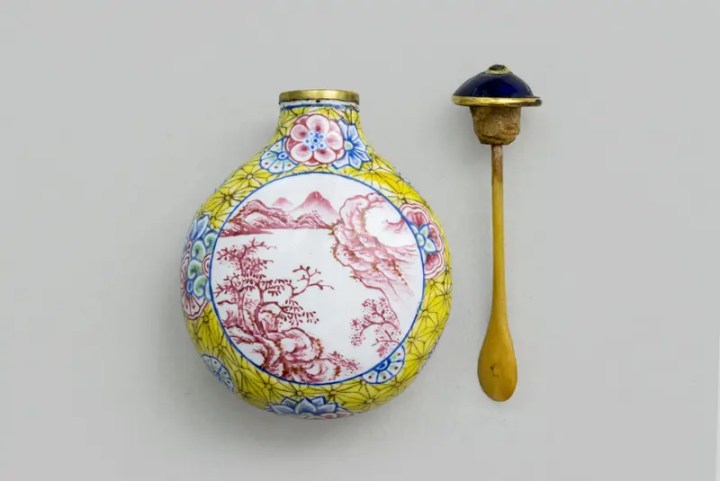
Snuff Bottle, China, 1661–1722 (Dresden: SKD).
For a long time, this delicate snuff bottle was regarded as a European piece in the chinoiserie style. It was not until 2013 that it was recognised as a rare and early example of Chinese enamel art from the Qing Dynasty. It has been possible to trace its origins to the imperial palace workshops in Beijing, where only works of the highest quality were produced for the imperial court.
Under the emperors Kangxi (r. 1661–1722) and his son Yongzheng (r. 1723–1735), the imperial workshops saw a period of significant artistic and technological innovation. Since the end of the 17th century, Jesuits had been bringing enamel objects from Europe as gifts to the imperial court, where they were greatly admired. The art-loving Emperor Kangxi subsequently took steps to recruit European artists who were familiar with the techniques, thereby promoting their further development in China.
The use of snuff, which was believed to have healing properties, had been introduced to China by European missionaries, envoys, and traders. Since the large snuff boxes commonly used in Europe proved impractical in China’s more humid climate, the use of small, tightly sealable vials soon became predominant. Particularly during the reign of Emperor Qianlong (r. 1735–1796), they were manufactured in a wide variety of shapes and designs and became sought-after collectors’ items.
Exhibition | Johann Baptist Lampi, the Elder and Younger
From the press release for the exhibition:
Johann Baptist Lampi the Elder and the Younger: Overpainted and Uncovered
Lower Belvedere, Vienna, 13 May — 11 October 2026
Curated by Katharina Lovecky
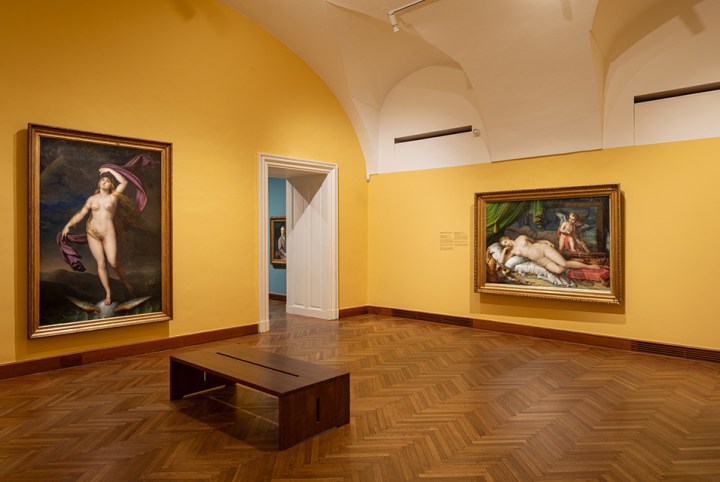
What do a Neoclassical family portrait and a Biedermeier depiction of Venus have in common? Both the portrait of Caroline and Viktor von Tomatis by Johann Baptist Lampi the Elder (1751–1830) and Sleeping Venus with Cupid in front of a Mirror by his eponymous son (1775–1837) were overpainted. Based on the results of technical investigations and art-historical research, this exhibition from the IN-SIGHT series traces the consequences of these later interventions in the work of the two artists.
General Director Stella Rollig: “Based on two works in the Belvedere’s collection, this show offers fresh perspectives on the oeuvres of Johann Baptist the Elder and Johann Baptist the Younger. The eventful history of these overpainted works demonstrates how they have changed over time in terms of both their formal appearance and their content and messages. In addition, the exhibition highlights how our current views on the treatment of art—defined by the principles of conservation and the ideal of originality—have evolved through history and only started to become established in the mid-nineteenth century.”
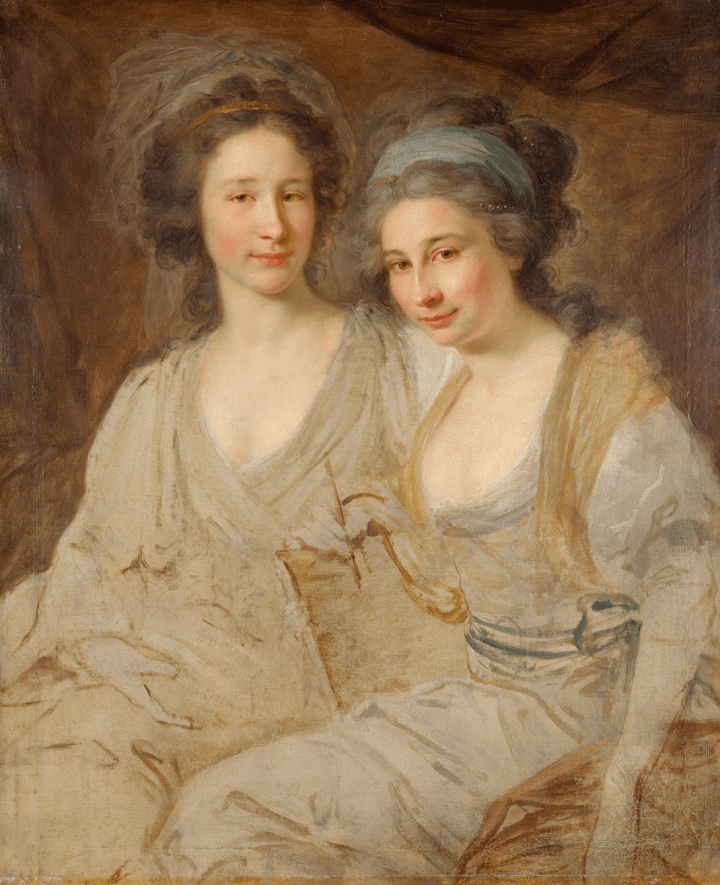
Johann Baptist Lampi the Elder, Zoë and Adelaide von Tomatis, 1788/89 (Vienna: Belvedere; photo by Johannes Stoll).
During his time in Warsaw in 1788–89, Johann Baptist Lampi the Elder painted several portraits of the Tomatis family. Milanese dancer Catarina, née Filipazzi, had moved to Warsaw with entrepreneur Carlo Tomatis in 1765. One of the three portraits of the family by Lampi shows two of their children, Caroline and Viktor, standing either side of a bust. X-ray and infrared imaging from 2016 revealed this bust to be an overpainting: hidden beneath the layers of paint is a portrait of their mother, Catarina, embracing her children. Based on this work and further portraits in addition to archival material, this exhibition tells the story of the Tomatis family.
In 2022 Johann Baptist Lampi the Younger’s painting Venus Sleeping on a Day Bed—as it was then known—was also analyzed using X-ray and infrared imaging. In this case, the figure of Cupid emerged, concealed beneath a black surface. The erasure of the god of love made the mythological content less apparent. This explains why the painting was later interpreted as a portrait of Emilie Victoria Kraus, one of Napoleon’s lovers, in two twentieth-century novels set in Salzburg. It was precisely this misinterpretation that paved the way to the painting’s popularity, which even reached as far as Paraguay. Now, for the first time since the revealing of Cupid in 2024, the painting will be shown to the public under its original title.
The history of these two paintings shows how fascinating art-historical research can be. The original content was forgotten due to overpainting, which resulted in misinterpretations. For the first time in the German-speaking world, the history of the Tomatis family has been examined in the context of their portraits while enduring myths surrounding this depiction of Venus have been challenged and debunked. At the same time, the comparison of the two works—encompassing the context in which they were created and commissioned—reveals the profound changes of this era that was characterized by the transition from a feudal to a bourgeois society, said curator Katharina Lovecky.
This exhibition uncovers the layers of meaning contained within two works, which had been hidden by overpainting. It shows that the meaning of artworks can be significantly altered once they leave the artist’s studio: A family portrait expressing a mother’s love for her children was transformed into a memorial while an idealized Venus morphed into the portrait of a local Salzburg celebrity.
Katharina Lovecky, Roberto Pancheri, Stella Rollig, and Ana Stefaner, Johann Baptist Lampi der Ältere und der Jüngere: Übermalt und freigelegt (Wien: Belvedere, 2026), 112 pages, ISBN: 978-3903327757, €19.
Exhibition | WORN
From the press release for the exhibition:
WORN
Rijksmuseum, Amsterdam, 27 March 2026 — 21 March 2027
Curated by Vanessa Jones
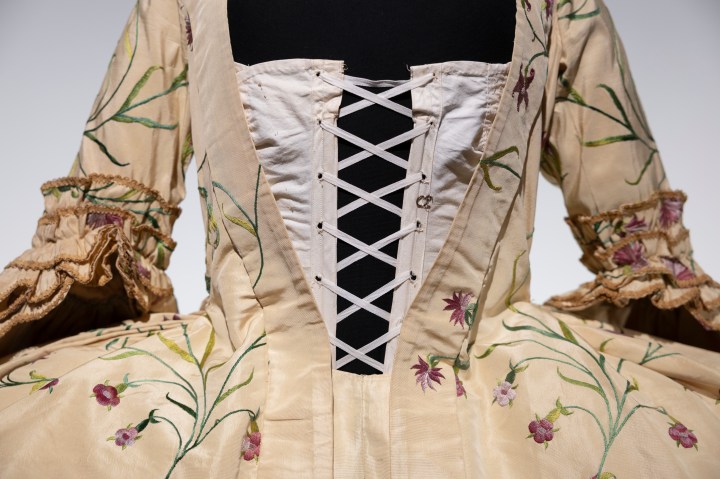
WORN at the Rijksmuseum is an intimate display of fashion garments that have been worn, altered and reused—with a focus on wear, repair and craftsmanship. On view are 24 garments and accessories dating from 1640 to 1930. All of them have been cherished for centuries, from the 17th-century mules with richly embroidered patterns to an 18th-century dress worn by multiple generations of the Six family.
WORN presents garments and accessories from the collection of the Rijksmuseum that were repeatedly re-worn and adapted. The display invites visitors to truly look—up close, slowly and with careful attention. Take time to discover the repairs, the crisscross patterns of darned stitching, the slight signs of wear on the fabric, and even traces of sweat. Every detail tells how these pieces were cherished, worn and carefully preserved for generations.
A 19th-century blue taffeta dress with a woven pattern shows how garments were altered multiple times. The dress consists of a skirt with several bodices that were swapped depending on the occasion. One of the bodices was taken apart and reassembled several times, to ensure the dress lasted even longer. Another garment that gained a second life is the citrine-yellow floral dress owned by the Six family: beneath the 18th-century exterior lies a 19th-century interior structure. Members of later generations wore the dress in 1896 and again as late as 1925, after the interior was modified with a modern corset with steel boning.
Every 12 months, the Rijksmuseum presents a new display in the Special Collections galleries of objects from its large and varied costume collection. The display design for WORN is by the French architectural firm Wilmotte & Associés.
Exhibition | Fanmania
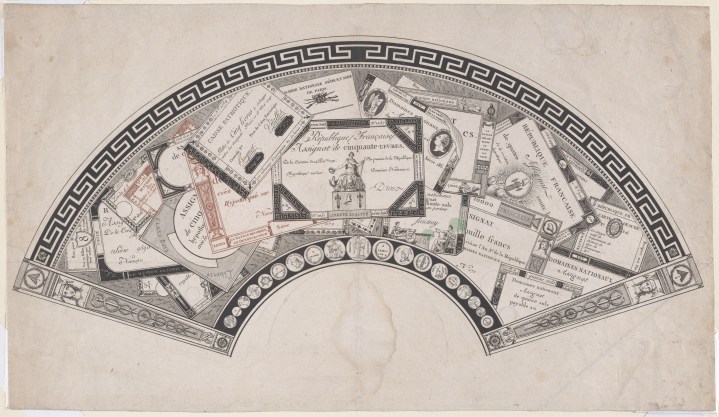
Fan Design with Republican Assignats (French revolutionary money), ca. 1795, etching, a small portion printed in red, sheet: 29 × 50 cm (New York: The Metropolitan Museum of Art, 38.91.56).
◊ ◊ ◊ ◊ ◊
While focused on the 19th-c, the exhibition includes a handful of 18th-c. examples:
Fanmania
The Metropolitan Museum of Art, New York, 11 December 2025 — 12 May 2026
Curated by Ashley Dunn and Jane Becker
The hand-held fan was an unexpected muse for some of the most innovative artists in 19th-century Europe. Fans became hugely popular across many levels of society during this period, serving as functional and fashionable objects of adornment and communication. Well-known French Impressioniscts such as Edgar Degas and Camille Pissarro not only featured this feminine accessory in their work but also adopted it as an experimental format for their art. Fanmania investigates why avant-garde artists incorporated fans into their work and sheds light on themes of gender, courtship, consumerism, and appropriation. Artists were attracted to the semicircular form for myriad reasons, including fascination with fans from Asia and Spain, commercial ambition, and their interest in formal and technical innovation. Displaying more than 75 artworks from across The Met collection, this multimedia exhibition features painted and printed fans from Europe and Asia as well as artworks that depict women wielding fans to explore the phenomenon of ‘fanmania’.
More information is available from the press release»
Exhibition | Generation 1700: Drawing at the Royal Academy in Paris
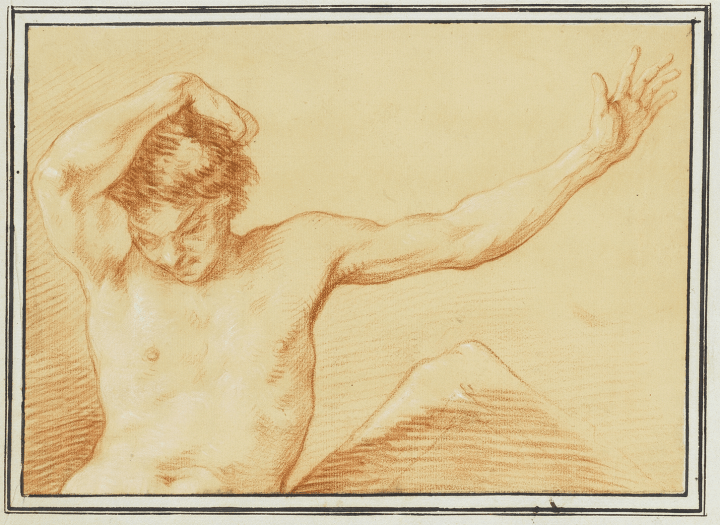
Michel-François Dandré-Bardon, Figure Study of a Man with an Outstretched Arm, ca. 1725
(Staatsgalerie Stuttgart)
◊ ◊ ◊ ◊ ◊
Now on view at the Staatsgalerie Stuttgart:
Generation 1700: Drawing at the Royal Academy in Paris
Generation 1700: Zeichnen an der Königlichen Akademie in Paris
Graphik-Kabinett, Staatsgalerie Stuttgart, 17 April – 30 August 2026
How does one learn to draw the human body? The question is at the heart of the exhibition Generation 1700, which focuses on drawing instruction at the Académie Royale de Peinture et de Sculpture, France’s prestigious art academy in the 18th century during a time of profound social upheaval: while the bourgeoisie emancipated itself from the absolutist court under the banner of the Enlightenment, drawing itself became a medium of liberation. At that time, young artists not only depicted the human body, but also studied anatomy with rational insight and understood it as an expression of individual ideas. Now in 2026, on the occasion of the anniversary “75 years of the Institut français Stuttgart,” the Staatsgalerie Stuttgart will highlight drawing from live models between discipline, science, and artistic development.
The exhibition, presented in the Graphic Cabinet, focuses on Michel-François Dandré-Bardon (1700–1783), one of the most important artists of the French Enlightenment. With his understanding of anatomy and a keen sense of movement and materiality, he stages the human body in dramatically composed studies—literally from head to toe. His works impressively demonstrate how the strict principles of the Academy provide fertile ground for artistic experimentation. The Staatsgalerie possesses one of the most extensive collections in Europe of Dandré-Bardon’s graphic works. Additional works by contemporaries such as Carle van Loo, Charles Joseph Natoire, and Nicolas Guibal complement the presentation. With around 70 drawings and graphic prints, most of which are being shown for the first time, Generation 1700 offers a glimpse into everyday life at the Academy.
Exhibition | Picturing the Revolution
From Historic Deerfield:
Picturing the Revolution
Historic Deerfield, 18 April 2026 — 3 January 2027
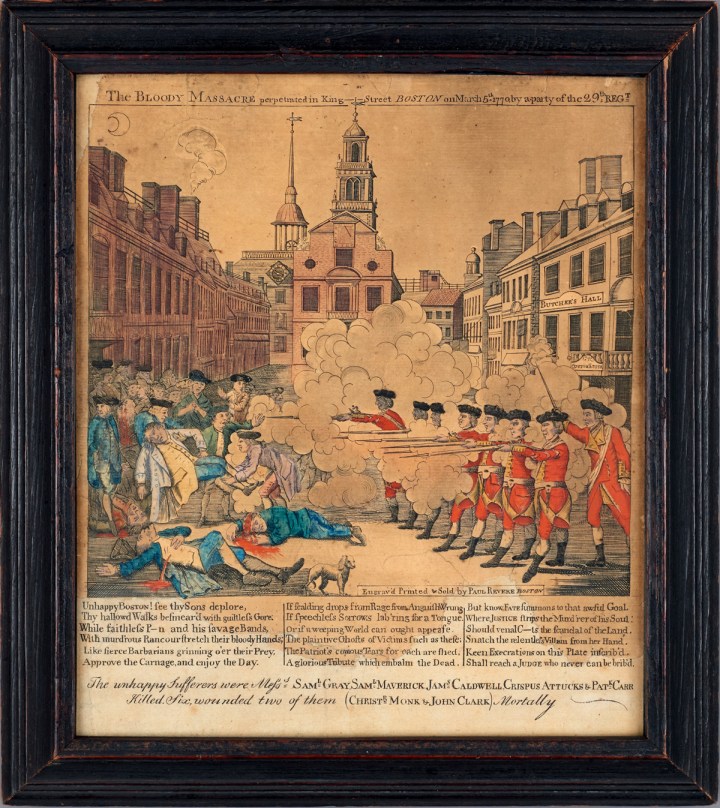
The Bloody Massacre, engraved by Paul Revere, Jr., Boston, 1770, ink on paper (Historic Deerfield, 0864).
Throughout the American War for Independence, scores of images circumnavigated the globe, fighting their own battles to establish a comprehensible narrative for the momentous events occurring in British North America. Differences in politics, disruptions in communication, and the delay of thousands of miles of distance produced competing and often contradictory accounts. Some images became enduring representations of the conflict. Others faded from memory.
Drawing from Historic Deerfield’s rich collection of Revolutionary-era materials, this exhibition explores the diverse ways that 18th-century individuals ‘pictured’ or understood the Revolution as it unfolded. Looking across prints, drawings, maps, broadsides, portraits, powder horns, ceramics, and satirical cartoons, Picturing the Revolution highlights how images shaped local and global perceptions of the war: its landscapes, its actors, its causes, and its goals. Mining these complex visual records reveals the often-overlooked importance of pictures in the shift from revolt to revolution, and in envisioning a future for the new nation.
This exhibition has been made possible with support from the National Endowment for the Humanities and the Massachusetts Office of Travel & Tourism.
Journal18, Spring 2026 — Revolutions
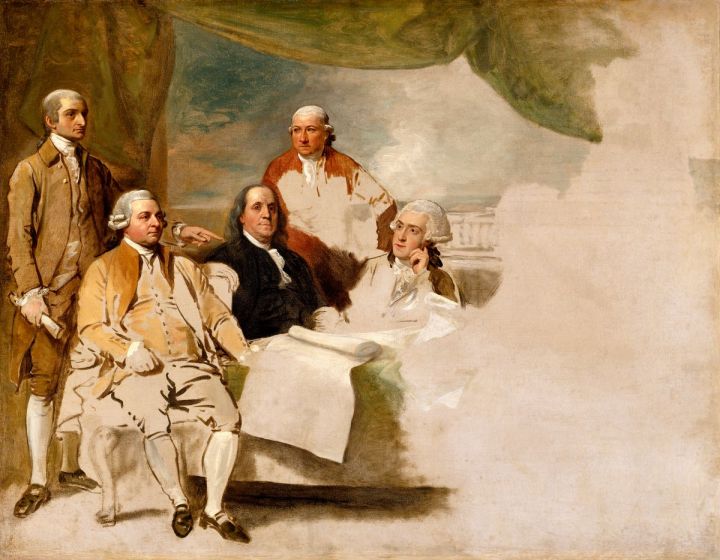
Benjamin West, American Commissioners of the Preliminary Peace Negotiations with Great Britain, 1783–1820, oil on canvas, 72 × 92 cm (Winterthur Museum, Garden & Library).
◊ ◊ ◊ ◊ ◊
The latest issue from J18:
Journal18, Issue #21 (Spring 2026) — Revolutions
Issue edited by Wendy Bellion and Kristel Smentek
Published in alignment with the 250th anniversary of the United States Declaration of Independence, the three articles and four shorter re-presentations explore the material and visual cultures of this and subsequent eighteenth-century Atlantic revolutions: the French Revolution (1789–99), the Haitian Revolution (1791–1804), the United Irishmen’s Rebellion (1798), and the Latin American Wars of Independence (1808–26).
a r t i c l e s
Emily C. Casey — Revolution’s Ends: American War, Patriotism, and Culture in a Dilating Eighteenth Century
Matthew Gin — The Revolution’s Sanctuary: Designing the La Réole Temple of Reason, Year II
Monica Anke Hahn — Three-Fingered Jack: Staging Resistance in the Toy Theater
r e – p r e s e n t a t i o n s
Zara Anishanslin — Finding William Lee: A Black Founder in Early American Portraiture
Daniella Berman — Contingent Truths of the French Revolution: Representing the Abolition of Slavery of 1794
Firelei Báez in conversation with J. Cabelle Ahn — ‘My interventions project back what has been erased’
Thomas Crow — Jacques-Louis David at the Louvre with Keith Michael Baker, Jean-Paul Marat: Prophet of Terror: A Review
◊ ◊ ◊ ◊ ◊
Reflections on a Decade of Journal18
Virtual Event in the HECAA Great Conversations Series
7 May 2026, 9.30am PDT / 12.30pm EDT / 5.30pm BST
Join the Journal18 editorial team for a reflection on the creation and aims of J18 and how it has developed over time, as well as an open-ended discussion about future possibilities. We are excited to come together for conversation about a decade of J18 and to look ahead. Registration is available here.
On Tour in the UK | Mignard’s Portrait of Marquise de Seignelay
From the press release:
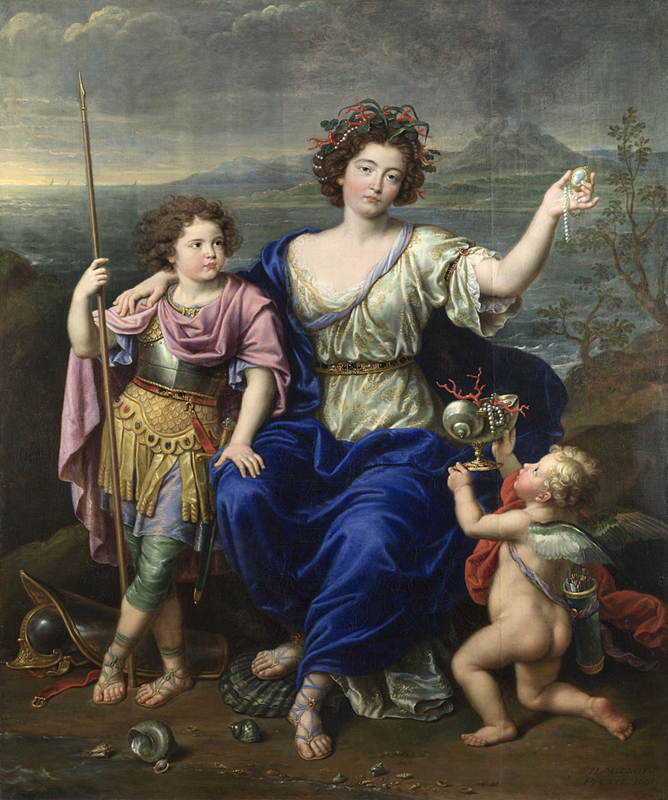
Pierre Mignard, The Marquise de Seignelay, 1691, oil on canvas, 195 × 154 cm (London: National Gallery).
The National Gallery announced the second painting for the National Gallery Masterpiece Tour, 2025–27. Pierre Mignard’s portrait of the Marquise de Seignelay (1691) will travel to our four partners between 2026 and 2027: South Shields Museum and Art Gallery (29 August 2026 – 8 November 2026); The Cooper Gallery, Barnsley (13 November 2026 – 20 February 2027); Grundy Art Gallery, Blackpool (27 February 2027 – 5 June 2027), and Ferens Art Gallery, Hull (11 June 2027 – 5 September 2027).
In this striking portrait, Mignard depicts the recently widowed Catherine-Thérèse de Goyon de Matignon-Thorigny, Marquise de Seignelay (1662–1699), as a woman of cultural and international importance. She is portrayed as the sea-goddess Thetis, while her eldest son Marie-Jean Baptiste (1683–1712) is dressed as the Greek hero Achilles, Thetis’s son by the mortal Peleus. Her sumptuous robe is painted using ultramarine, a highly expensive blue pigment, as a show of her wealth and status. The extensive marine imagery references her late husband, the Marquis de Seignelay’s position as head of the French Navy. The landscape in the background likely represents the shores of Martinique, an island in the West Indian ocean which was purchased for the French crown by the Marquise’s late father-in-law in 1664.
The exhibition programme plans to highlight the unique strengths of the partner venues, with three located on the coast—an ideal context for exploring the maritime themes of the painting and deepening its resonance with their surrounding landscapes and local collections.
At South Shields, the exhibition will be enriched through co-created elements developed with New Writing North’s Young Writers programme, students from South Tyneside College, and members of Our Voice Counts. The Cooper Gallery, Barnsley will co-produce its iteration of the exhibition with Next Big Thing, Barnsley Museums youth group, ensuring strong local engagement and creative collaboration. Grundy Art Gallery will shape its presentation by working for a 2nd year with Blackpool’s Young People’s charity The Magic Club. Grundy is working for all three years of The Masterpiece Touring Project with The Magic Club providing the opportunity for deep engagement over time. Ferens Art Gallery will further shape their presentation by working closely with community groups, drawing on local insights to inform and animate each exhibition, whilst providing a perspective which enriches our understanding of this painting.
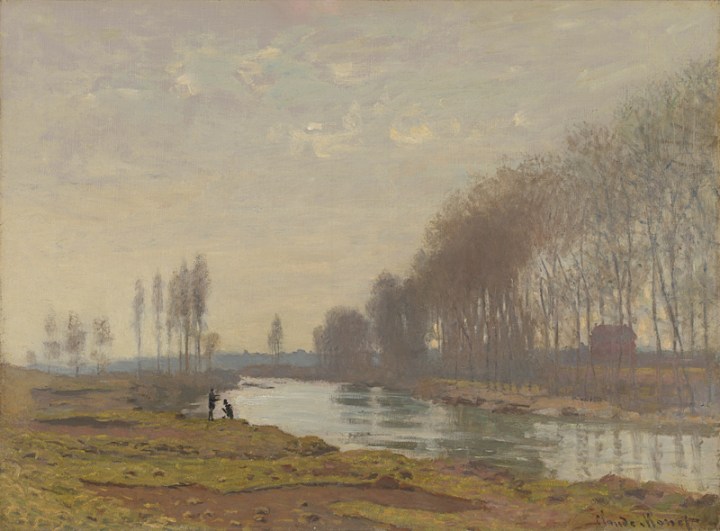
Claude Monet, The Petit Bras of the Seine at Argenteuil 1872, oil on canvas, 53 × 72 cm (London: National Gallery).
The National Gallery Masterpiece Tour: Monet was recently on display at South Shields Gallery (until 25 March). Monet’s The Petit Bras of the Seine at Argenteuil was presented with works from the South Shields, Laing and Shipley art collections, and artworks co-created by EBSA (Emotionally Based School Avoidant) young people, teachers, and local organisations. At Grundy Art Gallery (28 March – 13 June), the painting will be displayed alongside a new sonic art work produced by participants of Blackpool’s Young People’s charity, The Magic Club. Working with artist Kelly Jayne Jones, Blackpool’s young people have produced a sound-based response to their experience of Monet’s painting. The first round of the tour will then finish at Ferens Art Gallery (19 June – 13 September), where the picture will be part of an exhibition co-curated with Flourish, Ferens Art Gallery’s creative group for children and young people. Organised with and for disabled and neurodivergent visitors, the show will present select works from the Ferens’s vast collection alongside contemporary responses from Flourish.
Since its inception in 2014, The National Gallery Masterpiece Tour has reached 401,000 people across the UK. Our National Touring programme, including The National Gallery Masterpiece Tour and other travelling exhibitions, has now reached 1,467,618 people since 2014. As part of our ongoing commitment to sharing the collection, this exhibition partnership, made possible by the generous support from Hiscox, offers four UK museums and galleries outside of London the opportunity to work with the National Gallery for three years and display three major artworks from the collection.
For the second edition of the Masterpiece Tour, partners will each connect with a local community organisation to support the exhibition or public programme related to the selected painting each year. Each partner will develop their own display to explore and draw out themes most relevant to them and their communities.
National Gallery Director Sir Gabriele Finaldi said: “The National Gallery’s collection belongs to all of us. It is part of our duty and our honour to look after these paintings and to bring them to where people are, not just expect them to come to us. Partnering on touring exhibitions does so much more than bring beloved paintings from the collection to other places in the UK—it supports the whole country’s cultural ecosystem, connects people with paintings that belong to us all, and allows us to learn and expand our own practices and interpretations through the creativity of our partner organisations and their communities. That over one million people have visited these exhibitions in the last decade proves the desire to engage with our collection is growing, and we look forward to welcoming the next million visitors across the UK.”
North East Museums Director, Keith Merrin said: “We’re delighted to be part of the next chapter of the Masterpiece Tour and to welcome this extraordinary painting to South Shields Museum & Art Gallery. Bringing a work of this significance to our communities reflects the shared commitment between partners to making world-class art accessible, relevant and inspiring. Since the launch of the Masterpiece Tour on 17 January, when the museum welcomed Monet’s The Petit Bras of the Seine at Argenteuil (1872), footfall to the museum has increased by over 70%, highlighting the strong appetite for high-quality art experiences amongst our community.”
Exhibition | Canaletto & Bellotto
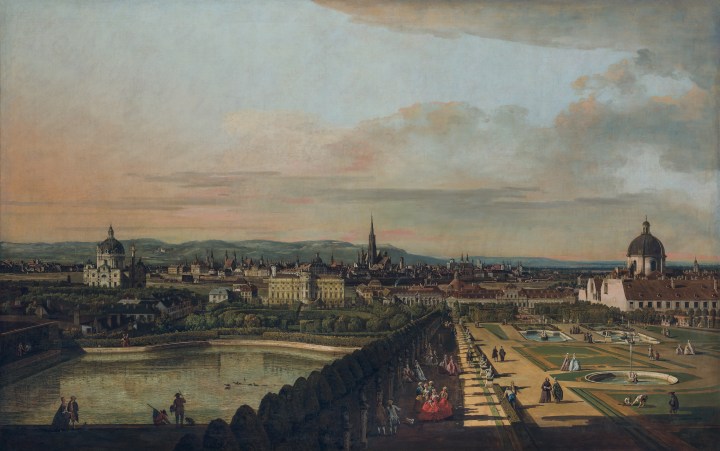
Bernardo Bellotto, Vienna Viewed from the Belvedere Palace, 1759/60, oil on canvas, 135 × 213 cm
(Vienna: Kunsthistorisches Museum)
◊ ◊ ◊ ◊ ◊
From the press release for the exhibition:
Canaletto & Bellotto
Kunsthistorisches Museum, Vienna, 24 March 2026 – 6 September 2026
Curated by Mateusz Mayer
In the 18th century, painted cityscapes (in Italian, vedute: ‘views’) became much sought-after souvenirs. Particularly so among young British aristocrats who bought these paintings on their so-called ‘Grand Tour’, an educational journey across Europe, as a sign of their newly acquired worldly finesse and as a keepsake of their travel experiences. Two of the most eminent exponents of veduta painting are in the center of the new exhibition at the Kunsthistorisches Museum. The Venetian painters Giovanni Antonio Canal, called Canaletto (1697–1768), and his nephew and pupil Bernardo Bellotto (1721–1780) have continued to inform our imagination of several European cities to this day. With their delicate feel for light, atmosphere, and architectural precision, Canaletto and Bellotto transformed these places into stages on which everyday life played out—and in the views of them, into places of longing.
“Canaletto’s and Bellotto’s works show Europe as a space of cultural encounter, long before the concept of a European public ever gained currency. Their vedute connect cities such as Venice, Dresden, London, and Vienna through the perspective of 18th- century travelers and collectors. The exhibition illustrates how art became the visual language of a shared European experiential environment—an empowering culture of exchange, inspiration, and curiosity about other cities and societies,” says Jonathan Fine, Director General of the Kunsthistorisches Museum.
 In the 1730s, Canaletto’s vedute fetched record prices in Venice. With the outbreak of the War of the Austrian Succession (1740–1748), however, the market slumped: international travel came to a halt, and deep-pocketed patrons stayed away. Uncle and nephew first responded by turning to new subject matter in their work, but soon realized that prospects for their careers were better outside Italy. The exhibition starts out in Venice and then moves on to Canaletto’s time in England as well as to Bellotto’s places of work in Vienna and Dresden, with the main focus on exploring the veduta as a painterly genre.
“City views from the 18th century, which are often perceived as immediate, almost photographic depictions of reality, are in fact carefully constructed pictorial creations that afford telltale insights into the social and political contexts of the time they were created,” adds Mateusz Mayer, curator of the exhibition.
Canaletto’s and Bellotto’s paintings unfold a multifaceted panorama of the Europe of their time. By showing a selection of particularly significant works and placing them within the scientific currents of the period, the exhibition demonstrates that the veduta is not an objective documentation. Rather, it is a deliberately designed image of a city—informed by artistic choices, socio-political conditions, and the expectations of the patrons commissioning them— manifesting a concept that is particularly relevant in light of present-day debates about visual media, urban development, and the cultural memory.
Canaletto—One Name, Two Artists
The name ‘Canaletto’ has come to be almost synonymous with the ‘veduta’ genre, and not infrequently has caused some confusion, as Bernardo Bellotto also added ‘called Canaletto’ to his signature in some works. He did this not only to underscore his artistic connection with his famous relative and teacher, but also to bolster up his own market value. In this exhibition, though, only the uncle is referred to as ‘Canaletto’. While the latter, throughout his lifetime, led the precarious existence of a freelance veduta painter, dependent on a changing clientele of patrons, Bellotto was eventually granted the honor of a permanent position at the court of the Elector of Saxony and King of Poland.
High-Caliber Loans
The exhibition features 32 outstanding paintings—comprising works from the Kunsthistorisches Museum as well as high-caliber loans. One of the highlights is Canaletto’s spectacular view Venice: The Bacino di San Marco from San Giorgio Maggiore (1735/44) from the holdings of the Wallace Collection. The son of a stage painter, Canaletto was familiar with perspective construction and geometry as they were employed in the theater. That theatrical quality becomes particularly evident in this painting in his subtle handling of spatial illusion.
Also of unique quality are Canaletto’s London paintings, such as London: The Thames on Lord Mayor’s Day (c. 1748) from the Lobkowicz Collection and Westminster Abbey with a Procession of the Knights of the Order of the Bath (1749) from the collection of the Dean and Chapter of Westminster. On view for the general public in Austria for the first time here, they afford rare insights into Canaletto’s artistic engagement with the English capital city.
Another main emphasis is on Bellotto’s two-year stay in Vienna, an extremely productive creative period. His large-size views of Vienna’s inner city, such as View of Vienna from the Belvedere (1759/60), and of palaces around the city from the holdings of the Kunsthistorisches Museum have been cleaned especially for the exhibition. Complemented by prominent loans from the collection of the Princes of Liechtenstein, such as The Liechtenstein Garden Palace in Vienna, Seen from the Belvedere (1759/60), these vedute can now be presented together, almost in their entirety, for the first time in more than 20 years.
In order to further elucidate the intellectual and artistic context of the epoch, the show is supplemented with additional paintings, art prints, and scientific instruments on loan from numerous European museums. Lenders include: Academy of Fine Arts Vienna; Albertina, Vienna; Andrew Lloyd Webber Foundation supported by Tate; Compton Verney; Fondazione Musei Civici di Venezia, Museo Correr, Venice; Gallerie dell’Accademia, Venice; Royal Castle in Warsaw – Museum; Leica Microsystems GmbH; Liechtenstein. The Princely Collections, Vaduz–Vienna; Musée des Beaux-Arts et d’Archéologie, Troyes; Museo Nacional Thyssen-Bornemisza, Madrid; Museu National d’Art de Catalunya, Barcelona; National Gallery of Ireland, Dublin; Nationalmuseum, Stockholm; Austrian National Library, Vienna; Saxon State Archives, Central State Archives Dresden; Schottenstift, Vienna; Vienna Museum of Science and Technology; The British Museum, London; The Dean and Chapter of Westminster, London; The Lobkowicz Collections, Lobkowicz Palace, Prague Castle, Czech Republic; The Wallace Collection, London; Wien Museum, Vienna.
The exhibition was curated by Mateusz Mayer, curator of the Picture Gallery of the Kunsthistorisches Museum. Serenella Zoppolat (architettura21) and Tilo Perkmann (Artvis) did the exhibition design.
The catalogue is distributed by The University of Chicago Press:
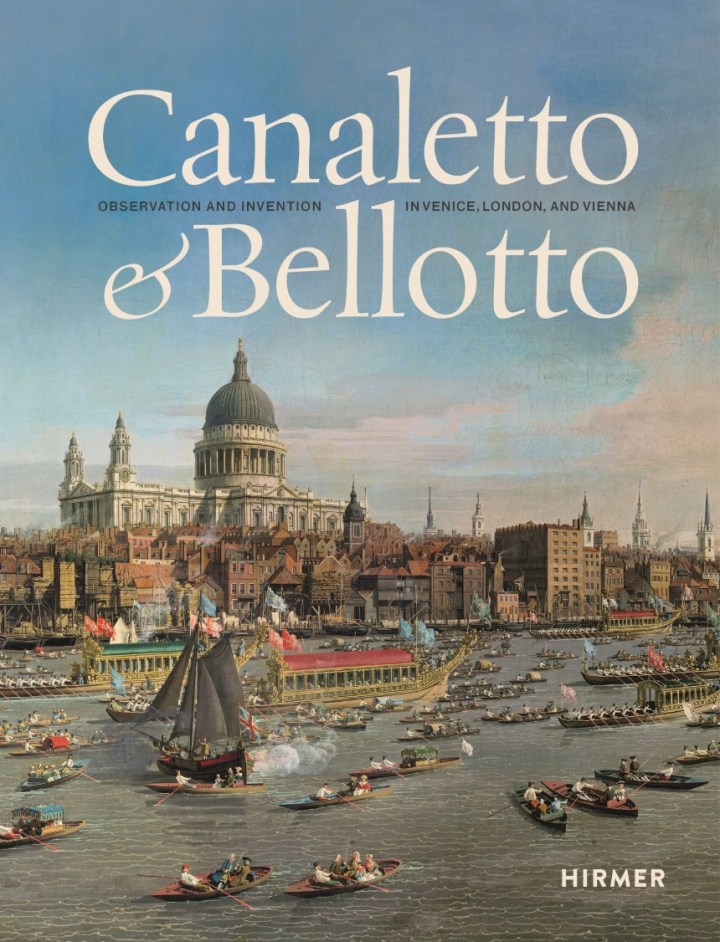
Mateusz Mayer, Canaletto & Bellotto: Observation and Invention in Venice, London, and Vienna (Munich: Hirmer, 2026), 176 pages, ISBN: 978-3777447551, $50 / Canaletto & Bellotto: Beobachtung und Erfindung in Venedig, London und Wien, ISBN: 978-3777447544, €40.
Exhibition | Unrelenting: Cherokee People and the American Revolution
From the press release for the exhibition:
Unrelenting: Cherokee People and the American Revolution
Museum of the Cherokee People, Cherokee, North Carolina, 17 March — 30 December 2026
Curated by Dakota Brown, Brandon Dillard, and Evan Mathis
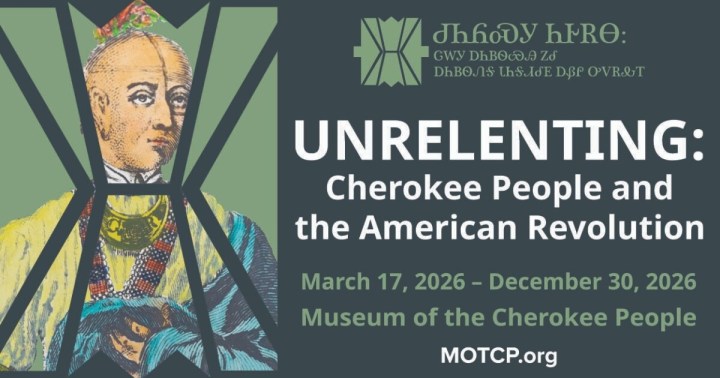
On 17 March 2026, the Museum of the Cherokee People (MotCP) opened Unrelenting: Cherokee People and the American Revolution, a first-of-its-kind exhibition centering Native voices, perspectives, and creativity in response to the 250th anniversary of the founding of the United States. The exhibition features historic objects in conversation with works by Cherokee artists, merging cultural heritage, military history, and contemporary art for a nuanced examination of a pivotal moment in Cherokee and American history.
“As a sovereign nation and the tribal museum of the Eastern Band of Cherokee Indians, we are so pleased we can present this self-funded, independent exhibition from a Cherokee perspective,” says Executive Director Shana Bushyhead Condill (Eastern Band of Cherokee Indians).
With research beginning in 2022, the exhibition’s curators—MotCP Director of Education Dakota Brown (Eastern Band of Cherokee Indians), MotCP Director of Collections and Exhibitions Evan Mathis, and guest curator Brandon Dillard (Cherokee Nation), Director of Historic Interpretation and Audience Engagement at Monticello—sought Cherokee accounts of the American Revolution (1775–1783) and the Cherokee American War (1776–1794), highlighting the complexities of memory and commemoration.
“For those of us from the South, memory is inscribed on the landscape in countless ways that are so naturalized that they feel omnipresent,” says Dillard. “Most people drive by roadside markers commemorating long-forgotten battles every day. We pass statues in public squares, learn and work in buildings named after complicated and often fraught people, and we partake in rituals commemorating historical events. But how often do most people sit around and actually talk about those events?”
In addition to showcasing historic objects, including weapons, adornments, and archival materials, MotCP invited Cherokee artists to create new works in response to historic treaties and documents from the Revolutionary era. Ranging in medium from spoken word songs to paintings to beadwork, these contemporary creative expressions “make it impossible for the viewer to put us, as Cherokee people, in the past,” says Condill.
As the nation commemorates the 250th anniversary of the signing of the Declaration of Independence, Unrelenting’s curators aspire to spark conversation about American identity and sovereignty among visitors of all walks of life, sharing new research in the first exhibit about Cherokees in the American Revolution by Cherokee scholars.
“Because American nationalist mythology pretends like Native people belong in the past, our contemporary existence contradicts the dominant memory and commemorative landscape of the United States,” says Dillard. “With Unrelenting, we just wanted to invite people to think about some of those things and recognize how complicated it all is…and most importantly, to welcome complexity when thinking about the past.”
Curators
Dakota Brown (EBCI), Brandon Dillard (Cherokee Nation), and Evan Mathis
Featured Artists
Joshua Adams (EBCI), Beth Anderson (Cherokee Nation), Karen Berry (Cherokee Nation), Martha Berry (Cherokee Nation), Anagali Shace Duncan (Cherokee Nation), Keli Gonzales (Cherokee Nation), Aaron Lambert (EBCI), Robert Lewis (Cherokee Nation, Navajo Nation, Apache), Louwana Jo “ᏍᎩᎵᎡᏆ” Montelongo (EBCI), Paula “Qualla” Nelson (EBCI), Isabella Saunooke (EBCI), Laura Walkingstick (EBCI), Tara White (Cherokee Nation), Alica Murphy Wildcatt (EBCI)










leave a comment