Exhibition | Revolutionary Women
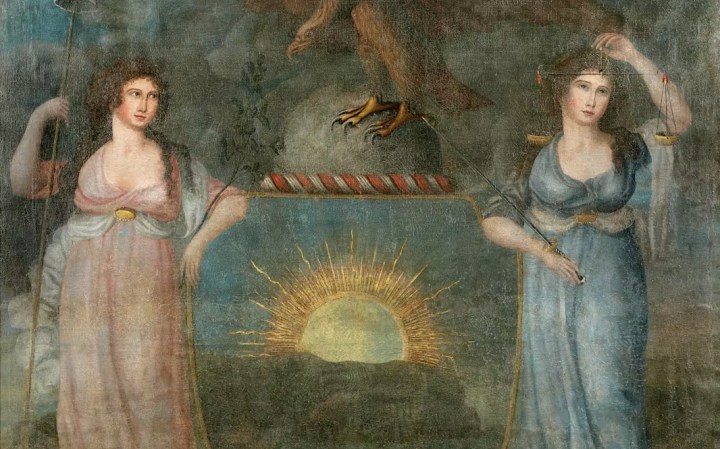
Excelsior with Allegorical Figures of Liberty and Justice, late 18th century.
◊ ◊ ◊ ◊ ◊
This summer the museum will also present its own unique copy of the Declaration, as Jennifer Schuessler reports in The New York Times (5 June 2026) . . .
“For generations, the institution (formerly the New-York Historical Society) has quietly held a rare, unattributed broadside of the Declaration, one of only a handful with no printer’s name attached. From June 18 to July 5, it will be on public display for the first time, along with a tentative attribution, to a New York City printer named Samuel Loudon.”
From the press release for the exhibition:
Revolutionary Women
The New York Historical, 29 May — 25 October 2026
Curated by Anna Danziger Halperin, Tessa Bangs, Isabelle Held, Rachel Pitkin, and Lauren Cain
Commemorating the nation’s semiquincentennial year, The New York Historical presents Revolutionary Women, a new exhibition on view in the Joyce B. Cowin Women’s History Gallery. Moving beyond the myths and legends that have long shaped narratives of the American founding, this exhibition draws on extensive research in The Historical’s Patricia D. Klingenstein Library to illuminate the lives of the women who helped define the American experiment. Through the close examination of overlooked primary sources—including letters, financial ledgers, and archaeological artifacts such as shoe soles and children’s toys excavated from military camps—Revolutionary Women reconstructs a compelling, evidence-based reappraisal of the 18th century, positioning women as central actors in the political, social, and economic transformations of the era.
“To understand the history of our nation, we must look at what is revealed in the margins of the traditional narrative,” said Dr. Louise Mirrer, president and CEO, The New York Historical. “This exhibition moves past symbolism to center the real expertise and labor of women who navigated a world of blurred allegiances to help found the United States. By unearthing these hidden contributions, we hope to shift how the American Revolution is understood for generations to come.”
At its core, the exhibition cuts through 250 years of mythmaking to reveal the documented realities behind iconic Revolutionary-era women. It spotlights figures such as Deborah Sampson, whose story of military enlistment was amplified in early print culture, alongside Abigail Adams and Phillis Wheatley Peters, who wielded Enlightenment ideals to expose the contradictions of a male-dominated republic. The exhibition also dismantles enduring legends like ‘Molly Pitcher’, revealing the figure likely to have been a composite of several women, including Margaret Corbin (‘Captain Molly’), the first woman to receive a federal pension after being wounded in combat, as confirmed by military and Board of War records. Drawing on rich archival evidence, including a public tribute from George Washington to widows who helped American prisoners, Revolutionary Women replaces folklore with a vivid, verifiable account of women’s central role in the time of America’s founding.
Using the New York region as a microcosm of the broader struggle for independence, the exhibition reveals the breadth of women’s economic and civic influence in a contested landscape. As men went to war, women assumed control of businesses, carried intelligence across military lines, and sustained the conflict through medical and logistical support. Archival materials, including the business records of merchant Mary Alexander, underscore women’s longstanding participation in transatlantic trade networks. Evidence from early ledgers of the Tontine Coffee House—the heart of early New York’s financial district—further documents women such as Rebecca Gomez as active investors and stakeholders, offering a powerful corrective to narratives that have long excluded women from the growing early American financial system.
For women of color and Indigenous women, whose voices were often suppressed by dominant narratives, Revolutionary Women reinterprets traditional sources to foreground their agency and resilience, telling the story of individuals like Elizabeth ‘Mumbet’ Freeman, whose court case, Brom and Bett v. Ashley (1781), set the legal precedent to abolish slavery in Massachusetts. Molly Brant, a Mohawk woman of the Wolf Clan, chose loyalty to the British over the Revolutionary forces, believing that it offered the best chance to protect Haudenosaunee lands from colonial expansion. The letter granting Brant a pension from the British government for her diplomatic service is on view. Meanwhile, soldiers’ orderly books and diaries from the Sullivan Campaign, while recording the destruction of Haudenosaunee lands, inadvertently preserve evidence of Indigenous women’s agricultural knowledge and authority.
Personal relationships are also explored in the exhibition. On display is a love poem written by Patriot Major Aquila Giles, who met his future wife, Eliza Shipton, the niece of a Loyalist, after he was captured. The star-crossed lovers secretly exchanged letters, and eloped in 1780 to thwart their impending separation. A woman’s shoe sole, children’s toys, and other archaeological evidence mark the presence of women and children in military camps and in occupied New York.
In the post-war years, women turned to the emerging legal system to assert their rights and redefine the boundaries of citizenship. Court records and legal depositions, like the property lawsuits of Elizabeth Rutgers, who sued for back rent when her brewery was occupied during the British occupation, demonstrate that women actively challenged the limits of the law.
The exhibition concludes by examining how women played a decisive role in building the social and economic infrastructure of the new nation. In the absence of robust public services, they established philanthropic and educational institutions that bound the city and nation together, while their wealth and labor provided an invisible backbone to the early republic’s economy. Acting as traders, financial participants, and diplomatic intermediaries, women sustained the nation’s daily operations, an often unrecognized foundation that Revolutionary Women brings to light, recasting their expertise as central rather than peripheral to the Revolutionary era. Through materials ranging from a sampler made at the New-York African Free-School to a portrait of Elizabeth Schuyler Hamilton, a founder of the Orphan Asylum Society—Revolutionary Women ultimately challenges audiences to reconsider whose stories endure, and to ask a vital question: How would you tell the story of the Revolution?
Revolutionary Women is curated by Anna Danziger Halperin, director for the Center for Women’s History; Tessa Bangs, Mellon Foundation Postdoctoral Fellow in Women’s History and Public History; Isabelle Held, Mellon Foundation Postdoctoral Fellow in Gender and LGBTQ+ History; and Rachel Pitkin and Lauren Cain, both Mellon Foundation Predoctoral Awardees in Women’s History.










leave a comment