Exhibition | The Three Perfections
Now on view at Mia:
The Three Perfections: Image, Poem, and Calligraphy in Chinese Painting
Minneapolis Institute of Art, 18 December 2021 — 4 December 2022

Zheng Xie (1693–1765), Qing dynasty, Bamboo and Rocks, detail, ca. 1760, 68 x 39 inches, ink on paper (Minneapolis: Mia, gift of Ruth and Bruce Dayton 95.54.2).
Western viewers are often curious about why Chinese artists write on their paintings and what the characters say. This exhibition answers such questions and explores the idea of integrating fine painting, poetry, and calligraphy, known as the ‘Three Perfections’, in a single artwork.
In traditional China, painting was regarded as ‘silent poetry’, and poetry as ‘painting with sound’. Both could only be manifested through the ‘art of handwriting’—calligraphy. Scholars and scholar-artists used calligraphic brushstrokes in their paintings and considered their artworks to be vehicles of self-expression. As a result, painting was not only considered the only art pure and lyrical enough to stand on an equal footing with poetry and contemplative thought, but also something through which one could experience sight, sound, smell, touch, and emotions.
Exhibition | Venice in the 1700s

Francesco Guardi, The Return of the Buncintoro from S. Nicolò di Lido (detail), ca. 1778, pen and brown ink and wash, over black chalk
(Minneapolis: Mia, the John R. Van Derlip Trust Fund 2021.25)
◊ ◊ ◊ ◊ ◊
Now on view at Mia:
Venice in the 1700s
Minneapolis Institute of Art, 22 January — 16 October 2022
By the 1700s, the once mighty seafaring republic of Venice had been in decline for 300 years. Yet the island city still had one undiminished power—magic. Grand palaces, churches, flotillas of elegant gondolas floated above luminous reflections. Intricate systems of canals and walkways offered endless unexpected perspectives. Centuries of exquisite art could be found everywhere. With much support from tourists who flocked to see the city’s wonders, Venice’s artistic tradition continued to flourish. Three great artists and their families dominated: Antonio Canale (known as Canaletto), Giambattista Tiepolo, and Francesco Guardi. Mia has long had fine prints and drawings by the first two. This presentation celebrates the recent addition of Mia’s first outstanding Guardi drawing.
Exhibition | Making East London Porcelain

Now on view:
Making East London Porcelain
Stratford Library, London, 1–30 June 2022
It is now over 250 years since the earliest dated pieces of Bow porcelain were produced in London. The success of the Bow Porcelain Factory reminds us that Newham was a global centre for experimentation and creativity during the middle of the eighteenth century. As part of our Making London Porcelain Project funded by the Arts and Humanities Research Council (AHRC), scientists and curators at the Victoria and Albert Museum and the Ashmolean Museum have been researching 15 objects owned by Newham Borough of London. Using scientific analysis, we have been trying to better understand the materials and processes used to create such incredible works of art.
Making East London Porcelain is part of a collaborative science-led heritage project between the V&A Museum and Newham Borough of London, which has been made possible by the Arts and Humanities Research Council’s (AHRC) Capability for Collections Fund. Focusing on the celebrated Bow Porcelain Factory, this project brings communities together to explore Newham Borough as a place of creativity, experimentation, and entrepreneurship in the mid-eighteenth century. Co-curated with sixth-form students from Chobham Academy (Newham) and Cardinal Vaughan Memorial School (Chelsea), the exhibition explores how heritage science and re-making practices can help us better understand the places we live today and inspire us to innovate and experiment tomorrow.
◊ ◊ ◊ ◊ ◊
Exploring Bow Porcelain
Stratford Library, London, Wednesday, 15 June 2022, 6.00pm
Join us for an object-handling workshop with local artists as we celebrate the launch of the exhibition Making East London Porcelain.
Take part in a conversation with local ceramic artist Julia Ellen Lancaster, one of the Explorer Leach 100 Artists, whose work offers a modern twist on sculptural figures and historic clay recipes, such as those made by the Bow Porcelain Factory. You will have the opportunity to handle and examine historic pieces of eighteenth-century Bow porcelain from Newham’s special collections guided by V&A Ceramics Curator, Dr Caroline McCaffrey-Howarth, and learn about how historic making processes inspire and influence ceramic artists in Newham today.
Online Exhibition | William Hogarth’s Topographies

Portrait of William Hogarth from a detail of the trade card of John Smith, printseller, at Hogarth’s Head, ca. 1760
(Lewis Walpole Library, Yale University, 749.00.00.02, Box 105)
◊ ◊ ◊ ◊ ◊
From The Lewis Walpole Library:
William Hogarth’s Topographies
Online, The Lewis Walpole Library, open from 17 May 2022
Curated by Pierre Von-Ow, with Cynthia Roman and Susan Walker
This online exhibition explores William Hogarth’s engagement with topography, an important, if lesser-known aspect of his art. Topography is understood for this project in the broad definition provided in Dr. Johnson’s Dictionary of the English Language (1755): “Description of particular places.” First, a series of engraved illustrations that the artist produced in his mid-twenties for the Travels of the French explorer Aubry de La Motraye (1723) offers an opportunity to study his methods to represent territories he only visited through textual descriptions. Then the Five Days Peregrination (1732), an impromptu trip to Kent on which Hogarth embarked with four fellows to satirize the tradition of the Grand Tour as well as the practice of antiquarians in Britain, demonstrates his irreverential relationship with historical traces of the country’s past. Finally, Hogarth’s engraved frontispiece for Joshua Kirby’s influential treatise on perspective is read in the light of the longer tradition of perspective studies in Britain and contemporary debates about the respective roles of the eye and of mathematical rules in the representation of space.
Drawing primarily from the extensive collections of Hogarth’s graphic work at the Lewis Walpole Library and other Yale collections, Hogarth’s Topographies seeks to contribute to recent historiographic efforts that re-read Hogarth’s work in a more international perspective, most notably the Hogarth and Europe retrospective at Tate Britain (November 2022 — March 2023), which stresses the necessity of approaching the artist’s work in the light of a broader European and global context that resonates in his production.
Exhibition | Luis Paret (1746–1799)

Luis Paret y Alcázar, The Shop of Geniani, 1772, oil on panel, 49 × 57 cm
(Madrid: Museo Lázaro Galdiano)
◊ ◊ ◊ ◊ ◊
Now on view at the Prado:
Paret
Museo Nacional del Prado, Madrid, 24 May — 21 August 2022
Curated by Gudrun Maurer
In the words of Javier Solana, President of the Royal Board of Trustees of the Museo Nacional del Prado: “Luis Paret is possibly the 18th-century Spanish artist who most deserved a major exhibition of the type now opening at the Museo del Prado.” With the invaluable collaboration of private and public lenders and the support of Fundación AXA, the Prado has thus reunited most of the artist’s known paintings. They include Masquerade, The Puerta del Sol, Paret’s Daughters, View of Bermeo, and The Annunciation to Zacharias, in addition to a remarkable group of drawings such as Hannibal at the Temple of Hercules in Cadiz and The Oath of Allegiance to don Fernando as Prince of Asturias, which together allow for an appreciation of the richness and variety of a painter alert to the changes of his day and one characterised by a remarkable originality and versatility.
In this first monographic exhibition on Paret organised by the Prado, Gudrun Maurer, the museum’s Curator of 18th-century Painting and Goya and the curator of the exhibition, has surveyed Paret’s professional career with the aim of singling out the excellent technical level and striking originality with which the artist depicted his chosen subjects while also presenting the new information on Paret’s working method obtained from the scientific analysis of his paintings undertaken by the Museum’s technical department.
The exhibition offers a complete survey of Paret’s career and is divided into nine sections. The first provides a unique opportunity to compare a key drawing from his early period with the first documented painting by his celebrated fellow-Spaniard Francisco de Goya, who, like Paret, was born in 1746. The two artists started their careers (Paret in fact five years before Goya) after being singled out in competitions organised by different Fine Arts Academies: Paret by the Academia de San Francisco in Madrid and Goya by the one in Parma, Italy. Those two works which brought the artists recognition—both, in fact on the subject of Hannibal—are now on display in the exhibition, one loaned from the Academia de San Fernando and the other in the Prado’s collection. In general, the two paintings reveal the importance of both academic competitions and the period of training in Italy for artists’ careers. The comparison with Goya also emphasises Paret’s notable technical and compositional skills at this early date while the marked artistic personalities of the two artists are evident in the different styles of their works.
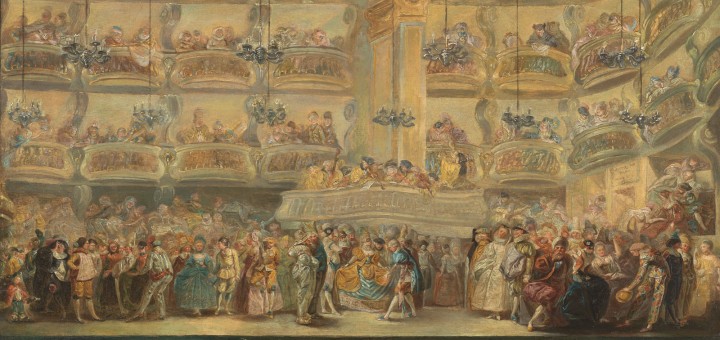
Luis Paret y Alcázar, Masquerade, detail, ca. 1767, oil on panel
(Madrid, Museo Nacional del Prado)
◊ ◊ ◊ ◊ ◊
The next section starts with a small group of early drawings by Paret from the collection of the Prado and the Biblioteca Nacional de España. They reveal the artist’s originality in his inventive and versatile approach to the subjects and the modernity of his choices. Subjects include The Necromancer, The Glory of Anacreon, and Roman Military Trophy. The principal work in this room is one of Paret’s earliest known paintings, Masquerade of 1767 from the Prado’s collection. It once again reveals Paret’s modernity in the context of his time, as an artist who from the outset was able to respond to the new demand for images of society in the public and private space and which reflected the varied fashions and customs of the different social classes. Displayed here are other small-format cabinet paintings on innovative subjects in the context of Spanish art of this period, such as Scene of a Boudoir (previously Play Rehearsal) from the Prado; The Letter from the Musée Goya in Castres; Geniani’s Shop from the Museo Lázaro Galdiano; and The Puerta del Sol from the Museo Nacional de Bellas Artes de Cuba. In addition, paintings on rarely depicted episodes from life at the Spanish court, such as The Royal Couples and Charles III dining before the Court (both in the Prado), offer a panoramic view of different facets of contemporary society and also demonstrate the success Paret enjoyed between 1766 and 1775, the year he was exiled.

Luis Paret y Alcázar, Zebra, 1774, Black pencil, gouache brush and opaque pigment gouache (Madrid: Museo Nacional del Prado).
The third section presents one of the artist’s exquisite coloured drawings of birds alongside Zebra from the Prado’s collection and a private collection respectively, works executed by Paret for the Natural History Cabinet of the Infante don Luis, Charles III’s brother, who appointed Paret his painter in 1774. They reveal the artist’s ability to combine an almost scientific depiction of his subjects with landscape settings of great subtlety and refined beauty.
The fourth section focuses on Paret’s few known portraits, which are notable for their exquisite technique and personal, intimate nature. They also mark the transition between the artist’s Madrid phase and his years in Bilbao. The four known Self-portraits of around 1770–75 to 1780 reflect the painter’s powerful, self-confident personality but also his different states of mind. This is evident during his exile in Puerto Rico when he portrayed himself not just as a jíbaro or local peasant in 1776 but also in the melancholy Self-portrait in the Studio of 1777 which Paret sent to a trusted individual in Madrid, as the inscription detected by the recent X-radiograph reveals. Shown alongside these works are other portraits such as those of the artist’s wife and their daughters, compositions enhanced by complex floral ornamentation; a portrait of a typical Enlightenment gentleman (on loan from the Real Academia de Bellas Artes de San Fernando); and that of Antonio Sancha from the Biblioteca Nacional de España. Finally, there are compositions on the theme of motherhood, such as the small painting of The Virgin and Child from the Abelló Collection, The Orange Seller from Patrimonio Nacional, and the two floral bouquets from the Prado. Flowers were an enormously important motif in Paret’s work and one that reveals the virtuosity characteristic of all the paintings in this section.
The fifth section opens with a painting of The Circumspection of Diogenes which Paret sent from Bilbao in 1780 to the Real Academia de Bellas Artes de San Fernando and which led to his nomination as an Academician of Merit. His subsequent enhanced reputation is evident in the large-format religious compositions that he executed in Bilbao, such as The Invention of the True Cross painted for the Gortázar family and their family chapel (private collection) and The Martyrdom of Saint Lucy for the parish church of Santa María in Larrabezúa (now in the Museo Diocesano de Arte Sacro in Bilbao). These exceptionally exquisite paintings of great technical and compositional delicacy demonstrate Paret’s importance in the context of 18th-century Spanish art. Their presence in the exhibition makes it possible to appreciate his mastery in devising subjects that were unusual in the context of the day and his ability to create scenes of a monumental nature with extremely dynamic figures. Furthermore, they reveal the artist’s extensive knowledge of classical sculpture and the work of the Old Masters such as Rubens, as well as his exceptional manner of combining grandiose, classical beauty with lighter Rococo resources such as a markedly pastel palette. The juxtaposition of these works with small-format paintings and drawings on religious subjects—including The Apparition of Saint Michael to Charles VIII of France and Saint Francis of Paula (private collection), a unique subject in Spanish art—and with a number of his designs for religious monuments in Bilbao further reveals Paret’s multifaceted nature in this pictorial genre.

Luis Paret y Alcázar, Self-portrait Attired in Blue, ca. 1780, oil on paper affixed to canvas (Colección Abelló).
The next section is devoted to paintings and drawings on bucolic subjects and classical, erotic ones produced for private clients. These reveal Paret’s enormously original powers of invention, including The Triumph of Love over War from the Museo de Bellas Artes de Bilbao and the drawings of The Eclogue from the Prado, which are shown together with paintings on similar subjects from real life, albeit with a certain critical element, such as Gallant Scene of High Society and Gallant Scene of Low Life (private collection), Saying the Rosary from Patrimonio Nacional and the drawing of The Procuress and the Lovers from the Prado. The small painting of Young Woman asleep in a Hammock from the Prado establishes a connection between the two worlds through references to classical sculpture and modern society, the latter including the exoticism of the Caribbean.
The seventh section features eight of the nine currently known views of the Basque Country painted by Paret, executed for the Prince of Asturias, for private clients and as commissions for Charles III. These are now divided between museums in Spain, France, and the UK. The group constitutes a striking survey of landscape and also of the variety of society of the day, its different working and leisure activities and the region’s ports and coastline. These notably complex paintings in both technical and compositional terms are among Paret’s most important creations from his time in Bilbao. Also on display are the two fine drawings of ports in the Basque country, loaned from private collections, which reveal the artist’s masterly ability in the use of different media, such as black chalk, pen, and brush, which he employed to capture the characteristics of these landscapes and the brilliant effects of light observed in nature.
The eighth section focuses on two oils on canvas executed by the artist for the chapel of San Juan del Ramo in the church of Santa María de la Asunción in Viana: The Annunciation to Zacharias and The Visitation of the Virgin to Saint Elizabeth. In these striking paintings, which are among the last produced by Paret during his Bilbao period, the remarkable quality and technical and compositional complexity achieved by the artist reaches its peak. Furthermore, they reveal the original way in which he made use of models to add liveliness and expressivity to his figures and scenes, as well as the excellent technique that he employed to describe all the details in his works with enormous naturalness and variety. Also evident is the way in which Paret applied a modern, art historian’s eye to make use of the Baroque and Neo-classical styles in order to emphasise the era of the scenes depicted. Finally, this section includes a group of excellent preparatory drawings for one of these paintings (private collection) and for the mural decoration of this chapel (Museo del Prado).

Luis Paret y Alcázar, The Oath of Allegiance to Ferdinand VII as Prince of Asturias, 1791, oil on canvas, 237 × 159 cm (Madrid: Museo Nacional del Prado).
Following his return to Madrid in 1789, in 1792 Paret was appointed Vice-secretary of the Academia de San Fernando and Secretary to its Architectural Committee, receiving few commissions for paintings but producing numerous drawings of beautiful scenes and figures for book illustrations and other projects. The paintings from the end of the artist’s career are displayed in this ninth section of the exhibition. They include three allegories of one of the provinces of Spain, works of enormous classical beauty which are the only ones now known from a series of ten paintings executed in 1789 for the headquarters of the Five Major Guilds in Madrid (private collection and Museo del Prado). The one in the Prado was only rediscovered five years ago and was acquired for the Museum. Finally, visitors will be able to appreciate an example of Paret’s creative process through the painting of The Oath of Allegiance to don Fernando as Prince of Asturias, its remarkable preparatory drawing in the Louvre, two preliminary drawings of details for that work (Biblioteca Nacional), and an infrared reflectograph that reveals an excellent underdrawing. Other equally important examples are shown in a video.
The exhibition closes with an unfinished painting of The Botanical Garden from the Paseo del Prado. It depicts the entrance to the garden, located close to the Museo del Prado.
This extremely comprehensive survey of Paret’s career furthers an analysis of his approach and techniques while promoting his recognition as the most important Spanish artist of the 18th century alongside Goya.
The exhibition is accompanied by a catalogue by the curator Gudrun Maruer with texts written by her, by other specialists, and by the technical staff of the Museo del Prado and the Museo de Bellas Artes de Bilbao.
Gudrun Maurer, ed., Paret (Madrid: Prado, 2022), 288 pages, €28.
Exhibition | New London County Quilts & Bed Covers, 1750–1825
The exhibition closed earlier this month, but there is an excellent virtual tour still available; from the Florence Griswold Museum:
New London County Quilts & Bed Covers, 1750–1825
Florence Griswold Museum, Old Lyme, CT, 12 February — 1 May 2022
Curated by Lynne Bassett

Attributed to Jerusha Foote Johnson (1755–1831), Colchester, bed rug, 1782, wool (Collection of Rick and Susan Copeland).
The domestic textiles produced in New London County from the mid-18th to early 19th century stand out today as masterpieces of American needle craft. Curated by independent scholar Lynne Z. Bassett, New London County Quilts & Bed Covers, 1750–1825 examines the artistic excellence of these pieces within the context of design inspiration drawn from an array of transatlantic sources and explores the question of how the county fostered such exceptional work.
Quilted petticoats with maritime motifs, bold geometric patterns on bed rugs, sophisticated feathers and fruit stitched on elegant whitework quilts, and patriotic appliqués reveal the range and accomplishment of New London County women. The exhibition unites for the first time examples by these makers, whose names are only sometimes known, but whose textiles survive as evidence of the network of connections between teachers, students, and family members.
Exhibition | Fashioning Masculinities: The Art of Menswear
Press release for the exhibition now on view at the V&A:
Fashioning Masculinities: The Art of Menswear
Victoria & Albert Museum, London, 19 March — 6 November 2022
Curated by Claire Wilcox and Rosalind McKever
Fashioning Masculinities: The Art of Menswear is the first major V&A exhibition to celebrate the power, artistry, and diversity of masculine attire and appearance. The show traces how menswear has been fashioned and refashioned over the centuries, and how designers, tailors, and artists—together with their clients and sitters—have constructed and performed masculinity, and unpicked it at the seams.
 Fashioning Masculinities will present around 100 looks and 100 artworks, displayed thematically across three galleries. Contemporary looks by legendary designers and rising stars will be displayed alongside historical treasures from the V&A’s collections and landmark loans: classical sculptures, Renaissance paintings, iconic photographs, and powerful film and performance. From looks by Harris Reed, Gucci, Grace Wales Bonner and Raf Simons, to paintings by Sofonisba Anguissola and Joshua Reynolds, contemporary artworks by Robert Longo and Omar Victor Diop, to an extract from an all-male dance performance by Matthew Bourne’s New Adventures, the exhibition will showcase the variety of possible masculinities across the centuries from the Renaissance to the global contemporary. Outfits worn by familiar faces will be interspersed throughout, from Harry Styles, Billy Porter and Sam Smith, to David Bowie and Marlene Dietrich. Innovative creations and diverse representations will highlight and celebrate the multiplicities of masculine sartorial self-expression, dressing beyond the binary.
Claire Wilcox and Rosalind McKever, co-curators of Fashioning Masculinities: The Art of Menswear, said: “Masculine fashion is enjoying a period of unprecedented creativity. It has long been a powerful mechanism for encouraging conformity or expressing individuality. Rather than a linear or definitive history, this is a journey across time and gender. The exhibition will bring together historical and contemporary looks with art that reveals how masculinity has been performed. This will be a celebration of the masculine wardrobe, and everyone is invited to join in.”
Fashioning Masculinities opens with a Craig Green SS2021 ensemble of a deconstructed suit, alluding to the construction and deconstruction of both the masculine body and conventions of masculinity, a central theme throughout the show. The three main galleries—’Undressed’, ‘Overdressed’, and ‘Redressed’—follow, with the exhibition design by JA Projects. ‘Undressed’ explores the male body and underwear in a utopian dreamscape, whilst ‘Overdressed’ takes visitors into the elite masculine wardrobe in a sumptuous, immersive space with courtly grandeur, featuring oversized silhouettes, abundant colour, and lavish materials. The third section, ‘Redressed’, explores the construction and dissolution of the suit, with the exhibition design conveying the idea of an urban reawakening.
‘Undressed’ explores the male body and underwear, looking at how classical European ideals of masculinity have been perpetuated and challenged over the centuries. Plaster casts of the Apollo Belvedere and the Farnese Hermes—which highlight a tradition of depicting idealised male bodies draped in textiles that reveal more than they conceal—are juxtaposed with modern and contemporary representations of the body, from prints and photography by David Hockney, Lionel Wendt, Zanele Muholi, and Isaac Julien, to a Calvin Klein advertisement.
Also on display is a film of Matthew Bourne’s Spitfire (1988) performed by New Adventures dancers, which takes place in the world of men’s underwear advertising and mail order catalogue photography, whilst contemporary ensembles highlight how designers are appropriating sheer fabrics to create ensembles, alluding to a new honesty about menswear. Fashion’s fascination with the body has seen it support changing masculine ideals from evoking classical drapery, to sculpting flesh—as seen in garments by Jean-Paul Gaultier and A- COLD-WALL*—to celebrating body diversity. This is exemplified in the exhibition by excerpts of Arrested Movement by Anthony Patrick Manieri, an inclusive portrait series and awareness initiative celebrating and promoting positive body image. ‘Undressed’ ends with Auguste Rodin’s Age of Bronze sculpture, and Tiresias, a performance by Cassils, in which the artist melts a neoclassical torso carved in ice with their body heat.

Installation view, V&A.
◊ ◊ ◊ ◊ ◊
The second gallery, ‘Overdressed’, explores the elite masculine wardrobe, epitomised by oversized silhouettes, lavish materials like silks and velvet in daring colours, and symbolic patterns to express status, wealth, and individuality. Drawing synergies across the centuries, the section will feature armoured breastplates to silky smoking suits, sweeping capes to ribbons and lace, including Grinling Gibbons’ wooden carving imitating a Venetian needlepoint lace cravat, displayed alongside real lace, and a Dolce & Gabbana cape juxtaposed with a Sofonisba Anguissola painting. The section also includes grooming, with makeup and shaving equipment.
Historically, menswear was full of pattern and colour, and a section on scarlet and pink highlights the return of this masculine colour to popularity. Aristocratic sitters in oil paintings by Joshua Reynolds and Jean-Baptiste Perronneau are displayed alongside pink ensembles by Harris Reed and Grace Wales Bonner among others. Nearby, a custom Randi Rahm ensemble—a suit and full-length embroidered cloak with a hot pink lining—worn by Billy Porter at the Golden Globes in 2019, complement the selection. Internationally traded textiles, imported silks, and floral patterns reflect their wearers relationship to the world. Through the lens of contemporary fashion, from Kim Jones for Fendi and Alessandro Michele for Gucci to Rahemur Rahman, Ahluwalia and Orange Culture, ‘Overdressed’ shows how historic ideas begin to shift, with a full rainbow of masculine outfits on display.
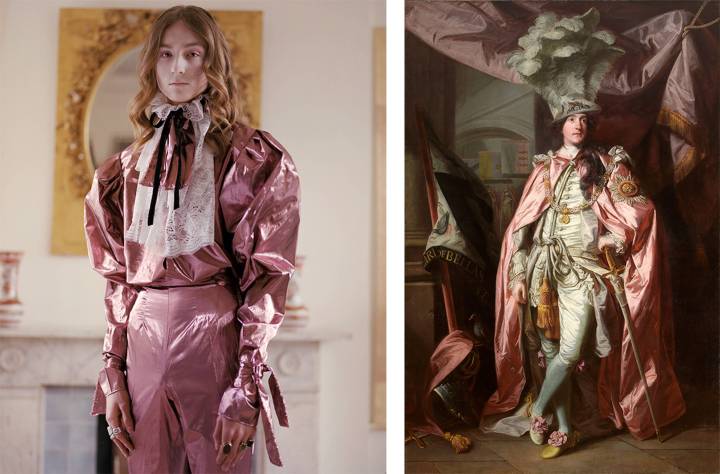
Left: Harris Reed Fluid Romanticism 001 (Courtesy Harris Reed; photo by Giovanni Corabi). Right: Joshua Reynolds, Portrait of Charles Coote, 1st Earl of Bellamont (1738–1800), in Robes of the Order of the Bath, 1773–74 (Dublin: National Gallery of Ireland).
◊ ◊ ◊ ◊ ◊
The third gallery, ‘Redressed’, pieces together the modern masculine uniform of the suit, from Beau Brummell to the contemporary runway. ‘Redressed’ opens with a reflection on English country tailoring and the origins of the suit—with historic garments from the V&A collection shown alongside contemporary reimaginings, including a kilt by Nicholas Daley—before exploring how military attire influenced civilian dress.
In the twentieth century an abundance of mass-produced suits bred creativity as Mods, Teddy Boys, and all manner of subcultures looked to define their styles through tailoring, explored in the exhibition through garments and photography. A section on leather shows how designers like Tom Ford for Gucci and Donatella Versace took their interest in leather to a new place, whilst a series of frock coats from the mid-nineteenth century to the present day include examples by Prada, Alexander McQueen, and Raf Simons. ‘Redressed’ also includes paintings as well as extensive photography showing changing styles and attitudes, from Oscar Wilde, Claude Cahun, and Cecil Beaton to The Beatles and Sam Smith.
Robert Longo’s 1981 drawing from the series Men in the Cities introduces the final part of the section about the dissolving of the suit. A new wave of fashion designers from Rick Owens to JW Anderson to Comme des Garçons to Lesiba Mabitsela are slashing away at conventions, both for menswear and masculinity.
Claire Wilcox and Rosalind McKever, eds., Fashioning Masculinities: The Art of Menswear (London: V&A Publishing, 2022), 272 pages, ISBN: 978-1838510114, $60.
Catalogue cover image: Jean-Baptiste Belley, by Omar Victor Diop, 2014, pigment inkjet print on Harman by Hahnemühle paper (Courtesy MAGNIN-A Gallery, Paris © Omar Victor Diop).
Sneak Preview | Seven Works from the Van Caloen Collection
On view this week in Bruges:
Seven Works from the Van Caloen Collection
Groeninge Museum, Bruges, 17–22 May 2022

François Boucher, Young Woman with a Lace Cap, 24 × 18 cm (Musea Brugge, 2022.GRO0326.II).
On 17 May, the Jean van Caloen Foundation transferred the administration of 1,920 drawing masterpieces and 25 sketchbooks by world famous artists like Michelangelo, Jordaens, and Boucher to the Bruges Print Room. To celebrate this exceptional transfer, we are exhibiting seven top works from the collection during an exclusive sneak preview in the Groeninge Museum together with the Caloen Foundation.
Discover The Priest’s Blessing by Jacques Jordaens and a fine depiction of a young woman by the French master François Boucher. The highlight of the collection is the magnificent Stoning of St. Stephen by Michelangelo Buonarotti. The only drawing of the celebrated Italian Renaissance artist currently held in Belgium, it is a remarkable piece, not least because it is a composition study: a drawing in which Michelangelo set down some of his ideas on paper. Drawings of this kind were used by artists as preparatory sketches for larger final works, such as paintings or sculptures.
The works will be on display from 17 to 22 May, after which they will be given a place with all the collection’s other works in the Bruges Print Room. Once there, they will be registered and digitalized in high resolution, before being made freely available to the public via Musea Brugge’s digital collection database. We will also thoroughly investigate and study the drawings. This research will result in the publication of a scientific catalogue for the collection and an exhibition of works from the collection in the new exhibition space at BRUSK.
Exhibition | Les Planches de l’Encyclopédie
Opening this month at the Mazarin Library in Paris:
Les Planches de l’Encyclopédie: Sources et Polémiques
Bibliothèque Mazarine, Paris, 21 May – 3 September 2022
Curated by Emmanuel Boussuge with Florine Lévecque-Stankiewicz and Marianne Besseyre
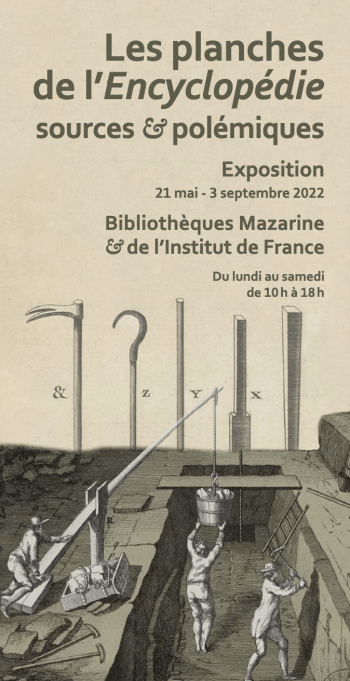 Entreprise emblématique des Lumières, l’Encyclopédie (1751–1772) doit une bonne partie de son formidable écho à sa composante technologique, illustrée à une échelle jusque-là inconnue. Les 11 volumes de planches, publiés à partir de 1761, proposaient la plus vaste collection d’images relatives aux « arts mécaniques » jamais rassemblée. Diderot entendait bien mettre en valeur cette part souvent méprisée de l’activité humaine, qu’il fallait envisager « comme la branche la plus importante de la vraie Philosophie ». Il dut renverser les préjugés, rassembler une vaste documentation complétée par de nouvelles enquêtes, s’entourer de collaborateurs aptes à dominer l’étendue des domaines embrassés, se coordonner avec des dessinateurs experts, et travailler en bonne intelligence avec les artisans du livre, notamment graveurs et imprimeurs.
Mais l’Encyclopédie n’était pas la première grande enquête sur les arts et métiers. Sous l’égide de l’Académie des Sciences, un projet de description complète avait été lancé dès 1693. Visant cependant un public restreint, il était en voie d’abandon dans les années 1740. De nombreuses gravures avaient été exécutées depuis les années 1690, mais elles restaient inexploitées. Diderot retrouva leur trace en 1748 et s’en servit de modèle général comme de sources pour la première mouture des planches de l’Encyclopédie. Cet emprunt fournit matière à scandale en novembre 1759. Ce fut « l’affaire Patte », qui touchait l’Encyclopédie alors qu’elle était déstabilisée par l’interdiction du Parlement, la condamnation du Conseil du roi et sa mise à l’index. Les encyclopédistes, avec le soutien de Malesherbes, surent une nouvelle fois se rétablir, mais il leur fallut réorganiser l’ensemble des planches, qui tripla presque de volume.
Filiations cachées, réemplois ou démarquages ostensibles, retombées polémiques croisées… la relation entre les planches de l’Encyclopédie et celles de la Description des Arts et Métiers de l’Académie des sciences constitue un vaste territoire d’investigation.
Commissariat: Emmanuel Boussuge, chercheur sur contrat rattaché (CELLF – Sorbonne Université-CNRS), avec la collaboration de Florine Lévecque-Stankiewicz (Mazarine) et de Marianne Besseyre (bibl. de l’Institut)
Autour de l’exposition: Les planches de l’Encyclopédie en lumière: Mises en perspective et recherches sur le Recueil de planches (1762–1772) de l’Encyclopédie de Diderot et D’Alembert (Colloque international, 19–21 mai 2022)
Exhibition | The Belvedere in Vienna
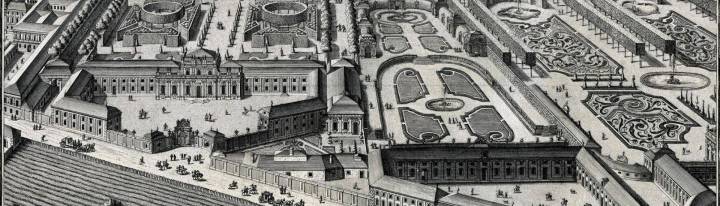
Salomon Kleiner, View of the Gardens of The Belvedere, detail, ca. 1731
(Vienna: Bibliothek des Belvedere)
◊ ◊ ◊ ◊ ◊
Opening in December at The Belvedere:
The Belvedere in Vienna: 300 Years a Place of Art
Lower Belvedere, Vienna, 2 December 2022 — 7 January 2024
It took more than a decade to build the summer residence of Vienna’s most famous general, Prince Eugene of Savoy. In 1723, construction of the upper palace drew to a close and the Belvedere estate was finally completed. The 300th anniversary of this event presents the perfect occasion for the museum to reflect on its history. Both as a museum and a landmark building, the Belvedere has stood for power and prestige throughout the ages, serving as the setting for courtly festivities, at times as a royal residence, and as the venue for the signing of the Austrian State Treaty in 1955. In an extensive exhibition, the museum will examine the building’s changing roles.
The show will mark the Belvedere’s 300th-anniversary year of 2023. Presented as a homage to an institution dedicated to the arts throughout the centuries, the exhibition casts a critical eye on historical developments and institutional changes. It illustrates the abundance and diversity of the museum, highlighting the collection’s evolution and the role of the holdings as symbols of power.
In 1777 when Marie Theresa opened the Imperial Picture Gallery in the Upper Belvedere to the public, she made a groundbreaking decision heralding a new age of enlightened absolutism: the collections would no longer be limited to courtly representation but would also serve to educate the general public. The Belvedere thrived during the succeeding centuries as both a place for the arts and a scene for glamorous events such as Marie Antoinette’s wedding. It was also the residence of the heir to the throne Franz Ferdinand, and the site where the Austrian State Treaty was signed. All of which is mirrored in its building and collection history.
The importance of the Belvedere as an art nexus over the centuries is examined in detail based on the rich holdings of the collection: they reflect the institution’s changing thematic concerns. The circulation and transfer of objects—additions and disposals of works from the collection due to museum reforms and barter transactions—provide further clues. This is particularly evident during the period from 1938 to 1945, when the museum was an agent and beneficiary of the Nazi state’s looting and cultural exploitation policy. Numerous works acquired after 1933 have been returned to the rightful heirs of the former owners since the enactment of the Austrian Art Restitution Law in 1998—the most notable example being Klimt’s Woman in Gold in 2006.
The Belvedere gallery and its collections reopened after World War II, once the damaged buildings and gardens were restored to their former glory. In 1955, the Austrian State Treaty was signed in the Upper Belvedere and presented to the public from the palace’s balcony.
The exhibition covers the period from the completion of the upper palace in 1723 to the present day, and illustrates the Belvedere’s role as a museum that honors the past, reflects on the present, and looks toward the future.










leave a comment