Exhibition | Masterpieces from Buckingham Palace

Installation of the exhibition Masterpieces from Buckingham Palace, at The Queen’s Gallery In London.
◊ ◊ ◊ ◊ ◊
Now on view at The Queen’s Gallery:
Masterpieces from Buckingham Palace
The Queen’s Gallery, Buckingham Palace, London, 17 May 2021 — 13 February 2022
Curated by Desmond Shawe-Taylor and Isabella Manning
Masterpieces from the Royal Collection have been displayed in Buckingham Palace since the residence was acquired by George III and Queen Charlotte in 1762. The painting displays were reinvented during the reign of their son, George IV, who commissioned the architect John Nash to renovate the palace in the 1820s. A Picture Gallery was included to display the monarch’s exceptional collection of paintings. Since then, the Picture Gallery has remained the focus for some of the most treasured Italian, Dutch, and Flemish paintings from the Royal Collection.
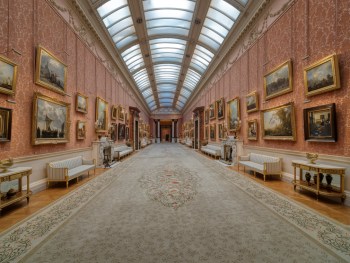
The Picture Gallery at Buckingham Palace (typically open to visitors only during the summer) is currently being renovated–creating an opportunity to display the paintings normally installed there in other contexts.
Palace displays are often imbued with dynastic meaning; the Picture Gallery was one of the few spaces intended for the enjoyment of art, pure and simple. It is in this same spirit that we have mounted this exhibition: for the first time the paintings are displayed together in modern gallery conditions, allowing us to look at them afresh.
In general these paintings are securely dated and attributed; mostly we know which monarch bought them. We are providing this information here, but we are also asking a different, more subjective question—what makes them important? What do they have to offer? In the exhibition catalogue we have suggested qualities that were valued by the makers of these works and can still be appreciated today: the imitation of nature; the sensuous use of materials; the creation of beautiful design; and the ability to express human emotion. But are we missing something? We hope that visitors will make up their own minds about what there is to enjoy in these paintings and find reasons to believe that they are still worth exploring.
Dou to Vermeer
The paintings in this room were all created in the Low Countries between 1630 and 1680, the heyday of the so-called Dutch Golden Age. They are modest in scale, the majority scenes of everyday life, with figures in landscapes or in homes, taverns and shops. These artists didn’t set up their easels in the market place; they worked from drawings, memory and imagination, but they depicted the familiar everyday world around them. The people they painted were of the same kind that bought their paintings: we can see examples in simple ebony frames on the walls of the interiors of de Hooch and Vermeer.
All but two of these paintings were acquired by George IV to hang in the sumptuous interiors of Carlton House, his London residence when Prince of Wales. Like their original purchasers, he admired them for their comedy, their brilliant technique and their truth to life. They continue to fascinate through their minute detail, tactile surfaces and ability to suggest spaces filled with light and air.

Canaletto, The Piazza Looking North-West with the Narthex of San Marco, ca. 1723–24, oil on canvas, 172 × 134 cm (London: Royal Collectin Trust, RCIN 401037). The painting is one of a set of six views of the Piazza San Marco and the Piazzetta.
Rubens, Rembrandt, and Van Dyck
The artists in this room all come from the Low Countries, as in the previous section. There are some comic scenes of everyday life, but the majority of works belong to the more prestigious branches of art—narrative painting, commissioned portraits, and ambitious landscapes with a symbolic or religious meaning.
This room is dominated by three artists of very different character: Rubens, a diplomat and land-owner; van Dyck, a courtier; and Rembrandt, a professional serving the merchants of Amsterdam. In other ways they are similar, especially in their enthusiasm for the type of Venetian painting that can be seen in the next section.
Painting in Italy, 1510–1740
The paintings in this room were created in Italy, in various artistic centres and over a period of two hundred years. Bringing together this great range of painting evokes something of the first displays at Buckingham Palace, during the reign of George III.
Several strands of Italian art are here on show. There are sober male portraits, often painted with a bare minimum of detail and colour range, but conveying great psychological intensity. There are ideal female figures, derived from the study of antique sculpture, their beauty impassive however dramatic the narrative. There are expressive landscapes, ranging from a cataclysmic storm to the unruffled stillness of a sunset. Then there are Canaletto’s boldly expressive views of Venice, where the imposing monuments of the city are spiced with a hint of picturesque shabbiness.
◊ ◊ ◊ ◊ ◊
In the United States, the catalogue is distributed by The University of Chicago Press:
Desmond Shawe-Taylor and Isabella Manning, Masterpieces from Buckingham Palace (London: Royal Collection Trust, 2021), 160 pages, ISBN: 978-1909741737, £20 / $25.
 In this beautifully designed book, Desmond Shawe-Taylor, Surveyor of The Queen’s Pictures, and Assistant Curator of Paintings, Isabella Manning, examine 65 of the most celebrated paintings from the Picture Gallery, which sits at the heart of Buckingham Palace. With masterpieces by such artists as Vermeer, Rembrandt, Van Dyck, Rubens, Titian, Jan Steen, Claude, and Canaletto, this publication offers new insights into these world-famous works of art. The authors encourage readers to look at the works in a new way and to consider how Claude paints a sky; how Rubens models the landscape through his use of color; and how Titian uses contrast to add gravitas to a portrait. Rather than re-treading the old boards of provenance and attribution, the authors seek to engage with different, perhaps riskier and more subjective, questions: asking not when were they painted and by whom, but why should we concern ourselves with them? A short introduction gives an account of the creation of the Picture Gallery and tells the story of the monarchs who curated this extraordinary collection of paintings and how the works entered the Collection.
C O N T E N T S
A History of Old Master Paintings at Buckingham Palace
Looking at the Old Masters
The Pictures
Further Reading
Index
◊ ◊ ◊ ◊ ◊
Desmond Shawe-Taylor’s very productive fifteen-year tenure as Surveyor of the Queen’s Pictures came to an end in December 2020, as reported by the BBC, in response to £64m of lost income related to the pandemic. Indeed, the historic Surveyor position—first filled in 1625 during the reign of Charles I—is for now “lost and held in abeyance.” Royal Collection Director, Tim Knox, has taken on “overall responsibility for the curatorial sections, supported by the Deputy Surveyors of Pictures and Works of Art.”
Exhibition | Canvas & Silk: Historic Fashion
From the press release (10 June 2021) for the exhibition:
Canvas & Silk: Historic Fashion from Madrid’s Museo del Traje
The Meadows Museum, SMU, Dallas, 19 September 2021 — 9 January 2022
Curated by Amanda Dotseth and Elvira González
The Meadows Museum, SMU, has announced a major exhibition of Spanish dress and fashion that will pair paintings from the Meadows’s collection with historic dress and accessories from the Museo del Traje, Centro de Investigación del Patrimonio Etnológico in Madrid. Canvas & Silk: Historic Fashion from Madrid’s Museo del Traje marks the first major collaboration between this important Spanish institution and an American museum and will include approximately 40 works from the Meadows alongside examples of dress and accessories from the Museo del Traje (Spanish National Museum for Fashion). Displayed together, the works in the exhibition not only tell the story of how fashion trends in Spain changed over four hundred years, but also reveal how elements of a country’s history—such as its involvement with global trade or the formation of a national identity—are reflected in its dress.
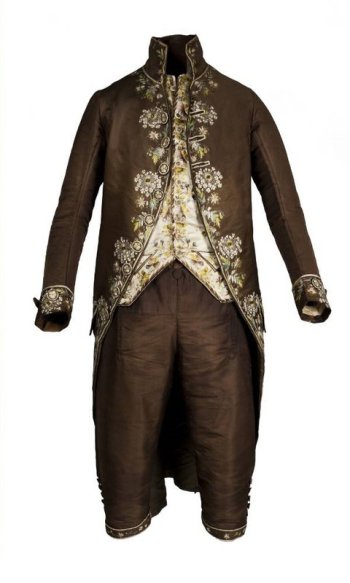
Traje a ‘la francesca’ (calzón, chupa, casaca) / French Costume (Breeches, Vest, Dress Coat), ca. 1795–1800; silk, linen, and cotton (Madrid: Museo del Traje, Centro de Investigación del Patrimonio Etnológico; Calzón, CE000663; chupa, CE000664; casaca, CE000665; photo by Gonzalo Cases Ortega).
Canvas & Silk will be on view at the Meadows from 19 September 2021 until 9 January 2022. Concurrently, the Meadows will also present Image & Identity: Mexican Fashion in the Modern Period, an investigation into Mexican dress spanning from Mexican Independence to modern times through photographs and prints from the collections of the Meadows Museum and SMU’s DeGolyer Library.
“We are thrilled to have the opportunity to gain further insight into the Meadows’s collection of Spanish art through its exhibition with loans from Spain’s premier collection of historic dress,” said Amanda W. Dotseth, curator at the Meadows Museum and co-curator of the exhibition in collaboration with Elvira González of the Museo del Traje. “This exhibition makes it possible to tell a more nuanced story about Spanish society through the presentation of historic paintings with contemporaneous examples of the garments depicted therein. We are as never before able to explore the complex relationships between representation and reality, between image and artifact. Spanish fashion has long been a point of interest for the Meadows Museum, whether in the form of past exhibitions—such Balenciaga and His Legacy: Haute Couture from the Texas Fashion Collection in 2007—or as portrayed in the collection’s prints, paintings, and sculptures. We look forward to continuing our study and display of Spanish fashion with this unprecedented collaboration with the Museo del Traje.”
Canvas & Silk will be divided into themes that elucidate various trends in the history of European fashion in general and Spanish dress in particular over the past five hundred years. These include ‘Precious Things’, featuring accessories like jewelry and combs made from precious metals and other rare materials such as coral; ‘Traditional Dress’ with examples of garments and ensembles that are typically identified with Spain, such as a traje de luces (the suit typically worn by bullfighters) and mantón de Manila (traditional embroidered silk shawls historically traded through Manila); and ‘Stepping Out’ demonstrating the importance of what one wore when presenting themselves in public. Highlights of pairings combining paintings from the Meadows’s collection and historic dress from the Museo del Traje include Ignacio Zuloaga’s The Bullfighter ‘El Segovianito’ (1912) accompanied by a traje de luces of the same color; Zuloaga’s Portrait of the Duchess of Arión, Marchioness of Bay (1918) displayed alongside a mantón de Manila similar to the one the duchess is holding; and Joan Miró’s Queen Louise of Prussia (1929) paired with a vibrantly hand-painted dress and shoes by twentieth-century fashion designer Manuel Piña.
“By pairing the Museo del Traje’s collection with that of the Meadows’s, we are bringing the dress, accessories, and other material objects to life, enabling viewers to see the contexts in which such articles were worn,” said Elvira González, curator of the historic apparel collection at the Museo del Traje. “Viewed together, the clothing allows for a deeper understanding of the painting; for example, the presence of the mantón de Manila (embroidered Manila silk shawl) in Ignacio Zuloaga y Zabaleta’s painting Portrait of the Duchess of Arión, Marchioness of Bay (1918) speaks to the social position of the woman depicted. Not only will our collection be seen by audiences in the U.S. for the first time, but it will also be displayed in a completely new light. We’re excited to see what kind of scholarship and new ideas might be generated by presenting these works in a new environment and alongside these paintings and drawings.”
The accompanying exhibition catalogue will contain an essay co-authored by Dotseth and González that illuminates themes linking the garments, accessories, and corresponding works in the Meadows collection. The publication will feature new photography of key objects by Jesús Madriñán.
Canvas & Silk will be accompanied by a focused exhibition in the museum’s first-floor galleries titled Image & Identity: Mexican Fashion in the Modern Period, curated by Akemi Luisa Herráez Vossbrink, the Center for Spain in America (CSA) Curatorial Fellow at the Meadows Museum. Featuring photographs, prints, books, and gouaches from the 19th and 20th centuries, this exhibition will explore Mexican fashion through images of everyday scenes, festivities, regional types, and occupations. Building on a theme developed in Canvas & Silk, Image & Identity will also show how national identity formation is reflected in fashion and is often accompanied by a resurgence in the popularity of indigenous dress. Works in Image & Identity are drawn from the collections of the Meadows Museum and SMU’s DeGolyer Library, named after Everette L. DeGolyer, Sr. who, with his son, collected maps, books, manuscripts, and photographs related to Mexican exploration and history. Artists featured in the exhibition include Alfred Briquet, Carlos Mérida, Diego Rivera, José Clemente Orozco, Jerry Bywaters, Paul Strand, and Manuel Álvarez Bravo.
Huntington Commissions Wiley to Paint New, ‘Blue-Boy’ Inspired Work

Thomas Kehinde Wiley, A Portrait of a Young Gentleman, 2021, oil on linen, 71 × 49 inches, © Kehinde Wiley (San Marino: Collection of The Huntington Library, Art Museum, and Botanical Gardens, commissioned through Roberts Projects, Los Angeles). Installation photo by Joshua White.
◊ ◊ ◊ ◊ ◊
Press release (9 September 2021) from The Huntington:
Kehinde Wiley, A Portrait of a Young Gentleman
San Marino, The Huntington Library, Art Museum, and Botanical Gardens, 2 October 2021 — 3 January 2022
The Huntington Library, Art Museum, and Botanical Gardens announced today that it has commissioned the renowned artist Kehinde Wiley to create a new work inspired by Thomas Gainsborough’s The Blue Boy (ca. 1770). Wiley’s A Portrait of a Young Gentleman (also the original title of the Gainsborough painting) will be a large-scale portrait in the Grand Manner style that will be added to The Huntington’s permanent collection. The new painting will be on view from 2 October 2021 through 3 January 2022, in The Huntington’s Thornton Portrait Gallery, opposite the institution’s iconic and recently restored Blue Boy. The acquisition of the Wiley portrait celebrates the 100th anniversary of the purchase of the Gainsborough painting by Henry and Arabella Huntington, the founders of the institution.
 “Just as scholars come to The Huntington to study and reinterpret our significant collections, with this commission we are delighted that Kehinde Wiley will reenvision our iconic work, The Blue Boy, and Grand Manner portraiture in a powerful way,” said Huntington President Karen R. Lawrence. “Across the breadth of our library, art, and botanical collections, we are inviting perspectives that alter the way we see tradition itself.”
Wiley has long talked about the role The Huntington played in his formative years as an artist growing up in Los Angeles. When he was young, his mother enrolled him in art classes at The Huntington, where he encountered a formidable collection of Grand Manner portraits—large-scale depictions of England’s 18th- and 19th-century noble class. The portraits made such an impression on Wiley that he would later incorporate their stylistic representations of wealth, glory, and power into his own artistic practice, focusing on the Black and brown bodies missing from the museums he visited.
“I loved The Huntington’s galleries; the paintings by Joshua Reynolds, Thomas Gainsborough, and John Constable were some of my favorites,” Wiley said. “I was taken by their imagery, their sheer spectacle, and, of course, their beauty. When I started painting, I started looking at their technical proficiency—the manipulation of paint, color, and composition. These portraits are hyperreal, with the detail on the face finely crafted, and the brushwork, the clothing, and the landscape fluid and playful. Since I felt somewhat removed from the imagery—personally and culturally—I took a scientific approach and had an aesthetic fascination with these paintings. That distance gave me a removed freedom. Later, I started thinking about issues of desire, objectification, and fantasy in portraiture and, of course, colonialism.”
For A Portrait of a Young Gentleman, Wiley has been painting in Senegal, where he has been living during the COVID-19 pandemic and where Black Rock Senegal, his artist-in-residence program, is headquartered.
Wiley, who earned a bachelor’s in fine arts from the San Francisco Art Institute in 1999 and a master’s in fine arts from Yale University in 2001, became famous for full-length depictions of everyday Black men and women in street clothes. The subjects are painted in classical poses against vibrant, patterned backgrounds, reminiscent of West African fabrics as well as wallpaper and textile designs by William Morris and Co. Wiley’s portraits have come to include depictions of a number of public figures, the most well known of which is the presidential portrait of Barack Obama, which coincidentally will be on view just a few miles from The Huntington at the Los Angeles County Museum of Art (LACMA) this fall, as part of a national tour.
“By adding a work by Kehinde Wiley to our collection, and offering it on view in our most lauded gallery of historic art, we are examining our shared history and beginning to curate our future,” said Christina Nielsen, Hannah and Russel Kully Director of the Art Museum at The Huntington. “I fully expect that Wiley’s portrait will speak to 21st-century audiences just as Thomas Gainsborough’s Blue Boy did to its original audience when it was first unveiled in 1770. We can’t wait to share this experience with visitors.”
In conjunction with the commission, The Huntington is developing plans for a related book.
In January 2022, The Blue Boy will travel to London for an exhibition at the National Gallery, opening 100 years to the day it departed from England for its new home in California.
◊ ◊ ◊ ◊ ◊
Note (added 2 October 2021) — The painting was unveiled on 2 October 2021. The posting has been updated to include the images.
Exhibition | The Jewish Past of Strawberry Hill
From the exhibition press release, via Art Daily,
The Unexpected Jewish Past of Strawberry Hill House
Online, starting in 2021
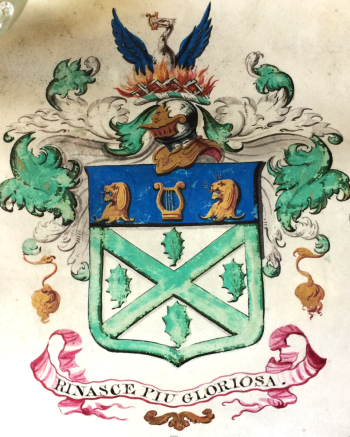
Grant of Arms to John Braham, detail, 1817, “Rinasce piu gloriosa” (It rises again more glorious).
As part of the events and activities celebrating the European Jewish Days of Culture festival, Strawberry Hill House has a free online exhibition exploring the lives of two of the historic west London villa’s former owners: Frances, Countess Waldegrave (1821–1879) and Herbert Stern, 1st Baron Michelham (1851–1919).
For many, Strawberry Hill House is synonymous with Horace Walpole, who built the neo-Gothic villa (1749–76), and filled it with his collections. However, following his death in 1797, the house was passed to a succession of owners, including the formidable Frances, Lady Waldegrave, the daughter of the internationally famous Jewish opera singer, John Braham, and later to Herbert Stern, the scion of a Jewish banking dynasty. As visitors will discover in Strawberry Hill’s comprehensive online exhibition, the House’s Jewish owners brought it back to the centre of the social and artistic milieu of their respective eras.
Through a variety of images and objects, online visitors can explore the aspects of Jewish culture and sociability that characterised the lives of Lady Waldegrave and the Stern Family. With themes including family ties, cosmopolitanism, art patronage, social status, religious identity, anti-Semitism, and different forms of philanthropy, the exhibition shines a spotlight onto the lives and activities of two very different chatelaines, whose time at Strawberry Hill has often been overshadowed by the presence of Walpole.
Visitors to Strawberry Hill House will be able to explore two objects on loan that complement the online exhibition: the Grant of Arms to John Braham (1817) and the Louis William Desanges painting Strawberry Hill: The Drawing Room (1865). Lady Waldegrave was very proud of the coat of arms granted to her father in 1817—a symbol of his success, and his patronage by important figures such as the Duke of Sussex. Appropriately enough for a poor orphan from the East End, who had sold pencils on the street as a young boy, he chose a phoenix rising from the ashes as his crest. The phoenix holds a lyre in its beak—a suitable symbol for a musician (the lyre was the crest of the Worshipful Company of Musicians), and the Grant is inscribed ‘Rinasce piu gloriosa’ (it rises again more glorious). One of the stained-glass windows in the Round Drawing Room at Strawberry Hill shows Braham’s Grant of Arms, and it can also be seen above the entrance gate. Lady Waldegrave became known as one of the foremost political hostesses of Victorian Britain. She, along with her last husband Chichester Fortescue, managed a wide circle of political friendships, both nationally and internationally. Whilst she was deeply involved with the fortunes of the Liberal Party, for which Fortescue was an MP and cabinet minister, the parties she hosted at Strawberry Hill were deliberately bipartisan. Lord Russell, Gladstone and Disraeli were all regular visitors to Strawberry Hill. The Desanges painting Strawberry Hill: The Drawing Room shows such a glittering gathering.
To coincide with the online exhibition, author and curator Nino Strachey will share her personal reflections on the life of her ancestor, Frances Waldegrave, with a talk on 29 September. Drawing on her research into the Braham family, Nino will share new insights from the papers recently acquired by the British Library.
Strawberry Hill House Curator, Silvia Davoli, says: “Our collaboration with the Jewish Country Houses Project has led me to develop a more in-depth documentary research on Lady Waldegrave and the Sterns. With this exhibition my hope is to engage our visitors with a new exciting dimension of the history of the house, a story full of surprises and yet to be told!”
Derek Purnell, Director, Strawberry Hill House & Garden, says: “I am delighted that by displaying these items we are able to begin to share some of the lesser-known stories of Strawberry Hill House’s illustrious history, and we are grateful to Nino Strachey for her contribution to making this project possible.”
Since 2018 Strawberry Hill House has collaborated with the Jewish Country Houses Project, a 4-year research project funded by the Arts and Humanities Research Council, you can find more information about the project and the ongoing initiatives here.
This exhibition is curated by Silvia Davoli (Curator, Strawberry Hill), in collaboration with Nino Strachey (Writer and former Head of Research for the National Trust), Tom Stammers (Associate Professor in Modern European Cultural History, University of Durham), Michele Klein (Independent Researcher), Chris Jones (Curator, Salomons Museum), Bethan Wood (Marketing and Communication Manager, Strawberry Hill), and Carole Tucker (Hon Librarian at Strawberry Hill).
Exhibition | Virginia Lee Montgomery: Sword in the Sphinx

Virginia Lee Montgomery (VLM), Sword in the Sphinx, 2018, resin, steel, rust, concrete, enamel. As installed at Socrates Sculpture Park, Queens, New York in 2018.
◊ ◊ ◊ ◊ ◊
Opening this month at Meijer Gardens and Sculpture Park:
Virginia Lee Montgomery: Sword in the Sphinx
Frederik Meijer Gardens & Sculpture Park, Grand Rapids, Michigan, 16 September — 31 October 2021
The figure of the sphinx originated as an ancient Egyptian and Greek mythological monster. The sphinx with a female head and upper body and with lion’s legs became a popular garden statue in 18th-century Europe. Its features resembled that of Madame Pompadour, the French patron of the arts and chief mistress of King Louis XV. In Sword in the Sphinx, VLM adopts the Pompadour-style sphinx with a shocking twist: her back is pierced with a steel sword. Known for combining surrealism and feminism, VLM asks provocative questions about the representation of female power in art, adding another layer of meaning to a mythical figure with a complex history. Sword in the Sphinx is VLM’s official entry in the 2021 ArtPrize competition.
Marble Ponytails, the smoothly carved and polished marble ponytails, installed in the Courtyard Level, are named after ancient deities, among them Aurora, Andromeda, and Medusa. VLM asks us to dissociate these forms from masculine phallocentric readings, shifting perspective toward what she calls “feminist metaphysics.” VLM carved these sculptures by hand at the historic West Rutland Marble Quarry, on a fellowship through The Vermont Carving Studio and Sculpture Center.
Two of VLM’s short films are also being screened in the O-A-K Theater.
◊ ◊ ◊ ◊ ◊
Virginia Lee Montgomery (VLM), CUT COPY SPHINX, 2018, digital video, 3minutes 30seconds. “A surreal, sculptural short art-film about metaphysics, myth, and destruction. A feminist twist on the classical myth of Oedipus and the Sphinx, CUT COPY SPHINX recasts the sphinx as the uncanny hero who endures ‘cuts’ across time. Shot en plein aire on a miniature prop-set with a Dewalt drill and a gallon of honey, CUT COPY SPHINX syncs philosophy, feminism, and image theory. The film is directed, edited, scored, and performed by the artist, VLM” (description from Vimeo).
◊ ◊ ◊ ◊ ◊
Responding to a 2018 installation of Sword in the Sphinx at Socrates Sculpture Park in Queens, New York, Wendy Vogel describes the video CUT COPY SPHINX:
“A video for the park’s website dramatizes how an eighteenth-century sculpture of Madame de Pompadour as a sphinx, the authorship of which is disputed, has been copied for centuries in decor and knickknacks. A response to the #MeToo movement, Montgomery’s work upends the masculine bravado of the tales of King Arthur and Oedipus. ‘In the myth, Oedipus kills the sphinx’, Montgomery says, ‘but in my version she just keeps replicating’.”
–Wendy Vogel, “First Look: Virginia Lee Montgomery,” Art in America (October 2018).
Exhibition | Imperfect History
From the press release (20 August 2021) . . .
Imperfect History: Curating the Graphics Arts Collection at Benjamin Franklin’s Public Library
The Library Company of Philadelphia, 20 September 2021 — 8 April 2022
Curated by Erika Piola and Sarah Weatherwax
 New exhibition reveals visual cues of bigotry and inequality over hundreds of years in America.
At a time when Americans are constantly bombarded with graphics, some with hidden meanings, our ability to interpret visuals has taken on new urgency. Imperfect History: Curating the Graphics Arts Collection at Benjamin Franklin’s Public Library is a new exhibit designed to help us read between the lines of popular graphics. Drawing from a collection of extraordinary breadth spanning 300 years, Imperfect History showcases hidden and rare items, the unseen stories of everyday people, and the prejudices and preconceptions of different time periods. It’s a visual time machine of the good, the bad, and the ugly of American culture.
“The point is not to take things at face value,” said Michael Barsanti, the Edwin Wolf 2nd Director of the Library Company. “Inequalities and prejudices have existed in plain view for centuries. We just need to look for the clues in visual materials. Our hope is that this exhibition will help teach the public to understand racist, sexist, and other biased imagery in popular culture today and throughout history, in an effort to mitigate bigotry.”
Items glorifying white men, stereotyping African Americans, satirizing feminism, and representing economic disparities will be on display. So too will ‘imperfect’ works that would never see the light of day in a fine arts exhibit, but that offer important lessons in how people lived, what they cared about and what they really thought.
“We want to help patrons understand American history through graphic materials,” notes co-curator Erika Piola, Director of the Visual Culture Program. “These are images created and seen by everyday people. They were collected by the son of a Library Company librarian, hung on the walls of American homes, were saved in scrapbooks, and mailed to the dwellings of average citizens.”
Included in the exhibition are an ink blotter with female nudes on lettuce, a promotional item never seen before publicly. There are rare items such as a print of an enslaved teen with vitiligo who was exploited as a sideshow curiosity and a lithograph of living and dead all-white male Masons described as the “wise and good among mankind.”
Among the exhibition’s five areas is the ‘Imperfection Section’ with items that have been altered, suffered age deterioration, damage, have artistic errors, or inscriptions. “We want people to appreciate that just because items like photographs, prints and sketches might be damaged, it doesn’t make them any less important to future generations,” says Piola.
Co-curator Sarah Weatherwax, Senior Curator of Graphic Arts notes, “Benjamin Franklin founded the Library Company to prepare colonists for citizenship by giving them access to books. But today, being an engaged citizen requires us to look beyond text and also focus on visuals, to understand nuance and context.”
The Imperfect History project includes an exhibition, publication, digital catalog, a visual literacy workshop, a one-day symposium, and a curatorial fellowship. It is in commemoration of the Fiftieth Anniversary of the Graphic Arts Department.
Digital Catalog
The digital catalog creatively demonstrates multiple viewpoints through descriptions of the same visual material written by four guest catalogers from different fields. The exhibition publication is an illustrated catalog providing an overview of the history of graphics collecting at the Library Company as well as narratives and a case study of the relationships between American art history, visual culture and literacy, race, gender, and Philadelphia imagery and image makers.
Visual Literacy Workshop: Urban In-sights
A select group of historians, curators, and other professionals from around the U.S. gathered virtually at the end of June for a workshop designed to enhance participants’ ability to ‘read’ and analyze graphic materials. In addition to historical context, they learned about different graphic processes, and how to conduct primary and secondary research using graphic materials.
Symposium: Collecting, Curating, and Consuming American Popular Graphic Arts Yesterday and Today
The one-day symposium scheduled for 25 March 2022 will examine the changing and innovative trends in how popular graphics are curated, interpreted, used and understood by those who produced, viewed, and consumed them.
Curatorial Fellowship
Imperfect History included a 20-month fellowship providing an aspiring graphics curator with practical career training.
Support for Imperfect History is provided by the Henry Luce Foundation, Walter J. Miller Trust, Center for American Art, Philadelphia Museum of Art, Jay Robert Stiefel, and Terra Foundation for American Art.
◊ ◊ ◊ ◊ ◊
About the Library Company of Philadelphia
Established in 1731 by Benjamin Franklin, the Library Company of Philadelphia was founded as the first public library with the mission of putting books in the hands of ‘ordinary citizens’. It is the oldest cultural institution in America, the Nation’s first Library of Congress, and the largest lending library through the Civil War.
Today, the Library Company is an independent research library and educational institution specializing in American and global history from the 17th through the early 20th centuries. With one of the world’s largest holdings of early Americana, the Library Company also has close to one million pieces in their collections that relate to African American history, economic and women’s history, the history of medicine, and visual culture. The Library Company promotes access to these collections through fellowships, exhibitions, programs, and online resources.
The holdings of over 100,000 items in the Graphic Arts Collection comprise one of the few public collections in the United States specializing in historical American popular graphics from the 17th century through the early 20th century. The works represent the multiple perspectives and aesthetic senses of their creators, while they also serve as material documents of the culture, politics, and economics in which they were produced and consumed.
Exhibition | Seeing Coal

James Hutton, Theory of the Earth, with Proofs and Illustrations
(Edinburgh, 1795)
◊ ◊ ◊ ◊ ◊
Though focused on the nineteenth and twentieth centuries, the online component of the LCP exhibition begins with James Hutton’s Theory of the Earth, with Proofs and Illustrations (Edinburgh, 1795). For the much wider arguments of coal’s significance for the industrial revolution—with important stakes for the history of science, economic history, and various forms of material culture, particularly textiles—see Margaret Jacob, The First Knowledge Economy: Human Capital and the European Economy, 1750–1850 (Cambridge UP, 2014); for one economic historian’s response to the book, see Cormac Ó Gráda, “Did Science Cause the Industrial Revolution?,” Journal of Economic Literature 54.1 (March 2016): 224–39. More recently, for the topic generally, see Ralph Crane, Coal: Nature and Culture (London: Reaktion Books, 2021). –CH
Seeing Coal: Time, Material, Scale
The Library Company of Philadelphia, 3 May — 28 August 2021
Curated by Andrea Krupp
Printed materials from the 19th and early 20th century attest to coal’s ubiquity. Today, coal has practically disappeared from Philadelphia’s visual and cultural landscape, though it is still extracted, traded, and consumed worldwide. Seeing Coal looks at Pennsylvania anthracite coal, and raises questions about the significance of its visible and invisible presence in our world. Through historic images, material specimens, poetry and visual art, coal is presented as a material that can help us re-think our relationship with Nature and Time.
It is 300-million-year-old life matter transformed into carbon. It performs a vital function—storing carbon underground. It is rich with meaning and portent, and it deserves our attention. Human lives are ephemeral, yet our actions in the here-and-now shape an unseen future. Through its dynamic materiality, coal connects us to Deep Time and Nature. It reminds us of our own Earth origins and helps us re-vision how to live on a fragile and finite planet.
The exhibition was curated by Andrea Krupp, Library Company Conservator and visual artist.
Display | Silk & Swan Feathers: A Luxurious 18th-Century Armchair

Armchair (Bergère), ca. 1770/1772 or early 1780s, Georges Jacob, walnut, painted and varnished, and beech; silk, linen, hemp, and horsehair upholstery with swan- and goose-down feather stuffing; silk trim; iron tacks and gilt-brass nails, 39 × 37 × 30 inches (Los Angeles: The J. Paul Getty Museum, 88.DA.123).
◊ ◊ ◊ ◊ ◊
From the press release (12 May) for the exhibition:
Silk & Swan Feathers: A Luxurious 18th-Century Armchair
The Getty Center Museum, Los Angeles, 25 May 2021 — 31 July 2022
Curated by Charissa Bremer-David
An extraordinary 18th-century Parisian armchair that has survived nearly unaltered for over 200 years, with its original painted-wood surface and silk upholstery, will be highlighted at the Getty Center Museum starting May 25. Getty curators and conservators conducted extensive analysis of its history and construction, and they reveal their findings alongside the elegant chair in the year-long exhibition Silk & Swan Feathers: A Luxurious 18th-Century Armchair.
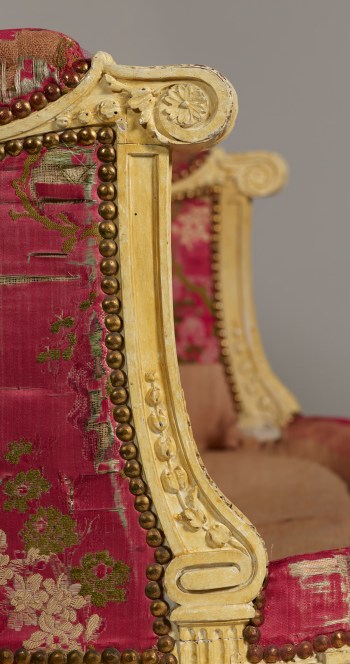 “Remarkably, this armchair still looks very much as it did when delivered to its first owner in the late 1700s,” says Charissa Bremer-David, curator of the exhibition. “Though the varnish on the wood has yellowed and the worn textile cover has gently faded, the finish and materials have endured without refurbishment or reupholstering. This armchair, therefore, is an important source of information about how late 18th-century French seat furniture was produced.”
Made in Paris in the early 1770s or early 1780s for an elite patron, the chair’s sumptuous appearance is striking, from its deep seat cushion stuffed with swan- and goose-down feathers to the vibrant crimson color of the silk fabric and the squares of gold leaf on its brass upholstery nails. Multiple craftsmen, including a joiner (woodworker) and an upholsterer, contributed to each facet of its construction.
It was created in the form known as bergère, the French term for a type of softly padded armchair with a lofty cushion that seemed to invite sitters to linger, rest, read, or chat. Its form developed in response to clothing fashion and notions of comfort. The receding curve of the arms could accommodate the voluminous drapery of women’s dresses and the extensive fabric of men’s knee-length coats, while the well-stuffed back and oval seat enveloped the occupants in luxury.
Marks on the armchair indicate it originally belonged to the château de Chanteloup, an important country house situated on an extensive estate in central France. It was part of a set that comprised five large armchairs, four long settees, and six smaller chairs. The group was dispersed in 1794, and the other surviving pieces no longer preserve their original appearance.
Getty conservators and scientists investigated the hidden joinery of the armchair frame and the layering of its painted surface and upholstery. This was accomplished through analysis of microscopic samples and by using imaging methods that did not disturb the original structure. An X-ray of the chairback reveals layers of upholstery materials that correspond to illustrated technical manuals of the period. Other images revealed the frame, made mostly of walnut, was put together using the traditional mortise-and-tenon joint, a method of interlocking two elements at right angles.
Also highlighted in the exhibition are four 18th-century illustrated books from the Getty Research Institute that detail the work of joiners and upholsterers, helping to put the bergère within the broader context of labor, craft, taste, and the market for furniture in France during the 1700s.

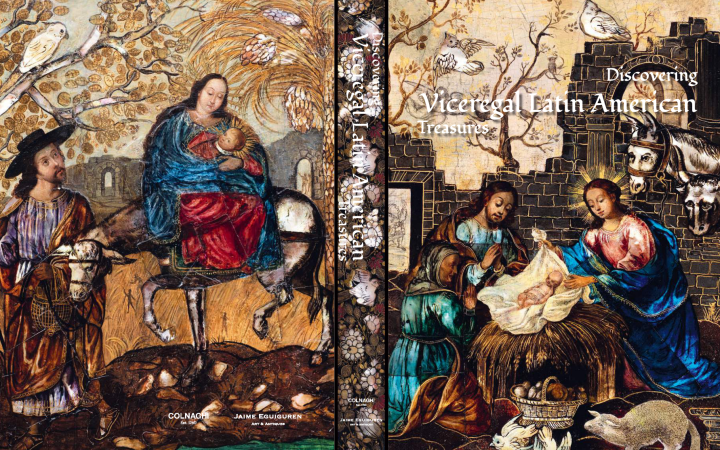
Exhibition | Discovering Viceregal Latin American Treasures
From Jaime Eguiguren Art & Antiques:
Discovering Viceregal Latin American Treasures
Colnaghi, New York and London, 2 July — 10 September 2021
Jaime Eguiguren Art & Antiques, Montevideo, Uruguay, 2 July — 10 December 2021
Jaime Eguiguren Art & Antiques and Colnaghi gallery are delighted to announce Discovering Viceregal Latin American Treasures, a survey exhibition that brings together more than a hundred works of art from the Viceregal period. The presentation takes place virtually and is supported by the publication of a printed exhibition catalogue, which will be the most in-depth publication on Viceregal art ever printed. The Old Master works in the exhibition date from the 16th to 18th century and include paintings, sculptures, silver, barniz de pasto (lacquer-like resin), ceramics, and furniture.
Discovering Viceregal Latin American Treasures, with essays by Pablo F. Amador Marrero, Alejandro Antuñano, Gonzalo Eguiguren Pazzi, Jaime Eguiguren, Cristina Esteras Martín, Sofía Fernández Lázaro, Concha García Sáiz, Jorge González Matarraz, Nuria Lázaro Milla, Yaiza A. Pérez Carracedo, Héctor San José, Dorie Reent (London: Colnaghi, 2021), 344 pages, ISBN: 978-8409304752.
Exhibition | Weaving Splendor: Treasures of Asian Textiles

One Hundred Cranes Imperial Robe (detail), Chinese, late 17th–early 18th century, Qing Dynasty (1644–1911), embroidered damask, 58 × 91 inches
(Kansas City: The Nelson-Atkins Museum of Art, William Rockhill Nelson Trust, 35-275)
◊ ◊ ◊ ◊ ◊
Opening next month at The Nelson-Atkins:
Weaving Splendor: Treasures of Asian Textiles
The Nelson-Atkins Museum of Art, Kansas City, 25 September 2021 — 6 March 2022
Frist Art Museum, Nashville, 7 October — 31 December 2022
For the first time in decades, The Nelson-Atkins Museum of Art will display rarely seen Chinese, Indian, Japanese, and Persian costumes and textiles. Made with fine materials, exemplary techniques, and artistry, Asian luxury textiles were central to global trade. The sumptuous textiles in this exhibition conveyed the identities, status, and taste of both local and international patrons and consumers.
The exhibition traces the journeys of key works of art and the people who owned them and carried them across the world. Luxurious costumes of the court performed power, while striking theater robes brought stage characters to life. Sturdy wall hangings and furniture covers transformed palaces, temples, and homes, while shimmering tapestry-woven carpets were created as diplomatic gifts for foreign rulers. Artists borrowed techniques from near and far to appeal to the latest fashions in the developing global market. The extraordinary stories of these treasures of the collection take visitors on an irreducible journey across continents, from the 1500s to today.
◊ ◊ ◊ ◊ ◊
Note (added 6 October 2022) — The posting was updated to include Nashville as a venue. More information is available here»










leave a comment