Exhibition | Chintz: Cotton in Bloom
Now on view at the Fashion and Textile Museum in London:
Chintz: Cotton in Bloom / Sits: katoen in bloei
Museum of Friesland, Leeuwarden, 11 March — 10 September 2017
Fashion and Textile Museum, Newham College, London, 18 May – 12 September 2021

Girl’s jacket with millefleur pattern, below a hand-painted girl’s chintz petticoat; cotton, painted and dyed using the chintz technique; India, 1725–75; jacket about 1760 (Fries Museum Leeuwarden; photo Studio Noorderblik).
Chintz: Cotton in Bloom is a collection with an extraordinary story, spanning hundreds of years and thousands of miles. The complicated technical craftsmanship required to fix bright dyes to cotton, devised across centuries and using complex chemical formulae, meant that for many years chintz was a closely guarded secret, or preserve of the elite. However, by the 18th century, chintz had become more widely accessible. The lightweight, washable, gaily coloured, and boldly patterned cottons eventually became a sensation throughout England and across Europe. These developments resulted in the intricate, colourful flowers of chintz fabric being cherished and preserved by generations.
Chintz: Cotton in Bloom showcases some 150 examples of this treasured textile, originating from all around the world—from mittens to wall hangings, from extravagant 18th-century sun hats to stylish mourning dresses.
The exhibition was organised by the Fries Museum, Leeuwarden (The Netherlands)—where the show, curated by Gieneke Arnolli, first appeared in 2017.
Exhibition | Paintings on Stone
Looking ahead to next year at SLAM (the catalogue is available now) . . .
Paintings on Stone: Science and the Sacred, 1530–1800
Saint Louis Art Museum, 20 February — 15 May 2022
Curated by Judith Mann
 In 2000 the Saint Louis Art Museum purchased Cavaliere d’Arpino’s Perseus Rescuing Andromeda (ca. 1593–94), an exceptional painting on lapis lazuli. The acquisition of the small, stunning work of art spurred extensive research that culminates in Paintings on Stone: Science and the Sacred 1530–1800, the first systematic examination of the pan-European practice of this unusual and little-studied artistic tradition.
By 1530 Italian artists had begun to paint portraits and sacred images on stone. At first artists used slate and marble. By the last decades of the sixteenth century, the repertoire expanded, eventually including alabaster, lapis lazuli, onyx, jasper, agate, and amethyst. In addition to demonstrating the beauty of these works, Paintings on Stone explains why artists began using stone supports and the role that stone played in the meaning of these endeavors. Bringing together more than 90 examples by 58 artists, the exhibition represents major centers of stone painting and features 34 different stones, nearly the full range that were used. The exhibition is curated by Judith W. Mann, curator of European art to 1800.
Judith W. Mann, ed., Paintings on Stone: Science and the Sacred, 1530–1800 (Munich: Hirmer Publishers, 2021), 320 pages, ISBN: 978-3777435565, $50.
Paintings on Stone examines a fascinating tradition long overlooked by art historians—stone surfaces used to create stunning portraits, mythological scenes, and sacred images. Written by an international team of scholars, the catalogue reveals the significance of these paintings, their complex meanings, and their technical virtuosity. Using a technique perfected by Sebastiano del Piombo (1485–1547), sixteenth-century Italian artists created compositions using stone surfaces in place of panel or canvas. The practice of using stone supports continued to engage European artists and patrons well into the eighteenth century. This volume reveals the beauty of these works and examines the complexity of using materials such as slate, marble, alabaster, lapis lazuli, and amethyst. Illustrated with more than one hundred examples, and with essays on topics ranging from importing stone to its relationship to alchemy, Paintings on Stone will become the essential reference on this little-studied practice.
Exhibition | Goya: Drawings from the Prado
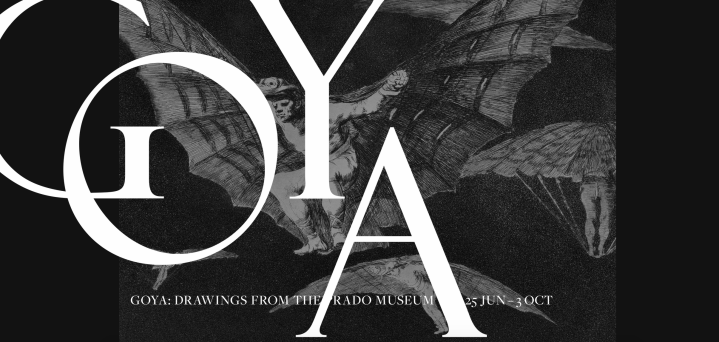
From the press release (18 May 2021) for the exhibition now on view at the NGV (with lots of interesting online features) . . .
Goya: Drawings from the Prado Museum
National Gallery of Victoria, Melbourne, 24 June — 3 October 2021
The world-exclusive exhibition Goya: Drawings from the Prado Museum features more than 160 works on paper by Francisco Goya (1746–1828), celebrating the artist’s extraordinary draughtsmanship and imagination. Considered to be one of the first truly modern artists, Goya produced humorous and critical images of Spanish society that comment on gender relationships, social inequality, and violence, as well as visions of fantastic creatures.
Goya: Drawings from the Prado Museum is the first major presentation of Goya’s work at the NGV in more than 20 years and features 44 drawings on loan from the Prado Museum, the largest group of Goya’s drawings ever seen in Australia. Ranging from bold ink drawings to delicate red chalk sketches, the drawings on display have been selected by the Prado especially for this NGV presentation. Highlights include examples from the artist’s earliest albums of social satires, preparatory drawings for his iconic print series, through to pages from the late albums, which contain some of Goya’s most complex and surreal images. This rich and diverse selection of drawings showcases the breadth of Goya’s drawing practice, as well as offering a rare insight into the artist’s image-making process.

Francisco Goya, This is how useful men usually end up, 1814–23, wash, brush, bistre on laid paper (Madrid: Prado).
Following a near-fatal illness in 1792, which left him profoundly deaf, Goya turned to drawing to record his private thoughts, visions, and dreams and continued this practice until the end of his life. In eight private albums, as well as in single sheet drawings, he gave expression to a vision of humanity that had no equivalent in the art of his day. Highlight works include This is how useful men usually end up (1814–23), a moving commentary on the consequences of poverty and war, and Literate animal (1824–28), a satirical image of an educated animal, which Goya drew in the last years of his life.
The works drawn from the Prado collection have been complemented by more than 120 etchings from Goya’s renowned print series: the Caprichos (1797–98), which satirised vices and follies in Spanish society; The Disasters of War (1810–15), based on the atrocities of the war and famine that followed the Napoleonic invasion of Spain in 1808; Tauromaquia (1815–16) on the subject of bullfighting; and the enigmatic Disparates (c. 1815–19), made during the reign of Ferdinand VII, whose suppression of civil liberties affected the lives of many intellectuals and reformers, including Goya and his friends. The prints are drawn from the NGV Collection with fifteen works on loan from the Art Gallery of South Australia. Goya’s most famous etching, The sleep of reason produces monsters, a striking composition of the sleeping artist haunted by monstrous apparitions, is also featured in the exhibition.
The exhibition is structured chronologically and thematically around recurring themes in Goya’s art, many of which are as relevant today as they were in Goya’s time: the relationship between men and women; the condemnation of ignorance and religious zeal; the exploration of violence and its consequences; and the device of the nightmare or dream to critique social and political realities.
Tony Ellwood AM, Director of the National Gallery of Victoria, said: “All aspects of society came under Goya’s critical eye—from education and marriage, to social justice and power relationships. Audiences to this exhibition will be astonished by the contemporary relevance of this exhibition and the universal themes that underpin the works of this celebrated Spanish artist.”
“The NGV has a longstanding relationship with the Prado Museum in Madrid, a cultural partnership which has resulted in the Melbourne Winter Masterpieces exhibition Italian Masterpieces from Spain’s Royal Court, as well as the NGV’s commitment to sharing its significant collection of William Blake watercolours with Spanish audiences in the near future. We are indebted to the Prado Museum for generously lending these important Goya drawings. Without their continued support and commitment to this cultural exchange between Europe and Australia, a presentation of this significance would not be possible,” said Ellwood.
Francisco de Goya y Lucientes was the most celebrated artist of his time in Spain. He was court painter to four monarchs and lived through the turbulent events of the French occupation, the subsequent Peninsular War, and the Inquisition. He moved in elite circles and painted portraits of statesmen, aristocrats, influential writers, and intellectuals. His friendships with liberals sharpened Goya’s political awareness and social conscience, which was particularly evident in his drawings and prints.
Goya: Drawings from the Prado Museum (Melbourne: National Gallery of Victoria, 2021), 360 pages, ISBN: 978-1925432862, $70 (AUD). With contributions by José Manuel Matilla, Manuela Mena Marqués, Mark McDonald, Phillip Adams, Eric Campbell, Michael Christoforidis, Gideon Haigh, Adrian Martin, Richard Read, and Colm Tóibín, as well as NGV curators.
Exhibition | Return Journey: Art of the Americas in Spain

Pueblo de Teotenango, en el valle de Matalcingo, en Nueva España / Town of Teotenango, in the Matalcingo Valley, in New Spain, detail
(Seville: Archivo General de Indias, MP-MEXICO,33). More information is available here.
◊ ◊ ◊ ◊ ◊
Opening this fall at the Prado (with the English description from Spain.info). . .
Tornaviaje: Arte Iberoamericano en España / Tornaviaje: Ibero-American Art in Spain
Museo Nacional del Prado, Madrid, 5 October 2021 — 13 February 2022
Curated by Rafael López Guzmán, with Jaime Cuadriello and Pablo F. Amador
This exhibition at the Prado Museum brings together around a hundred works of art that arrived in Europe from the Americas during the Modern Era. Most of them are housed in cultural and religious institutions, or are in private collections, mainly in Spain. Return Journey is divided into four sections. The first, ‘Geography, Conquest, and Society’, looks at the concept of cultural landscape within the geographical framework of the Americas, the Spanish conquest, and the peoples who lived there during the Modern Era. The second, ‘The Pantheon of the Americas: Religious Exchanges’, addresses religious beliefs, in both the Iberian Peninsula and in the Americas, how they have impacted each other, and the resulting fusions. Visitors will find oil paintings, sculptures, and drawings from important centres of production in Lima, Alto Perú, Puebla de los Ángeles and Ciudad de México, together with works by renowned Spanish painters such as Murillo. The third section, ‘Art Journeys’, presents a wide range of household and religious artefacts; and the fourth, ‘Impronta Indiana’, brings together a series of works that reflect the artistic materiality of Spanish America throughout the Modern Era.
◊ ◊ ◊ ◊ ◊
 El tornaviaje o viaje de regreso que da título a esta exposición nos permite valorar las obras de arte que llegaron desde América a España y, por extensión, a Europa durante la Edad Moderna.
La finalidad de esta muestra es visibilizar, a través de aproximadamente un centenar de obras, este rico patrimonio que, proveniente del Nuevo Mundo, se conserva en instituciones culturales, espacios religiosos o colecciones particulares, principalmente en España. Estos objetos, llegados en distintos momentos de la historia, forman parte de nuestro patrimonio histórico y cultural, sin que, a veces, reconozcamos las razones de su presencia.
La muestra se organiza en cuatro grandes secciones. La primera de ellas, ‘Geografía, Conquista y Sociedad’, gira en torno al concepto de paisaje cultural, dándose cita en el mismo la geografía de América, la conquista y las gentes que habitaron estos territorios durante la Edad Moderna. De esta forma, en esta sección, conviven obras de carácter religioso, aportes cristianos que justificaban la conquista, con valores estéticos indudables, a las que se unen vistas de ciudades en las que la traza urbana y el mercado con los productos de la tierra configuraron un paisaje sin igual. Espacios por donde deambulan y se desarrollan los distintos estamentos sociales, representados en cuadros de familias nobiliarias, eclesiásticos, virreyes y, claro está, indígenas, también con sus diferencias estamentales, que nos hablan de esa sociedad diversa.
Quizás el Biombo de la Conquista de México y La muy noble y leal ciudad de México resume con sus dos caras el concepto de esta sección, reproduciendo la conquista de Tenochtitlán, por un lado, y la ciudad de México, por el otro, habitada por más de doscientos personajes, representando el momento histórico constitutivo de América y la vitalidad de la capital novohispana y, por extensión, de las grandes ciudades capitales del nuevo continente.

Juan Patricio Morlete Ruiz (1713–1772), San José y el Niño / St Joseph with the Child Jesus (Church of Santa María la Real, or San Agustín of Badajoz, Spain).
La segunda sección, ‘El panteón americano. Devociones de ida y vuelta’, reúne una exquisita selección de óleos, esculturas y dibujos que tienen como objetivo analizar las devociones religiosas, tanto americanas como peninsulares, así como sus intercambios e hibridaciones. El visitante podrá entender el viaje y la transferencia de las imágenes de devoción, merced al patrocino de los indianos y de algunos virreyes, que reintegraron a sus lugares de origen parte de una memoria compartida; sobre todo, de sus experiencias de fe vividas desde ultramar. Quedará también patente en esta sección el constante envío de obras de pintura “fina” de los más afamados centros de producción de Lima, el Alto Perú, Puebla de los Ángeles o la Ciudad de México, así como obras realizadas en España, por importantes pintores como Murillo, que ejemplifican el impacto de los imaginarios americanos que formaron parte de la propaganda devocional y de los procesos de santificación.
La tercera sección, ‘Las travesías del arte’, se centra en uno de los intercambios comerciales con valores artísticos más fecundos como serían los objetos de ajuar que cruzaron el Atlántico con destino a los lugares más variopintos. Mobiliario diverso para el viaje o para las salas de las residencias dialogan con una nutrida selección de objetos de ajuar, domésticos y religiosos, que pretende cubrir un amplio abanico de tipologías, permitiendo mostrar físicamente el concepto de “tesoro” que asociamos con los objetos llegados de Indias. Los indianos, emigrantes enriquecidos en el nuevo mundo, son ese hilo que hilvana las lejanas tierras de donde proceden estos objetos con un crisol de pueblos y ciudades españolas.
La cuarta y última sección, ‘Impronta indiana’, reunirá un corpus de obras que, pese a su disparidad, se interrelacionan al ser referentes y reflejos de la materialidad artística hispanoamericana a lo largo de la Edad Moderna. Tendremos la ocasión de entender cómo la larga tradición artística prehispánica se adapta a las nuevas exigencias de los reinos hispánicos. Cómo leen los maestros artesanos indígenas las indicaciones y demandas de la nueva sociedad y cómo, a su vez, integran lenguajes y simbología de su propia cultura, permitiendo en su conjunto valorar la riqueza del patrimonio que llegado de América fue integrándose y moldeando, cambiando sin rupturas, la cultura de la península ibérica y, también, la europea; asumiendo América como parte de nuestra identidad.
Las investigaciones que han conducido a la concreción de este proyecto se reflejarán también en un catálogo que acompañará a la exposición.
El proyecto está comisariado por Rafael López Guzmán, Catedrático de Historia del Arte Iberoamericano en la Universidad de Granada, y cuenta con la colaboración de varios especialistas en cultura visual del periodo virreinal en América.
Rafael López Guzmán, Adrián Contreras-Guerrero, Gloria Espinosa, Jaime Cuadriello, and Pablo F. Amador, Return Journey: Art of the Americas in Spain (Madrid: Prado, 2021), 304 pages, ISBN: 978-8484805632, 32€. Also available in Spanish and Castellano editions.
◊ ◊ ◊ ◊ ◊
Note (added 4 October 2021) — The posting was updated to include a revised English title, identification of the exhibition’s curators, and details for the catalogue.
Note (added 14 October 2021) — The press release (in English) is available via Art Daily.
Exhibition | Enchanted: Visual Histories of the Central Andes
Now on view at the Menil Collection:
Enchanted: Visual Histories of the Central Andes
Menil Collection, Houston, 30 July — 14 November 2021
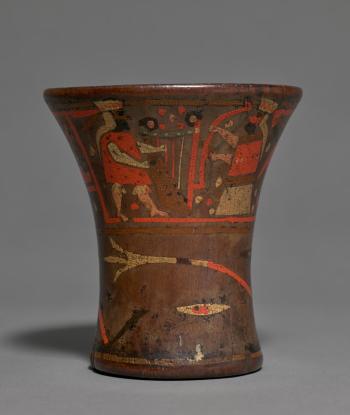
Waisted Cup (Kero) Depicting Two Musicians and Floral Elements, late 15th–18th century, Quechua, Colonial Period, Peru; wood, natural resin, and pigments, 6 × 5 × 5 inches (Houston: The Menil Collection, photo by Paul Hester).
Running along the western side of South America, the Andean Mountains have supported a rich, interconnected series of civilizations and empires for more than 3,000 years. Surveying this captivating, multifaceted world, the Menil Collection presents Enchanted: Visual Histories of the Central Andes from July 30 through November 14, 2021. The exhibition showcases works from the museum’s collection and loans from the Museum of International Folk Art in Santa Fe, New Mexico.
More than forty objects from different historical moments of Andean history are on view—including polychrome ceramic vessels of the Nazca culture (ca. 100 BCE–800 CE), important textiles from the Wari (ca. 600–1000 CE) and Chimú (ca. 1150–1450) civilizations, and 20th–21st century examples of elaborately embroidered esclavinas (short capes) and monteras (hats) worn during religious festivals in Peru. Complementing these objects is a selection of gelatin silver photographic prints by Pierre Verger, also known as Fátúmbí (1902–1996). Verger’s images of religious festivals in the Andes, taken between 1939 and 1945, highlight the costumes, dances, and dramatic moments of these annual events.
Rebecca Rabinow, Director of the Menil Collection, said, “Photographer Pierre Verger’s travels through the Andes in the 1940s were made possible, in part, thanks to the financial support of John and Dominique de Menil. The two portfolios of gelatin silver prints that he gave the couple at the time have never before been exhibited, which prompted Menil Curator of Collections Paul R. Davis to study the photographs along with related material in the collection. The resulting exhibition and online publication celebrating Andean visual cultures coincides with the 200th anniversary of Peru’s independence.”

Unidentified artist, Cuzco School, Virgin of Bethlehem (Virgen de Belén), 18th century, oil on canvas, 56 × 32 inches (Houston: The Menil Collection, Bequest of Jermayne MacAgy, 1964-142 McA).
Paul Davis, said, “This project led me to explore the museum’s permanent collection of Andean art more deeply and how it connects to the Menil’s rich institutional history. After meeting Verger by chance in 1941 while visiting Buenos Aires, Argentina, John and Dominique de Menil formed relationships with some of the leading scholars on the Andes and assembled a unique collection of objects from that area. The Menil is pleased to share these artworks in Enchanted, accompanied by a robust online publication.”
Highlights of the artworks on view include:
• Three blue-and-yellow macaw feather panels from the Wari culture, an imperial power during the Middle Horizon in Peru (ca. 600–1000 CE)
• Textile fragments from the 10th–15th century, including a large two-panel section of the so-called ‘Prisoner Textile’ from the Late Intermediate Period Chimú culture
• Polychrome ceramic vessels attributed to the Early Intermediate (ca. 100 BCE–800 CE) Nazca and Moche cultures
• A group of colonial–era painted keros (wood cups) from the 16th–18th centuries that were used consume to chicha (maize beer) and other ceremonial drinks
• An 18th-century painting of the Virgin of Bethlehem (Virgen de Belén), one of the patron saints of Cuzco, Peru.
Enchanted: Visual Histories of the Central Andes will be accompanied by an online publication with multimedia features and essays by Paul R. Davis, Curator of Collections, the Menil Collection; Susan E. Bergh, Chair of the Art of Africa and the Americas and Curator of PreColumbian and Native North American Art, Cleveland Museum of Art; Kari Dodson, Associate Objects Conservator, the Menil Collection; Zoila S. Mendoza, Professor and Chair, Native American Studies, University of California, Davis; Amy Groleau, Curator, Smithsonian Institution, National Museum of the American Indian; Heidi King, Independent Scholar; and Ana Girard, University of Houston Fellow at the Menil Collection.
Contextualizing the artworks in the museum’s permanent collection, the publication will be available in both English and Spanish. Paul R. Davis surveys the ancient history of the region and the formation of this aspect of the de Menils’ collection during the mid20th century. Essays by Susan E. Bergh, Heidi King, and Kari Dodson examine the two historically enigmatic textiles in the museum’s permanent collection—the Chimú ‘Prisoner Textile’ and iconic Wari blue-and-yellow macaw feathered panels. Ana Girard writes about colonial works. In their essays, Zoila S. Mendoza and Amy Groleau emphasize the importance of festivals as spaces to perform, celebrate, contest, or reinvent the Andean culture.
Exhibition | Slavery: Ten True Stories
Exhibition trailer by Boomerang Motion.
◊ ◊ ◊ ◊ ◊
From the press release for the exhibition now on view (an initial notice appeared here at Enfilade in September 2019, but here’s the full, updated information, including links for terrific online components). . .
Slavery: Ten True Stories
Rijksmuseum, Amsterdam, 5 June — 29 August 2021
United Nations Headquarters Visitors’ Lobby, New York, 26 February — 30 March 2023
Curated by Eveline Sint Nicolaas and Valika Smuelders
The Rijksmuseum, the national museum of arts and history of the Netherlands, presents its first ever major exhibition dedicated to the subject of slavery this summer. Slavery is inextricably bound up with Dutch history. This is the first time stories of slave trade across the Atlantic and the Indian Oceans are told together in one exhibition in the Netherlands. The exhibition presents ten true stories. Ten personal stories about enslaved people and slave owners, people who resisted, and people who were brought to the Netherlands in slavery. What were their lives like? What was their attitude to the system of slavery? Were they able to make their own decisions?
 The exhibition includes objects from national and international museums, archives, and private collections—including the Nationaal Museum voor Wereldculturen, British Museum, National Gallery of Denmark, Iziko Museums of South Africa, St Eustatius Historical Foundation, National Archeological Antropological Memory Management (NAAM) in Curaçao, the National Archives of South Africa, Indonesia and the Netherlands, and private collections in Sint Eustatius, Suriname, and the Netherlands.
Valika Smeulders, head of History Rijksmuseum: “By focusing on ten true personal stories, Slavery gives an insight into how individuals dealt with legalized injustice.”
Taco Dibbits, General Director Rijksmuseum: “The Rijksmuseum is the national museum of art and history. Slavery is an integral part of our history. By delving into it, we can form a more complete picture of our history and a better understanding of today’s society.”
Ten True Stories
During the 250-year colonial period, people were made into property and objects to be recorded in accounts. The exhibition highlights the lives of ten people who lived at the time. They each tell their own story: about living in slavery or taking advantage of it, about resistance, and—ultimately—freedom. They include enslaved people and slaveholders, as well as individuals who broke the shackles of slavery, an African servant in the Netherlands, and an Amsterdam sugar industrialist. An audio tour leads visitors through these widely differing lives. Among the narrators are Joy Delima, Remy Bonjasky and Anastacia Larmonie, who each have a connection with one of the ten people through their own background.
The exhibition includes objects, paintings, and unique archival documents. Visitors also will hear oral sources, poems, and music. To tell a more complete story, there will be exhibits that have never been shown in the Rijksmuseum before, such as objects that were cherished by people in slavery and tools that were used on plantations.
The Dutch Colonial Period on Four Continents

Alexander de Lavaux, Map of Suriname, 1737, silk, 187 × 216 cm (Amsterdam: Rijksmuseum).
The exhibition spans the Dutch colonial period from the 17th to the 19th century. It features the trans-Atlantic slavery in Suriname, Brazil, and the Caribbean, along with the part played by the Dutch West India Company (WIC) and Dutch colonial slavery in South Africa and Asia, where the Dutch East India Company (VOC) operated. The effects of the system in the Netherlands during the period are also highlighted. As a whole, it offers a geographically broad and at the same time specifically Dutch view that has never been seen before in a national museum.
Look at Me Now
The stories in the exhibition—about João, Wally, Oopjen, Paulus, Dirk, Lokhay, Van Bengalen, Surapati, Sapali and Tula—stand for millions of other stories about the slavery past of the Netherlands and its continued effects. At the end of the exhibition, the artists David Bade (Curacao, 1970) and Tirzo Martha (Curacao, 1965), both from Curacao’s Instituto Buena Bista, invite visitors to give expression to their own stories through the ten new artworks making up the Look at Me Now project. Visitors can follow the progress of this project via the website.
Online Exhibition
The Rijksmuseum is also presenting the ten stories in an online exhibition that features video and audio clips, animations, an overview of the exhibition galleries, and objects that can be viewed in exceptional detail. Visitors to the website will be able to see the Slavery exhibition in ten episodes, whenever and wherever it suits them.
Symposium
The Rijksmuseum partnered with the National Library of the Netherlands and the National Archive of the Netherlands to present an English-language online symposium on 23 April 2021, focusing on what it means to increase inclusivity in source usage by museums, archives, and libraries. What sources are available to people making presentations and conducting research on the subjects of slavery and the slave trade? Click here to view a recording of the symposium.
Rijksmuseum & Slavery
For the coming year, more than 70 objects in the permanent collection will have a second museum label that explores and highlights what has been, until now, an invisible relationship between the object and slavery. Subjects covered range from former rulers to the presence of people of colour and the way they are portrayed. Rijksmuseum & Slavery takes place concurrently with the Slavery exhibition, but it is not part of the exhibition.
Collaboration
The exhibition and accompanying events and activities are the result of collaboration with a wide variety of external experts, including historians, heritage experts, cultural entrepreneurs, artists, theatre practitioners, and performers.
Narrative advisor:
Jörgen Tjon A Fong
Think tank:
Reggie Baay, Raul Balai, Aspha Bijnaar, Mitchell Esajas, Karwan Fatah-Black, Martine Gosselink, Dienke Hondius, Wayne Modest, Ellen Neslo, Matthias van Rossum, Maurice San A Jong, Alex van Stipriaan, Jennifer Tosch, Urwin Vyent, Simone Zeefuik, and Suze Zijlstra
The exhibition design is by AFARAI, the agency led by architect Afaina de Jong. The graphic design of the exhibition and the book are by Irma Boom Office.
◊ ◊ ◊ ◊ ◊
Eveline Sint Nicolaas and Valika Smeulders, eds., Slavery: The Story of João, Wally, Oopjen, Paulus, Van Bengalen, Surapati, Sapali, Tula, Dirk, Lohkay (Amsterdam: Atlas Contact, 2021), 352 pages, ISBN: 978-9045044279, €28. (Also available in Dutch).
◊ ◊ ◊ ◊ ◊
Note (added 27 March 2023) — The posting has been updated to include the UN as a venue for a version of the exhibition.
Exhibition | Rijksmuseum & Slavery
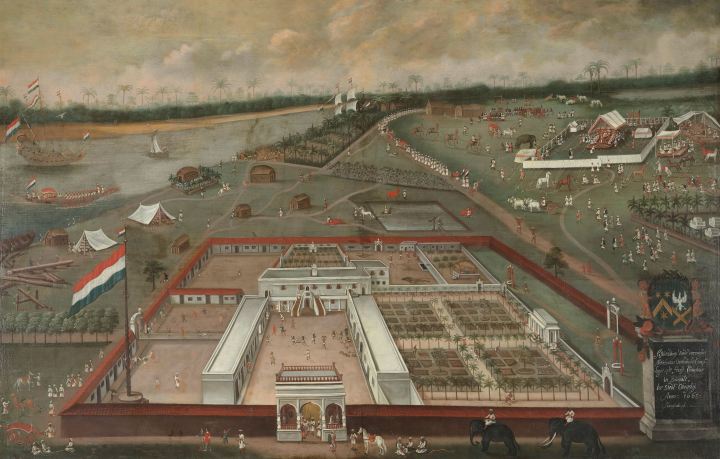
Hendrik van Schuylenburgh, The Trading Post of the Dutch East India Company in Hooghly, Bengal, 1665, oil on canvas, 203 × 316cm
(Amsterdam: Rijksmuseum)
◊ ◊ ◊ ◊ ◊
This project, aimed at reconsidering objects in the permanent collection of the Rijksmuseum, coincides with the major exhibition Slavery: Ten True Stories:
Rijksmuseum & Slavery: New Light on the Permanent Collection
Rijksmuseum, Amsterdam, 18 May 2021 — February 2022
Many of the works in the Rijksmuseum’s permanent collection have links with the Netherlands’ slavery past. It’s a relationship you probably won’t notice at first glance and one you won’t typically read about on a museum label next to an object: from the nutmeg harvested by enslaved people, to an enslaved woman shipped off to the Netherlands; from the image of a dance party on a Surinamese plantation that hides critical messages about the slaveholder, to the pulpit from which an 18th-century legal philosopher made the case for abolishing slavery.
Rijksmuseum & Slavery is adding 77 museum labels to paintings and objects in the permanent collection. The new labels will remain in place for a year, until February 2022. All of them focus on the colonial power of the Netherlands, which from the 17th century onwards was inextricably bound up with a system that included slavery. Some of the labels tell the stories of people who, under Dutch rule, were enslaved and put to work, and had their status reduced to that of objects, while others highlight people who profited from slavery, or spoke out against it.
When the Slavery exhibition and Rijksmuseum & Slavery have ended, the museum will evaluate both the pre-existing labels and the new ones. Wherever possible, the new information will be integrated into the museum in order to do greater justice to the Netherlands’ complicated history. The labels are collected in a booklet available free of charge in the museum. The booklet can also be downloaded here. In addition, all the labelled works are available online as a collection in Rijksstudio (in two parts: 1500–1650 and 1650–1960).
◊ ◊ ◊ ◊ ◊
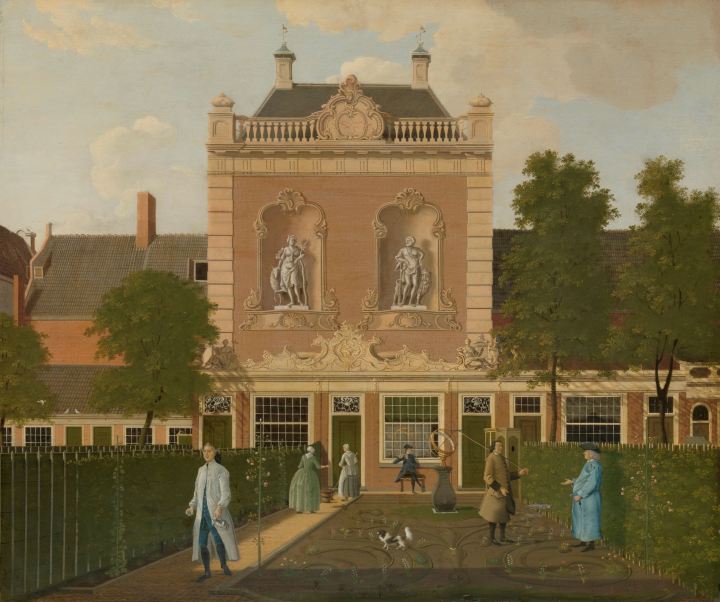
Hendrik Keun, The Garden and Coach House of 524 Keizersgracht in Amsterdam, 1772, oil on panel (Amsterdam: Rijksmuseum).
From the booklet: first the original label and then the newly added one:
Nicolaas Doekscheer, who lived at 524 Keizersgracht, built a grand, Rococo coach house on the Kerkstraat, which adjoined the back of his garden. He is here depicted conversing with the gardener, while his wife speaks to a maidservant. The two young men are Doekscheer’s nephews and heirs. The painting is still in its original Rococo frame.
The 18th-century Dutch elite benefitted greatly from the slavery-based plantation economy.[1] So did Nicolaas Doekscheer and his associate Hendrik Steenbergen, both depicted here in a garden. They financed no less than fifteen plantations in Berbice, Demerary, and Essequebo (all three part of present-day Guyana, South America).[2] Thanks to these loans, plantation owners were able to set up their coffee, cotton, and sugar plantations, while in Amsterdam Doekscheer and Steenbergen made a substantial profit from the interest.[3] See booklet for the footnotes.
Exhibition | By Her Hand, Women Artists in Italy, 1500–1800
From the press release (30 July 2021) for the exhibition:
By Her Hand: Artemisia Gentileschi and Women Artists in Italy, 1500–1800
Wadsworth Atheneum Museum of Art, Hartford, 30 September 2021 — 9 January 2022
Detroit Institute of Arts, 6 February — 29 May 2022
Curated by Eve Straussman-Pflanzer and Oliver Tostmann
 The first exhibition solely dedicated to Italian women artists at the Wadsworth Atheneum Museum of Art, By Her Hand: Artemisia Gentileschi and Women Artists in Italy, 1500–1800 explores how women succeeded in the male-dominated art world of the time. From the group of eighteen artists presented, Artemisia Gentileschi (1593–1654 or later), takes center stage with outstanding portraits and images of heroines. This exhibition recognizes and celebrates the vital contributions of women to the history of art in Italy through rarely seen works, recent scholarship, and introductions to virtually unknown artists.
“Sofonisba Anguissola, Artemisia Gentileschi, and Rosalba Carriera, among others, created pathbreaking works of art, simultaneously subverting expectations and challenging norms,” said Oliver Tostmann, Susan Morse Hilles Curator of European Art at the Wadsworth. “Their works and careers are often distinguished by alternative choices and idiosyncratic methods employed within the context of the male dominated art world of the time. By Her Hand brings together a wide spectrum of works by these artists—many on view for the first time—inviting visitors to explore, reassess, and celebrate the achievements of Italian women artists.”
The exhibition features a wide array of paintings, miniatures, and works on paper from institutional and private collections in the United States, Canada, and Europe. The artists take on a range of subjects from portraiture and still life, to historical and religious stories. Many works are being shown publicly for the first time or are making their U.S. debut such as Artemisia Gentileschi’s ravishing Mary Magdalene. By Her Hand reweaves history by examining women artists’ work and careers from the 1550s to the 1750s. Despite the fundamental differences and challenges women artists faced, some achieved notable success in their lifetime. The accomplishments of this diverse and dynamic group are introduced, discussed, and reassessed. Until recently, many of these Italian women artists were overlooked by critics, scholars, collectors, and institutions alike.
Artemisia Gentileschi is arguably the best-known artist included in the exhibition. Gentileschi’s talents were widely recognized by her contemporaries, many elite patrons of her day knew of and desired her work. Important works by Gentileschi highlight her innovative ideas, use of sensuous colors, and command of the brush. The Wadsworth’s Self-Portrait as a Lute Player is compared with the recently discovered Self-Portrait as Saint Catherine of Alexandria from the National Gallery, London, as well as Portrait of Saint Catherine from the Uffizi Galleries, Florence. This will be the first opportunity to see these three celebrated paintings side by side in the United States. Additional examples of Gentileschi’s pioneering depictions of strong women, such as Judith and Her Maidservant with the Head of Holofernes from the Detroit Institute of Arts, will also be on view.
The compelling works of art on view in By Her Hand coupled with stories of their pioneering makers reveals a nuanced picture of the role Italian women artists played from the Renaissance to the Rococo. By Her Hand celebrates their long-overlooked contributions, and aims to inspire continued reexaminations of the role women artists have played throughout the history of art.
“Never before in its long history has the Wadsworth devoted an exhibition to the work of professional women artists in sixteenth through eighteenth-century Italy, despite the fame of our Italian Baroque painting collection” said Jeffrey N. Brown, Interim Director & CEO of the Wadsworth Atheneum. “By Her Hand is the first exhibition in any encyclopedic museum in the United States to focus on this subject. This ground-breaking exhibition provides our audiences with a chance to encounter the outstanding art produced by these women artists in early modern Italy and to appreciate the far-reaching consequences of Artemisia Gentileschi’s illustrious career.”
By Her Hand is a collaboration between the Wadsworth and the Detroit Institute of Arts. Curated by Eve Straussman-Pflanzer former curator at the Detroit Institute of Arts now Curator and Head of Italian and Spanish paintings at The National Gallery of Art, Washington and Oliver Tostmann, Susan Morse Hilles Curator of European Art at the Wadsworth. After its debut at the Wadsworth, it will travel to Detroit where it will be on view February 6–May 29, 2022.
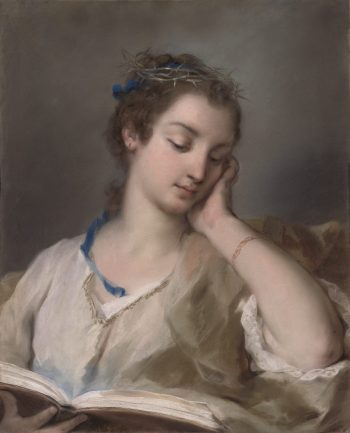
Rosalba Carriera, Allegory of Grammar, ca. 1715, pastel on paper (Private Collection).
Artists in the exhibition
Sofonisba Anguissola (c. 1535–1625)
Diana Scultori (c. 1547–1612)
Lavinia Fontana (1552–1614)
Fede Galizia (c. 1574–c. 1630)
Isabella Catanea Parasole (active 1585–1625)
Artemisia Gentileschi (1593–1654 or later)
Orsola Maddalena Caccia (1596–1676)
Giovanna Garzoni (1600–1670)
Virginia da Vezzo (1600–1638)*
Anna Maria Vaiani (1604–1655)
Elisabetta Sirani (1638–1665)
Ginevra Cantofoli (1618–1672)
Caterina de Julianis (c. 1670–c. 1742)
Rosalba Carriera (1673–1757)
Marianna Carlevarijs (1703–after 1750)
Maria Felice Tibaldi (1707–1770)*
Veronica Stern Telli (1717–1801)
Anna Bacherini Piattoli (1720–1788)
* Virginia da Vezzo and Maria Felice Tibaldi are represented in portraits painted by their husbands Simon Vouet (1590–1649) and Pierre Subleyras (1699–1749).
Eve Straussman-Pflanzer and Oliver Tostmann, with contributions by Sheila Barker, Babette Bohn, C. D. Dickerson, Jamie Gabbarelli, Hilliard T. Goldfarb, Joaneath Spicer, and Lara Roney, By Her Hand: Artemisia Gentileschi and Women Artists in Italy, 1500–1800 (New Haven: Yale University Press, 2021), 192 pages, ISBN: 978-0300256369, $40.
Exhibition | Fan Leaves: Between Europe and Japan
From the press release for the exhibition:
Feuilles d’éventail entre Europe et Japon
Musée d’art et d’histoire, Geneva, 1 October 2021 — 30 January 2022 (extended until 29 May 2022)
Curated by Bénédicte De Donker
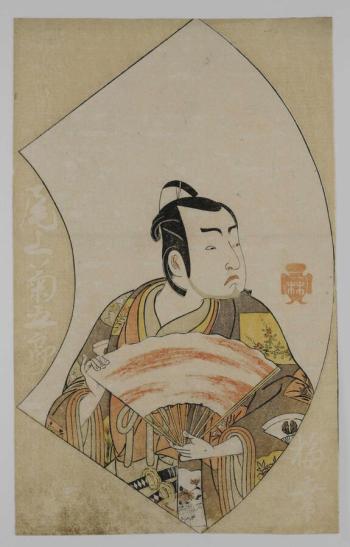
Katsukawa Shunshō 勝川 春章, Ippitsusai Bunchō 一筆斎 文調, Kariganeya Ihei 雁金屋 伊兵衛, The Actor Onoe Kikugorō, also called Kobaikō, 1770, woodblock print (Musée d’art et d’histoire de Genève, Inv. E 2013-0032). In 1770, Katsukawa Shunshō and Ippitsusai Bunchō published an illustrated book, in three volumes, of actors’ portraits on fans, introducing a new genre of portraiture known as nigao-e.
Cet automne, l’éventail est au cœur d’une présentation inédite déployée dans les trois cabinets consacrés aux arts graphiques au deuxième étage du musée. Accessoire de mode apparu dès l’Antiquité dont l’usage se retrouve de par le monde, l’éventail a également intéressé les artistes qui se sont plu à le représenter dans leurs œuvres, voire à réaliser des feuilles pour l’habiller. Feuilles d’éventails, entre Europe et Japon fait écho à la grande exposition proposée au même moment dans les salles palatines, Pour la galerie: Mode et portrait.
Cette présentation revient sur les influences croisées de l’art de l’éventail entre Europe et Asie, qui atteint son apogée au XIXe siècle avant son déclin irrémédiable. Elle témoigne surtout de l’engouement européen pour cet accessoire, dont les formes les plus répandues (brisé et plié) proviennent d’Extrême-Orient. Certains exemplaires, par le choix de matières précieuses ainsi que par la finesse et la qualité de leur travail sont de véritables œuvres d’art. Car au-delà de son utilité, un éventail présente également une dimension artistique, et même parfois politique, selon ses créateurs et les sujets représentés. Sans surprise, il rejoint le panthéon des objets avec lesquels l’on aime—et doit—se montrer. Accessoire de mode, il arbore des formes variées (brisé, plié, ballon, plein vol…) et des matériaux divers, au gré des tendances (plumes, dentelle, parchemin…).
Feuilles d’éventails, entre Europe et Japon puise sa sélection dans le fonds d’arts graphiques du MAH, ainsi que dans sa collection d’arts appliqués. Autour de quelques splendides éventails, se déploie une sélection de feuilles d’éventails provenant elles aussi d’Europe et du Japon. Dessinées ou gravées, celles-ci étaient destinées à être montées ou à servir de modèle. Cet ensemble inclut une série exceptionnelle de huit feuilles peintes au XVIIIe siècle, dévoilée pour la première fois au public. Enfin, une quinzaine de représentations de leur usage en Europe, du XVIe à l’aube du XXe siècle, côtoie des gravures japonaises mettant en scène des personnages hauts en couleurs munis d’éventails.
◊ ◊ ◊ ◊ ◊
Coordinating with the exhibition To Play to the Gallery: Fashion and Portrait, the Prints and Drawings Department has chosen to focus on a fashion accessory that is both an artistic medium and the subject of numerous representations: the fan. The three cabinets on the first floor show fan mounts, drawn or engraved, to be mounted or used as models, representations of their use in Europe from the 16th to the early 20th century, as well as a collection of Japanese engravings and fans. This presentation includes an exceptional series of eight sheets painted in the 18th century, unveiled to the public for the first time.
The full press release is available here»
Exhibition | To Play to the Gallery: Fashion and Portrait
Opening this fall at the MAH in Geneva:
Pour la Galerie: Mode et Portrait
Musée d’art et d’histoire, Geneva, 17 September — 14 November 2021
 Longtemps réservé à l’élite, aujourd’hui à portée de téléphone mobile, le portrait est le lieu de la projection et de la fabrication de l’image de soi par excellence. Le vêtement, des somptueux drapés des portraits d’apparat à la variété du vestiaire contemporain, en constitue un élément clé : il est un moyen de distinction, entre conformisme et quête d’originalité. Et au-delà de tout ce qui caractérise une époque, les codes traversent les modes comme autant de signes d’un statut affirmé ou rêvé. En confrontant les peintures et les objets du MAH à la collection d’histoire de la mode de la Fondation Alexandre Vassiliev, du XVe siècle à la période contemporaine, cette exposition invite à s’élancer dans un tourbillon de matières et de couleurs, un grand défilé déployé dans les salles palatines du musée transformées en galerie des miroirs. Instruments de pouvoir, de séduction ou d’évasion, vêtements et portraits nous entraînent dans une foire aux vanités où trouve à s’exprimer, de manière éblouissante ou dérisoire, toute la gamme des aspirations et des émotions humaines.










leave a comment