Display | Fans Unfolded
Now on view at The Fitzwilliam:
Fans Unfolded: Conserving the Lennox-Boyd Collection
The Fitzwilliam Museum, Cambridge, 5 March 2019 — 12 January 2020
Showcasing rare and exquisitely decorated fans from the collection of the Hon. Christopher Lennox Boyd, allocated to the Museum by H.M. Government in lieu of inheritance tax in 2015, this display reveals the techniques behind the making, investigation, and conservation of fans.
The collection of over 600 objects ranges in date from the 18th to the 20th centuries and in type from bejewelled and hand-painted court and wedding fans, to printed mass-produced advertising fans, aide-memoire fans, mourning fans and children’s fans. A conservation project generously funded by the Marlay group has allowed the museum to display a selection of these fragile but extraordinary objects for the first time.
Exhibition | William Blake
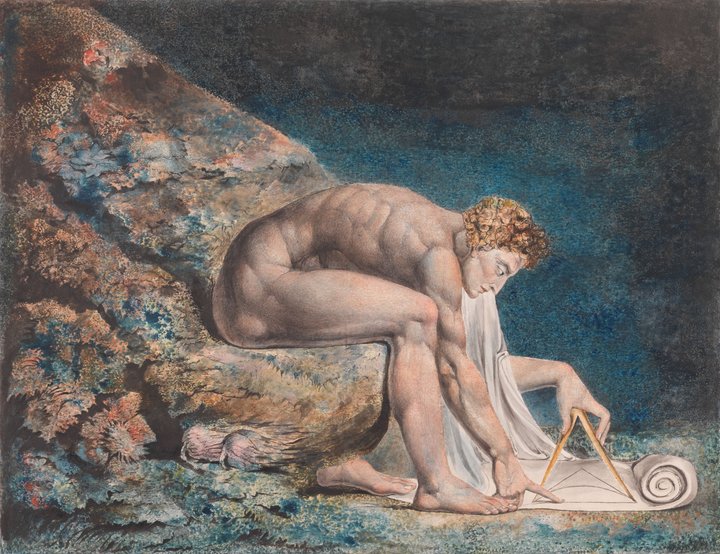
William Blake, Newton, 1795–c.1805, color print, ink and watercolour on paper
(London: Tate Britain)
◊ ◊ ◊ ◊ ◊
Press release (4 April 2019) for the exhibition:
William Blake
Tate Britain, London, 11 September 2019 — 2 February 2020
Curated by Martin Myrone and Amy Concannon
This autumn, Tate Britain will present the largest survey of work by William Blake (1757–1827) in the UK for a generation. A visionary painter, printmaker, and poet, Blake created some of the most iconic images in the history of British art and has remained an inspiration to artists, musicians, writers, and performers worldwide for over two centuries. This ambitious exhibition will bring together over 300 remarkable and rarely seen works and rediscover Blake as a visual artist for the 21st century.
 Tate Britain will reimagine the artist’s work as he intended it to be experienced. Blake’s art was a product of his tumultuous times, with revolution, war and progressive politics acting as the crucible of his unique imagination; yet he struggled to be understood and appreciated during his life. Now renowned as a poet, Blake also had grand ambitions as a visual artist and envisioned vast frescos that were never realised. For the first time, The Spiritual Form of Nelson Guiding Leviathan (c.1805–09) and The Spiritual Form of Pitt Guiding Behemoth (c.1805) will be digitally enlarged and projected onto the gallery wall on the huge scale that Blake imagined. The original artworks will be displayed nearby in a restaging of Blake’s ill-fated exhibition of 1809, the artist’s only significant attempt to create a public reputation for himself as a painter. Tate will recreate the domestic room above his family hosiery shop in which the show was held, allowing visitors to encounter the paintings exactly as people did in 1809.
The exhibition will provide a vivid biographical framework in which to consider Blake’s life and work. There will be a focus on London, the city in which he was born and lived for most of his life. The burgeoning metropolis was a constant inspiration for the artist, offering an environment in which harsh realities and pure imagination were woven together. His creative freedom was also dependent on the unwavering support of those closest to him, his friends, family, and patrons. Tate will highlight the vital presence of his wife Catherine who offered both practical assistance and became an unacknowledged hand in the production of his engravings and illuminated books. The exhibition will showcase a series of illustrations to Pilgrim’s Progress (1824–27) and a copy of the book The complaint, and the consolation Night Thoughts (1797), now thought to be coloured by Catherine.
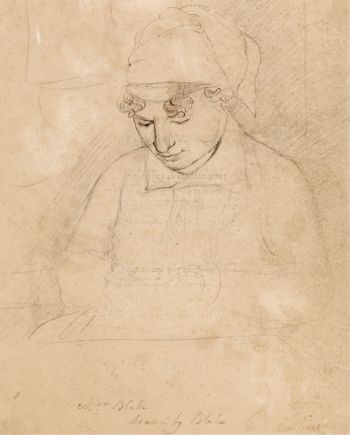
William Blake, Catherine Blake, 1805, graphite on paper (London: Tate Britain).
Blake was a staunch defender of the fundamental role of art in society and the importance of artistic freedom. Shaped by his personal struggles in a period of political terror and oppression, his technical innovation, and his political commitment, these beliefs have inspired the generations that followed and remain pertinent today. Tate Britain’s exhibition will open with Albion Rose (c.1793), an exuberant visualisation of the mythical founding of Britain, created in contrast to the commercialisation, austerity, and crass populism of the times. A section of the exhibition will also be dedicated to his illuminated books such as Songs of Innocence and of Experience (1794), his central achievement as a radical poet.
Additional highlights will include a selection of works from the Royal Collection and some of his best-known paintings including Newton (1795–c.1805) and Ghost of a Flea (c.1819–20). The latter work was inspired by a séance-induced vision and will be shown alongside a rarely seen preliminary sketch. The exhibition will close with The Ancient of Days (1827), a frontispiece for an edition of Europe: A Prophecy, completed only days before the artist’s death.
William Blake is curated by Martin Myrone, Lead Curator pre-1800 British Art, and Amy Concannon, Assistant Curator British Art 1790–1850. The exhibition will be accompanied by a catalogue from Tate Publishing (distributed by Princeton University Press), along with a programme of talks and events in the gallery.
Martin Myrone, ed., William Blake (London: Tate Publishing, 2019), 224 pages, ISBN: 978-0691198316, £43 / $55.
◊ ◊ ◊ ◊ ◊
Note (added 30 November 2019) — The original posting used the exhibition’s initial working title, William Blake: The Artist.
Exhibition | Power Couples: The Pendant Format

Barthel Bruyn the Younger, Portrait of a Gentleman and Portrait of a Lady, ca. 1555–65, oil on panel (Salt Lake City: Utah Museum of Fine Arts, University of Utah).
◊ ◊ ◊ ◊ ◊
Opening in July at UMFA:
Power Couples: The Pendant Format in Art
Utah Museum of Fine Arts, University of Utah, Salt Lake City, 11 July — 8 December 2019
Curated by Leslie Anderson
Power Couples: The Pendant Format in Art considers how two interdependent works, called ‘pendants’, convey meaning. The study of this popular format reveals a variety of artistic strategies at play—desires to communicate social hierarchy, gender roles, racial issues, complementary ideas, the passage of time, the continuity of space, and the appearance of truth in art.
Drawn from the UMFA’s rich collection and strengthened with select loans, the expansive exhibition will display works conceived as pairs in European, American, and regional art from the fifteenth century until the present day. Artists on view include Barthel Bruyn the Younger, Dirck Hals, Peeter Neefs the Elder, Gabriel and Augustin de Saint-Aubin, Gilbert Stuart, Edmonia Lewis, Robert Rauschenberg, Lorna Simpson, Nina Katchadourian, Kerry James Marshall, and Roni Horn. Leslie Anderson, curator of European, American, and regional art, organized this exhibition for the UMFA.
Despite its prevalence across time periods and cultures, the pendant, unlike its hinged predecessor the diptych, has never before been the subject of a comprehensive exhibition.
Exhibition | Frederick Augustus and Maria Josepha
◊ ◊ ◊ ◊ ◊
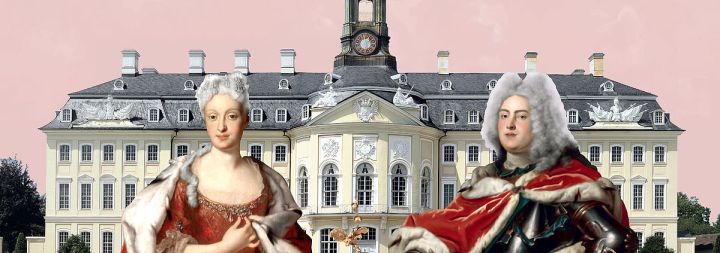
Begun in 1721, Hubertusburg Palace—named for the patron saint of hunting—was the site of the signing of the 1763 Treaty of Hubertusburg that ended the Seven Years’ War. From the Staatliche Kunstsammlungen Dresden:
Frederick Augustus and Maria Josepha: The Wedding of the Century and Saxony’s Lost Rococo
Es war die Hochzeit des Jahrhunderts – Das verlorene sächsische Rokoko
Schloss Hubertusburg, Wermsdorf, 28 April — 6 October 2019
Outstanding rococo art and a glittering wedding of the century: two special exhibitions at Schloss Hubertusburg, one of Europe’s largest hunting palaces, invite you on a journey through time. When Elector Frederick Augustus (Friedrich August), the son of Augustus the Strong, married the emperor’s daughter Maria Josepha in Dresden in September 1719, the people of Europe were treated to the sight of operas, parades, masquerades, and all the other trappings of a late baroque festival.
In the first part of this exhibition, Staatliche Kunstsammlungen Dresden invite visitors to rediscover the royal couple’s court and Saxony’s Lost Rococo. The exhibition rooms in the palace’s old piano nobile hold over 100 high-profile works of art and precious examples of Saxon rococo that transport visitors back in time to the everyday courtly life of this royal couple who left a deep mark on the style of their times with their passion for music, art, and culture.
In the second part of the exhibition, which addresses the couple’s wedding, Schlösserland Sachsen breathes new life into now unadorned rooms of the palace which have been opened to the public for the first time. Video installations and a rotating 360° video screen return sections of the building to their former glory, allowing visitors to see them as they were once imagined and designed by Maria Josepha and Frederick Augustus II and invites guests to join in the grandiose celebrations at The Wedding of the Century.
A New Royal Couple for Saxony and Poland
The wedding of Frederick Augustus II and Maria Josepha was a one-month spectacle of late baroque festivities. With operas, parades and masquerades, the young royals knew how to put on an impressive show and establish Saxony and Poland’s joint position among the other European powers.

Louis de Silvestre and workshop, Elector Frederick Augustus, ca. 1730 (Rüstkammer/Staatliche Kunstsammlungen Dresden, photo by Elke Estel and Hans Peter Klut).
Courtly Culture and Splendour
The reign of Frederick Augustus and Maria Josepha was marked by their great passion for culture, art and music. Thanks to their patronage and collecting, the Kingdom of Saxony and Poland developed into a thriving cultural landscape.
Operas and Music at the Court
Frederick Augustus and Maria Josepha transformed the Saxon court into a European centre for music, and especially operas. Soon, everyone was talking about the performances at Schloss Hubertusburg, with their high-profile casts and elaborate costumes.
A Passion for Collecting and Hunting
Frederick Augustus and Maria Josepha shared a keen enthusiasm for hunting, a courtly pleasure combining sociable entertainment and princely splendour. The extensive royal collection of hunting weapons—hunting knives, rifles, and pistols—includes some masterpieces of rococo art.
Rococo Palace and Hunting Lodge
Augustus the Strong—Frederick Augustus’s father—commissioned the building of Schloss Hubertusburg for the young royal couple in 1721. The building complex, with its magnificent grounds, is one of the largest hunting palaces in Europe.
Family and Dynasty
Masterpieces of portraiture depict the great family of Frederick Augustus II and Maria Josepha. The princes and princesses established important diplomatic networks by marrying strategically within Europe.
Exhibition | Solo la voluntad me sobra: Drawings by Goya
Opening this fall at The Prado:
Solo la voluntad me sobra: Dibujos de Goya
Museo Nacional del Prado, Madrid, 19 November 2019 — 16 February 2020
Curated by José Manuel Matilla and Manuela Mena
 This exhibition is the result of the research undertaken for the publication of a new catalogue raisonné of Goya’s drawings, as a result of the collaboration agreement signed in 2014 between the Fundación Botín and the Museo del Prado. Since the publication of Gassier’s catalogue in 1973 the number of drawings attributed to Goya has changed, giving rise to the need for a new catalogue raisonné which updates the enormous body of information accumulated over the course of two centuries of literature on this subject.
The exhibition will bring together more than 100 drawings by Goya from the Prado’s own collections and from public and private ones around the world. It will be presented as a chronological survey of his work that includes drawings from throughout his career, ranging from the Italian Sketchbook to the Bordeaux Albums. It will also offer an up-to-date vision of the ideas that recurrently appear in Goya’s work, revealing the ongoing and long-lasting relevance of his thinking. The exhibition is curated by José Manuel Matilla (Museo Nacional del Prado Senior Curator Drawings and Prints) and Manuela Mena (Museo del Prado Senior Curator Eighteenth-Century Painting).
Exhibition | The Master of Paper: Spanish Drawing Books

Opening this fall at The Prado:
The Master of Paper: Spanish Drawing Books of the 17th and 18th Centuries
El maestro de papel: Cartillas españolas para aprender a dibujar de los siglos XVII y XVIII
Museo Nacional del Prado, Madrid, 15 October 2019 — 2 February 2020
Curated by José Manuel Matilla and María Luisa Cuenca
This exhibition will place particular emphasis on Spanish drawing manuals of the 17th and 18th centuries, locating them in their international context. Although few in number they are particularly important, not just because they rapidly reflected this new tradition in art but also because they are notably from the outset for their distinctive Spanish and on occasions innovative character, as well as for the presence of unique elements that denote their national origin. Notable among Spanish artists in this field are Pedro de Villafranca y Malagón and prior to him, José de Ribera. Also notable are the manuals by José García Hidalgo, Friar Matías de Irala and José López Enguídanos.
The exhibition is curated by José Manuel Matilla, Museo Nacional del Prado Senior Curator Drawings and Prints and María Luisa Cuenca, Head of Library, Archive and Documentation Department at Museo Nacional del Prado.
Exhibition | Hogarth: Cruelty and Humor
Press release for the exhibition:
Hogarth: Cruelty and Humor
The Morgan Library & Museum, New York, 24 May — 22 September 2019
Curated by Jennifer Tonkovich
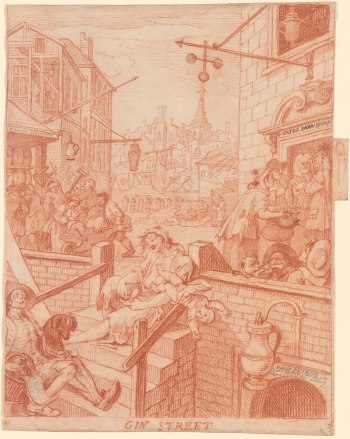
William Hogarth, Gin Street, 1750–51, red chalk, some graphite, on paper, incised with stylus (New York: The Morgan Library & Museum, purchased by Pierpont Morgan in 1909).
The Morgan Library & Museum announces a new exhibition of satirical drawings and prints by renowned artist William Hogarth (1697–1764). Best known for his humorous political commentary, Hogarth’s work engaged a broad audience and agitated for legislative and social change. His intricate drawings and richly anecdotal scenes depict the ills and injustices of eighteenth-century urban life, exploring the connections between violence, crime, alcohol abuse, and cruelty to animals. He hoped his graphic work would amuse, shock, and ultimately edify his audience. Hogarth: Cruelty and Humor tells the story of Hogarth’s iconic images and the social realities of life in Georgian London that inspired him to advocate for reform through popular works of art. It is the first show at the Morgan devoted to this artist, whose style was so influential in British art that the word ‘Hogarthian’ remains a recognizable way of describing works of satire.
Featuring over twenty works, the show investigates Hogarth’s creative process and examines his embrace of humor, highlighting the Morgan’s exceptional cache of preparatory drawings for his two most acclaimed print series from 1751: Beer Street and Gin Lane, and The Stages of Cruelty. Hogarth’s prints documenting the dangerous impact of the gin craze, Beer Street and Gin Lane, generated popular support for the 1751 Gin Act and other reform efforts, while the Stages of Cruelty reflects the growing anxiety about episodes of human brutality in London. Included in the show are the only other two known studies related to the Stages of Cruelty; these works reveal the complex generative process of the series. Also on view are drawings from The Royal Collection Trust that represent Hogarth’s first and last forays into satire.
Fiercely independent, Hogarth was driven to innovate in order to elevate the status of British art, creating new genres and modes of expression in his painting, printmaking, and drawing. His compositions are rich with narrative detail. It was his adoption of such ‘low’ subjects, no less than his use of humor, that led him to struggle to be taken seriously throughout his career.
“William Hogarth’s works should be enjoyed for their artistry, humor, and activism, and as such hold a special place in our drawings and prints collection,” said Colin B. Bailey, director of the museum. “The artist was a keen observer of his city, and his visual anecdotes were a brilliant means of communicating to a wider public.”
“Looking closely at Hogarth’s passion for socially relevant subjects reveals the challenges he faced in being known as a satirical artist,” said Jennifer Tonkovich, Eugene and Clare Thaw Curator of Drawings and Prints. “I think our current appetite for satire allows us to appreciate Hogarth’s tremendous intelligence and ambition in constructing narratives that he hoped would change the world around him.”
S E L E C T E D P R O G R A M M I N G
Laurel Peterson, Crafting Cruelty: Hogarth’s Innovative Drawing Methods
Tuesday, June 18, noon
William Hogarth achieved substantial artistic and commercial success in his lifetime, both as a printmaker and as a painter. Despite his enduring fame, Hogarth’s drawings are today little known and rarely studied. Laurel Peterson, Moore Curatorial Fellow in the Department of Drawings and Prints, will offer new insights into Hogarth’s practice as a draftsman, shedding light on the evolution of his drawing style and the role played by drawings in the development of his most iconic satirical prints. Co-sponsored by the Sir John Soane’s Museum Foundation.
Hogarth’s Gin Craze Festival
Friday, July 19, 6:00pm
Join us for an evening of revelry inspired by the Gin Craze of the 1750s! Enjoy gin-inspired bites and craft cocktails at Morgan Café and curatorial gallery talks at 6:00 and 7:30pm in the exhibition Hogarth: Cruelty and Humor. At 7:00pm we will screen the 1946 film Bedlam, which was inspired by William Hogarth’s A Rake’s Progress.
Bedlam, directed by Mark Robson (1946, 79 minutes)
Friday, July 19, 7:00pm
In 1760s London, an actress campaigns to reform a horrific hospital for the insane, but instead finds herself committed to the institution by the corrupt head of the asylum. Starring Boris Karloff and Anna Lee, Bedlam was the last in a series of stylish horror films produced by Val Lewton for RKO Radio Pictures.
Meredith Gamer, Hogarth: Cruelty and Crime
Thursday, 12 September, 6:30pm
Meredith Gamer, Assistant Professor of Art History at Columbia University, will explore the origins, evolution, and multi-layered meanings of William Hogarth’s The Four Stages of Cruelty (1751). A tale of neglect and abuse, murder and punishment, the series was—by eighteenth-century standards—one of Hogarth’s ‘lowest’ works. Paradoxically, however, it is also one of his most ambitious, for it aims to combat some of our most basic human frailties through the medium of art. Co-sponsored by the Sir John Soane’s Museum Foundation.
Display | Madame de Pompadour in the Frame
Opening in a few weeks at Waddesdon Manor:
Madame de Pompadour in the Frame
Waddesdon Manor, Buckinghamshire, 23 May – 27 Octotber 2019
 This exhibition will shine a spotlight on how technology is being used to enhance our understanding of art history, enabling masterpieces which have been victims of circumstance or history to be seen as they were once intended.
François Boucher’s famous portrait of Madame de Pompadour (1756) is today one of the most prized paintings on display at the Alte Pinakothek in Munich*, yet this monumental portrait was once owned by Baron Ferdinand de Rothschild. Ferdinand had acquired it in 1887, and displayed it in his London house, 143 Piccadilly. Either before, or shortly after he acquired it, the portrait was re-framed. When he died, Ferdinand bequeathed the painting to his brother Nathaniel, but while the canvas eventually found its way to Germany, the impressive 18th-century frame was retained and ended up at Waddesdon Manor.
Now, thanks to a collaboration with Factum Foundation, specialists in high-resolution digital scanning technology, and with the support of the Alte Pinakothek, this new exhibition will recreate the masterpiece as it would have been known in the 19th century by Baron Ferdinand. In a marriage of traditional conservation and restoration techniques with the most advanced 3D digital reproduction technology, it will place a facsimile of the portrait back in Baron Ferdinand’s frame, which has been conserved especially for the show. Visitors will be able to explore for themselves other digital and 3D reproductions in touch displays, and a film will illustrate Factum Foundation’s process of re-creating Madame de Pompadour.
The exhibition will also explore the historical connection between the Madame de Pompadour painting and frame and Waddesdon and the Rothschild family. A particular highlight will be a 1757 Charles-Germain de Saint-Aubin caricature from a unique book of satirical cartoons, which is seldom on display.
* François Boucher’s Madame de Pompadour (1756) is on display at the Alte Pinakothek in Munich (on permanent loan from the HypoVereinsbank, Member of UniCredit).
Exhibition | Madame de Maintenon
Now on view at Versailles:
Madame de Maintenon: In the Corridors of Power
Château de Versailles, 16 April — 21 July 2019
Curated by Alexandre Maral and Mathieu da Vinha
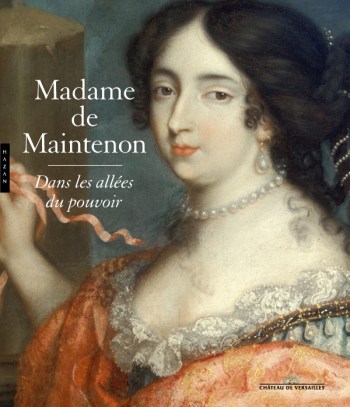 The first exhibition entirely devoted to the Marquise of Maintenon, on the tercentenary of her death on 15 April 1719, recounts the extraordinary life of Françoise d’Aubigné (1635–1719). She was born in a prison yet went on to become the Sun King’s wife in 1683.
The different stages of her life are shown in around 60 works from the collections of Versailles and other museums, including paintings, drawings, engravings, books, sculptures, medals, and so on. The visit passes through the four adjoining rooms of the apartment she lived in from 1682 until 1715, on the first floor of the Palace’s central section.
The scenography returns the walls to their original colours at the time. They are richly draped in alternating silk panels as described in the Furniture Store-House inventories from 1708: red damask, crimson damask, and red taffeta for the second antechamber; green and gold damask for the bedroom; and crimson and gold flower damask for the Chambers. This installation was made possible thanks to the restoration of these wall hangings by Tassinari et Chatel, the nation’s oldest silk manufacturer, founded in Lyon by Louis XIV.
The exhibition is curated by Alexandre Maral (Head Curator for Heritage and Director of the Centre de recherche du château de Versailles) and Mathieu da Vinha (Scientific Director of the Centre de recherche du château de Versailles), with scenography by Jérôme Dumoux.
Alexandre Maral and Mathieu da Vinha, Madame de Maintenon: Dans les allées du pouvoir (Paris: Hazan, 2019), 192 pages, ISBN: 978-2754110723, 35€.
The exhibition brochure (in French and English) is available as PDF file here
◊ ◊ ◊ ◊ ◊
Symposium | Madame de Maintenon, 1719–2019
Château de Versailles, 21–23 March 2019
This international symposium offered a fresh look at this multifaceted historical figure, reviewing the biographical aspects of the Marquise, as well as her correspondence and the literary and iconographic legend surrounding her.
Details along with audio recordings are available here.
Exhibition | The Taste of Marie Leszczyńska
Now on view at Versailles:
Le Goût de Marie Leszczyńska
Château de Versailles, open from 16 April 2019
Curated by Gwenola Firmin and Marie-Laure de Rochebrune, with Vincent Bastien
 During the 42 years she spent at Versailles, Marie Leszczyńska (1703–1768) had a profound impact on both the layout of the Palace and artistic life at the time. Her influence has inspired this dedicated exhibition. A Taste of Marie Leszczyńska is presented in the Dauphine’s Apartments, which have been reopened for the occasion. Although few traces of her 42 years at the Palace remain—most were wiped out as a result of the changes wrought by Marie-Antoinette—the wife of King Louis XV nevertheless made her mark through the art she commissioned and the private chambers she created.
The exhibition gathers together around 50 paintings and other works of art, most of which are from the Palace collections and include several recent acquisitions of great significance for the Musée National des Châteaux de Versailles et de Trianon. The aim is to illustrate how her personal taste evolved throughout the course of her reign and thus get to know her better.
In Pursuit of Privacy
Throughout her reign, Marie Leszczyńska abided by the ceremonial rules required in the Queen’s State Apartment, endeavouring always to lead an exemplary life free of any scandal. As for the layout of the Palace, from 1725 she set about redesigning her chamber in the style of the time: wood panelling carved by Vassé was installed over the fireplace, which was replaced with one in Sarrancolin marble. The décor between the windows was created by the master sculptors Verbeckt, Dugoulon, and Le Goupil. The overdoor panels, which are still in place today, were commissioned by the Queen in 1734 from Jean-François de Troy—whose La Gloire des princes s’empare des Enfants de France features the Dauphin and his two eldest sisters—and Charles-Joseph Natoire, who painted La Jeunesse et la Vertu présentent les deux princesses à la France.
In 1735, Gilbert de Sève’s ceiling painting of Apollon au milieu des Heures was replaced by a geometric design adorned with intertwined figures of the royal couple. At the same time, on the order of Louis XV, the managers of the King’s buildings asked François Boucher to decorate the arches with four grisaille paintings representing the Virtues: Prudence, Piety, Charity, Generosity. But Marie Leszczyńska had to wait another 13 years, until 1764, before the tarnished gilt was restored under the supervision of François Vernet.
The Queen liked to live a simple life, even if only for a few hours a day, so she had private chambers installed directly behind her parade apartment, and it was to these she withdrew for a number of hours each day to pray, meditate, read, and spend time with those closest to her.
Painting, Master of Arts

Marie Leszczyńska after the work by jean-Baptiste Oudry, The Farm (Château de Versailles; photo by Gérard Blot).
Marie Leszczyńska spoke several languages and was highly cultured, with a great interest in the creative occupations, literature, music and art—especially painting. Indeed, one of the rooms in her private apartment was laid out as a studio. Her ‘colourist’, Etienne Jeaurat, guided her paintbrush for 15 years, and she was advised by Jean-Baptiste Oudry. Among other works attributed to the Queen is a faithful rendition of a painting by the latter, called Une Ferme (A Farm).
One of her favourite painters was Jean-Marc Nattier, whose portrait of her wearing ‘town clothing’ was completed in 1748. But the one she regarded most highly was Charles-Antoine Coypel, who produced no fewer than 34 religious paintings for the Queen’s private chambers. She also liked to contemplate lightweight subjects, chinoiserie, pastoral scenes, and landscapes.
A Touch of the Exotic
Marie Leszczyńska had a particular affinity for China. In 1747, she created an oriental chamber in her ‘laboratory’, in the heart of her private apartment. In 1761, she decided to replace it with a collection of canvases known as the Chinese Chamber. The paintings were produced by five painters of the King’s State Apartments—Coqueret, Frédou, de la Roche, Prévost and Jeaurat—as well as Marie Leszczynska herself. They portray a picturesque image of China, inspired by the tales of travellers to the land of Cathay. The tea ceremony, evangelisation of the Chinese by the Jesuits, and a fair in Nanking are among the events depicted. Chinese architecture, dress and landscapes are portrayed in minute detail, while the bird’s-eye perspective is taken directly from Chinese painting.
During the last 15 years of her reign, a new artistic trend emerged in France, which, from the 18th century, was referred to as à la grecque (‘in the Greek style’). The trend marked the onset of the neoclassical movement and rejected the outmoded Rococo style in favour of a deliberate return to the simplicity of classical antiquity and a more decorative repertoire of subjects drawn from Greek art. The Queen participated in this movement in her own way.
For example, in 1753, she commissioned an overdoor panel for her chamber, depicting the arrival of Saint Francis Xavier in China, from Joseph Marie Vien (1716–1809), who would go on to become the leading exponent of this style in terms of painting. Later, in 1766, she appointed Richard Mique (1728–1794) to carry out a project that was particularly close to her heart: the construction at Versailles of a convent for the canonesses of Saint Augustine, who provided education for young girls (it is now the Hoche school). It was decided to lay the convent chapel out in the form of a Greek cross within a square, accessed by an entrance portal comprising an arcade of Ionic columns capped by a pediment. The chapel was completed after the Queen’s death thanks to the determined efforts of her daughter, Madame Adelaide.
From the early 1760s, the new style was also adopted by the Royal Sèvres porcelain manufacture for its service pieces, as well as vases and sculpted ornaments. Étienne-Maurice Falconet (1716–1791), head of the sculpture studio from 1757 to 1766, produced many bisque figures and vases with a neoclassical look and feel.
Through her architectural alterations, her style and, above all, the way in which she conducted herself as queen, Marie Leszczyńska led a quiet revolution.
The exhibition is curated by Gwenola Firmin, chief curator at the Musée National des Châteaux de Versailles et de Trianon, and Marie-Laure de Rochebrune, chief curator at the Musée National des Châteaux de Versailles et de Trianon, with assistance from Vincent Bastien, doctor of art history.
The exhibition brochure (in French and English) is available as PDF file here»










leave a comment