Exhibition | Triumph of the Baroque, Painting from 1600 to 1800
Now on view at the Hofburg:
Triumph des Barock: Malerei von 1600 bis 1800 / Il Trionfo del Barocco: Pittura dal 1600 al 1800
Diocesan Museum, Hofburg (Bishop’s Palace), Brixen / Bressanone, Italy, 28 April — 31 October 2018
 Barocke Kunst ist triumphale Ausdruckskunst. So auch in der Malerei. Die Ausstellung schöpft aus dem umfangreichen Bestand der Hofburg und zeigt Gemälde von den frühen Anfängen um 1600 bis in die Spätphase um 1800. Eine Schaulust für das Auge.
Nie waren den Menschen der Himmel und das Leben mit den Himmlischen so vertraut wie in der Barockzeit. Erzählungen aus der Bibel, Schilderungen aus dem Leben von Heiligen, Darstellungen von Maria mit dem Jesuskind—sie alle führen das Auf und Ab des Lebens vor Augen. Berühmte Maler aus Tirol sowie überregional bedeutende Künstler schufen Altarbilder für Kirchen und sakrale Gemälde zur privaten Andacht. Eine Auswahl ihrer Werke ist in der Ausstellung zu sehen, darunter Bilder von Stephan Kessler, Johann Georg Grasmair und Ulrich Glantschnigg, von Martin Theophil Polak, Karl Skreta und Johann Lingelbach. Auch Gemälde der in Wien zu Ruhm gelangten Tiroler Barockmaler, wie Paul Troger, Michael Angelo Unterberger und Josef Ignaz Mildorfer, sind ausgestellt.
Kopien nach berühmten Meistern spielten in der barocken Malerei eine große Rolle. Sie vermittelten das gedankliche Konzept des Originals nahezu ungeschmälert und trugen wesentlich zur Beliebtheit einzelner Bildmotive dar. Eine Auswahl hochwertiger Kopien wird in der Ausstellung gezeigt.
Neben Altarbildern und religiösen Werken sind auch Porträts zu sehen, einige von ihnen zum ersten Mal. Porträts stellten Macht und Reichtum, Bildung und Stand der Dargestellten zur Schau. Sie stehen für Inszenierung und Selbstdarstellung von Klerus, Adel und Bürgertum.
Johann Kronbichler, Die barocken Gemälde der Hofburg Brixen (Brixen: Hofburg, 2018), 396 pages, ISBN: 978-8888570235, $75.
 Zur Ausstellung erscheint ein Bestandskatalog. Dieser enthält—über die in der Ausstellung gezeigten Werke hinaus—alle barocken Gemälde aus der Schausammlung und den Depots sowie die Gemälde und Wandmalereien der barocken Ausstattung der Hofburg. Mit seinen knapp 700 vorgestellten Werken und dem umfangreichen Bildmaterial stellt der von Johann Kronbichler verfasste Bestandskatalog ein unverzichtbares Grundlagenwerk zur Barockkunst in Südtirol dar. Der Katalog, Band 4 der Veröffentlichungen der Hofburg Brixen, ist in der Hofburg und im Buchhandel erhältlich.
Exhibition | Blast from the Past: Artillery in the War of Independence
Along with artillery objects, the exhibition includes British paintings of arms manufacturing on loan from the National Maritime Museum in Greenwich and the Musée de l’Armée at Les Invalides in Paris.
Blast from the Past: Artillery in the War of Independence
American Revolution Museum, Yorktown, 10 June 2018 — 5 January 2019
Curated by Sarah Meschutt
 As the last great victory of the American Revolution, the 1781 Siege at Yorktown is known for the use of artillery by General George Washington’s Continental Army. Through interactive elements and artifact displays, Blast from the Past: Artillery in the War of Independence features artillery used on all fronts of the American Revolution by the American, French, and British forces. This special exhibition explores a range of topics from innovations in artillery design and technology to the individual roles of an artillery crew. Topics examine artillery deployment and transport, as well as the range of fire and science behind these powerful weapons.
Blast from the Past highlights the chronology of the weapons and reveal the technology and innovation that delivered the last great victory of the Revolution—a victory that forever made Yorktown, Virginia, the place where the subjects of a king became the citizens of a nation.
American, French and British artillery pieces include:
• British Light 3-pounder bronze field cannon, cast by Jan and Pieter Verbruggen, ca. 1776, on loan from the U.S. Army Center of Military History
• ‘La Perileuse’ French 4-pounder bronze field cannon, cast by Jean Bérenger at Strasbourg, ca 1758, on loan from the National Park Service Springfield Armory National Historic Site
• British 12-pounder bronze ‘Lafayette’ cannon, cast by William Bowen, ca. 1759, on loan from the National Park Service, Colonial National Historical Park, Yorktown Collection
• American 6-pounder iron cannon, cast by Samuel and Daniel Hughes, ca. 1775–83, on loan from the Mayor and Council of Boonsboro, Maryland
• ‘La Bellone’ French 4-pounder bronze battalion cannon, cast by D.E. Dupont at Rochefort, ca. 1773, on loan from the National Park Service, Home of Franklin D. Roosevelt National Historical Site
Visitors can take in the size and scope of American, French, and British artillery and then explore the museum for a range of hands-on experiences.
• Discover types of artillery—cannons, mortars and howitzers—and types of ammunition, from shot and shell to canister and grape.
• Figure out the right artillery tool for the job—types of shot and essential implements of rammer, sponge and linstock—in a hands-on display.
• How does one move a gun? Lift a door to determine the strength by men and horses to advance a light or heavy gun.
• Examine an artilleryman’s pocket guide; see interactive 18th-century artillery field manuals that served as reference to determine tasks such as how to draw a 6-pounder up a steep cliff or bluff.
Exhibition | The American Revolution: A World War

Louis-Nicolas Van Blarenberge, The Siege of Yorktown, 1786; gouache on panel, 24 × 37 inches
(Private Collection of Nicholas Taubman)
◊ ◊ ◊ ◊ ◊
Van Blarenberghe’s two Yorktown paintings were on view last year at Philadelphia’s Museum of the American Revolution. Press release (21 June 2018) from The National Museum of American History:
The American Revolution: A World War
Smithsonian’s National Museum of American History, Washington, D.C., 26 June — 9 July 2019
Curated by David Allison
A global lens is placed on the story of American independence in the exhibition The American Revolution: A World War, open June 26 through July 9, 2019, at the Smithsonian’s National Museum of American History. The focal point of this one-year exhibition, on view in The Nicholas F. and Eugenia Taubman Gallery, centers on two historical paintings that depict the culminating events at Yorktown in 1781, which ended the war on American soil, and a portrait of General George Washington.

Charles Willson Peale, Washington at Yorktown, 1780–82, painted for French General Comte de Rochambeau.
The American Revolution: A World War explores the Franco-American partnership during the Revolution and the extent to which international relations shaped the formation of the United States. General Jean-Baptiste Donatien de Vimeur, Comte de Rochambeau, led the French forces at Yorktown. Two of the paintings were created by Louis-Nicolas Van Blarenberghe and are copies he made for Rochambeau of paintings presented to King Louis XVI. The Washington portrait is by Charles Willson Peale. All three once hung in Rochambeau’s home as reminders of his partnership with Washington that resulted in the American victory.
“The American colonies had no hope of winning their independence alone,” said David Allison, project director and senior curator of the exhibition. “They had to gain support from other European powers, most importantly from France and Spain and the involvement of these nations would affect not only the history of the new United States of America, but their own histories as well.”
The Siege of Yorktown and The Surrender of Yorktown, both painted in 1786, and the Washington portrait painted in 1780–82 are united for the first time in a national museum since they were displayed together in the 1700s in Rochambeau’s chamber. The Van Blarenberghe paintings will each be augmented by an interactive computer, allowing visitors to examine enlargements of the paintings and to read eyewitness accounts of the events.
Other artifacts to be displayed include a pistol given to Washington by British General Edward Braddock during the Seven Years War; a cannon used at Yorktown, representing how the French supplied weapons, soldiers, funding and warships to America; Washington’s Yorktown siege map drawn after the conflict; a ship model of Admiral de Grasse’s Ville de Paris, which led the French fleet that blocked British ships; and an almanac and memorabilia commemorating the Marquis de Lafayette’s visit to the United States near the 50th anniversary of Independence. In addition to Peale’s Washington, images of the other three leaders involved in the American Revolution will be on display: Rochambeau, the Marquis de Lafayette of France and General Charles Cornwallis of Great Britain.
Americans often think that the American Revolution ended with the Siege of Yorktown in 1781, but, in fact, war continued around the world as European powers fought to defend their interests. These wider conflicts ultimately determined the terms Britain accepted in the 1783 treaty granting the United States its independence. Britain also had to negotiate treaties with France, Spain and the Dutch Republic before the wider war connected to the American Revolution finally concluded in 1784.
The exhibition is made possible through the generous support of Ambassador Nicholas F. and Eugenia L. Taubman with additional support from Jeff and Mary Lynn Garrett and Susan and Elihu Rose. A number of objects are on loan from private collections, museums and other institutions, including the Society of the Cincinnati, Winterthur and the Musée de l’Armée in Paris. The exhibition will open in the recently transformed wing of the museum’s second floor, which is themed The Nation We Build Together and features exhibitions that tell the story of America’s founding and future as a country built on the ideals and ideas of freedom and opportunity.
A book to accompany the exhibition will be published in November:
David Allison and Larrie Ferreiro, eds., The American Revolution: A World War (Washington, D.C.: Smithsonian Books, 2018), 272 pages, ISBN: 978-1588346339, $30.
 The American Revolution: A World War argues for the importance of understanding the American Revolution in a global context. The illustrated companion volume to the Smithsonian National Museum of American History exhibition of the same name, this book posits that it is not possible to fully understand the Revolution if it is seen as a solely American conflict. Instead, American motivations and contributions must be considered alongside those of the British, French, Spanish, and Dutch. Highlighting the often overlooked international nature of the Revolution while grounding it in its origins—the fight for independence from Great Britain—this collection of essays from leading writers on the Revolution touches on such topics as European diplomacy, overseas empires, economic rivalries, supremacy of the seas, and more. Together the book’s incisive text, full-color images, and topical sidebars underscore that America’s fight for independence is most clearly comprehended as one of the first global struggles for power.
David K. Allison is Senior Scholar at the Smithsonian’s National Museum of American History. Larrie D. Ferreiro teaches history and engineering at George Mason University in Virginia, Georgetown University in Washington, D.C., and the Stevens Institute of Technology in New Jersey. He is the author of Brothers at Arms: American Independence and the Men of France and Spain Who Saved It, a finalist for the Pulitzer Prize.
Installation | Brian Tolle’s Eureka

Press release, via ArtDaily (30 June 2018). . .
Brian Tolle’s Eureka
Federal Hall National Memorial, Wall Street, New York, 27 June — 8 September 2018
The National Parks of New York Harbor Conservancy, in partnership with the National Park Service, announces the presentation of Brian Tolle’s Eureka, on view from June 27 until September 8, 2018, in Federal Hall, the iconic memorial to democracy on Wall Street. Eureka is part of a new art initiative, curated by Bonnie Levinson, inviting contemporary artists to investigate themes that resonate with the history and legacy of Federal Hall, melding the past and present, to serve as a catalyst toward the reinvigoration of civic life and a platform for free expression.
 For this presentation of Eureka, Tolle has chosen to exhibit his work alongside a rare viewing of the Flushing Remonstrance, the 1657 New Netherland petition for “liberty of conscience” that served as the precursor to religious freedom, as cemented in the First Amendment written at Federal Hall over a century later. Not seen in Manhattan in over 30 years, the Remonstrance shares a room with the Bible from President Washington’s 1789 inauguration at Federal Hall.
Tolle’s 40-foot tall sculpture, reflecting a rippling and distorted facade of a 17th-century Dutch canal house, pays homage to the legacy of 40 years of Dutch rule in New York. Originally created for Jan Hoet’s city-wide exhibition, Over the Edges, 2000, in Ghent, Belgium, its re-presentation in Federal Hall blurs the site’s architectural and political history with the contemporary in the conceptual artwork.
Brian Tolle describes the work: “Eureka is a sculptural play with illusion—a facade of a facade. Its Dutch-inspired form points to New York’s early history and its fluid, but troubled, transformation from a Dutch seat of power to British colony, to an American platform for diversity and democracy. The sculpture is an apparition, a mirage of a building that has been displaced and no longer exists. Like the Dutch buildings of lower Manhattan and the canal that was once Broad Street—erased with only the street names lingering as a reminder of their existence—Eureka serves as a marker of Federal Hall’s complex history. Its thin veil floats upwards, into the neoclassical dome of Federal Hall, evoking the strife between form and object, as well as the tension between political volley and social action.”
The artwork’s title is inspired by the brilliant Greek polymath Archimedes’s exploration of displacement. After finding the upward pressure on a submerged object created buoyant force, Archimedes ran through the streets of Syracuse, Sicily, shouting, “Eureka! Eureka!” or “I found it! I found it!” Tolle envisioned Eureka as a metaphor for Archimedes’s principle of leverage. With the right tools, Archimedes believed all was possible. “Give me a lever long enough and a fulcrum on which to stand,” he said, “and I shall move the world.”
The nation’s Founders leveraged principles as powerful as Archimedes’s when they codified the historic events that occurred at Federal Hall, including: the acquittal in 1735 of the newspaper publisher John Peter Zenger for libel, after he exposed government corruption, which established the foundation for freedom of the press; the 1765 Stamp Act Congress, which protested taxation of then British colonies without representation, and sowed the seeds for the union to come; and the passing of the first amendments to the Constitution, which cemented in perpetuity individual rights.
“The National Park Service is honored to host Tolle’s magnificent edifice Eureka and the Flushing Remonstrance, a transformational document to establishing the governing principles of the United States,” said Shirley McKinney, Superintendent for Federal Hall National Memorial. “As the site where George Washington took the oath of office as our first President and the site of the first Congress, Supreme Court, and Executive Branch offices, Federal Hall is the appropriate venue to bring the two together to spark conversations about history through a contemporary lens.”
“As we embark on a new day for Federal Hall, this installation highlights this historic site’s potential as an ever-evolving arena for public discourse through the arts,” said Marie Salerno, President of the Harbor Conservancy. “Federal Hall must be steeped, but not stuck in the past. This will be a place where artists with diverse perspectives will be invited to interpret the ideas, ideals and flaws of our democracy forged here.
Brian Tolle’s sculptures and installations emphasize a formal and iconographic dialog with history and context. Using a variety of media, his work draws from the scale and experience of its surroundings, provoking a rereading by cross-wiring reality and fiction. Drawing ideas from a broad-based conceptual analysis, Tolle blurs the border between the contemporary and the historical. His approach involves in-depth research, which is then distilled and directed creating an intuitive personal response.
Tolle is acclaimed for his major permanent public artworks including the Irish Hunger Memorial in Battery Park City, New York; Miss Brooklyn and Miss Manhattan at the entrance of the Manhattan Bridge, Flatbush, Brooklyn; and his recent appointment as the lead artist of the East Midtown Waterfront Project, an esplanade between East 53rd and East 59th Streets along New York City’s East River. Tolle’s works have been exhibited in the Whitney Biennial; the Tate Modern; the S.M.A.K.; the Institute of Contemporary Art, Philadelphia; the Queens Museum of Art, New York; and the Invitational Exhibition at the American Academy of Arts. The artist is currently represented by C24 Gallery.
Exhibition | Storytelling: French Art from the Horvitz Collection
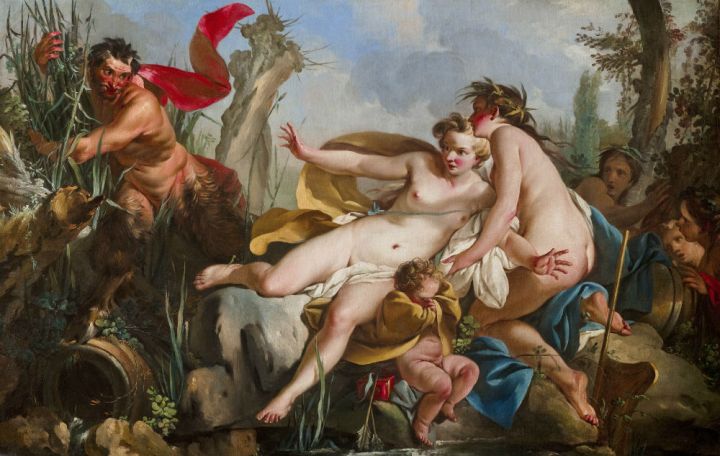
Jean-Baptiste-Marie Pierre, Pan and Syrinx, 1746, oil on canvas, 90 × 141 cm
(Boston: The Horvitz Collection, P-F-57).
◊ ◊ ◊ ◊ ◊
Now on view at the Cummer Museum:
Storytelling: French Art from the Horvitz Collection
Cummer Museum of Art & Gardens, Jacksonville, Florida, 25 May — 29 July 2018
John and Marble Ringling Museum of Art, Sarasota, Florida, 9 September — 2 December 2018
Fairfield University Art Museum, Fairfield, Connecticut, 25 January — 29 March 2019
Curated by Alvin Clark
Storytelling: French Art from the Horvitz Collection combines two exhibitions: Imaging Text: Drawings for French Book Illustration and Seventeenth- and Eighteenth-Century French Paintings, from one of the world’s finest private collections of French art. Created between the 16th and 19th centuries, and ranging from mythological and biblical studies to more playful imagery, the 80 works included in the exhibition vary in terms of style, genre, and period. Captured in crisp and swift pen strokes, finely modulated chalk, or brilliant colors, these captivating compositions were produced by some of the most prominent artists of their time, such as Charles Le Brun (1619–1690), Charles-Nicolas Cochin, the younger (1715–1790), and Jean-Honoré Fragonard (1732–1806).
The exhibition is curated by Alvin L. Clark, Jr, Curator, The Horvitz Collection, Department of Drawings, Division of European and American Art, Harvard Art Museums.
Alvin Clark and Elizabeth M. Rudy, Imaging Text: French Drawings for Book Illustration from The Horvitz Collection (Boston: The Horvitz Collection, 2018), 76 pages, ISBN: 978-0991262533, $15.
◊ ◊ ◊ ◊ ◊
Note (added 10 January 2018) — The posting was updated to included Fairfield University Art Museum.
Exhibition | 18th-Century Baltic Faience

Dish, eighteenth century, faience, Rörstrand
(Stockholm: Nationalmuseum)
◊ ◊ ◊ ◊ ◊
On view this summer in Sweden:
Colour and Form: 18th-Century Baltic Faience
Färg och form: Östersjöfajanser från 1700-talet
Läckö Castle, Lidköping, 10 June — 26 August 2018
Curated by Micael Ernstell
Eighteenth-century pieces of faience from the Baltic region seduced the market with their rich decoration and fine design. This exhibition presents faience artefacts from Nationalmuseum’s amazing collection of ceramics from the 18th century that were manufactured in the countries around the Baltic Sea.
The items in the exhibition, which Nationalmuseum is presenting in partnership with the Läckö Castle Foundation, have a vibrancy and joy that combine with the manufacturers’ ambitions for good design, both aesthetically and technically. The colour palette used by the pattern painters was a rich one, and it seduced the market for much of the 18th century. There has been strong interest among collectors since then.
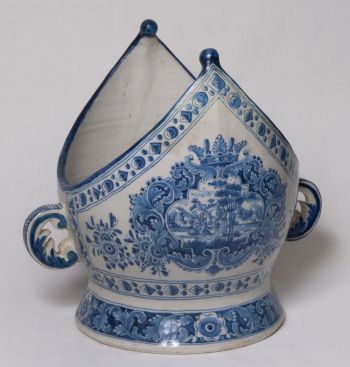
Bowl, so called ‘Bispebolle’, unknown Danish artist active during the 18th century, faience (Stockholm: Nationalmuseum).
The exhibition is dominated by Swedish faience, with the Rörstrand and Marieberg factories as the most important actors. The factories had their own designers, who created many inspirational models and patterns. Production resulted in many examples of international influences. There was also movement of labour between the factories. This saw patterns and designs moving between the competitors.
The manufacturing of faience in Sweden during the 18th century was one element of the national leadership’s desire to develop the nation’s economy and avoid expensive imports. Tax rules and other privileges created the economic preconditions for Swedish faience. Another major factor in helping the Swedish factories was the Manufactory Office (Manufakturkontoret), which aimed to provide manufacturers with both economic and artistic guidance.
“We’re delighted about the long-term and rewarding partnership with the Nationalmuseum. The fact that artefacts from Rörstrand are included feels especially pleasing for Lidköping. One of the financiers of the Rörstrand faience factory was Carl-Gustaf Tessin, the owner of Läckö from 1752 until 1770,” says Magnus Lönnroth, CEO of the Läckö Castle Foundation.
There were almost 40 faience factories around the Baltic Sea in the 18th century. Although production reached a high level, the factories were mostly unprofitable. This meant that many factories only existed for a few years. The ones that started up first were the factories of Store Kongensgade in Copenhagen and Rörstrand in Stockholm. They started in the 1720s, both with a dream of being able to produce the same kind of porcelain as in China or at the Meissen factory in Dresden.
Apart from examples of Swedish manufacturing, the exhibition features artefacts from ten or so factories around the Baltic. There are examples from the Store Kongensgade factory in Copenhagen, which was founded in 1722 and is the oldest faience factory in the Nordic region. Johan Wolff came from that factory to Stockholm and founded the Rörstrand factory in 1726. Norway is also represented, as that was part of Denmark at the time.
“It’s wonderful that we can also use the exhibition to highlight the 100th anniversary of the Baltic States as independent nations with colourful pieces of faience from the factory in Reval, the modern-day Tallinn in Estonia,” says Micael Ernstell, curator of the exhibition and director of the National Museum.
Exhibition | Pastels at the Louvre
Now on view at the Louvre:
Pastels in the Musée du Louvre: The 17th and 18th Centuries
Musée du Louvre, Paris, 7 June — 10 September 2018
Curated by Xavier Salmon
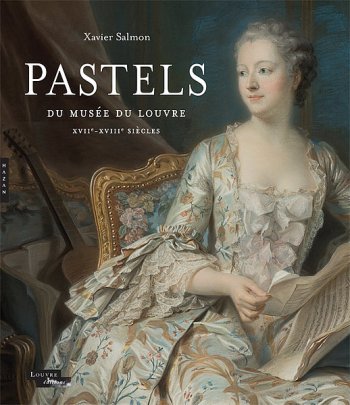 The Louvre holds an unrivaled collection of European pastels from the 17th and 18th centuries. Mostly dating from the reigns of Louis XV and Louis XVI, these extremely fragile works, created with a colored powder that has often been compared to that of a butterfly’s wings, introduce us to Enlightenment society and illustrate the genius of its most celebrated artists: Rosalba Carriera, Maurice Quentin de La Tour, Jean-Baptiste Siméon Chardin, Jean-Baptiste Perronneau, Jean Étienne Liotard, Jean-Marc Nattier, and Élisabeth Louise Vigée Le Brun, together with lesser known artists such as Marie-Suzanne Giroust, Adélaïde Labille-Guiard, Joseph Boze, and Joseph Ducreux.
These pastels illustrate the genius of the artists who produced them as artworks in their own right rather than preparatory studies enhanced with color. Many of them still have their original frame, and sometimes their original glass.
Thanks to the support of American Friends of the Louvre and Joan and Mike Kahn, the more than 150 works in the collection were systematically conserved and remounted to protect them from dust—a long-term project which provided an opportunity for new research on the collection. The results are included in a comprehensive annotated inventory, published in French and English with the support of the Joan Kahn Family Trust.
The exhibition takes a new look at masterpieces such as Maurice Quentin de La Tour’s Portrait of the Marquise de Pompadour and features new acquisitions such as Simon Bernard Lenoir’s portrait of the actor Lekain. It is also an opportunity to compare these works by French artists with others by eminent international pastel artists such as Rosalba Carriera in Venice, Jean-Étienne Liotard in Geneva, and John Russell in London.
The exhibition is curated by Xavier Salmon, director of the Départment des Arts Graphiques and general heritage curator at the Musée du Louvre.
The catalogue, in French and English editions, is published by Hazan and distributed by Yale UP:
Xavier Salmon, Pastels du musée du Louvre, XVIIe XVIIIe siècle (Paris: Hazan, 2018), 384 pages, ISBN: 978-2754114547 (French) / ISBN: 978-0300238631 (English), €59 / $75.
Exhibition | Cozens and Cozens

The exhibition closed earlier this month:
Cozens and Cozens
The Whitworth, University of Manchester, 16 June 2017 — 24 June 2018
Father and son, Alexander and John Robert Cozens, were influential watercolour painters of the 18th century. Alexander was a drawing master who dedicated his career to teaching young men and the aristocracy how to create landscapes without needing to attend the Royal Academy. This resulted in the publication of multiple guides demonstrating how to create the ideal landscape from a catalogue of features, such as clouds, mountains and trees. Consequently, many of Alexander’s surviving works are fictional landscapes. Alexander argued that landscape images could evoke particular states of mind or moral feelings in the viewer. He became known as the ‘blot master’ for creating improvised compositions from random markings, an idea first suggested by Leonardo da Vinci. His theories elevated the status of landscape painting in the 18th century and helped propel art practice towards the freedom that resulted in Abstract Expressionism.
Visually John Robert inherited the skill of his father, but by contrast his works were honest accounts of his travels. The Romantic painter John Constable declared that John Robert ‘was the greatest genius that ever touched landscape’ as his work ‘was all poetry’. Painting a landscape with watercolours was traditionally for topography, mapping landscapes. Watercolour was ideal as it was portable and could be used to ‘tint’ or ‘stain’ a map within the lines without distorting it. John Robert revolutionized landscapes by painting with watercolour to create mystery and emotion in the places he depicted.
The Whitworth owns nineteen watercolours and a rare oil by Alexander, one of only five known to exist. The gallery owns seventeen watercolors and thirteen soft-ground etchings by John Robert. Seven sketchbooks from his Grand Tours of Europe in 1782–83 have been digitized allowing visitors to see every page for the first time. They are unique in the world and were copied by JMW Turner and Thomas Girtin in the 1790s. This exhibition showcases the Whitworth’s collection of works by father and son, the largest outside of London. By drawing on their uniting elements of trees and European exploration, visitors will gain a rare insight into the practices of 18th-century artists.
Exhibition | Japanese Arms and Armor
Now on view at The Met Fifth Avenue:
Japanese Arms and Armor from the Collection of Etsuko and John Morris
The Metropolitan Museum of Art, New York, 25 January 2018 — 6 January 2019

Armor (Gusoku), Helmet signed by Bamen Tomotsugu (Japanese, Eichizan province, Toyohara, active 18th century); iron, lacquer, copper-gold alloy (shakudō), silver, silk, horse hair, ivory (New York: The Metropolitan Museum of Art, 2001.642).
Presenting a wide array of samurai armor, blades, and accoutrements dating from the fifteenth to the nineteenth century, this exhibition celebrates the promised gift of thirty-seven objects from the collection of Etsuko and John Morris, as well as other important gifts made by Mr. and Mrs. Morris to The Met’s Department of Arms and Armor over the past seventeen years.
The collection was originally assembled in the early twentieth century by Dr. Frederick Malling Pedersen (1869–1947) of New York. It later passed by descent to Mr. and Mrs. Morris, who have seen to its care and restoration. Key works include a rare complete armor (gusoku) by Bamen Tomotsugu (active eighteenth century); a blade attributed to Fusamune of Sōshū (active late fifteenth–early sixteenth century) with mounting; and a helmet (kawari-kabuto) in the shape of a wave (seventeenth century, restored 2015). The gift of choice objects from the collection represents a significant addition to the Museum’s holdings of Japanese arms and armor, which are the most comprehensive of their kind outside of Japan.
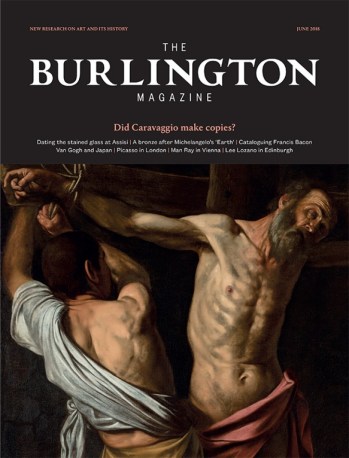
The Burlington Magazine, June 2018
As the June 2018 issue of The Burlington launches a new design (the work of Studio Frank), editor Michael Hall provides a brief overview of the history of the journal’s design in his editorial comments, noting that “many readers now access the magazine in its digital edition and for most people the first sight of the cover is likely to be on the screen of a tablet or smartphone, meaning that it has to work on a small scale” (453).
The eighteenth century in The Burlington:
The Burlington Magazine 160 (June 2018)
 A R T I C L E S
• Tessa Murdoch, “A Set of Silver-Gilt Waiters by Benjamin Pyne for the Courtenay Family of Powderham Castle, Devon,” pp. 478–89.
R E V I E W S
• Xavier F. Salomon, Review of the exhibition Tiepolo Segreto (Vicenza: Palladio Museum, 2017–18), pp. 495–97.
• Sanda Miller, Review of the exhibition Fashioned from Nature (London: V&A, 2018), 497–99.
• Steven Jaron, Review of John Onians, European Art: A Neuroarthistory (Yale UP, 2016), 516–17.
• Antoine Maës, Review of Alexandre Maral, François Girardon (1628–1715): Le Sculpteur de Louis XIV (Arthena, 2015), p. 519.
• Clare Hornsby, Review of Paola Bianchi and Karin Wolfe, eds., Turin and the British in the Age of the Grand Tour (Cambridge UP, 2017), pp. 520–21.
• Jonathan Brown, Review of Elena Santiago Páez, ed., Ceán Bermúdez: Historiador del arte y coleccionista ilustrado (Centro de Estudios Europa Hispánica, 2016), p. 521.
• Timothy Wilcox, Review of Ann Gunn, The Prints of Paul Sandby (1731–1809): A Catalogue Raisonné (Brepols, 2016), pp. 521–23.
• Caroline Finkel, Review of Francis Russell, 123 Places in Turkey: A Private Grand Tour (Bitter Lemon Press, 2017), p. 527.










 Enfilade
leave a comment