Conference | Portraiture and Biography
From the Paul Mellon Centre:
Portraiture and Biography Conference
National Portrait Gallery, London, 29–30 November 2018

Thomas Gainsborough, Self-Portrait, ca. 1758–59 (London: National Portrait Gallery).
An international conference collaborative organised by the Paul Mellon Centre for Studies in British Art and the National Portrait Gallery
Biography has always haunted the study of portraiture. Although in recent decades art-historians may have developed a healthy scepticism for the intuitive practice of interpreting portraits with straightforward reference to what is known about the lives of their subjects, the temptation to do so remains strong. These tendencies often appear in their most untrammelled form in analyses of artists’ likenesses of themselves, or of their most intimate acquaintances. Taking the current major exhibition Gainsborough’s Family Album at the National Portrait Gallery as a starting point, leading academics will explore the how the biographical archive might play in this field of study going forward.
Tickets: £30 General Admission and £25 Concessions and Gallery Supporters. The first day ends with an out-of-hours view of the exhibition and drinks reception. Unlimited entry to the exhibition on the second day of the conference is also included in the ticket price. Tea and coffee are provided on both days. Book online, or visit the National Portrait Gallery in person.
T H U R S D A Y , 2 9 N O V E M B E R 2 0 1 8
13.30 Registration
14.00 Introduction and welcome by Lucy Peltz (National Portrait Gallery) and Sarah Turner (Paul Mellon Centre)
14.15 Session One: Heads and Tales
Chaired by Lucy Peltz
• Meredith Gamer (Columbia University), Of Sitters and Subjects: William Hunter and the Anatomical Portrait
• Lejla Mrgan (University of Copenhagen), The Bewildering Silence of Bertel Thorvaldsen’s Portrait Busts
15.30 Tea Break
16.00 Session Two: Parallel Lives
Chaired by Martin Postle (Paul Mellon Centre)
• Rosemary Keep (University of Birmingham), ‘… masculine in all save her body and her sexe’: Lady Jane Burdett, Portrait and Biography
• Kerstin Maria Pahl (Humboldt University and King’s College London), Back-Ups: Portraiture, Life-Writing, and the Art of Information in Long-Eighteenth-Century England
17.15 Break
17.30 Session Three
• David Solkin (Courtauld Institute of Art) and Mark Hallett (Paul Mellon Centre) in conversation: Gainsborough’s Family Album
18.30 Exhibition view and drinks
F R I D A Y , 3 0 N O V E M B E R 2 0 1 8
10.30 Session Four
Chaired by by Mark Hallett
• Ludmilla Jordanova (Durham University), Portraiture, Biography, and Occupational Identities
11.15 Coffee Break
11.45 Session Five: Love and Likeness
• Marlen Schneider (Université Grenoble Alpes), Portraiture as Cultural Practice: Displaying Social Identity in French ‘Portraits Historiés’
• Katherine Fein (Columbia University), Indexical Portraiture and Embodied Biography in Harriet Hosmer’s ‘Clasped Hands of Robert and Elizabeth Barrett Browning’
13.00 Lunch Break
14.00 Session Six: Circulating Lives
Chaired by David Solkin
• Georgia Haseldine (Queen Mary University of London and National Portrait Gallery), Competing Likenesses: Portraits and Biographies of Radical Reformers
• Claudine van Hensbergen (Northumbria University), Portraits, Mezzotint, and Public Lives: The Image of the Royal Mistress, 1660–1700
15.15 Tea Break
15.45 Session Seven: Space and Status
Chaired by Sarah Turner
• Niharika Dinkar (Boise State University), Portrait of the Artist as a ‘Gifted Highborn’: Ravi Varma and Artistic Personhood in India
• Hannah Williams (Queen Mary University of London), Lived Space: Portraits, Studios, and the Life of the Artist
• Olivia Tait (University College London), ‘Neutralising’ Biography? Georg Baselitz’s Bedroom Portraits
Exhibition | Eighteenth-Century Pastel Portraits

Jean-Étienne Liotard, Portrait of Maria Frederike van Reede-Athlone at Seven Years of Age (detail), 1755–56, pastel on vellum
(Los Angeles: J. Paul Getty Museum)
◊ ◊ ◊ ◊ ◊
Now on view at The Getty Center:
Eighteenth-Century Pastel Portraits
J. Paul Getty Museum, Los Angeles, 28 August — 13 October 2018
Pastels—dry, satiny colors, manufactured in sticks of every hue—enjoyed a surge in popularity during the eighteenth century, becoming, for a time, the medium of choice for European portraiture. This display of pastels from the permanent collection explores the specific physical properties that made this medium so appealing to eighteenth-century portraitists and their patrons.
Exhibition | Manufacturing Luxury
Opening next month at the Cognacq-Jay, from the press release:
La Fabrique du Luxe: Les Marchands Merciers Parisiens au XVIIIe Siècle
Musée Cognacq-Jay, Paris, 29 September 2018 — 27 January 2019
Curated by Rose-Marie Herda-Mousseaux
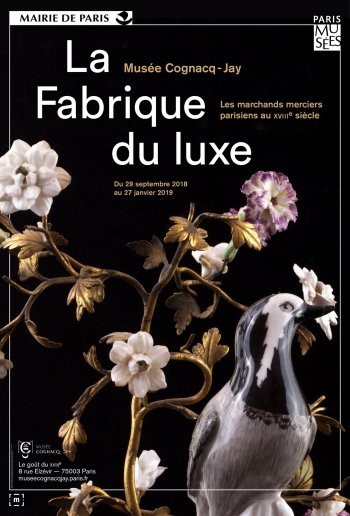 Du 29 septembre 2018 au 27 janvier 2019, le musée Cognacq-Jay organise la toute première exposition consacrée à cette corporation particulièrement codi ée et incontournable dans la diffusion de l’art et du luxe français. À travers les destins de marchands comme Gersaint ou Duvaux, le musée présente une centaine d’œuvres d’art, de documents et d’archives illustrant les origines du luxe à la parisienne.
À la fois négociant, importateur, collecteur, designer et décorateur, le marchand mercier occupe un rôle majeur dans l’essor de l’industrie du luxe à cette époque. Personnage atypique, il entretient des liens dans la haute aristocratie et s’appuie sur un réseau international d’artistes comprenant les meilleures spécialités techniques et artistiques, qu’elles proviennent de Lyon ou de Chine. Les marchands merciers se trouvent au cœur d’un réseau à trois pôles : le commanditaire, l’artisan ou artiste et, phénomène nouveau à la puissance croissante, la « mode ». Aussi, pour se faire connaître et agrandir leurs réseaux, ils développent les mécanismes de la promotion publicitaire, avec le concours de dessinateurs anonymes ou d’artistes comme Boucher ou Watteau.
Dissoute durant la période révolutionnaire, cette corporation suscite encore aujourd’hui l’intérêt des historiens de l’art et d’universitaires qui en font leur sujet de recherches. Le parcours de l’exposition explore le contexte propice à l’épanouissement de ce réseau, les clefs de leur succès et leurs innovations, et s’attache à dépeindre quelques-uns de ses illustres représentants.
Les marchands merciers : une corporation unique
L’appellation “marchand mercier” provient du terme « mercerie » qui, s’il désigne de nos jours les articles liés à l’habillement et à la parure, était synonyme au XVIIIe siècle de « marchandise ». Les statuts de la corporation, codi és en 1613, permettent aux marchands de vendre des objets enjolivés ou assemblés par leurs soins ou de seconde main. Ainsi, au XVIIIe siècle, les marchands merciers deviennent incontournables dans la diffusion des arts et du luxe hors de la cour. Ils acquièrent auprès des manufactures de porcelaine ou des grandes compagnies de transport des objets qu’ils font monter à l’aide d’orfèvres, de bronziers ou d’ébénistes pour créer des pièces décoratives aux formes nouvelles.
Cartographie du luxe parisien
Paris réunit les ingrédients indispensables d’un marché du luxe en plein essor : capitaux, clientèle nombreuse, fournisseurs hautement quali és, large réseau artistique, proximité avec la cour… Il est possible d’identi er des quartiers privilégiés dans l’organisation de ce commerce : la rue Saint-Honoré, bien sûr, mais aussi le Palais de Justice et les rues Saint-Martin et Saint- Denis, où les marchands disposaient d’adresses physiques.
La naissance des stratégies publicitaires
Dans un secteur concurrentiel, les marchands doivent faire preuve d’une stratégie permanente. C’est ainsi que l’émergence des enseignes ou « marques » s’appuient sur des ressorts marketing novateurs : contrats d’exclusivités ou monopoles, identi cation de clients prestigieux dans les réclames ou encore création d’identité visuelle dont témoignent les enseignes et cartes de visite.
L’exemple de Gersaint : un marchand-mercier emblématique
En 1720, Antoine Watteau peint en seulement « huit matins », pour la boutique de son ami Gersaint, une enseigne remarquable qui fait l’admiration du Tout-Paris. Ce coup de publicité fait de Gersaint un des premiers marchands merciers à développer une image publicitaire soignée. Le musée Cognacq-Jay conserve une étude préparatoire de cette œuvre et présente une reconstitution du tableau original à grande échelle.
Commissariat
Rose-Marie Herda-Mousseaux, Conservateur en chef du patrimoine, directrice du musée Cognacq-Jay
La Fabrique du Luxe: Les Marchands Merciers Parisiens au XVIIIe Siècle (Paris-Musées, 2018), 176 pages, ISBN: 978-2759604005, 30€.
Exhibition | What is Europe? Views from Asia
Now on view at The British Museum:
What is Europe? Views from Asia
The British Museum, London, 23 August — 22 October 2018

Painted wooden Hentakoi board, Nicobar Islands, around 1800–1900.
Exploring the interconnected relationships between Asia and Europe from the 18th century to the mid-20th century, the exhibition What is Europe? Views from Asia looks at Europe from the outside. Examining perceptions of Europe through a series of objects from Japan, China and South Asia, this display illustrates how encounters between Asia and Europe are often far more nuanced than has been previously presented. The exhibition includes a wide variety of objects that challenge common preconceptions—from prints, magazines, and paintings to sculptures and protective figures.
Two objects from the Nicobar Islands in the Indian Ocean shed light on the complex artistic response to European trade and power relations. The Islands were colonised by Denmark in 1756, and then sold to Britain in 1869, and are now a union territory of India. A Nicobarese hentakoi (painted board) shows the selective adoption of European practices and goods and the importance of local objects deemed valuable and symbolic. Hentakoi were thought to have protective powers, and this example shows a European ship, a local vessel and a Chinese boat, as well as a deity flanked by a compass and chronometer. A kareau (protective figure) from the Nicobar Islands is also included in the display—portrayed wearing a European pith helmet.
Subtle examples of subversion and dissent are also on display, such as the reception of European religions in Asia—a porcelain figure of the bodhisattva Guanyin and child shows this relationship. Made for hundreds of years for Buddhist devotion in China and Japan, in the 18th century some manufacturers added Christian imagery to these statues in the form of a mantilla—a Christian head-covering. Christianity was forbidden in Japan from 1587 to 1859, so sculptures like this, made for European export markets, allowed ‘hidden’ Christians to worship in secret in Japan.
The ridicule and mocking of Europe is also represented in the exhibition. A 1943 manga magazine mocks Allied wartime leader Winston Churchill, and an earlier print made during the Russo-Japanese war of 1904–05 ridicules the Russian Navy, describing them as ‘aimless boats’.
The display contains examples of the multi-faceted relationship and mutual adoption of Asian and European artistic styles. Instances of Western influence on Asian artists are shown alongside Chinese porcelain made for export to markets in Europe. There are also links between individual artists in the exhibition—German printmaker Käthe Kollwitz and Chinese artist Li Hua.
Together, the objects in this display reveal the nuanced and complex relationships between Asian and European nations from the 1700s to the mid-1900s, presenting narratives from many different backgrounds and encouraging debate about the present.
The Burlington Magazine, August 2018
The eighteenth century in The Burlington:
The Burlington Magazine 160 (August 2018)
 A R T I C L E S
• Alessandro Spila, “Ferdinando Fuga’s Proposals for Displaying Relics in S. Maria Maggiore, Rome,” pp. 646–53. Recently identified drawings show Fuga’s initial design [produced in the 1740s] for a pair of nave platforms in S. Maria Maggiore intended for the display of relics displaced by the recent reorganization of the choir. They were not executed, almost certainly because they conflicted with Benedict XIV’s wish to see a radical simplification of the church’s interior.
R E V I E W S
• Claudia Bodinek, Review of the exhibitions 300 Years of the Vienna Porcelain Manufactory (MAK, 2018) and Eternally Beautiful: 300 Years of Vienna Porcelain (Augarten Porcelain Museum, 2018), pp. 674–75.
• Philippe Bordes, Review of the exhibition Napoleon: Power and Splendor (Virginia Museum of Fine Arts, 2018), pp. 676–78.
• Jonathan Yarker, Review of the exhibition The Great Spectacle: 250 Years of the Summer Exhibition (Royal Academy of Arts, 2018), pp. 678–81.
• Roberto Valeriani, Review of Teresa Leonor M. Vale, ed., The Art of the Valadiers (Umberto Allemandi, 2017), pp. 703–05.
Exhibition | 300 Years of the Vienna Porcelain Manufactory
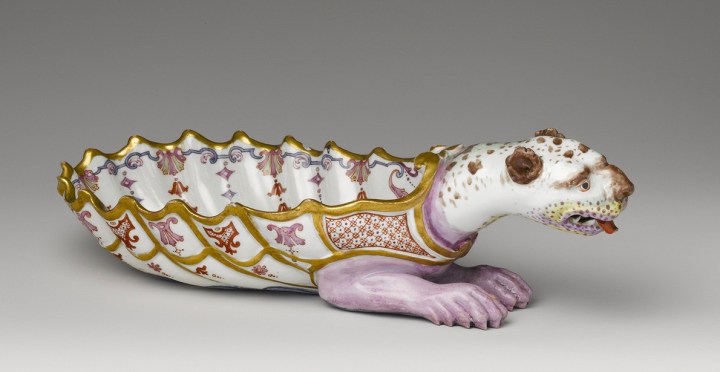
Claudius Innocentius, Du Paquier, Panther Bowl, ca. 1730, glazed, painted, and gilt porcelain, 8 × 25.5 × 10.3 cm
(Vienna: MAK)
◊ ◊ ◊ ◊ ◊
Now on view at Vienna’s MAK:
300 Years of the Vienna Porcelain Manufactory
MAK – Austrian Museum of Applied Arts / Contemporary Art, Vienna, 16 May — 23 September 2018
Curated by Rainald Franz and Michael Macek
With its wide-ranging jubilee exhibition 300 Years of the Vienna Porcelain Manufactory, the MAK is drawing attention to the history and significance of the second-oldest porcelain manufactory in Europe. Founded in May 1718 when the imperial privilege for porcelain production was granted to Claudius Innocentius Du Paquier, the Vienna Porcelain Manufactory set new aesthetic standards over the following decades. Some 1000 objects from the holdings of the MAK as well as national and international collections offer a formidable overview of Viennese developments in the context of Asian precursors and European competitors.
 The MAK has housed the legacy of the Vienna Porcelain Manufactory—under imperial ownership from 1744 and closed in 1864—and has been dedicated to researching porcelain since its founding years. With examples from all eras of production, the legacy provides an overview of some 150 years of porcelain production in Vienna. Viennese porcelain production covered a wide spectrum of ceramics: from dinnerware sets and vases to clocks, from high-quality porcelain sculptures to scenic and floral miniatures, from porcelain paintings with cobalt blue and gold decorations in relief to large-format porcelain pictures with floral still lifes.
The exhibition 300 Years of the Vienna Porcelain Manufactory presents the latest research findings with as yet unpublished documents on major works by the Vienna Porcelain Manufactory, such as the porcelain room from the Palais Dubsky in Brno (ca. 1740) and the centerpiece from Zwettl Abbey (Vienna, 1767/68). Both the ‘Dubsky Room’, one of the first rooms to be decorated with European porcelain, and the centerpiece from Zwettl Abbey are on permanent display in the MAK Permanent Collection Baroque Rococo Classicism, designed by Donald Judd.
The catalogue is distributed by ACC Art Books:
Christoph Thun-Hohenstein and Rainald Franz, eds., 300 Jahre Wiener Porzellan / 300 Years of the Vienna Porcelain Manufactory (Stuttgart, Arnoldsche Art Publishers 2018), 272 pages, ISBN: 978-3897905306, 48€ / $85.
With contributions by Rainald Franz, Andreas Gamerith, Michael Macek, Errol Manners, Waltraud Neuwirth, Kathrin Pokorny-Nagel, A. Philipp Revertera, Elisabeth Schmuttermeier, Ulrike Scholda, Leonhard Weidinger and Johannes Wieninger and a foreword by Christoph Thun-Hohenstein.
C O N T E N T S
• Christoph Thun-Hohenstein, Viennese Porcelain as a Resonance
• Rainald Franz, Three Centuries of Viennese Porcelain and Three Centennials
• Rainald Franz and Michael Macek, The Dubsky Chamber and the MAK: An 18th-Century Aristocratic Porcelain Room and its History
• Andreas Gamerith, At a Loss for Words: The Zwettl Centerpiece and its Origins
• Rainald Franz, The Viennese Porcelain Set for the Duke of Wellington
• Errol Manners, The Travels of an Arcanist, Joseph Jakob Ringler
• Johannes Wieninger, Exemplars from East Asia
• Elisabeth Schmuttermeier, Porcelain versus Silver
• Michael Macek, The Hülfswerk von Engelhardtszell 1798–1809 and its Impact beyond 1809
• Waltraud Neuwirth, Johann Poysel, First Modelleur of the Vienna Porcelain Manufactory: His 1858 Journey to Limoges, Paris, Sèvres, Wallerfangen, and Nymphenburg
• Kathrin Pokorny-Nagel and Ulrike Scholda, The Museum as the Administrator of an Estate: The Closure of the Vienna Porcelain Manufactory and Transfer of Its Holdings to the Imperial Royal Austrian Museum of Art and Industry
• Leonhard Weidinger, The Viennese Porcelain Scene: The Museum and Private Collections
• Rainald Franz, Paul Wittgenstein’s Porcelain Room
• A. Philipp Revertera, Etcetera: Random Thoughts on Collecting (and) Viennese Porcelain
• Rainald Franz and Michael Macek, History of the Vienna Porcelain Manufactory 1718–1864 in its Cultural and Political Context
A Visual History of the Vienna Porcelain Manufactory
Claudius Innocentius Du Paquier, 1718–1744
Imperial Porcelain Manufactory Phase 1, 1744–1749
Imperial Porcelain Manufactory Phase 2, 1750–1783
Conrad Sörgel von Sorgenthal, 1784–1805
Matthias Niedermayer, 1805–1827
Benjamin von Scholz, 1827–1833
Andreas Baumgartner, 1833–1842
Franz von Leithner, 1842–1855
Alexander Löwe, 1856–1862
Alois Auer von Welsbach, 1862–1864
Augarten Porcelain Manufactory, since 1923–24
Exhibition | Eternally Beautiful: 300 Years of Vienna Porcelain
Now on view at the Augarten Porcelain Museum in Vienna:
Eternally Beautiful: 300 Years of Vienna Porcelain, 1718–2018
Augarten Porcelain Museum, Vienna, 20 March — 13 October 2018
 The central theme of the Augarten Porcelain Museum’s jubilee exhibition is the dialogue between the designers and the users of Vienna porcelain since 1718. Select exhibits from the hands and minds of innovative artists and designers from the various eras enter into dialogue with their respective cultural context, distinctive creative styles thus being paired with their era’s distinctive mood. The historical spectrum ranges from astounding miracles of Baroque craftsmanship to light-hearted Rococo objets d’art, from the golden glory of Neoclassical porcelain through the simplicity of Biedermeier to the allusive reminiscences of Historicism, and then continues up to the present day via the delicate creations of Art Déco, the bright colours of the 1950s and the fascinating world of modern design.
In all the most important phases of the Vienna porcelain manufactory first founded by Claudius Innocentius du Paquier in 1718, production has been characterized by an interplay between the vision of the porcelain-makers and the actual lifestyle of the porcelain-users. Conrad von Sorgenthal (1733–1805), the most successful director of the Imperial Porcelain Manufactory, sent staff out as ‘lifestyle scouts’ to sound out the habits, fashions, special preferences and opinions of his customers, so that the findings could then be reflected in the design process. When the Augarten manufactory was founded in 1923 as the successor to the imperial works, it strove to achieve a similar closeness to contemporary lifestyle. The craft of fine porcelain was enriched with significant formal and emotional input not only from designers of the Wiener Werkstätte and but also from a host of excellently trained graduates from the Vienna School of Arts and Crafts. By putting innovative creations from three centuries under the spotlight, the exhibition is intended to stimulate fresh debate and generate a new discourse. As part of the presentation, the Museum has invited the designers currently cooperating with the Augarten manufactory to take part in designing the present-day exhibition space.
Claudia Lehner-Jobst, Ewig Schön: 300 Jahre Wiener Porzellan (Vienna: Residenz Verlag, 2018), 192 pages, ISBN: 9783701734498, 35€.
Exhibition | The Furniture of Isaac Vose
Now on view at the Massachusetts Historical Society:
Entrepreneurship and Classical Design in Boston’s South End: The Furniture of Isaac Vose and Thomas Seymour, 1815–1825
Massachusetts Historical Society, Boston, 11 May — 14 September 2018
 Virtually forgotten for 200 years, Isaac Vose and his brilliant furniture are revealed in a new exhibition and accompanying volume. Beginning with a modest pair of collection boxes he made for his local Boston church in 1788, Vose went on to build a substantial business empire and to make furniture for the most prominent Boston families. The exhibition and catalog restore Vose from relative obscurity to his rightful position as one of Boston’s most important craftsmen.
Robert Mussey and Clark Pearce, Rather Elegant Than Showy: The Classical Furniture of Isaac Vose (Boston: David R Godine, 2018), 312 pages, ISBN: 978-1567926194, $50.
C O N T E N T S
Dennis M. Fiori
Foreword
Robert D. Mussey, Jr.
• Introduction: Isaac Vose Forgotten, Rediscovered
• Early Career and Partnerships, 1788–1819
• Boston’s Classical Style Matures: The Salisbury Group
• The Global Elite: Vose & Son and the World of Imports
• Demanding the Finest
• A Hero Returns, an Era Ends
Clark Pearce
• By These Signs You Will Know Them: Connoisseurship and Construction of Vose Furniture
Appendix 1: Labeled, Signed, and Documented Furniture by Isaac Vose
Appendix 2: Vose’s Partners, Journeymen, Subcontractors, and Apprentices
Index
Colophon
Exhibition | Laurent Amiot: Canadian Master Silversmith
Now on view at the National Gallery of Canada:
Laurent Amiot: Canadian Master Silversmith
National Gallery of Canada, Ottawa, 11 May — 23 September 2018
Curated by René Villeneuve
 Laurent Amiot: Canadian Master Silversmith brings together an exceptional selection of silver pieces from the collection of the National Gallery of Canada, as well as from various public and private collections around the world. Considered one of the most influential Canadian silversmiths of the 18th and 19th centuries, Laurent Amiot (1764–1839) completely redefined his craft, turning it into an art form. Visitors to the National Gallery of Canada can explore the brilliance and delicacy of his work through the presentation of nearly a hundred key works, most exhibited for the first time. In addition to religious vessels, accessories, and commemorative and domestic objects, the exhibition features a unique set of preparatory drawings by the artist, as well as several portraits of patrons and paintings providing further context for Amiot’s life and work.
More information is available here»
René Villeneuve, Laurent Amiot: Canadian Master Silversmith (Vancouver: Figure 1 Publishing, In partnership with the National Gallery of Canada, 2018), 240 pages, ISBN: 978-1773270418, $50. Also available in French.
Laurent Amiot was born in Quebec City in 1764, and after a first apprenticeship stayed in Paris for five years, just before the French Revolution, to perfect his artistic training. He returned to his hometown in the spring of 1787, acquainted with the latest European stylistic trends, mastering the art of composition and possessing a solid technique. He opened a workshop in the Old City the following year, inaugurating a fruitful practice that spans five decades. This illustrated catalog, containing some 80 works on display, is published on the occasion of the presentation of the first retrospective devoted to the artist. Three chapters highlight the fundamental role of Amiot’s contribution to the development of art in Canada. The first two scrutinize his training, his practice, the operation of the workshop, the role of the collaborators and relationships with patrons. The third analyzes the work, trying to advance knowledge of the society in which it blossomed.
Exhibition | The Genius of Grinling Gibbons
Now on view at Fairfax House:
The Genius of Grinling Gibbons: From Journeyman to King’s Carver
Fairfax House, York, 14 April – 14 September 2018

Grinling Gibbons, King David Panel, ca. 1670, boxwood (York: Fairfax House).
Fairfax House is delighted to announce the recent acquisition of Grinling Gibbons’s King David Panel the earliest-known, surviving work by Gibbons—made in York. Saved from international export and potential obscurity in a private collection, this magnificent work now forms part of the permanent collection at Fairfax House.
To celebrate the ‘home-coming’ of this exquisite piece of craftsmanship and to illuminate the extraordinary skill of Grinling Gibbons—the ‘Michelangelo of Wood’—Fairfax House will be mounting a major new exhibition in 2018, The Genius of Grinling Gibbons: From Journeyman to King’s Carver. Opening on the 370th anniversary of Grinling Gibbons’ birth, this exhibition also marks the 350th year of his arrival in York. Drawing on new research and bringing together artworks and sculpture by the hand of this iconic individual from across the country (including St Paul’s Cathedral, Hampton Court Palace, the Sir John Soane Museum, and the V&A), The Genius of Grinling Gibbons celebrates Grinling Gibbons’s unequalled talent, his visionary genius, and his ability to transform the medium of wood into something magical. It will explore his development from an obscure journeyman through to becoming the country’s most celebrated master-carver, working for the King himself.










leave a comment