Exhibition | Exhibiting Art In Georgian Ireland
From the press release for the exhibition:
Exhibiting Art In Georgian Ireland: The Society of Artists’ Exhibitions Recreated
City Assembly House, Dublin, 16 June — 29 July 2018
Curated by Ruth Kenny
 This summer the Irish Georgian Society will host a world-class exhibition of eighteenth-century Irish paintings to mark the restoration of the City Assembly House and to commemorate the Society of Artists in Ireland who erected the building over 250 years ago. Celebrating the building’s original incarnation as the first purpose-built public gallery in Britain and Ireland, the exhibition will re-assemble works by Society of Artists members such as Thomas Roberts, Jonathan Fisher, James Forrester, Robert Carver, Robert Healy, and Hugh Douglas Hamilton, including many pieces which were first displayed in the room in the series of exhibitions the Society held there between 1766 and 1780.
By honouring the pioneering spirit of these exhibitions, we aim to provide an insight into the fascinating range of artistic production taking place in eighteenth-century Ireland. As the original exhibition catalogues reveal, Georgian Dublin was a hive of creativity, with landscape artists working alongside portraitists, history painters, sculptors, printers, and draughtsmen in an astonishing range of media, including oil paint, pastel, marble, wood, glass, wax and hair. With loans secured from national institutions and private collectors, this exhibition will reunite over eighty works by exhibiting Society of Artists’ members. An accompanying catalogue will evaluate these stimulating years, assessing Ireland’s first introduction to exhibition culture and the significant contribution it made to an increasingly self-confident national school of Irish art.
Exhibiting Art In Georgian Ireland has been curated by Dr Ruth Kenny, formerly Assistant Curator of British Art, 1750–1830 at Tate Britain, who has identified over seventy works of art that will showcase the breadth of talent displayed by the Society of Artists’ initial series of exhibitions between 1765 and 1780. The public will have free access to the exhibition, with guided tours and exclusive events to mark the completion of the restoration of the City Assembly House.
David Fleming, Ruth Kenny, and William Laffan, eds., with contributions by Victoria Browne, Paul Caffrey, Donough Cahill, Logan Morse, and Brendan Rooney, Exhibiting Art In Georgian Ireland: The Society of Artists’ Exhibitions Recreated (Dublin: Irish Georgian Society, 2018), .
Exhibition | Andreas Gallasini (1681–1766)

Now on view in Fulda:
Andrea(s) Gallasini: Vom Stuckateur zum fürstlichen Baumeister in Fulda
Vonderau Museum, Fulda, 13 May — 19 August 2018
In der Reihe „Berühmte Architekten in Fulda” wird nach Johann Dientzenhofer und Sep Ruf am Internationalen Museumstag die große Sonderausstellung über den Barockbaumeister Andrea(s) Gallasini (1681–1766) eröffnet.
 Der in Lugano im Tessin geborene Andrea(s) Gallasini begann seine Laufbahn als Stuckateur, avancierte zunächst zum Bauinspektor in Waldeck–Pyrmont und war dann seit 1720 für rund 40 Jahre in den Diensten der Fuldaer Fürstäbte als Baumeister tätig. Unter seiner Regie entstanden rund 45 Bauten unterschiedlichster Bestimmung: vom Amtshaus über das Adelspalais bis zum repräsentativen Landsitz, von der Pfarrkirche bis zur anspruchsvollen Kloster- oder Propsteikirche. Zu seinen Hauptwerken gehören die fürstliche Sommerresidenz Schloss Fasanerie, das Heilig-Geist-Hospital und die „Alte Universität”.
Schwerpunkt der Ausstellung bilden zum einen Person und der bis jetzt noch weitgehend unbekannte Lebensweg des italienischen Stuckateurs und Hofbaumeisters Andrea(s) Gallasini sowie die zeitgenössischen politischen und organisatorischen Verhältnisse in Fulda. Ein zweiter Schwerpunkt der Schau nimmt das architektonische Werk Gallasinis in den Fokus, um den typischen „Gallasini – Stil” aufzuzeigen, der das Gesicht der Stadt Fulda bis heute prägt.
Zur Ausstellung erscheint ein Begleitband. Außerdem wird ein Begleitprogramm mit Führungen mit den Ausstellungsmachern, regelmäßigen Führungen am Sonntag, Architekturspaziergängen, Exkursionen, Workshops mit Stucktechniken sowie einem Konzert mit Musik aus der Feder der Komponisten des 18. Jahrhunderts angeboten.
Volker Rößner and Sabine Wagner with contributions by Thomas Heiler and Markus Miller, edited by Sabine Fechter, Andrea(s) Gallasini 1681–1766: Vom Stuckateur zum fürstlichen Baumeister in Fulda (Petersberg: Imhof Verlag, 2018), 320 pages, ISBN: 978-3731907176, 25€.
Exhibition | Venice in the Footsteps Casanova
Now on view in Grenoble, at the the Convent of St Cecilia, headquarters of the Glénat publishing house:
Venise sur les pas Casanova: De la peinture du XVIIIe siècle à la bande dessinée
Musée d’Angoulême, 25 January — 11 March 2018
Couvent Sainte-Cécile, Grenoble, 22 March — 16 June 2018
Curated by Stéphane Beaujean and Bożena Anna Kowalczyk
 Le Fonds Glénat pour le Patrimoine et la Création (couvent Sainte-Cécile – Grenoble) et le Festival International de la Bande dessinée dédient une nouvelle exposition à la Venise de Canaletto et de Casanova. Les deux images de la ville, pour la première fois confrontées, celle perpétuée par la peinture du XVIIIe siècle, officielle, sereine, de la carte postale, et le scenario des aventures vénitiennes de l’auteur libertin de L’Historie de ma vie, sont complémentaires et nous introduisent dans cette ville fascinante, la plus admirée dans l’Europe de l’époque. L’exposition permettra de faire dialoguer des toiles du XVIIIe siècle avec des images contemporaines, et mettra tout à la fois en évidence l’opposition entre le centre de la ville, magnifié par la veduta, et les ruelles plus interlopes empruntées par Casanova, la vision, d’une ville essentielle de l’Europe renaissante qui continue aujourd’hui d’enchanter des visiteurs du monde entier par son imaginaire, mais aussi bien entendu le dialogue entre ces deux arts que sont la peinture et la bande dessinée.
Stephane Beaujean and Bozena Anna Kowalczyk, Venise sur les pas de Casanova: De la peinture du XVIIIe siècle à la bande dessinée (Grenoble: Glénat Livres, 2018), 96 pages, ISBN: 978-2344023907, 15€.
Display | Publishing at the Paul Mellon Centre
On view at the Mellon Centre:
Publishing at the Paul Mellon Centre: A Brief History
Paul Mellon Centre for Studies in British Art, London, 19 January — 18 May 2018
Organized by Emily Lees
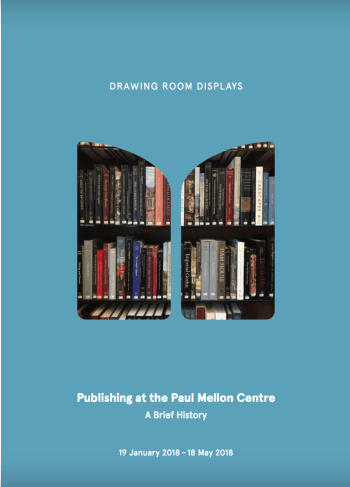 The new Drawing Room Display and accompanying brochure are designed to give a brief introduction to the beginnings of our publishing history and to highlight the different strands of our list. We begin with the story of our very earliest publications; and then, to showcase the variety of our output, we have asked a selection of colleagues associated with the Centre to tell the stories behind some of our most important books. Inevitably, we only had space for a small selection of our publications in the display itself. However, to see our complete list, the variety of subjects we have covered and the pantheon of authors we have been privileged to work with, you will find a copy of every book we have published in the bookcases in the Drawing Room. All the material in this display is taken from the PMC’s institutional archive and library.
The 36-page brochure accompanying the display includes brief entries by ten contributors and is available online. As Emily Lees writes:
The Paul Mellon Centre’s first fully fledged publications, and the first of its books to be published in association with its long-standing partner, Yale University Press, was Ronald Paulson’s Hogarth: His Life, Art, and Times, which was published in the spring of 1971 (13).
Exhibition | Biting Wit and Brazen Folly: British Satirical Prints
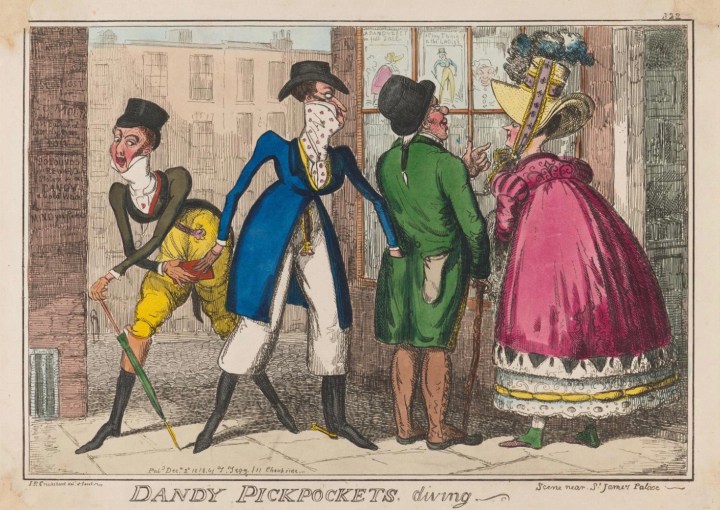
Isaac Robert Cruikshank, Dandy Pickpockets, Diving, 1818 hand-colored etching
(Philadelphia Museum of Art, 1974-179-250)
◊ ◊ ◊ ◊ ◊
Now on view in Philadelphia:
Biting Wit and Brazen Folly: British Satirical Prints, 1780s–1830s
Philadelphia Museum of Art, 4 May — 22 August 2018
Printed satirical caricatures were inescapable in London during the 1700s and 1800s. Often lighthearted and cheeky upon first glance, the images could also be mulled over and picked apart at leisure. A bawdy scene or grotesque facial expression instantly amused, while closer study revealed deeper literary or political references. Whether a fashionable dandy or a poor chimney sweep, no one escaped the scrutiny of caricaturists. This exhibition reveals the widespread appeal of caricature in Georgian England and demonstrates the ways in which such images teased and provoked audiences. Featuring over sixty brightly colored etchings from the Museum’s large collection of British satirical prints, it presents images of the everyday with a riot of color and a roar of laughter.
Browse all the works in the exhibition»
Life in London
London in the late 1700s and early 1800s was a chaotic place marked by social upheaval. People of every class—from the chimney sweep to the Duke of Wellington—witnessed dramatic changes all around them. Their struggles and triumphs did not escape the sharp eye of caricaturists, who were quick to distill their follies and successes into humorous yet arresting images.
Fashion Foibles
In the 1700s and 1800s, innovations in British textile production, along with increased travel between England and France, contributed to a boom in new fashions for both men and women. Caricaturists delighted in exaggerating trendy cinched waists, high collars, and big beards and lampooning the blind following of these fads. In their images, dresses become impossibly large, elaborate headpieces swallow the wearer, and common sense is thrown by the wayside in pursuit of youth and beauty.
Fiendish Ailments & Dubious Doctors
Health and hygiene in London in the late 1700s and early 1800s were dismal. In a city lacking effective medicine and an adequate sewage system, disease was rampant. Because illness was a devastating reality for all classes, it became a fitting subject for satirical artists. Caricatures confronted the corruption of quack doctors and the public’s obsession with cure-all potions. They also made light of common illnesses like gout and colic while showing the darker side of living under physical and mental distress.
Exhibition | Disappear Here: On Perspective
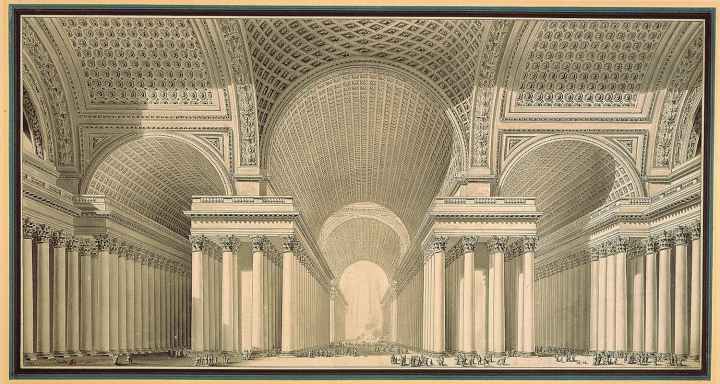
Étienne-Louis Boullée, Project for a Metropolitan Cathedral in the Form of a Greek Cross with a Domed Centre, 1782
(London: RIBA Collections)
◊ ◊ ◊ ◊ ◊
Now on view at RIBA:
Disappear Here
On Perspective and Other Kinds of Space: A Commission by Sam Jacob Studio
RIBA, London, 2 May – 7 October 2018
Proportion, distortion, geometry, distance, power, the infinite, the divine—perspective traverses truth and illusion, linking the disciplines of art, architecture, and mathematics. For this new exhibition, sponsored by Arper and Colt, RIBA has commissioned Sam Jacob Studio to explore how perspective drawing has been applied to the art of building for centuries and used as a tool to evoke illusory architectural spaces.
The Disappear Here installation will include original drawings and early writings by some of the most talented designers in history. Visitors will become active participants within the space where deceptive murals, playful architectural structures, and a newly commissioned film will trace the lineage of perspective from the Renaissance to present day. In a further twist, the system of perspective will dictate how everything in the gallery is arranged.

Unknown designer, Design for a Ceiling with Columns and Coffered Arches, Italy, ca. 1700 (London: RIBA Collections).
Speaking about the commission, Sam Jacob: “Since its invention in the 15th century perspective has been a fundamental tool in the way we imagine space and design architecture. But perspective is also a kind of tyranny too, forcing its own logic onto the worlds we create. This commission gave us the opportunity to explore how perspective has not only been used to illustrate the world but also how it creates and organises the world. This continues the studio’s longstanding interest in how ways of drawing shape the architecture we create. For this installation we wanted to create a space where visitors can experience the essentially illusory nature of perspective and question the making and breaking of rules.”
Sam Jacob Studio was invited by RIBA to draw on RIBA’s historic collections for inspiration to create a site-specific installation. The Studio has selected a diverse range of items, from rare books dating back to the Renaissance to contemporary works. Highlights vary from John Smythson’s early 17th-century Jacobean designs to a colourful modern interior by Max Clendinning and from Sebastiano Serlio’s architectural treatise Seven Books of Architecture to Étienne-Louis Boullée’s intricately drawn perspectives of neo-classical buildings. Other original drawings on display include works by Andrea Palladio, Edwin Lutyens, and William Talman. Additional material on loan from Drawing Matter include modern works from the radical Italian architecture firm Superstudio, French-born American industrial designer Raymond Loewy, and British architect James Gowan.
The material on display represents some of the most distinguished examples of perspectival drawing, depicting vast imaginary spaces and imposing mega structures on a single sheet of paper. Alongside these textbook examples, the show will reveal imperfect versions: drawings that more easily reveal their constructed nature and provide an insight into the strategies employed to achieve an illusory space.
The perspectival system plays an important role in how the collection objects are shown. Spanning two walls in the gallery, the drawings are displayed according to their vanishing points and perspective lines. Geometrical shapes drawn from 16th-century publications, and modern era drawings are used to design new furniture and a quarter of a structural shape will in part be completed by three-sided mirrored panels, referencing the work of Robert Smithson.
To end the exhibition, the specially commissioned film takes the theme of perspective into a contemporary reality. Sam Jacobs Studio has worked with game developer Shedworks to devise an algorithm that places 50 deconstructed architectural assemblies, taken from various architectural treatises, within an endless moving grid. The film, with no beginning or end, challenges ideas around perspectives in a digital age and interrogates notions of space, infinity and vanishing points.
Exhibition | William Birch, Ingenious Artist
From The Library Company of Philadelphia:
William Birch, Ingenious Artist: His Life, His Philadelphia Views, and His Legacy
The Library Company of Philadelphia, 1 May — 19 October 2018
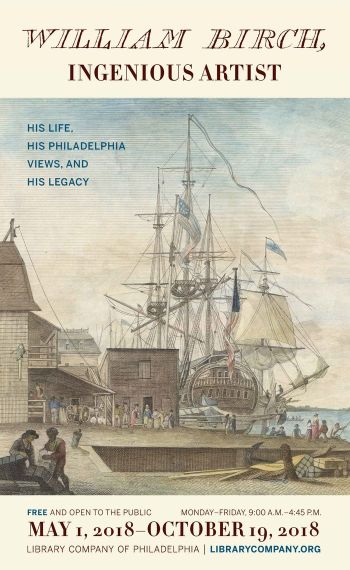 Through watercolors, enamels, manuscripts, books, and prints—some of which have never before been exhibited—we will explore the life and work of one of the most important artists of the Federal period, William Birch (1755–1834).
Birch established himself in London as a miniaturist and a graphic artist before immigrating to Philadelphia, where he published the first two American books of engraved views. The City of Philadelphia in the Year 1800 captures the spirit of the cultural and political capital of the new nation and remains a cornerstone of Philadelphia iconography. His second book, The Country Seats of the United States (1808), brought to America the ideal of the country house in a picturesque landscape, a vision that persists to this day. Join us as we explore Birch’s transatlantic career as an enamellist, landscape architect, and artist of the British and American scene.
◊ ◊ ◊ ◊ ◊
With a symposium scheduled for October:
William Birch and the Complexities of American Visual Culture
The Library Company of Philadelphia, 5 October 2018
“This country is new and flourishing. The mechanical arts are at their highest pitch, but the fine arts are of another complexion. They are the last polish of a refined nation… From an insignificant conceit of merit we have generally no knowledge of or feeling for, our imitations of nature, however beautiful, are mechanical altogether. But [these limitations] may be considered as the first lesson necessary for the fine arts… I do not profess myself a member of the fine arts; I am a copyist only, but from my knowledge of them [I] have been allowed judgment and taste, which is competent to give me a relish for them …” –William Birch
In celebration of the tenth anniversary of the establishment of the Visual Culture Program at the Library Company of Philadelphia (VCP), a one-day symposium on Friday, 5 October 2018 will explore the visual, cultural, and social themes elicited from the work of Philadelphia artist William Russell Birch (1755–1834). Inspired by the Library Company’s 2018 exhibition about Birch and his art, the symposium aims to promote discussions that reflect broadly on the continual resonance in American visual culture of the work of this premier enamel miniaturist, aspiring gentleman, and artist of the first American viewbooks.
While British-born Birch’s Views of Philadelphia (1798–1800) was enormously successful, his second, smaller plate book, The Country Seats of the United States (1808), in essence failed. Yet both—promoted through subscription—remain cornerstones of Philadelphia iconography and American visual culture and its complexities. Birch’s body of work includes some of the earliest American visual records of the new nation’s preeminent city as well as expressions of picturesque landscape crucial to 19th-century American makers of art. At the same time, his work evinces political and cultural propaganda, aesthetics of the ordinary and the everyday, and innovation in design.
Presentations are intended to foster broad and interdisciplinary discussions about the aesthetic, political, social, cultural, economic, material, and technological themes in Birch’s art, in his own time, and in the two centuries that followed. We will ask: What can be learned from works conceived and executed by a non-native artist parallel to constantly (and infinitely) evolving fields and definitions of art, and means of art production, distribution, and appreciation?
Exhibition | James Cook: The Voyages

Now on view at the British Library, with lots of information and resources on the BL’s exhibition website:
James Cook: The Voyages
British Library, London, 27 April — 28 August 2018
Curated by William Frame and Laura Walker
It is 250 years since the Endeavour set sail from Plymouth in August of 1768. Our exhibition tells the story of Captain James Cook’s three world-changing voyages through original documents, many of which were produced by the artists, scientists, and sailors on board the ships. Maps, artworks, and journals from the voyages sit alongside newly-commissioned films offering contemporary perspectives. Examine the expeditions that shaped Europe’s knowledge of the world and consider their far-reaching legacy.
See Cook’s handwritten journal detailing the first crossing of the Antarctic Circle, when they travelled further south than anyone in the world, stunning artwork including the earliest European depiction of a kangaroo, and intricate maps charting the voyages that spanned more than a decade. Learn about the experiences on board the Endeavour, Resolution, and Discovery and the impact of their arrival. Drawings by the Polynesian high priest and navigator Tupaia, who accompanied Cook to New Zealand and Australia, will be displayed together for the first time. These will sit alongside works by expedition artists Sydney Parkinson, William Hodges, and John Webber.
Visit our James Cook: The Voyages website for a range of different perspectives on the voyages and their legacy and impact. These include responses from people of the communities Cook encountered, documented, and learned from. You can also follow the timeline of the journeys, read articles about the individual voyages and immerse yourself in the expeditions through our digitised collection items.
Hear the stories. Read the diaries. Revisit the momentous voyages made 250 years ago.
Programming information is available here»
William Frame with Laura Walker, James Cook: The Voyages (London: British Library Publishing, 2018), 224 pages, ISBN: 978-0773552869, £25 / $45.
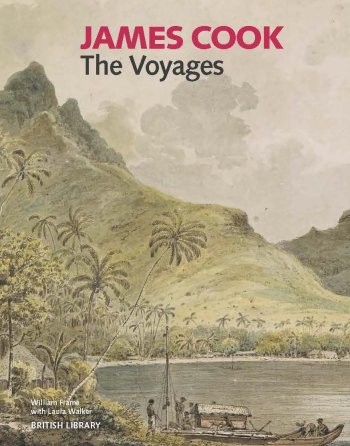 A stunningly illustrated, object-centred history, this book offers a once in a generation opportunity to discover the uniquely rich Captain Cook collection of the British Library. The authors explore a series of themes including the navigation and charting of the Pacific; first encounters between Western and indigenous cultures; the representation of the voyages in art; and scientific discovery and the natural world. Themes of cultural encounter and scientific discovery are interwoven with the personal stories of the key protagonists, including James Cook and Joseph Banks. The illustrations include drawings by all the artists employed on the voyage, as well as the only surviving paintings by Tupaia, a Polynesian high priest who joined Cook’s ship at Tahiti and sailed to New Zealand and Australia.
William Frame is head of modern archives and manuscripts at the British Library. Laura Walker is lead curator of modern archives and manuscripts, 1850–1950, at the British Library.
Exhibition | The Art of Science: Nicolas Baudin’s Voyagers, 1800–1804
I noted this exhibition in 2015 when it was entitled Napoleon’s Artists in Australia. Here’s a more complete venue listing with details on the catalogue, published by Wakefield Press. –CH
The Art of Science: Nicolas Baudin’s Voyagers, 1800–1804
South Australian Maritime Museum, Adelaide, 30 June — 11 December 2016
Queen Victoria Museum and Art Gallery, Launceston, 7 January — 20 March 2017
Tasmanian Museum and Art Gallery, Hobart, 7 April — 9 July 2017
Australian National Maritime Museum, Sydney, 31 August — 26 November 2017
National Museum of Australia, Canberra, 30 March — 20 June 2018
Western Australian Museum, Perth, 12 September — 12 December 2018
See exquisite illustrations of Australian animals and marine life, as well as striking portraits of Aboriginal people, rare documents and hand-drawn maps from Nicolas Baudin’s expedition to Australia. Discover the ambitions behind this lavishly funded French voyage and experience a captivating fusion of art and science.
Jean Fornasiero, Lindl Lawton, John West-Sooby, eds., The Art of Science: Nicolas Baudin’s Voyagers 1800–1804 (Adelaide: Wakefield Press, 2016), 176 pages, ISBN: 978-1743054277, $40AU.
 It was one of the most lavishly equipped scientific expeditions ever to leave Europe. At the dawn of the nineteenth century, French navigator Nicolas Baudin led two ships carrying 22 scientists and more than 230 officers and crew on a three-and-a-half-year voyage to the ‘Southern Lands’, charting coasts, studying the natural environment and recording encounters with indigenous peoples. Inspired by the Enlightenment’s hunger for knowledge, Baudin’s expedition collected well in excess of 100,000 specimens, produced more than 1500 drawings and published the first complete chart of Australia. Baudin’s artists, Charles-Alexandre Lesueur and Nicolas-Martin Petit, painted a series of remarkable portraits of Aboriginal people and produced some of the earliest European views of Australian fauna. An integral part of the French scientific project, these exquisite artworks reveal the sense of wonder this strange new world inspired.
Jean Fornasiero is Emeritus Professor of French Studies at the University of Adelaide and a Fellow of the Australian Academy of the Humanities. Lindl Lawton is Senior Curator at the South Australian Maritime Museum. John West-Sooby is Professor of French Studies at the University of Adelaide.
Exhibition | ‘So That You Might Know Each Other’
From the press release (19 April 2018) for the exhibition:
‘So That You Might Know Each Other’: Faith and Culture in Islam
Sharjah Museum of Islamic Civilisation, Emirate of Sharjah, United Arab Emirates, 2014
National Museum of Australia, Canberra, 20 April — 22 July 2018
 Fine embroidered textiles, camel and horse saddles, musical instruments, and carved amulets headline a new exhibition on view at the National Museum of Australia in Canberra, which showcases intriguing objects from the Anima Mundi Museum, the section of the Vatican Museums devoted to extra-European collections, and the Sharjah Museums Authority, United Arab Emirates.
Featuring over 100 precious 18th- to 20th-century objects from over twenty countries, ‘So That You Might Know Each Other’: Faith and Culture in Islam illustrates the evolution of Islam across the globe and celebrates diverse Muslim societies from the Middle East, through to Africa and India, China and South East Asia. Inspired by a verse from the Holy Qur’an, the exhibition’s title invites visitors to learn more about each other’s lives, religions, and cultures in a spirit of intercultural respect and dialogue.
Including many everyday items, the exhibition—which opened at the National Museum as its only Australian venue—tells the stories of ordinary peoples’ lives, beliefs, and cultural traditions. It is the first time these objects, rarely seen outside their own institutions, have been displayed in Australia. This unique international collection is being complemented by Australian objects that celebrate the contributions made by people of Islamic faith to Australian history.
National Museum of Australia director, Dr Mathew Trinca, said he was delighted Australian audiences would have the opportunity to see these distinctive and beautiful collections. “Islamic arts and decorative crafts are globally recognised for their beauty and artistry, and we hope this exhibition promotes mutual understanding and dialogue between cultures and faiths,” said Dr Trinca. “There has never been a more important time for a show of this kind in Australia.”
Director of the Vatican Museums, Dr Barbara Jatta, said she hopes Australian audiences would embrace the show. “As I followed the preparation of this exhibition, I was sincerely struck by the beauty and sophistication of the Islamic world—I saw firsthand the refined productions of people living across a vast area stretching from Africa to Australia.”
Director General, Sharjah Museums Authority, Manal Ataya, hoped the exhibition boosted intercultural understanding: “‘So That You Might Know Each Other’ is an unique exhibition devised to give a glimpse of the diversity of Muslim material culture and is intended to foster intercultural dialogue and promote tolerance and peace—among Muslims the world over and between Islam and other faiths.”
Key objects in the exhibition include a late 19th-century wood and leather horse saddle from Tunisia; a late 19th- or early 20th-century silver coral, horn, and glass necklace from Libya; a tapestry wool and silk overcoat from Syria; traditional women’s and men’s costumes from Sharjah; an illuminated Qur’an from Ottoman Turkey; and an 18th-or 19th-century vase from China, combining Islamic inscriptions and Buddhist symbols.
These are complemented by Australian objects from the National Museum’s collection, including an intricate bark painting depicting early contact between Aboriginal people in north Australia and Muslim fisherman from Makassar in southern Sulawesi, Indonesia, who came to Australia in search of trepang or sea cucumber, a delicacy they traded to China as food and medicine.
The exhibition highlights the role Muslims played in the exploration and opening up of huge expanses of outback Australia for the pastoral industry and trade. On show is a rare original drawing made in 1953, of Bejah Dervish. Described as Australia’s ‘greatest cameleer’, Bejah was born in Baluchistan (now Pakistan) and came to Australia in 1890 as a camel-handler. He excelled in this profession, helping to save members of the ill-fated Calvert Expedition of 1896–97, and later running a successful camel string at Marree, on the Birdsville track, for a further thirty years. The drawing is featured alongside a rare early camel saddle on loan from the Museum of Arts and Applied Sciences, Sydney.
The ‘Afghans’ or ‘Ghans’, as they became known (although they mainly came from India and present-day Pakistan), pioneered a network of tracks that became the major roads of Central Australia. Apart from Australian Aborigines, they were the first people who were able to navigate and survive these challenging terrains. Together with their imported camels, they hauled the equipment, water, food and other supplies needed for building the great desert railways, and, with their work on the Overland Telegraph Line, they helped revolutionise communications in Australia.
From the 1860s to the 1920s, an estimated 20,000 camels and 2000 cameleers reached Australia. While many of the men who were indentured to large agricultural companies returned to their countries of origin, others, like Bejah Dervish, remained, building mosques and raising families who formed the first Islamic communities in Australia.
Launched in April 2018, ‘So That You Might Know Each Other’: Faith and Culture in Islam invites Muslim and non-Muslim people to learn more about each others’ lives across regions, religions, beliefs, and cultures. The objects highlight and celebrate the diverse cultures of traditional Muslim societies ranging from Africa and the Middle East, to China, India, Indonesia, and Australia.
The exhibition is an unprecedented collaboration between the Vatican Anima Mundi Museum, the Sharjah Museums Authority and the National Museum of Australia. It focuses on areas around the world and in Australia, where Muslim people have settled and created communities. The objects from the Vatican Museums and Sharjah Museums have not appeared in Australia before, nor have many been on display elsewhere, apart from the previous 2014 exhibition at the Sharjah Museum of Islamic Civilisation, Emirate of Sharjah, United Arab Emirates.
The majority of the objects in the exhibition came to the Vatican Museums as gifts sent to Pope Pius XI, on the occasion of the Universal Exposition held in Rome in 1925. These gifts formed the basis of the Vatican’s large extra-European collections, recently rebranded as the Vatican Anima Mundi (‘Soul of the World’) Museum. Almost 90 years later, after preserving and caring for these gifts with the same dedication extended to Italian masterpieces, the Vatican offered a selection of its collection for the exhibition, displayed at the Sharjah Museum of Islamic Civilization in 2014. This first exhibition was also called ‘So That You Might Know Each Other’.
The Sharjah Museum of Islamic Civilization opened in 2008 and is just one of 16 museums that form the Sharjah Museums Authority (SMA). This Museum and others—including the Sharjah Maritime Museum, Calligraphy Museum, Heritage Museum, and the Bait Al Naboodah Museum—have contributed objects for the exhibition in Canberra.
‘So That You Might Know Each Other’: Faith and Culture in Islam (Canberra: National Museum of Australia Press, 2018), 120 pages, ISBN: 978-1921953316, $30.










 Enfilade
leave a comment