Exhibition | Religion in Early America
From the Smithsonian:
Religion in Early America
National Museum of American History, Washington, D.C., 28 June 2017 — 3 June 2018

Thomas Jefferson’s private text, The Life and Morals of Jesus of Nazareth—colloquially known as the Jefferson Bible (Smithsonian’s National Museum of American History; photo by Hugh Talman).
The role of religion in the formation and development of the United States is at the heart of this one-year exhibition that explores the themes of religious diversity, freedom, and growth from the colonial era through the 1840s. National treasures from the Museum’s own collection are on view, such as George Washington’s christening robe from 1732, Thomas Jefferson’s The Life and Morals of Jesus of Nazareth, also known as ‘The Jefferson Bible’, and Wampum beads. Significant objects on loan include Massachusetts Bay Colony-founder John Winthrop’s communion cup, circa 1630; a Torah scroll on loan from New York’s Congregation Shearith Israel, founded in 1654; a chalice used by John Carroll, the first Roman Catholic bishop in the U.S. and founder of Georgetown University; and a first edition of the Book of Mormon. The objects represent the diverse range of Christian, Native American, and African traditions as well as Mormonism, Islam, and Judaism that wove through American life in this era.
◊ ◊ ◊ ◊ ◊
Peter Manseau, Objects of Devotion: Religion in Early America (Washington, D.C.: Smithsonian Books, 2017), 260 pages, ISBN: 978-1588345929, $30.
 Objects of Devotion: Religion in Early America tells the story of religion in the United States through the material culture of diverse spiritual pursuits in the nation’s colonial period and the early republic. The beautiful, full-color companion volume to a Smithsonian National Museum of American History exhibition, the book explores the wide range of religious traditions vying for adherents, acceptance, and a prominent place in the public square from the 1630s to the 1840s. The original thirteen states were home to approximately three thousand churches and more than a dozen Christian denominations, including Anglicans, Baptists, Catholics, Congregationalists, Lutherans, Methodists, Presbyterians, and Quakers. A variety of other faiths also could be found, including Judaism, Islam, traditional African practices, and Native American beliefs. As a result, America became known throughout the world as a place where, in theory, if not always in practice, all are free to believe and worship as they choose. The featured objects include an 1814 Revere and Sons church bell from Salem, the Jefferson Bible, wampum beads, a 1654 Torah scroll brought to the New World, the only known religious text written by an enslaved African Muslim, and other revelatory artifacts. Together these treasures illustrate how religious ideas have shaped the country and how the treatment and practice of religion have changed over time. Objects of Devotion emphasizes how religion can be understood through the objects, both rare and everyday, around which Americans of every generation have organized their communities and built this nation.
Peter Manseau is the Lilly Endowment Curator of American Religious History at the Smithsonian Institution’s National Museum of American History. He holds a doctorate in religion from Georgetown University and writes frequently for publications including The New York Times, The Atlantic, and The Wall Street Journal.
Exhibition | The Great Spectacle: 250 Years of the Summer Exhibition
From the RA:
The Great Spectacle: 250 Years of the Summer Exhibition
Royal Academy of Arts, London, 12 June — 19 August 2018
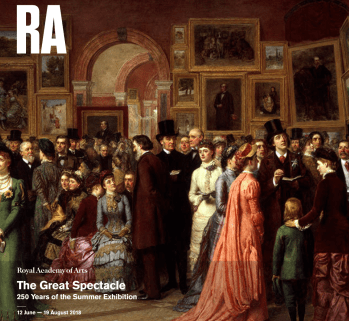 The Great Spectacle tells the story of 250 years of the Summer Exhibition, the world’s longest running annual display of contemporary art. Ever since 1769, and at a succession of locations ranging from Pall Mall to Piccadilly, the Academy’s exhibition rooms have been crowded for some two months each year with hundreds of paintings and sculptures produced by many of Britain’s leading artists.
Over the last two hundred and fifty years, these spectacular displays of art—dominated by what has become a famously crowded and collage-like arrangement of pictures across the Academy’s walls—have provided thousands of artists with a crucial form of competition, inspiration and publicity, and captured the interest of millions of visitors. The Great Spectacle tells the story of these exhibitions and, in doing so, offers an innovative, illuminating and visually stunning celebration of the Academy’s first 250 years and demonstrates the impact of these exhibitions on art in Britain and internationally.
Staged to coincide with the Summer Exhibition of 2018, and taking the form of a sequence of interlinked gallery displays that will recreate a series of important moments in the history of the Academy and its shows, The Great Spectacle will dramatise the excitement, variety and richness of the Summer Exhibition, offering visitors a fascinating, ever-changing journey from Joshua Reynolds to Wolfgang Tillmans.
Mark Hallett and Sarah Victoria Turner, The Great Spectacle 250 Years of the Summer Exhibition (London: ACC Publishing Group, 2018), 224 pages, ISBN: 9781910350706, £25.
Note added (23 August 2018) — Also, see the related online publication: Hallett, Mark, Sarah Victoria Turner, Jessica Feather, Baillie Card, Tom Scutt, and Maisoon Rehani, eds., The Royal Academy Summer Exhibition: A Chronicle, 1769–2018 (London: Paul Mellon Centre for Studies in British Art, 2018).
Exhibition | Napoleon the Strategist
From the press release for the exhibition:
Napoleon the Strategist / Napoléon stratège
Musée de l’Armée, Paris, 6 April — 22 July 2018
 Following on from the presentation of Napoleon’s political vision with the 2013 exhibition Napoleon and Europe and an exploration in 2016 of his fall and his legend with Napoleon in Saint Helena: His Fight for His Story, in spring 2018 the Musée de l’Armée will tackle another aspect of the history of Napoleon, whose skills as a ‘military genius’ are universally recognised.
Any examination of Napoleon the strategist has to start by defining the notion of strategy and how it evolved. For it was in Napoleon’s time that the notion became inextricably linked to power and the abilities of the person wields it. The word ‘strategy’ emerged in the military world, gradually taking on the meaning and form that are now applied more broadly to politics, the economy, finance, and communications. The idea behind the exhibition is therefore to train the spotlight on strategy, the intangible expression of Napoleonic thinking where the skill lies in mastering a vast range of parameters and their interactions. The exhibition will draw on maps, documents illustrating the master strategist’s deliberations, and objects—vestiges, symbols and representations of historical facts—that embody the tangible reality that strategic thinking seeks to control.
To ensure that the theme is as widely accessible as possible, Napoleon’s role will be illustrated in the context of his era, including a description of his education, abilities, and the means available to him and to his enemies. The exhibition sets out to show the strategist at work, explain the issues at stakes and how campaigns progressed, and get to the heart of the action to analyse his most famous battles, defeats as well as victories.
Although the new event is separate from the permanent collection galleries devoted to the Revolution and the Empire, it contributes to them with a complementary viewpoint. Multimedia tools will offer an immersive experience to help visitors grasp what is an abstract and complex notion. The permanent galleries will feature new digital installations providing a more narrative and explanatory approach to Napoleon’s strategic ideas. Visitors will be able to move freely between these two approaches. The visit continues on the Invalides site with an exploration of the Dome church, home to Napoleon’s tomb.
François Lagrange and Émilie Robbe, eds., Napoléon stratège (Paris: Lienart, 2018), 296 pages, ISBN: 978-2359062328, 29€.
Exhibition | France Viewed from the Grand Siècle
Now on view at the Louvre:
France Viewed from the Grand Siècle: Drawings by Israël Silvestre (1621–1691)
Musée du Louvre, Paris, 15 March — 25 June 2018
Curated by Bénédicte Gady and Juliette Trey
 While Israël Silvestre’s engravings circulated widely, his drawings remain relatively unknown. The Musée du Louvre is home to a remarkable collection of them, to be shown to the public for the first time.
After training as an engraver under Jacques Callot, Israel Silvestre very quickly turned to the cityscape. Small and picturesque, his early ‘views’ were of his native Nancy and the cities he passed through on the several journeys he made between Paris and Rome. By contrast, his mature works offer broad panoramas of the French capital, with its royal festivities and the changes it was undergoing, and outlines of the cities conquered by Louis XIV in Lorraine and the Ardennes. In addition, his series devoted to the handsome Ile-de-France châteaux—Vaux-le-Vicomte, Meudon, Montmorency, Versailles—brought a fresh eye to architecture and gardens.
The exhibition is organized by Bénédicte Gady and Juliette Trey of the Department of Prints and Drawings, Musée du Louvre.
Benedicte Gady and Juliette Trey, La France vue du Grand Siècle: Dessins d’Israël Silvestre (1621–1691) (Paris: Lienart, 2018), 208 pages, ISBN: 978-2359062311, 29€.
Exhibition | Slaves of Fashion: New Works by The Singh Twins
Now on view at the Walker Art Gallery:
Slaves of Fashion: New Works by The Singh Twins
Walker Art Gallery, Liverpool, 19 January — 20 May 2018
Wolverhampton Art Gallery, 21 July — 16 September 2018
 Slaves of Fashion: New Works by The Singh Twins explores the history of Indian textiles, Empire, enslavement and luxury consumerism, and the contemporary relevance of these issues in the world today. Focusing on the relationship between Britain and India, hidden details of Europe’s colonial past and its legacies are uncovered, including current debates around ethical trade and responsible consumerism.
The exhibition showcases almost 20 new artworks by the internationally-renowned artists, Amrit and Rabindra Singh. Primarily known for their entirely hand-painted work in the Indian miniature tradition, The Singh Twins’ new work combines traditional hand-painting techniques with digitally created imagery. The series includes 11 digital fabric artworks displayed on lightboxes, with each one highlighting a different theme relating to India’s textile industry. A further nine paper artworks explore the relationship between trade, conflict, and consumerism in an age of Empire and the modern day. Also included in the exhibition are 40 highlights from over 100 objects across National Museums Liverpool’s collection, which have inspired the exhibition.
This exhibition is a collaboration between National Museums Liverpool, The Singh Twins, and Professor Kate Marsh, University of Liverpool. Slaves of Fashion: New works by The Singh Twins has been developed in partnership with Wolverhampton Art Gallery, and the exhibition will tour to Wolverhampton Art Gallery from 21 July to 16 September 2018.
The artworks in this exhibition reflect the artists’ views, not those of the Walker Art Gallery or National Museums Liverpool
Exhibition | The Chocolate Girl by Liotard
On view this fall at the Zwinger in Dresden:
‘The Most Beautiful Pastel Ever Seen’: The Chocolate Girl by Jean-Étienne Liotard
Zwinger, Staatliche Kunstsammlungen Dresden, 28 September 2018 — 6 January 2019

Jean-Étienne Liotard, The Chocolate Girl, ca. 1744–45 (Dresden: SKD, Gemäldegalerie Alte Meister).
The exhibition focuses on one of the most famous works in the collection of the Dresden Gemäldegalerie, The Chocolate Girl by the Swiss artist Jean-Étienne Liotard (1702–1789). Liotard enjoyed enormous success as a pastel painter; even Rosalba Carriera, whose mastery of the medium had helped transform it into a serious and highly-admired art form, declared The Chocolate Girl to be “the most beautiful pastel ever seen.”
It was thanks to the art dealer Count Francesco Algarotti, who purchased the picture in Venice in 1745, buying it directly from the artist for the Dresden collection of Augustus III, that the gallery first began to show works by contemporary artists. The pastel medium suited the Rococo taste for lifelike, brilliant portraits and allowed Liotard to create flawless, porcelain-smooth surfaces. The great popularity of the picture, however, also rests on the fact that it depicts a simple, unidentified housemaid, a hitherto rare motif. The clear-eyed precision of Liotard’s observation anticipated not only the art of the Enlightenment but also nineteenth-century Realism.
Equally worthy of mention are the countless adaptations and appropriations of the motif for other, often trivial purposes. Of no less interest is the eccentric painter himself. A true cosmopolitan, he travelled far and wide, sported a luxuriant beard, exotic clothing and a turban and called himself ‘Le peintre turc’. The exhibition’s epilogue showcases Hann Trier’s take on Liotard’s masterpiece. Painted in 1991, Trier’s three-part sequence La Tasse au chocolat, reinterpreted The Chocolate Girl for the twentieth century.
Stephan Koja and Roland Enke, eds., ‘The Most Beautiful Pastel Ever Seen’: The Chocolate Girl by Jean-Étienne Liotard in the Dresden Gemäldegalerie (Munich: Hirmer Verlag, 2018), 272 pages, ISBN: 978-3777431369, $42.
A full press release is available via Art Daily.
◊ ◊ ◊ ◊ ◊
Note (added 28 September 2018) — The posting was updated to include details of the catalogue and a link to the press release.
Exhibition | The Grand Cure, 1738–1740
From the exhibition flyer:
The Grand Cure, 1738–1740: A Disabled Saxon Prince and His Tour of Italy
Die Grande Kur, 1738–1740: Prinz Friedrich Christian Von Sachsen auf der Suche Nach Heilung und Kultur in Italien
Grünes Gewölbe / Green Vault, Residenzschloss, Staatliche Kunstsammlungen Dresden, 9 May — 19 August 2018
Curated by Maureen Cassidy-Geiger
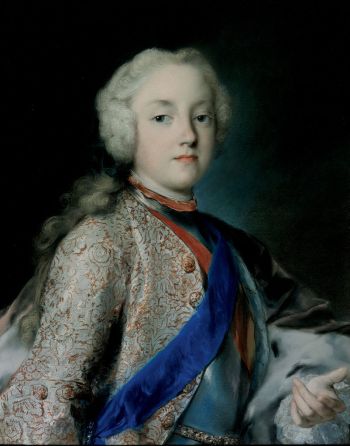
Rosalba Carriera, Crown Prince Friedrich Christian of Saxony, 1740, pastel on paper, 63.5 × 51.5 cm (Dresden, SKD, Gemäldegalerie Alte Meister; photo by Hans Peter Klut/Elke Estel).
This is the first exhibition to be devoted to Elector Friedrich Christian of Saxony (1722—1763), who succeeded King August III in 1763 for just 74 days. Given his brief reign, few are aware of the prince’s profound physical disabilities, akin to cerebral palsy, which prevented him from standing or walking without assistance and made simple tasks like eating and dressing difficult. The marriage of his sister Maria Amalia to the King of Naples in May 1738 inspired their parents to send the fifteen-year-old heir to the throne on an impromptu journey to Italy, for life-saving medical treatments. This exceptional two-year adventure was amply documented, allowing us to precisely reconstruct the prince’s route and daily experiences as he travelled from Dresden to Naples, Rome, Florence, Milan, and Venice. Like the able-bodied Grand Tourists he met along the way, he also travelled incognito with an entourage, enjoyed celebrity status, and collected art, relics, books, and ephemera for shipment home. Some of the Italian gifts and souvenirs have been identified in museums, archives and libraries and are presented in the intimate setting of the Sponselraum.
August the Strong and August III both made Grand Tours as teenagers, with the court of Louis XIV and carnival in Venice as their primary targets. Friedrich Christian, by contrast, went to Italy as a medical tourist. Although he would never be cured, the mineral baths and holistic treatments administered abroad did soothe and strengthen the prince’s atrophied limbs, allowing him to regain the use of his left hand, bear his own bodyweight and walk short distances with two canes. Of necessity, however, he was mostly carried around Italy in a porte-chaise (sedan chair), even ascending the Leaning Tower of Pisa in this manner. Since there was no precedent for portraying a disabled heir to the throne, the Crown Prince was chronicled and painted conventionally, as able-bodied, and even thought of himself as such. A glimpse of his handicap is shown in the view of his arrival at Venice in 1739, but it was not until 1761, while in exile in Munich during the Seven Years’ War, that he was portrayed in a wheelchair. With his premature death from smallpox at the age of 41, however, the Elector’s great promise went unfulfilled.
Maureen Cassidy-Geiger, Die Grande Kur, 1738–1740: Prinz Friedrich Christian Von Sachsen auf der Suche Nach Heilung und Kultur in Italien / The Grand Cure, 1738–1740: A Disabled Saxon Prince and His Tour of Italy (Dresden: Staatliche Kunstsammlungen Dresden, 2018), 52 pages, ISBN: 978-3000596810 (German and English text).
Note (added 26 June 2018) — The posting was updated to include details for the booklet accompanying the exhibition.
Exhibition | Chippendale’s Director
Press release (9 February 2018) from The Met:
Chippendale’s Director: The Designs and Legacy of a Furniture Maker
The Metropolitan Museum of Art, New York, 14 May 2018 — 9 January 2019
Curated by Femke Speelberg and Alyce Englund
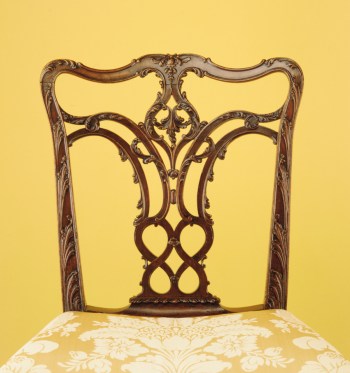
Attributed to Benjamin Randolph and possibly carved by Hercules Courtenay, side chair (detail), ca. 1769, made in Philadelphia, mahogany, northern white cedar, modern upholstery (New York: The Metropolitan Museum of Art, 1974.325).
Thomas Chippendale (1718–1779) has been a household name in the furniture world since the mid-18th century. He is remembered today for the furniture produced by his successful London workshop as well as his influential book of furniture designs, The Gentleman and Cabinet-Maker’s Director. To celebrate the 300th anniversary of Chippendale’s birth, the exhibition Chippendale’s Director: The Designs and Legacy of a Furniture Maker will open at The Metropolitan Museum of Art on May 14 and look closely at how the unprecedented publication cemented Chippendale’s name as England’s most famous cabinetmaker and also endured to inspire furniture design up to the present day. Built around works in The Met collection, the exhibition will combine the original preparatory drawings from the Chippendale workshop with a selection of British and American furniture inspired by Chippendale’s designs and aesthetic. The legacy of Chippendale will be presented through representations in portrait painting and revival pieces from the 19th and 20th centuries. The Chippendale-inspired chair, designed in 1984 by the architects Robert Venturi and Denise Scott Brown, will be one of the highlights.
Born and trained in the north of England, Thomas Chippendale had moved to London to start his own workshop by 1748. One of many cabinetmakers in the thriving metropolis, he devised an innovative business plan to market his furniture by creating a book of design, issued in 1754 as The Gentleman and Cabinet Maker’s Director. The book had a dual function: to show prospective clients what he could design and make, and to inform the tastes of both ‘gentlemen’ and his colleagues. With 160 designs for seating, beds, tables, cabinets, shelves, and other furnishings in a wide variety of styles, from Rococo and Chinoiserie to Gothic-Revival, the Director was the most extensive publication of its kind. Copies of the book quickly appeared beyond the British market in the American Colonies, where those in the aspiring mercantile class sought to fill their homes with furnishings in the latest fashion.
The exhibition will be arranged thematically in two adjoining rooms (galleries 751 and 752, on the second floor of The American Wing). The exhibition will open with the first edition of Chippendale’s Director paired with three chairs signifying the geographic and continuing reach of his work—one made in Chippendale’s London workshop; one made around 1769 for General Cadwalader’s posh townhouse by Philadelphia craftsmen; and one designed by Venturi and Brown as a modern reflection on the Chippendale chair. The gallery will also feature printed works illustrating the context in which Chippendale conceived his book, including popular publications by furniture designers on the European continent, such as Daniel Marot and François Cuvillies, and the few English publications that preceded Chippendale’s work. Alongside the Director, publications of the works of Inigo Jones and Sir Christopher Wren will denote how England embraced print culture as a way to celebrate its own artistic achievements, and how artists and craftsmen used the medium as a promotional tool. The works in this gallery will stand against the backdrop of the permanently installed Rococo-style architectural woodwork and wallpaper from the Great Hall of the Van Rensselaer House, allowing the visitor a direct window into the early impact of European print culture in America.
For the unique occasion of this exhibition, the second gallery will feature a selection of original drawings dismounted temporarily from The Met’s two Chippendale albums for the first time since their acquisition. Approximately 20 of a total of 200 drawings will be on view, and images of the complete collection of The Met’s Chippendale drawings will be digitally projected in the gallery. The drawings provide an intimate behind-the-scenes view of the creation of the Director and highlight aspects of the drawing techniques, variety in forms and decorations, and the practical information Chippendale incorporated into his furniture designs. The drawings will be accompanied by groupings of furniture and paintings that focus on the different styles in which Chippendale worked, new forms of furniture that emerged during his lifetime, and the ways in which Chippendale’s designs were absorbed by furniture makers in various regions and at different moments in time.
The exhibition is organized by Femke Speelberg, Associate Curator, Drawings and Prints, and Alyce Englund, Assistant Curator, The American Wing.
The exhibition will be featured on The Met website and on Facebook and Twitter and the special Chippendale300 website. Blog posts for the “Now at The Met” section of the website will be written by the exhibition’s curators. An issue of The Metropolitan Museum of Art Bulletin on Chippendale’s Director, by Morrison H. Heckscher, Curator Emeritus of The American Wing, will be published in concert with the exhibition. The Met’s quarterly Bulletin program is supported in part by the Lila Acheson Wallace Fund for The Metropolitan Museum of Art, established by the cofounder of Reader’s Digest. This Bulletin made possible by the William Cullen Bryant Fellows of The Metropolitan Museum of Art.
Exhibition | Visitors to Versailles

An earlier posting included information for the exhibition at Versailles, but here’s information for the exhibition at The Met, including details for the English edition catalogue, distributed by Yale UP:
Visitors to Versailles: From Louis XIV to the French Revolution
Château de Versailles, 24 October 2017 — 25 February 2018
The Metropolitan Museum of Art, New York, 16 April — 29 July 2018
Curated by Bertrand Rondot and Daniëlle Kisluk-Grosheide
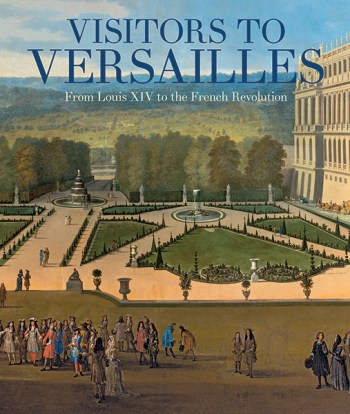 The palace of Versailles and its gardens have attracted travelers ever since it was transformed under the direction of the Sun King, Louis XIV, from a simple hunting lodge into one of the most magnificent and public courts of Europe. French and foreign travelers, including royalty, ambassadors, artists, musicians, writers, scientists, grand tourists, and day-trippers, all flocked to the royal palace surrounded by its extensive formal gardens. Versailles was always a truly international setting, and not only drew visitors from Europe and America, but also hosted dignitaries from as far away as Thailand, India, and Tunisia. Their official receptions at Versailles and gift exchanges with the king were among the attractions widely recorded in tourists’ diaries and court gazettes.
Bringing together works from The Met, the Château de Versailles, and over 50 lenders, this exhibition will highlight the experiences of travelers from 1682, when Louis XIV moved his court to Versailles, to 1789, when the royal family was forced to leave the palace and return to Paris. Through paintings, portraits, furniture, tapestries, carpets, costumes, porcelain, sculpture, arms and armor, and guidebooks, the exhibition will illustrate what visitors encountered at court, what kind of welcome and access to the palace they received, and, most importantly, what impressions, gifts, and souvenirs they took home with them.
Daniëlle O. Kisluk-Grosheide and Bertrand Rondot, eds., Visitors to Versailles: From Louis XIV to the French Revolution (New York: The Metropolitan Museum of Art, 2018), 392 pages, ISBN: 9781588396228, $65.
Exhibition | France, Between Enlightenment and Gallantry
From the Städtischen Museen Freiburg:
La France, Zwischen Aufklärung und Galanterie: Meisterwerke der Druckgraphik
La France au siècle des Lumières et de la galanterie: Chefs-d’œuvre de la gravure
La France, Between Enlightenment and Gallantry: Masterworks of Graphic Reproduction
Augustinermuseum, Freiburg, 24 February — 3 June 2018
 Das französische Bürgertum des 18. Jahrhunderts liebte gute Unterhaltung: galant und charmant, mit Witz und scharfem Verstand. Reich bebilderte Bücher erfreuten sich größter Beliebtheit. Die Verlage druckten Romane, Gedichte und Theaterstücke mit Illustrationen und gaben Graphikserien heraus, gestochen nach Gemälden des Rokoko.
Angespornt durch die große Nachfrage schufen die Künstler der Zeit wahre druckgraphische Meisterwerke. Das Haus der Graphischen Sammlung zeigt Zeichnungen, Graphiken und illustrierte Ausgaben galanter Literatur, satirischer Romane und moralischer Fabeln aus der Schenkung des Freiburger Sammlers Josef Lienhart, darunter Radierungen von François Boucher und Bilderfindungen Antoine Watteaus.
Hélène Iehl and Felix Reusse, eds., La France—Zwischen Aufklärung und Galanterie: Meisterwerke der Druckgraphik aus der Zeit Watteaus (Petersberg: Michael Imhof Verlag, 2018), 192 pages, ISBN: 9783731906339, $53. [French and German Text]










 Enfilade
leave a comment