Exhibitions | Colony: Australia and Colony: Frontier Wars

Press release (6 February 2018) for the exhibitions:
Colony: Australia 1770–1861
National Gallery of Victoria, Melbourne, 15 March — 15 July 2018
Colony: Frontier Wars
National Gallery of Victoria, Melbourne, 15 March — 2 September 2018
NGV Australia will host two complementary exhibitions that explore Australia’s complex colonial history and the art that emerged during and in response to this period. Presented concurrently, these two ambitious and large-scale exhibitions, Colony: Australia 1770–1861 and Colony: Frontier Wars, offer differing perspectives on the colonisation of Australia.

Richard Browne (illustrator), Insects, 1813, p. 52 in Select Specimens from Nature of the Birds Animals &c &c of New South Wales collected and arranged by Thomas Skottowe, 1813, watercolour (Sydney: Mitchell Library, State Library of New South Wales, SAFE/PXA 555).
Featuring an unprecedented assemblage of loans from major public institutions around Australia, Colony: Australia 1770–1861 is the most comprehensive survey of Australian colonial art to date. The exhibition explores the rich diversity of art, craft, and design produced between 1770, the arrival of Lieutenant James Cook and the Endeavour, and 1861, the year the NGV was established.
The counterpoint to Colony: Australia 1770–1861, Colony: Frontier Wars presents a powerful response to colonisation through a range of historical and contemporary works by Indigenous and non-Indigenous artists dating from pre-contact times to present day. From nineteenth-century drawings by esteemed Wurundjeri artist and leader, William Barak, to the iridescent LED light boxes of Jonathan Jones, this exhibition reveals how Aboriginal people have responded to the arrival of Europeans with art that is diverse, powerful, and compelling.
Tony Ellwood, Director, NGV said: “Cook’s landing marks the beginning of a history that still has repercussions today. This two-part exhibition presents different perspectives of a shared history with unprecedented depth and scope, featuring a breadth of works never-before-seen in Victoria. In order to realise this ambitious project, we have drawn upon the expertise and scholarship of many individuals from both within and outside the NGV. We are extremely grateful to the Aboriginal Elders and advisory groups who have offered their guidance, expertise and support,” said Ellwood.
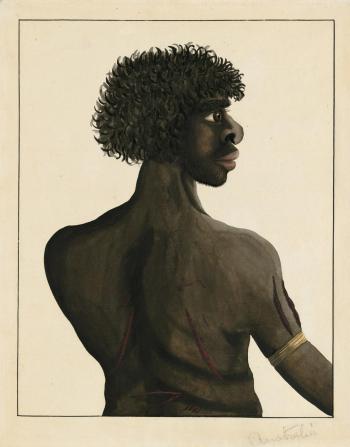
Port Jackson Painter, Half-length Portrait of Gna-na-gna-na, ca. 1790, gouache (Canberra, National Library of Australia, Rex Nan Kivell Collection NK144/D).
Joy Murphy-Wandin, Senior Wurundjeri Elder, said: “I am overwhelmed at the magnitude and integrity of this display: such work and vision is a credit to the curatorial team. The NGV is to be congratulated for providing a visual truth that will enable the public to see, and hopefully understand, First Peoples’ heartache, pain and anger. Colony: Australia 1770–1861 / Frontier Wars is a must-see for all if we are to realise and action true reconciliation.”
Charting key moments of history, life, and culture in the colonies, Colony: Australia 1770–1861 includes over 600 diverse and significant works, including examples of historical Aboriginal cultural objects, early watercolours, illustrated books, drawings, prints, paintings, sculpture, and photographs, to a selection of furniture, fashion, textiles, decorative arts, and even taxidermy specimens.
Highlights from the exhibition include a wondrous ‘cabinet of curiosities’ showcasing the earliest European images of Australian flowers and animals, including the first Western image of a kangaroo and illustrations by the talented young watercolourist Sarah Stone. Examples of early colonial cabinetmaking also feature, including the convict made and decorated Dixson chest containing shells and natural history specimens, as well as a rarely seen panorama of Melbourne in 1841 will also be on display.
Following the development of Western art and culture, the exhibition includes early drawings and paintings by convict artists such as convicted forgers Thomas Watling and Joseph Lycett; the first oil painting produced in the colonies by professional artist John Lewin; work by the earliest professional female artists, Mary Morton Allport, Martha Berkeley and Theresa Walker; landscapes by John Glover and Eugene von Guérard; photographs by the first professional photographer in Australia, George Goodman, and a set of Douglas Kilburn’s silver-plated daguerreotypes, which are the earliest extant photographs of Indigenous peoples.
Colony: Frontier Wars attests to the resilience of culture and community, and addresses difficult aspects of Australia’s shared history, including dispossession and the stolen generation, through the works of Julie Gough, Brook Andrew, Maree Clarke, Ricky Maynard, Marlene Gilson, Julie Dowling, S. T. Gill, J. W. Lindt, Gordon Bennett, Arthur Boyd, Tommy McRae, Christian Thompson, and many more.
Giving presence to the countless makers whose identities have been lost as a consequence of colonialism, Colony: Frontier Wars also includes a collection of anonymous photographic portraits and historical cultural objects, including shields, clubs, spear throwers and spears, by makers whose names, language groups and Countries were not recorded at the time of collection. Challenging global museum conventions, the exhibition will credit the subjects and makers of these cultural objects as ‘once known’ rather than ‘unknown’.
Colony: Australia 1770–1861 / Frontier Wars (Melbourne: National Gallery of Victoria, 2018), 394 pages, ISBN: 9781925432503, $50.
 This publication accompanies the two-part exhibition Colony: Australia 1770–1861 and Colony: Frontier Wars, which explores Australia’s shared history. Featuring works from the National Gallery of Victoria and key collections throughout Australia, it highlights the multiple perspectives on our colonial history through new scholarship and first-person statements from contemporary artists. This volume is a valuable addition to existing analyses of Australia’s complex colonial past.
Contributors
Brook Andrew, Robert Andrew, Louise Anemaat, Alisa Bunbury, Maree Clarke, Bindi Cole Chocka, Michael Cook, Carol Cooper, Julie Dowling, Amanda Dunsmore, Rebecca Edwards, Daina Fletcher, Elle Freak, Joanna Gilmour, Dr Ted Gott, Dr Julie Gough, Genevieve Grieves, Dr David Hansen, Peter Hughes, David Hurlston, Julia Jackson, Jonathan Jones, Cathy Leahy, Greg Lehman, Dr Donna Leslie, Dr Jane Lydon, John McPhee, Kimberley Moulton, Aunty Joy Murphy-Wandin AO, Richard Neville, Sarina Noordhuis-Fairfax, John Packham, Steaphan Paton, Cara Pinchbeck, Elspeth Pitt, Dr Joseph Pugliese, r e a, Beckett Rozentals, Dr Lynette Russell, Myles Russell-Cook, Judith Ryan AM, Yhonnie Scarce, Caitlin Sutton, Dr Christian Thompson, James Tylor (Possum), Michael Varcoe-Cocks, Judy Watson, H. J. Wedge, Danielle Whitfield, Nat Williams, Susan van Wyk.
Exhibition | Black Out: Silhouettes Then and Now
From the National Portrait Gallery:
Black Out: Silhouettes Then and Now
Smithsonian National Portrait Gallery, Washington, D.C., 11 May 2018 — 10 March 2019
Mississippi Museum of Art, Jackson, 27 April — 25 August 2019
Curated by Asma Naeem
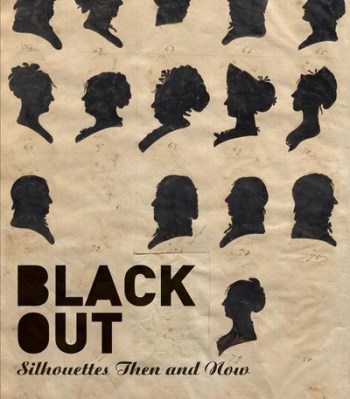 Silhouettes—cut paper profiles—were a hugely popular and democratic form of portraiture in the 19th century, offering virtually instantaneous likenesses of everyone from presidents to those who were enslaved. The exhibition Black Out: Silhouettes Then and Now explores this relatively unstudied art form by examining its rich historical roots and considering its forceful contemporary presence. The show features works from the Portrait Gallery’s extensive collection of silhouettes, such as those by Auguste Edouart, who captured the likenesses of such notable figures as John Quincy Adams and Lydia Maria Child, and at the same time, the exhibition reveals how contemporary artists are reimagining silhouettes in bold and unforgettable ways.
Highlights of the historical objects include a double-silhouette portrait of a same-sex couple and a rarely seen life-size silhouette of a nineteen-year-old enslaved girl, along with the bill of her sale from 1796. The featured contemporary artists are Kara Walker, who makes panoramic silhouettes of plantation life and African American history; Canadian artist Kristi Malakoff, who cuts paper to make life-size sculptures depicting a children’s Maypole dance; MacArthur-prize-winner Camille Utterback, who will present an interactive digital work that reacts to visitors’ shadows and movements; and Kumi Yamashita, who ‘sculpts’ light and shadow with objects to create mixed-media profiles of people who are not there. With both historical and contemporary explorations into the silhouette, Black Out reveals new pathways between our past and present, particularly with regard to how we can reassess notions of race, power, individualism, and even, our digital selves.
This exhibition is curated by Portrait Gallery Curator of Prints, Drawings and Media Arts, Asma Naeem.
Asma Naeem, Black Out: Silhouettes Then and Now (Princeton University Press, 2018), 192 pages, ISBN: 978 0691180588, $45.
◊ ◊ ◊ ◊ ◊
Note (added 27 April 2019) — The posting was updated to include the Mississippi Museum of Art as a second venue.
Exhibition | Blondel, Architecte des Lumières
Opening next month in Metz:
Blondel, Architecte des Lumières
Galerie de l’Arsenal, Metz, 12 April — 13 July 2018
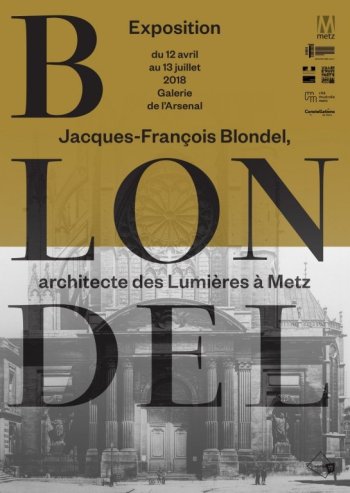 Architecte parisien, académicien, professeur royal, Jacques-François Blondel (1705–1774) vint à Metz en 1761. Il est chargé par le Maréchal d’Estrées d’aménager les places autour de la Cathédrale Saint-Étienne. Son projet, réalisé quelques années plus tard, constitue l’un des meilleurs ensembles urbains du xviiie siècle. En effet, avant tout théoricien, ses constructions sont rares et précieuses. Son chef-d’oeuvre est incontestablement l’aménagement de la Place d’Armes à Metz qui se situe dans la lignée de ses prestigieuses consoeurs parisiennes, que sont Vendôme ou Concorde. Cette exposition inédite, accompagnant la candidature de « Metz royale et impériale » sur la liste du patrimoine mondial, propose de faire découvrir à travers le projet messin les talents multiples de Jacques-François Blondel, collaborateur de l’Encyclopédie de Diderot et d’Alembert, auteur prolifique, créateur de décors éphémères, concepteurs de nombreux projets et surtout professeur qui forma toute une génération d’architectes européens et dont la méthode d’enseignement servira de fondement au système actuel d’apprentissage de l’architecture.
Une production de la Ville de Metz en partenariat avec la Cité de l’Architecture et du Patrimoine de Paris, l’École Nationale Supérieure d’Architecture de Nancy et la Cité musicale-Metz.
◊ ◊ ◊ ◊ ◊
More information about Metz’s UNESCO application is available here:
The National Committee of French World Heritage Properties, meeting on January 9, 2009, issued a favorable opinion about the inclusion of Metz on the French tentative list. This is only a first step, but it is essential. The city is eligible for inclusion on the UNESCO World Heritage List. Metz has accumulated an incredible architectural and urban heritage over time. Under the label “Royal and imperial Metz,” the application aims at recognizing the unusual urban adventure that took place in the Messin city from the second half of the 19th century to the beginning of the 20th century, before, during and after the German annexation [in 1871].
Exhibition | Architecture et Pouvoir
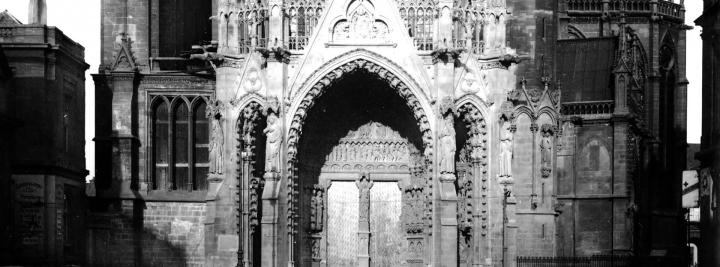
In 1903 Paul Tornow’s neo-Gothic portal for the Cathedral of Metz replaced the classical portal designed by Jacques-François Blondel, which dated to 1764.
◊ ◊ ◊ ◊ ◊
From Cité de l’architecture et du patrimoine:
Architecture et Pouvoir: Un Portail pour la Cathédrale de Metz
Cité de l’architecture et du patrimoine, Paris, 28 March — September 2018
Curated by Aurélien Davrius
En parallèle de l’exposition Blondel, architecte des Lumières présentée à Metz, du 12 avril au 13 juillet 2018, le musée des Monuments français, en partenariat avec la Ville de Metz et l’École nationale supérieure d’architecture de Nancy, propose une exposition-dossier consacrée à la singulière fortune du portail de la cathédrale de Metz.
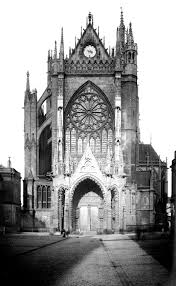 Le portail élevé en 1764 par Jacques-François Blondel est remplacé par le portail néo-gothique que nous connaissons aujourd’hui, inauguré en 1903. Les photographies et documents rassemblés dans l’exposition retracent l’histoire de cette transformation ; ils soulignent aussi la manière dont les deux portails ont chacun servi de support à la manifestation et à l’expression du pouvoir politique. Le roi Louis XV tout d’abord, à qui l’œuvre de Jacques-François Blondel rendait hommage ; Guillaume II ensuite, kaiser du Second Reich immortalisé sous le traits du prophète Daniel sur le portail néo-gothique conçu par son architecte, Paul Tornow (1848–1921).
La massivité et la dissonance du vocabulaire classique du portique élevé par Jacques-François Blondel avec le style gothique de la cathédrale, maintes fois décriées dès le début du XIXe siècle, ont certainement contribué à cette métamorphose. Cependant, dans le contexte de l’annexion de l’Alsace-Moselle par la Prusse, son démantèlement au profit du portail néo-gothique de Paul Tornow invite aussi à interroger la portée politique du geste architectural : entre francisation et germanisation d’un territoire, le nouveau pouvoir n’a-t-il pas tenté de faire disparaître les traces d’un certain passé pour inscrire sa propre histoire ?
Exhibition | House of Portraits at Powis Castle
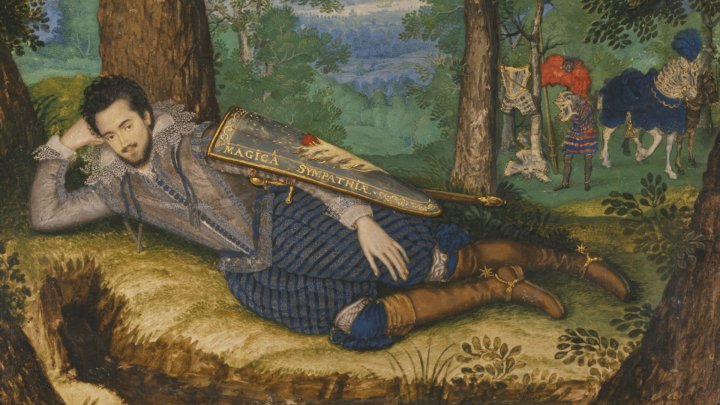
Isaac Oliver, Sir Edward Herbert, later 1st Baron Herbert of Cherbury, ca. 1613–14, 18 × 23 cm
(National Trust, 1183954)
◊ ◊ ◊ ◊ ◊
Press release (21 March 2018) for the exhibition:
House of Portraits
Powis Castle, Welshpool, 20 March 2018 — 27 January 2019
Curated by John Chu
Powis Castle, near Welshpool in Wales, unveils its House of Portraits exhibition and invites visitors to uncover the secrets hidden within its world-class portrait collection. The great halls and quiet chambers of Powis Castle are a time machine full of exceptional portraits that can transport visitors back through the ages.From majestic full-length portraits, to intimate miniatures that can be held in the palm of your hand, they are the work of generations of talented artists and each tells a unique story. Launching on 20 March, House of Portraits delves beneath the surface of these intricate works by prominent artists such as Joshua Reynolds, Thomas Gainsborough, and John Singer Sargent.
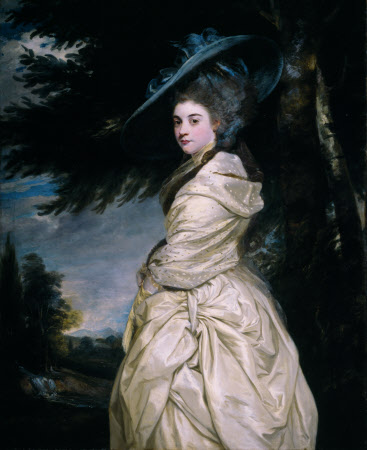
Sir Joshua Reynolds, Portrait of Lady Henrietta Antonia Herbert, Countess of Powis, 1778–78 (National Trust 1181064).
Some of the castle’s works feature kings, emperors and maharajas but the majority of portraits depict men, women and children of the Herbert family who have lived at Powis for over four centuries. House of Portraits examines not only the people behind the faces, but explores how they wanted to be seen by the world, through the clues embedded in costumes, settings, expressions, poses, and gestures. Throughout the castle, the exhibition shows how the people in the portraits were involved in crafting the image they wished to convey, from wealth, social status, and eligibility for marriage to religious allegiance or military prowess.
The centrepiece of the exhibition is an intricate Jacobean miniature portrait painted by Isaac Oliver (1565–1617) which will be on display at Powis for the first time since it was purchased for the nation, with generous support from the National Heritage Memorial Fund and Art Fund. The miniature features Lord Edward Herbert of Cherbury, an unabashedly ambitious soldier, scholar, diplomat, musician, and poet, who epitomised the romance and chivalry of his age. Lord Herbert commissioned numerous portraits of himself from the most fashionable artists of the day, many of which hang in Powis Castle. Foremost amongst these is this miniature by the court artist, Isaac Oliver, who depicted him in a relaxed pose lying in the woods following a joust. Isaac’s attempt to capture the many layers of Lord Herbert’s complex character in a single, exquisite likeness resulted in one of the true masterpieces of British art.
Visitors will be invited to join the exhibition’s curator, Dr John Chu, the National Trust’s Assistant Curator of Pictures and Sculpture and a specialist in the works of Thomas Gainsborough and Joshua Reynolds, as he guides them through the castle’s opulent state rooms by audio tour.
John Chu says: “Powis is quite literally a ‘house of portraits’; its rich collection of portraits mostly depict the Herberts, one of the most influential families in Welsh history. Portraits didn’t just capture the likeness of a person at a particular moment in life; they were also used to convey something about the sitter. At the time the portraits were painted, the symbols and meanings within them would have been easily recognised, but they are not always obvious to us viewing them today. Long before any celebrity posted a ‘selfie’, the Herberts were manipulating and projecting their personal image to make a place for themselves in a competitive and sometimes dangerous world of politics, money and power. It is these many facets of their characters, and what they cared about most that we aim to explore in House of Portraits.”
Visitors to the exhibition will be encouraged to contemplate the careful thought behind portraits of the past. Important moments and achievements in Herbert family history were recorded by famous portrait painters, but the time and cost involved often meant the sitter had only one opportunity to capture their character in an image that would be passed down the generations. Today, portraits commissioned by individuals 400 years ago still hang proudly on the walls inside the castle for all to see.
Emma Thompson, General Manager at Powis Castle and Garden says:“In a matter of seconds and with little thought, important moments in our lives today can be easily recorded and sh ared with family and friends through digital and social media. Yet many of the portraits we have here at Powis Castle are the only representation we have of members of the Herbert family. Who knows, the images we take of ourselves today might be how we are remembered for generations to come. We’ll be inviting visitors to create a portrait in the form of a ‘selfie’ and to consider how they would depict themselves if their family were to display their portrait for hundreds of years as the Herbert family have done.”
Fiona Talbott, Head of NHMF, said: “The National Heritage Memorial Fund was set up to secure the future of heritage treasures just like the exquisite miniature of Lord Herbert of Cherbury. It belongs in its original context of Powis Castle and there’s no doubt it’s the star of the Powis collection, standing out for both its artistry and the colourful story it tells of Elizabethan and Jacobean court culture.”
Stephen Deuchar of Art Fund, said: “We are very pleased to see Isaac Oliver’s superb miniature of Edward Herbert, 1st Baron Herbert of Cherbury, go on public display for the first time at Powis Castle since it was bought for the nation with the support of Art Fund and several other donors. In its natural home, it will be enjoyed by visitors to Wales from across the whole of the UK.”
Exhibition | Zurbarán’s Jacob and His Twelve Sons
I’m late with this posting, having only recently come to understand that the eighteenth-century provenance of the paintings (of which we have no knowledge until they appeared at auction in England in the 1720s) makes the series potentially relevant for issues of collecting and the South Sea Company, Jewish civil rights in the eighteenth century, and, of course, the reception of the Spanish Golden Age. –CH
From The Frick:
Zurbarán’s Jacob and His Twelve Sons: Paintings from Auckland Castle
The Meadows Museum, SMU, Dallas, 17 September 2017 — 7 January 2018
The Frick Collection, New York, 31 January — 22 April 2018
Curated by Susan Grace Galassi, Mark Roglán, Amanda Dotseth, and Edward Payne
 In collaboration with the Meadows Museum, Dallas, Texas, and The Auckland Project, County Durham, England, The Frick Collection has organized an exhibition of Jacob and His Twelve Sons, an ambitious series of thirteen paintings that depict over life-size figures from the Old Testament. On loan from Auckland Castle, the works by the Spanish Golden Age master Francisco de Zurbaran (1598–1664) have never before traveled to the United States. They were first presented at the Meadows Museum in the fall of 2017, and are on view at The Frick Collection from January 31 through April 22, 2018. In preparation for this American tour, these important seventeenth-century Spanish paintings, dating from the 1640s, have undergone a year-long in-depth technical analysis in the conservation department at the Kimbell Art Museum, Fort Worth, the most extensive study of the series to date.
The iconography of Zurbarán’s remarkable series is derived from the ‘Blessings of Jacob’ in Chapter 49 of the Book of Genesis, a poem that has significance for Jews, Christians, and Muslims. On his deathbed, Jacob called together his sons, who would become the founders of the Twelve Tribes of Israel. He bestowed on each a blessing, which foretold their destinies and those of their tribes. Jacob’s prophecies provide the basis for the manner in which the figures are represented in Zurbarán’s series. For his compositions, the artist drew inspiration from northern European prints.
The series was likely intended for export to the New World. In seventeenth-century Spain, it was commonly believed that indigenous peoples of the Americas were descended from the so-called ‘lost tribes of Israel’. The paintings, however, did not come to light until the 1720s in England when they appeared at auction and were purchased by a Jewish merchant. In 1756 they were acquired by Richard Trevor, Bishop of Durham, a supporter of Jewish rights. Trevor hung them in the dining room at Auckland Castle, where they have remained for over 250 years. A two-year restoration of Auckland Castle presents this extraordinary study and exhibition opportunity.
Comments Frick Director Ian Wardropper, “We are thrilled to collaborate with Auckland Castle and the Meadows Museum on the first North American showing of Francisco de Zurbarán’s extraordinary series Jacob and His Twelve Sons. The technical analysis carried out at the Kimbell has greatly enriched our understanding of the master’s methods, while catalogue essays commissioned for the show explore the works in historical, cultural, and religious contexts. The sheer visual power and rich narrative content of this series will draw visitors in and will be beautifully complemented by the Frick’s strong holdings in Spanish art, which include paintings by Velázquez and Murillo—Zurbarán’s Sevillian contemporaries—as well as by El Greco and Goya.”
Zurbarán’s Jacob and His Twelve Sons: Paintings from Auckland Castle has been organized by Susan Grace Galassi, Senior Curator, The Frick Collection; Mark A. Roglan, Director of the Meadows Museum; Amanda Dotseth, Meadows/Mellon/Prado Fellow at the Meadows Museum; and Edward Payne, Senior Curator, Spanish Art, The Auckland Project, County Durham, England.
Susan Grace Galassi, Edward Payne, and Mark Roglán, eds., Zurbarán: Jacob and His Twelve Sons, Paintings from Auckland Castle (Seattle: Lucia Marquand, 2017), 136 pages, ISBN: 978 0998093024, $45.
The Burlington Magazine, March 2018
The eighteenth century in The Burlington:
The Burlington Magazine 160 (March 2018)

Portrait of a Consul, identified by Lucy Whitaker as a portrait of Joseph Smith, pencil and watercolour on paper, 28.6 × 20 cm; page from Giovanni Grevembroch: Gli abiti de’ veneziani di quasi ogni età con diligenza raccoliti e dipinti nel secolo XVIII (Venice: Biblioteca del Museo Correr, MS Gradenigo-Dolfin 49, II, fol.125.2).
A R T I C L E S
• Lucy Whitaker, “A Portrait of Consul Smith,” pp. 214–16. A watercolour in Giovanni Grevembroch’s Gli abiti de’ veneziani, compiled ca. 1754–59, can probably be identified as the only surviving portrait of the celebrated art collector and art dealer Joseph Smith, British consul in Venice from 1744 to 1760.
• Esmé Whittaker, “‘Almost Her Creation’: Georgiana, Duchess of Devonshire, and the Decoration of Chiswick House,” pp. 217–25. Letters, inventories and contemporary prints and drawings help paint a clearer picture of the extensions made to Chiswick House, London, in 1790–92 and the role that Georgiana, Duchess of Devonshire, played in their execution and furnishing.
R E V I E W S
• Duncan Robinson, Review of the exhibition Casanova: The Seduction of Europe (Kimbell Art Museum, Fort Worth, 2017; The Legion of Honor, San Francisco, 2018; and Museum of Fine Arts, Boston, 2018), pp. 241–43.
• David Pullins, Review of the exhibition Shockingly Mad: Henry Fuseli and the Art of Drawing (Art Institute of Chicago, 2018), pp. 243–44.
Chatsworth Reopens after £33m Restoration

Before and after restoration at Chatsworth, from Treasure House of England.
◊ ◊ ◊ ◊ ◊
Press release, via Art Daily (24 March 2018) . . .
Chatsworth Renewed: The House Past, Present, and Future
Chatsworth, 24 March — 21 October 2018
With its gold leaf and pale yellow stonework glinting in the spring sunshine, Chatsworth reopens on 24 March 2018 following the biggest restoration and conservation of the house, garden, and park since the 1820s. The 10-year long programme, costing more than £32m, sees Chatsworth restored to its full glory, inside and out. The Chatsworth Renewed exhibition, running between March and October, highlights the work of those involved in the restoration process. From rebuilding the Belvedere turrets to replacing vast tracts of lead on the roof, carving the tiniest details in stone using dentistry tools to replacing huge blocks in the walls, careful restoration of priceless artworks to the renovation of famous water features in the garden, over the last decade Chatsworth has been fully restored and made ready for the next century.
The Duke of Devonshire: “The level of forensic research, expertise, and craftsmanship applied by so many people has been absolutely inspiring. It has always been a thrilling moment to see the house come into view as you drive across the park and now that view has been made even more magical. With the years of blackened grime now removed from the stone, it looks truly magnificent.”
In 1981, the charitable Chatsworth House Trust was set up by the 11th Duke to ensure the long-term survival of the house and collection. Since 1949 the entrance money paid by more than 25 million visitors has made a vital contribution to the maintenance of the house and garden, and it is this income, rather than any public funding, that has enabled the current restoration works to be completed.
Visitors will also be able to see the artwork of Linder Sterling, artist-in-residence at Chatsworth and a Paul Hamlyn Foundation award winning artist.

Linder Sterling, Eidothea (left), 2017, and Latona, 2018 (right).
◊ ◊ ◊ ◊ ◊
Her Grace Land by Linder Sterling
Chatsworth, 24 March — 21 October 2018
Award-winning artist Linder Sterling (b. 1954) spent several months over winter 2017 immersing herself in the life of the Chatsworth Estate as the inaugural artist-in-residence. As well as creating a new image bank for future photo montages to take Chatsworth ‘out into the world’, some of the pieces created during her residency will go on display at Chatsworth. Her Grace Land features four installations exploring the female voice at Chatsworth in the centenary year of the Act of Representation.
N.B. — At the risk of puncturing the joke with an explanation, I would note that the former Duchess of Devonshire, Deborah Cavendish nee Mitford (1920–2014), was an ardent Elvis fan. –CH
Exhibition | Heavenly Bodies: Fashion and the Catholic Imagination
Press release (9 March 2018) from The Met:
Heavenly Bodies: Fashion and the Catholic Imagination
The Metropolitan Museum of Art and The Met Cloisters, New York, 10 May — 8 October 2018
Curated by Andrew Bolton, with C. Griffith Mann, Barbara Drake Boehm, Helen Evans, and Melanie Holcomb
The Costume Institute’s spring 2018 exhibition, Heavenly Bodies: Fashion and the Catholic Imagination, on view from May 10 through October 8, 2018 (preceded on May 7 by The Costume Institute Benefit) will be presented in two Metropolitan Museum of Art locations: at The Met Fifth Avenue—in the medieval galleries, Mary and Michael Jaharis Galleries for Byzantine Art, part of The Robert Lehman Wing, and the Anna Wintour Costume Center—and uptown at The Met Cloisters. The thematic exhibition will feature a dialogue between fashion and masterworks of medieval art in The Met collection to examine fashion’s ongoing engagement with the devotional practices and traditions of Catholicism. A group of papal robes and accessories from the Vatican will travel to the United States to serve as the cornerstone of the exhibition, highlighting the enduring influence of liturgical vestments on designers.
“The Catholic imagination is rooted in and sustained by artistic practice, and fashion’s embrace of sacred images, objects, and customs continues the ever-evolving relationship between art and religion,” said Daniel H. Weiss, President and CEO of The Met. “The Museum’s collection of Byzantine and western medieval art, in combination with the architecture and galleries that house these collections at The Met, provide the perfect context for these remarkable fashions.”
In celebration of the opening, the Museum’s Costume Institute Benefit, also known as The Met Gala, will take place on Monday, May 7, 2018. The evening’s co-chairs will be Amal Clooney, Rihanna, Donatella Versace, and Anna Wintour. Christine and Stephen A. Schwarzman will serve as Honorary Chairs. The event is The Costume Institute’s main source of annual funding for exhibitions, publications, acquisitions, and capital improvements.
“Fashion and religion have long been intertwined, mutually inspiring and informing one another,” said Andrew Bolton, Curator in Charge of The Costume Institute. “Although this relationship has been complex and sometimes contested, it has produced some of the most inventive and innovative creations in the history of fashion.”
The exhibition will feature approximately 40 ecclesiastical masterworks from the Sistine Chapel sacristy, many of which have never been seen outside the Vatican. These will be on view in the Anna Wintour Costume Center galleries and will include papal vestments and accessories, such as rings and tiaras, from the 18th to the early 21st century, encompassing more than 15 papacies. The last time the Vatican sent a loan of this magnitude to The Met was in 1983, for The Vatican Collections exhibition, which is the Museum’s third most-visited show.
In addition, more than 150 ensembles, primarily womenswear, from the early 20th century to the present will be shown in the Byzantine and medieval galleries, part of the Robert Lehman Wing, and at The Met Cloisters alongside medieval art from The Met collection, providing an interpretative context for fashion’s engagement with Catholicism. The presentation situates these designs within the broader context of religious artistic production to analyze their connection to the historiography of material Christianity and their contribution to the construction of the Catholic imagination.
Designers in the exhibition will include A.F.Vandevorst, Azzedine Alaïa, Cristobal Balenciaga, Geoffrey Beene, Marc Bohan (for House of Dior), Thom Browne, Roberto Capucci, Jean Charles de Castelbajac, Gabrielle “Coco” Chanel, Ann Demeulemeester, Sorelle Fontana, Domenico Dolce and Stefano Gabbana (for Dolce & Gabbana), John Galliano (for House of Dior), Gattinoni, Jean Paul Gaultier, Craig Green, Madame Grès (Alix Barton), Demna Gvasalia (for Balenciaga), Rosella Jardini (for Moschino), Stephen Jones, Christopher Kane, Christian Lacroix, Karl Lagerfeld (for House of Chanel), Jeanne Lanvin, Shaun Leane, Claire McCardell, Mariuccia Mandelli (for Krizia), Laura and Kate Mulleavy (for Rodarte), Thierry Mugler, Rick Owens, Carli Pearson (for Cimone), Maria Grazia Chiuri and Pierpaolo Piccioli (for Valentino), Pierpaolo Piccioli (for Valentino), Stefano Pilati (for Saint Laurent), Gareth Pugh, Simone Rocha, Yves Saint Laurent, Elsa Schiaparelli, Raf Simons (for his own label and House of Dior), Viktor Horsting and Rolf Snoeren (for Viktor & Rolf), Olivier Theyskens, Josephus Thimister, Riccardo Tisci, Jun Takahashi (for Undercover), Philip Treacy, Donatella Versace (for Versace), Gianni Versace, Valentina, and Madeleine Vionnet.
The exhibition—a collaboration between The Costume Institute and the Department of Medieval Art and The Cloisters—is organized by Andrew Bolton, Curator in Charge of The Costume Institute, working together with colleagues in The Met’s Medieval department: C. Griffith Mann, Michel David-Weill Curator in Charge of the Department of Medieval Art and The Cloisters; Barbara Drake Boehm, Paul and Jill Ruddock Senior Curator for The Met Cloisters; Helen C. Evans, Mary and Michael Jaharis Curator of Byzantine Art; and Melanie Holcomb, Curator. The interdisciplinary architecture and design firm Diller Scofidio + Renfro (DS+R) will create the exhibition design with The Met’s Design Department. Raul Avila will produce the gala décor, which he has done since 2007.
A publication by Andrew Bolton will accompany the exhibition and will include texts by Barbara Drake Boehm, Marzia Cataldi Gallo, C. Griffith Mann, David Morgan, Gianfranco Cardinal Ravasi, and David Tracy in addition to new images by Katerina Jebb. It will be published by The Metropolitan Museum of Art and distributed by Yale University Press.
Andrew Bolton, ed., Heavenly Bodies: Fashion and the Catholic Imagination (New York: The Metropolitan Museum of Art, 2018), 336 pages, ISBN: 978 1588396457, $65.
Exhibition | UnSeen: Our Past in a New Light
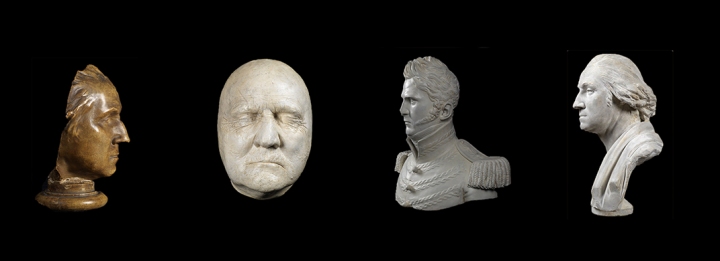
Ken Gonzales-Day, 13 Plasters [Row 3], 2014 (printed 2017), Chromogenic print / Courtesy of the artist and Luis De Jesus, Los Angeles.
◊ ◊ ◊ ◊ ◊
From the press release (8 March 2018) for the exhibition:
UnSeen: Our Past in a New Light: Ken Gonzales-Day and Titus Kaphar
Smithsonian National Portrait Gallery, Washington, D.C., 23 March 2018 — 6 January 2019
Curated by Taína Caragol and Asma Naeem
As the Smithsonian’s National Portrait Gallery marks its 50th anniversary, it will not only honor the past with special exhibitions but also shape the museum’s next chapter. The first contemporary exhibition of the museum’s anniversary season, UnSeen: Our Past in a New Light: Ken Gonzales-Day and Titus Kaphar examines how people of color are missing in historical portraiture and how their contributions to the nation’s past were rendered equally invisible. Focused around two contemporary artists, Ken Gonzales-Day and Titus Kaphar, the exhibition brings to the forefront African Americans, Native Americans, and Latino Americans to amend America’s historical narrative. Reworking traditional art presentations, Gonzales-Day and Kaphar aim to expose mainstream cultural biases and social constructions of race.
This exhibition continues the National Portrait Gallery’s Portraiture Now series and is curated by the museum’s Curator of Latino Art and History Taina Caragol and Curator of Prints, Drawing and Media Arts Asma Naeem.
“The history of early American portraiture favored white men who owned land, and it defined American identity in ways that excluded women and people of color from our nation’s visual record,” said National Portrait Gallery Director, Kim Sajet. “UnSeen: Our Past in a New Light presents the perspectives of two leading contemporary artists who create powerful works of art that re-frame history.”

Titus Kaphar, Behind the Myth of Benevolence, 2014, oil on canvas, Guillermo Nicolas and Jim Foster.
While obtaining his Master of Fine Arts from Yale University, the New Haven-based artist Titus Kaphar (b. 1976) realized how Euro-American colonial paintings, specifically the genre of portraiture, coded racial difference. His work is included in the collections of major museums, including Birmingham Museum of Art, Alabama; Brooklyn Museum, New York; Museum of Modern Art, New York; Perez Art Museum, Miami; Seattle Museum of Art, Seattle; Studio Museum of Harlem, New York; and Virginia Museum of Fine Arts, Richmond. In this exhibition of 17 paintings and one sculpture by the artist—the largest exhibition of his work to date—Kaphar invites viewers to reflect on the absence of race in traditional representations of America’s history by recreating well-known paintings to include those traditionally left out. Kaphar smears tar, erases with white paint, shreds the canvas into strips, and peels it back to reveal another story. His portion of the exhibition is divided into three sections: ‘Darkened National Histories’, ‘Deconstructed Portraits’, and ‘Disappearing Bloodlines’. All of Kaphar’s examples point to how portraiture in the 18th and 19th centuries aggrandized people in power while ignoring the powerless.
Los Angeles-based artist Ken Gonzales-Day (b. 1964) will present works across three themes: ‘Absence’, ‘Distance’, and ‘Naming’. His work has been widely exhibited at major institutions, including the Los Angeles County Museum of Art, Los Angeles; LAXART, Los Angeles; The New Museum, New York; Palais de Tokyo, Paris; and Tamayo Museum, Mexico City. Recipient of a Bachelor of Fine Arts from Pratt Institute, a Master of Fine Arts from the University of California in Irvine, and a master’s in art history from Hunter College, City University of New York, Gonzales-Day explores how ideas of racial difference, otherness, and national identity have taken shape historically and visually. This artistic investigation has yielded two bodies of work. Erased Lynchings grew out of Gonzales-Day’s archival research into lynching in the American West and the recovery of little-known histories of racial violence against Latinos, Native Americans, and Asian Americans. In parallel, his series Profiled examines how race and ideal beauty have been represented in sculpture, by photographing the collections of international museums and creating compositions that look comparatively at the representation of white bodies and bodies of color. Gonzales-Day’s juxtapositions prompt the question: “Who is recognized and remembered in the national history, and why?” The National Portrait Gallery’s presentation features work from both of these series.










 Enfilade
leave a comment